

Saved Bookmarks
This section includes 7 InterviewSolutions, each offering curated multiple-choice questions to sharpen your Current Affairs knowledge and support exam preparation. Choose a topic below to get started.
| 1. |
What will be the total flux through the face of the cube with side of length a if a charge q is placed at a corner of the cube. |
Answer» Solution :When a charge q is placed at the corner of the CUBE at a point A, it is being equally shared by EIGHT CORNERS. ACCORDING to gauss.s theoram, `phi=(q/8)/epsilon_@= q/(8 epsilon_@)`
|
|
| 2. |
Assertion : Electromagnetic waves carries not only energy and momentum but also angular momentum. Reason : Electromagnetic waves can be polarized. |
|
Answer» Assertion and REASON are CORRECT and Reason is the correct EXPLANATION of Assertion. |
|
| 3. |
In alpha-particles experiment how nucleus and alphap-particles act ? |
| Answer» SOLUTION :POINT MASSES and CHARGES | |
| 4. |
Spotting a police car ahead, the driver of the car in the previous example slows from 32 m//s to 20 m//s in 2 sec. Find the car's average acceleration. |
| Answer» Solution :Dividing the change in velocity `(20 m//s -32 m//s = - 12 m//s)` by the time interval during which the change OCCURRED (2 s) gives us ` overline(a) = Delta V // Delta t = (-12 m//s) // (2 s)= -6 m//s^(2)`. The negative sign MEANS that the DIRECTION of the acceleration is opposite the direction of the velocity. The CAR is slowing down. | |
| 5. |
What are the (a) wavelength range and (b) frequency range of the Lyman series? What are the (c) wavelength range and (d) frequency range of the Balmer series? |
| Answer» SOLUTION :(a) 31 NM, b) `8.2xx10^(14)Hz`, (C) 292 nm , (d) `3.7xx10^(14)Hz` | |
| 6. |
The physical medium connecting a transmiter and receiver is called |
|
Answer» ANTENNA |
|
| 7. |
A battery is charged at a potential of 15 V for 8 hours when the current flowing is 10 A. The battery on discharge supplies a current of 5 A for 15 hours. The mean terminal voltage during discharge is 14 V. The Watt-hour efficiency of the battery is |
| Answer» ANSWER :D | |
| 8. |
What will be the total flux through the face of the cube with side of length a if a charge q is placed at center of a face of the cube ? |
Answer» Solution :when q is placed at POINT C, it is shared by 2 CUBES , `PHI=(q/2)/epsilon_@=q/(2 epsilon_@)`
|
|
| 9. |
Biot Savart law states dBprop directly to _____,____and _____and inversely proportional to______. |
| Answer» SOLUTION :I, LENGTH L, `SINTHETA` and `r^2` | |
| 10. |
What will be the total flux through the face of the cube with side of length a if a charge q is placed at mid point of B and C. |
Answer» SOLUTION :When Q is placed at D, it is shared by two CUBES , `phi=q/(2epsilon_@)`
|
|
| 11. |
What is order of wavelegth of gamma rays ? |
| Answer» SOLUTION :`6xx10^-5`m to`10xx^-10m` | |
| 12. |
A copper disc of radius 1m is rotated about its natural axis with an angular velocity 2 rad/sec in a uniform magnetic field of 5 tesla with its plane perpendicular to the field. Find the emf induced between the centr of the disc and its rim. |
| Answer» SOLUTION :`e= (1)/(2) B OMEGA R^(2), e = (1)/(2) XX 5 xx 2 xx 1 xx 1= 5` volt | |
| 13. |
To minimise the percentage error in the determination of unknown resistance of a conductor in meter bridge experiment , the balance point is adjusted near...............of the wire. |
|
Answer» |
|
| 14. |
An object moves at constant speed in a circular path. True statement about the motion include which of the following I. the velocity is constant. II. The acceleration is constant. III. The net force on the object is zero since its speed is constant. |
|
Answer» II only |
|
| 15. |
A proton and an alpha particle enter into a region of uniform electric field oversetto E . The ratio of the electric force experienced by the proton to that by the alpha particle is __________ |
|
Answer» |
|
| 16. |
A transistor is being used as a common emitter amplifier . a What is the phase relationship between the output and input voltages ? b. Define voltage gain of an amplifier. c. Define the transconductance of a transistor . |
|
Answer» Solution :a. A PHASE CHANGE `pi` is introduced between the input and output signal . b. Voltage gain , `A_(V)` of a transistor amplifier is the RATIO of O/P voltage `(V_(o))` to I/P voltage `(V_(i))`. `A_(V) = (V_(o))/(V_(i)) = (- Delta I_(C). R_(L))/(Delta V_(BE)) = beta ((R_(o))/(R_(i)))` c. Transconductance , `g_(m)` is the ratio of change in collector current to the change in the base-emitter voltage . i.e, `g_(m) = (Delta L_(C))/(Delta V_(BE)) ""` Also , `g_m = (|A_(V)|)/(R_(L))` |
|
| 17. |
The fact that light can be polarized confirms that light: |
|
Answer» is a TRANSVERSE wave |
|
| 18. |
The difference in frequencies of series limit of Lymen series and Balmer series is equal to the frequency of the first line of the : |
|
Answer» Lymen series `hv_(1)=E_(alpha)-E_(1) .......(1)` `hv_(2)=E_(alpha)-E_(2) .........(2)` `hv_(1)-hv_(2)=E_(2)-E_(1)` But `E_(2)-E_(1)=hv` `or hv_(1)-hv_(2)=hv` `v_(1)-v_(2)=V` where v is the FREQUENCY of the first line of Lyman series. |
|
| 19. |
A transformer has 400 primary turns and 300 secondary turns. If the operating voltage for the load connected to the secondary is measured to be 300 V, what is the voltage supplied to the primary? |
|
Answer» SOLUTION :Here, `N_(P)=400, N_(S)=300,` `E_(S)=300, E_(P)=?"Using "(E_(S))/(E_(P))=(N_(S))/(N_(P))," we GET"` `E_(P)=(N_(P))/(N_(S))xxE_(S)=(400xx300)/(300)=400V` |
|
| 20. |
Calculate the frequency of revolution of an electron in the first orbit of an aluminum atom. Given that mass of electron =9x10^(-31) kg, e= 1.6 xx10^(-19) C, radius of the orbit =0.2xx10^(-11) m. |
|
Answer» |
|
| 21. |
An electric dipole is placed in uniform electric field. The magnitude of electric dipole moment of dipole is p and external electric field intensity is E. Asume theta is the angle between electric dipole moment and electric field intensity and U represents potential energy of electric dipole |
|
Answer» If U=0 for `theta=0` then for other orientations `U=pE (1-cos theta)` `U(theta)-U(0)=(-pE cos theta)-(-pE cos 0^@)` `=pE (1-cos theta)` Hence, option (a) is correct . `U(theta)-U(180^@)=(-pE cos theta)-(-pE cos 180^@)` `=-pE(1+cos theta)` Hence , option (c) is correct. |
|
| 22. |
Obtain lens maker's formula using the expression n_(2)/v - n_(1)/u = (n_(2)-n_(1))/R, propagating from a rarer medium of refractive index (n_(1))to a denser medium of refractive index (n_(2)) is incident on the convex side of spherical refracting surface of radius of curvature R. |
|
Answer» Solution :Consider a point object O situated on the PRINCIPAL axis of a biconvex lens, whose two surfaces have radii of curvature `R_(1)`and `R_2`, respectively. As SHOWN in figure due to refraction at 1st surface of lens an image Y is formed for the object O. If `OC = u, Cl. =v.` then using the refraction formula at a single spherical surface, we have `n_(2)/v. = n_(1)/u = (n_(2)-n_(1))/R_(1)`.....(i) The image Y BEHAVES as a VIRTUAL object for refraction at the second surface of the lens and the final real image is formed at J. Thus, for second surface applying refraction formula, we have `n_(1)/v - n_(2)/v^(.) = (n_(1)-n_(2))/R_(2) = (n_(2)-n_(1))/(-R_(2))`......(ii)  Adding (i) and (ii), we have `n_(1)/v - n_(1)/u = (n_(2)-n_(1))(1/R_(1) - 1/R_(2))` `=(n_(21) -1)(1/R_(1) -1R_(2))` If `u = infity`, then by the definition v=f and, hence, `1/f -1/infty = (n_(21)-1) (1/R_(1)-1/R_(2)) rArr 1/f = (n_(21)-1) (1/R_(1) - 1/R_(2))` This relation is known as lens maker.s formula. |
|
| 23. |
(A) : The core of transformer is made laminated in order to increase the eddy currents. (R): The sensitivity of transformer increases with increase in the eddy currents. |
|
Answer» Both 'A' and 'R' are TRUE and 'R' is the correct explanation of 'A'. |
|
| 24. |
Einsteins photoelectric equation is |
|
Answer» <P>Light isemitted only when electrons jump between ORBITS |
|
| 25. |
On mole of a monoatomic ideal gas is taken through the cycle shown in figure . A rarr B : Adiabatic expansion"" BrarrC : Cooling at constant volume CrarrD: Adiabatic compression "" D rarr A : Heating at constant volume The pressure and temperature at A , B, etc, are denoted by P_(A) , T_(A) , P_(B) , T_(B) etc., respectively . Given that T_(A) = 1000K, P_(B) = ((2)/(3))P_(A)"and"P_(C) = ((1)/(3))P_(A). Calculatethe following quantities: (i) The work done by the gas in the processs A rarr B (ii) The heat lost by the gas in the process B rarr C (iii) The temperature T_(D). ("Given" : ((2)/(3))^(2//5) = 0.85) |
|
Answer» `T_(A)=1000K n=1` `P_(B)=(2/3)P_(A),lambda=5/3` `P_(C)=(1/3)P_(A),(2/3)^(2//5)=0.85` For Process `ATOB` `P_(A)^(1-y)T_(A)^(y)=P_(B)^(1-y)T_(B)^(y)` `T_(B)=T_(A)(P_(A)/P_(B))^((1-lambda)/lambda)=1000xx(3/2)^(-2//5)` `=1000xx0.85=850 K` For process `B to C ` `P_(B)/T_(B)=P_(C)/P_(c)RightarrowT_(c)=T_(B)(P_(C)/P_(B))=850xx1/2=425K` (i) `W_(AtoB)=(nR(T_(A)-T_(B)))/(lambda-1)` `=(1xx8.134 XX (1000-850))/((5)/(3) - 1) = 1870.2J` (II) `DeltaQ_(BrarrC) = DeltaU_(BrarrC) + DeltaW_(BrarrC) = nC_(V)DeltaT + 0` = `(3)/(2)R(T_(C)-T_(B)) = 1 xx (3)/(2)xx 8.314(425-850)` =`-5300.175J` (iii) For process `A RARR B P_(A)V_(A)^(gamma) = P_(B)V_(B)^(gamma) implies ((V_(B))/(V_(A))^(gamma) = (P_(A))/(P_(B)) = (3)/(2)` For process ` C rarr D P_(C)V_(C)^(gamma) = P_(D)V_(D)^(gamma)` `implies ((V_(C))/(V_(D)))^(gamma) = ((V_(B))/(V_(A)))^(gamma) = (3)/(2) =(P_(D))/(P_(C)) implies P_(D) = (3)/(2)P_(C)` At end points A and D `implies (P_(A))/(T_(A)) = (P_(D))/(T_(D)) implies (3P_(C))/(1000) = ((3P_C)/(2))/(T_(D)) implies T_(D) = 500K` _E01_271_S01.png)
|
|
| 26. |
A steel wire of length l has a magnetic moment M . It is bent in L shape. The new magnetic moment is _____. |
| Answer» SOLUTION :`[M/sqrt2]` | |
| 27. |
What is doping ? Why is it essential ? What are different dopants used ? |
|
Answer» Solution :Doping. The process of adding desirable impurity in a controlled manner to a pure semiconductor crystal (Si or Ge) so as to improve the conductivity is called doping. At room temperature,t he conductivity of an intrinsic semiconductor is very low, and also its conductivity depends on temperature. Thus by adding impurity atom in the semiconductor (i.e. doping), the conductivity of the semiconductor can be controlled as desired. Two TYPES of dopants are used. `1.` PENTAVALENT dopant. If the dopant is an element from `5th` group of periodic table having `5` VALENCE electrons like SB or As, the semiconductor so PRODUCED is called n-type semiconductor. `2.` Trivalent dopant. If the dopant is an element from `3rd` group of periodic table having `3` valence electrons like In or Ga, the semiconductor so produced is called p-type semiconductor. |
|
| 28. |
A bullet fired into a fixed target loses 20% of its K.E.in penetrating 1 cm. Find the total distance penetrated by bullet before it comes to rest : |
|
Answer» 2 cm or`v^2=4/5u^2` APPLYING `v^2-u^2=2aS,4//5u^2=u^2-2axx1` or `a=(u^2)/(10)`. LET .X. be the distance penetrated.When bullet comes to rest i.e v=0, then `:. 0=u^2-2(u^2/10)x` or x=5 cm. |
|
| 29. |
A hydrogen-like atom (described by Bohr's model) is observed to emit six wavelengths originating from all possible transitions between a group of levels. These levels have energies between -0.85 eV and -0.544 eV (including both these values). Find the atomic number of the atom. |
|
Answer» |
|
| 30. |
In the previous question, immediately after the impact, |
|
Answer» AC=l/3 |
|
| 31. |
A running man has half the kinetic energy of that of a boy of half his mass. The man speeds up by one metre per second and then has the same kinetic energy as that of the boy. What are the original speeds of the boy and man? |
|
Answer» `(4.8:2.4)ms^(-1)` Then `1/2mv_(m)^(2)=1/2[1/2xxm/2xxv_b^2]` or `v_b^2=4v_m^2` or `v_b=2v_m` Also `1/2m(v_m+1)=1/2xxm/2ccv_b^2` `:. 2v_m^2-4 v_m-2=0` Solving the quadratic `v_m=1+sqrt2=1+1.4=2.4 ms^(-1)` `:.v_b=2xx2.4=4.8 ms^(-1)`. |
|
| 32. |
Two children Ramesh (on path ARB) and Sohan (on path ASB), travel down slides of identical height h but different shapes as shown in the figure. Assuming they start down the frictionless slides at the same time with zero initial velocity , which of the following statements is true? |
|
Answer» Remesh reaches the bottom first with the same AVERAGE velocity as SOHAN. |
|
| 33. |
A circular disc is to be made by using iron and aluminium so that it acquires maximwn moment of inertia about geometrical axis. It is possible with |
|
Answer» aluminium at INTERIOR and iron surrounding it Since the density (mass per UNIT volume) for iron is more than that of aluminium, the proposed rings made of iron should be PLACED at a higher radius to get more value of `MR^(2)`. Hence to get maximum moment of inertia for the circular disc aluminium should be placed at interior and iron at the outside. |
|
| 34. |
State Coulomb's inverse law. |
| Answer» Solution :The force of attraction or REPULSION between two magnetic poles is directly PROPORTIONAL to the product of their pole strengths and INVERSELY proportional to the square of the DISTANCE between them. `vecF alpha (q_(m_(wedge)) q_(m_(b)))/(r^(2)) hatr` | |
| 35. |
If one zero of the polynomial (a^2+9)x^2+ 13x + 6a is the reciprocal of the other, find a |
|
Answer» a = 5 |
|
| 36. |
A small telescope has an objective lens of focal length 140 cm and eyepiece of focal length 5.0 cm. What is the magnifying power of the telescope for viewing distant objects when (a) the telescope is in normal adjustment and (b) the final image is formed at least distance of distinct vision ? |
|
Answer» SOLUTION :Data SUPPLIED, `f_(0) = 140 cm, "" f_(e) = 5.0` cm a.M = -`(f_(0))/(f_(e)) = (-140.0)/(5) = - 28` b.` m = - (f_(0))/(f_(e)) ( 1 + (f_(e))/(D) ) = - (140)/(5) ( 1 + (5)/(25) ) = - 33.6` |
|
| 37. |
An observer moving with uniform velocity towards a stationary sound source observes frequency f = 170 hz over a distance of x = 80 m. If frequency of sound is f_(0) = 160 Hz and sound travel with speed c = 340 ms^(-1) , then duration of beep emitted by source is n. Find n. |
|
Answer» `1 + (v_(ob))/(v) = (f_(ob))/(f_o)` `v_(ob) = ((f_(ob)-f_(o))/(f_o))v` `Delta tau = tau_(o) - tau_(ob) = L/(f_0) - L/(f_(ob))` `Delta tau = (f_(ob)-f_(o))/(f_(o) CDOT f_(ob))` Difference in time interval of BEEP observed and produced is no. of OSCILLATION multipled by `Delta tau`. `t' = (Delta t)/(tau_(ob)) Delta tau` `:. Delta t + t' = 4 "sec"`. |
|
| 38. |
...... is optical length of telescope. |
|
Answer» `(f_0-f_e)/(f_0)` |
|
| 39. |
A plane undamped harmonic wave propagates in a medium. Find the mean space density of the total oscillation energy ( :w: ), if at any point of the mediumthe space density of the total oscillation energy becomes equal to w_(0) one- sixth of an oscillation perio after passing the displacement maximum |
|
Answer» Solution :The DISPLACEMENT of oscillations is GIVEN by `xi=a COS ( omegat- kx)` Without loss of generality , we confine overselves to ` x=0`. Then the displacement maxima OCCUR at `omegat=npi`. Concentrate at `omegat=0`. Now the energy density is given by `w= rho a^(2) omega^(2) sin^(2) omegat `at ` x=0` `T//6` time later `(` where `T=(pi)/( omega)` is the time period `)` than `t=0`. `w=rho a^(2) omega^(2) sin^(2) ((pi)/( 3))=(3)/(4) rho a^(2) omega^(2)= w _(0)` Thus `lt w gt . = (1)/(2)rho a^(2) omega^(2)=(2w_(0))/( 3)`. |
|
| 40. |
In a transformer, the number of turns in the primary and the secondary are 410 and 1230 respectively. If the current in primary is 6A, then that in the secondary coil is |
|
Answer» 2A |
|
| 41. |
जब युग्मक संलयन जीव के शरीर के बाहर होता है तब उसे कहते हैं |
|
Answer» अनिषेकजनन |
|
| 42. |
The vertical component of earth's magnetic field exists everywhere except at |
| Answer» SOLUTION :MAGNETIC EQUATOR | |
| 43. |
Two large, thin metal plates are parallel and close to each other , On their inner faces, the plates have surface chargesdensitiesof opposite signs and of magnitude 17.0 xx10 ^(-22)C//m^(2) .What is overset to E : in the outer region of the first plate, (b) in the outer region of the second plate, (c) between the plates? |
|
Answer» Solution :Let A and B be two large, thin metal plates held parallel and close to each other as shown in surface density of charges on `A sigma =+17.0 xx 10^(-22)C//m^(2)`. And surface density of charges on ` B, -sigma =-17.0 xx 10 ^(-22)C//m^(2) ` At any point K in the outer region of first plate A, we have ` |oversetto (E_A) | = |oversetto (E_B)| =(sigma )/(2in _0)` but their directions are mutuallyopposite, Hence ` ""Oversetto (E_k) =overset to (E_A)+overset to (E_B) =overset to 0` (b) Let A and B be two large, thin metal plates held parallel and close to each other as shown in surface density of charges on `A sigma =+17.0 xx 10^(-22)C//m^(2)`. And surface density of charges on ` B, -sigma =-17.0 xx 10 ^(-22)C//m^(2) ` Again at a point M in the outer region of the second plate, net ELECTRIC field is zero (c) Let A and B be two large, thin metal plates held parallel and close to each other as shown in surface density of charges on `A sigma =+17.0 xx 10^(-22)C//m^(2)`. And surface density of charges on ` B, -sigma =-17.0 xx 10 ^(-22)C//m^(2) ` At a point N betweenthe plates A and B , `overset (E_A)and oversetto (E_B) ` are equal in magnitudeand both are directed in same direction and are, therefore, added up, hence net electric field is GIVEN by, ` oversetto E =oversetto (E_A) +overset to (E_B)=(sigma )/(2in _0) +(sigma)/(2in _0)=(sigma)/(in_0) =(1.70xx10^(-22))/(8.85xx10^(-12)) =1.9 xx10^(-10) NC^(-1) ` 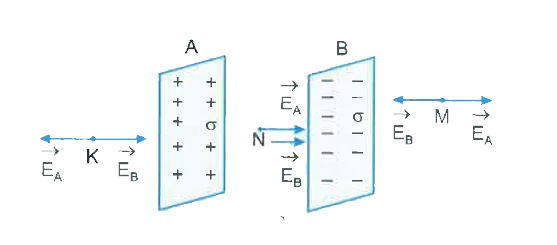
|
|
| 44. |
If there had been one eye of the man then |
|
Answer» IMAGE of the object wouldhave been inverted |
|
| 45. |
If the velocity (V), acceleration (A) and force (F) are taken as fundamental quantities instead of mass (M), length (L) and time (T), the dimensions of young's modulus (Y) would be : |
|
Answer» `FA^(2)V^(-4)` `[ML^(-1)T^(-2)]=[LT^(-1)]^(a)[LT^(-2)]^(b)[MLT^(-2)]^(c)` `ML^(-1)T^(-2)=M^(c )L^(a+b+c)T^(-a-2b-2c)` `:.c=1,a+b+c=-1,-a-2b-2c=-2` On solving, we get `a=-4,b=2` and `c=1`. Hence the correct CHOICE is `(a)`. |
|
| 46. |
A real object is placed at a distance f from the pole of a convex mirror, in front of the convex mirror. If focal length of the mirror is f, then distance of the image from the pole of the mirror is ........ |
|
Answer» SOLUTION :f is positive for convex mirror `THEREFORE 1/f=1/u+1/v` `therefore 1/f=(1)/(-f)+(1)/(v)`(by u=-f) `therefore 1/f+1/f=1/v` `therefore2/f=1/v` `therefore v=f/2` |
|
| 47. |
In the above problem, what force should the man exert on the rope to get his correct weight on the machine? |
|
Answer» Solution :`T-CANCEL(MG) + cancel(Mg) = Ma` `(THEREFORE R=Mg) , a=T/M` `T-Mg -mg = ma` `T = m.T/M =(m+M)g` `T=((m+M)Mg)/(M-m) = ((30+60)60 XX 10)/(60-30)` `=(cancel(90) xx 600)/(cancel(30)) = 1800 N` 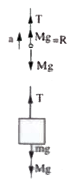
|
|
| 48. |
The main role of F_(2) layer in communication is |
|
Answer» Most useful REFLECTING layer for low frequency WAVES |
|
| 49. |
The magnetic field is made radial in a M.C.G. |
|
Answer» to make field STRONGER |
|
| 50. |
For removal of hypermetropia, one should use |
|
Answer» concave |
|