

Saved Bookmarks
This section includes 7 InterviewSolutions, each offering curated multiple-choice questions to sharpen your Current Affairs knowledge and support exam preparation. Choose a topic below to get started.
| 1. |
A coil of inductance 0.1H and resistance 100Omegaare connected to a 210V, 50Hz AC supply. Find the maximum current in the coil and time lag between maximum voltage and maximum current. |
| Answer» SOLUTION :`i_m = 2.83 A, PHI = 17.4^@ , t = 0.968 MS ` | |
| 2. |
Sha went to a doctor and said that he could not see distant objects clearly. Doctor tested and prescribed a lens of power - 0.75 D. a. what is the eye defect of sha ? b.Why did the doctor prescribe a lens - 0.75 D ? c. What type of lens is this ? |
|
Answer» <P> Solution :a. Short sightB. Power of lens = - 0.75 d `therefore` FOCAL length , F = `(-1)/(P) = (-1)/(0.75) = (-100)/(75) = (-4)/(3) ` m A short sighted person can see only nearby OBJECT clearly. By using a concave lens of power - 0.75 D, the image is made to fall on the retina. c. the concave lens |
|
| 3. |
A point object moves along an arc of a circle of radius 'R'. Its velocity depends upon the distance covered 'S' as V=K sqrtS where 'K' is a constant. If 'theta' is the angle between the total acceleration and tangential acceleration, then |
|
Answer» `tan THETA = SQRT((S)/(R))` |
|
| 4. |
A capillary tube of uniform bore is dipped vertically in water which rises by 7mm in tube, the radius of capillary tube is (T_(water) = 70 dyne/cm and g = 980 cm//s^2) |
|
Answer» 0.2 mm |
|
| 5. |
A hollow charged conductor has a tiny hole cut into its surface. Show that the electric field in the hole is (sigma)/( in_(0))hat(n), where hat(n) is the unit vector in the outward direction, and sigma is the surface density of charge near the hole . |
|
Answer» Solution :Suppose the hole has been plugged. Then the field inside the conductor is zero and outside it is `(sigma)/( in_(0)) hat (n)`. This FIELDIS essential the sum of two fields. One DUE to the plugged hole and other due to the RESET of the conductor. Inside the conductor these two forces are equal and opposite and the resultant is zero. But on the outer SURFACE these two forces are equal act in the same direction. Since the resultant is `( sigma)/( in_(0) ) hat(n)`, then each of these FORCE is equal to `( sigma)/( 2in_(0))hat (n) `. Thus the electric field in the hole is equal to `( sigma)/( in_(0)) hat (n)`. |
|
| 6. |
A small sphere of radius r_1 and charge q_1 is enclosed by a spherical shell of radius r_2 and charge q_2. Show that if q_1is positive, charge will necessarily flow from the sphere to the shell (when the two are connected by a wire) no matter what the charge q_2 on the shell is. |
|
Answer» Solution :The potential of the outer spherical shell `V_2={:("potential DUE to "),("its own charge " q_2):}+{:("potential due to"),("inner charge "q_1) :}` The potential of the inner solid sphere is `V_1={:("potential due to "),("its own charge " q_1):}+{:("potential due to"),("inner charge "q_2) :}` `=1/(4pi epsi_0) (q_1/r_1 + q_2/r_2)` `:. V_1 -V_2 = q_1/(4pi epsi_0)[1/r_1 - 1/r_2] = (q_1(r_2-r_2))/(4pi epsi_0 r_1r_2) = + ve` As positive charge FLOWS from higher potential to lower potential, hence charge will necessarily FLOW solid sphere to spherical shell, when the two are connected by a wire. 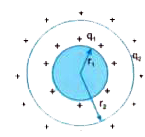
|
|
| 7. |
A dipole of dipole momentoversetto p,is present in a uniform electric fieldoversetto E. Write the value of the a between oversetto p and oversetto Efor which the torque experienced by the dipole is minimum. |
| Answer» SOLUTION :TORQUE ` oversetto TAU ` is minimum when angle between `oversetto p and oversetto E ` is either zero or `pi ` RAD. | |
| 8. |
The moon has mass M and radius R.A small object is dropped from a distance of 3R from the moon's center. The object's impact speed when it strikes the surface of the moon is equal to sqrt(kGM//R) for k= |
|
Answer» `1/3` `K_(0)+U_(0)=K_(f)+U_(f)` `0-G(Mm)/(3R)=(1)/(2)mv_(f)^(2)-G(Mm)/(R)` `(1)/(2)mv_(f)^(2)=G(2MM)/(3R)` `v_(f)=sqrt(((4)/(3)GM)/(R))`. |
|
| 9. |
Unpolarised light passes from a rarer into a denser medium. If the reflected and the refracted rays are mutually perpendicular, the reflected light is linearly polarised ___________ to the plane of incidence. |
|
Answer» |
|
| 10. |
The semi vertical angle of the cone of the rays of light incident on the objective of a microscope is 20^(@). If the wavelength of incident light is 6000Å, calculate the smallest distance between two points which can be just resolved. |
|
Answer» Solution :Data: `i_("max") = 20^(@), lambda= 6 xx 10^(-7)m, n=1` (air) Numerical APERTURE, `NA=nsini_("max")= 1XX SIN20^(@) = 0.34420` The limit of resolution (for illuminated OBJECTS), `d_("min") = lambda/(2NA) = (6 xx 10^(-7))/(2 xx 0.3420) = 8.772 xx 10^(-7)`m The limit of resolution (for self-luminous objects), `d_("min") = (1.22lambda)/(2NA) = 1.22 xx 8.772 xx 10^(-7) = 1.053 xx 10^(-6)`m |
|
| 11. |
In the given circuit, if point b is connected to earth and a potential of 1200 V is given topoint a, the charge on 4 muF capacitor is |
|
Answer» `800 MUC` |
|
| 12. |
Susceptibility is positive for |
|
Answer» PARAMAGNETIC SUBSTANCES |
|
| 13. |
Match Column-I (layers in the ionosphere for skywave propagation) with Column-II (their height range) : The correct answer is : |
|
Answer» `{:(I , II , III , IV) , (a , B , C , d):}` |
|
| 14. |
The following configuration having the highest voltage gain is, |
|
Answer» CB configuration |
|
| 15. |
A magnet moves inside a coil. Which of the following factors can affect the emf induced in the coil? I. The speed at which the magnet moves II. The magnetic field of the magnet III. The number of turns in the coil |
|
Answer» |
|
| 16. |
A cylindrical rod of length l=2m & density (rho)/(2) floats vertically in a liquid of density rho as shown in Fig (a) (a) Show that it performs SHM when pulled slightly up & released & find its time period. Neglect change in liquid level. (b) Find the time taken by the rod to completely immerse when released from position showm in (b). Assume that it remains vertical throughout its its motion ("take" g=pi^(2)m//s^(2)) |
|
Answer» `F_(R)=-[Axx2xx(rho)/(2)xxg-A(1-x)rhog]` `F_(R)=-[Arhog-Arhog+Axrhog]` `F_(R)=-Arhogx` So `K=Arhog` HENCE `T=2pisqrt((m)/(k))IMPLIES" " T=2pisqrt((Arho)/(Arhog)) implies T=2pisqrt((1)/(g))implies T=2sec` 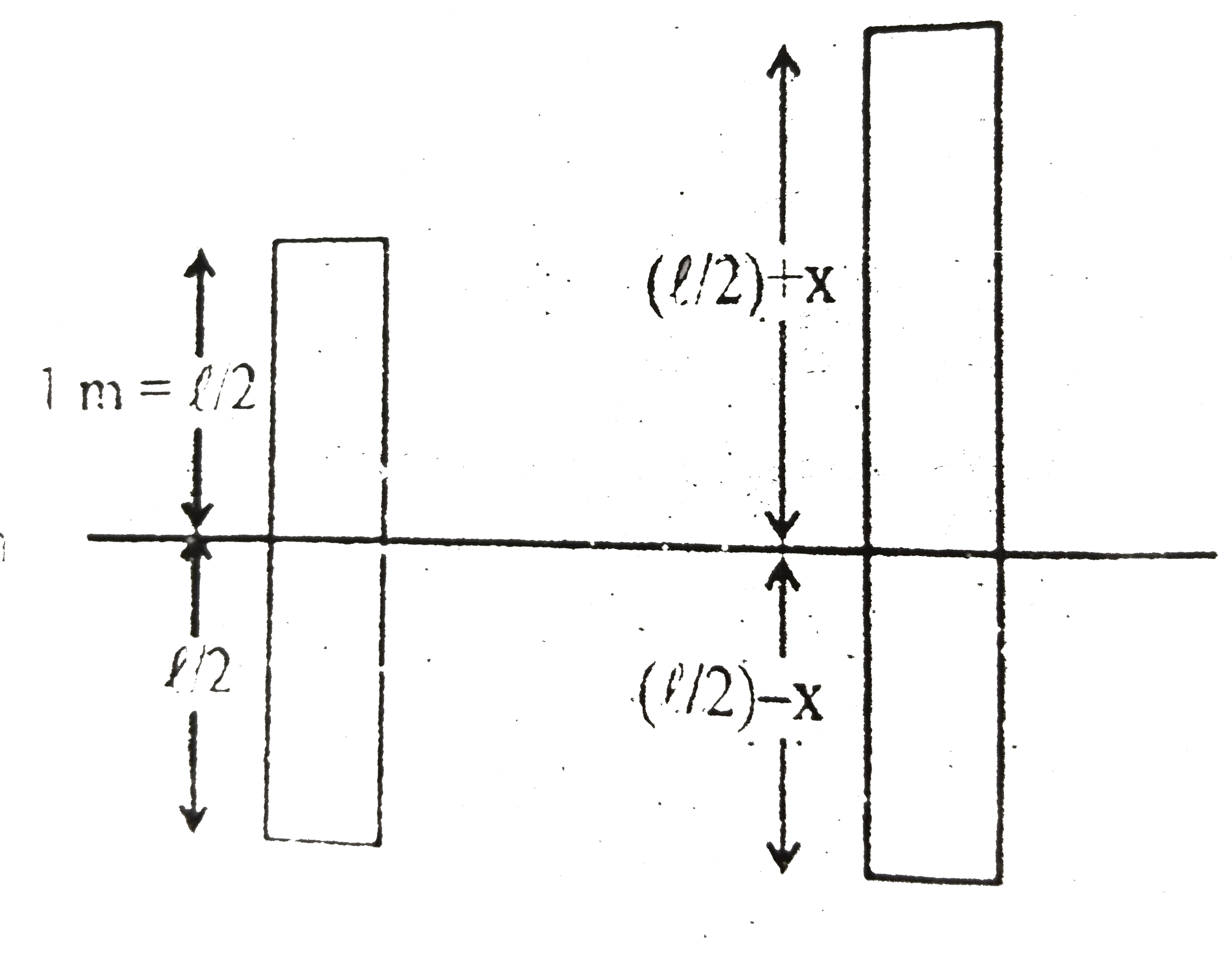
|
|
| 17. |
Fig (a) and (b) show the field lines of a single positive and negative charges respectively . Does the kinetic energy of a small negative charge increase or decrease in going from B to A ? |
| Answer» Solution :We have SEEN in PART (b) of the QUESTION that there is a gain in potential energy ofa small -ve charge in going from B to A . Gain in potential energy means LOSS of kinetic energy . It means that K.E. of a small -ve charge DECREASES in going from B to A . | |
| 18. |
Two car garages have a common gate which needs to open automatically when a car enters eitherof the garages or cars enter both. Devise a circuit that resembles this situation using diodes for this situation. |
Answer» Solution :Here, CIRCUIT containing OR GATE should be used because in this gate, we GET OUTPUT "1" when either of two inputs or both the inputs are "1". It circuit is as follows:  Truth table for OR gate, 
|
|
| 19. |
Where was the author's grandfather's portrait placed? |
|
Answer» on a shelf |
|
| 20. |
Assertion : A current continues to follow in superconducting coil even after switch is off. Reason : Superconducting coils show Meissner effect. |
|
Answer» If both assertion and reason are true and reason is the correct EXPLANATION of assertion |
|
| 21. |
An sudio signal V_(m)=15omega_(1)t is modulated on a CW of V_(c)=60 sin omega_(2)t. The percentage modulation is |
| Answer» ANSWER :C | |
| 22. |
In the example (2), the current flowing through the wire is l_(l) = l_(0)sinomega t. What is the flux through the loop at t= (pi)/(2omega)? |
| Answer» Solution :(a) `phi_(B) = -(mu_(0)l_(0)l)/(2pi)log_(E)""(a+l)/(a)` | |
| 23. |
In a reactor, an element X decays to a radioactive element Y, at a constant rate r atoms per second. Each decay reaction releases energy E_(1). Half life of element Y is equal to T and decays to a stable element. During each decay of Y, energy E_(2) is released. If at t=0, there was no atom of element Y and all the energy released is used in the reactor for generation of electrical power with efficiency eta, calculate electrical power generation in the reactor (i) at time t and (ii) in steady state. |
|
Answer» |
|
| 24. |
A series circuit has an impendence of 50.0 Omega and a power factor of 0.63 to 60Hz. The voltage lags the current. To raise the power factor of the circuit |
|
Answer» `(sqrt5V_(0))/(2E)` |
|
| 25. |
How many minimum NAND GATES are required for obtaining an output of Agt B + C. D ? |
Answer» 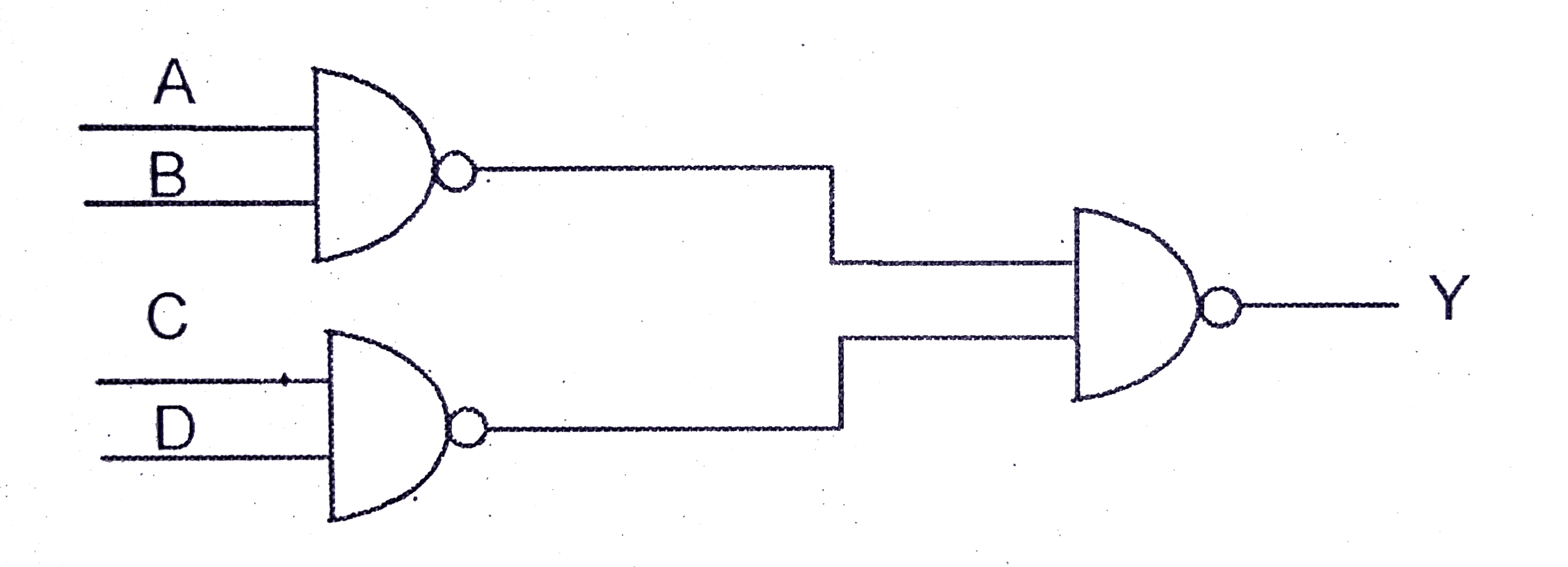
|
|
| 26. |
For the photoelectric emission from cesium, show that wave theory prodicts that (i) maximum kinetic energy of the photoelectrons (K_(max)) depends on the intensity I of the incident light (ii) K_(max) does not depend on the frequency of the incident light and (iii) the time interval between the incidence of light and the ejection of photoelectrons is very long. (Given : The work function for cesium is 1.90 eV and the power absorbed per unit area is 1.60 xx 10^(-6) Wm^(-2) which produces a measurable photocurrent in cesium.) |
|
Answer» Solution :According to wave theory, the energy in a light wave is spread out uniformly and continuously over the wavefront. For the sake of simplicity, the following assumptions are made. (a) Light is absorbed in the top atomic layer of the metal (b) For a given element, each atom absorbs an equal amount of energy and this energy is proportional to its cross-sectional area A (c) Each atom gives this energy to one of the electrons. The energy absorbed by each electron in time t is given by E = IAt With this energy absorbed, the most energetic electron is released with `K_(max)` by overcoming the surface energy barrier or work function `phi_(0)` and this is expressed as `K_(max) = IAt - phi_(0)` Thus, wave theory predicts that for a unit time, at low light intensities when `IA lt varphi_(0)`, no electrons are emitted. At higher intensities, when `IA ge phi_(0)`, electrons are emitted. This implies that higher the light intensity, greater will be `K_(max)`. Therefore, the predictions of wave theory contradict experimental observationa at both very low and very high light intensities. `K_(max)` is dependent only on the intensity under given conditions - that is, by suitably increasing the intensity, one can produce photoelectric effect even if the frequency is less than the threshold frequency. So the concept of threshold frequency does not even exist in wave theroy. According to wave theory, the intensity of a light wave is proportional to the square of the amplitude of the electric field `(E_(0)^(2))`. The amplitude of this electric field increases with incresing intensity and imparts an increasing acceleration and kinetic energy to an electron. Now I REPLACED with a quantity proportional to `E_(0)^(2)` in equation (1). This means that `K_(max)` should not depend at all on the frequency of the classical light wave which again contradicts the experimental results. If an electron accumulates light energy just enough to overcome the work function, then it is ejected out of the atom with zero kinetic energy. Therefore, from equation (1), `0 = IAt - phi_(0)` `t = (phi_(0))/(IA) = (phi_(0))/(I(PI r^(2)))` By taking the atomic radius `r = 1.0 xx 10^(-10)` m and substituting the given values of I and `phi_(0)`, we can estimate the time interval as `t = (1.90 xx 1.6 xx 10^(-19))/(1.60 xx 10^(-6) xx 3.14 xx (1 xx 10^(-10))^(2)) = 0.61 xx 10^(7) s ~~ 71` days Thus, wave theory predicts that there is a large time GAP between the INCIDENCE of light and the ejection of photoelectrons but the experiments show that photo emission is an instantaneous process. |
|
| 27. |
In the above the question the loss of the kinetic energy during the above process is : |
|
Answer» `(IOMEGA^(2))/(2)` `E_(k)=E_(i)-E_(f)` `=[(1)/(2)xxIxx(2omega)^(2)+(1)/(2)xx2Ixxomega^(2)]-(1)/(2)(I+2I)xx((4omega)/(3))^(2)` `=3Iomega^(2)-(8)/(3)Iomega^(2)=(1)/(2)Iomega^(2)` |
|
| 28. |
A particle of mass m and charge q moves at high speed along the x-axis. It is initially near x = -oo and it ends up near x=+oo. A second charge is fixed at the point x = 0, y=-d. As the moving charge passes the stationary charge, its x component of velocity does not change appreciably, but it acquires a small velocity in y-direction. Determine the angle through which the moving charge is deflected |
|
Answer» `theta=tan^(-1)((QQ)/(2piepsilon_0dmv^2))` |
|
| 29. |
According to Bohr's theory ,the speed of electron in the nth orbit is porportional to |
|
Answer» `1//N^2` |
|
| 30. |
A : The drift velocity of electrons in a metallic wire will decrease, if the temperature of the wire is increased. R: On increasing temperature, conductivity of metallic wire decreases. |
|
Answer» Both Assertion and REASON are true and the Reason is correct explanation of the Assertion. In `v_(d) = a tau, tau ` is the relaxation TIME and a is acceleration. As TEMPERATURE INCREASE `tau` decreases, so `v_(d)` also decreases. Conductance of metal is `sigma = (l)/(RA)` As temperature increases R increases and `sigma` decreases . So Reason is also correct but it is not the correct explanation of Assertion. |
|
| 31. |
It is estimated that the energy released in the explosion of atomic bomb at Hiroshima was 9 xx 10^13J. If an average 200MeV of energy is released in the fission of one , ._92U^235. The mass of uranium used for the bomb is nearly |
|
Answer» 1.1 KG |
|
| 32. |
The part of the fallopian tube which is closer to the ovary possess finger like projections called |
|
Answer» ampulla |
|
| 33. |
What we call a convex lens? |
| Answer» SOLUTION :It is TERMED as SIMPLE MAGNIFIER or a simple MICROSCOPE. | |
| 34. |
In ohm's law exp, reading of voltmeter across the resistor is 12.5V and reading of currect I = 0.20 ltbr. Amp Estimate the resistance in correct S.F . |
| Answer» SOLUTION :`R = (V)/(i) = (12.5rarr3SF)/(0.20rarr\2SF)=62.5Omegaunderset(t o2S.F)UNDERSET(ROUNDOFF)rarr62Omega` . | |
| 35. |
Two particles each have a mass of 6.0 xx 10^(-3) kg. One has a charge of +5.0 xx 10^(-6) C. and the other has a charge of -5.0 xx 10^(-6) C. They are initially held at rest at a distance of 0.80 m apart. Both are then released and accelerate toward each other. How fast is each particle moving when the separation between them is one-third its initial value? |
|
Answer» `7.3` m/s |
|
| 36. |
A bullet of mass 10g strikes a fixed target and penetrates 8 cm into it before coming to rest. If the average force of resistance offered by the target is 100 N with what velocity does it strike ? : |
|
Answer» `10 ms^(-1)` `Fxxx=1/2mv^(2)` `:. v=sqrt((2Fx)/(m))=sqrt((2xx100xx(8)/(100))/((10)/(100)))=40 ms^(-1)` |
|
| 37. |
Two equal point charges are fixed at x=-a and x = +a on the axis. Another point charge Q is placed at the origin. The change in the electrical potential energy of system, when it is displaced by a small distance x along the X-axis is approximately proportional to |
|
Answer» X |
|
| 38. |
If thekinetic energy of thr particle is increased to 16 times its previous value, the percentage change in the de Broglie wavelength of the particle is : |
|
Answer» 25 |
|
| 39. |
(a) A point object is placed on the principal axis of a convex spherical surface of radius of curvature R, which separates the two media of refractive indices nx and n_(2)(n_(2) gt n_(1)) Draw the ray diagram and deduce the relation between the object distance (w), image distance (v) and the radius of curvature (R) for refraction to take place at the convex spherical surface from rarer to denser medium. (b) A converging lens has a focal length of 20 cm in air. It is made of a material of refractive index 1.6. If it is immersed in a liquid of refractive index 1.3, find its new focal length. |
|
Answer» Solution :(a) N/A (b)Focal LENGTH of lens in air f= + 20 cm, refractive index of glass ng = 1.6 and refractive index of liquid `n_(L) = 1.3` If radii of CURVATURE of two surfaces be `R_1` and `R_2`, respectively, then in air: `1/f =(n_(g)-1)(1/R_(1)-1/R_(2))` i.e. `1/20 = (1.6-1) (1/R_(1) -1/R_(2))` .........(i) and on immersing the lens in given liquid, new focal length f.will be given by: `1/f^(.) =(n_(g)/n_(1)-1) (1/R_(1)-1/R_(2)) = (1.6/1.3-1) (1/R_(1)-1/R_(2))` ...........(ii) Dividing (i) by (ii), we get `f^(.)/20 =(0.6 xx 1.3)/0.3 rArr f^(.) = 52 cm` |
|
| 40. |
Answer the following questions regarding earth's magnetism. a. A vector needs three quantities conventionally used to specify the earth's magnetic field. b. The angle of dip at a location in southern India is about 18^@ . Would you expect a greater or smaller dip angle in Britain ? c. If you made a map of magnetic field lines at Melboune in Australia, wouldthe lines seem to go into the groung or come out of the ground ? d. In which direction would a compass free to move in the vertical plane point to , if located right on the geomagnetic north or south pole ? e. the earth' s field, it is claimed roughly approximates the field due to a dipole of magnetic moment 8 xx10^(22)JT^(-1) located at its centre. Check the order of magnitude of this number in some way. f. Geologists claim that besides the main magnetic N - S poles, there are several local poles on the earth's surface oriented in different directions. How is such a thing possible at all ? |
|
Answer» Solution :a. Magnetic elements i. declination `""` II. Dip and `""` HORIZONTAL intensity. b. Greater in Britain (it is about `70^@` ) , because Britain is closer to the magnetic north pole c. Field lines of B due to the earth.s magnetism would seem to COME out of the GROUND. d. Compass needle can move only in horizontal PLANE. Since field is entirely vertical no directions is shown by the needle. e. Calculate B , from `B=(mu_0M)/(4pir^3),M=8xx10^(22)JT^(-1)` `r=6.4xx10^6m` . It turns to the value `~~0.3G` approximately the horizontal field as the surface. f. Because of the deposit of magnetic , at different places, there can be different local poles. |
|
| 41. |
A long wire is bent into a circular loop of radius R and a current I is passed through it produces a magnetic field B at its centre. If the same wire is bent into two turns of smaller redius and the same current is passed through it, how does the magnetic field at the centre change? |
|
Answer» SOLUTION :FIRST CASE, `B=(mu_0I)/(2R)` Second case, `B=(mu_0"2I")/(2R/2)=(4mu_0I)/(2R)=4B` |
|
| 42. |
Let the angle between two nonzero vectors A and B be 120° and its resultant be C . |
|
Answer» C must be EQUAL to |A-B| |
|
| 43. |
Two identical metal plates show photoelectric effect. Light of wavelength lamda_A falls on plate A and lamda_B fall on plate B and lamda_A=2lamda_B, The maximum KE of the photoelectrons are K_A and K_B, respectively, Which one of the following is true? |
|
Answer» `2K_2=K_1` |
|
| 44. |
A transverse sinusoidal wave is generated at one end of a long horizontal string by a bar that moves with an amplitude of 1.12 cm . The motion of the bar is continuous and is repeated regularly 120 times per second. The string has linear density of 117g/m. The other end of the string is attached to a mass 4.68 kg. The string passes over a smooth pulley and the mass attached to the other end of the string hangs freely under gravity. The maximum magnitude of the transverse speed is |
|
Answer» 10.884 m/s |
|
| 45. |
A transverse sinusoidal wave is generated at one end of a long horizontal string by a bar that moves with an amplitude of 1.12 cm . The motion of the bar is continuous and is repeated regularly 120 times per second. The string has linear density of 117g/m. The other end of the string is attached to a mass 4.68 kg. The string passes over a smooth pulley and the mass attached to the other end of the string hangs freely under gravity. The maximum magnitude of the transverse component of tension in the string is |
|
Answer» zero |
|
| 46. |
Given a uniform electric fieldoversetto E =5xx10 ^(3) hati NC^(-1). Find the flux of this field through square of 10 cm on a side whose plane is parallel to the y-Z plane. What would be the flux through the same square if the plane makes a 30^(@)angle with the x-axis? |
|
Answer» Solution :Here `oversetto E= 5xx 10^(3) hatiNC^(-1)` and area of square S = 10 `XX 10 cm ^(2)= 100 cm ^(2)= 100 xx 10^(4)m^(2)=0.01 m ^(2) ` Since surface is in Y-Zplane , hence `oversetto S =0.01 hat I m^(2) ` ` therefore "" ` Flux ` phi_in oversetto E. oversetto S= ES =( 5 xx10^(3) ) xx0.01 = 50 N m^(2)C^(-1) ` Whenplane of square makes ` 30 ^(@) ` angle with the x-axis ,then area vector ` oversetto S ` subtends an angle ` theta = 60^(@) ` from x-axis and hence new flux will be `"" phi_in . =ES cos theta = (5xx10^(3) )xx 0.01 xx cos 60^(@) =25 N m^(2) C^(-1) ` |
|
| 47. |
A charge q is uniformly distributed along the periphery of a non conducting uniform circular disc pivoted at its centre in a vertical plane and can freely rotate about a horizontal axis passing through its centre. A cylindrical region with its axis passing through the centre of the disc has a varying magnetic field B = kt as shown in the adjacent figure. wrapped over the disc as shown and remains stationary, then |
|
Answer» `m=(kqR)/(2g)` |
|
| 48. |
In the above question No.326, the reason for the bodies to have different times of descent is |
|
Answer» they have same mass |
|
| 49. |
Two infinite line have linear charge densities -lamda and +lamda. They are parallel to z axis passing through x axis at point x=-a and x=a respectively. Show that the equipotential surface having potential (lamdaln(2))/(4piepsilon_(0)) is a cylinder haivng radius 2sqrt(2)a |
| Answer» | |