

Saved Bookmarks
This section includes 7 InterviewSolutions, each offering curated multiple-choice questions to sharpen your Current Affairs knowledge and support exam preparation. Choose a topic below to get started.
| 1. |
The earth is bulged at the equator due to the |
|
Answer» CENTRIFUGAL force |
|
| 2. |
Explain the role of control rods in a reactor. Why are they made of cadmium ? |
|
Answer» Cadmium can easily absorb a suitable FRACTION of neutrons emitted during nuclear fission in the nuclear reactor to obtain a controlled chain reaction. |
|
| 3. |
Obtain the resonant frequency omega_(r ) of a series LCR circuit with L = 2.0H, C = 32 muF and R = 10 Omega. What is the Q-value of this circuit? |
| Answer» SOLUTION :`125s^(-1),25` | |
| 4. |
cylindrical volume of radius R has a uniform axial magnetic field B, which is increasing at a rate of (dB)/(Dt) = alpha Ts^(-1). A chord (AB) of the circular cross section of the cylindrical region has length L.Calculate the line integral of induced electric field (int_(A)^(B) vec(E) vec(dl)) as one moves along the chord from A to B. Try to find the answer without actually performing the integration. Is the value of integral same if one moves along the arc from A to B ? |
|
Answer» |
|
| 6. |
A wiere mesth consisting of very small squares is viewed at a distances of 8cm through a magnifying lens of fcoal length 10cm, kept close to the eye. The magnification produced by the lens is |
|
Answer» 5 Given `f=10cm` (as lens is converging) `u=-8cm` (as object is placed on LEFT SIDE on thelens) Substituting these values in Eq. (i) We get `1/10=1/v-1/(-8)implies1/v=1/10-1/8implies1/v=(8-10)/80` `:. V=80/(-2)=-40CM` Hence, MAGNIFICATION produced by the lens `m=v/u=(-40)/(-8)=5` |
|
| 7. |
In a transistor beta= 45, the change in the v voltage across 5 kOmegaresistor which is connected in collector M circuit is 5V. Find the change in base current. |
|
Answer» SOLUTION :Change in the collector CURRENT `Delta I_C = Delta V //R_L` But `BETA =( DeltaI_C )/(Delta I_B) ` ` DeltaI_B= (Delta I_C ) /( beta) = (10^(-3))/(45)= 0.022 mA .` Change in BASE current `( Delta I_B ) = 0.022mA` |
|
| 8. |
A parallel plate capacitor with plate area 100cm^2 and separation between the plates 1.0 cm is connected across a battery of emf 24V. The force of attraction between the plates is |
|
Answer» `1.0 XX 10^(-7)N` |
|
| 9. |
If f: R rarr R begiven by f(x) = (3 - x^3)^(1/3) then fof(x) is- |
|
Answer» `X^(1/3)` |
|
| 10. |
According to Gauss's law, the electric field due to an infinitely long straight wire isproportional to |
|
Answer» R |
|
| 11. |
The phenomenon of electromagnetic induction was discovered by |
|
Answer» Oersted |
|
| 12. |
In cold countries heat pumps are used in winter to transfer heat from some source (such as a pond of water) to the interior ofhouses. Do they violate the law of thermodynamics ? |
| Answer» SOLUTION :The heat pump transfers heat from some COLD place to a hotter place at the expense of energy SUPPLIED externally by a motor. Thus it does not violate any law of thermodynamics | |
| 13. |
Using Kichhoff's law in the given circuit determine the current 'I' in the are EF. |
|
Answer» SOLUTION :Applying kirchoff's FIRST rule at E `rArr 0.5 =I_(1)=I` Where 'I' flows through 'R' Now Kirchoff's 2dn rule in closed LOOP FEABF `-2I_(2)=0.5xx2=-4+3` `-2I_(2)+1=-1` `cancel-2I_(2)=cancel-2` The CURRENT in arm `EF=12=+1A` |
|
| 14. |
The magnetic lines of forces prefer to pass through ferromagnetic substances than air, because permeability for ferromagnetic substances is : |
| Answer» ANSWER :D | |
| 15. |
For a transistor in a common base arrangement, the alternating currnet gain (alpha)is given by ? Where V_c= constant |
|
Answer» `(/_\I_C)/(/_\I_B)` |
|
| 16. |
At abosolute zero, a metal will behave as : |
|
Answer» CONDUCTOR |
|
| 17. |
What are the differences between Coulomb force and gravitational force ? |
|
Answer» Solution :1) The gravitational force between TWO masses is always attractive but Coulomb force between two charges can be attractive or repulsive, depending on the nature of charges. 2) The VALUE of the gravitational constant `G = 6.626 xx 10^(-11) Nm^(2) kg^(-2)`. The value of the constant k in Coulomb law is `k = 9 xx 10^(9) m^(2)C^(-2)`. (3) The gravitational force between two masses is INDEPENDENT of the medium. The electrostatic force between the two charges depends on nature of the medium in which the two charges are kept at rest. (4) The gravitational force between two point masses is the same whether two masses are at rest or in motion. If the charges are in motion, yet another force (Lorentz force) comes into play in addition to coulomb force. |
|
| 18. |
Two electric lamps of 40 W each are connected in parallel across the mains supply. Find the total power consumed by the two bulbs together. |
|
Answer» Solution :Power of each bulb b= 40 W Total consumption of power by the two BULBS `P= P_1 + P_2 = 40 + 40 `= 80 W. |
|
| 19. |
the average kinetic energy of the thermal neutron is of the order of |
|
Answer» 3 eV |
|
| 20. |
Assertion: Em wave with frequencies more than the critical frequency of ionosphere cannot be used for communication using sky-wave propagation. Reason: The refractive index of the ionosphere becomes very high for frequencies higher than the crtical frequency. |
|
Answer» If both the assertion and reason are true and reason is a true explantion of the assertion. 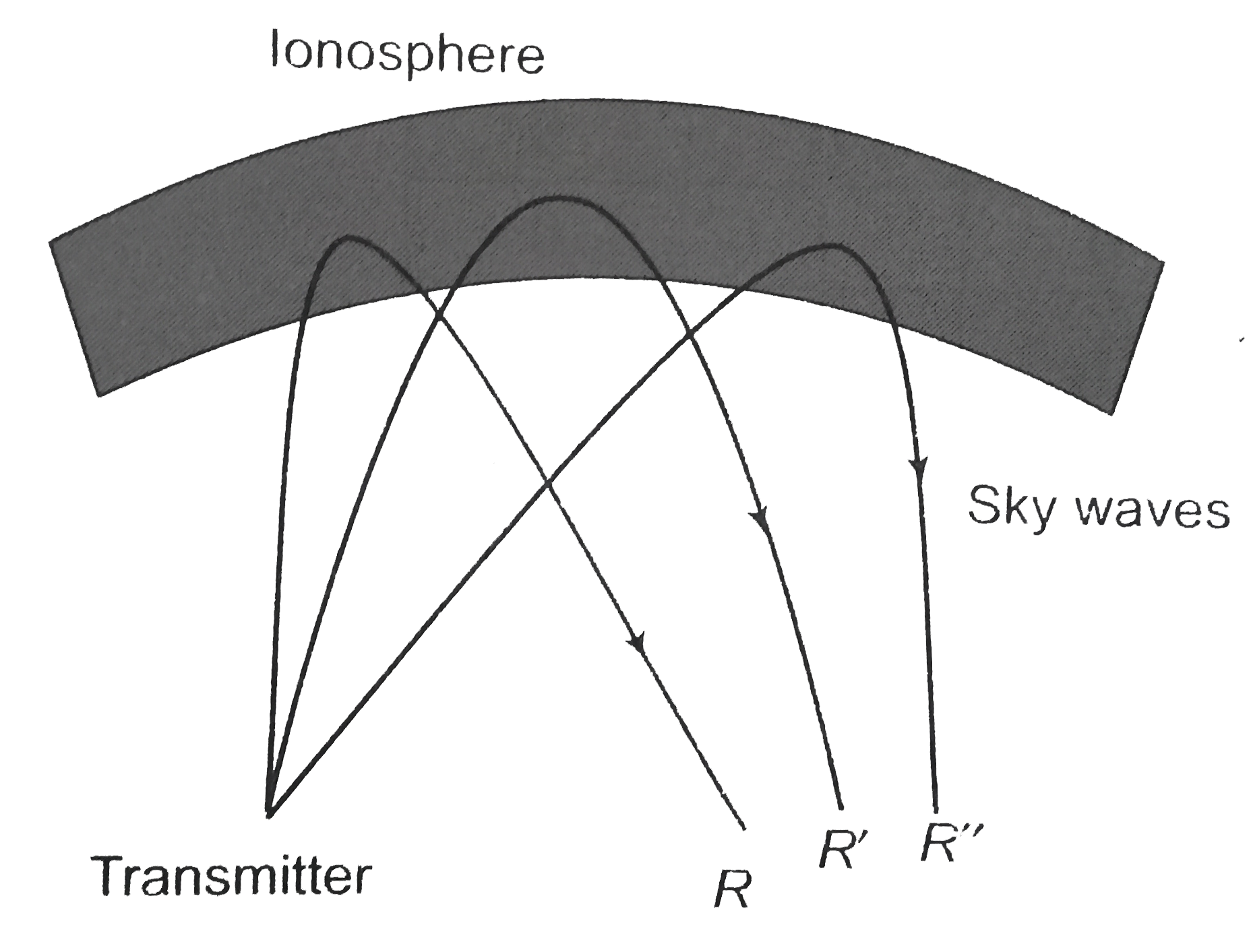 The refraction or bending of the beam will continue till it reaches ctritical ANGLE after which it is will be reflacted back. If the frequency is too high, then after a CERTAIN value, the electron density `N` may never be so high as to produce enough bending for attainment of critical angle or condition of reflection. This is called ctritical frequency. For frequencies higher than this value, the refractive index of the ionosphere becomes very high, so they cross the ionosphere and do not return back to the earth. Hence, the option (a) is true. |
|
| 21. |
The temperature of a refrigerator is kept at7^@C to keep the food articles kept in it in good condition. What is its coefficient of performance, if the room temperatures 37^@C ? |
|
Answer» 7.5 |
|
| 22. |
Dispersive power omega in terms of Refractive Index is given by omega |
| Answer» SOLUTION :`(DMU)/(mu-1` | |
| 23. |
Discuss Bohr's theory of the spectrum of hydrogen atom. |
|
Answer» Solution :1) According to Bohr's model an electron continuous to revolve round the nucleus in fixed, STATIONARY orbits. This is called ground state of the atom In ground state there is no EMISSION of radiation. 2) But when some energy is given to an atom the electron absorbs this energy. This is called excited state of the atom. In this state the electron jumps to the NEXT higher orbit. But it can remain `10^(-8)` sec and it immediatly RETURNS back to its ground state and the balance of the energy is emitted out as a spectral line. 3) According to Bohr's third postulate, the emitted energy is given by `E =hv = E_(2) - E_(1)` `"But "E_(2)=(-"me"^(4))/(8epsi_(0)^(2)h^(2))(1)/(n^(2))` and `E_(1)=(-"me"^(4))/(8epsi_(0)^(2)h^(2))(1)/(n_(1)^(2))" "(because Z=1)` `therefore barv =(1)/(lamda)=("me"^(4))/(8epsi_(0)^(2)ch^(3))[(1)/(n_(1)^(2)) (1)/(n_(2)^(2))]=R[(1)/(n_(1)^(2))-(1)/(n_(2)^(2))]" "[because v=(c)/(lamda)]` Where `R=(-"me"^(4))/(8epsi_(0)^(2)"ch"^(3))`= Rydberg const. 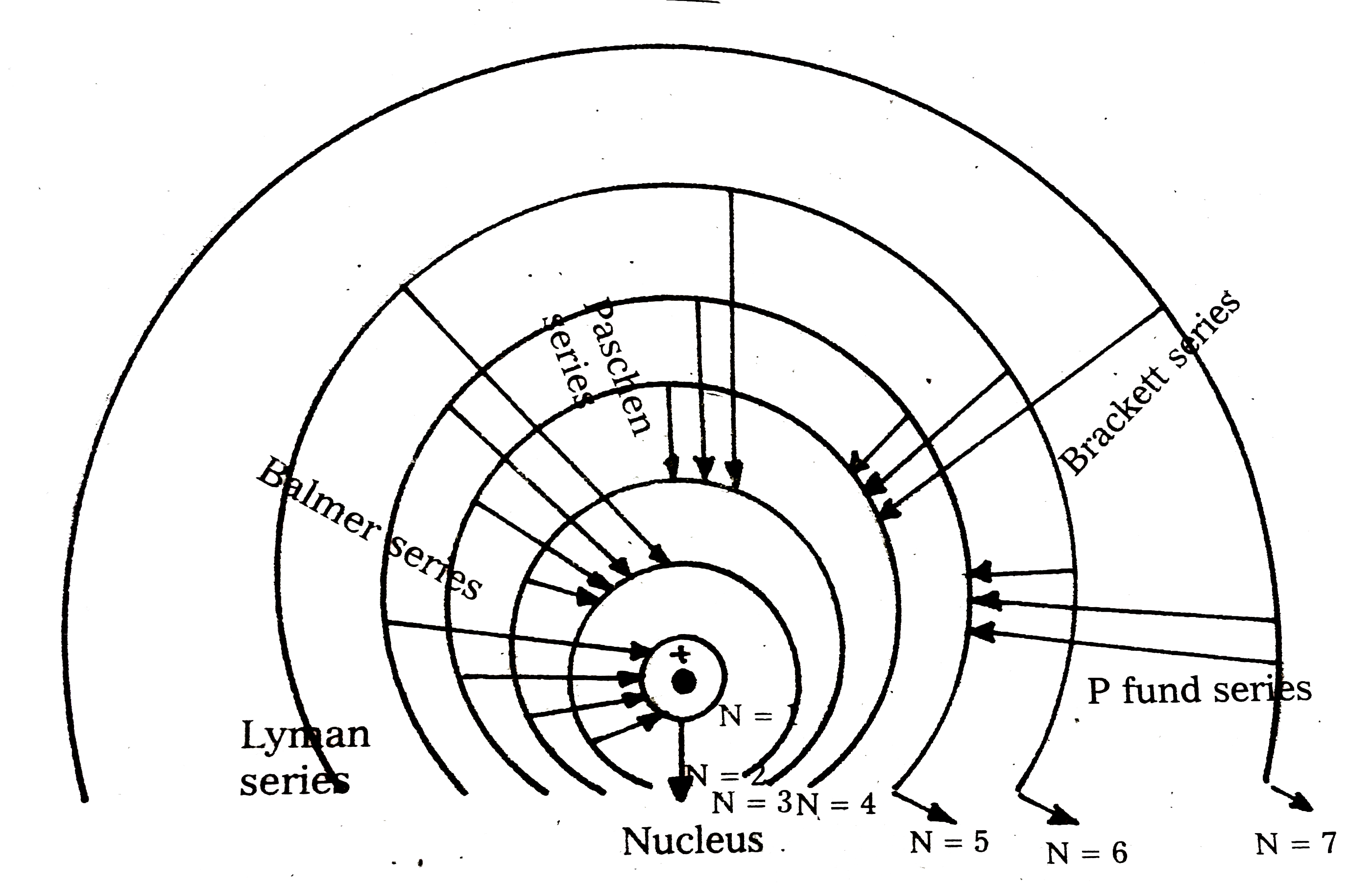 Hydrogen atom has five series of spectral lines. They are 1. Lyman series : When an electron jumps from the OUTER orbits to the first orbit, the spectral lines are in the ultra - violet region: Here `n_(1) = 1, n_(2) = 2, 3, 4, 5....` `(1)/(lamda)=R[(1)/(1^(2))-(1)/(n_(2)^(2))]=R[1-(1)/(n_(2)^(2))]` 2) Balmer Series : When an electron jumps from the outer orbits to the second orbit, the spectral lines are in the visible region. Here `n_(1) = 2, n_(2) = 3, 4, 5.....` `(1)/(lamda)=R[(1)/(2^(2))-(1)/(n_(2)^(2))]` 3) Paschen series : When an electron jumps from the outer orbits to the third orbit, the spectral lines are in the near infrared region. Here `n_(1)= 3, n_(2) = 4, 5, 6....` 4) Brackett series : When an electron jumps from outer orbits to the forth orbit, the spectral lines are in the infrared region. Here `n_(1) = 4, n_(2) = 5, 6, 7....` `(1)/(lamda)=R[(1)/(4^(2))-(1)/(n_(2)^(2))]` 5) Pfund series : When an electron jumps from outer orbits to the fifth orbit, the spectral lines are in the far infrared region. Here `n_(1). = 5, n_(2) = 6, 7, 8, .....` `(1)/(lamda)=R[(1)/(5^(2))-(1)/(n_(2)^(2))]` |
|
| 24. |
A cameraman on a pickup truck is traveling westward at 20 km/h while he records a cheetah that is moving westward 30 km/h faster than the truck. Suddenly, the cheetah stops, turns, and then runs at 45 km/h east-ward, as measured by a suddenly nervous crew member who stands alongside the cheetah's path. The change in the animal's velocity takes 2.0 s. What are the (a) magnitude and (b) direction of the animal's acceleration according to the cameraman and the ( c) magnitude and (d) direction according to the nervous crew member? |
| Answer» Solution :(a) `13m//s^(2)`, (b) `+HATI`, or EASTWARD, ( C) `13m//s^(2)`, (d) `+hati`, or eastward | |
| 25. |
The forbidden band energy of silicon is 1.1 eV What does it mean ? |
| Answer» Solution :This means if ENERGY 1.1 EV is given.to an electron in the valence band it will JUMP to the CONDUCTION band. | |
| 26. |
Describe a simple experiment (or activity) to show that the polarity of emf induced in a coil is always such that it tends to produce a current which oppose the change of magnetic flux that produce it |
Answer» Solution :When the North pole of a bar magnet MOVES TOWARDS the closed coil, the magnetic FLUX through the coil increases. This produces an induced emf which produces (or tend to produce if the coil is open) an induced current in the anti-clockwise sense. The anti-clockwise sense corresponds to the generation of North pole which opposes the motion of the approaching N pole of the magnet. The face of the coil, facing the approaching magnet, then has the same polarity as that of the approaching pole of the magnet. The induced current, therefore, is seen to oppose the change of magnetic flux that produces it. When a North pole of a magnet is moved away from the coil, the current (I) flows in the clock-wise sense which corresponds to the generation of SOUTH pole. The induced South pole opposes the motion of the RECEDING North’pole. 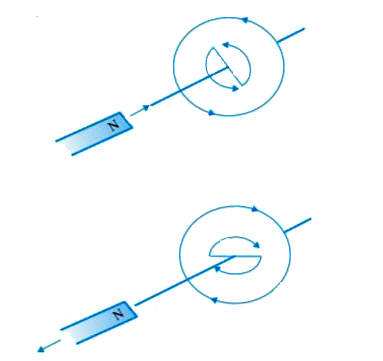
|
|
| 27. |
What is the nature of change in internal energy in the following three thermodynamical processes as shown in the given figure. |
|
Answer» `Delta` U is positive in all the three cases |
|
| 28. |
A certain diatomic gas has the same specific heats as an ideal gas but a slightly different equation of state : PV =R(T + alphaT^(2)), alpha = 0.001 K^(-1).The temperature of the gas is raised from T_(1) = 300K to T_(2)at constant pressure. It is found that work done on the gas is 70% higher than what would be on an ideal gas. Choose the correct statement(s) |
|
Answer» `T_(2) = 400 K`,internal ENERGY increases by 250 R per MOLE. |
|
| 29. |
The reading of a spring balance when a block is suspended from it in air is 60 N. This reading is changed to 40 N when the block is submerged in water. The specific gravity of the block must be therefore : |
|
Answer» 3 `=(60)/(60-40)=3` Thus CORRECT choice is (a). |
|
| 30. |
The number of photoelectrons emitted for light of a frequency v (hiigher than the threshold frequency v_(0)) is proportional to |
|
Answer» `v-v_(0)` |
|
| 31. |
Uniform inward magnetic field B = 0.5 T exists in a circular region of radius 5m. At t = 0 one metal ring of radius 5 m completely encloses the magnetic field. Now ring starts a moving with constant velocity 1 m//s. Find the emf in volts induced in the ring at t=6s. |
Answer»  Some PORTION of the loop is still inside the field and we can calculate that straight length of this portion is 8 m. Hence motional emf can be WRITTEN as follows: V = Bvl `V = 0.5 xx 1 xx 8 = 4 V`. Hence, answer is 4. |
|
| 32. |
The magnetic induction at center O as shown in the figure is |
|
Answer» `(mu_(0)I)/(2A) + (mu_(0)I)/(2b) ox` `rArr B= (3mu_(0)I)/(8a) + (mu_(0)I)/(8b)` (into plane of paper) |
|
| 33. |
The physical quantities of the wave used for modulation |
|
Answer» AMPLITUDE only |
|
| 34. |
A machine gun fires a bullet of mass 40 g with a velocity 1200 ms^(-1). The man holding it, can exert a maximum force of 144N on the gun. How many bullets can he fire per second at the most? |
| Answer» Answer :D | |
| 35. |
The energy gap in case of which of the following is less than 3 eV? |
|
Answer» COPPER |
|
| 36. |
An insulating rod of length l carries a charge q distributed uniformly on it. The rod is pivoted at an end and is roated at a frequency f about a fixed perpendicular axis . The magnetic moment of the system is |
|
Answer» ZERO |
|
| 37. |
Give any two characteristics of interference of light waves. |
|
Answer» Solution :Characteristics of interference of light WAVES are, (i) Bright fringes are equally bright and dark fringes are equally dark. (ii) FRINGE WIDTH remains UNIFORM for EITHER bright or dark fringes. |
|
| 38. |
A sinusoidal voltage amplitude modulates another sinusoidal voltage of amplitude 2kV to result in two sidebands, each of amplitude 200V the modulation index is |
|
Answer» 0.2 `THEREFORE 200 V=(muxx2kV)/(2)=(muxx2000V)/(2)` or `mu=(2xx200)/(2000)=0.2` |
|
| 39. |
The resostivity of an impurity-free semiconductor at room tempterature is rho=50 Omega cm. It becomes equal to rho_(1)= 40 Omega cm. When the semiconductor is illuminated with light, and t= 8ms after swithching off the light source the resistivity becomes equal to rho_(2)= 45 Omega cm. Find the mean lifetime of conduction electrons and holes. |
|
Answer» Solution :We write the CONDUCTIVITY of the simple as `sigma= sigma_(i)+sigma_(gamma)` where `sigma_(i)=` intrinsic conductivity and `sigma_(gamma)` is the photo conductivity. At `t=0`, assuming saturation we have `(1)/(rho_(1))=(1)/(rho)+ sigma_(gamma_(0)) or sigma_(gamma_(0))=(1)/(rho_(1))-(1)/(rho)` Time `t` after light source is switched off we have beacuse of recombination of electron and holes in the sample `sigma= sigma_(i)+sigma_(gamma_(0))e^(-t//T)` where `T=` mean lifetime of electrons and holes. Thus `Thus (1)/(rho_(2))=(1)/(rho)+((1)/(rho_(1))-(1)/(rho))e^(-t//T)` or `(1)/(rho_(2))-(1)/(rho)=((1)/(rho_(1))-(1)/(rho))e^(-t//T)` or `e^(t//T)=((1)/rho_(1)-(1)/(rho))/((1)/(rho_(2))-(1)/(rho))=(rho_(2)(rho-rho_(1)))/(rho_(1)(rho-rho_(2)))` Hence `T= t//In {(rho_(2)(rho-rho_(1)))/(rho_(1)(rho-rho_(2)))}` Substitution gives `T= 9.87 ms~ 0.01 sec` |
|
| 40. |
When a current drawn from a battery is 0.5 A, its terminal potential difference is 20 V. And when current drawn from it is 2.0 A , the terminal voltage reduces to 16 V . Find out e.m.f and internal resistance of the battery. |
|
Answer» Solution :Let E and R be the e.m.f and internal resitance of battery. When a current I ampere is drawn from it, then POTENTIAL drop across internal resitance or inside the CELL is = Ir. Then `V= E- Ir, I= 0.5 A , V= 20 ` VOLT, we have `20 = E- 0.5 r "".....(i)` `I = 2 A , V= 16 ` Volt, we have `16- E- 2r "".....(ii)` From eqs (i) and (ii) `2E - r = 40 and E= 2r = 16` So solving we get `E= 21.3 V, r = 2.67 Omega` |
|
| 41. |
The measured mass and volume of a body are 53.63 g and 5.8 cm^(3) respectively, with possible errors of 0.01 g and 0.1 cm^(3). The maximum percentage error in density is about |
| Answer» ANSWER :B | |
| 42. |
A charge q is placed at the centre of the line joining two equal charges Q. The system of the three charges will be in equilibrium , if q is equal to |
|
Answer» `-(Q)/(2) ` ` THEREFORE ""(1)/(4 pi in _0) .(Qq)/((®/(2))^(2)) +(1)/(4 pi in _0 ).(Q^(2))/(r^(2)) =0 rArr(1)/(4 pi in _0) .(Q)/(2) [4Q +Q] =0 ` or`""4q +Q=0 or q=-(Q)/(4) ` 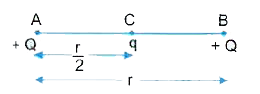
|
|
| 43. |
Two small -sized identical equally charged spheres each having mass 1 mg are hanging in equilibrium as shown in the figure . The length of each string is 10 cm and the angle theta is 7^(@) with the vertical . Calculate the magnitude of the charge in each sphere . (Take g =10ms^(-2)) |
|
Answer» Solution :If the spheres are neutral the angle between them will be `0^(@)` when HANGED vertically . SINCE they are positively charged spheres , there will be a repulsive force between them and they will be at equilibrium with each other at an angle of `7^(@)` with the vertiction. We can draw a free body diagram for one of the charged spheres and apply Newton.s second law for both vertical and horizontal directions . The free body diagram is shown. In the x -direction the ACCELERATION of the charged sphere is zero . Using Newton.s second law `(vecF_(m)=mveca)` , we have T sin `thetahati-F_(e)hati=0` T`sin THETA=F_(e)` Here T is the tension acting on the charge due to the string and `F_(e)` is the electrostatic force between the two charges . In the y -direction also the net acceleration experienced by the charge is zero . T `cos thetahatj-mg hatj=0` Therefore T cos `theta =mg ` . By DIVIDING equation (1) by equation (2), `tan theta = (F_(e))/(mg)` Since they are equally charged the magnitude of the electrostatic force is `F_(e)= k""(q_(2))/(r^(2))` where k `=(1)/(4piepsilon_(0))` Here r = 2a = 2L `sin theta`. By substituting these values in equation (3) , `tan theta = k(q^(2))/(mg(2L sin theta)^(2))` Rearranging the equation (4) to get q `q=2L sinthetasqrt(("mg tan" theta)/(k))=2xx0.1xxsin7^(@)xxsqrt(10^(-3)xx10xxtan7^(@))/(9xx10^(9))` `q = 8.9xx10^(-9)C = 8.9nC` 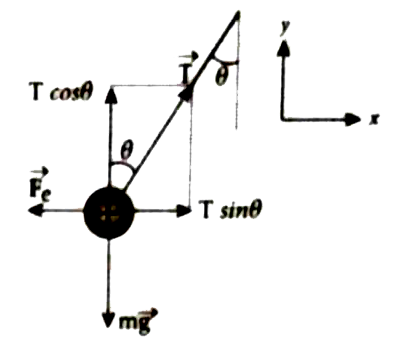
|
|
| 44. |
Consider a harmonic wave travelling on aistring of mass per unit length fl. The wave has a velocity v, amplitude A and frequency if. The power transmitted by a harmonic wave on the string is proportional to (take constant of proportionality as 2pi^(2)) |
|
Answer» `mu` |
|
| 45. |
I-V graph for a given metallic wire at two temperatures T_1 and T_2 is as shown in Fig. Which of the two temperatures is lower and why? |
| Answer» Solution : At lower TEMPERATURE resistance of metallic WIRE is LESS or slope of I-V graph is more. HENCE, `T_1 LT T_2` . | |
| 46. |
निम्न में से कौन सी एक विमीय गति है |
|
Answer» पृथ्वी पर उतरते हुए हवाई जहाज की गति |
|
| 47. |
Give below are some famous numbers associated with electromagnetic radiation in different contexts in physics. State the part of the e.m. spectrum to which each belongs: (a) 21cm [wavelength emitted by atomic hydrogen in intersteller space]. (b) 1057MHz [Frequency of radiation arising from two close energy levels in hydrogen , known as of the Lamb shift]. (c) 2.7K[temperature associated with the isotropic filling all space-throught to be a relic of the 'big bang' origin of the universe] (d) 5890Å-5896Å (double lines of sodium). (e) 14.4keV(energy of a particular transition in Fe^(57) nucleus associated with a famous high resolution spectroscopic method Mossabuer spectroscopy)]. |
|
Answer» Solution :(a) This wavelength corresponds to RADIO waves (SHORT wavelength or high freqenncy end). (b) This frequency alos corresponds to radio WAVE (short wavelength or high frequency end). (c) Given `T=2.7^@K As lambda_mT=0.29cm^@K` `:. Lambda_m=0.29/T=0.29/2.7~=0.11 cm` This wavelength corresponds to microwave region of the ELECTROMAGNETIC spectrum. (d) This wavelength lies in the visible region (yellow) of the electromagnetic spectrum, (E) Here, Energy `E=14.4 keV=14.4xx10^3xx1.6xx10^-19J` As `e=hv:. v=E/h=(14.4xx10^3xx1.6xx10^-19)/(6.6xx10^-34)~=3xx10^11MHz` This frequency lies in the X-ray region of the electromagnetic spectrum, |
|
| 49. |
An astronomical telescope has an angular magnification of magnitude 5 for distant objects. The seperation between the objective and the eye piece is .36 cm and the final image is formed at infinity. The focal length fQ of the objective and the focal length f_( c) of the eye piece are |
|
Answer» `f_(0) = 45 cm, f_(e) = -9 cm` |
|