

Saved Bookmarks
This section includes 7 InterviewSolutions, each offering curated multiple-choice questions to sharpen your Current Affairs knowledge and support exam preparation. Choose a topic below to get started.
| 1. |
Huygen's principle cannot explain ..... |
|
Answer» INTERFERENCE |
|
| 2. |
The faintest sound the human ear can detect at a frequency of 1kHz (for which the ear is most sensitive) corresponds to an intensity of about 10^(-12)W//m^2(the so called threshold of hearing). Determine the pressure amplitude and maximum displacement associated with this sound assuming the density of air = 1.3kg//m^2 and velocity of sound in air = 332 m/s |
|
Answer» `2.94 xx 10^(-5) N//m^2 , 1.1 xx 10^(-11) m` |
|
| 3. |
The concentration of hole-electron pairs in pure silicon at T=300K is 7xx10^(15)per cubic metre, Antimony is doped into silicon in a proportion of 1 atom in 10^7atons. Assuming that half of the impurity atons contribute electrons in the conduction band, calculate the foctor by which the number of silicon atoms per cubic metre is 5xx10^(28) |
|
Answer» Solution :The number of charge carries beforedoping is equal to the number of holes plus the number of charge carriers per cubic metre before doping `2xx7xx10^(15)=14xx10^(15).` SINCE antimony is doped in a proportion of 1 in `10^(7)`,the number of antimony atoms per cubic metre is `10^(-7)xx5xx10^(28)=5xx10^(21)`.As HALF of these atoms contribute electrons to the conduction band,teh number of extra conduction electrons produced is `2.5xx10^(21)`per cubic metre after the doping is `2.5xx10^(21)+14xx10^(15)` `~~2.5xx10^(21)` The factor by which the number of charge is increased `=(2.5xx10^(21))/(14xx10^(15))=1.8xx10^(5).` In fact, as the n-type impurity is doped ,the number of holes and conduction electrons remains almost the same.However this does not AFFECT our result as the number of holes is anyway to small as compared to the number of conduction electrons. |
|
| 4. |
A diffraction pattern is obtained using a beam of red light. What happens if the red light is replaced by blue light? |
|
Answer» Solution :`:.` Angular WIDTH of CENTRAL maxima is `theta=(LAMBDA)/(a)` CLEARLY, `theta prop lambda` The wavelength of red colour is greater than that of BLUE colour. So, the angular width of red colour is large. |
|
| 5. |
A light bulb is rated at 100W for a 220 V supply. Find the peak voltage of the source |
|
Answer» Solution :We know, `V_("RMS") = (V_(m))/(SQRT(2))` `RARR`Peak voltage `V_(m) = sqrt( 2) V_(rms)` `:. V_(m) = ( 1.414) (220)``( :.` Here `V_(rms) = V =220 ` VOLT) |
|
| 6. |
A carrier wave of peak voltage 12V is used to transmit a message signal. Find the peak value of voltage of the modulating signals in order to have a modulation index of 75% |
|
Answer» SOLUTION :`mu=A_m/A_c` `75%=0.75=A_m/12` `A_m=9V` |
|
| 7. |
Two coils connected as shown in Fig. 30-48 separately have inductances L_(1) and L_(2). Their mutual inductance is M. (a) Show that this combination can be replaced by a single coil of equivalent inductance given by L_(eq)=L_(1)+L_(2)+2M (b) How could the coils in Fig. 30-48 be reconnected to yield an equivalent inductance of L_(eq)=L_(1)+L_(2)-2M? |
| Answer» SOLUTION :(b) have the turns of the two SOLENOIDS wrapped in OPPOSITE DIRECTIONS, `L_(eq)= L_(1) + L_(2)- 2M` | |
| 8. |
The nuclear radius of {:(179),(79):} Au is nearly |
|
Answer» `1.2root(3)(79)fm` |
|
| 9. |
An inductance L having a resistance R is connected to an alternating source of angular frequency omega.The quality factor Q of the inductance is |
|
Answer» `(R)/(omegaL)` |
|
| 10. |
निम्नांकित में से फैरोमैग्नेटिक (लौह-चुम्बकीय पदार्थ है)- |
|
Answer» कैल्शियम घातु |
|
| 11. |
For one coil, kept in 1T external magnetic field, current passing through it increases from 1 A to 2 A in 2 xx 10^(-3) s. Meanwhile time rate of change of its area is found to be 5 "m"^2/"ms" . Then the self inductance of the coil is ____ |
|
Answer» 2 H `therefore - (dPhi)/(dt)=-L (dI)/(dt)` `therefore d/(dt)(NAB)=L(dI)/(dt)` `therefore NB(DA)/(dt) =L (dI)/(dt)` `therefore 1xx1xx5xx1/10^(-3)=L (2-1)/(2xx10^(-3))` `therefore` L=10 H |
|
| 12. |
The sides of rectangular block are 2 cm, 3 cm and 4 cm. The ratio of the maximum to minimum resistance between its parallel faces is |
|
Answer» 3 |
|
| 13. |
A heater is designed to operate with a power of 1000 watt in a 100 V line. It is connected in combination with a resistance of 10Omega and a resistance R. to a 100 V mains as shown in the figure. What will be the value of R so that the heater operates with a power of 62.5 W? |
|
Answer» Solution :Let R. be the RESISTANCE of the heater of coil. `R=(V^(2))/(P)=((100)^(2))/(1000)=10Omega` If the heater has to operate with a power `P=62.5W`, the voltage V. ACROSS its coil should be `V.=(P.R.)^(1//2)=(6.25xx10)^(1//2)=25V` Thus, out of 100 V, a voltage DROP of 25 V occurs across the heater and the rest `100-25=75V` occurs across the `10Omega` resistor. Therefore, current in the circuit is `I=(75)/(10)=7.5A` Now, current through the heater `=(V.)/(R.)=(25)/(10)=2.5A` Therefore, current through resistor `R=7.5-2.5=5.0A` `"Hence, "R=(V.)/(5.0A)=(25V)/(5.0A)=5Omega` |
|
| 14. |
The wries which connect the battery of an automobile to its starting motor carry a current of 300 A (for a short time). What is the force per unit length between the wires if they are 70 cm long and 1.5 cm apart ? Is the force attractive or repulsive? |
|
Answer» Solution :It is given that `I_1 = I_2 = 300 A and d = 1.5 cm = 0.015 m`. Hence , the force per unit length between the wires is `F/l = (mu_0)/(4 pi) cdot (2 I_1 I_2)/(d) = (10^(-7) XX 2 xx300 xx 300)/(0.015) = 1.2 N m^(-1)` SINCE, the CURRENT in the wires are in mutually opposite direction, the force is REPULSIVE in nature. |
|
| 15. |
If the total energy of a simple harmonic oscillator is E, then its potential energy, when it is halfway to its endpoint will be |
|
Answer» `(2)/(3)F` |
|
| 16. |
Two point charges +Q_1 and -Q_2, are placed at A and B respectively. A line of force emanates from Q_1 at an angle theta with the line joining A and B. At what angle will it terminate at B ? |
|
Answer» SOLUTION :We know that number of lines of force emerge is proportional to magnitude of the CHARGE. The field lines emanating from `Q_1`, spread out equally in all directions. The number of field lines or flux through cone of half ANGLE `theta` is `(Q_1)/(4pi ) 2pi (1 - cos theta)`. SIMILARLY the number of lines of force terminating on `-Q_2` at an angle `phi`is `(Q_2)/(4 pi) 2 pi (1 - cos phi)`. The total lines of force emanating from `Q_1` is equal to the total lines of force terminating on `Q_2` `implies (Q_1)/(4pi) 2pi (1 - cos theta) = (Q_2)/(4pi) 2pi (1 -cos phi)` or `(Q_1)/(2) (1 - cos theta) = (Q_2)/(2)(1 - cos phi)` `Q_1 "sin"^2 theta//2 = Q_2 "sin"^2 phi/2` `sin phi//2 = sqrt((Q_1)/(Q_2)) sin theta//2 implies phi = 2 sin^(-1) {sqrt((Q_1)/(Q2)) sin theta//2}`. |
|
| 17. |
The forbidden gap in the energy bonds of silicons is …… |
|
Answer» 2.6 eV Forbidden GAP in energy BAND of Si = 1.1 eV. |
|
| 18. |
{:("List-I","List - 2"),((a)"Temperature", "(e)Light Year"),((b)"Mass",(f)"Shake"),((c)"Length",(g)"Fahrenheit"),((d)"Time",(h)"Atomi Mass unit"):} |
|
Answer» a - H`""` b -F `""` C - g `"" `d - e |
|
| 19. |
A : For best contrast between maxima and minima in the interference pattern of Young.s double slit experiment, the intensity of light emerging out of the two slits should be equa. R : The intensity of interference pattern is proportional to square of amplitude. |
|
Answer» Both A and R are true and R is the correct explanation of A |
|
| 20. |
As per Lenz's law the induced emf tends to produce a current which opposes the change in magnetic flux that produced it. |
|
Answer» |
|
| 21. |
Explain the refraction of plane wavefront of light in a concave mirror. |
Answer» Solution :In the figure , AOB represents a plane wavefront . A'O'B' represents a converging spherical wavefront and XPX' represents a CONCAVE mirror. The time of travel of a BEAM AX and BX' will be the same and shorter than for the LIGHT beam OP. THUS the emergent wavefront is converging spherical wavefront. 
|
|
| 22. |
W_(1),W_(2) and W_(3) are the different sizes of windows 1, 2, and 3 respectively placed in a vertical plane. A particle is thrown up in the vertical plane. Let t_(1),t_(2) and t_(3) are the time taken to cross the window W_(1), W_(2) and W_(3) respectively and DeltaV_(1), DeltaV_(2) and DeltaV_(3) are the change in speed after respective window cross. |
|
Answer» AVERAGE speed of the particle passing the windows may be equal if `W_(1)ltW_(2)ltW_(3)` Simultaneously `DeltaVpropt` `:.DeltaV_(1)ltDeltaV_(2)lt DeltaV_(3)` For UNEQUAL windows `t_(1)=t_(2)=t_(3)` may be if `W_(3)ltW_(2)ltW_(1)` |
|
| 23. |
The leaf which has only green pigament is given light of 0.6328 um wavelength, then it will be seen of ...... colours. |
|
Answer» brown |
|
| 24. |
A diatomic ideal gas undergoes a thermodynainic change according to the P-V diagram shown in figure, The total heat given to the gas is nearly |
|
Answer» `2.5 P_(0)V_(0)` `Delta U_(AB) = n C_(V) Delta T ` ` RARR Delta U _(AB) = 5/2 (Delta PV)` `:. Q_(AB) = 2.5 P_(0)V_(0) ` 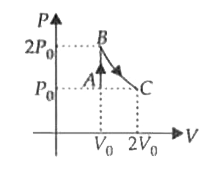 PROCESS `BC, Q_(BC) = Delta U_(BC) + W_(BC)` `rArr Q_(BC) = 0 + 2 P_(0)V_(0) log 2 = 1.4 P_(0)V_(0)` ` :. ` Total heat given to the GAS is , `Q_("net") = Q_(AB) + Q_(BC) = 3.9 P_(0)V_(0)` |
|
| 25. |
A point charge q is located at the centre of a thin ring of radius R withuniformly distributed charge "-q". Find the magnitude of the electric field strength vector at the point lying on the axis of the ring at a distance x from its centre if x gt gt R. |
|
Answer» Solution :Electric field at P due ring `E_(1)=(qx)/(4PI in_(0) (x^(2)+R^(2))^(3//2))` (towards centre) Electric field at P due to +q `E_(2)=(q)/(4pi in_(0)x^(2))` (away from centre) Thus net field at P is `E_("Net") =E_(1)+E_(2)` `=(q)/(4pi in_(0)) [(1)/(x^(2)) -(x)/((x^(2)+R^(2))^(3//2))]` For `x GT gt R` `E_("net")=(q[(x^(2)+R^(2))^(3//2)-x^(3)])/(4pi in_(0)x^(2)(x^(2)+R^(2))^(3//2))` `=(3qR^(2))/(4pi in_(0) 2x^(4))=(3qR^(2))/(8pi in_(0)x^(4))` (Using Binomial approximation). |
|
| 26. |
The electromagnetic wave used in the telecommunication are : |
|
Answer» ULTRA violet |
|
| 27. |
A substance of mass M kg requires on input power P J/s to remain in the molten state its melting point. When the power source is turned off the sample completely solidifies is |
|
Answer» `(2Pt)/M` |
|
| 28. |
What is the general definition of electric dipole moment? |
| Answer» Solution :The ELECTRIC dipole moment VECTOR lies along the LINE JOINING two charges and is directed from -q to +q. The SI unit of dipole moment is COULOMB meter (Cm).`vecp=qahati-qa(-hati)=2qahati` | |
| 29. |
Limitations of Huygen's principle is explained by..... |
|
Answer» HUYGEN's and Rayleigh |
|
| 30. |
Find the capacitance of the system shown in figure. |
|
Answer» `(25)/(24)(epsilon_0A)/d` |
|
| 31. |
In a single slit diffraction experiment first minimum for lambda_(1)=66nm coincides with first maxima for wavelength lambda_(2). Calculate lambda_(2). |
|
Answer» Solution :Position of minima in diffraction PATTERN is give by, `d sin theta = n lambda`. For first minima of `lambda_(1)`, we have `d sin theta_(1)= (1)lambda_(1)" or "sin theta_(1)= (lambda_1)/(d)"""……….."(i)` The first manima approximately LIES between first ans second minima. For wavelength `lambda_(2)` its position will be, `d sin theta_(2)= (3)/(2)lambda_(2)""therefore sin theta_(2)= (3 lambda_2)/(2d)"""..........."(ii)` The TWO will coincide if, `theta_(1)=theta_(2)" or "sin theta_(1)= sin theta_(2)` `therefore (lambda_1)/(d)= (3lambda_(2))/(2d)" or "lambda_(2)= (2)/(3)lambda_(1)= (2)/(3)xx 660 nm= 440nm`. |
|
| 32. |
An electron is accelerated through a potential difference of 1000 V and directed into space between two parallel plates separated by 2 cm with a potential difference of 100 V applied across them. If the electron enters perpendicular to the electric field between the polates, what magnetic field perpendicular to both the electron path and the electric field will be neccessary so that the electron may travel undeflected. Take e=1.6xx10^(-19) C and m=9xx10^(31)kg. |
|
Answer» |
|
| 33. |
Electric charge Q having mass M moves on a circular path of radius R with velocity vecv, perpendicular to uniform magnetic field B. When a particle completes one revolution, work done by the field is _______ |
|
Answer» QvBR |
|
| 34. |
A rod of 5m length is moving perpendicular to uniform magnetic field of intensity 2 xx 10^(-4)"Wb/m"^2. If the acceleration of rod is 2ms^(-2), th rate of increase of the induced emf is____ |
|
Answer» `20xx10^(-4) "V/sec"^2` Taking derivation w.r.t. t,`"dE"/"dt"=d/"dt"` (Bvl) B and L are constant `therefore (dE)/(dt)=B(DV)/(dt)l` `therefore (dE)/(dt)=Bal "" [because (dv)/(dt)=a]` `=2xx10^(-4)xx2xx5` `therefore (dE)/(dt)=20xx10^(-4)` V/s |
|
| 35. |
The carrier frequency is 500kHz. The modulating frequency is 15 kilohertz and the deviation frequency is 75 kilohertz. Find (a) modulation index (b) Number of side bands (c) Band width |
|
Answer» Solution :`MI=(DELTAF)/(f_(m))=5` We can have that there are `16` significant sidebands for a modulation index of `5`. 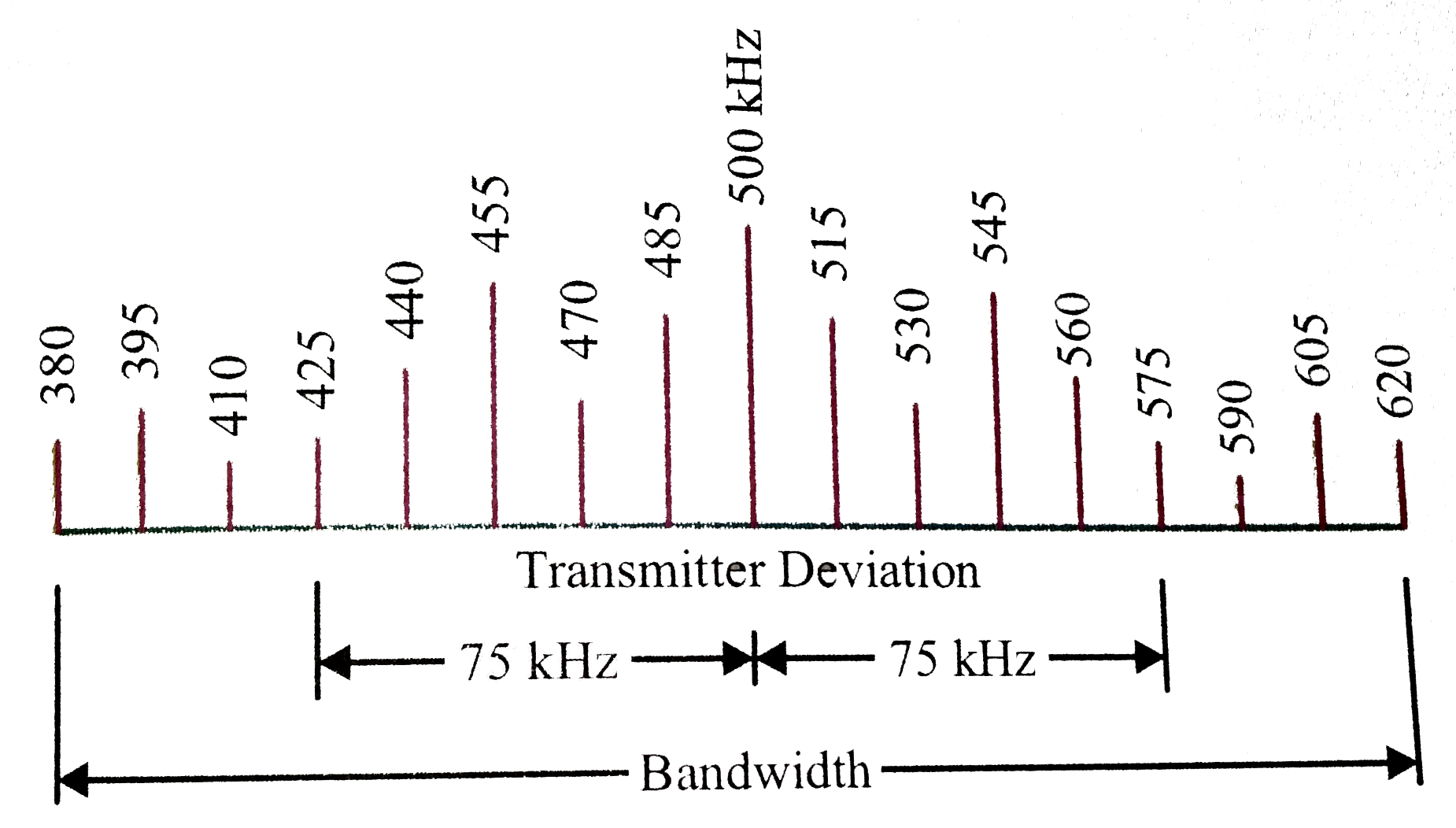 To determine total bandwidth for this case, we use: `bW=f_(m)xx(NUMBER of sidebands)` `bW=15xx16=240 kHz` |
|
| 36. |
Define relative permittivity of a medium. |
| Answer» SOLUTION :Relative PERMITTIVITY `(in_r) ` of a MEDIUM is defined as the RATIO of the permittiivity of given medium ` (in) ` to the permittivity of freespace `(in_0) , `Thus `in_r =(in)/(in_0) ` | |
| 37. |
Match the following List I with List II |
|
Answer» `{:(A,B,C,D),(I,II,III,IV):}` Water when chamges into steam, its volume increase . Melting point of ice decreases on increasing pressure. BOILING point of water increase with pressure. |
|
| 38. |
Coefficient of thermal expansion of a wire varies with temperature T asalpha = 1.6 xx 10^(-6) T, where T is temperature in degree Celsius. If the length of wire is 10 m at 0^@C, what is the change in length of wire (in mm), when its temperature is raised to 25^@C? |
|
Answer» `int_0^(Delta L) dl = l_0 alpha_0 int_0^25 TdT` `Delta l = l_0 alpha_0 xx 625/2 "" = 10 xx 1.6 xx 10^(-6) xx 625/2 = 5 xx 1000 xx 10^(-6) = 5 mm`. |
|
| 39. |
Using Huygens's principle, construct the wavefronts and the propegation directions of the ordinary and extraordinary rays in a positive uniaxial crystal whose optical axis (a) is perpendicualr to the incidence plane and parallel to the surfcae of the crystal, (b) lies in the incidence plane and is parallel to the surface of the crystal, (c ) lies in the incidence plane at an angle of 45^(@) to the surface of the crystal, and light falls at right angles to the optical axis. |
|
Answer» Solution :The wave surface of a unixial crystal consists of TWO sheets of which on eis a sphere while the other is an ellipsoid of revolution. The optic axis is the line joining the points of contact. To MAKES the appropriate Huyghen's construction we MUST drawthe relevent section of the wave surface inside the crystal and determine the direction of the ordinary and extraordianry rays. The result is as SHOWN in Fig. `(a, B& c)` of the answers 
|
|
| 40. |
Examine table 3 and express (a) energy required to break on bond in DNA in eV, (b) typical energy of a proton in a nucleus in eV, (c ) energy released in burning 1000 kg of coal in kilocalories. |
|
Answer» Solution :(a) Energy required to BREAK one bond of DNA `=(10^(-20)J)/(1.6xx10^(-19)Je//V)=0.06eV` (B) Typical energy of a proton in a nucleus `=(10^(-13)J)/(1.6xx10^(-19)J//eV)=625000eV` (c ) Energy released in buming 1000 kg of coal `=(3xx10^(10)J)/(4.2xx10^(3)"J/kcal")=7142857.14" kcal"` |
|
| 41. |
Find the dispersive power of flint glass if the refractive indices of flint for red, green and violet light are 1.613, 1.620 and 1.632 respectively. |
|
Answer» SOLUTION :GIVE: `n_(v) = 1.632 , n_(R) = 1.620` Equation for DISPERSIVE POWER is ,`omega=((n_(v)-n_(n)))/((n_(G)-1))` Substituting the values, `omega=(1.632-1.613)/(1.620-1)=(0.019)/(1.620)=0.0306` The dispresive power of flint glass is, `omega = 0.306` |
|
| 42. |
A circular current loop of magnetic moment M is in an arbitrary orientation in an external magnetic field vecB. The work done to rotate the loop by 30^(@) about an axis perpendicular to its plane is |
|
Answer» MB  Here ANGLE between `vecMandvecB` does not change and REMAIN same. `W=MBcos90^(@)` W = 0 Now if when angle between `vecBandvecM` be `theta=30^(@)`, then work done, `W=MBcos30^(@)` `thereforeW=sqrt3/2MB` |
|
| 43. |
A thermal neutron (with approximately zero kinetic energy) is absrobed by a ""^(238)U nucleus. How much energy is transferred from mass energy to the resulting oscillation of the nucleus? Here are some atomic masses and the neutron mass. ""^(237)U""237.048723u"" ""^(238)U""238.050782u ""^(239)U""239.054287u""""^(240)U""240.056585u n""1.008664u |
|
Answer» |
|
| 44. |
The binding energy per nucleus (_2He^4) is 1.1 MeV and 7 meV respectively. It two _2He^4, then energy released is : |
|
Answer» 13.9 MEV |
|
| 45. |
Two nuclei have their mass numbers in the ratio of 1:3. The ratio of their nuclear densities whould be |
| Answer» ANSWER :A | |
| 46. |
Consider two straight parallel conductors A and B separated by a distance x and carrying individual current I_(A)andI_(B) respectively. If the two conductors attract each other, it indicates that _____ . |
|
Answer» The two currents are parallel in DIRECTION |
|
| 47. |
Which of the following is polynomial? |
|
Answer» `x^2 -5x+4sqrt x +3` |
|
| 48. |
An uncharged capacitor C, Resistances R_(1)=R and R_(2)=2R, cells of emf epsilon_(1)=epsilonand epsilon_(2)=epsilon are connected as shown in the figure. Switch S is initially connected to terminal 1 for a long time and then it is connected to terminal 2 for an another long duration. IF H_(1), U_(1) are the heat energies lost through the resistor R_(1) and energy stored in the capacitor respectively at steady state, when the switch is connected to terminal 1 and H_(2), U_(2) are corresponding value when the switch is connected to terminal 2. Choose the correct statements(s). |
|
Answer» `U_(1)//U_(2)=1` `W_("cell")=DeltaH+U_(f)-U_(i)`, where `U_(f)=U_(i)` |
|
| 49. |
Inductors in parallel. Two inductors L_(1) and L_(2) are connected in parallel and separated by a large distance so that the magnetic field of one cannot affect the other. (a) Show that the equivalent inductance is given by 1/(L_(eq))=1/(L_(1))=1/(L_(2)) (Hint: Review the derivations for resistors in parallel and capacitors in parallel. Which is similar here?) (b) What is the generalization of (a) for N inductors in parallel? |
| Answer» Solution :(b) `1/(L_(EQ))=sum_(n=1)^(N)1/(L_(N))` | |
| 50. |
if -3 is one of the polynomial (k-1)x^2 +kx+1,find the value of k. |
|
Answer» `4/3` |
|