

Saved Bookmarks
This section includes 7 InterviewSolutions, each offering curated multiple-choice questions to sharpen your Current Affairs knowledge and support exam preparation. Choose a topic below to get started.
| 1. |
Give dimensional formula of electric potential. |
|
Answer» `M^(1) L^(-2)T^(-3) A^(-1)` `:. [V] = ([W])/([Q])=(M^(1)L^(2)T^(-2))/(A^(1)T^(1))=M^(1)L^(2)T^(-3)A^(-1)` |
|
| 2. |
Two coherent narrow slits emitting sound of wavelengthlambdain the same phase are placed parallel to each other at a small separation of2 lambda. The sound is detected by moving a detector on the screen at a distance D ( gt gt lambda) from the slit S_1 as shown in figure. Find the distance y such that the intensity at P is equal to intensity at O. |
|
Answer» Solution :LET `Deltax= LAMBDA` at ANGLE `theta` (see fig) Path DIFFERENCE between the waves is `Deltax = 2lambdacos theta` `:. 2lambda cos theta = lambda (Deltax =lambda) or theta = 60^@` Now, `PO = S_1O cot 30^@ or y = sqrt 3D` |
|
| 3. |
Two lenses of local lengths 0.20m and 0.30m are kept in contact. Find the focal length of the combination. Calculate power of two and combination. |
|
Answer» Solution :Here: `f_1=0.20m,f_2=0.30m,f=?, P_(1)=?,P_(2)=?,P=?` The effective focal length of the combination is `1/f=1/(f_(1) ) + 1/(f_2)` `= (1)/(0.20) + 1/(0.30)` f = 0.12 m POWER of LENS is P = 1/f `P_(1) = 1/f_(1) = 1/(0.20) = 5D` `P_(2) = 1/f_(2) = 1/(0.30) = 3.333D` `P = 1/f = 1/(0.12) = 8.333 D` `P = P_(1) +P_2` `= 5 + 3.333` `= 8.333` D |
|
| 4. |
A coil of 50 turns is pulled in 0.02 s fron between the poles of a magnet, where its are: includes magnetic flux of 31 xx 10^(-6) Wb to the place, where its area includes 1 xx 10^(-6) Wb. The average emf is ____ |
|
Answer» `7.5xx10^(-2)`V `=-N[(phi_2-phi_1)/(Deltat)]` `=-50[(1xx10^(-6)-31xx10^(-6))/0.02]` `=+(50xx30xx10^(-6))/(2xx10^(-2))` `therefore epsilon=7.5xx10^(-2)` V |
|
| 5. |
In Fig.25-25 a potentila difference V=100V is applied across a capacitor arragnement with capacitances C_1=10.0 mu F, C_2=5.00 muF and C_3=2.00 mu F What are (a) charge q_3, (B) potential difference V_3 and (c ) stored energy U_3 for capacitor 3 (d) q_1 (v) v_1 and (f) U_2 for capacitor 1, and (g) q_3 (h) V_2 and (i) U_2 for capacitor 2? |
| Answer» Solution :`a)2.00 times 10^-4 b) 100V C) 1.00 times 10^-2 J d)3.33 times 10^-4 C E)33.3V F)5.55 times 10^-3 J g)3.33 times 10^-4 C H) 66.7 V i) 1.11 times 10^-2 J` | |
| 6. |
A system has two charges q_A = 2.5 xx 10^(-7)C and q_(B)= - 2.5 xx 10^(-7)C located at points A:(0, 0, -15 cm) and B : (0, 0, + 15 cm), respectively. What are the total charge and electric dipole moment of the system ? |
|
Answer» SOLUTION :Total charge of given SYSTEM. `q_(A) + q_(B) = -2.5 XX 10^(-7) + 2.5 xx 10^(-7) =0` Electric dipole moment of given dipole, `vecp = (2veca)Q ={vecr_(+) - vecr_(-)}.q` `=(vecr_(A) - vecr_(B))q` `=(0,0, -0.15) - (0,0,0.15) (2.5 xx 10^(-7))` `therefore vecp = (0,0, -0.3) (2.5 xx 10^(-7))` `therefore p = 7.5 xx 10^(-8) Cm` (Along -Z axis) |
|
| 7. |
A 3.00 M Omega resistor and a 1.00 muF capacitor are connected in series with an ideal battery of emf epsi= 4.00 V.At 6.00 s after the connection is made, what is the rate at which (a) the charge of the capacitor is increasing, (b) energy is being stored in the capacitor, (c) thermal energy is appearing in the resistor, and (d) energy is being delivered by the battery? |
|
Answer» |
|
| 9. |
The self inductance of the motor of an electric fan is 10H. In order to impart maximum power at 50Hz, it should be connected to acapacitance of (Usepi^2=10): |
| Answer» ANSWER :A | |
| 10. |
A body of rest mass m_0 collides perfectly inelastically at a speed of 0.8c with anotherbody of equal rest mass kept at rest . Calculate the common speed of the bodies after the collision and the rest mass of the combined body . |
|
Answer» Solution :The linear momentum of the first body `= m_0 v / (SQRT 1 - v ^(2) / c^(2)) =m_0 XX 0.8c / 0.6 ` ` = 4 / 3 m_0c.`This should be the total linear momentum after the collision. If therest mass of the combined body is `M_0` and it moves at speed v' `M_0 v' / (sqrt 1 - v'^(2) / c^(2)) = 4 / 3 m_0 c` The ENERGY before the collison is `m_0 / (sqrt 1 -v '^(2) / c^(2)) c^(2) + m_0 c^(2) = m_0 C^(2) (1 / 0.6 +1)`The linear momentum of the first body `= m_0 v / (sqrt 1 - v ^(2) / c^(2)) =m_0 xx 0.8c / 0.6 ` ` = 4 / 3 m_0c.`This should be the total linear momentum after the collision. If therest mass of the combined body is `M_0` and it moves at speed v' `M_0 v' / (sqrt 1 - v'^(2) / c^(2)) = 4 / 3 m_0 c` The energy before the collison is `m_0 / (sqrt 1 -v '^(2) / c^(2)) c^(2) + m_0 c^(2) = m_0 c^(2) = m_0 c_^(2) (1 / 0.6 +1) ` The linear momentum of the first body `= m_0 v / (sqrt 1 - v ^(2) / c^(2)) =m_0 xx 0.8c / 0.6 ` ` = 4 / 3 m_0c.`This should be the total linear momentum after the collision. If therest mass of the combined body is `M_0` and it moves at speed v' `M_0 v' / (sqrt 1 - v'^(2) / c^(2)) = 4 / 3 m_0 c` The energy before the collison is `m_0 / (sqrt 1 -v '^(2) / c^(2)) c^(2) + m_0 c^(2) = m_0 C^(2) (1 / 0.6 +1)` The linear momentum of the first body `= m_0 v / (sqrt 1 - v ^(2) / c^(2)) =m_0 xx 0.8c / 0.6 ` ` = 4 / 3 m_0c.`This should be the total linear momentum after the collision. If therest mass of the combined body is `M_0` and it moves at speed v' `M_0 v' / (sqrt 1 - v'^(2) / c^(2)) = 4 / 3 m_0 c` The energy before the collison is `m_0 / (sqrt 1 -v '^(2) / c^(2)) c^(2) + m_0 c^(2) = m_0 C^(2) (1 / 0.6 +1)` `= 8/ 3 m_0c^(2). The linear momentum of the first body `= m_0 v / (sqrt 1 - v ^(2) / c^(2)) =m_0 xx 0.8c / 0.6 ` ` = 4 / 3 m_0c.`This should be the total linear momentum after the collision. If therest mass of the combined body is `M_0` and it moves at speed v' `M_0 v' / (sqrt 1 - v'^(2) / c^(2)) = 4 / 3 m_0 c` The energy before the collison is `m_0 / (sqrt 1 -v '^(2) / c^(2)) c^(2) + m_0 c^(2) = m_0 C^(2) (1 / 0.6 +1)` `= 8/ 3 m_0 c^(2)` The energy after collision is `M_0 c^(2) / (sqrt 1 - v'^(2) / c^(2) )` Thus , `M_0 c^(2) / (sqrt 1 - v'^(2) / c^(2)) = 8 /3 m_0c^(2)` Dividing (i) by (ii) , `v' /c^(2) = 1 / 2c or, v' = c / 2 .` Putting this value of v' in (ii) `M_0 = 8/3m_0 (sqrt 1 - 1/ 4)` or, `M_0 = 2.309 m_0` The rest mass of the combined body is greater than the sum of the restmasses of the individual bodies |
|
| 11. |
In young's double slit experiment the fringe width is 4mm. If the experiment is shifted to water of refractive index 4/3 the fringe width becomes (in mm) |
|
Answer» 3 |
|
| 12. |
Two charges 4 xx 10^(-9)C and -16 xx 10^(-9)C are separated by a distance 20cm in air. The position of the neutral point from the small charge is |
|
Answer» 40/3 cm |
|
| 13. |
If in the above problem the mirror is convex of focal length 20 cm the distance of image |
|
Answer» 10 cm |
|
| 14. |
If lamda_(m) denotes the wavelength at which the radiative emission from a black body at a temperature TK is maximum, then : |
|
Answer» `lamda_(m)propT` `lamda_(m)T=brArrlamda_(m)=b/T"or"lamda_(m)propT^(-1)`. Correct choice is (c ). |
|
| 15. |
A block of steel of size 5 cm x 5 cm x 5 cm is weighed in water. If the relative density of steel is 7, its apparent weight is: |
|
Answer» `6 xx 5 xx 5 xx 5` g `=vp_(5)g-vp_(w)g` `=(Vp_(s)-vp_(w))g` `=[5xx5xx5xx7-5xx5xx5xx1]g` `=5xx5xx5xx6g` Hence CORRECT choice is (a). |
|
| 16. |
A ball is dropped on the floor from a height of 10m. It rebounds to a height of 2.5 m. If the ball is in contact with the floor for 0.01 seconds, What is the average acceleration during contact. |
|
Answer» SOLUTION :`v_1=sqrt2gh=sqrt(2xx10xx10)=sqrt200` `v_2=-sqrt(2xx10xx2.5) =-sqrt50` ACCELERATION `(DELTAV)/(DELTAT) = (v_1-v_2)/(Deltat)=(sqrt200+sqrt50)/0.01 = 2100 m/s^2` |
|
| 17. |
Two particles of mass m_(1) and m_(2), approach each other due to their mutual gravitational attraction only. Then |
|
Answer» acceleration of both the particles are equal. `F=(Gm_(1)m_(2))/(r^(2))`  Acceleration of particle of mass `m_(1)a_(1)(F)/(m_(1))=(Gm_(2))/(r_(2))` `:. a_(1) PROP m_(2)`. |
|
| 18. |
A p-n diode is used in a half wave rectifier with a load resistance of 1000 Omega.If the forward resistance (r_(f)) of diode is 10Omega calculate the efficiency of this half wave rectifier. |
|
Answer» Solution :LOAD resistance `R_(L)= 1000Omega,` Forward resistance of the DIODE` =r_(f) = 10Omega` Efficiency of half WAVE rectifier `[(0.406R_(L))/(r_(f)+R_(L))]=(0.406xx1000)/(1010)=0.4019.` The PERCENTAGE efficiency of the half wave rectifier `eta=40.19%` |
|
| 19. |
Assertion (A): Two equipotential surfaces can never intersect. Reason (R) : Potential at all points of an equipotentialsurface is uniform. |
|
Answer» If both assertion and reason are true and the reason is the correct explanation of the assertion. |
|
| 20. |
Suppose you want to cool 0.25 kg of cola (mostly water ),at 25"^(@)C by adding ice initially at -20"^(@)C How much ice should you add so that the final temperature will be 0"^(@)C with all the ice melt? Neglectthe heat capacity of the container of the container Specific heat of ice isheat of cola [4160 j/kgK] |
|
Answer» Solution :HEAT lost by cola is ``(Q_cola=m_cola s_colaDeltaT_cola)`` `=(0.25 kg)(4160 J//kg K)(25"^(@)C-0"^(@)C)` `Q_1=m_ice S_ice DeltaT_ice` `=m_ice (2000J kg^(-1) k^-1)(0"^(@)C-(-20"^(@)C)` `m_ice (4.0xx10^(4)J kg^(-1))` The heat needed to melt this mass of ice is `Q_2=m_ice L_1=m_ice (3.34xx10^5J Kg^(-1))` Total energy gained by ice is `Q_1+Q_2=m_ice(3.74xx10^5J Kg^(-1)` Using heat lost =Heat gained we GET 26000 J =`m_ice(3.74xx10^5 jKg^-1)` or `m_ice =0.07 kg =70 g` |
|
| 21. |
A stone dropped from a cliff hits the ground in 4 sec. Height of the cliff is |
|
Answer» 39.2 m |
|
| 22. |
A charge q_0 is moved from a point A above a dipole of dipole moment p to a point B below the dipole at equatorial plane without acceleration. Find the work done in the process. |
| Answer» Solution :Work done is ZERO because potential due to dipole is zero at POINT A as well as point B. | |
| 23. |
An ac source producing V=V_0 sin omegat + V_0 sin 2omega t is connected in series with a box containing either capacitor or inductor and resistance. The current found in the circuit is I=I_1 sin (omegat +phi_1)+ I_2sin (2omegat + phi_2) . Here, phi_1 and phi_2 may be positive or negative. |
|
Answer» If `I_1 GT I_2`,BOX has inductor and RESISTOR |
|
| 24. |
At 0 Ksilicon behaves as a super conductor. |
| Answer» Solution :False - At 0 K TEMPERATURE silicon behaves as a PERFECT INSULATOR. | |
| 25. |
Solubility of gas ………………. with increase in temperature |
|
Answer» INCREASE |
|
| 26. |
If displacement x= t^(4) , then the ratio of acceleration and velocity of motion will be |
|
Answer» `(3)/(t)` `:. ` VELOCITY = `(DX)/(DT) = 4t^(3)`, Acceleration = `(d^(2))/(dt^(2))=12t^(2)` `:. ("Acceleration ")/("Velocity ") = (12t^(2))/(4t^(3)) = (3)/(t)` |
|
| 27. |
In moving coil galvanometer, the coil is wound over the………………..frame in order to make the galvanometer……………. . |
|
Answer» |
|
| 28. |
The x-component of the resultant of several vectors a) is equal to the sum of the x-components of the vectors b) may be smaller than the sum of the magnitudes of the vectors c) may be greater than the sum of the magnitudes of the vectors d) may be equal to the sum of the magnitudes of the vectors |
|
Answer» only a |
|
| 29. |
A stationary hydrogen atom undrgoes a transition from n=5 to n=4. Recoil speed of the atom is (R=Rydberg constant, h=Planck's constant and m=mass of the proton.) |
|
Answer» `(Rh)/(m)` MOMENTUM of PHOTON,`p=h/(lambda)=hR(1/16-1/25)` and RECOIL speed, `v=p/m=(hR(1/16-1/25))/(m)=(9hR)/(400m)` |
|
| 30. |
(a) Two thin lenses are placed coaxially in contact. Obtain the expression for the facal lengths of the lenses. (b) A converging of refractive index 1.5 has power of 10 D. When it is completely immersed . In a liquid , it behaves as a diverging lens of focal length 50 cm. Find the refractive index of the liquid. |
|
Answer» Solution :(a) Consider two thin lenes A and B of focal lengths `f_1 and f_2` placed in contact. Let a point object be placed at O, beyond the focus of first lens. A Lens A forms a real image at `I_1`. This imagge serves as VIRTUAL object for second lens B and the final real image is formed at I. For image `I_1` formed by first lens, we have `1/(v_1)-1/u=1/(f_1) ""...(1)` and for the image I formed by the second lens , we have `1/v-1/v_1=1/(f_2)""...(ii)` Adding (i) and (ii) ,we have `1/v-1/u=(1)/f_1+1/(f_2)""...(iii)` If the two lens system is considered as EQUIVALENT to a single lens of focallength f , then `1/v-1/u=1/f""...(iv)` Comparing (iii) and (iv), we find that `1/f=1/f_1+1/f_2` (b) Here refractive index of lens n = 1.5 , its power in air = P = +10 D, hence its focal LENGTH in air `f=1/p=1/10=10 cm` . when immersed in liquid of refracting index, `n_l` the lens BEHAVES as a diverging lens length 50 cm , i.e. `f_e = - 50 cm`. As per lens formula `1/f=(n-1)(1/R_(1) - 1/R_(2))`, we have `1/10 = (1.5 -1) (1/R_1-1/R_2)""` ...(1) , and `1/(-50)=((1.5)/n_l-1)(1/R_(1)-1/R_2)""` ...(2) Dividing (i) by (ii) , we get `-5=(0.5)/(((1.5)/n_l-1))` `implies ((1.5)/n_l-1)=-(0.5)/5=-0.1` `implies (1.5)/n_l=1-0.1=0.9` `implies n_(1)=(1.5)/(0.9)=1.67` 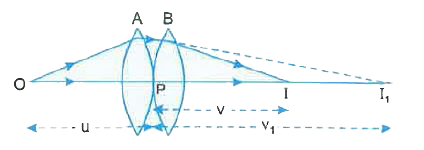
|
|
| 31. |
Two waves of nearly same omplitode. same frequency travelling with same velocity are superimposing to give phenomenon of interference. If a_1 and a_2 be their respective amplitudes, omegato be frequency for both, Deltaphibe the velocity for both and Delta_(0)is the phase difference between the two waves then, |
|
Answer» the RESULTANT intensity varies periodically with time and distance. |
|
| 32. |
A galvanometer has a current sensitivity of 1mA per division. A variable shunt is connected across the galvanometer and the combination is put in series with a resistance of 500Omega and cell of internal resistance 0.5 Omega. It gives a deflection of 5 division for shunt of 5 ohm and 20 division for shunt of 25 ohm. Find the emf of cell and resistance of galvanometer. |
|
Answer» 50V, 100`OMEGA` |
|
| 33. |
निम्नलिखित में से कौन सा कथन सत्य है? |
|
Answer» `{3,5}VAREPSILON{1,3,5}` |
|
| 34. |
What happens when the pollution goes up? |
|
Answer» QUALITY OF LIFE ERODE |
|
| 35. |
The paths of electrons between successive collisions (with the positive ions of the metal) in the absence of electric field are .........and in the presence of electric field the paths are..... |
|
Answer» STRAIGHT LINES, CURVED. |
|
| 36. |
Assume that light of wavelength 6000 dotA is coming from a star. What is the limit of resolution of a telescope whose objective has a diameter of 100 inch? |
|
Answer» Solution :A 100 INCH telescope implies that `= 100 "inch"= 254 cm.` Thus if, `lambda approx 6000 dotA= 6xx 10^(-5)cm` then, `TRIANGLE theta = (1.22 lambda)/(a) approx 2.9xx 10^(-7)` radians. |
|
| 37. |
A positive point charge, which is free to move , is placed inside a hollow conducting sphere with negative charge, away from its centre . It will. |
|
Answer» MOVE towardsthe CENTRE |
|
| 38. |
from the relation R=R_0A^(1//3), where R_0 is a constant and A is the mass number of a nucleus, show that the nuclear matter density is nearly constant (i.e., independent of A ). |
|
Answer» SOLUTION :Nuclear MATTER density =`("Mass of nucleus")/("Volume of nucleus")` `=(mA)/(4/3piR^3) =(mA)/(4/3 piR_0^3A)` `=m/(4/3piR_0^3)=2.3 xx 10^(17) kg //m^3` = constant |
|
| 39. |
A transistor has alpha=0.95.If the emitter curent is 10 mA,What is (a) the collector current ,(b)the base current and ( c)gainbeta? |
|
Answer» Solution :Here,`ALPHA=0.95,I_E=10mA` (a)`alpha=(I_C)/(I_E)=gtI_C=alphaI_E=0.95xx10=9.5mA` (B)`I_B=I_E-I_C=10-9.5=0.5mA` ( C) `BETA=(alpha)/(1-alpha)=(0.95)/(1-0.95)=(0.95)/(0.05)=19` |
|
| 40. |
The distance travelled by a particle in n^(th) second is S_(n) = u+(a)/(2) (2n-1) where u is the velocity and a is the acceleration. The equation is |
|
Answer» dimensionally TRUE |
|
| 41. |
A thin uniform circular disc of mass M and radius R is rotating in a horizontal plane about an axis passing through its centre and perpendicular to its plane with an angular velocity omega. Another disc of same thickness and radius but mass 1/8M is placed gently on the first disc co-axially. The angular velocity of the system is now |
|
Answer» `8/9 OMEGA` |
|
| 42. |
A body is projected at an angle theta so that its range is maximum. If T is the time of flight then the value of maximum range is (acceleration due to gravity= g) |
|
Answer» `(G^2T)/(2)` |
|
| 43. |
The following four insulating spheres contain magnet, dipole, proton and neutron. Pick the odd one out of the following based on the net flux. |
|
Answer» |
|
| 44. |
How does a fire alarm work? |
| Answer» Solution :In fire alarm, a NUMBER of photocells are installed at suitable places in a BUILDING. In the EVENT of BREAKING out of fire, light radiation and IR light fall upon photocell, MAKING an electric bell or siren to ring. | |
| 45. |
Meiosis does not occur in |
|
Answer» ASEXUALLY REPRODUCING DIPLOID individuals |
|
| 46. |
A diode is called as a unidirectional device.Explain. |
| Answer» Solution :Diode is called as a unidirectional device i.e current flows inonly one direction (ANODE to cathode internally) when a forward voltage is applied the diode conducts and when reverse voltage is applied, theres is no CONDUCTION. A mechanical ANALOGY is a RAT CHAT , which allows motion in one direction only. | |
| 47. |
n a rocket, the mass of the fuel is 90% of the total mass. The rocket is blasted from the launching pad. If the exhaust gases are ejected at a speed of 1000 S^(-1) what is the maximum speed attained by the rocket? (Neglect the effects of gravity and air resistance). |
|
Answer» `2.3 km//s` Since fuel is 90% of total mass :.mass of container, `m_(c) = m_(0) -(90)/(100)m_(0)` `m_(c)=(1)/(10)m_(0)` `:.(m_(0))/(m_(c))=10` Now burnt out speed `upsilon_(B)=ulog_(e)(m_(0))/(m_(c))=2.303u log_(10)10` `=2.303xx1000xx1=2303m//s=2.3 kms^(-1)` Hence correct choice is (a) |
|
| 48. |
When arsenic is added as an impurity to silicon, the resulting material is |
|
Answer» n-type conductor |
|
| 49. |
The equation of state for n moles of an ideal gas is PV=nRT, where R is a constant. The SI unit for R is |
|
Answer» `JK^(-1)` PER molecule implies `R=(PV)/(nT)=("Pressure"xx"volume")/("no. of MOLES"xx"temperature")` `=(Pam^(3))/(molK)=(Nm^(-2)m^(3))/(molK)=(Nm)/(molK)=Jmol^(-1)K^(-1)` The S.I. UNIT of R is J `mol^(-1)K^(-1)`. |
|
| 50. |
Whichof the following statements is correct ? |
|
Answer» If the centre of mass is at rest , then the net WORK done dy all the forces ACTING on the system is ZERO |
|