

Saved Bookmarks
This section includes InterviewSolutions, each offering curated multiple-choice questions to sharpen your knowledge and support exam preparation. Choose a topic below to get started.
| 5551. |
निम्न मे असत्य कथन है - |
|
Answer» `SIN theta=-1/5` |
|
| 5552. |
A parallel stream of monoenergetic electrons falls normally on a diaphragm with narrow square slit of width b=1.0 mu m. Find the velocity of the electrons if the width of the central diffraction maximum formed on a screen located at a distance l= 50cm from the slit is equal to Delta x= 0.36mm. |
|
Answer» SOLUTION :The first MINIMUM in a Fraunhofer diffraction is given by (`B` is the width of the slit) `b sin theta= lambda` Here `sin theta=(Deltax//2)/(sqrtl^(2)+((Deltax)/(2))^(2))~~(Deltax)/(2l)` Thus `lambda=(bDeltax)/(2l)=(2pi ħ)/(mv)` so `V=(4pi ħl)/(mbDeltax)=2.02xx10^(6)m//s` |
|
| 5553. |
Consider a region inside which there are various types of charges but the total charge is zero. At points outside the region |
|
Answer» the electric field is necessarily zero. Hence, electric field at point at large distance routside this area varies according to `prop 1/r^(3)`. Also, electric field is conservative. Work done by charge moving in closed loop away from this area is zero. |
|
| 5554. |
A metallic surface with work function of 2 eV , on heating to a temperature of 800 K gives an emission current of 1 mA . If another metallic surface having the same surface area, same emission constant but work function 4 eV is heated to a temperature of 1600 K, then the emission current will be |
|
Answer» 1 mA |
|
| 5555. |
Does the principle of conservation of energy hold for interference and diffraction phenomena ? Explain briefly. |
|
Answer» Solution :Yes, law of conservation energy is obeyed. In CASE of constructive interference, intensity BECOMES maximum. Hence bright fringes are formed on the screen where as in the case of destructive interference, intensity becomes minimum. Hence dark fringes are formed on the screen. This establishes that in the interference and DIFFRACTION pattern, the intensity of light is SIMPLY being redistributed i.e., energy is being transferred from dark fringe to bright fringe. No energy is being created (or) destroyed in the process. Hence energy is redistributed. THUS the principle of conservation of energy is being obeyed in the process of interference and diffraction. |
|
| 5556. |
What is the maximum number of spectral lines emitted by a hydrogen atom when it is in the third excited state ? |
| Answer» Solution :Third excited state in hydrogen atom corresponds to N=4. HENCE maximum number of spectral lines, which can be EMITTED, is =`(n(n-1))/(2) = (4(4-1))/(2) = 6` | |
| 5557. |
A car is traveling in a straight line along a highway at a speed of 20 m//s. The driver steps on the gas pedal, and 3 seconds later, the car's speed is 32 m//s. Find its average acceleration. |
| Answer» Solution :Assuming that the DIRECTION of the velocity doesn't change, its's simply a matter of dividing the change in velocity `(32 m//s- 20 m//s= 12 m//s)` by the time INTERVAL during which the change OCCURRED : `overline(a)= Delta v // Delta t = (12 m//s) // (3 s)= 4 m//s^(2)`. | |
| 5558. |
A current of i ampere flows along the inner conductor of a co-axial cable and returns through the outer conductor of the cable .If r_1 and r_2 are inner and outer radii of the cable, then the magnetic induction at a distance x meter form the cable will be : |
|
Answer» `(mu_@i)/(2R)` |
|
| 5559. |
Out of the following graphs, which graph shows the correct relation (graphical representation) for LC parallel resonant circuit? |
|
Answer»
|
|
| 5560. |
The digital signal for the OR gate with two inputs is shown in the figure. Sketchthe output waveform obtained from OR gate. |
Answer» SOLUTION :
|
|
| 5561. |
A spherical rain drop, falling in a constant gravitational field, grows by absorption of moisture from the surroundings at a rate proportional to its surface area. If it starts with zero radius, find its acceleration. |
|
Answer» SOLUTION :`(dm)/(dt) = K.4pir^(2)` Where K is a constant and .r. is the radius of the DROP at any instant . But ` m=(4)/(m) PIR^(3) RHO=(4)/(3) pi r^(3)` since ` rho`= density of water is 1 gram/c.c `(dm)/(dt) =(4)/(3) pi. 3R^(2) (dr)/(dt) = 4pir^(2) (dr)/(dt) = K. 4 pir^(3)"":. K=(dr)/(dt)` `:. ` r=Kt ( since it starts with zero radius ) Since ` m(dv)/(dt) + v(dm)/(dt) = mg ` `(4)/(3) pir^(3) (dv)/(dt) + v.k 4pir^(2)=(4)/(3) pir^(2) g , (dv)/(dt) + vK(3)/(r) =g ` But `(dv)/(dt) =a , v = at ` `:. a + at. K. (3)/(Kt) =g ` becomes `4a=g,a =` acceleration of drop =g/4 |
|
| 5562. |
In double slit experiment using light of wavelength 600 nm, the angular width of a fringe formed on a distance screen is 0.1^(@). What is the spacing between the two slits? |
|
Answer» Solution :` d sin THETA = n lamda` `d =(n lamda)/( sin theta)=( 1xx600xx10^(-9))/(sin(0.1)^(@))=(6XX10^(-7))/0.0017=3.5xx10^(-4)m` |
|
| 5563. |
Do all the electrons that absorb a photon come out as photoelectrons ? |
| Answer» SOLUTION :No, most electrons GET SCATTERED into the metal. Only a few come out of the surface of the metal. | |
| 5564. |
In a vernier callipers, one main scale division is x cm and n divisions of the vernier scale coincide with (n-1) divisions of the main scale. The least count (in cm) of the callipers is :- |
|
Answer» <P>`(p)/(Q)(p-1)` |
|
| 5565. |
(A): Unlike electrostatic field the lines of induced field from closed loop. (R): Electrostatic field is conservative unlike induced fields. |
|
Answer» Both A and R are true and R is the correct EXPLANATION |
|
| 5566. |
Kinetic energy remaining the same, which of the two have greater de-Broglie wavelength proton or electron ? Explain. |
|
Answer» Solution :For photon `K.E., E_(p) =1/2m_(p).v_(p)^(2)` so `m_(p)v_(p) =SQRT(2m_(p)E)`…..(i) For electron K.E. `E_(e) =1/2m_(e)v_(e)^(2)`, So `m_(e)v_(e)=sqrt(2m_(e)E)`……(II) So the ratio of de-Broglie wavelength of protons and ELECTRONS is `lambda_(p)/lambda_(e) =h/(m_(p)v_(p)) xx (m_(e) v_(e))/h = (m_(e) v_(e))/(m_(p)v_(p))` Using EQ. (i) & (ii), we get `lambda_(p)/lambda_(e) =sqrt((2m_(e)E)/(2m_(p)E)) = sqrt(m_(e)/m_(p)) lt 1` `lambda_(p) lt lambda_(e)` or `lambda_(e) gt lambda_(p)` .e. de-Broglie wavelength associated with electron is more than that of proton. |
|
| 5567. |
What is the function of a photodiode? |
| Answer» SOLUTION :A photodiode is USED for DETECTING optical SIGNALS. | |
| 5568. |
Two coherent monochromatic light beams of intensities I and 41 are superposed. The maximum and minimum possible intensities in the resulting beam are |
|
Answer» 5I and I `I_(max) = (sqrt(I_(1))-sqrt(I_(2)))^(2)=(sqrt(4I)-sqrt(I))^(2)=I` |
|
| 5569. |
A rectangular loop of area 20xx30cm is placed in a magnetic field of 0.3T with its plane (i) normal to the field (ii) inclined 30^(@) to the field and (iii) parallel to the field. Find the flux linked with the coil in each case. |
|
Answer» Solution :Given : `A=20cmxx30cm` B = 0.3T Let `theta` be the angle made by the field B with the normal to the PLANE of the coil. i. Here, `theta=90^(@)-90^(@)=0^(2)` So,flux `phi=BAcostheta` `=0.3xx6xx10^(-2)xxcos0^(@)` `e=1.8xx10^(-2)Wb` II. Here, `theta=90^(@)-30^(@)=60^(@)` `phi=0.3xx6xx10^(-2)xxcos60^(@)` `phi=0.9xx10^(-2)Wb` iii. Here, `theta=90^(@)-0^(@)=90^(@)` `phi=0.3xx6xx10^(-2)xxcos90^(@)` `phi=0^(@)` |
|
| 5570. |
The time period of revolution of a satellite is T. The kinetic energy of the satellite is proportional to: |
|
Answer» `T^(-2//3)` ALSO `T^(2)prop r^(3) rArr r prop T^(2//3)`. `THEREFORE E_(k) prop T^(-2//3)` So the CORRECT choice is (a). |
|
| 5571. |
Figure shows two circuits each having a galvanometer and a battery of 3 V. When the galvanometer in each arrangement do not show any deflection, find the ratio ofR_1/R_2 |
|
Answer» SOLUTION :Circuit (a) and (b) both show balanced Wheatstone.s BRIDGE. Hence, we have `(4)/(R_1) = 6/9 RARR R_1 = 6Omega " and " 6/12 = (R_2)/(8) rArr R_2 = 4Omega` ` THEREFORE R_1/R_2 = 6/4 = 3/2 rArr R_1 : R_2 = 3:2` |
|
| 5572. |
If action force acting on a body is gravitational in nature, the reaction force |
|
Answer» may be a CONTACT force |
|
| 5573. |
A non-relativistic protons beampasses withoutdiviationthroughthe regionof space wherethere are unifrom transverse mutuallyperpendicularelectricand magneticfieldswith E = 120 kV//m and B = 50 mT. Then the beam strikes a groundedtarget. Findthe force withwhichthe beam acts on the targetif the beam currentis equal to I = 0.80mA. |
|
Answer» Solution :In crossed field, `eE = evB`, so `v =(E)/(B)` Then `F`, force externed on the PLANE `= (1)/(e) XX m (E)/(B) = (m I E)/(EB)` |
|
| 5574. |
The coefficient of linear expansion of a rod of length 1 m, at 27^@C, is varying with temperature as alpha = 2/T unit (300 K leT le600 K), where T is the temperature of rod in Kelvin. The increment in the length of rod if its temperature increases from 27^@C to 327^@C is |
|
Answer» 0.3 m |
|
| 5575. |
In a common base amplifier, the phase difference between the input signal voltage and output voltage is |
|
Answer» ZERO |
|
| 5576. |
Eddy current do not cause…….. |
|
Answer» damping |
|
| 5577. |
The mutual inductance between two coil is 2.5 H. If the current in one coil is changed at the rate 2.0 As^(-1) , what will be theemf induced in the other coil? |
|
Answer» |
|
| 5578. |
In the circuit shown in the given figure, the resistances R_(1) and R_(2) are respectively |
|
Answer» `14Omega and 40Omega` Current in `R_(2)=0.5A` `THEREFORE R_(2)=(20V)/(0.5A)=40Omega=40Omega` Potential difference across `R_(1)=69V-20V=49V` Current in `R_(1)=0.5A+(20)/(10)+1A=3.5A` `therefore R_(1)=(49)/(3.5)=14Omega` |
|
| 5579. |
A vessel contains 1 mole of O_(2) gas (molar mass 32) at a temperature T. The preesure of thegas is p. An identical vessel containing one mole of He gas (molar mass 4) at temperatuer 2T has a pressure of |
| Answer» Answer :C | |
| 5580. |
Assertion: Uniform electric and magnetic field are applied along Y-axis andZ-axis respectively. Kinetic energy of particle released at rest from origin depends only on the y-coordinate of particle. Reason: Work done by the magnetic force is zero. Kinetic energy gained by the particle is only due to electric force |
|
Answer» If both ASSERTION and REASON are CORRECT and reason is correct EXPLANATION of the assertion |
|
| 5581. |
Aconductor AB carries a current i in a magnetic field vec(E) . If vec(AB) = vec(r)andthe force on the conductor is vec(F) |
|
Answer» `VEC(F)` does not DEPEND on the SHAPE of AB |
|
| 5582. |
In a wave motion y = a sin(kx – wt), y can represent |
|
Answer» ELECTRIC field |
|
| 5583. |
What unintended effect did the decades of oppression and brutality had? |
|
Answer» CREATED MEN of EXTRAORDINARY courage, wisdom and generosity |
|
| 5584. |
When a ray of light enters a glass slab from from air |
|
Answer» its WAVELENGTH increases |
|
| 5585. |
The value of the following limit lim_(ntooo) n(n+1)(ln(1+(1)/(n))-sin((1)/(n+1)))si- |
| Answer» Answer :A | |
| 5586. |
A nuclear reactor delivers a power of 10 W. Find fuel consumed by the reactor per hour, if its efficiency is 20%. (Given, c = 3 xx10^(8)ms^(-1)) |
|
Answer» `2xx10^(-6)gh^(-1)` |
|
| 5587. |
In the given figure, R = 3Omega. Determine equivalent resistance between points A and B. . |
|
Answer» `3 Omega` 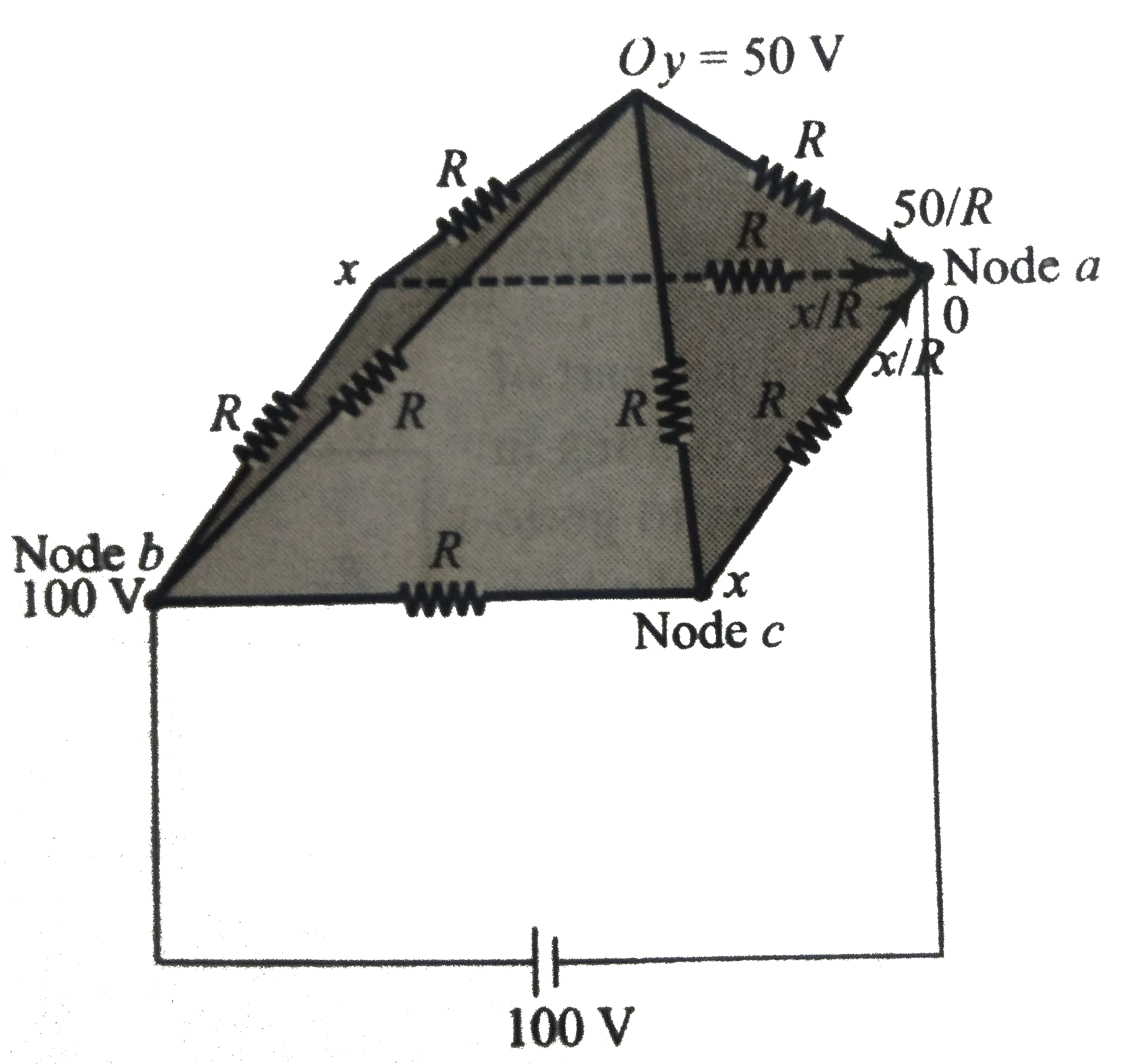 Step 2: By SYMMETRY `100 - y = y -0 or y = 50V` Step 3: Now apply KCL at node c `(x-100)/R + (x+50)/R + (x-0)/R = 0 ` ` or x = 50 V` Step 4: If `R_(eq)` is equivalent RESISTANCE of this circuit, we have `100/R_(eq) = x/R + 50/R + 50/12 or R_(eq) 2/3 R` Alternative method Making 2D projection There is perpendicular axis of symmetry, i.e., the points COP will be equipotential then the circuit will be , (##BMS_V03_CA2_E01_107_S03.png) rArr 2/3 R` . rArr 2/3 R` .
|
|
| 5588. |
A bar magnet having a magnetic moment vecMis cut into four pieces i.e.,first cut in two pieces along the axis of the magnet and each piece is further cut into two pieces. Compute the magnetic momment of each piece . |
|
Answer» Solution :CONSIDER a bar magnet of magnetic moment `vec(M) ` . When a bar magnet FIRST cut in two pieces along the axis, their magnetic moment is `(vec(M))/(2)` THER magnetic moment of each pieces is `(vec(M))/(4)` Magnetic moment of each piece `vec(M)_("new") = (1)/(4) vec(M)` 
|
|
| 5589. |
In Young's double slit experiment , the distance between double slit and the screen is 1 m . If the distance between two slits is 5 mm , the separation of successive maxima is found to be 0.1092 mm , calculate the wavelength of light used . |
|
Answer» |
|
| 5590. |
The depletion layer in the p-n junction region is caused by …… |
|
Answer» drift of holes. |
|
| 5591. |
The neutron separation energy is defined as the energy required to remove a neutron from the nucleus. Obtain the neutron separation energies of the nuclei ""_(20)^(41)Ca and ""_(13)^(27)Al from the following data: m(""_(20)^(40)Ca) = 39.962591u m(""_(20)^(41)Ca) = 40.962278 u m(""_(13)^(26)Al) = 25.986895 u m(""_(13)^(27)Al) = 26.981541 u. |
|
Answer» Solution :Neutron SEPARATION energy `S_n` of a nucleus `""_Z^AX` is given by `S_n = {m_N(""_Z^(A-1)X) + m_n - m_N(""_Z^AX)}c^2` `=[{m_N(""_Z^(A-1)X) + Zm_e} - m_n - {m_N(""Z^AX) + Zm_c}]c^2` `[m(""_Z^(A-1)X) + m_N - m(""_Z^AX)]c^2` `:. S_n(""_(20)^(41)Ca) = [m(""_(20)^(40)Ca) + m_N -m(""_(20)^(41)Ca)]c^2` `= [39.962591 + 1.008665 - 40.962278]c^2` `= 0.008978 xx 931 = 8.363 MeV` Similarly `S_n (""_(13)^(27)Al) = [m(""_Z^(A-1)X) + m_N - m(""Z^AX)]c^2 = 13.06 MeV`. |
|
| 5592. |
What mass must by suspended from free end of steel wire of length 2m and diameter 1 mm to stretch it by 1 mm ? (Y = 2 xx 10^11 N/m^2,g = 9.8m/s^2) |
|
Answer» a)5kg |
|
| 5593. |
The thickness of a glass slab is 0.25 m. It has a refractive index of 1.5 A ray of light is incident on the surface of the slab at an angle of 60^(@). Find the lateral displacement of the light when it emerges from the other side of the mirror. |
|
Answer» Solution :Give: thickness of the lab, (t) =0.25 m, REFRACTIVE index, (n) =1.5 angle of INCIDENCE (i) = `60^(@)`. Using Snell.s law, `1 xx sin I = n sin R` `sin r = (sin r)/(n) = (sin 60)/(1.5) = 0.58` `r = sin^(-1)(0.58) = 35,256(@)` Latereal displacement is, `L=t((sin(i-r))/(COS(r)))` `L=(0.25)xx((sin(60-35.25))/(cos(35.25)))=0.1281m` The lateral displacement is, `L = 12.81 cm` |
|
| 5594. |
A particle of mass 1 mg has the same wavelength as an electron moving with a velocity of3 xx 10^6 m s^(-1). The velocity of the particle is : |
|
Answer» `3 XX 10^ (-31) m s ^(-1)` |
|
| 5595. |
Estimate the average drift speed of conduction electrons in a copper wire of cross-sectional area 1.0 xx 10^(-7) m^(2) carrying a current of 1.5 A. Assume that each copper atom contributes roughly one conduction electron. The density of copper is 9.0 xx 10^(3) kg//m^(3) and its atomic mass is 63.5 u. |
|
Answer» SOLUTION :(a) The direction of drift velocity of conduction electrons is opposite to the electric field direction, i.e., electrons drift in the direction of increasing potential. The drift speed `u _(d)` is given by `u _(d) =(l//n eA)` No, `e = 1.6 xx 10 ^(-19) C, A = 1.0 xx 10^(-7) m ^(2).I = 1. 5 A.` THe density of conduction electrons, n is equal to the number of atoms per cubic meter (assuming one conduction enectron per Cu atom as is reasonable from its valence electron count of one). A cubic metre of copper has a mass of `9.0 xx 10 ^(3)Kg.` Since `6.0xx 10^(23)` copper atoms have a mass of `63.5g.` `n = (6.0 xx 10 ^(23))/(63.5) xx 9.0 xx 10 ^(6)` ` = 8.5 xx 10 ^(28) m^(-3)` which gives, `u _(d) = ( 1.5)/(8.5 xx 10 ^(28) xx.16 xx 10 ^(-19) xx 1.0 xx 10 ^(-7))` `=1.1 xx 10 ^(-3) ms ^(-2) =1.1 mm s ^(-1)` (b) (1) At a temperature T.the thermal speed of a copper atom of mass M is obyained from` [ lt (1//2) Mv ^(2)gt = (3//2) K _(B) T]` and is THUS typically of the order of `sqrt (k_(B) T//M).` where `k _(B)` is the Boltzmann constant. For copper at 300 K. this is about `2 xx 10 ^(2)` m/s. This FIGURE indicates the random vibrattonal speeds of copper atoms in a conductor. Note that the drift speed of electrons is much smaller, about `10 ^(-5)` times the tpyical thermal speed at ORDINARY temperatures. (i) An electric field travelling along the conductor has a speed of an electronagetic wave, namely equal to `3.0 xx 10 ^(8) m s ^(-1)`The drift speed is, in comparison, extremely small, smaller by a factor of `10 ^(-11).` |
|
| 5596. |
Match the statements in Column I labeled as (a), (b), (c), and (d) with those in Column II labeled as (p), (q), (r), and (s).Any given statement in Column I can have correct matching with one or more statements in Column II. {:("","Column I","","Column II"),((a),ointvecE.dvecs=-(dphi_(B))/(dt),(p),"Maxwell's law of induction"),((b),ointvecB.dvecs=mu_(0)epsilon_(0)(dphi_(E))/(dt),(q),"Ampere-Maxwell law"),((c),ointvecB.dvecs=mu_(0)I_("enc"),(r),"Ampere's law"),((d),ointvecB.dvecl=u_(0)epsilon_(0)(dphi_(E))/(dt)+mu_(0)I_("enc"),(s),"Faraday's law of indcution "):} |
|
Answer» `2.8 xx10^(-8) s^(- 1)` |
|
| 5597. |
Name the part of the electromagnetic spectrum of wavelength 10^(-2) m and mention its one application. |
| Answer» Solution :Microwaves. These are USED in radar system, TELECOMMUNICATION and in microwave OVEN. | |
| 5598. |
In a fcc lattice structure, what is the effective number of atoms? |
| Answer» Solution :`N=(N_C)/(8)+(N_F)/(2)=(8)/(8)+(6)/(2)=4` | |
| 5599. |
If a simple harmonic oscillator has got a displacement of 0.02 m and acceleration equal to 2.0" ms"^(-2) at any time, the angular frequency of the oscillator is equal to : |
|
Answer» `10" RAD s"^(-1)` |
|
| 5600. |
At a hydroelectric power plant, the water pressure head is at a height of 300 m and thewater flow available is 100 m^3 s^(-1). If the turbine generator efficiency is 60%, estimatethe electric power available from the plant (g = 9.8 ms^(-2)). |
|
Answer» SOLUTION :Hydroelectric power = pressure X RATE of FLOW of water ` = (h rho g) (av) = 300 xx 9.8 xx 10^3 xx (100)` Electric power ` = 60/100 xx 300 xx 9.8 xx 10^3 xx 100 = 176 MW` |
|


