Saved Bookmarks
This section includes InterviewSolutions, each offering curated multiple-choice questions to sharpen your knowledge and support exam preparation. Choose a topic below to get started.
| 39751. |
What is a capacitor ? ? |
|
Answer» |
|
| 39752. |
In a capillary tube, the liquid rises to a height of 8cm and surface tension of liquid is 70 dyne/cm. Then the radius of capillary tube is |
|
Answer» 0.01785 cm |
|
| 39753. |
The resistance of the platinum wire of a platinum resistance thermometer at the ice point is 5 Omega and at steam point is 5.39 Omega. When the thermometer is inserted in a hot bath, the resistance of the platinum wire is 5.795 Omega. Calculate the temperature of the bath. |
|
Answer» SOLUTION :Here, `T_(0) `= ice point = `0^(@) C, R_(0) = 5 Omega` `T_(1) = ` steam point = `100^(@)C, " " R_(1) = 5.23 Omega` `T_(2) = ?, R_(2) = 5.795 Omega ` `R_(1) = R_(0) { 1 + ALPHA (T_(1) - T_(0))} ` `therefore 5.23 = 5{ 1 + alpha (100 - 0 )} ` `therefore 1.046 = 1 + alpha (100)` `therefore 0.046 = alpha (100) ""` .... (1) `R_(2) = R_(0) {1 + alpha (T_(2) - 0) }` `5.795 = 5 { 1 + alpha (T_(2) - 0)} ` ` therefore 1.159 = 1 + alpha (T_(2))` ` therefore 0.159 = alpha (T_(2)) "" ` ... (2) Taking ratio of equations (1) and (2), 0.2893 = `(100)/(T_(2))` `therefore T_(2) = (100)/(0.2893) = 345.7^(@) C ` |
|
| 39754. |
The equation of a stationary wave isy = 4 sin((pix)/5) cos(100 pit). The wave is formed using a string of length 20cm. The second and 3rd antinodes are located at positions (in cm) |
|
Answer» 7.5, 12.5 |
|
| 39755. |
A bullet loses 1/20 of its velocity in passing through one plank What is the minimum number of plank's required to stop the ballet: |
|
Answer» 5 |
|
| 39756. |
Calculate the photon energy corresponding to the first line of the ultraviolet hydrogen series (Lyman-alpha). |
|
Answer» |
|
| 39757. |
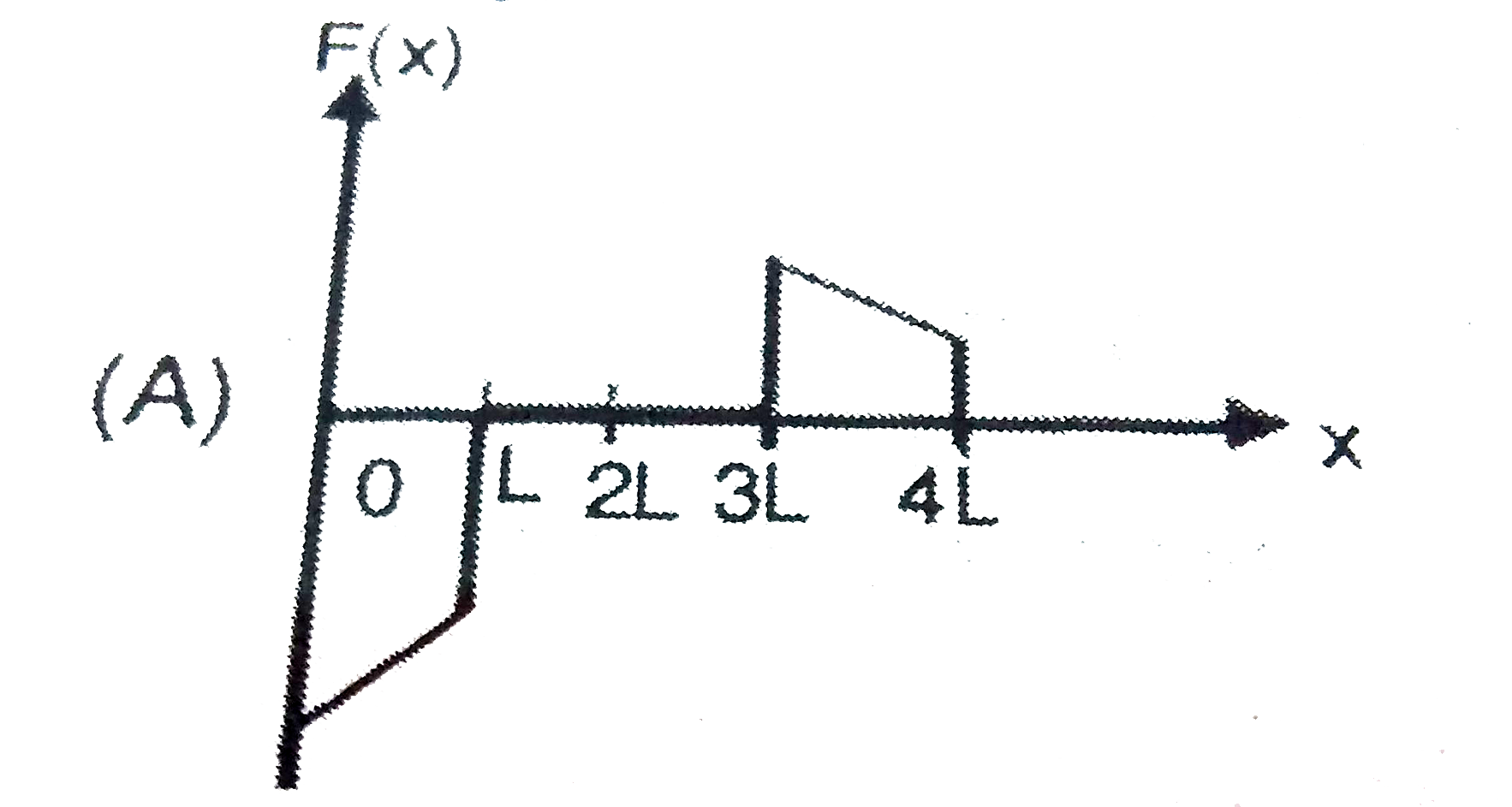
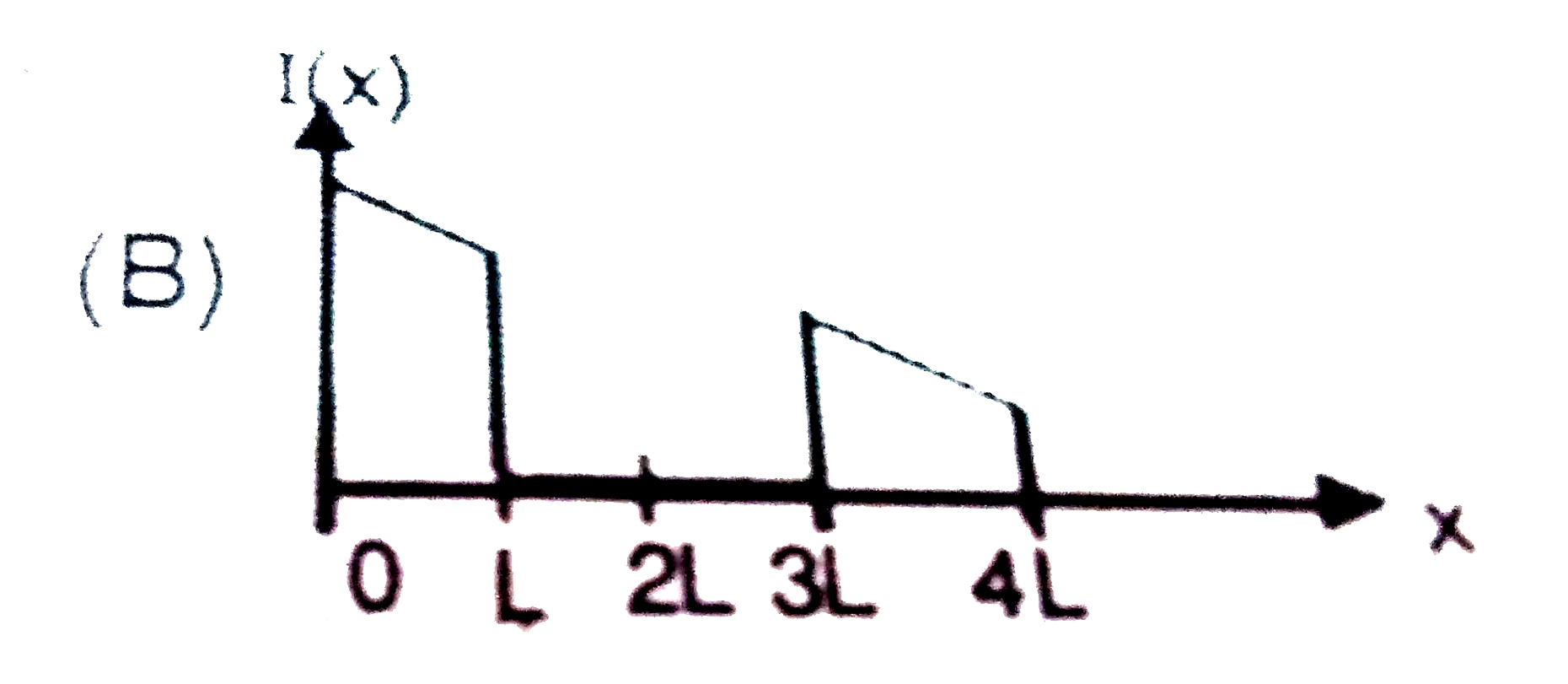
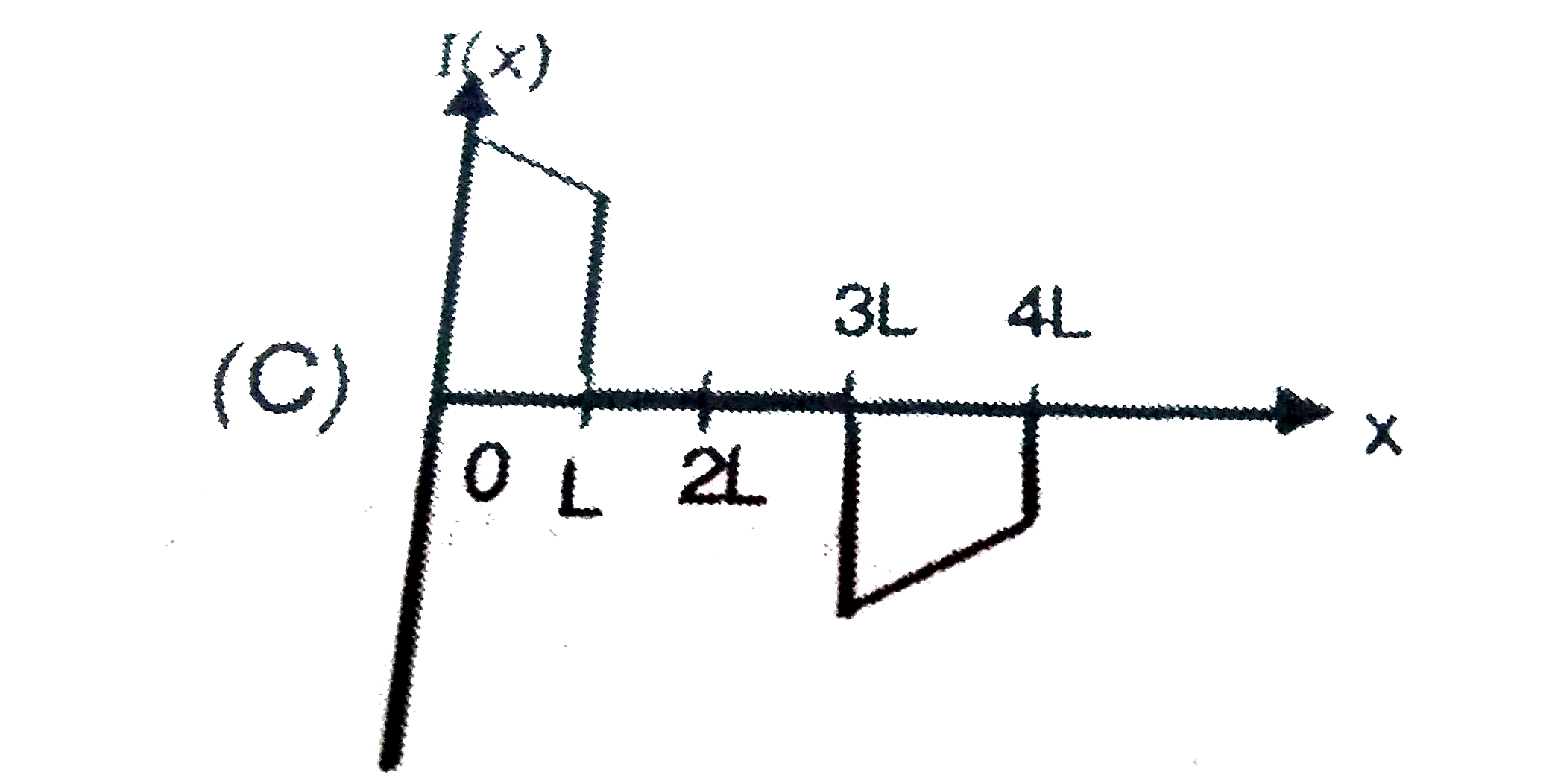
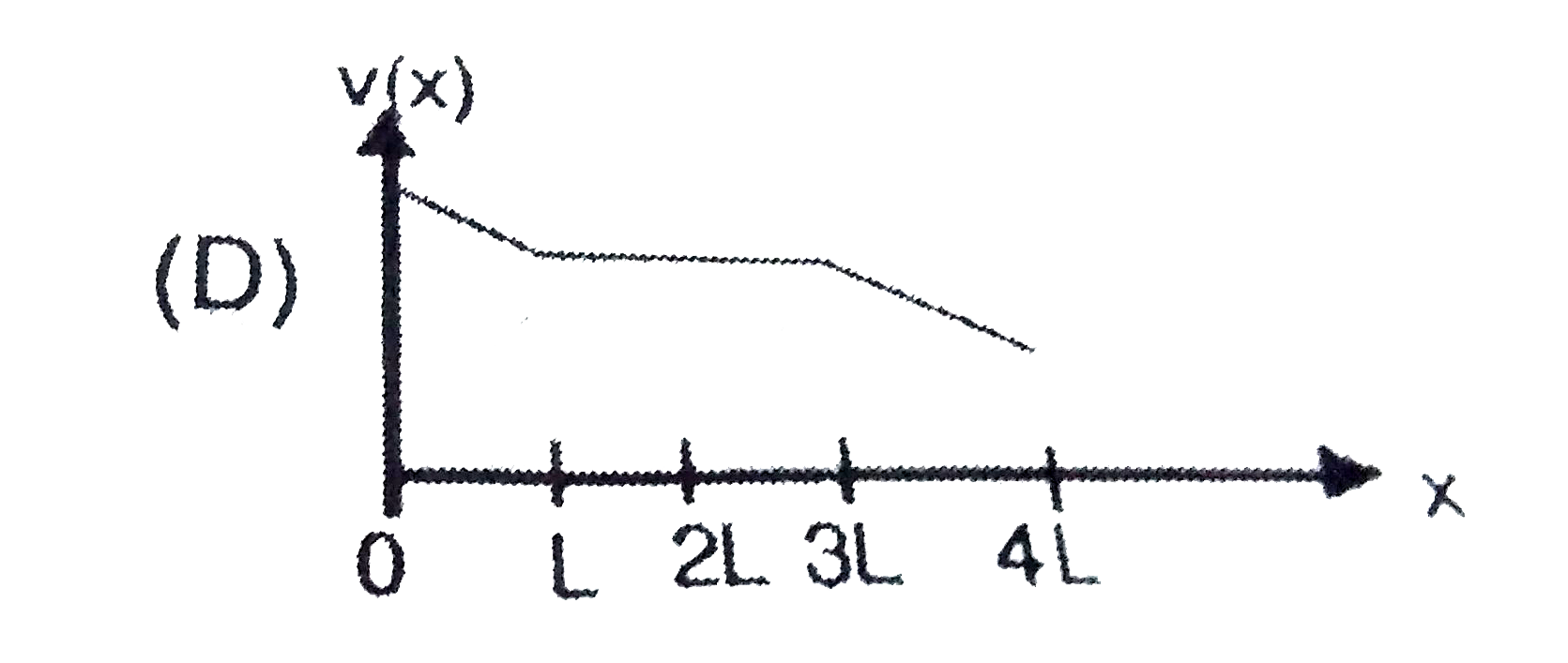
A rigid wire loop of square shape having side of length L and resistance R is moving along the x-axis with a constant velocity v_(0) in the plane of the paper. At t=0 , the right edge of the loop enters a region of length 3L where there is a uniform magnetic field B_(0) into the plane of the paper, as shown in the figure. For sufficiently large v_(0), the loop eventually crosses the region. Let x be the location of the right edge of the loop. Let v(x),I_(x) and F_(x) represent the velocity of the loop, current in the loop, and force on the loop, respectively, as a function of x. Counter-clockwise curren is taken as positive. Which of the following schematic plots (s) is are correct ? (Ignore gravity ) |
|
Answer»
|
|
| 39758. |
Rays of light are incident on a plane mirror at 40^@. At what angle with the first should a second mirror be placed such that the rays emerge from the second mirror parallel to the first mirror. |
|
Answer» Solution :In triangle BOC, we have `20^@ + 50^@ = 180^@` or, `theta= 130^@/2=65^@` 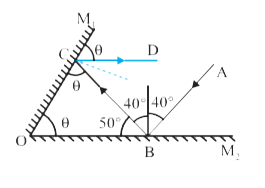
|
|
| 39759. |
Find the momentum and the velocity acquired by an electrically charged particle which has travelled through a potential difference varphi =varphi_(1) - varphi_(2). Take the initial velocity of the particle to be zero. Do the calculation both for the nonrelativistic and the relativistic cases. |
|
Answer» Solution :Consider the PROBLEM using the approximation of Newto nian mechanics. Put `K_(0) = 0, varphi_(1) -varphi_(2)= varphi, A = K- K_(0) = q(varphi_(1) -varphi_(2))` `qvarphi= (1)/(2)mu^(2) , U= SQRT(2qvarphi//m),p= mu= sqrt(2mqvarphi)` (b) In the relativistic case `K= qvarphi= sqrt(p^(2)c^(2)-E^(2))-E_(0)` we obtain `p= (1)/(c) sqrt(qvarphi(2E_(0)+qvarphi)), u= (m uc^(2))/(mc^(2) ) = (pc^(2))/(E)= (csqrt(qvarphi(2E_(0)+qvarphi))/(E_(0)+qvarphi))` In the Newtonian approximation `E_(0) gtgtqvarphi`and the formulas assume the form `p~~ (1)/(c)sqrt(2E_(0)qvarphi)= sqrt(2m_(0)qvarphi), u= (csqrt(2E_(0)qvarphi)/(E_(0)))= sqrt((2qvarphi2)/(m_(0)))` We have of COURSE obtained the same expressions as in (a), for in that case `m= m_(0)` |
|
| 39760. |
Fusion reaction takes place at high temperature because |
|
Answer» nuclei BREAK up at HIGH temperature |
|
| 39761. |
A perfect black body emits radiation at temperature T_(1)""^(@)K. If it is to radiate 16 times this power, its temperature T_(2) will be : |
|
Answer» `T_(2)=16T_(1)` `rArrT_(2)=2T_(1)`. Thus CORRECT choice is (d). |
|
| 39762. |
A thin converging lens is placed between as fixed object and a screen. There are two positions of the lens for which a sharp image is formed on the screen. The height of one of the image is 2 cm while the magnification of the other image is 3. What is the height of the object? |
| Answer» Answer :A | |
| 39763. |
A plane polarized beam of intensity I is incident on a polarizer with the electric vector inclined at 30^@to the optic axis of the polarizer. Light coming out of the polarizer through an analyser whose optic axis is inclined at 30^@to the polarizer. Find the intensity of light coming out of the analyser. |
| Answer» SOLUTION :`9/16 I` | |
| 39764. |
Avalanche breakdown in a semiconductor diode occurs when |
|
Answer» forward current EXCEEDS a certain VALUE |
|
| 39765. |
Consider example 25, taking the coefficient of friction mu to be 0.4 and calculate the maximum compression of the spring (g=10ms^(-2)) |
Answer» Solution :Both the frictional force and the SPEING force act so as to oppose the compressin of the springas shown in figure. 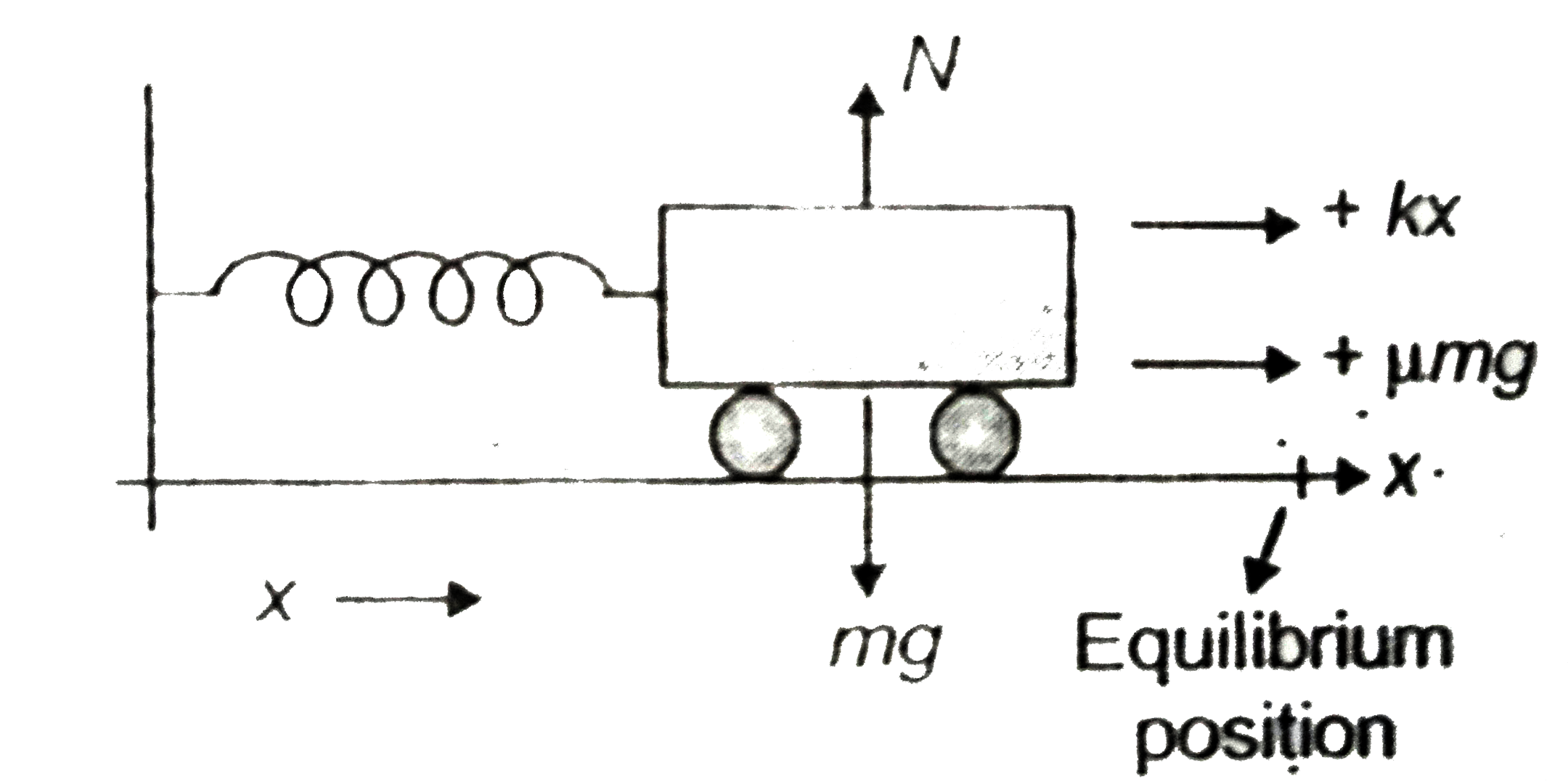 Use the work-ENERGY theorem, The change in `KE=Delta K=K_(t)-K_(i)=0-1/2mv^(2)` The work done by the net force is `W=1/2kx_(m)^(2)MU mgx_(m)` Equating the two, we get `1/2mv^(2)=1/2Kx_(m)^(2)+mumgx_(m)` `mumg=0.4xx1500xx10=6000N` `Kx_(m)^(2)+2mumgx_(m)-mv^(2)=0""("After rearranging the given equlatin")` `x_(m)=(-2mumg+sqrt(4mu^(2)m^(2)g^(2)-4(k)(-mv^(2))))/(2K)("Taking + ve sign with square ROOT as"x_(m)"is +ve")` `=(-mumg+sqrt(mu^(2)m^(2)g^(2)+MKV^(2)))/(K)` `=(-0.4xx1500xx10+sqrt((0.4xx1500xx10)^(2)+1500+7.5xx10^(3)xx10^(2)))/(7.5xx10^(3))=3.74m` Whichas expected, is less than the result in Example 25. If the two forces on the body consist of a conservation for `F_(c)` and a non-nocervative force `F_(nc,)` the conservation of mechanical energy formula will have to be modified by the W-E theorem, `(F_(c)+F_(nc))Deltax=DeltaK` But `F_(c)Deltax=-DeltaV` Hence `Delta(K+V)=F_(nc)Deltax` `DeltaE=F_(nc) Delta x` Where E is the total mechanical energy. Over the path this assumes the form ` E_(f)-E_(i)=W_(nc)` Where `W_(nc)` is the total work done by the non-conservative forces over the path. Unlike conservative force, `W_(nc)` depends on the path taken. |
|
| 39766. |
The collector supply in a common emitter amplifier is 8V and the voltage drop across the load of 800 Omega is 0.4 V. If the current gain for common base be alpha = 0.96, then the base current is |
|
Answer» `20muA` Then `I_c = (0.4)/800 and I_b=I_c/24` |
|
| 39767. |
A uniform rope of length 12 metres and mass 6 kg hangs vertically from a rigid support. A block of mass 2 kg is attached to the free end. A transverse pulse of wavelength 0.06 metre is produced at the lower end of the rope. What is the wavelength of the pulse when it reaches the top of the rope ? |
|
Answer» `0.6` METRE |
|
| 39768. |
Consider a magnet surrounded by a wire with an on/off switch S as shown in figure. If the switch is thrown from the off position (open circuit) to the on position (closed circuit), will a current flow in the circuit ? Explain. |
Answer» Solution :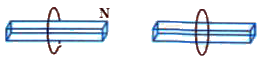 No, because when the SWITCH S is closed there is no change in the magnetic flux linked with the COIL, so no induced CURRENT will FLOW. |
|
| 39769. |
A charged 8mF capacitor having charge 5mC is connected to a 5mH inductor. What is : (ii) the frequency of electrical energy oscillations in the capacitor? |
| Answer» Solution :(II) Frequency of ELECTRICAL energy oscillation `v_(c ) = 2V`` | |
| 39770. |
The standard EMF for the given cell reaction Zn + Cu^(2+) rarr Cu + Zn^(2+) is 1.10 V at 25^(@)C. The EMF for the cell reaction, when 0.1 M Cu^(2+) and 0.1 M Zn^(2+) solutions are used, at 25^(@)C is - |
|
Answer» `1.10 V` `= 1.10 - (0.059)/(2)"log"(0.1)/(0.1)` `= 1.10 V` |
|
| 39771. |
(I) : In some AC generators, there are three seprate coils, which would give three seprate emf. So they are called poly - phase generators (II) : Eddy current loss can be minimised by using shell type core. Which one is correct statement ? |
| Answer» | |
| 39772. |
Statement I: Space wave is almost neve employed in long distance communication. Statement II: Space wave propagates in a straight line. Due to the curvature of earth it can not advance to a long distance. |
|
Answer» Statement I is TRUE, statement II is true, statement II is a CORRECT explanation for statement I. |
|
| 39773. |
A 2 kg mass lying on a table is displaced in the horizontal direction through 50 cm. The work done by the normal reaction will be: |
|
Answer» 10 J `:.` Work done is ZERO `because W=FS cos 90^(@)=0` |
|
| 39774. |
Assertion: If a point charge Q is kept at the corner of a cube then flux through the given cube Q_("cube") = Q/(8 in_0) Reason:For enclosing the charge completely, seven more identical cubes are required. |
|
Answer» Both Assertion and Reason are true and Reason is the correct explanation of Assertion |
|
| 39775. |
What is the end error in meter bridge ? How do you remove it? |
|
Answer» Solution :The end error in the METER bridge is due to the FOLLOWING reasons , (i) The zero mark of the scale provided along the bridge wire may not startfrom the position where the bridge wire leaves the copper STRIP and 100 cm mark of the scale may not be at position, where the bridge wire just touches the other copper strip. (II) The resistances of the connecting wires and copper strips of meter bridge have not been taken into account. The end error can be removed by repeating the EXPERIMENT by interchanging the known and unknown resistances and taking the mean of the resistances determined. |
|
| 39776. |
An object is placed in front of a converging lens of focal length 10 cm and image formed is double the size of object. Then find out the position of object. |
|
Answer» Solution :Case I : If the image FORMED is real `-h_(i)/h_(0)=2` `rArr v/u=-2 rArr v=-2u` `1/f=1/v-1/u` `rArr 1/10=-1/(2v)-1/u` `rArr 1/10=-3/(2u)` `rArr u=-15` CM Case II :If the image formed is virtual `h_(i)/h_(0)=2` `rArr v=2u` `1/f=1/v-1/u` `rArr 1/10=1/(2u)-1/u` `rArr 1/10=-1/(2u)` `rArr u=-5` cm |
|
| 39777. |
An aluminium wire of cross-sectional area 10"mis joined to a copper wire of the same crosssection. This compound wire is stretched from a fixed end, pulled by a load of 10 kg. The total length of the compound wire between two bridges is 1.5 m of which the aluminium wire is 0.6 m and the rest is the copper wire. Transverse vibrations are set in the wire by rising an external force of variable frequeney. Find the lowes! frequency of excitation for which standing waves are formed, such that the joint in the wire is anode. What is the total number of modes observed at this frequency excluding the two at the ends of the wire? The density of aluminium is 2.6xx10^(4) kg//m^(3). |
|
Answer» Solution :Now as in case of composite wire, the WHOLE wire will vibrate with fundamental frequency. `f=n_(A)f_(A)=n_(c)f_(c)` `(n_(A))/(2xx0.6) sqrt((T)/(Axx2.6xx10^(-3)))=(n_(c))/(2xx0.9) sqrt((T)/(Axx1.0401xx10^(4)))` `i.e (n_(A))/(n_(e))=(2)/(3) sqrt((2.6)/(10.4))=(2)/(3)xx(1)/(2)=(1)/(3)` So that for fundamental frequency of composite string, N = 1 and n = 3, i.e., ALUMINIUM string will vibrate in first harmonic and copper wire at second, overtone as shown in figure.  `:.f=f_(A)=3f_(c)` This in turn implies that total NUMBER of nodes in the string will be 5 and so number of nodes excluding the nodes at the ENDS =5-2=3 and `f=f_(A)=(1)/(2xx0.6) sqrt((0xx9.8)/(10^(-6)xx2.6xx10^(3)))~~161.8 Hz (=3f_(c))` |
|
| 39778. |
(A) : Solenoid produces uniform magnetic field along its axis. (R) : Field of a solenoid is independent of its radius. |
|
Answer» Both 'A' and 'R' are true and 'R' is the CORRECT EXPLANATION of 'A'. |
|
| 39779. |
A circute contains a capacitance of 20mu F. What is the reactance of the frequency of A.C. is 50 Hz ? |
|
Answer» Solution :`C =20 MU F = 20 xx 10^(-6)F = 2 xx 10^(-5)F` v= 50 Hz `therefore x_c = 1/omegaC = 1/2pi VC = (1/2pi xx 50 xx 2 xx10 ^(-5))` 159 `OMEGA` |
|
| 39780. |
Answer the following questions: (a) When a low flying aircraft passes overhead, we sometimes notice a slight shaking of the picture on our Tv screen. Suggest a possible explanation. |
| Answer» Solution :INTERFERENCE of the DIRECT SIGNAL received by the antenna with the (WEAK) signal reflected by the passing aircraft. | |
| 39781. |
A potential barrier of 0.7V exists across a p-n junctionIf the depletion layer is 7.0xx10^(-7)m thick, what is the intensity of the electric filed in this region?If an electron is approaching the p-n junction from the n-side with a speed 6.0xx10^(5)ms^(-1), determine the speed with which it enters the p-side of p-n junction. |
|
Answer» SOLUTION : Here, `V_B=0.7V,d=7.0xx10^(-7)m` Intensity of electric field in the REGION of depletion layer, `E=V_B/d=(0.7)/(7.0xx10^(-7))=1.0xx10^(6)V//m` Here, `v_(1)=6.0xx10^(5)ms^(-1)`, LET `v_(2)` be the velocity with which electron ENTERS the p-region. Then `1/2xx9.1xx10^(31)xx(6.0xx10^(5))^(2)` `=(1.6xx10^(-19))xx0.7+1/2xx9.1xx10^(-31)xxv_(2)^(2)` `1.64xx10^(-19)=1.12xx10^(-19)+(9.1xx10^(-31))/2v_(2)^(2)` On solving, `v_(2)=3.4xx10^(5)ms^(-1)` |
|
| 39782. |
The excess pressure inside a soap bubble of radius R is (S is the surface tension) |
|
Answer» `2S/R` |
|
| 39783. |
Two particles P and Q are located at the origin of a co-ordinate system.Both the particle start moving simultaneously at time t=0 .Particle P moves with a constant speed of 2pi m/s on a circle x^(2)+y^(2)+120y=0 in clock wise direction while Q moves with a constant acceleration such that at t=5s velocities of both are same. Find :(a)The average acceleration of P during this time (b)the position vectors and velocities of particles at t=5s |
| Answer» Solution :(a)`(pi)/(5(-026hati)m//s^(2)`, (B) (30`HATI`-7.8`hatj`)m,13.65`hati`-7.85 `hatj`)m,`pi(1.74hati-hatj`)m/s | |
| 39784. |
Numerical value of Bohr's magnetion is …………………. . |
| Answer» Solution :`9.27 XX 10^(-24) J T^(-1)` | |
| 39785. |
A particle of mass 'm' at rest is acted upon by a force 'P for a time 'r'. Its Kinetic energy after an interval 'r' is: |
|
Answer» `(P^2t^2)/(m)` |
|
| 39786. |
The poet felt sorry because... |
|
Answer» He COULD not see the road well |
|
| 39787. |
A thermal power plant produces electric power of 600 kW at 4000 V, which is to be transported to a place 20 km away from the power plant for consumers' usage . It can be transported either directly with a cable of large current-carrying capacity or by using a combination of step-up and step-down transformers at the two ends. the drawback of the direct transmission is the large energy dissipation is much smaller. In this method, a step-up transformer is used at the plant side so that the current reduced to a smaller value. At the consumers' end. a step-down transformer is used to supply power to the consurmer at the specified lower voltage . it is reasonableto assume that the power cable is purely resistive and the transformers are ideal with a power factor unity. All the currents and voltages mentioned are rms values. In the method using the transformers, assume that the ratio of the number of turns in the primary to that in the secondary in the step-up transformer is 1 : 10. If the power to the consumer has to be supplied at 200 v, the ratio of he number of turns in the primary to that in the secondary in the step-down transformer is |
|
Answer» `200 : 1` `1:10` `4000V rarr40000 V ` Step-down transform `40000 V rarr 200` `:. ` TURNS ratio =` (40000)/(200) = 200 :1` Hence OPTION (a) is correct. |
|
| 39788. |
What did Ricky suggest for a big Mejhi? |
|
Answer» To CUT down the JAMUN tree |
|
| 39789. |
if the earth's magnetic field is supposed to be due a magnetic dipole placed at the centre of earth , then the angle of dip at a point on the geographic equator |
|
Answer» is always zero |
|
| 39790. |
In Figure, two radio- frequency point sources S_(1) and S_(2) separated by distance d = 1.8 m, are radiating in phase with lambda = 0.50 m. A detector moves in a large circular path around the two sources in a plane contain- ing them. How many (a) maxima and (b) minima does it detect? |
| Answer» SOLUTION :(a) 14, (B) 16 | |
| 39791. |
A sledge moving over a smooth horizontal surface of ice at a velocity v_( 0) drives out on a horizontal road and comes toa halt. The sledge has a length l, mass m and friction between runner and road is mu. |
|
Answer» No work is done by friction to switch the siedge from iceto the road |
|
| 39792. |
यदि A={x : x E N और 3 < x < 7} तो A बराबर है: |
|
Answer» {4,5,6,7} |
|
| 39793. |
The TV broad casting bands are |
|
Answer» MF and HF BANDS |
|
| 39794. |
A uniform rod of length L and mass M, is lying on a frictionless horizontal plane and is pivoted at one of its ends, as shown in the figure. An inelastic ball of mass m is fixed with the rod at a distance L//3 from O. A horizontal impulse J is given to the rod at a distance 2L //3 from O in a direction perpendicular to the rod. Assume that the ball remains in contact with the rod after the collision and the impulse J acts for a small time interval Delta t. (a) Find with resulting instantaneous angular velocity of the rod just after the impusle is imparted. (b) Find the impulse acted on the ball during the time interval Delta t. (c ) Find the magnitude and direction of the impulse applied by the pivot during the time interval Delta t. |
|
Answer» |
|
| 39795. |
A string of length 0.4 m and mass 10^(-2) kg is tightly clamped at its ends. The tension in the string is 1.6 N. Identical wave pulses are produced at one end in equal intervals of times Deltat. the minimum value of Deltat, which allows constructive interference between successive pulses , is : |
|
Answer» 0.05s ` v = sqrt(((1.6)/(10^(-2)))/(0.4)) = `8 m/s. When the pulse is reflected at the end it suffers a phase chase of `pi`. Again with REFLECTION at other end it suffers a phase change of `pi`. so the original pulse is obtianed after two reflections . If wave is produced at that instantthem two waves interfere CONSTRUCTIVELY. `therefore` MINIMUM time for the same is t `= (l + l)/(v)` `= (0.4 + 0.4)/(8) = (1)/(10) = 0.1 ` s. Correct choice is (d). |
|
| 39796. |
Which one of the following is not true about the following thermodynamic processes ? |
|
Answer» A. For ISOBARIC PROCESS `DeltaP=0` |
|
| 39797. |
Which of the following is better propagation mode to propagate television frequency and radar signals ? |
|
Answer» SATELLITE communication |
|
| 39798. |
Two batteries A and B each of e.m.f. 2V are connected in series to an external resistance R = 1 Omega. If the internal resistance of battery A is 1.9 Omega and that of B is 0.9 Omega. What is the potential difference between the terminals of battery A ? |
Answer» SOLUTION :TOTAL current through the circuit `i=("voltage")/("RESISTANCE resistance")`  `=(4)/((1+ 1.9+ 0.9)) =4/(3.8) A` potential difference of A, `V_A= epsi - IR`, `=2-4/(3.8)xx1.9 = 2-2 =0` |
|
| 39799. |
Show using a proper diagram how unpolarised light can be linearly polarised by reflection from a transparent glass surface. |
|
Answer» <P> Solution : Plane POLARISED light can be obtained by reflection from a transparent surface (SAY a plane GLASS plate) when the light is incident on the surface at the polarising angle `i_(p)`, Value of polarising angle is given by Brewster.s law, according to which `tani_(p)=n or i_(p)=tan^(-1)(n)` In such a condition, the reflected light contains vibrations of electric vector perpendicular to the plane of incidence only and is thus, completely plane polarised one. |
|
| 39800. |
In a uniform electric field, equipotential surfaces must |
|
Answer» be plane SURFACES |
|