

Saved Bookmarks
This section includes InterviewSolutions, each offering curated multiple-choice questions to sharpen your knowledge and support exam preparation. Choose a topic below to get started.
| 42151. |
In a double-slit experiment the angular width of a fringe is found to be 0.2^(@) on a screen placed 1 m away. The wavelength of light used is 600 nm. What will be the angular width of the fringe if the entire experimental apparatus is immersed in water ? take refractive index of water to be (4)/(3). |
|
Answer» SOLUTION :Here angular fringe width in air `alpha_(air)=0.2^(@)` and refractive index of water `n_(W)=(4)/(3)` `THEREFORE` Angular fringe width in water `alpha_(water)=(alpha_(air))/(n_(w))=(0.2^(@))/(4//3)=0.15^(@)`. |
|
| 42152. |
Draw a ray diagram showing the formation of the image by a point object on the principal axis of a spherical convex surface separating two media of refractive indices n_(1) and n_(2), when apoint source is kept in rarer medium of refractive index n_(1). Derive the relation between object and image distance in terms of refractive index of the medium and radium of curvature of the surface. Hence obtain the expression for lens-maker's formula in the case of thin convex lens. |
Answer» Solution :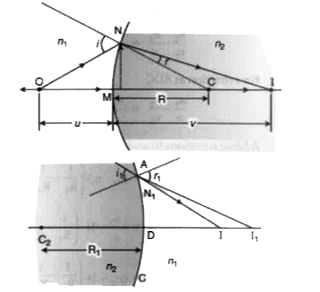 The incident rays coming from the OBJECT .O. kept in the rarer medium of REFRACTIVE index `n_(1)`, incident on the REFRACTING SURFACE NM produce the real image at I. From the DIAGRAM, `/_ i = /_ NOM + /_ NCM` `= ( NM )/( OM )+ ( NM )/( MC )` `/_r = /_ NCM - /_ NIM ` `= ( NM )/( MC ) - ( NM ) /( MI )` From Snell.s law, `:. ( n_(2))/( n_(1)) = ( sin i)/( sin r ) ~ (i) /( r )`( for small angles, sin` theta ~ theta )` `:. n_(2) r = n_(1) i ` or `n_(2) ((NM)/( MC) - ( NM )/( MI)) = n_(1) ((NM)/( OM) + ( NM)/( MC))` or `n_(2) ((1)/( + R ) - ( 1)/( +v)) = n_(1) ((1)/( - u ) + ( 1)/( R ))` or `(n_(2) - n_(1))/( R ) = ( n_(2))/( v ) - ( n_(1))/( u )` Lens maker.s formula `:` 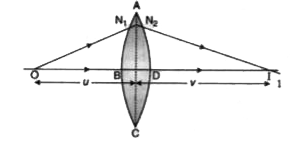 The first refracting surface ABC forms the image `I_(1)` of the object O. The image `I_(1)` acts as a virtual object for the second refracting surface ADCwhich forms the real image I as shown in the diagram. `:`. For refraction at ABC `(n_(2))/( v_(1)) - ( n_(1))/(u)= ( n_(2) - n_(1))/( R_(1))`....(i) For refraction at ADC `(n_(1))/( v) - ( n _(2))/(v_(1)) = ( n_(1) - n_(2))/( R_(2))`....(ii) Adding equations (i) and (ii) , we get `(n_(1))/( v) - ( n_(1))/( u ) = ( n _(2) - n_(1)) ((1)/( R_(1)) - ( 1)/( R_(2)))` `(1)/( v) - ( 1)/( u ) = ( ( n_(2))/(n_(1)) - 1) ((1)/( R_(1)) - ( 1)/( R_(2)))` `(1)/( f) = ( mu_(21) - 1) ((1)/( R_(1))- ( 1)/( R_(2)))` |
|
| 42153. |
Assertion : Communication in UHF/VHF regions can be established by space wave or tropospheric wave. Reason: Communication in UHF/VHF regions tosva is limited to line of sight distance |
|
Answer» |
|
| 42154. |
Take A and B input waveforms similar to that in Ex. Sketch the output waveform obtained from AND gate . |
Answer» Solution : BASED on the above, the OUTPUT WAVEFORM for AND GATE can be drawn as given below: 
|
|
| 42155. |
A boat travels between two points and B on the banks of a river along line AB,Distance between A and B is 1200m. Velocity of river water is 1.9 ms^(-1). Line AB makes alpha - 60^@with direction of water flow. With what velocity and at what angle betaboat must move to cover AB and back in 5 minutes ? Angle betaremains the same from A to B an while moving from B to A |
| Answer» SOLUTION :`8 ms ^(-1), BETA= 12^@ ` | |
| 42156. |
Use the formula lambda_(m)T=0.29 cm K to obtain the characteristic temperature ranges for different parts of the electromagnetic spectrum. What do the numbers that you obtain tell you ? |
|
Answer» Solution :We know , every body at given temperature `T_(1)` emits radiations of all wavelengths in CERTAIN range .For a black body, the wavelength corresponding to maximum intensity of radiation at a given temperature . `lambda_(m)T=0.29 CMK ` or `T=(0.29)/(lambda_(m))` For `lambda_(m)=10^(-6)m =10^(-4) cm , T=(0.29)/(10^(-4))=2900 K` Temperature for other wavelengths can be SIMILARLY found. These NUMBERS tell us the temperature ranges required for OBTAINED radiations in different parts of e.m spectrum . Thus to obtain visible radiation, say, `lambda_(m)=5xx10^(-5)` cm, the source should have temperature `T=(0.29)/(5xx10^(-5))=6000 K` It is to be noted that , a body at lower temperature willalso proudce this wavelength but not with maximum intensity. |
|
| 42157. |
Three waves A, B and C of frequencies 1600 kHz, 5 MHz and 60 MHz, respectively are to be transmitted from one place to another. Which of the following is the most appropriate mode of communication ? |
|
Answer» A is transmitted via space WAVE while B and C are transmitted via sky wave |
|
| 42158. |
State Ampere's circuital law and represent it mathematically. |
|
Answer» Solution :LINE integral of magnetic FIELD B around any closed PATH in free SPACE is equal to absolute PERMEABILITY `mu_0` times the net current I enclosed by the path. i.e., `phivecB.vec(dl)=mu_0I` |
|
| 42159. |
The aperture of telescope is of 1m diameter and wavelength of light incident on the on the paerture is 5500 A^(0) . The angular limit if resolution of the telescope is |
|
Answer» `6.71xx10^(7)` RADIAN |
|
| 42160. |
Estimate the fraction of electrons in copper which will rise above the Fermi level when it is heated to 100^(@)C. |
|
Answer» |
|
| 42161. |
Yayati went to kubera's |
|
Answer» garden |
|
| 42162. |
A semiconductor is known to have an electron concentration of 5x10^(12) cm^(-3) and a hole concentration 8x10^(13) cm^(-3) . (i)Is the semiconductor n-type of p-type ? (ii)What is the resistivity of the sample. If the electron mobility is 23,000 cm^(2)v^(-1)s^(-1) ' and hole mobility is100cm^(2)v^(-1)s^(-1) ' Take charge on electron, e=.16x10^(-19)c. |
| Answer» Solution :(i)`n_(e) =5xx10^(12)cm^(-3)=5xx10^(18)m^(-3)``n_(e) =5xx10^(12)cm^(-3)=5xx10^(18)m^(-3)`` u_(e) =23000cm^(-2)v^(-1)s^(-1)=2.3m^(-2)v^(-1)s^(-1)` ` u_(e) =23000cm^(-2)v^(-1)s^(-1)=2.3m^(-2)v^(-1)s^(-1)`` u_(e) =100cm^(-2)v^(-1)s^(-1)=0.01m^(-2)v^(-1)s^(-1)` Since the SEMICONDUCTOR has greater HOLE density hence it is p-type.(ii)`n_(e) =5xx10^(12)cm^(-3)=5xx10^(18)m^(-3)` `n_(e) =5xx10^(12)cm^(-3)=5xx10^(18)m^(-3)`` u_(e) =23000cm^(-2)v^(-1)s^(-1)=2.3m^(-2)v^(-1)s^(-1)` ` u_(e) =23000cm^(-2)v^(-1)s^(-1)=2.3m^(-2)v^(-1)s^(-1)` ` u_(e) =100cm^(-2)v^(-1)s^(-1)=0.01m^(-2)v^(-1)s^(-1)` Now `((1)/(p))=e((n_(e)u_(e)+n_(H)u_(h)) =1.6xx10^(-19)[5xx10^(18)xx2.3+8xx10^(19)xx0.01]`=`1.6xx10^(-19)[1.15xx10^(19)xx2.3+0.08xx10^(19)]=1.968` or `RHO =((1)/(1.968))=0.508 Omega -m` | |
| 42163. |
A uniform conductor of resistance R is cut into 20 equal pieces. Half of them are joined in series and the remaining half of them are connected in parallel. If the two combinations are joined in series, then the effective resistance of all the pieces is |
| Answer» Answer :C | |
| 42164. |
Assertion :- Faraday's copper disc generator is based on dynamic electromagnetic induction. Reason :- Alternating current generator is based on periodic electromagnetic induction. |
|
Answer» If the ASSERTION & REASON are True& the Reason is a correct EXPLANATION of the Assertion . |
|
| 42165. |
In an A.C. circuit the ratio of inductive reactance and capacitive reactance is …… |
|
Answer» 1 `therefore X_L/X_C=(omegaL)/(1/(omegaC))=omega^2 LC` |
|
| 42166. |
What is the force between two parallel current carrying conductors if I_1=I_2=IAand r=1m |
| Answer» SOLUTION :`2XX10^(-7)N` | |
| 42167. |
Power factor of AC series circuit having resistance R and inductor L having angular frequency omega is …….. |
|
Answer» 0 `THEREFORE` POWER factor =`R/"|Z|"` `=R/sqrt(R^2+omega^2L^2)` |
|
| 42168. |
During (beta^-)decay (beta minus), the emission of antinenutrino particle is supported by which of the following statement(s) (A) Angular momentum conservation holds good in any nuclear reaction (B) Linear momentum conservation holds good in any nuclear reaction (C) The KE of emitted beta-particle varies in any nuclear reaction |
|
Answer» A, B and D are correct |
|
| 42169. |
A parallel plate capacitor with air as medium between the plates has capacitane 10 mF. Then area of the capacitor is divided two equal halves and filled with two media having dielectric constants K_(1) =2 and K_(2) =4. The capacitance of the system will be |
|
Answer» 10 mF |
|
| 42170. |
a. What type of particles can be accelerated in a cyclotron? b. Why cyclotron is not used to accelerate electrons and neutrons? |
|
Answer» SOLUTION :a. PROTON, deutron. a -particle etc. B. As electron gets accelerated, its frequency of revolution CHANGES from that of applied electric field. Neutron is UNCHARGED |
|
| 42171. |
Magnetic flux linked with a stationary loop of resistance R varies with respect to time during the time period T as follows: phi=aT(T-r) Find the amount of heat generated in the loop during that time. Inductance of the coil is negligible. |
|
Answer» `(aT)/(3R)` `=at(0-1)+a(T-t)` `=a(T-2t)` So, induced emf is ALSO a function of time. :. Heat genrated in time `T` is `H=int_(0)^(T)(E^(2))/(R )dt=(a^(2))/(R )int_(0)^(T)(T-at)^(2)dt` `=(a^(2))/(R )int_(0)^(T)(E^(2))/(R )dt=(a^(2))/(R )int_(0)^(T)(T-at)^(2)dt` `=(a^(2))/(R )int_(0)^(T)(T^(2)+4t^(2)-4tT)dt=(a^(2)T(3))/(3R)` |
|
| 42172. |
A zener diode has a breakdown voltage of 9.1 volts with a maximum power dissipation of 364 milliwatts. What is the maximum current the diode can handle? |
|
Answer» <P> Solution :`P_(MAX) = V_z I_z `( max)` I_z ( max ) =(P_("max"))(/(V_z) = ( 364 xx 10^(-3))/( 9.1) = 40 mA ` |
|
| 42173. |
The ratio of contributions made by the electric field and magnetic field components to the intensity of an EM wave is |
|
Answer» c : 1 Energy of MAGNETIC field `U=(B_(0)^(2))/(2mu_(0))` Relation between electric and magnetic field, `E_(0)=cB_(0)` `THEREFORE (1)/(2)in_(0)E_(0)^(2)=(1)/(2)in_(0)(cB_(0))^(2)` `=(1)/(2)in_(0)c^(2)B_(0)^(2)` `=(1)/(2)in_(0)xx(B_(0)^(2))/(mu_(0)in_(0))[because c=(1)/(sqrt(mu_(0)in_(0)))]` `=(B^(2))/(2mu_(0))` THUS, energy of electromagnetic waves is equally distributed in electric field and magnetic field. Intensity of electric field and magnetic field and magnetic field are equal. Hence, RATIO is 1 : 1. |
|
| 42174. |
In the given LCR series ciruit reading of voltmenter is 120V. The reading (in A) of the ammeter is : |
|
Answer» `4sqrt(2)A` |
|
| 42176. |
consider three charges q_(1),q_(2),q_(3)eachequal to q at the vertices of anequilateral triangleof side l what is the force on acharge Qplaced at the centroidof the triangle |
|
Answer» Solution :In THEGIVEN EQUILATERAL triangle ABCof sides of length l if we draw a perpendicualre ADto the side BC AD=AC cos `30^(@) =sqrt(3)//2` l and the distanceAO of the centroid o from A is `(2/3)` AD=`(1/sqrt(3))` l by symmatry AO=BO=CO FORCE `F_(1)` and Q due to chargeq at A=`(3)/(4piepsilon_(0))(Qq)/(l^(2))` along AO force `F_(2)` and Q due to chargeq at B=`(3)/(4piepsilon_(0))(Qq)/(l^(2))` along AO force `F_(3)` and Q due to chargeq at C=`(3)/(4piepsilon_(0))(Qq)/(l^(2))` along AO parallelogram law thereforethe toal force on Q =`(3)/(4piepsilon_(0))(Qq)/(4piepsilon_(0))(Qq)/(l^(2))(VECR-vecr)` =0 where `vecr` isthe unit vectoralong OA it is clear alos by symmetry that the three forces will sum to zero considerwhat wouldhappen if the system was rotated through `60^(@)`about O |
|
| 42177. |
We have seen that a gamma-ray does of 3 Gy is lethal to half the people exposed to it. If the equivalnet energy were absorbed as heat, what rise in body temperature would result ? |
|
Answer» `300 muK` `DeltaT = (Q//m)/(c) = (3)/(4180) = 7.2 xx 10^(-4) K~~ 700 muK` Obviously the damage done by ionizing radiation has nothing to do with thermal HEATING. The harmful effects arise because the radiation damages `DNA` and thus interferes with the normal functioning of tissues in which it is obsorbed. |
|
| 42178. |
A point source S is placed midway between two converging mirrors having equal focal length f as shown in figure. Find the values of d for which only one image is formed. |
| Answer» SOLUTION :DISTANCE between MIRROR will be 2F or 4F. | |
| 42179. |
A particle of mass m is located outside a uniform sphere of mass M at a distance r from its centre. Find: (a) the potential energy of gravitational interaction of the particle and the sphere, (b) the gravitational force which the sphere exerts on the particle. |
|
Answer» Solution :Suppose that the sphere has a radius equal to a. We may imagine that the sphere is made up of concentric thin spherical shells (layers) with radii ranging from 0 to a, and each spherical layer is made up of elementary bands (rings). Let US first calculate potential due to an elementary band of a spherical layer at the point of location of the point mass m (say point P) (figure). As all the points of the band are located at the distance l from the point P, so, `delta varphi=-(gammadeltaM)/(l)` (where mass of the band) (1) `deltaM=((dM)/(4pia^2))(2pi a sin theta)(a dtheta)` `=((dM)/(2))sin theta d theta` (2) And `l^2=a^2+r^2-2arcos theta` (3) Differenciating Eq. (3), we get `ldl=arsin theta d theta` (4) Hence using above equations `delta varphi=-((lambdadM)/(2ar))dl` (5) Now integrating this Eq. over the whole spherical layer `d varphi=int delta varphi=-(gammadM)/(2ar)underset(r=-a)overset(barr+a)int` So `d varphi=-(gammadM)/(r)` (6) Equation (6) demonstrates that the potential PRODUCED by a thin uniform spherical layer outside the layer is such as if the whole mass of the layer were concentrated at it's CENTRE, Hence the potential due to the sphere at point P, `varphi=intdvarphi=-gamma/rintdM-(GAMMAM)/(r)` (7) This expression is similar to that of Eq. (6) Hence the sought potential energy of gravitational interaction of the particle m and the sphere, `U=mvarphi=-(gammaMm)/(r)` (b) Using the Eq. `G_r=-(deltavarphi)/(deltar)` `G_r=-(gammaM)/(r^2)` (using Eq. 7) So `vecG=-(gammaM)/(r^3)vecr` and `vecF=mvecG=-(gammamM)/(r^3)vecr` (8) 
|
|
| 42180. |
The frequency of e.m. wave which is best suited to observe a particle of radius 3 xx 10^(-4) cm is of the order of : |
|
Answer» `10^(15)` `:. v=(C)/(lambda)=(3 xx 10^(8))/(3 xx 10^(-6))=10^(14)` For observation of particle the WAVE frequency should be more than `10^(14)` Hz, or wave length should be SMALLER. |
|
| 42181. |
A uniform electric field and uniform magnetic field are acting along the same direction in a certain region. If an electron is projected in the region such that its velocity is pointed along the direction of fields, then the electron |
|
Answer» will TURN TOWARDS right of DIRECTION of motion |
|
| 42182. |
A short linear object of length b lies along the axis of a concave mirror of focal length f at a distance u from the pole of the mirror. The size of the image is approximately : |
|
Answer» `bsqrt((U-f)/(f))` Differentiating we get `- ((1)/(v^(2)) (dv)/(DU) - (1)/(u^(2)) = 0` `therefore(dv)/(du)=(v^(2))/(u^(2))=-((v)/(u))^(2)thereforem=-((v)/(u))^(2) "" ...(i)` Further `(1)/(v) + (1)/(u) = (1)/(f)` `(u)/(v)+1=(u)/(f)therefore(v)/(u)=(f)/(u-f) "" ...(ii)` As `m=(I)/(O)=(I)/(b) ""...(iii)` From (i) and (iii), `(I)/(b)=-((v)/(u))^(2)=-((f)/(u-f))^(2), "from eqn," (ii)` `therefore(I)/(b)=-((f)/(u-f))^(2)` `therefore I=b((f)/(u-f))^(2)` (numerically). |
|
| 42183. |
Two seconds after projection, a projectile is moving at 30^@ above the horizontal. After one more second it is moving horizontally. If g = 10ms^(-2), the velocity of projection is |
|
Answer» `10 sqrt(3) ms^(-1)` |
|
| 42184. |
The displacement y of a particle executing periodic motion is given by : y = 4 cos^2(1/2 t) sin(1000t). This expression may be considered to be a result of the superposition of 'X' Independent harmonic motions |
|
Answer» |
|
| 42185. |
A glass slab is placed on a page of a book kept horizontally. What should be the value of the minimum refractive index of the glass slab so that the printed letters of the page will not be visible from any vertical side of the slab? |
|
Answer» Solution :It is assumed that there is a thin layer of air between the page of the book and the glass SLAB. So ray coming from any portion of the book is incident on the glass at an ANGLE of almost `90^(@)` [Fig. 2.62]. If the angle of REFRACTION is `phi` and refractive index of glass then, `sinphi = (1)/(mu)` If `theta_(c)` is the critical angle, then `sintheta_(c) = (1)/(mu)`. So here, `phi = theta_(c)` This REFRACTED ray is incident on any vertical side of the slab at an angle `theta(say). So" " theta + phi = 90^(@)` If `theta` is greater than `phi`, total internal reflection of light takes place and the printed letters of te page will not be visible from any vertical side. `mu` will be minimum when `theta = phi`. `therefore "" 2phi = 90^(@) or,phi = 45^(@)` `therefore "" mu_(min) = (1)/(sin phi) = (1)/(sin 45^(@)) = sqrt(2) = 1.414` 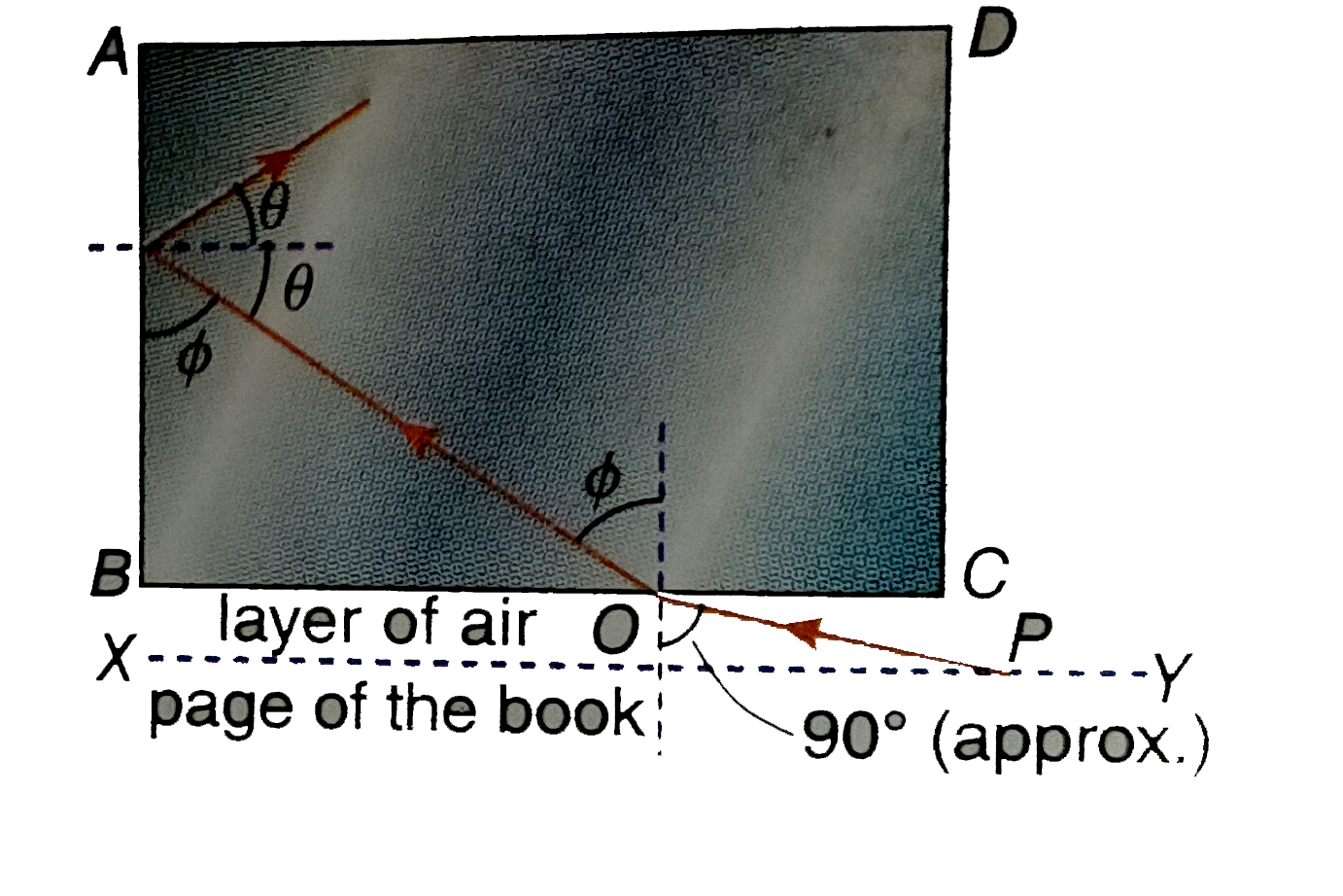
|
|
| 42186. |
A radioactive decay can form as isotope of the original nucleus with the emission of particles |
|
Answer» one `alpha` and FOUR `beta` |
|
| 42187. |
The objective of a small telescope has focal length 120 cm and diameter 5 cm. The focal length of the eyepiece is 2 cm. What is the magnifying power and length of tube for distant objects and relaxed eye? |
|
Answer» |
|
| 42188. |
The Bohr model for the H-atom relies on the Coulomb's law of electrostatics . Coulomb'slaw has not directly been varified for very short distances of the order of angstroms. Suppos-ing Coulomb's law between two oppsite charge +q_(1),-q_(2) is modified to |vec(F)|=(q_(1)q_(2))/((4piepsilon_(0))r^(2))1/r^(2),rgeR_(0) =(q_(1)q_(2))/((4piepsilon_(0))r^(2))1/R_(0)^(2)(R_(0)/r)^(epsilon), rleR_(0) Calculate in such a case , the ground state enenergy of H-atom , if epsilon= 0.1,R_(0)=1Å |
|
Answer» `-11.4` In CASE of H-atom , `(q_1q_2)/(4piepsilon_0)=(1.6xx10^(-19))^2 (9xx10^9)=2.3xx10^(-28) N m^(2)` It is given that `(1/R_0^2)(R_0/R)^epsilon=(1/R_0^2)(R_0/r)^(2+delta)=(R_0^delta)/r^(2+delta)` Thus, `F=(xR_0^delta)/r^(2+delta) " " (because X=(q_1q_2)/(4piepsilon_0))` As `F=(mv^2)/rimplies (mv^2)/r=(xR_0^delta)/(r^(2+delta) " " or " "v^2=(xR_0^delta)/(mr^(1+delta))`...(i) (i)As mvr=nħ`implies`r=`(nħ)/(mv)` Using eqn (i) r=`(nħ)/m[m/(xR_0^delta)]^(1//2) r((1+delta))/2` or `r^((1+delta)//2)=((n^2ħ^2)/(mxR_0^delta))^(1//2) THEREFORE r=((n^2ħ^2)/(mxR_0^delta))^(1//(1-delta))` For n=1, `r_1=(ħ^2/(mxR_0^delta))^(1//(1-delta))` `=[(1.05xx10^(-34))^2/((9.1xx10^(-31))(2.3xx10^(-23))(10^19)]]^(1/2.9)` `=8xx10^(-11) m=0.8Å` (ii)From `v_n=(nħ)/(mr_n)=nħ((xR_0^delta)/(n^2ħ))^(1/(1-delta))` for n=1,`v_1=ħ/(mr_1)=1.44xx10^6 m s^(-1)` (iii) K.E. =`1/2mv_1^2=9.43xx10^(-19) J =5.9 eV` (iv)P.E. of electron from `oo` to `R_0` ,`U_1=1/(4piepsilon_0)((q_1q_2)/R_0)=(-x)/R_0` P.E. of electron from `R_0` to r, `U_2=-int_(R_0)^(r)Fdr` `=xR_0^deltaint_(R_0)^r (DR)/(2+delta)=(xR_0^delta)/(r^(1+delta))|1/r^(1+delta)|_(R_0)^(r)=(-x)/((1+delta))[R_0^delta/r^(1+delta)-1/R_0]` Total P.E. of electron P.E. =`-x/(1+delta)[R_0^delta/r^(1+delta)-1/R_0+(1+delta)/R_0]` `=(-2.3xx10^(-28))/0.9[R_0^delta/r^(1+delta)-delta/R_0]=(-2.3xx10^(-28))/0.9[R_0^(-19)/r^(-0.9)-1.9/R_0]` `=(-2.3xx10^(-28))/(-0.9)[(0.8)^(0.9)/(10^(-10xx(-1.9))-1.9/10^(-10)]` `=(2.3xx10^(-28))/(0.9xx10^(-10))[(0.8)^(0.9)-1.9]=-17.3 eV` Total energy `E=KE+PE=5.9-17.3 eV=-11.4 eV`. |
|
| 42189. |
When the current changes from + 2A to -2A in 0.05 s, an emf of 8 V is induced in a coil is co-efficient of self-induction of the coil is |
|
Answer» 0.2H |
|
| 42190. |
Can the value of absolute refractive index of a medium be less than 1? |
| Answer» Solution :The absolute refractive index of a MEDIUM is the ratio of the velocity of light in VACUUM to the velocity of light in that medium. Since the velocity of light in vacuum is GREATER than that in any other medium, the value of the absolute refractive index of a medium cannot be less than 1. | |
| 42191. |
A source is moving along a circle x^(2) + y^(2) =R^(2) with constant speed V_(s) =(330pi)/(6sqrt(3))m/s in clockwise direction direction while on observer is stationary at point (2R,0) with respect to the centre of circle frequency emitted by the source is f [velocity of sound V= 330 m/s] Maximum wave length received observer |
|
Answer» `(SQRT(3) + npi)V/f` |
|
| 42192. |
Assume that light of wavelength 6000Å is coming from a star. What is the limit of resolution of a telescope whose objective has a diameter of 100 inch? |
|
Answer» SOLUTION : A 100 inch telescope implies that a = 100 inch = 254 cm. Thus if, `LAMDA = 6000Å = 6 xx 10^(-5) cm ` then `DELTA THETA = (1.22 lamda)/(a) = 2.9 xx 10^(-7) ` radians |
|
| 42193. |
A source is moving along a circle x^(2) + y^(2) =R^(2) with constant speed V_(s) =(330pi)/(6sqrt(3))m/s in clockwise direction direction while on observer is stationary at point (2R,0) with respect to the centre of circle frequency emitted by the source is f [velocity of sound V= 330 m/s] Maximum frequency heard by observer : |
|
Answer» `[SQRT(3)/(sqrt(3)-pi)]f` |
|
| 42194. |
A source is moving along a circle x^(2) + y^(2) =R^(2) with constant speed V_(s) =(330pi)/(6sqrt(3))m/s in clockwise direction direction while on observer is stationary at point (2R,0) with respect to the centre of circle frequency emitted by the source is f [velocity of sound V= 330 m/s] The cooridnates of source when observer records the jpaximum and minimum frequency |
|
Answer» `(R/2, R/2) (R/2, -R/2)` |
|
| 42195. |
The process of changing some characteristic of a carrier wave in accordance with the intensity of the signal is called: |
|
Answer» AMPLIFICATION |
|
| 42196. |
An ammeter is obtained by shunting a 20Omega galvanometer with a 20Omega resistor. What additional shunt should be connected across it to double its range ? |
|
Answer» `30Omega` |
|
| 42197. |
The properties of electric lines of force, tubes of force and tubes of induction are : |
|
Answer» NEVER similar |
|
| 42198. |
A tall man of height 6 feet wants to see his full image .The required minimum length of the mirror should be : |
|
Answer» 12 FEET |
|
| 42199. |
Two bulbs whose resistances are in the ratio of 1 : 2 are connected in parallel to a source of constant voltage. What will be the ratio of power dissipation in these? |
|
Answer» `1:2` |
|
| 42200. |
A car moving with a velocity of 36 km/h crosses a siren of frequency 500 Hz. The apparent frequency of siren after passing it will be |
|
Answer» 530 HZ `v_("EMITTED") = 500 Hz, v_("SOUND") = 330 m//s` `v_("obs") =v_("emitted") xx (v_("sound" -v_("obs"))/v_("sound"))` Observed frequency `v_("obs") = 500 xx ((330-10)/330)` `rArr v_("obs") = 484 Hz` |
|