

Saved Bookmarks
This section includes InterviewSolutions, each offering curated multiple-choice questions to sharpen your knowledge and support exam preparation. Choose a topic below to get started.
| 42201. |
At the moment when the potentiometer is balanced |
|
Answer» Current FLOWS only in the PRIMARY CIRCUIT |
|
| 42202. |
The magnetic potential at a point distant 10 cm from the middle point of a magnetic dipole on a line inclined at an angle of60^(@) with the axis is 3 e.m.u Then the magnetic moment of magnet is |
|
Answer» 600 ab amp`cm^(2)` `V=(mcostheta)/(r^(2)) "in" C.G.S. system` `M=(VR^(2))/(costheta)=(3xx100)/(cos60)=600 abA cm^(2)` |
|
| 42203. |
यदि A=60 डिग्री तो sin 2A का मान होगा |
|
Answer» `SQRT (3/2)` |
|
| 42204. |
Consider three charges q_(1),q_(2), q_(3) each equal to q at the vertices of an equilateral triangle of side l. What is the force on a charge Q (with the same sign as q) placed at the centroid of the triangle, as shown in figure ? |
Answer» Solution :SITUATION given in the statement is depicted in following figure. 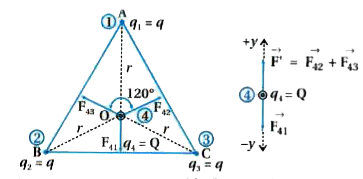 Here O is the centroid of an equilateral triangle `TRIANGLEABC` . Hence, OA = OB = OC = r ... (1) Electric repulsive forces exerted by `q_(1),q_(2), q_(3)`on `q_(4)` have same magnitudes each EQUAL to F because, `F_(41) = F_(42) = F_(43) =F = k(QQ)/r^(2)`......(2) Suppose, `vecF^(.) = vecF_(42) + vecF_(43)` `therefore F. = sqrt(F^(2) + F^(2) + 2F F cos (120^(@))` `(therefore F_(42) = F_(43) = F)` `=sqrt(2F^(2) + 2F^(2) (-1/2))` (`therefore` Angle between `vecF_(42)` and `vecF_(43)` is `theta = 120^(@)`) `=sqrt(F^(2))` =F.............(3) If resultant force exerted on `q_(4) =Q` is `vecF_(4)` then `vecF_(4) = vecF_(41) + vecF_(42) + vecF_(43)` `=vecF_(41) + vecF^(.)` `=F(-hatj) + F(hatj)` `therefore vecF_(4)=vec0` |
|
| 42205. |
A constant force (F) is applied on a stationary particle of mass 'm'. The velocity attained by the particle in a certain displacement will be proportional to |
| Answer» ANSWER :D | |
| 42206. |
The forbiden energy gap in Ge is 0.72 eV, Given , hc=1240 eV Å . The maximum wavelength of radiation that will generate electron hole pair is : |
|
Answer» `172220Å` `lamda=(hc)/E_g=(12400)/(0.72)=17222Å` |
|
| 42207. |
The trajectory of a body with two simultaneous, mutually perpendicular oscillations is determined by x=asin(pomegat)""(1) y=bsin(qomegat+phi)""(2) where x and y are the projections of the body displacement on X and Y axes For simplicity, assume pomega=qomega=omega_(0). Then, the equation of trajectory will be y^(2)/b^(2)+x^(2)/a^(2)-(2xy)/(ab)cosphi=sin^(2)phi""(3) which is a general equation of ellipse. But if qomeganepomegaandpneq, then the graph of trajectory on the X-Y plane is either a closed curve, whose loop number is defined by the ratio n = p/q, or an open curve. Note that at the point where the curve reverses along the same trajectory, the velocities along the X-axis and Y-axis become equal to zero simultaneously. The body moving along the curve stops exactly at this moment at a certain point, say P, and then starts moving back, If p = 2, q = 1 and phi=0, the path of trajectory of motion of the body with the above two oscillations (1) and (2) is |
|
Answer» an ellipse |
|
| 42208. |
In Young.s double slit experiment, 12 fringes are observed to be formed in a centain segment if wavelength of 600 nm is used. If the wavelength of light is changed to 400 nm, number of fringes observed in the same segment |
| Answer» ANSWER :B | |
| 42209. |
ताप में वृद्धि होने पर वाष्प दाब- |
|
Answer» समान रहेगा |
|
| 42210. |
If a ray of light is allowed to pass through a quartz crystal, then the two refracted rays obtained are |
|
Answer» plane POLARIZED and PLANES of polarization are parallel |
|
| 42211. |
In the following nuclear reaction, what does X stands for ? ""_(4)Be^(9)+""_(2)He^(4) rarr ""_(6)C^(12)+X |
|
Answer» Proton |
|
| 42212. |
A 4 muFcapacitor is charged by a 200 V supply. It is then disconnected from the supply, and is connected to another uncharged 2 µF capacitor. How much electrostatic energy of the first capacitor is lost in the form of heat and electromagnetic radiation? |
| Answer» SOLUTION :`2.67 XX 10^(-2)` J | |
| 42213. |
What kind of symmetry is there in electric field of electric dipole? |
| Answer» SOLUTION :The electric field of dipole is CYLINDRICALLY SYMMETRIC. | |
| 42214. |
Organ pipe A, with both ends open, has a fundamental frequency of 425 Hz. The fifth harmonic of organ pipe B, with one end open, has the same frequency as the second harmonic of pipe A. How long are (a) pipe A and (b) pipe B? |
| Answer» SOLUTION :`(a) 40.4 CM, (B) 50.4 cm` | |
| 42215. |
A person finds that the sun rays reflected by the still surface of water in a lake are polarized. If the refractive index of water is 1.327 the sun will be seen at the angle of .... with the horizon |
|
Answer» `57^(@)`  Using Brewster.s law. `N= tan theta_(p)` `1.327= tan theta_(p)` `:. theta_(p)=53^(@)` ANGLE made by the sun with the HORIZON `=90^(@)-theta_(p)` `=90^(@)-53^(@)` `=37^(@)` |
|
| 42216. |
Can the force on unit N- pole between two isolated unlike poles be zero at any point? |
| Answer» SOLUTION :No. At EVERY point on the line JOINING them the resultant force in non-zero. | |
| 42217. |
The given diagram indicates the energy levels of a certain atom. When the system moves from 2E level to E, a photon of wavelength 2 is emitted. The wavelength of photon produced during its transition from 4E/3 level of E is: |
|
Answer» `lambda//3` `lambda.=3lambda` |
|
| 42218. |
In the adjacent figure, if the incline plane is smooth and the springs are identical then the period of oscillation of this body is |
|
Answer» `2pi SQRT((M)/(2k))` |
|
| 42219. |
Power consumed in a bulb of 1000W and 220V when connected to 110 V mains = ......... |
|
Answer» 750 W `P_(1) = (V_(1)^(2))/(R) and P_(2) = (V_(2)^(2))/(R)` `THEREFORE (P_(2))/(P_(1)) = ((V_(2))/(V_(1)))^(2)` `therefore P_(2) = P_(1) xx ((V_(2))/(V_(1)))^(2) = 1000 xx ((110)/(220))^(2)= (1000)/(4)` `therefore P_(2) = 250 W ` |
|
| 42220. |
On which of the following factors the emf induced in the coil does not depend? No. of turns in the coil, resistance of the coil, rate of change of magnetic flux. |
| Answer» SOLUTION :RESISTANCE of the COIL | |
| 42221. |
(i) State the two Kirchhoff's laws. Explain briefly how these rules are justified.(ii) The current is drawn from a cell of emf E and internal resistance r connected to the networkof resistors each of resistance r as shown in the Fig.Obtain the expression for (a) thecurrent draw from the cell and (b) the power consumed in the network. |
Answer» Solution :(ii) The circuit diagram of network of resistors can be redrawn asshown in Fig. 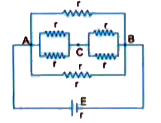 Obviously, here RESISTANCE of branch ACB is : `R. = (1)/((1/r + 1/r)) + (1)/((1/r + 1/r)) = r/2 + r/2 = r` Thus, effectively between A and B, we have three resistors each of value r. Hence effective resistance R between A and B will be `1/R = 1/r + (1)/(r.) + 1/r = 1/r + 1/r + 1/r = 3/r rArr R = r/3` As INTERNAL resistance of CELL is also r, hence (a)the current DRAWN from the cell `I = (E )/(R + r) = (E )/(r/3 + r) = (3E)/(4r)` and (b) power consumed in the network `P = I^2 R ( (3E)/(4r))^2 xx r/3 = (3E^2)/(16r) ` |
|
| 42222. |
Define magnetic permeability and magnetic susceptibility of a magnetic material . Determine the relation between magnetic permeability and magnetic susceptibility . |
|
Answer» |
|
| 42223. |
There is a sample containing 16g of radioactive material, the half-life of which is 2 days. What is the amount of sample left after 32 days: |
|
Answer» Solution :`m/m_(0)=(1/2)^(t/T)` T=2 days and t=32 days `m/m_(0)=[1/2]^((32)/(2)) =[1/2]^(16)` `m=m_(0) [1/2]^(16)=16 xx 1/(2^(16))=(1)/(4096)g` `approx 0.24 mg LT 1 mg` |
|
| 42224. |
Which of these particles having the same KE has the largest de Broglie wavelength |
|
Answer» electron |
|
| 42225. |
(a) Using the Bohr's model calculate the speed of the electron in a hydrogen atom in the n = 1, 2, and 3 levels. (b) Calculate the orbital period in each of these levels. |
|
Answer» Solution : (a) As per Bohr.s model speed of electron is given by `v_(N) = (e^(2))/(2 in_(0) n H) ` . where `e = 1.6 xx 10^(-19) C, epsi_(0) 8.85 xx 10^(-12)C^(2) N^(-1) m^(-2) and h = 6.63 xx 10^(-34) JS` `therefore"" v_(1) = (e^(2))/(2 in_(0) (1)h) = ((1.6 xx 10^(-19))^(2))/(2xx8.85 xx 10^(-12) xx 6.63 xx 10^(-34)) = 2.18 xx 10^(6) m s^(-1)` ` v_(2) = (v_(1))/(2) = 1.09 xx 10^(6) m s^(-1) and v_(3) = (v_(1))/(3) = 7.27 xx 10^(5) ms^(-1)` (B)Orbital period` T = (2pi r_(n))/(v_(n))= (2pi xx ((in_(0) n^(2) h^(2))/(pi m e^(2))))/(((e^(2))/(2 in_(0) n h))) = (4 in_(0)^(2) n^(3) h^(3))/(m e^(4))` `therefore"" T_(1) = (4 xx (8.85 xx 10^(-12)) xx (1)^(2) xx (6.63 xx 10^(-34))^(3))/((9.1 xx 10^(-31)) xx (1.6 xx 10^(-19))^(4)) = 1.52 xx 10^(-16)s` `T_(2) = T_(1) xx(2)^(3) = 1.52 xx 10^(-16) xx 8 = 1.22 xx 10^(-5)` and `T_(3) = T_(1) xx (3)^(3)= 1.52 xx 10^(-16) xx 27=4.11 xx 10^(-15)s` |
|
| 42226. |
A wave propagates on a string in positive x-direction with a speed of 40 cm/s. The shape of string at t =2s is y =10 cos x/5,where x and y are in centimeter. The wave equation is |
|
Answer» `y = 10 cos(x/5 -8t)` |
|
| 42227. |
We know that electric field is discontinuous across the surface of a charged conductor. Is electric potential also discontinuous there? |
| Answer» Solution :No, electric POTENTIAL is not discontinuous like electric field. If we consider a charged CONDUCTOR (SAY a spherical shell) then potential at each POINT inside the spherical shell is same as that on its outer surface. | |
| 42228. |
A semiconductor is known to have an electron concentration of 8 xx 10^(12)//cm^3and hole concentration of 5 xx 10^(12) //cm^3. The semiconductor is |
|
Answer» n-type |
|
| 42229. |
The net charge flow between points A and B when the switch is closed in the given circuit and the final potential points Q, P and B are |
|
Answer» q = 3 CE |
|
| 42230. |
A cell whose emf is 2V and thermal resistance is 0.1Omega is connected with a resistance of 3.9Omega. The voltage across the terminals of the cell will be: |
|
Answer» 1.95 V |
|
| 42231. |
There are basic modes of communication point and broadcasting name any other two modes of propagation of radio wave in communication |
| Answer» SOLUTION :SPACE WAVE and GROUND wave | |
| 42232. |
Which is due to the change in wave speed when a wave strikes the boundary to another medium? |
|
Answer» Reflection |
|
| 42233. |
A equiangular glass prism of Refractive index 1.6 is kept fully immersed in water of refractive index 4/3, for a certain ray of monochromatic light. What is the closest value for the angle of minimum deviation of the light ray in this setup ? ("Take sine" 37^(@) = 0.6). |
|
Answer» `10^(@)` `rArr .^(w)mu_(g)=(sin""(60^(@) + delta_(m))/(2))/(SIN30^(@))` `rArr (1.6)/(4//3)XX(1)/(2)=sin((60^(@) + delta_(m))/(2))` `rArr delta_(m) = 14^(@)`. |
|
| 42234. |
Explain what would happen if in the capacitor given in Exercise, a 3 mm thick mica sheet (of dielectric constant = 6) were inserted between the plates, (a) while the voltage supply remained connected. (b) after the supply was disconnected. |
|
Answer» Solution :(a) V = 100 V, C = 108 pF, `Q = 1.08 xx 10^(-8)` C (b) `Q = 1.8 xx 10^(-9) C, C= 108pF, V = 16.6 V` |
|
| 42235. |
A bulb of 100 W electrical power emits visible light with 3% efficiency. Find amplitude of oscillations of electric field at 5 m from the bulb. |
| Answer» SOLUTION :`E_(0)=2.683(N)/(C )` | |
| 42236. |
A metal wire of area of cross-section 1.8xx10^(-7)m^(2) and specific resistance 9xx10^(-6)Omega-mis bent into a square loop and moved with a constant speed in a uniform magnetic field of induction 2Wb//m^(2). What should be the speed of loop so that a current of 3mA passes through it ? |
|
Answer» `7.5m//s` |
|
| 42237. |
A body is thrown up from the top of a tower with some velocity reaches the ground in 16 second. The same body if thrown with same velocity in downward direction reaches the ground in 4 second. If the body is just dropped from the tower, then it will reach the ground in time: |
|
Answer» 10 s |
|
| 42238. |
A : In Young.s double slit expriment the band width for red colour is more R : Wavelength of red is small among the colours of white light. |
|
Answer» Both A and R are true and R is the correct EXPLANATION of A |
|
| 42239. |
Whatis meantby electrostatic energydensity ? |
| Answer» SOLUTION :The energy stored per unit VOLUME of space is defined as energy density `u_E = U/("volume")` From EQUATION, `u_E = 1/2((epsilon_0A))/d(Ed)^2 = 1/2epsilon_0(AD) E^2 or u_E = 1/2 epsilon_0E^2` | |
| 42240. |
Why did Yayati go to the garden of Kubera? |
|
Answer» to GET more SENSUAL satisfaction |
|
| 42241. |
Explain the effective internal resistance of cells connected in parallel combination. Compare the results to the external resistance. |
Answer» Solution :Cells in SERIES Several cells can be connected to form a battery. In series connection, the NEGATIVE terminal of one cell is connected to the positive terminal of the second cell, the negative terminal terminal of second cell is connected to the positive terminal of the third cell and so on. The free positive terminal of the first cell and the free negative terminal of the last cell become the terminals of the battery.  SUPPOSE n cells, each of emf `xi` volts and internal resistance r ohms are connected in series with an external resistance R. The total emf of the battery `=n xi` The total resistance in the circuit `=nr+R` By Ohm.s law, the current in the circuit is `I=("total emf")/("total resistance")=(n xi)/(n r +R)"" ...(1)` Case (a) If `r lt lt R`, then, `I=(n xi)/(R) nI_(1)=nI_(1)"" ...(2)` where, `I_(1)` is the current due to a single cell `(I_(1)=(xi)/(R))` Thus, if r is negligible when compared to R the current supplied by the battery is n TIMES that supplied by a single cell. Case (b) If `r gt gt R "" I=(n xi)/(nr)=(xi)/(R )"" ...(3)` It is the current due to a single cell. That is, current due to the whole battery is the same as that due to a single cell and hence there is no advantage in CONNECTING several cells. Thus series connection of cells is advantageous only when the effective internal resistance of the cells is negligibly small compared with R. |
|
| 42242. |
A charged sphere of mass m and charge -q starts sliding along the surface of a smooth hemispherical bowl, at position P. The region has a transverse uniform magnetic field B. Normal force by the surface of bowl on the sphere at position Q is |
|
Answer» `mg sin THETA+qBsqrt(2gRsin theta)`  `v=sqrt(2gRsintheta)` and `""F=qvB` Now `N-(F+mgsin theta)=(mv^(2))/(R)` `:. ""N=F+mg sin theta+(mv^(2))/(R)` `=qBsqrt(2gRsin theta)+mg sin theta+2mg sin theta` `:. "" N=3 mg sin theta+qBsqrt(2gRsin theta)` |
|
| 42243. |
In electron microscope 25 kV voltage is used to accelerate electron .By changing voltage to 100 kV de-Broglie wavelength becomes.. |
|
Answer» INCREASES by two times `IMPLIES(lambda_(1))/(lambda_(2))=sqrt((V_(2))/(V_(1)))=sqrt((100kV)/(25kV))=2` `implieslambda_(2)=(lambda_(1))/(2)` |
|
| 42244. |
The mass and volume of a block of material are 4.237 g and 2.5cm^(3) respectively. The density of material of the block in correct significant figures is : |
|
Answer» `1.6045gcm^(-3)` |
|
| 42245. |
If a charged conductor is enclosed by a hollow charged conducting shell (assumed concentric and spherical in shape), and they are connected by a conducting wire, then which of the following statement (s) would be correct ? |
|
Answer» Potential difference between the two conductors becomes zero. `V_(I) - V_(II) = (q_(1)/(4 pi epsilon_0 R_1) + q_(2)/(4 pi epsilon_0 R_2)) - ((q_1 _ q_2)/(4 pi epsilon_0 R_2))` `V_(I) - V_(II) = q_(1)/(4 pi epsilon_0) [(1)/R_(1)- (1)/R_(1)]` As two conductors are connected, transfer of charge takes place from one conductor to other till both acquire same potential, i.e., here `V_I - V_II = 0`. Potential difference depends only on `q_1` (charge of inner conductor), so `V_I - V_II = 0`, where `q_1 = 0`, i.e., TOTAL charge is transferred to the outer conductor. 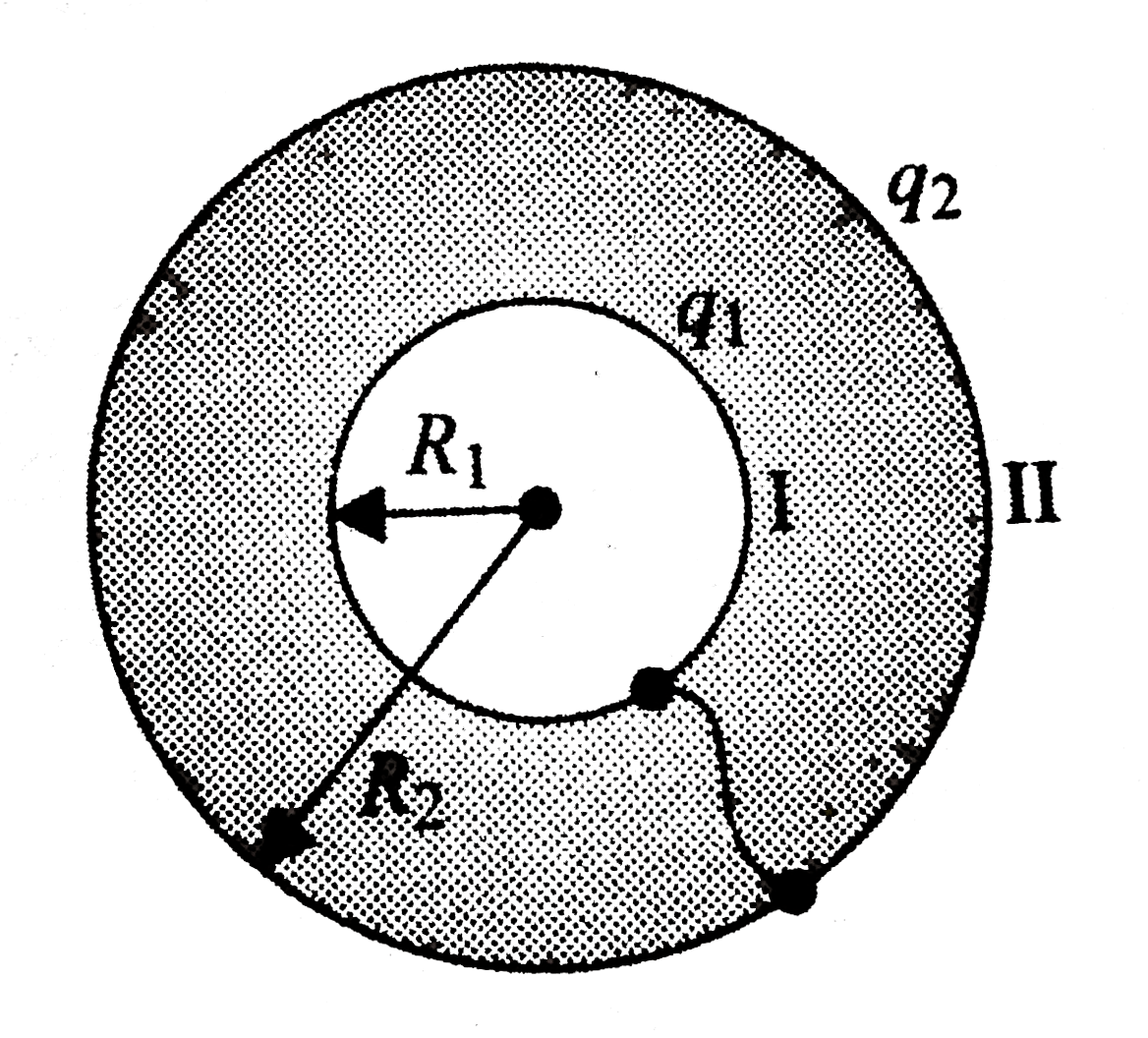
|
|
| 42246. |
An electron moves with a constant speed v along a circle of radius r. Its magnetic moment will be (e = eletronic charge) |
|
Answer» `evr` |
|
| 42247. |
In the system shown in the figure, which the following is correct? (Pulleys and strings are of negligible mass) |
|
Answer» The system can NEVER be in EQUILIBRIUM |
|
| 42248. |
What is motional electromotive force ? |
| Answer» SOLUTION :The amount of e.m.f induced across a moving conductor is an uniform magnetic FIELD is CALLED MOTIONAL e.m.f. | |
| 42249. |
If the bar magnet in exercise 5.13 is turned around by 180^@, where will the new null points be located? |
Answer» Solution :When BAR MAGNET given in above example is turned around by 180° such that its poles get interchanged, we obtain new null points `N_1 and N_2` on the equator of bar magnet in the plane of figure, suppose at distance y from the centre of magnet. See the figure given below.  At null points `N_1 and N_2`, we have `THEREFORE (mu_0)/( 4 pi) ((m) /( y^3) )= (mu_0)/( 4pi) ((2m)/( r^3))""`[From equation (1) of above example] `therefore y^(3)= (r^3)/( 2)` `therefore y= (r)/( 2^(1//3)) ` `therefore y= (14)/( 1.2599) = 11.112` CM Note : Here all the points located on the circle of radius y in the equatiorial plane of a bar magnet are ALSO null points along with points `N_(1) and N_(2)`. |
|
| 42250. |
In a metre bridge the length of the wire is 100 cm. At what point will the balance point be obtained if the two resistances are in the ratio of 4:5. |
|
Answer» |
|