

Saved Bookmarks
This section includes InterviewSolutions, each offering curated multiple-choice questions to sharpen your knowledge and support exam preparation. Choose a topic below to get started.
| 42101. |
The critical angle for total internal reflection for a substance is 45^@ . What is the polarizing angle for this substance? |
| Answer» SOLUTION :`TAN^(-1) SQRT2` | |
| 42102. |
The dielectric permittivity of gaseous argon at standard conditions is 1.00054. Find the dipole moment of an argon atom in an electric field of 10 kV/m. Compare with the dipole moment of a water molecule. |
|
Answer» Solution :A characteristic feature of the INERT gases is their DEFORMATION polarizability. From the formulas of 38.5 we have `che_(e)=n alpha` where `n=p//kT` is the ATOMIC concentration and a is the polarizability of the atom. The dipole MOMENT of an atom in an electric field is `pe=alpha epsi_(0)E=(1)/(n) chi_(e)epsi_(0)E` The atomic concentration at standard conditions is Loschmidt number). Hence `pe=(chi_(e)epsi_(0)E)/(N_(L))=((epsi-1)epsi_(0)E)/(N_(L))` Calculations show that even in such strong fields the dipole moment of an argon atom is six orders of magnitude smaller than that of a water MOLECULE |
|
| 42103. |
Figure show two reservoirs containing two liquids of masses 4m and 2m and their specific heat capacities are S and 2S respectively. Their initial temperatures are 4T_(0) and T_(0) respectively. The containers are joinedby a conducting K, length l and cross section area A specific heat capacity of the rod is negligible. |
|
Answer» The TEMPERATURE of mid-point `'P'` of the ROD is always constant. On solving we get `/_\T_(F)=/_\T_(i)e^((-KAt)/(2msl))` Temperature of point `P` remains constant |
|
| 42104. |
In Young's double slit experiment , two wavelengths lamda_1 = 780 nmand lamda_2 = 520 nm are used to obtain interference fringes. If the n^(th) bright band due to lamda_1 coincides with (n+1)^(th) bright band due to lamda_2, then the value of n is |
|
Answer» 4 `""^(n)beta_(1)=(n+1)beta_(2)` `(nlamda_(1)D)/d=(n+1)(lamda_(2)D)/d` `nlamda_(1)=(n+1)lamda_(2)` `(n+1)/n=lamda_(1)/lamda_(2)=780/520` `52n+52=78n` 26n = 52 n = `52/26` = 2 |
|
| 42105. |
In the figure S_(1)and S_(2)are identical springs. The oscillation frequency of the mass m is f. If one spring is removed, the frequency will become |
|
Answer» f As per question, the two springs are in PARALLEL in horizontal position, EFFECTIVE force constant = 2K, `f=1/(2pi) sqrt((2K)/m), , f. =1/(2pi) sqrt(K/m)` When ONE spring is removed, `f.= f/sqrt(2)` |
|
| 42106. |
How much greater is one micro coulomb compared to an electronic charge? |
|
Answer» `10^13` TIMES |
|
| 42107. |
Which of the following has highest specific heat ? |
|
Answer» Water |
|
| 42108. |
A proton is moving perpendicular to a uniform magnetic field of 2.5 tesla with 2MeV kinetic energy. The force on the proton is ______ . |
|
Answer» `8XX10^(-11)` `thereforev=SQRT((2k)/m)` Now, F = Bqv = `Bexxsqrt((2k)/m)` = `2.5xx1.6xx10^(-19)sqrt((2xx2xx10^(6)xx1.6xx10^(-19))/(1.6xx10^(-27)))` = `4xx10^(-19)xxsqrt(4xx10^(6)xx10^(8))` = `4xx10^(-19)xx2xx10^(7)` `thereforeF=8xx10^(-12)N` |
|
| 42109. |
A coil of reistance 5Omega and inductance 1H is connected to a battery of 10V. At t = 0s, calculate (i) the current in the circuit (ii) the rate of rise of current (iii) the rate at which energy is supplied by the battery, (iv) the rate at which energy is dissipated as heat and (v) the rate at which energy is stored in the magnetic field of the coil. |
|
Answer» |
|
| 42110. |
A very small circular loop of radius a is initially (at t = 0) coplanar and concentric with a much larger fixed circular loop of radius b. A constant current I flows in the larger loop. The smaller loop is rotated with a constant angular speed omega about the common diameter. The emf induced in the smaller loop as a function of time t is |
|
Answer» `(pi a^(2)mu_(0)I)/(2B)omega cos (omega t)` The magnetic field at the common centre due to the current in LARGER loop is `B_(l)=(mu_(0))/(4pi)(2pi I)/(b)=(mu_(0)I)/(2b)` where SUBSCRIPT l refers to larger loop. The magnetic flux linked with the smaller loop at time t is `phi_(s)=B_(l)A_(s)cos omega t` where subscript s refers to smaller loop. `phi_(s)=(mu_(0)I)/(2b)pi a^(2)cos omega t` The emf induced in the smaller loop is `epsilon_(s)=-(d PHI)/(dt)=-(d)/(dt)((mu_(0)I pi a^(2))/(2b)cos omega t)=(mu_(0)I pi a^(2))/(2b) omega sin omega t` 
|
|
| 42111. |
Find the energy eqivalent of one atomic mass unit, first in Joules and then in MeV. Using this express the mass defect of ""_8^16O in MeV//e^2. |
|
Answer» Solution :`1u = 1.6605 xx 10^(-27) kg` To CONVERT it into energy UNITS, we multiply it be `c^2` and FIND that energy equivalent `=1.6605 xx 10^(-27) xx (2.9979 xx 10^8) kg m^2//s^2 = 1.4924 xx 10^(-10)J` `= (1.4924 xx 10^(-10))/(1.602 xx 10^(-19)) eV = 0.9315 xx 10^9 eV = 931.5 MeV` Or, `1u = 931.5 MeV//c^2` For `""_8^16O, DeltaM = 0.1369 u = 0.13691 xx 931.5 MeV//c^2 = 127.5 MeV//c^2` The energy needed to SEPARATE `""_8^16O` into its constituents is thus `127.5 MeV//c^2`. |
|
| 42112. |
Long distance communication betwwen two points on earth is achieved by |
|
Answer» Space wave COMMUNICATION |
|
| 42113. |
Whatis rectification? Withrelevantcircultdiagramand waveformsexplaintheworkingof p- njunction diode asa fullwave rectifier. |
|
Answer» SOLUTION :Fullwaverectification: Theprocessin whichboththe halvesof a.care reactifiedto obtainapulsatingdirectcurrentis knownasfullwaverectification. A transformerwitha centretapis usedfor afullwaverectification. INputcontainsac.A minimumof twodiodes are usedat thesecondart of thetransformer. A loadresistorisconnected BETWEENTHE juctionof theN typesemiconductorbetweenthejuctionof theN typesemiconductorandthecentretap. Duringthe firsthalfcycle, diode`D _(1)`will beforwardbiased and `D_(2)`will bereverseso thatthecurrentflowsfromBto centretap . 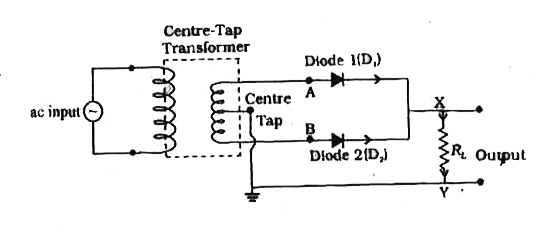 Duringthe secondhalfcycle, diode, `D_(2)`will beforwardbiasedwhile `D_(1)`will bereversebiased . The currentonceagaintakesthe samedirectionfromB tocentretap.theI/Pand the O/Pwaveformsare shownin fig . TheaverageDCis`2((V_P)/(pi )).` 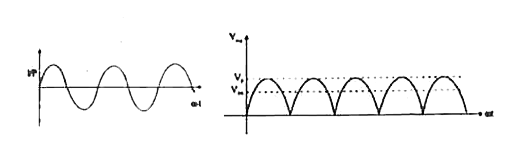
|
|
| 42114. |
The size of the image of an object, which is at infinity, as formed by a convex lens of focal length 30cm is 2 cm. If a concave lens of focal length 20 cm is placed between the convax lens and the image at a distance of 26 cm from the convex lens, calculate the new size of the image. |
|
Answer» `1.25 cm` `I_(1)` actsas virtual objectfor concavelens. Concavelens FORMS the image of`I_(1)` at `I_(2)`.  Lens formula: `1/V - 1/u = 1/f` For concave lens, `1/v - (1)/(4) = - (1)/20` or `1/v = -(1)/(20) + 1/4 = 4/20 = 1/5` or `v = 5 cm` = Distance of `I_(2)`from concavelens. `:. "Magnification" = v/u = ("size of image")/("size ofobject") = 5/4` `:. ("size of image")/(2) = 1.25` `:.` size of image due to concave lens `= 2.5 cm` |
|
| 42115. |
A single turn cirular coil is connected to a cell as shown. Magnetic field at the centre O of the coil is |
| Answer» Solution :`2 pi l` | |
| 42116. |
A point mass of -q mass m is released form rest form a distance R along the axis of a uniform circular disc of charge Q Assuming gravity free situation the velocity attained by point mass when it reaches centre of disc is (Radius of disc-R) |
|
Answer» <P>`{((sqrt(2)Qqsqrt(2)-1))/(piepsilon_(0)mR)}^(1//2)` 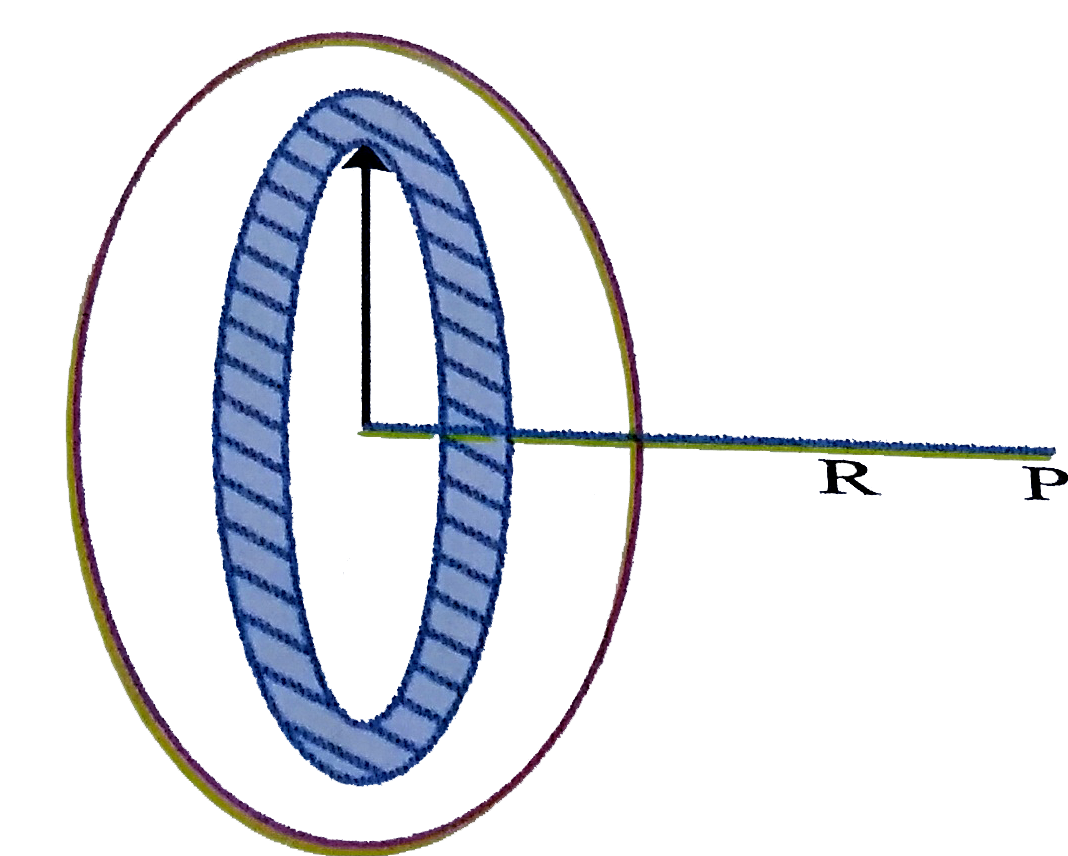 The charge on the SHADED part `dQ=(Q)/(piR^(2))2pirdr=(2Q)/(R^(2)r(dr)` POTENTIAL DUE to `dQ` at `P` `dV=(2Q)/(R^(2))=((r)(dr))/(4piepsilon_(0)sqrt(R^(2)+r^(2)))=(Q)/(2piepsilon_(0)R^(2))(rdr)/(sqrt(R^(2)+r^(2)))` `V=(Q)/(2piepsilon_(0)R^(2))int_(0)^(R)(rdr)/(sqrt(R^(2)+r^(1)))(Q)/(2piepsilon_(0)R^(2))(sqrt(R^(2)+r^(2)))_(0)^(R)` `=(Q)/(2piepsilon_(0)R^(2))(sqrt(2)-1)R=(Q(sqrt(2)-1))/(3piepsilon_(0)R)` `rArr U` of `-q=(-Qq(sqrt(2)-1))/(2piepsilon_(0)R)` Similarly the potential due to `dQ` at CENTRE of disc is `dV=(2Q)/(R^(2))(r(dr))/(4piepsilon_(0))=(Q)/(2piepsilon_(0)R^(2))dr` `V=(Q)/(2piepsilon_(0)R)rArr (1)/(2)mv^(2)-(Qq)/(2piepsilon_(0)R)` `rArr (1)/(2)mv^(2)=(qQ)/(2piepsilon_(0)R)(1-sqrt(2)+1)` `rArr (1)/(2)mv^(2)=(Qq)/(2piepsilon_(0)R)(2-sqrt(2))` `rArr (1)/(2)mv^(2)=((Qq)sqrt(2)(sqrt(2)-1))/(2piepsilon_(0)R)V=[(sqrt(2)Qq(sqrt(2)-1))/(piepsilon_(0)mR)]^(1//2)` |
|
| 42117. |
Name two factors on which mutual inductance between a pair of coils depends? |
| Answer» SOLUTION :NUMBER of turns in the coils, area of SECONDARY COIL. | |
| 42118. |
Two metals balls of the same radius a are placed in a homogenous poorly conducting media with resistivity rho. Find the resistance if they are separated by a large distance. [Hint: Use j=sigmaE to evaluate total current through mid-plane and then use V=IR] |
|
Answer» |
|
| 42119. |
Which of the following serves as a quick referral systems in taxonomical studies ? |
|
Answer» Museum |
|
| 42120. |
What is electrical resistance ? Its value depend on which factors ? |
|
Answer» Solution :`rArr` Property of opposing flow of charge in conductor is called resistivity. `rArr ` From OHMS law R = `(V)/(I)`.Its unit is `("Volt")/("Amp")` = ohm`(Omega)` . Its dimensional formula is `M^(1) L^(2) T^(-3) A^(-2)`. `rArr ` Consider a conductro with LENGTH. l and area A as shown in figure (a).  `rArr` Such two similar rectangular block are shown in figure (b). Here, length of combination will be 2L `rArr` Current flowing through combination of block will be EQUAL to current flowing through each block. Hence, potential difference between two ends of each block will be V only. ` rArr` So for total two block potential differenc between ends of combination will be 2V. ` rArr` Let resistance combination of blocks be `R_(C)`the by Ohm.s law, `R_(C) = (2V)/(I)` = 2R ....(1) where `(V)/(I)= ` R = reistance of each block `rArr` Thus, reistance of conductor is proportional its length. By making length double resistance will become double. `therefore R prop l "" `....(2) `rArr` let given block is cut into two equal parallel to length. in this case length of each part will be l and cross-section area will be `(A)/(2)`  ` rArr ` Now blocks are arranged as shown in figure (c). Let potential difference between end o! combination be V and current flowing througt- combination be I then current flowing through `rArr` each part will be `(I)/(2)`. `rArr` Let resistance of each block be `R_(1)` then by Ohm law, ` R_(1) = (V)/((I)/(2)) = (2V)/(I) = 2R "....(3)" [ because (V)/(I) = R ] ` `rArr` Thus, resistance of conductor is inversely proportional to its cross-sectional area, by changing cross-section area to `((A)/(2))` resistance will become double. `therefore R prop (1)/(A)""` ....(4) where A = cross-section area comparing equation (2) and (4), Resistance of given conductor. `R prop (l)/(A)` `therefore R = rho (l)/(A) "" `....(5) `rArr` Thus, resistance of conductor depends on its length, cross-sectional area and type of material. p is proportionally constant. It is called resistivity. |
|
| 42121. |
The penetrating power of X-rays can be increased by |
|
Answer» INCREASING the current in the filament |
|
| 42122. |
The variation of terminal potential difference (V) with current flowing through a cell is as shown. The emf and internal resistance of the cell are |
|
Answer» `6 V, 2Omega` `:.` E = V = 3 V When V = 0, I = 6 A `rArr` r = `E/I = 3/6 = 0.5 Omega` |
|
| 42123. |
The radioactive isotope D decays according to the sequence Doverset(beta^(-))(to)D_(1)overset(alpha-"particle")(to)D_(2) If the mass number and atomic number of D, are 176 and 71 respectively, what is (i) the mass number (ii) atomic number of D ? |
| Answer» Solution :As `D_(2)` is `" "_(71)^(176)D`, HENCE `D_(1)` should be `" "_(73)^(180)D`, and D should be `" "_(72)^(180)D` | |
| 42124. |
The following equations give the position x(t) of a particle in four situations : (1) x= 3t-4, (2) x= -5t^(3)+4t^(2)+6 , (3) x= 2//t^(2)-4//t, (4) x=5t^(2)-3. To which of these situations do the equations of Table 2-1 apply ? |
|
Answer» |
|
| 42125. |
(A) : Displacement current is a fictitious current and has nothing in common with the conduction current. (R) : Displacement current was proposed by Maxwell only to satisfy K irchhoff’s junction rule. |
|
Answer» Both 'A' and 'R' are TRUE and 'R' is the CORRECT EXPLANATION of 'A'. |
|
| 42126. |
The time period of a simple pendulum in a stationary train is T. The time period of a mass attached to a spring is also T. The train accelerates at the rate 5 m//s^(2). If the new time periods of the pendulum and spring be T_(P) and T_(S) respectively, then :- |
|
Answer» <P>`T_(P)=T_(S)` |
|
| 42127. |
The value of 1 Mev is equal to : |
|
Answer» `1XX10^(-19)J` |
|
| 42128. |
A sinusoidal voltage of Peak value 200 volt is connected to a diode and resistor R in the circuit shown so that half wave rectification occurs . If the forward resistance of the diode is negligible compared to R the rms (in volt) across R is approximately |
|
Answer» 200 |
|
| 42129. |
The light emitting diode (LED) is |
|
Answer» A)a heavily doped p-n junction with no external BIAS |
|
| 42130. |
A curved surface of radius R separates two medium of refractive indices mu_(1) and mu_(2) as shown in figures A and B Choose the correct statement(s) related to the real image formed by the object O placed at a distance x, as shown in figure A |
|
Answer» Real image is always formed IRRESPECTIVE of the position of object if `mu_(2) gt mu_(1)` |
|
| 42131. |
Activity of a certain radioactive sample is 25 muCi at the end of 20 days and 6.25 mu Ci at the end of 40 days. What will be its activity at the end of 30 days? |
|
Answer» Solution :We know that `A=A_(0)e^(lambda t)=(A_(0))/(2^(n)), n-(t)/(T)` given,`25=(A_(0))/(2^((20//T))` and`6.25=(A_(0))/(2^((40//T))` `(1)DIV(2),` we get `2^(2)=2^([40//T-20//T])` `"i.e.,"(40)/(T)-(20)/(T)=2` `(20)/(2)=T` `THEREFORE ""T=10` days Initial activity`=25=(A_(0)/(2^(20//10)))` `"i.e.,"A_(0)=25xx4=100 mu Ci` `therefore` Activity of the sample at the end of 30 days will be, `A=(10)/(2^(30//10))=(110)/(8)=12.5 mu Ci`. |
|
| 42132. |
Imagine a hypothetical material whose average temperature coefficient of linear expansion is 0.1//.^@C .Find the fractionalincrease in area of thin square plate of above material when temperature is increase by 10^@C |
|
Answer» |
|
| 42133. |
When a pieace of a ferromagnetic substance is put a uniform magnetic fieldthe flux density inside it isthe magneticpermeability of the material is |
|
Answer» 1 |
|
| 42134. |
The r.m.s. velocity of molecules each of mass1.4xx10^(-19) kg at27@C is nearly |
| Answer» Answer :A | |
| 42135. |
The output of a dynamo using a splitting commutator is |
|
Answer» DC |
|
| 42136. |
The output of an AND gate is connected to both the inputs of a NOR gate , then this circuit will act as a |
|
Answer» OR GATE |
|
| 42137. |
A medium is not required for transfer of thermal energy from one body to another body is |
|
Answer» conduction |
|
| 42138. |
Which series of hydrogen spectrum lies in visible region ? |
|
Answer» LYMAN SERIES |
|
| 42139. |
What is space communication? |
| Answer» SOLUTION :SPACE communication means the PROPAGATION of radio WAVES into the space and their reception by the receiver. | |
| 42140. |
A car of mass m = 1000 kg is moving with constant speed v = 10 m/s on a parabolic shaped bridge AFOE of span l=40m and height h = 20 m as shown in the figure. Then the net force applied by the bridge on the car when the car is at point F, is |
|
Answer» `5000 sqrt((5)/(2))N`  So, slope at `F=(dy)/(dx)=(2x)/(20)=(2xx10)/(20)=1` At point F, `mg=(1)/(sqrt(2))-N=(mv^(2))/(R)` `N=(mg)/(sqrt(2))-(mv^(2))/(R) and f_(s)=(mg)/(sqrt(2))` At F, `R=((1+1)^(3//2))/((1)/(10)) = 20 sqrt(2)` (metre) `N=(10m)/(sqrt(2))-(100m)/(20sqrt(2))=(5m)/(sqrt(2))` `f_(s)=(20m)/(sqrt(2))` `because ` Net force `=m sqrt((25)/(2)+(100)/(2))=5m sqrt((5)/(2))N` |
|
| 42141. |
In experiment of a-scattering if thickness of foil is changed from 2xx10^(-7)m to 2.5xx10^(-6) m what will be increase in number of alpha- particle scatered ? |
|
Answer» about 12 times Thickness of foil a NUMBER of a-particles (N) `Nalphat` `:.(N_(2))/(N_(1))=(t_(2))/(t_(1))=(2.5xx10^(-6))/(2xx10^(-7))=12.5=12` |
|
| 42142. |
Statement 1: The poles of a magnet cannot be separted by breaking it into two pieces Statement2: The magnetic moment of a bar magnetwill be reduced to half when a bar magnet is broken into two equalparts |
|
Answer» STATEMENT -1 is true statement -2is true statement -2 is a correct eaplanatio for statement -1 |
|
| 42143. |
Answer the following: (a) The top of the atmosphere is at about 400 kV with respect to the surface of the earth, corresponding to an electric field that decreases with altitude. Near the surface of the earth, the field is about 100 Vm^(-1). Why then do we not get an electric shock as we step out of our house into the open? (Assume the house to be a steel cage so there is no field inside!) (b) A man fixes outside his house one evening a two metre high insulating slab carrying on its top a large aluminium sheet of area 1m^(2) . Will he get an electric shock if he touches the metal sheet next morning (c) The discharging current in the atmosphere due to the small conductivity of air is known to be 1800 A on an average over the globe. Why then does the atmosphere not discharge itself completely in due course and become electrically neutral? In other words, what keeps the atmosphere charged?(d) What are the forms of energy into which the electrical energy of the atmosphere is dissipated during a lightning? (Hint: The earth has an electric field of about 100 Vm^(-1)at its surface in the downward direction, corresponding to a surface charge density = –10^(–9) Cm^(–2). Due to the slight conductivity of the atmosphere up to about 50 km (beyond which it is good conductor), about + 1800 C is pumped every second into the earth as a whole. The earth, however, does not get discharged since thunderstorms and lightning occurring continually all over the globe pump an equal amount of negative charge onthe earth.) |
|
Answer» Solution :(a) Our body and the GROUND form an equipotential surface. As we STEP out into the open, the original equipotential SURFACES of open air change, keeping our head and the ground at the same potential. (B) Yes. The steady discharging current in the atmosphere charges up the aluminium sheet GRADUALLY and raises its voltage to an extent depending on the capacitance of the capacitor (formed by the sheet, slab and the ground). (c) The atmosphere is continually being charged by thunderstormsand lightning all over the globe and discharged through regions of ordinary weather. The two opposing currents are, on an average, in equilibrium. (d) Light energy involved in lightning, heat and sound energy in the accompanying thunder. |
|
| 42144. |
1. What are the equations for C,E and V of a cylindrical plate capacitor |
|
Answer» (III) (II) (L) |
|
| 42145. |
Which of the following rays has minimum frequency? |
|
Answer» U.V rays |
|
| 42146. |
Two prisms A and B have dispersive powers of 0.012 and 0.018 respectively. The two prisms are in contact with each other. The prism A produces a mean deviation of 1.2^(@), the mean deviation produced by B if the combination is achromatic is |
|
Answer» `3.6^(@)` |
|
| 42147. |
Who is the poet of the poem "Fire and Ice"? |
|
Answer» ROBERT Charles |
|
| 42148. |
A body moves with uniform acceleration. If , U, and 1, be the average velocities in three successive intervals of time , and I, then |
|
Answer» `V_1 -v_2:v_2-v_3 =t_1- t_2 :t_2+t_3` |
|
| 42149. |
An infinitely long conductor PQR is bent to form a right angle as shown. A current I flows through PQR. The magnetic field due to this current at the point Mis B, Now another infinitely long straight conductor QS is connected to Q so that the current is 1/2 in QR as well as in QS, the current in PQ remaining unchanged. The magnetic field at M is now B. The ratio B/B, is given by |
| Answer» ANSWER :C | |
| 42150. |
What si meant by Self inductance and Mutual Inductance ? |
| Answer» SOLUTION :The phenomenon in which an emf induced in a coil due to the change of current through it is called self induction. The S.I. unit of self INDUCTANCE is Henry (H). 1 The phenomenon in which a change of current in one coil INDUCES an emf in ANOTHER coil placed in its proximity is called mutual inductance. | |