Saved Bookmarks
This section includes InterviewSolutions, each offering curated multiple-choice questions to sharpen your knowledge and support exam preparation. Choose a topic below to get started.
| 44601. |
A freshly prepared radioactive sample of half-life 4 hours emits radiation of intensity which is 64 times the safe level. The minimum hours after which it would be safe to work with it is |
|
Answer» 4 |
|
| 44602. |
A toroid has a core (non-ferromagnetic) of inner radius 25 cm and outer radius 26 cm, around which 3500 turns of a wire are wound. If the current in the wire is 11 A, what is the magnetic field (a) outside the toroid, (b) inside the core of the toroid, and ( c) in the empty space surrounded by the toroid. |
Answer» Solution :(a)  Applying Ampere-Maxwell circuital law to Amperean loop-1 (outside the toroid) `ointvecB*vec(dl)=mu_(0)(sumI)` = `mu_(0)(-NI+NI)` = 0 `thereforeB=0` (Outside the toroid) (b) Magnetic FIELD inside the toroid (which has the volume and shape like circular inflated TUBE also called toroidal region) is, `B=mu_(0)NI` = `mu_(0)(N/(2pir))I""("Where "r=(r_(1)+r_(2))/2)` `thereforeB=((4pixx10^(-7))(3500)(11))/((2pi)((0.25+0.26)/2))` `thereforeB=3.02xx10^(-2)T` (In a direction, tangential to a circle of radius r, inside the toroid) ( C) Applying Ampere-Maxwell circuital law to Amperian loop-2, surrounded by toroid, `ointvecB*vec(dl)=mu_(0)(sumI)` = `mu_(0)(0)` = 0 `thereforeB=0` (In the region surrounded by toroid) |
|
| 44603. |
A positive charge of 1.5 muC is moving with a speed of 2 xx 10^(-6) ms^(-1) along the postive X-axis. A magnetic field,vec(B) = (0.2 hat(j) + 0.4 hat(k)) tesla acts in space. Find the magnetic force acting on the charge. |
|
Answer» SOLUTION :Here q = 1.5`mu`C = 1.5 `xx 10^(-6)` C `vec(V) = 2xx 10^(6) hat(i) MS^(-1) : vec(B) = (0.2 hat(j) + 0.4 hat(k))`T Magnetic FORCE on the positive charge is `vec(F) = q (vec(v) xx vec(B))` = `1.5 xx 10^(-6) [ 2 xx 10^(6) hat(i) xx (0.2 hat(j) + 0.4 hat(k)) ] ` = 3.0` [ 0.2 HATI xx hatj + 0.4 hati xx hatk ]` `= (0.6 hatk - 1.2 hatj ) N"" [ because i xx hatj = hatk, hati xx hatk = - hatj]` |
|
| 44604. |
What are intrinsic semiconductor? |
| Answer» Solution :A SEMICONDUCTOR in its PURE form without impurity is called an INTRINSIC semiconductor. In intrinsic semiconductors, the NUMBER of electrons in the conduction band is equal to thenumber of holes in the VALENCE band. | |
| 44605. |
What is the a. momentum, b. speed, and c. de Broglie wavelength of an electron with kinetic energyof 120 eV. |
|
Answer» Solution :KINETIC energy, `K.E = 120 eV = 120 XX 1.6 xx 10^(-19)` `K = K.E = 1.92 xx 10^(-17)J` (a) Momentum of an electron, `P = sqrt(2 mK)` `P = sqrt(2 xx 9.1 xx 10^(-31) xx 1.92 xx 10^(-17))` `P = 5.91 xx 10^(-24) "kg ms"^(-1)` (B) Speed of an electron, `v = (P)/(m) = (5.91 xx 10^(-24))/(9.1 xx 10^(-31)) = 6.5 xx 10^(6) ms^(-1)` (c) de-Broglie wavelength, `lambda = (H)/(P) = (6.6 xx 10^(-34))/(5.91 xx 10^(-24)) = 1.117 xx 10^(-10) = 0.112 xx 10^(-9)m` `lambda = 0.112 m` |
|
| 44606. |
The wavelength of the first spectral line in the Balmer series of hydrogen atom is 6561 Å. The wavelength of the second spectral line in the Balmer series of singly ionized helium atom is |
|
Answer» 1215Å `(1)/(lambda_(He))=RZ_(He)^(2) [1/4-1/(16)]=R(4) [3/(16)]` `(lambda_(He))/(lambda_(H_(2)))=1/4 [(16)/(3) xx(5)/(36)]=(5)/(27)` `lambda_(He)=(5)/(27) xx 6561 =1215Å` |
|
| 44607. |
A wire loop of 5 turns area vector vecA=(4hati+3hatj) m^2 is placed is a magnetic field of induction vecB=0.4 hatj T. Then the flux linked with the coil is ? |
|
Answer» SOLUTION :`vecB=0.4 HATJ,vecA=4hati+3hatj, N=5` `phi=N vecB.vecA` `=5(0hati+0.4hatj).(4hati+3hatj)` =5(0+1.2) =6.0 WB |
|
| 44608. |
Two parallel large thin metal sheets have equal surface charge densities of opposite signs given by sigma= 26.4xx10^-12c//m^2. Electric field between these sheets is |
|
Answer» `1.5N//C` |
|
| 44609. |
A road runs midway between two parallel rows of buildings. A motorist moving with a speed of36 Km/h sounds the horn. He hears the echo one second after he has sounded the horn: Then the distance between the two rows of buildings is. (Velocity of sound in air is 330 m/s) |
|
Answer» `80 SQRT17 m` |
|
| 44610. |
Young.s experiment is performed with light of wavelength 6000 Å wherein 16 fringes occupy a certain region on the screen. If 24 fringes occupy the same region with another light, of wavelength lambda, then lambda is |
| Answer» ANSWER :D | |
| 44611. |
Calculate the focal length of a convex lens of crown glass of dispersive power 0.012 and concave lens of dispersive power 0.020 that from an achromatic converging comination of focal length 0.3m when placed in contact. |
|
Answer» |
|
| 44612. |
What we call the physical quantities which completely describe earth's magnetic field. |
| Answer» SOLUTION :ELEMENTS | |
| 44613. |
Power factor can often be improved by the use of a capacitor of appropriate capacitance in the circuit. Explain. |
|
Answer» <P> Solution : Suppose in a given series ac circuit, current I lags behind the voltage by an angle `phi`. Here POWER factor is `COS phi = ( R )/( | Z| )` Here resultant current phasor can be represented as, `vec( I ) = vec( I_(p)) + vec( I_(q))` where `I_(p) `= power component of `vec( I)` `I_(q) ` = wattless component of `vec( I)` `( :.` Angle between `vec( I_(q))` and `vec( V)` is `90^(@)` and so it is wattless ) Now , if we cannot a capacitor of an APPROPRIATE capacitance in parallel to above circuit then we can have `vec( I_(q) ^(.))` equal and opposite to `vec( I_(q))`. Here` vec(I_(q)^(.))` is leading and `vec( I_(q))` is lagging by same amount and so they cancel out eachother and then `phi` becomes zero and so `cos phi ` =1 =` max and so, `I_(RMS) =( P)/( V_(rms) cos phi ) `= minimum `rArr` Power loss would be minimum |
|
| 44614. |
In the above questions, the intensity of the waves reaching a point P far away on the +x axis from each of the four sources is almost the same, and equal to I_(0). Then, |
|
Answer» <P>If `d = lambda//4`, the INTENSITY at P is `4I_(0)` |
|
| 44615. |
A pn photo diode is. made up of a material with a band gap of 2.0 ev. The minimum frequency of the radiation that can be absorbed by the material is .nearly |
|
Answer» `5xx10^14Hz` |
|
| 44616. |
The refractive index of water is 4//3 and that of glas is 5//3. What will be the critical angle for the ray of light entering water form the glass? |
|
Answer» `SIN^(-1)(4/5)` `sinC=1/(mu)=4/5impliesC=sin^(-1)(4/5)` |
|
| 44617. |
The density of a stationary body is equal to rho_0. Find the velocity (relative to the body) of the reference frame in which the density of the body is eta=25% greater than rho_0. |
|
Answer» Solution :We DEFINE the density `RHO` in the frame K in such a way that `rhodxdydz` is the rest MASS `dm_0` of the element. That is `rhodxdydz=rho_0dx_0dy_0dz_0`, where `rho_0` is the proper density `dx_0`, `dy_0`, `dz_0` are the dimensions of the element in the rest frame `K_0`. Now `dy=dy_0`, `dz=dz_0`, `dx=dx_0sqrt(1-v^2/c^2)` if the frame K is moving with velocity, v relative to the frame `K_0`. Thus `rho=(rho_0)/(sqrt(1-v^2/c^2))` Defining `ETA` by `rho=rho_0(1+eta)` We get `1+eta=(1)/(sqrt(1-v^2/c^2))` or , `v^2/c^2=1-(1)/((1+eta)^2)=(eta(2+eta))/((1+eta)^2)` or `v=csqrt((eta(2+eta))/((1+eta)^2))=(csqrt(eta(2+eta)))/(1+eta)` |
|
| 44618. |
Electric field on surfaces of twospheres of radius r_(1) and r_(2) are same, then ratio of their electric potential will be ....... . |
|
Answer» `(r_(1)^(2))/(r_(2))` `E_(2) =(kq)/(r_(2)^(2))=(kq)/(r_(2))xx(1)/(r_(2))=(V_(2))/(r_(2))` but `E_(1)=E_(2):. (V_(1))/(r_(1))=(V_(2))/(r_(2)):. (V_(1))/(V_(2))=(r_(1))/(r_(2))` |
|
| 44619. |
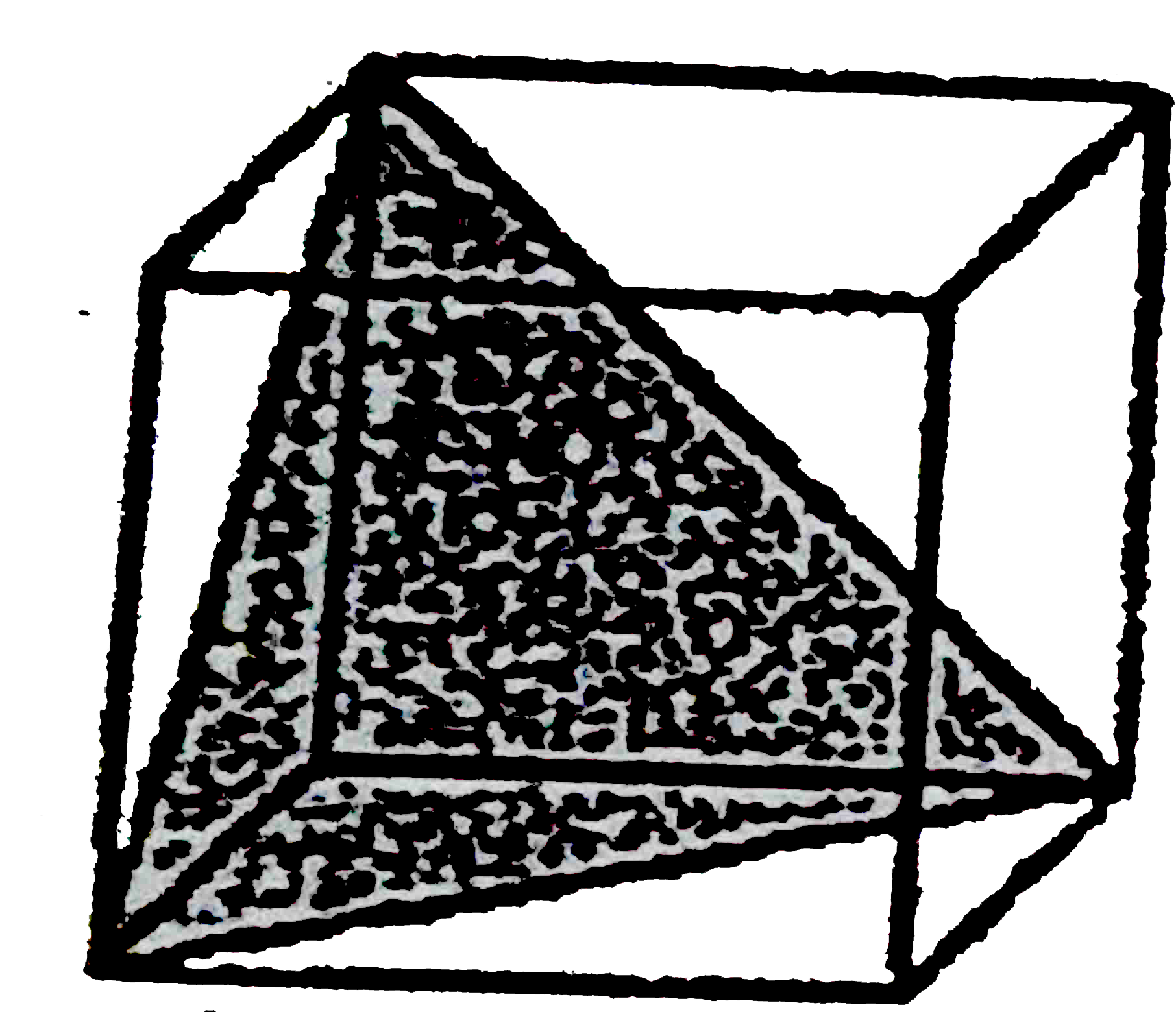
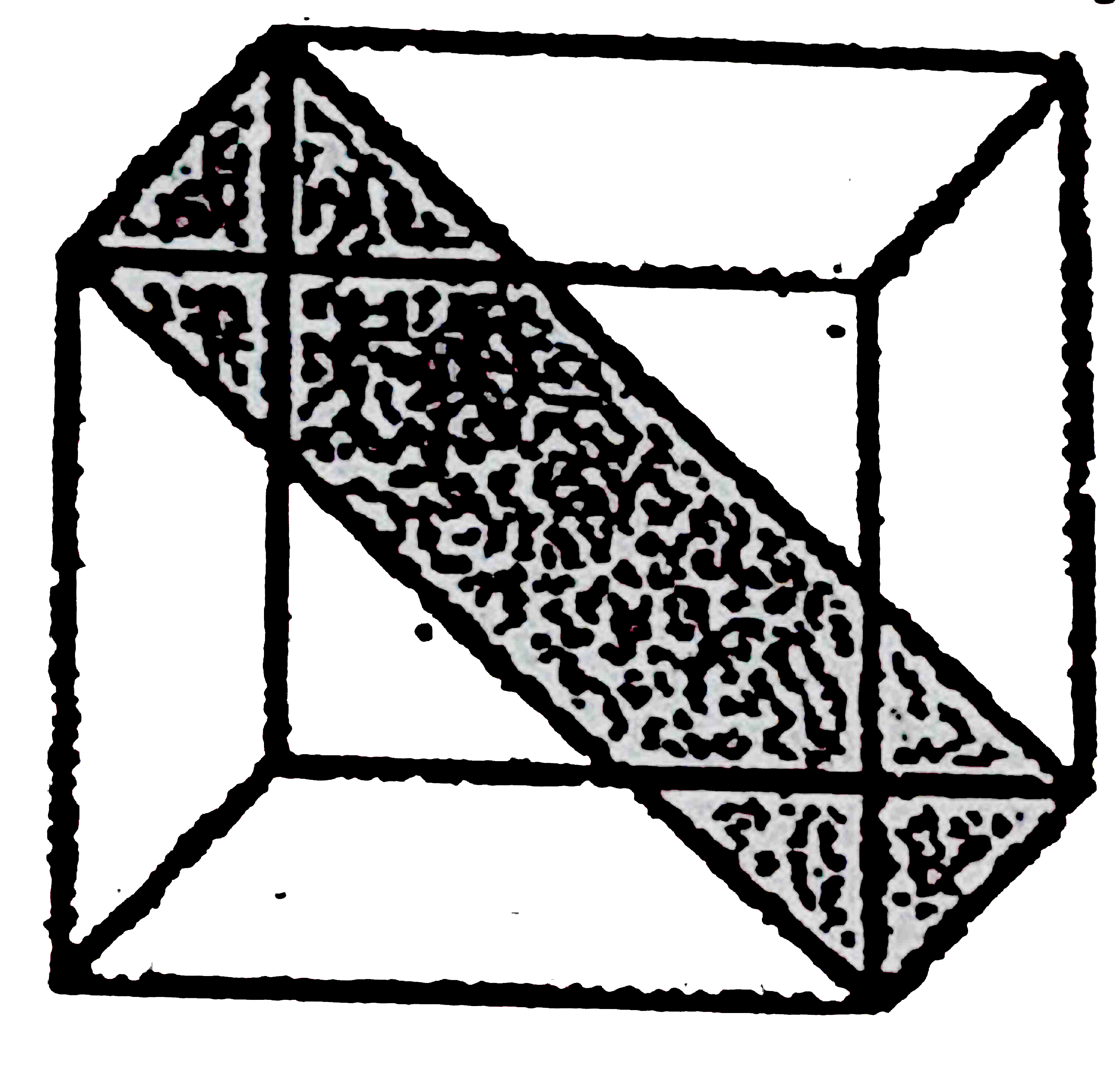
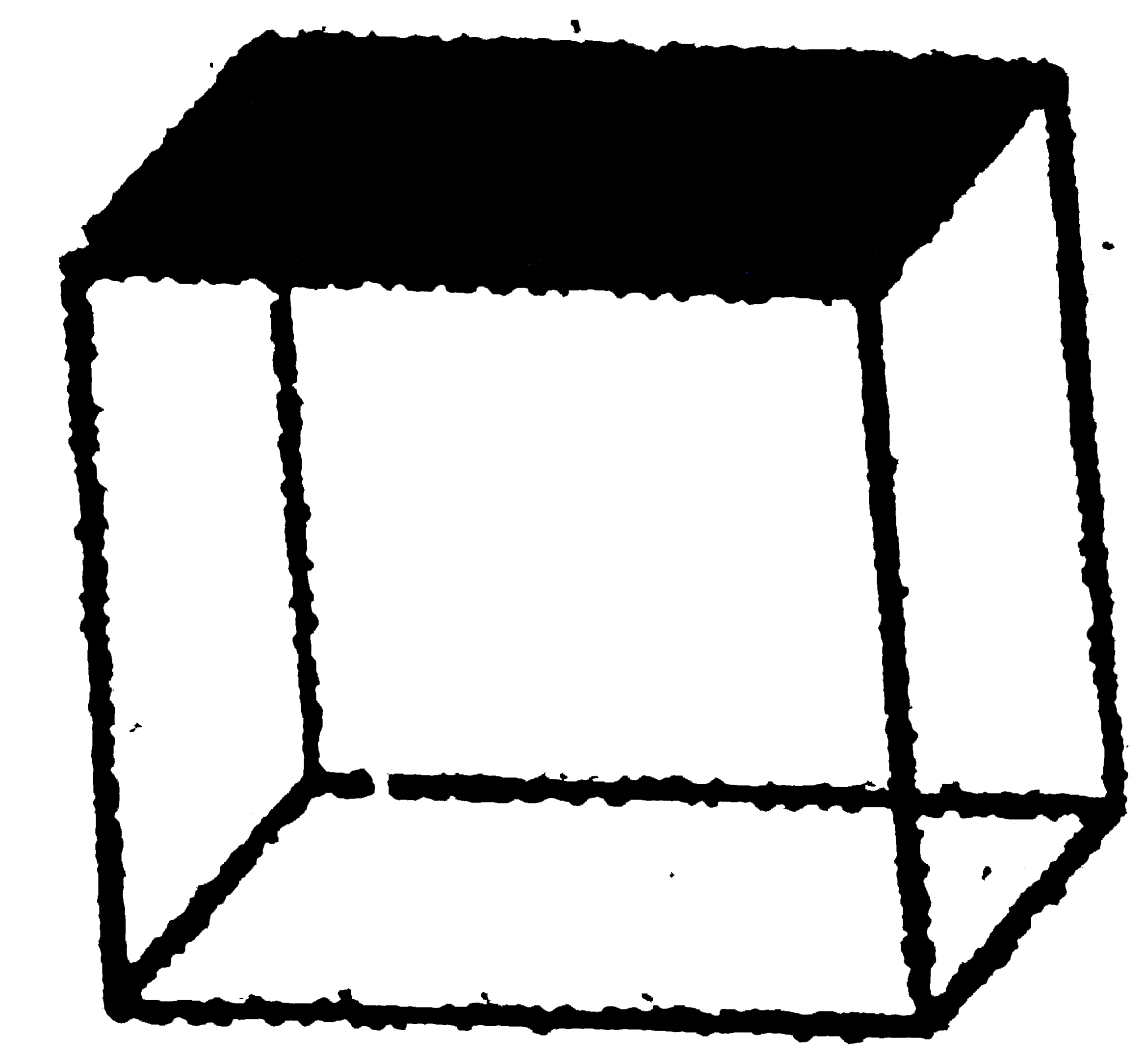
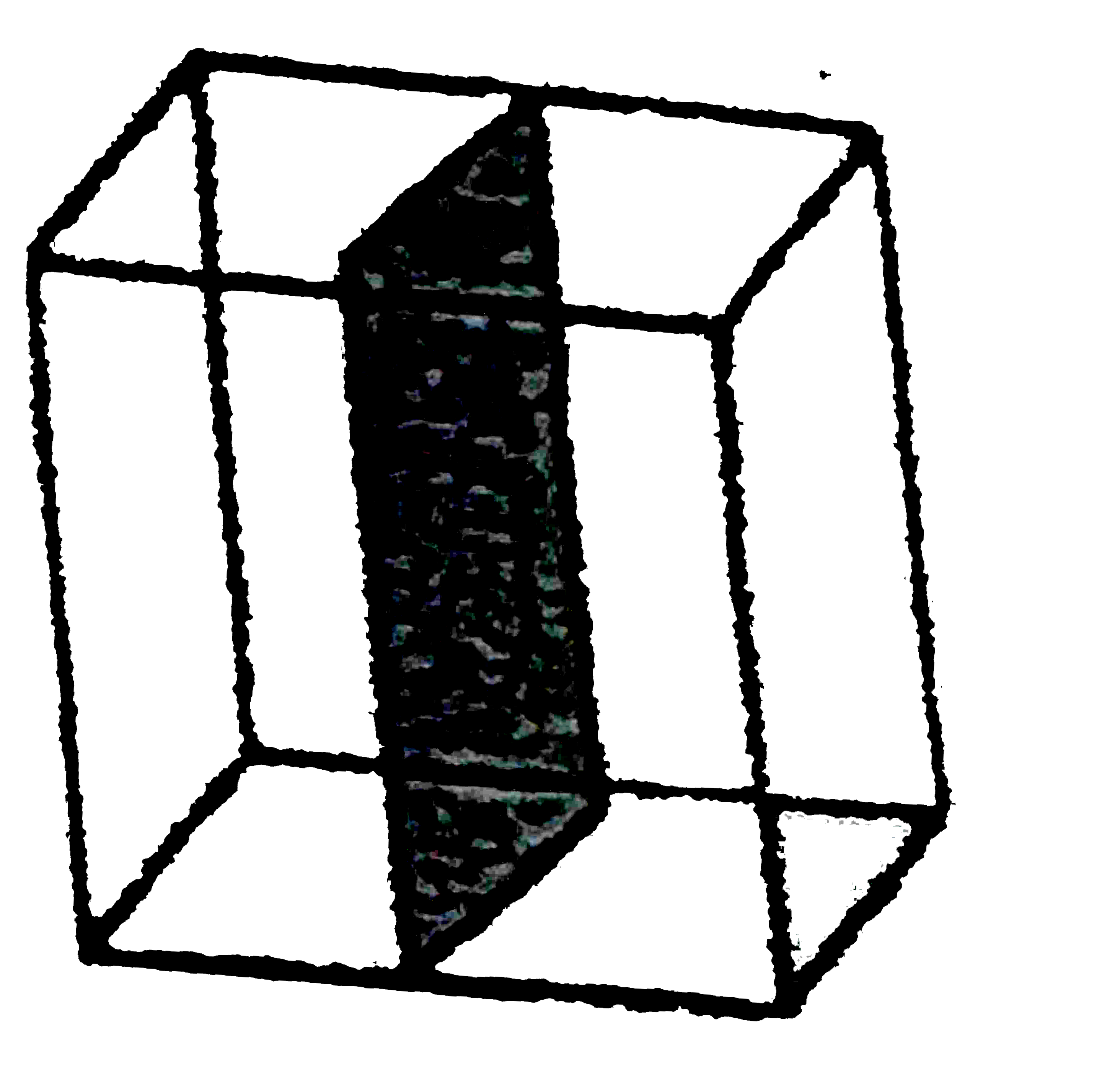
In an f.c.c. crystal , which of the following shaded plane contains the following type of arrangement of atoms ? |
|
Answer»
|
|
| 44620. |
A chargedconductoris placed near an earthesconductors. Its capacitance |
| Answer» Answer :D | |
| 44621. |
What is the shortest wavelength present in the Paschen series of spectral lines? |
| Answer» ANSWER :A | |
| 44622. |
A hydrogen atom is in its third excited state. (a) How many spectral lines can be emitted by it before coming to the ground state ? Show these transitions in the energy level diagram. (b) In which of the above transitions will the spectral line of shortest wavelength be emitted ? |
|
Answer» (b) In TRANSITION (4 - 1) energy DIFFERENCE and frequency of emitted radiation is maximum and as a RESULT we get a spectral line of shortest wavelength. 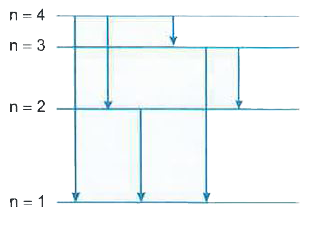
|
|
| 44623. |
Speed of electromagnetic waves through vacuum is equal to |
|
Answer» `mu_0epsilon_0` |
|
| 44624. |
Justify the output waveform (Y) of the OR gate for the following inputs A and B given in figure. |
Answer» Solution :Truth table OBTAINED from the waveform diagram A and B.  Hence from the INPUT A and B, the output (wave form) Y of the OR GATE will be given as follows. 
|
|
| 44625. |
Assertion :- Magnetic flux through the wood ring changes with respect to time then an emf is induced in it . Reason :- Two basic difference between an electric line and a magnetic line of force is that former is discontinueous and latter is continueous or endless. |
|
Answer» If the ASSERTION & Reason are True& the Reason is a CORRECT EXPLANATION of the Assertion . |
|
| 44626. |
If a proton and electron have the same de-Broglie wavelength, then |
|
Answer» a. kinetic energy of ELECTRON lt kinetic energy of proton |
|
| 44627. |
The threshold wavelength for photoelectric emission from a material is 5200 Å. Photoelectrons will be emitted when the material is illuminated with monochromatic radiation from a |
|
Answer» 50 W infrared lamp |
|
| 44628. |
The volume of a sphere is 1.76cm^(3) . The volume of 25 such spheres will be correctly represented by |
|
Answer» `0.44xx10^(2)CM^(3)` |
|
| 44629. |
A solid cyclinder of mass 4 kg and radius 20 cm is rotating about its axis with a frequency of 10//pi Hz. What is the rotational kinetic energy of the cylinder? |
|
Answer» 4 J `=(1)/(2)((1)/(2)xx4xx((20)/(100))^(2))(2pi.(10)/(pi))^(2)` `=(4)/(100)xx400=16J` |
|
| 44630. |
Consider a Wheatstone bridge with resistance and capacitance connected as shown Find the condition on the resistance and the capacitance such that the bridge remains balanced at all times. |
|
Answer» Solution :SUPPOSE that the bridge is balanced i.e. `V_(AB) = V_(AD)` and `V_(BC) = V_(DC)`Let the current and the charges on the capacitors in the circuit as SHOWN then `I_(1)R_(1)=I_(3)R_(3)ldot`s(i) `(q_(2)/(C_(2))=(q_(4)/(C_(4))`ldots(II) Consider the charging of the part of the circuit shown alongside. Let qz be the charge on `C_(2)` and `i_(1)` be the current in the circuit. Then `I_(1)R_(1)+q_(2)/(C_(2))=epsilonldots(iii)` `(dq_(2))/(dt)+(q_(2))/(R_(2)C-(2))=i_(1)ldots(iv)` Substituting (iv) in (ill) and simplifying `(dq_(2))/(dt)+(q_(2))/(R_(eq)C_(2))=(epsilon)/(R_(1))`where`(1)/(R_(eq))=(1)/(R_(1))+(1)/(R_(2))` therefore`q_(2)=(epsilonR_(4)C_(4))/(R_(1))[1-e^((1)/(R_(EqC_(4)))]]=(epsilonR_(2)C_(2))/R_(1)+R_(2)[1-e^(-1//R_(eqC_(2))]]` Similarly, for the other circuit, we have`q_(4)=(epsilonR_(4)C_(4))/(R_(3)+R_(4))[1-e^(1)/(R_(eq)C_(4))]`,where`(1)/(R_(eq))=(1)/(R_(3))+(1)/(R_(4))` NOW,`(q_(2))/(C_(2))=(q_(4)/C-(4))`,which LEADS to `(R_(2))/(R_(1)+R_(2))=(R_(4))/(R_(3)+R_(4))`and`(1)/(R_(eq)C_(2))=(1)/(R_(eq)C_(2))Or(R_(1))/(R_(2))=(R_(3))/(R_(4))`and`R_(1)C_(2)=R_(3)C_(4)` 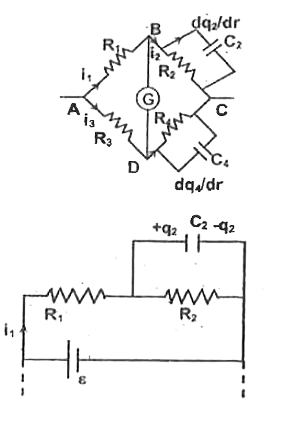
|
|
| 44631. |
Young's double slite experiment is made in a liquid. The bright fringe in liquid lies in screen where 6^(th) dark fringes lies in vaccume. The refractive index of the liquid is approximately. |
|
Answer» `1.8` |
|
| 44632. |
The minimum wavelength of the X-rays produced by electrons accelerated through a potential difference of V volt is directly proportional to ...... |
|
Answer» `(1)/(V)` `:.lambda_(min)prop (1)/(V)` |
|
| 44633. |
A parallel plate condenser has plates of area 200cm^2 and separation 0‘05 cm. It has been charged to a RD. of 300 volt. The energy of the condenser is : |
|
Answer» `0.8xx10^-5J` |
|
| 44634. |
A body of mass 10kg is under the action of 138N on the horizontal surface. If coefficient of friction in between the surfaces is one, the distance it travels in 10s in metre is |
|
Answer» 100 |
|
| 44635. |
A siren placed at a railway platfere is emitting a sound of frequency 5 kHZ. A passenger sitting in a moving train A records the frequency of the siren as 5.5 kHz. During his return journey by train B he records the frequency of the siren as 6 kHz. The ratio of the speed of train B to that of train A is |
|
Answer» `242/252` |
|
| 44636. |
Which one of the following statements is WRONG in the context of X-rays generated from a X-ray tube ? |
|
Answer» WAVELENGTH of characteristic X-rays decreases when the atomic number of the TARGET increases. The cut off wavelength depends on the energy eV of the acclerated electrons and is independent of the atomic number of target. |
|
| 44637. |
A capacitor and a bulb are connected in series with a source of alternating emf. If a dielectric slab is inserted between the plates of the capacitor, then |
|
Answer» The BRIGHTNESS of the BULB decreases |
|
| 44638. |
(a) Obtain the de Broglie wavelength of a neutron of kinetic energy 150 eV. As you have seen in Exercise 11.31, an electron beam of this energy is suitable for crystal diffraction experiments. Would a neutron beam of the same energy be equally suitable? Explain. (m_(n) = 1.675 xx 10^(-27) kg) (b) Obtain the de Broglie wavelength associated with thermal neutrons at room temperature (27^(@)C). Hence explain why a fast neutron beam needs to be thermalised with the environment before it can be used for neutron diffraction experiments. |
|
Answer» Solution :`lambda=(h)/(p)=(h)/(sqrt(2mK))`.Thus, for some K, `lambda` decreases with m as `(1//sqrtm)`. Now `(m_(n)//m_(e))=1838.6`, therefore for the same energy, (150 ev) as in EX. 11.31 wavelength of neutron `=(1//sqrt(1838.6))xx10^(-10)m=2.33xx10^(-12)m`. The interatomic spacing is about a HUNDRED times GREATER. A neutron beam of 150 ev energy is therefore not suitable for diffraction experiments. (b) `lambda=1.45xx10^(-10)m[" Use "lambda=(h//sqrt(3mkT))]`which is comparable to interatomic spacing in a crystal. CLEARLY, from (a) and (b) above, thermal neutrons are a suitable probe for diffraction experiments, so a high energy neutron beam should be first thermalised before using it for diffraction. |
|
| 44639. |
Read the paragraph and answer the following questions. Paragraph : Two stars P and Q each having mass M constitute a binary system. The stars revolves in circular orbitsabout their centre of mass under the effect of mutual gravitational force of attraction. The radius of orbit of star P is R. The dimensions of stars are negligible as compared to the separation between the stars. The energyrequired to separate the two stars P and Q to infinite distanceapart is |
|
Answer» `(GM^(2))/(4R)` |
|
| 44640. |
Read the paragraph and answer the following questions. Paragraph : Two stars P and Q each having mass M constitute a binary system. The stars revolves in circular orbitsabout their centre of mass under the effect of mutual gravitational force of attraction. The radius of orbit of star P is R. The dimensions of stars are negligible as compared to the separation between the stars. The orbital speed of star Q is : |
|
Answer» `SQRT((GM)/(R ))` |
|
| 44641. |
Answer the following questions: (b) In viewing through a magnifying glass, one usually positions one’s eyes very close to the lens. Does angular magnification change if the eye is moved back? |
| Answer» Solution :(b) Yes, it DECREASES a little because the ANGLE SUBTENDED at the eye is then slightly less than the angle subtended at the LENS. The effect is negligible if the IMAGE is at a very large distance away. [Note: When the eye is separated from the lens, the angles subtended at the eye by the first object and its image are not equal.] | |
| 44642. |
A uniform rod of mass 2 kg is 1 meter long. Its radius of gyration about an axis passing through its centre and perpendicular to its lengthis |
|
Answer» |
|
| 44643. |
Plasma membrane is |
|
Answer» permeable |
|
| 44644. |
An air-cored solenoid with length 30cm area of cross-section 25cm^(2) and number of turns 500carries a current of 2.5 amp. The current is suddenly switched off in a brief time of 10^(-3) sec. How much is the average back e.m.f induced across the ends of the open switch in the circuit? Ignore the variation of magnetic field near the ends of the solenoid. |
|
Answer» |
|
| 44645. |
A thin prism P_1 of angle of prism 4^@ and refractive index 1.54 is combined with another prism P_2 of refractive index 1.72 for dispersion without deviation. The angle of prism of P_2 is: |
| Answer» ANSWER :A | |
| 44646. |
A capacitor of capacitance C_1 is charged to a potential V_1 , while another capacitor of capacitance C_2 is charged to a potential difference V_2 . The capacitors are now disconnected from their respective charging batteries and connected in parallel to each other Find the total energy stored in the parallel combination of two capacitors. |
|
Answer» Solution :On DISCONNECTING the capacitors from their respective batteries and JOINING them in parallel , the capacitors acquire a COMMON potential V , which is given as : `V = ("TOTAL charge")/("Total CAPACITANCE") = (Q_(1) + Q_(2))/(C_(1) + C_(2)) = (C_(1) V_(1) + C_(2) V_(2))/((C_(1) + C_(2)))` `therefore` Total electric energy stored in parallel combination of capacitors : `U_(f) = (1)/(2) (C_(1)+ C_(2)) V^(2) = ((C_(1) V_(1) + C_(2) V_(2))^(2))/(2 (C_(1) + C_(2)))` |
|
| 44647. |
The SI unit of i = epsilon_0 (d phi_E)/dt is |
|
Answer» volt |
|
| 44648. |
Two identical loops, one of copper and the other of aluminium are rotate same speed in the same magnetic field. In which case induced current will be more and why? |
| Answer» SOLUTION :Induced CURRENT `I=epsilon/R` where R is the resistance of the loop. SINCE the resistance of copper is LESSER than that of aluminium, induced current will be more in the copper coil. | |
| 44649. |
A capacitor of capacitance C_1 is charged to a potential V_1 , while another capacitor of capacitance C_2 is charged to a potential difference V_2 . The capacitors are now disconnected from their respective charging batteries and connected in parallel to each other Find the total energy stored in the two capacitors before they are connected . |
|
Answer» Solution :INITIALLY capacitor of capacitance `C_1` is charged to a POTENTIAL `V_1` , hence energy stored in it `U_(1) = (1)/(2) C_(1) V_(1)^(2)` . Similarly for SECOND capacitor of capacitance `C_2` charged to a potential `V_2` the stored energy `U_2 = (1)/(2) C_(2) V_(2)^(2)` `therefore` Total electric energy stored in the COMBINATION before they are connected `U_(2) = U_(1) + U_(2) = (1)/(2) [C_(1) V_(1)^(2) + C_(2) V_(2)^(2)]` |
|
| 44650. |
Two identical loops, one of copper and the other of aluminium are rotate same speed in the same magnetic field. In which case induced emf. |
| Answer» SOLUTION :Induced EMF `epsilon=NBA OMEGA sin omega t` will be the same in both the coils, Since N,B,A and `omega` are the same. | |