Saved Bookmarks
This section includes 7 InterviewSolutions, each offering curated multiple-choice questions to sharpen your Current Affairs knowledge and support exam preparation. Choose a topic below to get started.
| 1. |
Anhydrous AlCl_(3) is obtained when |
|
Answer» ALLUMINIUM oxide reacts with HCl |
|
| 2. |
Anhydrous AlCl_(3) is covalent. From the date given below , predict whether it would remain covalent or became ionic in aqueous solution (Ionizatiion energy for AlCl_(3) = 5137 kJ mol^(-1), Delta H_("hydration") for Al^(3+) = - 4665 kJ mol^(-1), DeltaH_("hydration") forCl^(-)= - 381 KJ mol^(-1)). |
|
Answer» SOLUTION :`AlCl_(3) (S) + aqto AlCl_(3) (aq)^(3+) (aq) + 3Cl^(-) (aq)` Total ENERGY released on hydration of 1 MOLE of `Al^(3+)` ions and 3 MOLES of `Cl^(-)` ions `= 4665+3xx381 KJ = 5808 mol ^(-1)` Energy required for ionization= 5137 kJ `mol^(-1)` As energy released is greater than the ENERG required the compound will ionize in aqueous solution . |
|
| 3. |
Anhydrous AlCl_(3) is covalent. From the data given below, predict whether it would remain covalentor become ionic in aqueous solution (Ionization energy for Al=5137 kJ "mol"^(-1), Delta H_("hydration") "for" Al^(3+) = - 4665 kJ "mol"^(-1), Delta H_("hydration") for Cl^(-1)=-381 kJ "mol"^(-1)). |
| Answer» Solution :TOTAL energy RELEASED due to hydration of ions = - 4665`-3xx381=-5808 KJ "mol"^(-1)`. This energy isgreater than the ionisation energy of AL which is 5137 kJ `"mol"^(-1)`. Hence , it would be ionic in the solution . | |
| 4. |
Anhydrous AICI, is covalent while AlF_3 is ionic. This is justified by |
|
Answer» CRYSTAL STRUCTURE |
|
| 7. |
{:((A)NH_(3),,,,(i)CO_(3)^(2-)),((B)HCO_(3)^(-),,,,(ii)NH_(4)^(+)),((C)H_(2)O,,,,(iii)H_(3)O^(+)),((D)HSO_(4)^(-) ,,,,(iv)H_(2)SO_(4)),((E)H_(2)CO_(3) ,,,,):} |
|
Answer» |
|
| 8. |
Anhydrid of dentro sulphuric acid |
|
Answer» `SO_(2)` |
|
| 9. |
Angular momentum of an orbit of a H like species in which the electron revolving is 4.2197 xx 10^(-34) JS. The number of waves made by the electron in that orbit. |
|
Answer» 6 |
|
| 10. |
Angular distribution functions of all orbitals have: |
|
Answer» L NODAL SURFACES |
|
| 12. |
Angle between two OH groups of solid hydrogen peroxide is |
| Answer» Answer :C | |
| 13. |
Aneesh, a student of Class XII, went to a hospital along with his mother. There he saw a woman patient whose neck was highly swollen. He asked his mother what had happened to this woman. She told him that this woman had a problem of thyroiddisorder which was due to deficiency of iodine. After reading the above paragraph, answer the following questions : (a) What values do you attach to the information conveyed by Aneesh's mother to him ? (b) What is the simplest way to follow to save ourselves from this disease ? |
|
Answer» SOLUTION :(a) We should be careful that DEFICIENCY of IODINE does not occur in our body . (b) The simplest way is to use REGULARLY iodized salt, i.e, common salt (table salt)containing a very small amount of iodine in the FORM of iodide salf. |
|
| 14. |
Andrew's worked on a temporary gas (so called at that time) and derived the condition to liquefy the permanent gases (so called at that time) Andrew studied isotherms of CO_(2) and obtained the required condition for liquefaction of gas T_(gas) lt T_(c) (critical temperature) . |
| Answer» SOLUTION :Andrew studied isotherms of `CO_(2)` and found that even `CO_(2)` (the so called TEMPORARY gas at that time) can not LIQUEFIED above `31.1^(@)C` the critical temperature of `CO_(2)` although pressure may be INCREASED MANIFOLDS . | |
| 16. |
…….and……. used to reduce pressure in distillation under reduced pressure |
| Answer» SOLUTION :WATER PUMP, VACCUM pump | |
| 17. |
……….and ………precipitate will be produced by estimation of phosphrous |
| Answer» SOLUTION :`Mg_(2)P_(2)O_(7) or (NH_(4))_(3)PO_(4). 12MoO_(3)` | |
| 18. |
……..and ……..are increases the stability |
| Answer» SOLUTION :RESONANCE and HYPERCONJUGATION | |
| 19. |
Anange the tollowing alkyl halide in increasing order of bond enthalpPy ot RX: CH_3Br, CH_3F, CH_3Cl,CH_3I |
|
Answer» Solution :Increasing ORDER of bond enthalpy of RX is …………………. . <BR> `CH_3l` bond enthalpy 234 kJ `mol^(-1)` `CH_3Br` bond enthalpy 293 kJ `mol^(-1)` `CH_3Cl` bond enthalpy 351 kJ `mol^(-1)` `CH_3F` bond enthalpy 452 kJ `mol^(-1)` `CH_3F gt CH_3Cl gt CH_3 Br lt CH_3I` |
|
| 21. |
Analysis shows that nickel oxide has the formula Ni_(0-98) O_(1.00) . What fractions of the nickel exist asNi^(2+) and Ni^(3+)ions ? |
| Answer» Solution :`Ni^(2+) = 96 % , Ni^(3+) = 4%` | |
| 22. |
Analysis shows that a metal oxide has the empirical formula of M_0.96 O_1.00 Calculate the percentage of M^(2+) and M^(3+) ions in this crystal. |
|
Answer» |
|
| 23. |
Analysis show that FeO has a non-stoichiometric composition with formula Fe_0.95 O.Give reason. |
| Answer» SOLUTION :In FEO crystal, some of the `FE^(2+)` ions are replaced by `Fe^(3+)` ions. Three `Fe^(2+)` ions are replaced by two `Fe^(3+)` ions to maintain electrical neutrality. As a result, there will less amount of Fe , i.e., Fe is less than O and has the COMPOSITION `Fe_0.95`O as compared to stoichiometric composition , FeO. | |
| 24. |
Analysis of chlorophyll shows that it contains 2.68 % Mg . Number of magnesium atoms present in 2.4 g of chlorophyll is |
|
Answer» `2.68 XX 6 xx 10^(21)` |
|
| 25. |
Analysis of an organic compound gave 40%C, 6.6%H by weight and the remaining is oxygen. If the molecular weight of the compound is 90 what is molecular formula? |
|
Answer» |
|
| 26. |
Analysis of a compound yields the following percentage composition. 65.03% of Ag, 15.68% Cr , 19.29% O. The simplest formula of the compound is [Cr At.wt=52] |
|
Answer» `Ag_(2)CrO_(4)` |
|
| 27. |
Analysis of a compound known to contain only Mg, P, and O gives this analysis. 21.8% Mg, 27.7% P , 50.3% O by mass What is its empirical formula? |
|
Answer» <P>`MgPO_(2)` |
|
| 28. |
Analyse the deviation observed in the solution of phenol and aniline. |
|
Answer» Solution :Both phenol and aniline form hydrogenbonding interactions amongst themselves .However , when mixed with aniline ,the phenol MOLECULES forms hydrogen bonding interactions with aniline,which are stronger than the hydrogen bonds formed amongst themselves . Formation of NEW hydrogen bonds considerably REDUCE the escaping tendency of phenol and aniline from the solution. As a result ,the vapour pressure of the solutions is less and there is a slight decrease in volume ` (Delta V_("mixing ") LT 0) ` on mixing . During this process evolution of heat takes place (i.e.) ` Delta H_("mixing") lt 0 ` ( exothermic ) ` (##SUR_CHE_XI_V02_C09_E05_005_S01.png" width="80%"> Examplesfor non-ideal solutions showing negative deviation : Acetone + chloroform , aniline , Chloroform + Benezene. |
|
| 29. |
Analyes the following wing pairs of compounds. Write 1, if they are tautomers. Write 2, id they are metamers. Write 3, if they are position isomers. Write 4, id they are functional group isomers. Write 5, if they are chain siomers. Write 6, if they are not isomers. |
|
Answer» (B) MOLECULAR formular is not same (6) (c ) Function group has been changed, so these are example of functional isomers (4) (d) These are metamers (2) |
|
| 31. |
An unsaturated hydrocarbon on ozonolysis gives one mole each of methanal, ethanal and 2-ketopropanal. The structure of the hydrocarbon is |
|
Answer» `CH_2=CH-CH=CHCH_3` |
|
| 32. |
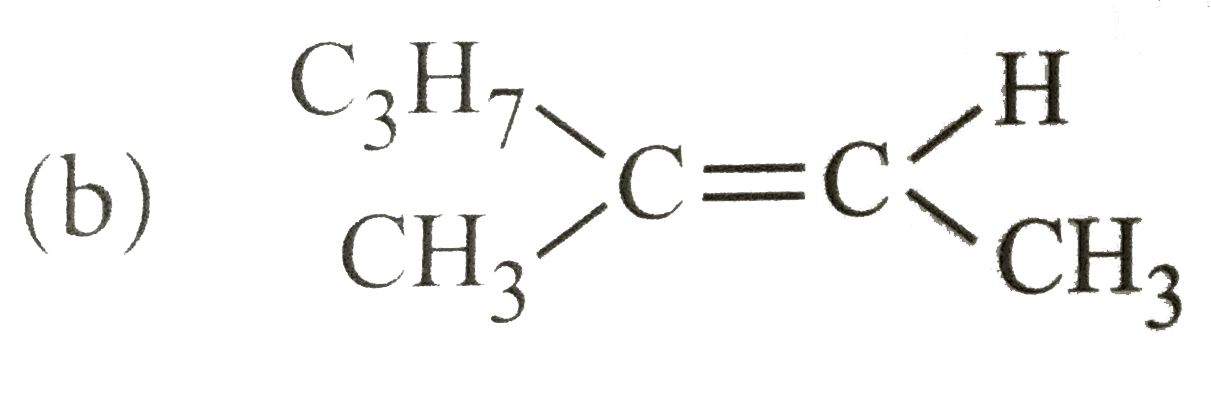
An unsaturated hydrocarbon was treated with ozone and resulting ozonide on hydrolysis gives 2-pentanone and acetaldehyde. What is the structure of alkene? |
|
Answer» `C_(3)H_(7)-CH=CH-CH_(3)` 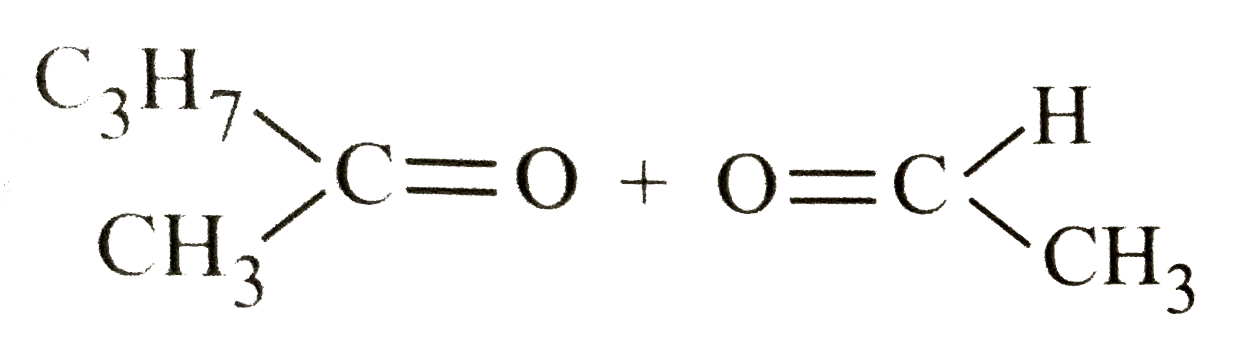 HENCE, the STRUCTURE of an alkene is 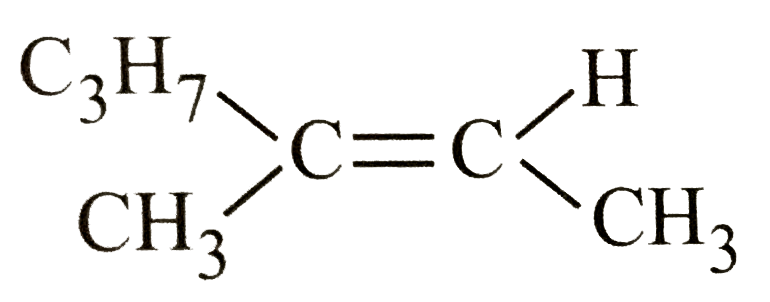
|
|
| 33. |
An unsaturated hydrocarbon (A), C_6H_10 readily gives (B) on treatment with sodamide in liquid NH_3. When (B) is allowed to react with 1-chloropropane,a compound (C ) is obtained. On partial hydrocarbon, in present of Lindlar's catalyst, (C ) gives (D), C_9H_18. On ozonolysis , (D) gives dimethylpropanal and 1-butanal. With proper reasoning give the structures of (A) , (B) , (C ) and (D) |
|
Answer» Solution :Step 1. To determine the structure of compound (D) Since (D) with M.F. `C_9H_18` on ozonolysis GIVES 2-2-dimethylpropanal and 1-butanal, therefore , (D) must be 2,2-dimethyl-3-heptene. `underset"2,2-Dimethylpropanal"(CH_3-undersetunderset(CH_3)|oversetoverset(CH_3)|C-CH)=O+O=underset"1-Butanal"(CHCH_2CH_2CH_3)underset((ii)Zn//H_2O)OVERSET((i)O_3)LARR underset("2,2-Dimethyl-3-heptane" (D, C_9H_18)) (CH_3-undersetunderset(CH_3)|oversetoverset(CH_3)|C-CH=CHCH_2CH_2CH_3)` Step 2. To determine the structure of the compound (C ) Since alkene(D) with `MFC_9H_18` is obtained by partial reduction of compound (C ) in presence of Lindlar catalyst, therefore, (C ) must be an alkyne , i.e., 2,2-dimethyl-3-heptyne. `underset"2,2-Dimethyl-3-heptyne(C)"(CH_3-undersetunderset(CH_3)|oversetoverset(CH_3)|C-C-=C CH_2CH_2CH_3)underset"(Lindlar's catalyst)"overset(H_2//Pd+BaSO_4)to underset("2,2-Dimethyl-3-heptene(D)"C_9H_18)(CH_3-undersetunderset(CH_3)|oversetoverset(CH_3)|C-CH=CHCH_2CH_2CH_3)` Step 3 To determine the structure of the compound (A) and (B) . Since an alkyne (C ) is obtained by treatment of (B) with 1-chloropropane and (B) is obtained from (A) on treatment with sodamide in liquid `NH_3`, therefore (A) must be 3,3-dimethyl-1-butyne and (B) must be sodium salt of (A) , i.e., sodium 3,3-dimethylbutynide. `underset((M.F.=C_6H_10))underset"3,3-Dimethyl-1-butyne(A)"(CH_3-undersetunderset(CH_3)|oversetoverset(CH_3)|C-C-=CH)underset("in lin" NH_3)overset"Na"to underset"Sod. 3,3-dimethyl-butynide (B)"(CH_3-undersetunderset(CH_3)|oversetoverset(CH_3)|C-=barCNa^(+)) underset"-NaCl"overset(ClCH_2CH_2CH_3)to underset"2,2-Dimethyl-3-heptyne (C )"(CH_3-undersetunderset(CH_3)|oversetoverset(CH_3)|C-C-=C-CH_2CH_2CH_2)` Thus, (A)=3,3-dimethyl-1-butyne, (B)=sodium 3,3-dimethylbutynide , (C )=2,2-dimethyl-3-heptyne and (D)=2,2-dimethyl-3-heptene. |
|
| 34. |
An unsaturated hydrocarbon 'A' adds two molecules of H_2 and on reductive ozonolysis gives butane-1,4-dial, ethanal and propanone. Give the structure of 'A' , write its IUPAC name and explain the reactions involved. |
|
Answer» Solution :(i)Since the hydrocarbon(A) adds two molecules of `H_2` , therefore, (A) is either an alkadiene or an alkyne. (ii)On reductive ozonolysis 'A', gives three fragements , one of which is a DIALDEHYDE. Therefore , the molecule has UNDERGONE cleavage at two unsaturated SITES. In other words, hydrocarbon 'A' has two double bonds, i.e., A is an alkadiene and not an alkyne. (iii) PLACE the three fragements of reductive cleavage side by side in such a way that the dialdehyde is placed in the middle while the other two products on either side of the dialdehyde. Thus, we have,  Now , REMOVE the oxygen atoms, and connect the remaining three fragments by double bonds, the structure of the alkadiene (A) is  Step 3.To explain reactions involved in the question . 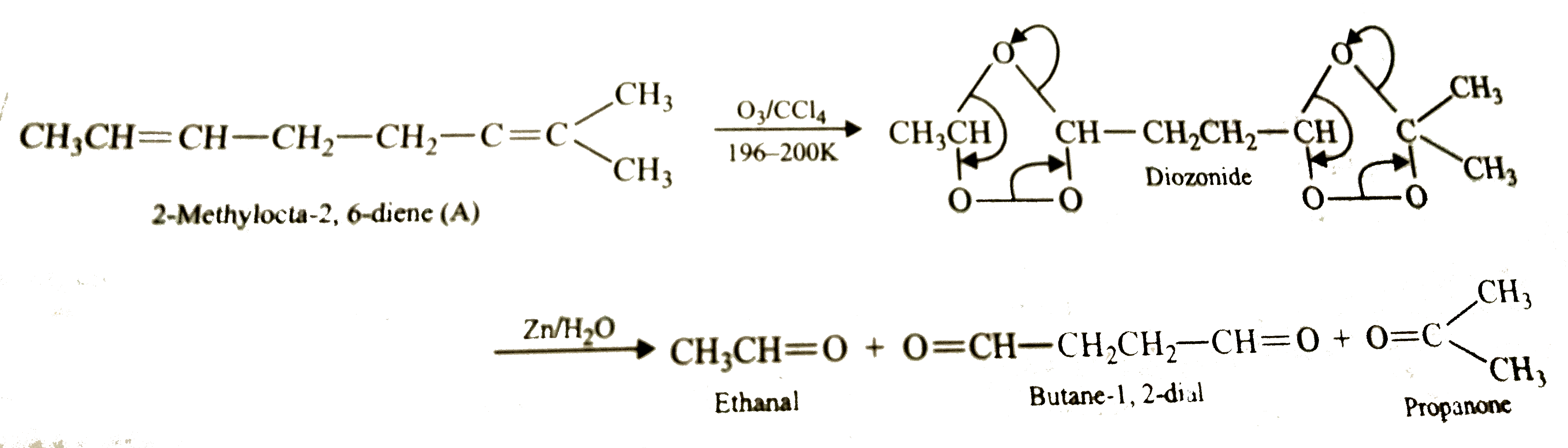
|
|
| 35. |
An unsaturated hydrocarbon 'A' adds two molecules of H_(2) and on reductive ozonolysis gives butane-1, 4-dial, ethanal and propanone. Give the structure of 'A', write its IUPAC name and explain actions involved. |
|
Answer» SOLUTION :COMPOUND A on ozonolysis gives `CH_(3)CHO + O - CH - CH_(2)-CH_(2)-CHO + O-C(CH_(3))_(2)` `CH_(3)-CH-CH_(2)-CH_(2)-CH_(2)-CH=C(CH_(3))_(2)` The structure of A is IUPAC name : 2-methylocta 2,6-diene. |
|
| 36. |
An unknown sample weighing 1.5 g was found to contain only Mn and S. The sample was completely reacted with oxygen and it produced 1.22 g of Mn(II) oxide and 1.38 g of SO_(3).What is the simplest formula for this compound? (MnS) |
|
Answer» |
|
| 37. |
An unknown particle having double charge as proton itself moves with wavelenght lambda, if it is accelerated from rest through a potential difference of(V)/(8)voltus. While proton itself moves with same wavelenght lambda when acceleratedfrom rest thought a potentialdifference 'V' volts. Theparticls is |
|
Answer» `He^(+)` `(lambda)=(h)/sqrt(2xxm'xx2exx(V)/(8))` `mxx2exx(V)/(8)=mxxexxv` `m'=4m` |
|
| 38. |
An unknown metal reacts with excess chlorine to give the metal chloride MCl_(2). When 2.375 gm of metal chloride is dissolved in water and passed through an anion-exchange column packed with hydroxide ion, the solution requires 100 ml of 0.5 M HCl for neutralization. Calculation atomic mass ("in" g//"mole") of unknown metal. |
|
Answer» |
|
| 39. |
An unknown gas effuses through a pin-hole in a container at a rate of 7.2 mmol/s/ Under the same condition gaseous oxygen effuses at a rate of 5.1 mmol/s. what is the molar mass (in g/mol) of the unknown gas? |
|
Answer» 16 |
|
| 40. |
An unknown gas is placed in a sealed container with a fixed volume. Which of the characteristics listed change(s) when the container is heated from 25^(@)C to 250^(@)C? (P) The density of the gas (Q) The average kinetic energy of the molecules (R) The mean free path between molecular collisions (R) The mean free path between molecular collisions |
|
Answer» <P>P only |
|
| 41. |
An unknown compound weighin 4.2 gm is dissolved in enotgh carbon tetrachloride to make a total volume of 250 cc. The observed rotation of this solution is+357.75^(@) in a 25 cm cell using the sodium D line. But if 4.2 gm is dissolved in 125 cc we observed rotation is +355.50^(@) calculate specific rotation for this compouns. |
|
Answer» |
|
| 42. |
An unknown gas effuses through a small hole one half as fast as methane, CH_(4), under the same conditions. What is the molar mass of the unknown gas? |
|
Answer» `4G "MOL"^(-1)` |
|
| 43. |
An unknown compound on ozonolysis to give acid C_(3)H_(6)O_(2) and a keton C_(4)H_(8)O . From this information identify structure of unknown compound |
|
Answer» `(CH_(3))_(2)C=CHCH_(2)-CH_(2)CH_(3)` |
|
| 44. |
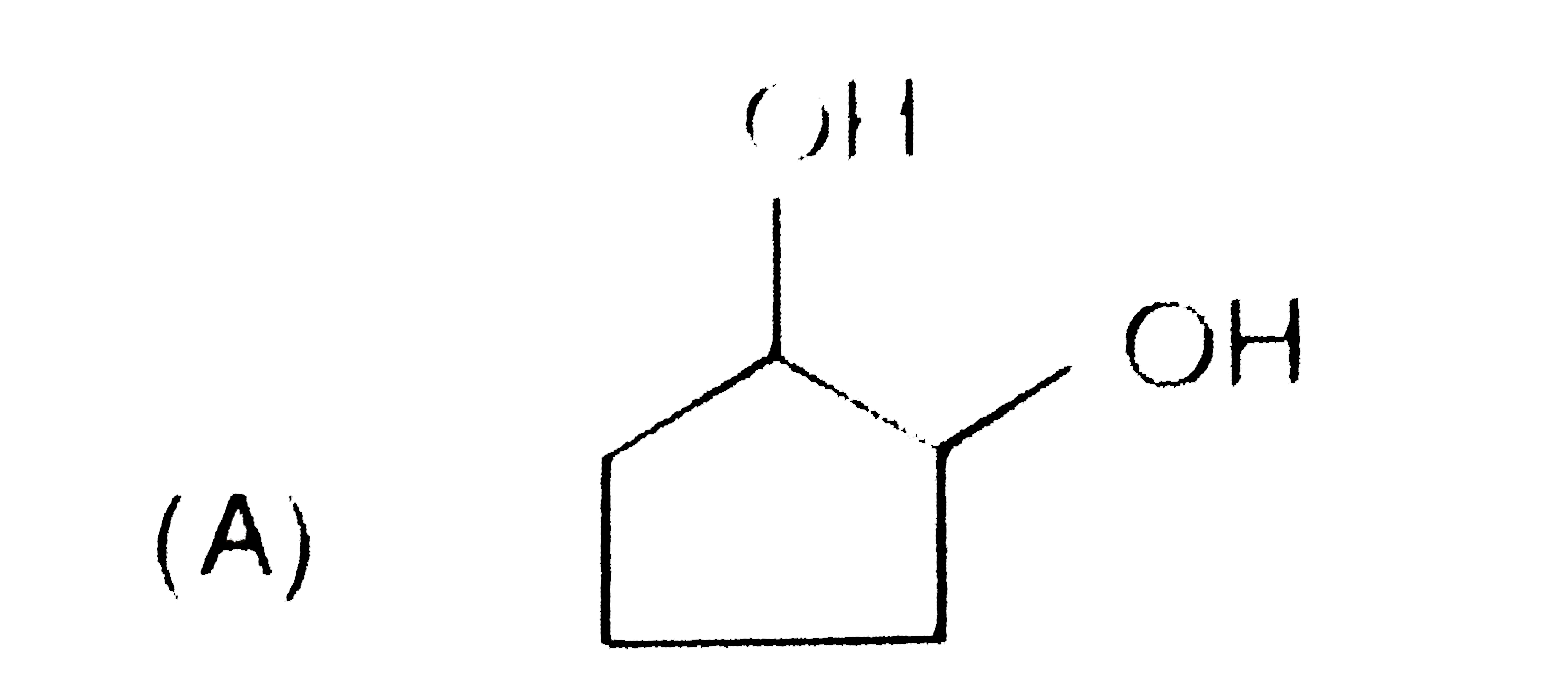
An unknown compound on oxidative cleavage (HIO_(4)) forms one mole each of cyclopentanone and methanol. The compound is |
|
Answer»
 `HIO_(4)` reacts only when TWO `-OH` GROUPS are present on adjacent carbon atoms. |
|
| 45. |
An unknown compound of carbon , hydrogen and oxygen contains 69.77 % C and 11. 63% H, and has a molecular weight of 86 . It does not reduce Fehling solution but forms abisulphate addition compound and gives a positive iodoform test. What are possible structures is |
|
Answer» `CH_(3)CH_(2)CH_(2)COCH_(3)` Empirical formula of compound is`C_(5)H_(10)O`andempirical formula a wt. =86.Also molecular wt. 86 Molecular formula of compound is `C_(5)H_(10)O`. ii) Compound format bisulpate addition compound and thus, has carbonyl gp. Ie., aldehyde or ketone. iii) it does not REDUCE Fehling solution and thus, it is aldehyde but it is ketone. iv)it give positive iodoform test and thus, it has  v)Above facts reveals that compound is 
|
|
| 46. |
An unknown compound is analyzed to have a molecular mass of 84 and elements has carbon and hydrogen only.When subjected to chlorination in the presence of light, three monochlorinated products are isolated . This compound must be |
|
Answer» methylcyclopentane |
|
| 47. |
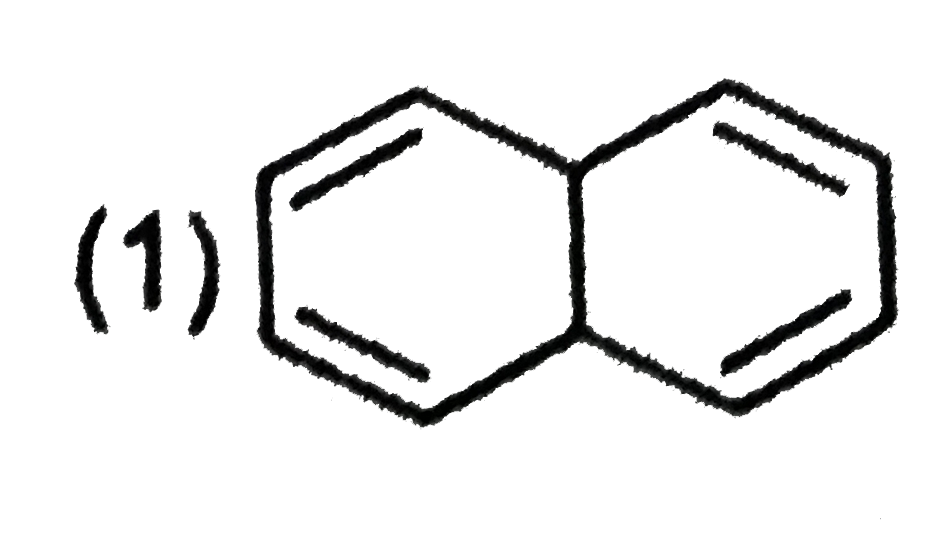
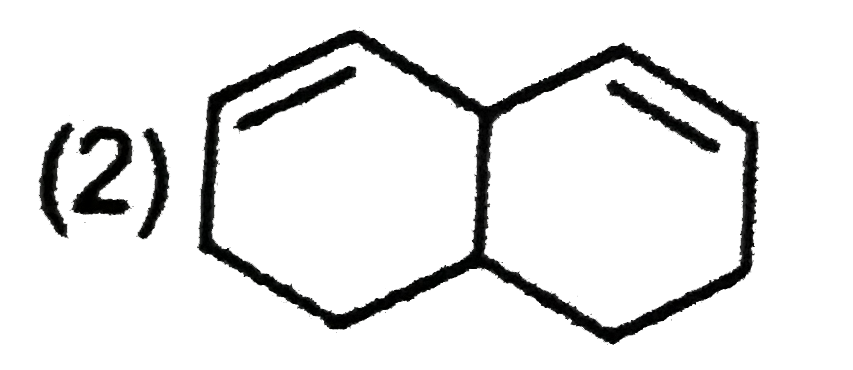
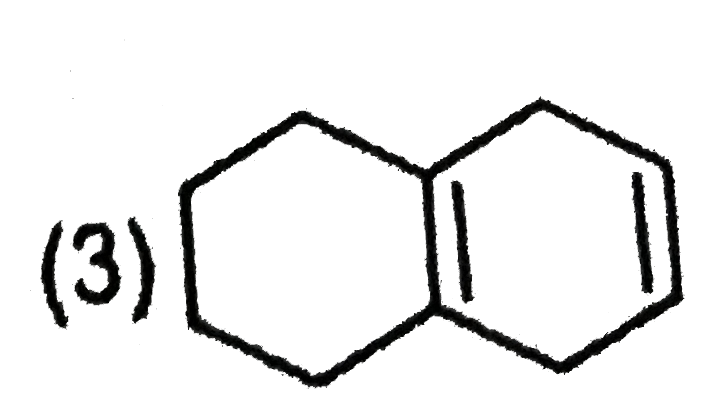
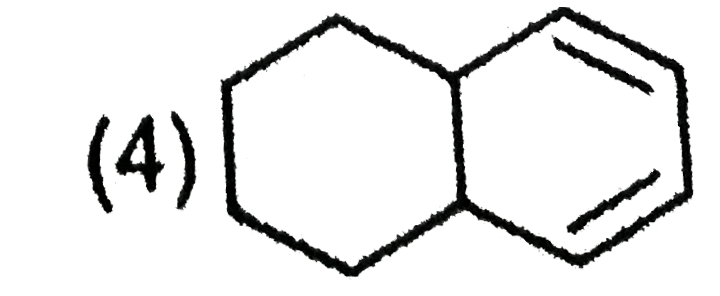
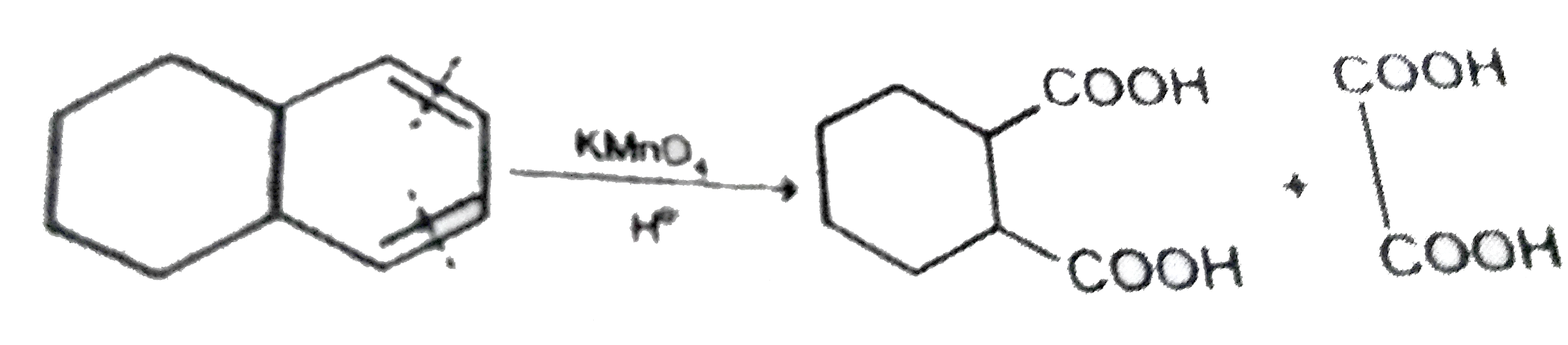
An unknown compound decolorizes bromine in carbon tetrachloride, and it undergoes catalytic reduction to give decalin. When treated with warm, conc, potassium permangate, this compound give cis-cyclohexane-1, 2-dicaboxylic acidand oxalic acid. Possible a structure for th unknown compound is- |
|
Answer»
|
|
| 48. |
An unknown alkene of molecular formula C_(8)H_(16) on oxidation with hot alkakline KMnO_(4) yields propanoic acid and pentanoic acid. Find the structure of the alkene. Strategy: C_(8)H_(16)underset((2)H_(3)O^(+))overset((1)KMnO_(4),H_(2)O,OH^(-)"heat")rarrCH_(3)CH_(2)-underset("acid")underset("Pentanoic")overset(O)overset(||)C-OH+HO-underset("acid")underset("Pentanoic")overset(O)overset(||)C-CH_(2)CH_(2)CH_(2)CH_(3) Remove the OH groups and join the carboxylic acid carbons by a double bond to get the alkene. |
|
Answer» Solution :The KNOWN alkene is either cis-or-trans-oct-`3-"ENE"`. Oxidative cleavage takes place as FOLLOWS: `underset("UNKNOWN alkane either cis-or trans -oct -3 -ene")(CH_(3)CH_(2)-CH!=CH-CH_(2)CH_(2)CH_(2)CH_(3))`underset((2)H_(3)O^(+))overset((1)KMnO_(4),H_(2)O`,`OH^(-)" heat")to` `CH_(3)CH_(2)-overset(O)overset(||)C-OH+CH_(3)CH_(2)CH_(2)CH_(2)-overset(O)overset(||)C-OH` |
|
| 49. |
An unknown alkene on reductive ozonolysis gives two isomeric carbonyl compounds of molecular formula, C_3H_6O. Write the structures of the alkene and the two isomeric carbonyl compounds. |
|
Answer» |
|
| 50. |
An unknown alcohol is treated with the "Lucas reagent" to determine whether the alcohol is primary, secondary or tertiary. Which alcohol reacts fastest and by what mechanims : |
|
Answer» secondary alcohol by `S_(N^(2))` |
|