Saved Bookmarks
This section includes 7 InterviewSolutions, each offering curated multiple-choice questions to sharpen your Current Affairs knowledge and support exam preparation. Choose a topic below to get started.
| 2. |
Arrange in the given order: Increasing electronegativity :F , Cl , Br, I |
|
Answer» <BR> ANSWER :`I LT Br lt C lt F` |
|
| 4. |
Arrangein order of increasing strength of hydrogen bonding : O, F, S, Cl, N |
| Answer» SOLUTION :`S LT CL lt N lt O lt F`. | |
| 5. |
Arrange in order of increasing bond strengths : F_(2), N_(2), O_(2), Cl_(2) |
| Answer» Solution :`F_(2) LT Cl_(2) lt O_(2) lt N_(2)` . | |
| 6. |
Arrange in increasingorderof energy (I ) n=2,l =0,m_(1)= 0 m_(s ) = (1)/(2) (ii) n= 2 , l= 1 , m_(1) =+ 1 , m_(s )= (1)/(2) (ii)n=3 ,l m_(1) =+ 1 ,m_(s) = (1)/(2) (iv)n=3,l= m_(l)=-1 m_(s )=+ (1)/(2) |
|
Answer» SOLUTION :(i) n=2 and l=1 : 2P (II) n=2 andl=1 : 2p (iii)n=3and l=2 : 3D (iv) n=3 andl=1 : 3p Increasingorderof energy: 2S ,2p,3p ,3d increasingorderof energy(i) ,(ii) ,(iv) ,(iii) |
|
| 7. |
Arrange in increasing order of heat of hydrogenation of following dienes. |
|
Answer» iiiltvltiltivltii |
|
| 8. |
Arrange in desending order of its stability. overset(+)(C H_(3)), (CH_(3))_(3) overset(+)(C ), CH_(3) C overset(+)(H)_(2), (CH_(3))_(2) overset(+)(C )H |
| Answer» SOLUTION :`(CH_(3))_(3) OVERSET(+)(C ), GT (CH_(3))_(2) overset(+)(C )H gt CH_(3) overset(+)(C) H_(2) gt overset(+)(C )H_(3)` | |
| 9. |
Arrange in decreasing order of melting and boiling pouints of hydrides of groups 15,16 and 17 (b) Give the decreasing order of melting and boiling points of H_(2)ONH_(3) and HF (c ) Give the decreasing order of boiling points (I) C_(2)H_(5)OH (II) (CH_(3))_(3)NH (III) C_(2)H_(5)NH_(2) (d) Give the decreasing of solubility in H_(2)O (I) PhNH_(2) (II) (C_(2)H_(5))_(2)NH , (III) C_(2)H_(5)NH_(2) . |
|
Answer» Solution :(a)(i) Melting point of group 15 hydries `NH_(3) gt BiH_(3) gt SbH_(3) gt AsH_(3) gt PH_(3)` Boiling point of group 15 hydries `BiH_(3) gt SbH_(3) gt NH_(3) gt AsH_(3) gt PH_(3)` (ii) Melting point of group 16 hybries `H_(2)O gt H_(2)Te gt H_(2)Se gt H_(2)S` Boiling point of group 16 hybries `H_(2)O gt H_(2)Te gt H_(2)Se gt H_(2)S` (iii) Melting point of group 17 hydries `HI gt HF gt HBr gt HCI` Boiling point of group 17 hydries `HF gt HI gt HBr gt HCI` (b) `H_(2)O gt NH_(3) gt HF` Boiling point `H_(2)O gt HF gt NH_(3)` (c ) Boiling point of alcohols gt boiling points of amines (due to EN of `O gt ENofN)` (ii) Boiling points of `1^(@) gt2^(@)` amine gt `3^(@)` amine due to the THREE H-bonds, TWO H-bonds in `1^(@)` and `2^(@)` amines, `3^(@)` amine do not form H-bonds, since no H-atoms is present Therefore, decreasing boiling order is `C_(2)H_(5)OH gt C_(2)H_(5)NH_(2) gt (C_(2)H_(5))_(2)NH(I gt III gt II)` (d) Solubility in `H_(2)O` of `1^(@)` amine `gt 2^(@)` amine `gt 3^(@)` amine due to three H-bonds and two H-bonds in `1^(@)` and `2^(@)` amines respectively Aromatic amines are less solubel in `H_(2)O` due to larger NON polar part than aliphatic amines Therefore, decreasing solubility order is `C_(2)H_(5)NH_(2) gt (C_(2)H_(5))_(2)NH:PhNH_(2)(III gt II gt I)` . |
|
| 10. |
Arrange in decreasing order of basicity. (1) m-BO_2-C_6H_4-NH_2 (2) C_6H_5NH_2 (3) p-NO_2-C_6H_4NH_2 (4) o-NO_2-C_6H_4NH_2 (b) Acidic character of: (1) 3-Butenoic acid (2) 3-Butynoic acid ( c) (1) (CH_3)_3 N (2) (3) CH_3-C -= N (d) Acidic character of : (e) Basic character of : (f) Basic character at a,b, and c : H_2 overset(a) underset N(ddot) (g) Acidic Character : o-,m-, and p-aminobenzoic acid and benzoic acid. (h) Acidic character of p-chloro, bromo, iodo, and fluoro phenols and phenol. (i) Give the decreasing order of acidic character at a, b,c and d. . |
|
Answer» Solution :(a) `2 gt 1 gt 3 gt 4 gt [(2)` Aniline (standard) `gt (1) - NO_2` at m-POSITION , (only `-I` effect ar `m) gt (3) - NO_2` at `p-(-I` and `-R)gt (4)- NO_2` at `o (-I` and `-R`, but `-I` at `o- gt m - gt p -)` net `overline e` - withdrawing power of `-NO_2` at `orarr p- gt m -]` (b) `2 gt 1 [(2) sp` character due to `C -= C gt (1) sp^2` character due to `(C = C)` bond] `( c) 1 gt 2 gt 3 [(1) 3^@` amine `gt (2)` Aromatic heterocycle amine, `L P overline e^, s` are not delocalised) `gt (3) sp` character due to `(C -= N)` group.] (d) `1 gt 2 gt 3 gt [(1) - NO_2` at `p-(-I` and `-R) gt (2) - CN` at `p- (- I` and `-R)` but `- I`of `-NO_2 gt (-CN) gt (3)` Standard (phenol)] ( e) `1 gt 2 gt 3 gt 4 [(1) 1^@` aliphati camine `gt (2)` Aromatic amine (Aniline) `gt (3), - NO_2` at `p- (-I` and `-R)gt (4)` Three `- NO_2` groups `(-I` and `-R)` (f) `a gt b gt c` (i) Structure `(a)` has no resonance structure, so `L P overline e^, s` on `N` are available for donation, resulting in `(a)` as the strongest base. (ii) In (b) and (c), `LP overline e^, s` on `N` are in resonance but at `C EWG (C = O)` is present. (g) 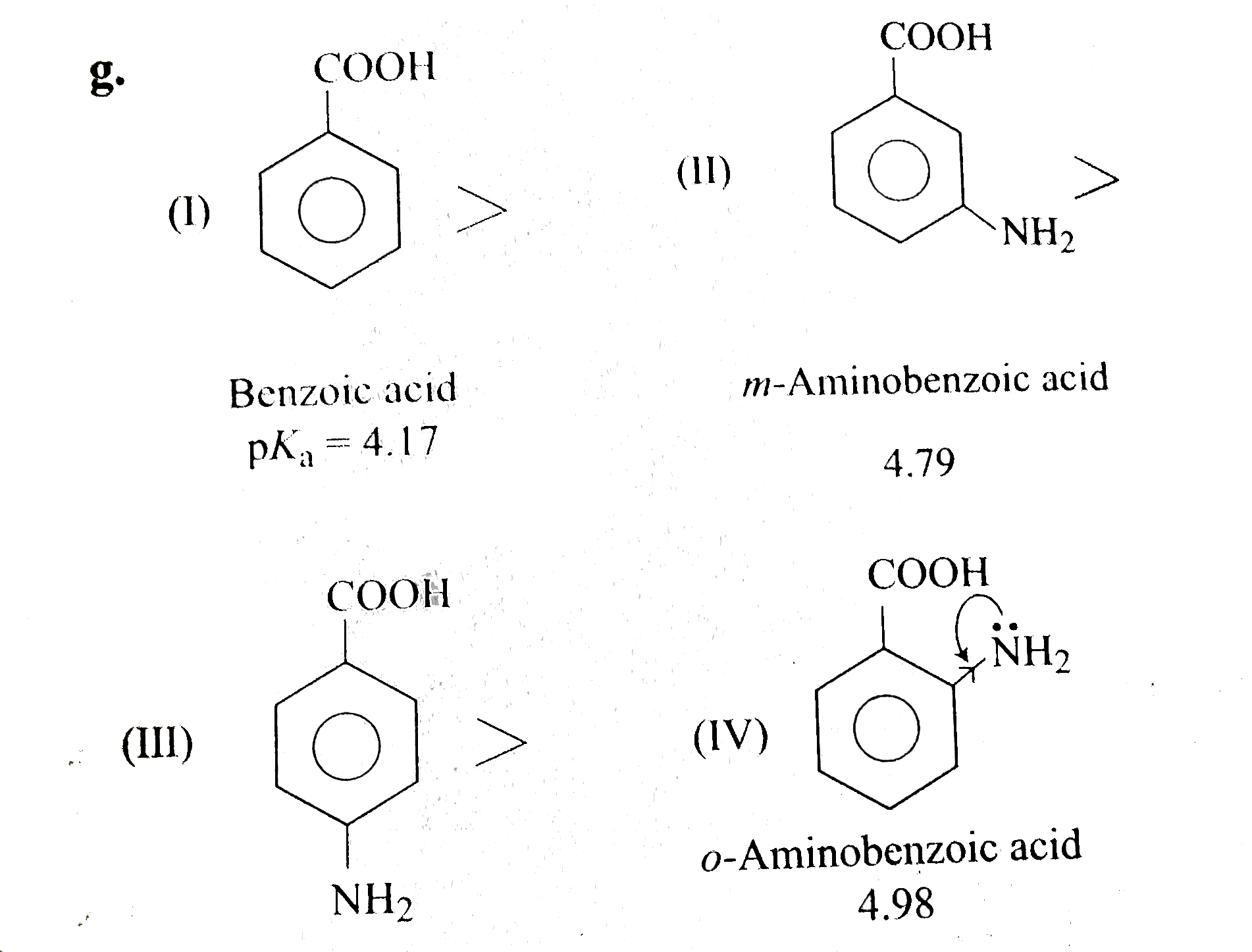 (h) 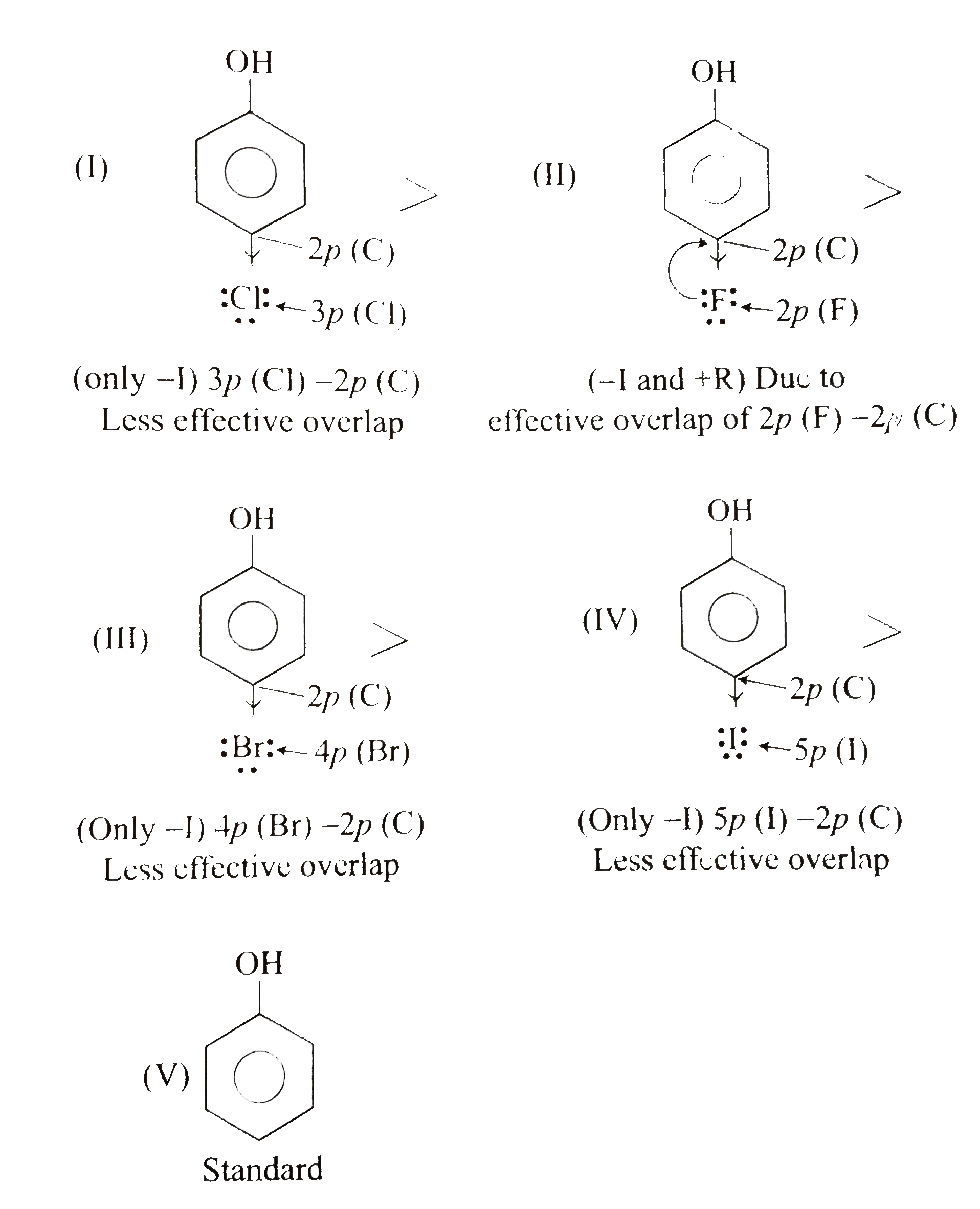 In case of `F`, both `-I` and `-R` effects are considered because of the effective overlap of `2 p (F) - 2p ( C)`. But in other halogens. only `-I` effect is considered due to the INEFFECTIVE overlap. So net `overline e` - withdrawing power of `C1 gt F gt Br gt I`. Hence, the acidic order is. `I gt II gt III gt IV gt V` (refer to `pK_a` , Table). (i) ( I) `c gt b gt a` (i) (c) is p-nitrophenol, which is stronger than o-nitro phenol `(b)` (due to intramolecular `H`-BONDING) (ii) In (a), acidic character is decreasing due to `+ I` and `H.C` effects of `(Me)` group at o-position. (II) `c gt d gt b` (i) Due to `EWG (NO_2` group) (`-I` and `-R` effects), `C` is most acidic. (ii) Due to ortho-effect, `(a)` is more acidic than `(b)` and `(d)` but less than `(c)` (iii) Due to only `+I` effect of `Me` at `m-`position, `(d)` is more acidic than `(b)` (iv) Due to `+ I` and `H.C` effects of `Me` at `p-`position (b) is least acidic. (III) `a gt c gt d ("Phenol" )gt "Aldehyde "gt (C = C) (sp` character) `gt(C = C) (sp^2` character). |
|
| 11. |
Arrange in decreasing order of reactivity with HCl : |
|
Answer» II gt III gt I |
|
| 12. |
Arrange in decreasing order , the energy of 2s orbital in the following atoms H, Li, Na , K |
|
Answer» `E_(2S(H)) gt E_(2s(LI)) gt E_(2s(Na)) gt E_(2s(K))` |
|
| 13. |
Arrange HI, HCl, HBr and HF in increasing order of rate of reaction with alkene. |
| Answer» SOLUTION :`HI LT HBR lt HCl lt HF` | |
| 14. |
Arrange HF, HCl, HBr, HI in decreasing order of bond length and give reason. |
|
Answer» Solution :`(H - I) GT (H - Br) gt (H - CL) gt (H - F)` `rarr`Bond length decrease `rarr` Because of, as the electronegativity of ATOM INCREASE the bond length also increase. |
|
| 15. |
Arrange halobenzenes (C_(6)H_(5)-X,X=F,Cl.Br.I) in the order of their increasing polarity. |
| Answer» SOLUTION :`C_(6)H_(5) F lt C_(6)H_(5) CL lt C_(6)H_(5) Br lt C_(6)H_(5) I`. | |
| 16. |
Arrange H_(2), O_(2), N_(2)in decreasing order of bond enthalpy. |
Answer» SOLUTION :So, bond ENTHALPY number : `O_(2) lt H_(2) lt N_(2)`  NOTE : Generally, Bond ORDER `prop ` bond enthalpy but this is not in `H_(2) and O_(2) `. Why ? `because ` RULES only for, between two atoms of only one elements. |
|
| 17. |
Arrange following reaction in decreasing order on its completion.(i)H_(2(g)) + Br_(2(g)) hArr 2HBr_((g)) "" K_c=2xx10^9(ii)2CH_(4(g)) hArr C_2H_(6(g)) + H_(2(g)) "" K_c=8.5xx10^(-12) (iii)CH_3OH_((g)) + H_(2(g)) hArr CH_(4(g)) + H_2O_((g)) "" K_c=2.6xx10^21 |
|
Answer» Solution :(iii) `to` (i) `to` (II) `K_c:2.6xx10^21 GT 2xx10^9 gt 8.5xx10^(-12)` `to` As the `K_c` decrease completion decrease `to` As `K_c` INCREASE REACTION TOWARDS completion. |
|
| 18. |
Arrange following in increasing pH value 0.1 MCH_(3)COOH, 0.1 M NaCl, 0.1 MHCl, 0.1 MNaOH, 0.1 MNH_(4)OH |
| Answer» Solution :`0.1 MNCl lt 0.1MCH_(3)COOH lt 0.1 M NACL lt 0.1 NH_(4)OH lt 0.1 M NAOH ` | |
| 19. |
Arrange following in increasing order of degree of hydrolysis. 0.1 M NH_(4)OH, 0.01 M NH_(4)OH , 10^(-5) M NH_(4)OH, 10^(-3) M NH4OH, 10^(-6) M NH_(4)OH |
| Answer» Solution :`0.1M NH_(4)OH lt 10^(-2) M NH_(4)OH, 10^(-3)M NH_(4)OH lt 10^(-5)MNH_(4)OH lt 10^(-6)MNH_(4)OH ` | |
| 20. |
Arrange following in increasing order of basic strength in gas phase NH_(3),(CH_(3))_(2)NH,(CH_(3))_(3)N,CH_(3)NH_(2) |
| Answer» SOLUTION :`NH_(3) lt NH_(3)NH_(2) lt (CH_(3))_(2)lt (CH3)_(3)N` | |
| 21. |
Arrange following in increasing order of acidic strengh CH_(3)COOH , HCOOH, CH_(3)CH_(2)COOH , C_(6)H_(5)COOH, CH_(2)COOH |
| Answer» Solution :`CH_(3)COOH lt C_(6)H_(5)COOH lt HCOOH lt CH_(2)FCOOH` | |
| 22. |
Arrange following compounds in decreasing order of their dipole moment. underset("I")(CH_(3)-CH_(2)-NO_(2))""underset("II")(CH_(3)-CH_(2)-NH_(2))""underset("III")(CH_(3)-CH_(2)-F)""underset("IV")(CH_(3)-CH_(2)-C-=N) |
|
Answer» `IVgtIIIgtIgtII` |
|
| 23. |
Arrange decreasing order of K^(+) , Cl^(-) , S^(2-) , Ca^(2+)with explanation. |
|
Answer» Solution :`K^(+) , Cl^(-) , S^(2-) , Ca^(2+)`ions having same e- but its radius are different because they have different radius. Positive ion having positive charge so effective nuclear charge increases, so radius decreases Negative ion having negative charge so effective nuclear charge decreases, so radius increases. S contain `16e^(-)` and 16 p but `S^(2-)` contain 16 p and `18e^(-)` . Cl contain 17P and `19e^(-) " but " K^(+)` contain17p and `18e^(-)`. K contain 19p and `19e^(-)" but " K^(+)` contain 19p and `18e^(-)` . Ca having 20p and `20e^(-), " but " Ca^(+2)` having 20p and `18e^(-)` . So, `S^(2-) , Cl^(-) , K^(+) , Ca^(2+)` contain `18e^(-)` but nuclear charges are different. In `Ca^(2+)` ion ATTRACTION between proton and ELECTRON is MAXIMUM and in `S^(-2)` ion attraction between proton and electron is minimum so, ORDER of ionic radius is as follows : ` S^(2-) gt Cl^(-) gt K^(+) gt Ca^(2+)` |
|
| 24. |
Arrange decreasing order of compounds for oxidation number of .S.. |
|
Answer» `H_(2)SO_(4)gtSO_(2)gtH_(2)SgtH_(2)S_(2)O_(8)` |
|
| 25. |
Arrange CaCO_(3),KHCO_(3) and NaHCO_(3) in increasing order of solubilities. |
| Answer» SOLUTION :`CsCO_(3)ltNaHCO_(3)ltKHCO_(3)` | |
| 26. |
Arrange, C - O, C - N and C - C in increasing order of bond length and give reason. |
|
Answer» Solution :C - O `lt C - N lt C - C ` `LARR` bond LENGTH decrease `larr` Because, more NEGATIVE ATOM is attach. So, bond is strong and length is less. |
|
| 27. |
Arrange BF_3, BCl_3, B Br_3, BI_3 in the decreasing order of Lewis acid character and explain. |
| Answer» SOLUTION :`B Br_3 GT BCl_3 gt BF_3` | |
| 28. |
Arrange benzene, n-hexane and ethyne in the decreasing order of acidic behaviour. Also give reason for this behaviour. |
| Answer» SOLUTION :ETHYNE>BENZENE>n-hexane | |
| 29. |
Arrange benzene, n-hexene and ethyne in decreasing order of acidic behaviour. Also give reason for this behaviour. |
Answer» Solution :The hybridization state of carbon in these three compounds is 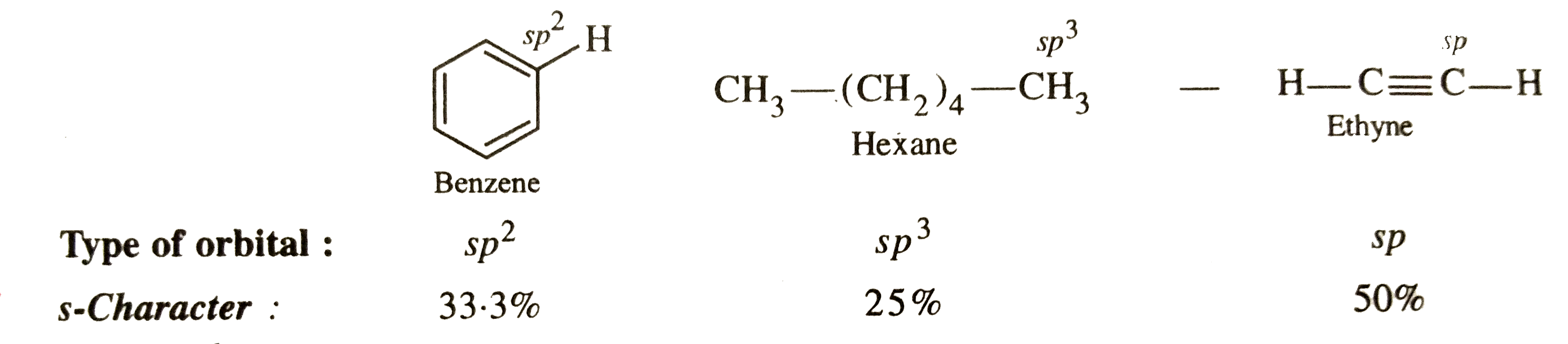 Since, s-electrons are closer to the nucleus , therefore , as the s-character of the orbital making the C-H bond increases, the electrons of C-H bond LIE closer and closer to the carbon ATOM. In other words, the PARTIAL +ve charge on the H-atom increases and hence the acidic character increases as the s-character of the orbital increases. Thus, the acidic character DECREASES in the order : Ethyne gt Benzene gt Hexane |
|
| 30. |
Arrange benzene, n-hexane and ethyne in decreasing order of acidic behaviour. Also give reason for this behaviour. |
|
Answer» Solution :Acidic character of a species is define on the basis of ease with which it can lose its H-atoms. The hybridization state of carbon in the GIVEN compound is : As the s-character increase, the electro-negativity of carbon increases and the electron of C-H bond pair lie closer to the carbon atom. As a result, partial positive charge of H-atom incresaes and H ions are set free. The s-character increases in the order : `SP^(3) lt sp^(2) lt sp` hence, the decreasing order of acidic behaviour is : ETHYNE `GT` BENZENE `gt` Hexane. 
|
|
| 31. |
Arrange benezene n hexane and ethynein decreasing order of acidicbehavior alsogivereason for hisbehavior |
Answer» SOLUTION : Sinces- ELECTRONARE closerto thenucleusthereforeas thecharacterof theorbitalmakingthe C-Hbondincreasesthe electrons of C-Hbondliescloserand closerto thecarbonatom. asthe s-characterof the orbitalincreases.Thusthe acidiccharacterdecreasesin theorder ETHYNE `gt`BENZENE`gt` Hexzne |
|
| 32. |
Arrange all elements of group - 1 in increasing order of their ionic radius. |
|
Answer» Solution : On moving top to BOTTOM in a group ionic size increases as the atomic size increases. Therefore on increasing atomic number ionic RADIUS also increases. `Li^(+) lt Na^(+) lt K^(+) lt RB^(+) lt Cs^(+) lt FR^(+)` |
|
| 33. |
Arrange atomic radius in decreasing order of atomic radius of elements S, O, Na, Li. |
|
Answer» Solution :Order : `Na to LI to S to O` NOTE : Radius alkali metals `GT` NON - metals |
|
| 34. |
Arrange alkali metal fluorides and halides in the decreasing order of solubility. |
|
Answer» SOLUTION :a.`CsFgtRbFgtKFgtNaFgtLiF` B.`KIgtKBrgtKCIgtKF` |
|
| 35. |
Arrange according to increase order pH CH_3 COONa, KI , NH_4Cl, HNO_3 |
|
Answer» Solution :Increasing ORDER of PH is as under, `{:(HNO_3, LT , NH_4Cl , lt , Kl ,lt , CH_3COONa),("ACIDIC",,"Acidic",,"Neutral",,"BASIC"):}` |
|
| 36. |
Arrange A,BC D,E and H in order of increasing electrode potential in the electrochemical series if A+H_(2)SO_(4)rarrASO_(4)+H_(2),ACI_(2)+C rarr CCI_(2)+A ECI_(2)+C rarr NO reaction , 2 BCI+ DrarrDCI_(2)+2 B H_(2)SO_(4)+D rarr NO reaction |
|
Answer» Solution :(i) Since `H_(2)SO_(4)` reacts with A to evolve `H_(2)` but not with D therefore `E^(@)` of A is lower than that of H while than of D is higher than that of H i.e D lis above H while A lies below H in the electrochemical series (ii) since D displaces B from BCI therefore `E^(@)` of D is lower than that of B From (i),(ii) and (III) it followis that the overall order of decreasing electrode potential is `BgtDgtH gtAgtCgtE` conversely `E^(@)` INCREASES in the order : `Elt Clt A lt H lt D lt B` |
|
| 37. |
Arrange according to bond order ? |
|
Answer» NO `lt C_(2) lt O_(2)^(-) lt He^(+)` BOND order : `O_(2)^(-) : " KK" (SIGMA 2S)^(2) (sigma^(**) 2s)^(2) (sigma 2p_(z))^(2) (pi 2p_(x))^(2) (pi 2pi_(y))^(2) (pi^(**)2p_(x))^(2) (pi^(**)2p_(y))^(1)` `O_(2)^(-)` bond order = `(1)/(2) (8 -5) = 1.5 ` `He^(+)_(2) : (sigma 1s^(2)) (sigma^(**)1s^(1))` `He_(2)^(+)` bond order =` (1)/(2) (2 - 1) = 0.5` `C_(2): " KK" (sigma 2s)^(2) (sigma^(**) 2s)^(2) (pi 2p_(x))^(2) (pi 2p_(y))^(2)` Bond order = `(1)/(2) ( 6 - 2)= 2.0 ` No : KK `(sigma 2s)^(2) (sigma^(**) 2s)^(2) (pi 2p_(x))^(2) (pi_(2) p_(y))^(2) (sigma_(2)p_(2))^(2) (pi^(**) 2p_(x))^(1) ` Bond order = `(1)/(2) ` (10 - 5) =2.5 |
|
| 38. |
Arrabge in decreasing order, the energy of 2s orbital in the following atoms H, Li, Na, K |
|
Answer» `E_(2s) (H) GT E_(2s) (Li) gt E_(2s) (Na) gt E_(2s) (K)` |
|
| 40. |
Aromaticity in benzene is due to |
|
Answer» Three double bonds |
|
| 41. |
Aromatic hydrocarbonsare highly unsaturated molecules but behave like saturated hydrocarbons. Those which contain a benzene ring are called benzenoids but those which contain some highly unsaturated ring other than benzene are called non-benzenoids. Their aromatic character can be ascertained through Hückel rule. Aromatic hydrocarbons are, however, more reactive than alkanes but are less reactive than alkenes and alkynes. The lower reactivity of arenes is because of the extra stability associated with these molecules due to delocalization of -electrons. Their stability is measured in terms of resonance energy which can be estimated from either heat of combustion or heat of hydrogenation data. They normally undergo electrophilic substitution reactions. In presence of a Lewis acid catalyst, nuclear halogenation occurs but in absence of Lewis acid catalyst and in presence of light, halogens add to the benzene ring. If an aromatic hydrocarbon contains an alkyl side chain, then in presence of heat/light side chain halogenation occurs in preference to addition of halogens to the benzene ring. The reactivity of aromatic hydrocarbons towards electrophilic substitution reactions depends upon the electron density in the benzene ring. Electron-donating groups favour while electron-withdrawing groups retard these reactions. Orientation of electrophilic substitution reactions is governed by the nature of the substituent already present in the ring. Although aromatic hydrocarbons are resistant to oxidising agents (KMnO_4, K_2Cr_2O_7, etc.) they do undergo ozonolysis. In the reaction of C_6H_5Y, the major product ( gt 60%) is m-isomer , so the group Y is |
| Answer» SOLUTION :Only -COOH is m-directing , REST are all o,p-directing. | |
| 42. |
Aromatic hydrocarbonsare highly unsaturated molecules but behave like saturated hydrocarbons. Those which contain a benzene ring are called benzenoids but those which contain some highly unsaturated ring other than benzene are called non-benzenoids. Their aromatic character can be ascertained through Hückel rule. Aromatic hydrocarbons are, however, more reactive than alkanes but are less reactive than alkenes and alkynes. The lower reactivity of arenes is because of the extra stability associated with these molecules due to delocalization of -electrons. Their stability is measured in terms of resonance energy which can be estimated from either heat of combustion or heat of hydrogenation data. They normally undergo electrophilic substitution reactions. In presence of a Lewis acid catalyst, nuclear halogenation occurs but in absence of Lewis acid catalyst and in presence of light, halogens add to the benzene ring. If an aromatic hydrocarbon contains an alkyl side chain, then in presence of heat/light side chain halogenation occurs in preference to addition of halogens to the benzene ring. The reactivity of aromatic hydrocarbons towards electrophilic substitution reactions depends upon the electron density in the benzene ring. Electron-donating groups favour while electron-withdrawing groups retard these reactions. Orientation of electrophilic substitution reactions is governed by the nature of the substituent already present in the ring. Although aromatic hydrocarbons are resistant to oxidising agents (KMnO_4, K_2Cr_2O_7, etc.) they do undergo ozonolysis. Reaction of benzene with excess of Cl_2 in presence of light and in presence of anhydrous AlCl_3 and in dark give respectively |
|
Answer» HEXACHLOROBENZENE and BENZENE hexachloride |
|
| 43. |
Aromatic hydrocarbonsare highly unsaturated molecules but behave like saturated hydrocarbons. Those which contain a benzene ring are called benzenoids but those which contain some highly unsaturated ring other than benzene are called non-benzenoids. Their aromatic character can be ascertained through Hückel rule. Aromatic hydrocarbons are, however, more reactive than alkanes but are less reactive than alkenes and alkynes. The lower reactivity of arenes is because of the extra stability associated with these molecules due to delocalization of -electrons. Their stability is measured in terms of resonance energy which can be estimated from either heat of combustion or heat of hydrogenation data. They normally undergo electrophilic substitution reactions. In presence of a Lewis acid catalyst, nuclear halogenation occurs but in absence of Lewis acid catalyst and in presence of light, halogens add to the benzene ring. If an aromatic hydrocarbon contains an alkyl side chain, then in presence of heat/light side chain halogenation occurs in preference to addition of halogens to the benzene ring. The reactivity of aromatic hydrocarbons towards electrophilic substitution reactions depends upon the electron density in the benzene ring. Electron-donating groups favour while electron-withdrawing groups retard these reactions. Orientation of electrophilic substitution reactions is governed by the nature of the substituent already present in the ring. Although aromatic hydrocarbons are resistant to oxidising agents (KMnO_4, K_2Cr_2O_7, etc.) they do undergo ozonolysis. The enthalpy of hydrogenation of cyclohexene is -119.5 "kJ mol"^(-1).If resonance energy of benzene is -150.4 "kJ mol"^(-1), its enthalpy of hydrogenation would be |
|
Answer» `-208.1 "KJ MOL"^(-1)` |
|
| 44. |
Aromatic hydrocarbonsare highly unsaturated molecules but behave like saturated hydrocarbons. Those which contain a benzene ring are called benzenoids but those which contain some highly unsaturated ring other than benzene are called non-benzenoids. Their aromatic character can be ascertained through Hückel rule. Aromatic hydrocarbons are, however, more reactive than alkanes but are less reactive than alkenes and alkynes. The lower reactivity of arenes is because of the extra stability associated with these molecules due to delocalization of -electrons. Their stability is measured in terms of resonance energy which can be estimated from either heat of combustion or heat of hydrogenation data. They normally undergo electrophilic substitution reactions. In presence of a Lewis acid catalyst, nuclear halogenation occurs but in absence of Lewis acid catalyst and in presence of light, halogens add to the benzene ring. If an aromatic hydrocarbon contains an alkyl side chain, then in presence of heat/light side chain halogenation occurs in preference to addition of halogens to the benzene ring. The reactivity of aromatic hydrocarbons towards electrophilic substitution reactions depends upon the electron density in the benzene ring. Electron-donating groups favour while electron-withdrawing groups retard these reactions. Orientation of electrophilic substitution reactions is governed by the nature of the substituent already present in the ring. Although aromatic hydrocarbons are resistant to oxidising agents (KMnO_4, K_2Cr_2O_7, etc.) they do undergo ozonolysis. Which of the following is not a non-benzenoid aromatic compound ? |
|
Answer» Tropylium cation |
|
| 45. |
Aromatic hydrocarbon can show electrophilic substitution reaction, oxidation and acidic nature. If alkyl group attached to benzene ring has alpha-H atom,it is oxidiesd into-COOH group. The electrophilic sustittion in aromatic compounds takes The at the position where most stable sigma complex is formed : the product formed is/are: |
|
Answer»
|
|
| 46. |
Aromatic hydrocarbon can show electrophilic substitution reaction, oxidation and acidic nature. If alkyl group attached to benzene ring has alpha-H atom,it is oxidiesd into-COOH group. The electrophilic sustittion in aromatic compounds takes The at the position where most stable sigma complex is formed : The product formed si/are : |
|
Answer»
|
|
| 47. |
Aromatic electrophilic substitution reaction that is reversible is |
|
Answer» nitration |
|
| 48. |
Aromatic compounds containing benzene are termed as |
|
Answer» BENZENE |
|
| 49. |
Aromatic compounds burn with soofy flame because: |
|
Answer» They have a ring structure of CARBON atoms. |
|
| 50. |
Argol a brown crust formed during the fermentation of grape juice contains |
| Answer» Solution :Potassium hydrogen tartarate. | |