Saved Bookmarks
This section includes 7 InterviewSolutions, each offering curated multiple-choice questions to sharpen your Current Affairs knowledge and support exam preparation. Choose a topic below to get started.
| 1. |
Arrange the following bonds in order of increasing ionic character giving reason. N - H , F - H , C - H andO - H |
Answer» Solution :Greater is the electronegativity difference between the two bonded atoms, greater is the ionic character. Therefore, INCREASING ORDER of ionic character of the given bonds is as follows : C - H `LT N - H lt O - H lt F - H` |
|
| 2. |
Arrange the following bonds in order of increasing ionic character giving reasonN-H,F-H,C-HandO-H |
|
Answer» Solution :Increasing ionic CHARACTER of the GIVEN bonds is : Electronegativity difference :`{:(N-H "" lt ""N-H""lt ""O-H ""lt ""F-H),("(2.5-2.1)(3.0-2.1)(3.5- 2.1)(4.0-2.1)"),( = "0 . 4= 0.9= 1.4= 1. 9 "):} ` Greater is the electronegativity differnce BETWEENTHE two bonded atoms, greater is the ionic character. |
|
| 3. |
Arrange the following as ststed: Increasing order of basic character: MgO,SrO_(2),K_(2)O,NiO,Cs_(2)O. |
|
Answer» Solution :In the periodic table, the basic character of OXIDES DECREASES from left to right. Also the basic character of oxides increases down the group. THEREFORE, following is the INCREASING order of basic character of the given oxides. Moreover, basic character of group 1 is greater than that of group 2. `NiO lt MgO lt SrO lt K_(2)O lt Cs_(2)O` |
|
| 4. |
Arrange the following as stated: (i) N_(2),O_(2),F_(2),CI_(2), (Increasing order of bond dissociation energy) (ii) F,CI, Br, 1 (Increasing order of electron gain enthalpy) (iii) F_(2),N_(2), CI_(2),O_(2), (Increasing order of bond length). |
|
Answer» Solution :(i) `F_(2)ltCl_(2)ltO_(2)ltN_(2)` (ii) IltBrltFltCl (III) `N_(2)ltO_(2)ltF_(2)ltCl_(2)` |
|
| 5. |
Arrange the following aqueous solutions in the order of their increasing boiling points (i)10 ^(-4) M NaCl (ii)10^(-3) Murea ( iii)10^(-3) M Mg Cl_2 ( iv)10^(-3) MNaCl |
|
Answer» ` (i) LT ( II) lt (IV ) lt ( III) ` |
|
| 6. |
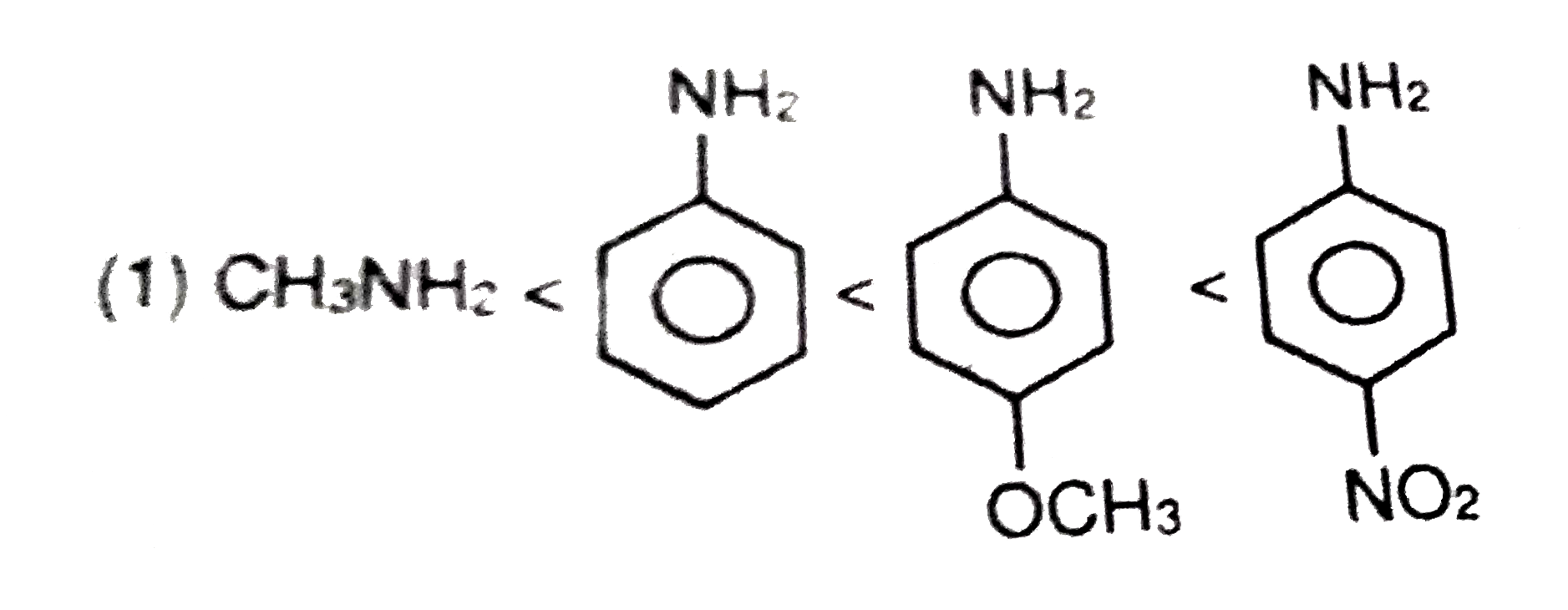
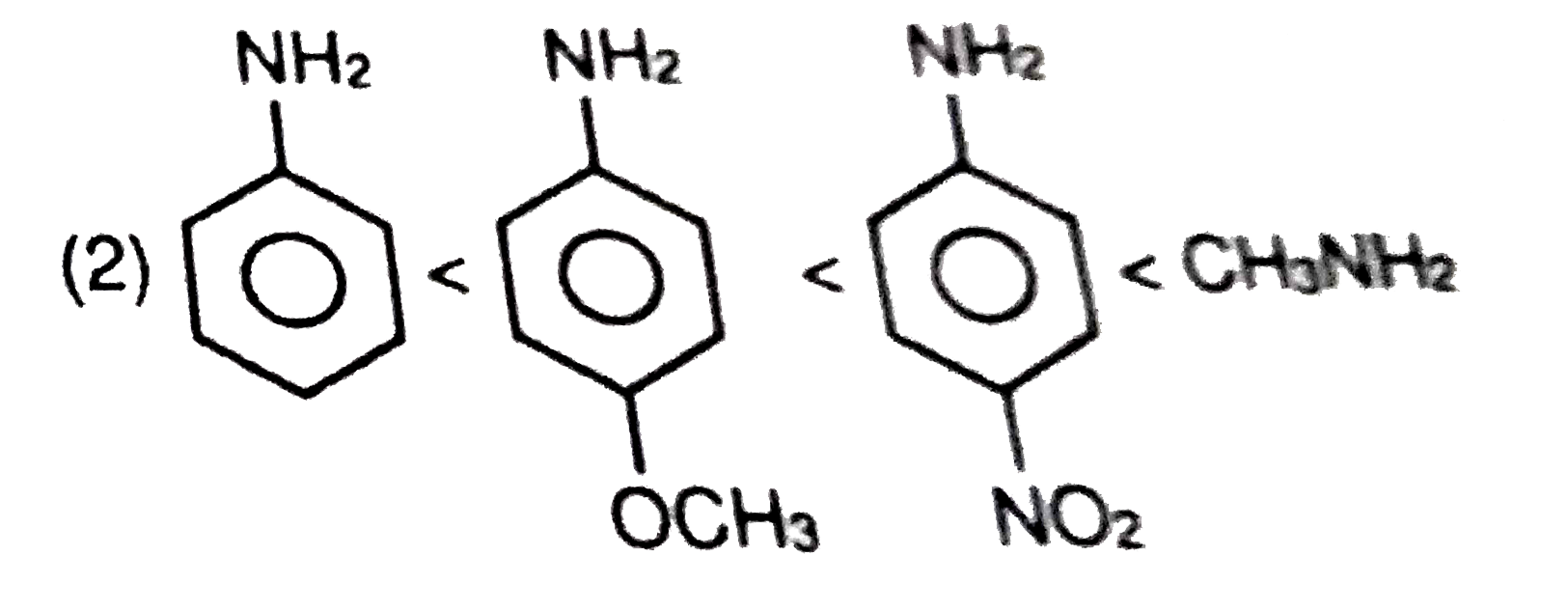
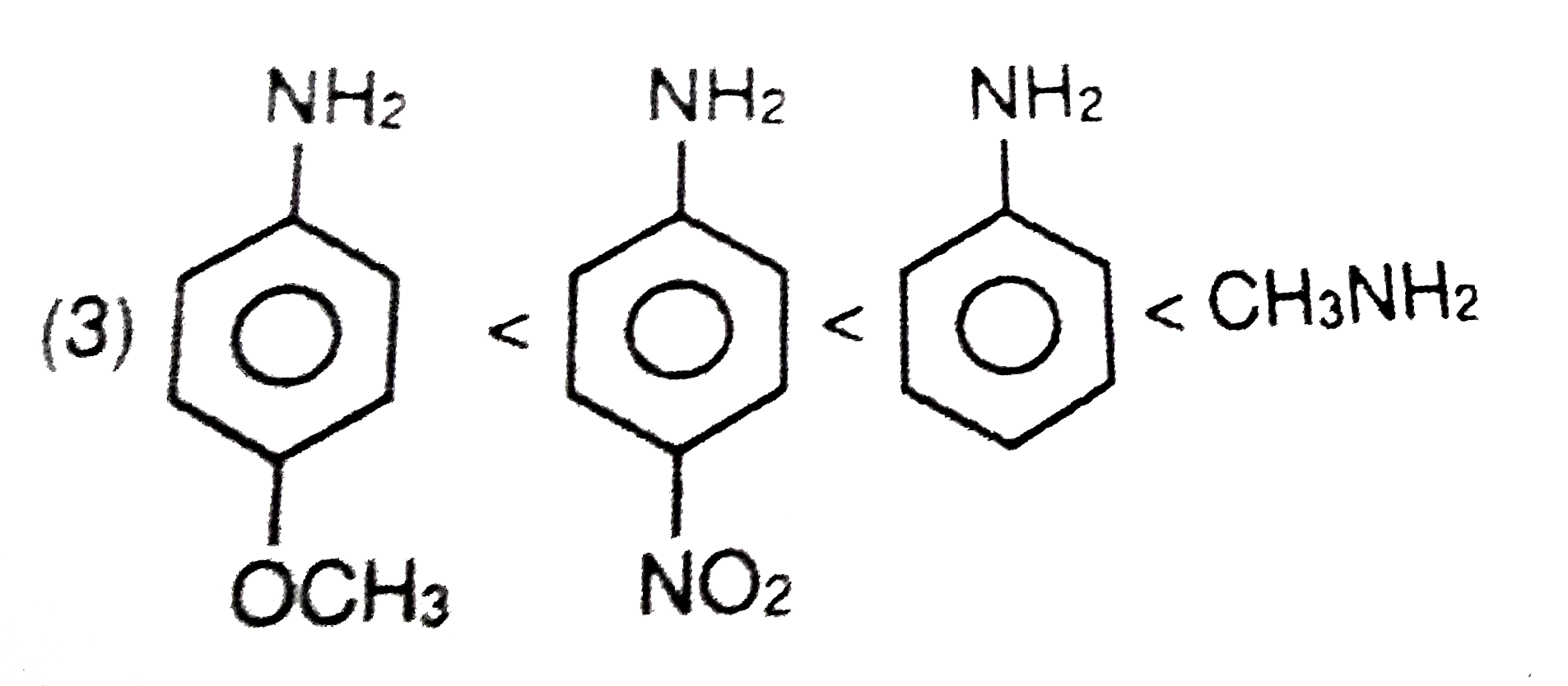
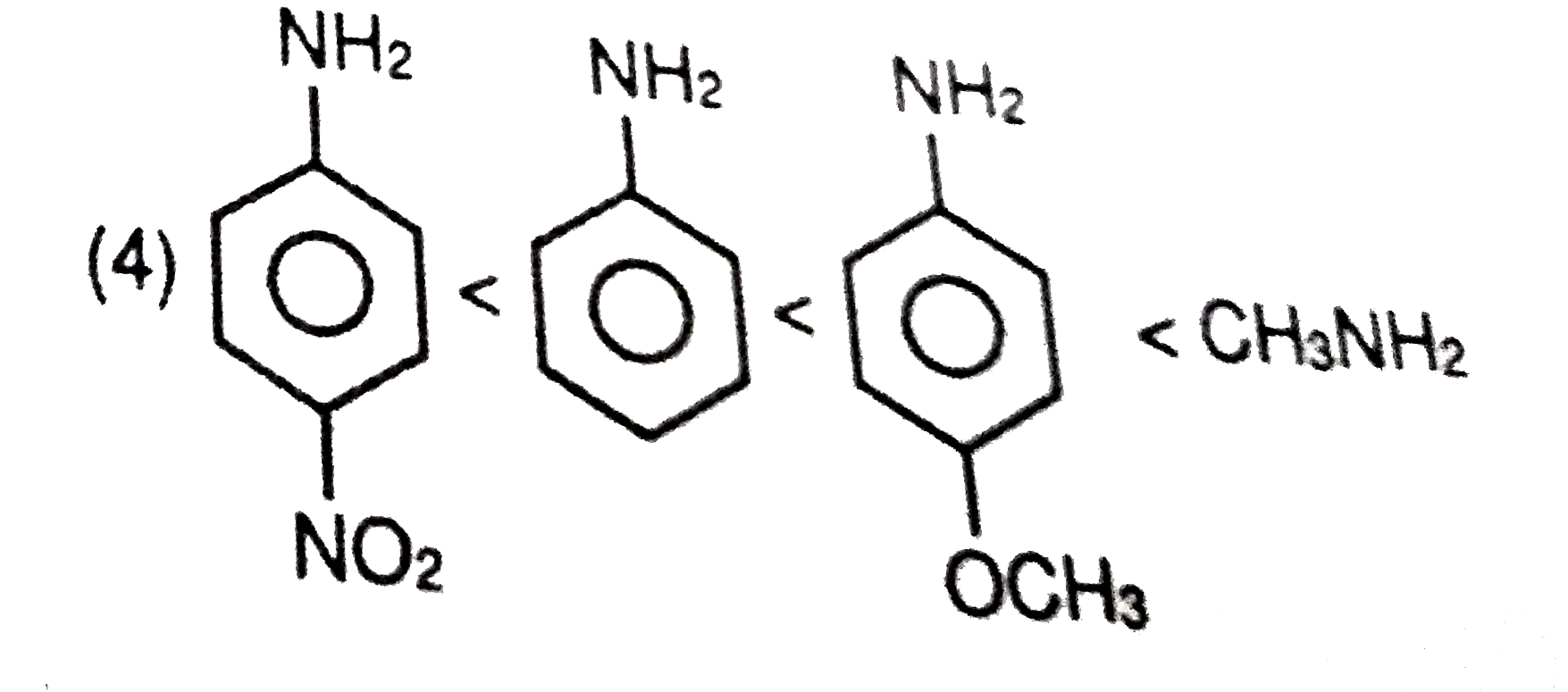
Arrange the following amines in the order of increasing basicity: |
|
Answer»
|
|
| 7. |
Arrange the following alkyl halides in decreasing order of the rate of -elimination reaction with alcoholic KOH. (A) H_(3)C-underset(CH_(3))underset(|)overset(H)overset(|)(C)-CH_(2)Br (B) CH_(3)-CH_(2)-Br (C) CH_(3)-CH_(2)-CH_(2)-Br |
|
Answer» `A gt B gt C` |
|
| 8. |
Arrange the following alkyl halides in decreasing order of the rate of beta-elimination reaction with alcoholic KOH. (I) CH_(3)-underset(CH_(3))underset(|)overset(H)overset(|)(C)-CH_(3)Br (II) CH_(3)-CH_(2)-Br (III) CH_(3)-CH_(2)-CH_(2)-Br |
|
Answer» IgtIIgtIII More the number of `beta`-substituents (alkyl GROUPS), more STABLE alkene it will form on `beta`-elimination and more will be the reactivity. thus, the decreasing order of the RATE of `beta`-elimination reaction with alcoholic KOH is: IgtIIIgtII |
|
| 9. |
Arrange the following alkyl halides in decreasing order of the rate of beta-elimination reaction with alcoholic KOH (A)CH_3-undersetunderset(CH_3)|oversetoversetH|C-CH_2Br (B)CH_3-CH_2-Br (C )CH_3-CH_2 -CH_2-Br |
|
Answer» A gt Bgt C |
|
| 10. |
Arrange the following alkyl halide in increasing order of bond enthalpy of RX CH_(3)Br, CH_(3)F, CH_(3)Cl,CH_(3)I. |
| Answer» SOLUTION :The bond strength of C-X bond decreases form C-F to C-I in `CH_(3)-X`. Increasing order of bond enthalpy. <BR> `CH_(3)I lt CH_(3) Br lt CH_(3)Cl lt CH_(3)F`. | |
| 11. |
Arrange the following alkenes in the descending order of their reactivity with HBr. a) Ethene b) Propene c) 2-Butene d) 2-Methyl-2-butene |
|
Answer» `agtbgtcgtd` |
|
| 12. |
Arrange the following alkene in increasing order of reactivity towards addition reaction with HCI. |
|
Answer» `IV lt III lt I lt II` |
|
| 13. |
Arrange the following acid in order of increasing acidity |
|
Answer» `I gt II gt III gt IV` `C lt D lt B lt A` |
|
| 14. |
Arrange the following acids in decreasing order of acidity : (I)H_2SO_4 ,(II)H_3PO_4 , (III)HClO_4 |
|
Answer» `I GT II gt III` |
|
| 15. |
Arrange the following according to their packing fractions : Simple cubic, face-centred cubic, body-centred cubic |
| Answer» SOLUTION :SIMPLE (0.52 ) LT body-centred (0.68) lt face-centred (0.74 ) | |
| 16. |
Arrange the following according to instruction. (i) Arrange in desending order of its acidic strength. CH_(3)COOH, (CH_(3))_(3)C COOH, (CH_(3))_(2) CHCOOH, CH_(3)CH_(2)COOH |
| Answer» SOLUTION :`CH_(3) COOH gt CH_(3)CH_(2)COOH gt (CH_(3))_(2) CHCOOH gt (CH_(3))_(3)C COOH` | |
| 17. |
Arrange the following a.CaH_(2),BeH_(2)and TiH_(2) in order of increasing electrical conductance. b. LiH,NaH and CsH in order of increasing ionic character. c. H-H,D-D and F-F in order of increasing bond dissociaton enthalpy. d. NaH,MgH_(2) and H_(2)O in order of increasing reducing property. |
|
Answer» Solution :a. The order of increasing ELECTRIC conductance is `BeH_(2)ltCH_(2)ltTiH_(2)` Skince `CaH_(2)` is an ionic hydride, it conducts electricity in fused state, `BeH_(2)` being covalent hydride does not conduct electricity at all. `TiH_(2)`, a metallic hydride conducts electricity at room temperature. B. The order of increasing ionic character is `LiHltNaHltCsH` Down the group `(DARR)`, from `Li` to `Cs`, electronegativity decreases adn and hence ionic character increases. c. Order of increasing bond dissociation enthalpy: `F-FltH-HltD-D` Due to greater nucleus mass, the bond pair in `D-D` bond is attracted more strongly than in `H-H` bond. THUS, the bond dissociation enthalpy of `D-D` is higher than `H-H` bond. However, due to repulsion between lone pairs of `F` and the bond, `F-F` bond dissociation enthalpy is the minimum, and hence the order. d. Order of increasing reducing property: `H_(2)OltMgH_(2)ltNaH` `NaH` is ionic hydride whereas `H_(2)O` adn `MgH_(2)` are covalent hydrides. Ionic hydrides are STRONGER reducing agent as compared to covalent hydrides. Hence `NaH` is stronger reducing agent as compared to `H_(2)O` and `MgH_(2)`. Out of `H_(2)O` and `MgH_(2)`, hence `H_(2)O` is weaker reducing agent as compared to `MgH_(2)`. |
|
| 18. |
Arrange the fallowing alkanes in decreasing order of their heat of combustion: |
|
Answer» `X GT Y gt Z ` |
|
| 19. |
Arrange the followin according to their packing fractions. Simple cubic , face- centred , body -centred cubic . |
| Answer» SOLUTION :SIMPLE ( 0.52) LT body -centred (0.68) lt FACE - centred ( 0.74) | |
| 20. |
Arrangethe elements withthe followingelectronicconfigurationin orderof increasingelectron gainenthalpy (i) 1s^(2)2s^(2) 2p^(5)(ii)1s^(2)2s^(2)2p^(4)(iii)1s^(2)2s^(2)2p^(3)(iv)1s^(2)2s^(2)2p^(6)3s^(2)3p^(4) |
|
Answer» |
|
| 21. |
Arrangethe elementsof secondperiodin orderof increasingsecondionizationenthalpies. |
|
Answer» Solution :The electron CONFIGURATION of the ionsobtainedafterremovalof firstelectronfrom theelements of2nd `(1s^(2) 2s^(2)2p^(3), F^(+) (1s^(2) 2s^(2) 2p^(4))` and `(Ne^(+) (1s^(2) 2s^(2) 2p^(5))` Thefollowingconclusions can bedrawnfrom theaboveconfiguration (i) `Li^(+)` has nolegas VIZ. He gasconfigurationtherefore`Delta_(i)H_(2)`of Li is thehighest in the secondperiod (ii) Since `B^(+)` the electronhas to beremovalfrom amorestablefullyfilled2 s-orbitalwhilein `Be^(+)` ithas to belost fromthe lessstablehalf-filled 2s-orbitalandfurthermore, the lossof anelectronfrom `Be^(+)` givesmore stable `Be^(2+)` ion withnoblegas configuration therefore `Delta_(i)H_(2)` of Be islowerthan thatof B. (iii)Sincemoreenergy is requiredto remove an s-electron than a p-electronof thesameenergy level thereforemore energy is requiredto removea 2s-electronfrom `B^(+) (1s^(2) 2s^(2))` than a 2p- electronfrom`C^(+) (1s^(2) 2s^(2) 2p^(1))`. Inotherwords `Delta_(i)H_(2)` of Cis lowerthan that of B. (iv) As wemovefrom C to N O, thenuclear charge increases by oneunit attimethereforetheir`Deltai H_(2)` alsoincreaseaccordingly. Inotherwords `Delta_(i)H_(2)` ofhighest thanthat of N whichin turnis higher thanthat of C. (v) In caseof `O^(+) (1s^(2)2s^(2) 2p^(3))` and electronis to befrom an exactlyhalf- filled2p- orbitalbut in case of`F^(+) (1s^(2) 2s^(2) 2p^(4))` THISIS notso. However, lossof an electron from `F^(+)` givesan exactlyhalf-filled2p- ORBITAL(i.e, `F^(2+) (1s^(2) 2s^(2) 2p^(3))` therefore `Delta_(i)H_(2)` of F shouldbe lowerthan thatof O. (vi)Like `O^(+) (1s^(2) s^(2) 2p^(3))` and `F^(+) (1s^(2)2s^(2)2p^(4))` in caseof `Ne^(+) (1s^(2) 2s^(2)2p^(5))` alsoan electronis to beremovedfrom a 2p-orbital. SinceNe hasthehighestnuclear nuclearchargein 2ndperiod`Delta_(i)H_(2)` ofNe isexpectedto bemuchhigherthan thatof O ro E. Fromthe abovediscussionit follows that `Delta_(i)H_(2)` of THEELEMENTSOF 2ndperiodincreasein the order. `Be lt C lt B lt N lt F ltO ltNe ltLi` |
|
| 22. |
Arrange the elements N, P, O and S in the order of - (i) increasing first ionisation enthalpy. (ii) increasing non metallic character. Give reason for the arrangement assigned. |
Answer» Solution :The placing of elements are as  Ionisation enthalpy of nitrogen `(""_(7)N=1s^(2),2s^(2),2p^(3))` is greater than oxygen `(.::_(8)O=1s^(2),2s^(2),2p^(4))` DUE to extra stable exactly half-filled 2p-orbitals. Similarly, ionisation enthalpy of phosphorus `(""_(15)P=1s^(2),2s^(2),2p^(6),3S^(2),3P^(3))` is greater than sulphur `(""_(16)S=1s^(2),2s^(2),2p^(6),3s^(2),4p^(4))` On moving down the group, ionisation enthalpy decreases with increasing atomic size.So the ORDER is `S lt P lt O lt N to` first ionisation enthalpy increases. (ii) Non-metallic character across a period (left to right) increases but on moving down the group it decreases. So, the order is, `P lt S ltN lt O to ` Non-metallic character increases. |
|
| 23. |
Arrangethe elementsN, P , O and S in theorder of - (i) increasingfirstionisationenthalpy. (ii)increasingnonmetalliccharacter .Givereason for thearrangementassigned . |
|
Answer» Solution :Arrangetheelements N, P, Oand S intodifferentgroupsand periodsin order of theirincreasingatomicnumbers we have `{:("Group " to ,,15,,16),("Period " 2,,N,,O),("Period " 3 ,,P ,,S):}` (i) theelectronicconfigurationof `N (1 s^(2) 2s^(2) 2p_(y)^(1) 2p_(y)^(1) 2p_(z)^(1))`in which2p-orbitals areexactly half - filledismorestablethan theelectronicconfigurationof `O (1s^(2)2s^(2)2p_(x)^(2) 2p_(y)^(1) 2p_(z)^(1))` in which2p- ORBITALSARE neither half- fillednorcompletelyfilled.Thereforeit is difficult toremove anelectron from N andthan from Oin spites ofthe fact theO (+ 8)has highest nuclearcharge than `N ( +7)` . As aresult `Delta_(i) H_(1)` ofN is higherthant thatofO. Similarlythe electronicconfigurationof `P (1s^(2)2s^(2)2p^(6)3S^(2)3p_(x)^(1) 3p_(y)^(1) 3p_(z)^(1))` in which3p- orbirtals are exactlyhalf- filledis morestablethan theelectronicconfigurationof `S (1s^(2) 2s^(2)2p^(6) 3s^(2)3p_(x)^(2)3p_(y)^(1)2p_(z)^(1))` in which 3p-orbitals are neitherhalf - fillednorcompletelyfilled.Thereforeis is difficultto removeon electronfromPthan fromS inspiteof the factthat S (+ 16)has highernuclearchargethan P (+ 15). Thus `Delta_(i)H_(1)` ofP ishigherthan thatS. Furthersince `Delta_(i)H_(1)` decreasesdown agrouptherefore`Delta_(i)H_(i)` ofN isgreaterthan thatof Pand thatof O isgreaterthan thatof S. Combiningthe tworesultstogetherthe firstionizationenthalpies of N, P, Oandincreases in the order `: S ltP lt O lt N` (ii) Sincenon metalliccharacterincreasesalonga periodand decreasesdown AGROUP, thereforenonmetalliccharacterincreases in THEORDER`: Plt Slt N lt O` |
|
| 24. |
Arrange the decreasing order of rate of electrophilic aromatic substitution |
|
Answer» AgtBgtCgtD |
|
| 25. |
Arrange the carbanions (CH_(3))_(3)C^(-), Cl_(3)C^(-), (CH_(3))_(2)CH^(-), C_(6)H_(5)CH_(2)^(-) in order of their decreasing stability |
|
Answer» `(CH_(3))_(2)CH^(-) gt Cl_(3)C^(-) gt C_(6)H_(5)CH_(2)^(-) gt (CH_(3))_(3)C^(-)` |
|
| 26. |
Arrange the carbanions , (CH_(3))_(3) bar(C), bar(C) Cl_(3), (CH_(3))_(2) bar(C) H, C_(6)H_(5) bar(C) H_(2) in order of their decreasing stability : |
|
Answer» `(CH_(3))_(2)bar(C)H GT bar(C) Cl_(3) gt C_(6)H_(5)BARC H_(2) gt (CH_(3))_(3) barC` |
|
| 27. |
Arrange the carbanions, (CH)_(3) bar(C ), bar(C )Cl_(3), (CH_(3))_(2) bar(C )H, C_(6)H_(5) bar(C )H_(2) in order of their decreasing stability |
|
Answer» `C_(6)H_(5) OVERSET(-)( C)H_(2) gtoverset(-)(C )Cl_(3) gt (CH_(3))_(3)overset(-)(C )gt (CH_(3))_(2)overset(-)(C )H` |
|
| 28. |
Arrange the bonds in order of increasing ionic chargacter in the molecules , LiF, K_(2)O, N_(2), SO_(2)" and " ClF_(3) |
|
Answer» Solution :Ionic character `alpha` LATTICE energy `alpha 1/("size of ion ") alpha ` CHARGE on ion . A non-polar molecule like `N_(2)` has almostnegligible ionic character . `:.` The order of ionic character is `N_(2) lt SO_(2) lt ClF_(3) lt K_(2)O lt LIF` |
|
| 29. |
Arrange the bonds in order of increasing oinic character in the molecules : LiF, K_2 O,N_2 ,SO_2and CIF_3 |
| Answer» Solution :ORDER is `N_(2)ltSO_(2)ltClF_(3)ltK_(2)OltLiF` | |
| 30. |
Arrange the bonds in the order of increasing ionic character in the following molecules:LiF,K_2O,N_2, SO_2 and ClF_3 |
| Answer» SOLUTION :`N_2 LT SO_2 lt ClF_3 lt K_2 lt LIF` | |
| 31. |
Arrange the bonds in order of increasing ioniccharacter in the molecules : LiF, K_(2)O ,N_(2),SO_(2) and CIF_(3). |
|
Answer» SOLUTION :Increasing order of ionic character :`N_(2) lt CIF_(2) lt SO_(2) lt K_(2) O ltLiF` EXPLANATION : Ionic character of non BONDING `prop` difference of electronegativity.  In `SO_(2)" &" CIF_(3)` difference of electronegativity is some 1.0. In `SO_(2), S^(2+) and "in" CIF_(3) Cl^(+)` ions are there in which `S^(2+)` is smaller than `Cl^(+)`. Electronegativities of `O^(-2)` (1.40) and `F^(-1)` is (1.36) While `O^(2-)` is larger in size than `F^(-1)`. As the positive ION is smaller & negative ion islarger l, d covalent character is more and ionic character is less. `SO_(2)` is ionic more then `CIF_(3)`. |
|
| 32. |
Arrange the basic strength of following F^(-),Br^(-), C1^(-),I^(-) |
| Answer» SOLUTION :`I^(-) LT BR^(-) lt C1^(-) lt F^(-)` | |
| 33. |
Arrange the1s, 2s, 4s, 3p, 4p and 3dorbitalsaccordingto increasingorderof energy . |
|
Answer» SOLUTION :Energy order : ` 1 s lt2s lt2p lt3s lt 3P lt4s lt 3dlt 4p` thisorderis basedon (n+1)(n+l)is samethan nis moreenergyis more 
|
|
| 34. |
Arrange s, p and d sub-shells of a shell in the increasing order of effective nuclear charge (Z_("eff")) experienced by the electron present in them. |
| Answer» SOLUTION :s-orbital, being spherical in shape, SHIELDS the electrons from the nucleus more effectively than p-orbital which in turn shields more effectively than d-orbital. Hence, the increasing order of effective nuclear CHARGE `(Z_("eff"))` experienced by the electrons PRESENT in them is: `d lt p lt s` | |
| 35. |
Arrange solid, liquid and gas in order of energy, giving reasons. |
| Answer» SOLUTION :Solid lt LIQUID lt Gas. This is because a solid ABSORBS ENERGY to change into a liquid which further absorbs energy to change into a gas. | |
| 36. |
Arrange NH_4^(+ ) , H_2O , H_3O^(+),HF and OH^(-)in increasing order of acidic nature : |
|
Answer» `OH ^(-) lt H_2O lt NH_4^(-) lt HF lt H_3O^(+)` |
|
| 37. |
Choose the correct increasing order of acidic strength |
|
Answer» `OH ^(-) LT H_2O lt NH_4^(-) lt HF lt H_3O^(+)` |
|
| 38. |
Arrange NH_3,H_2O and HF in the order of increasing magnitude of hydrogen bonding and explain the basis for your arrangement. |
|
Answer» SOLUTION : (i) Increasing magnitude of hydrogen BONDING among `NH_(3)`, `H_(2)O` and HF is `HF>H_(2)O>NH_(3)` (II) The extent of hydrogen bonding depends upon electronegativity and the number of hydrogen atoms available for bonding. (iii) Among N, F and the increasing order of their ELECTRONEGATIVITIES are N |
|
| 39. |
Arrange Na, Na^(+) , F, F^(-)in decreasing order of radius. |
|
Answer» SOLUTION :`F^(-) GT F " and " Na^(+) gt Na` `{:("RADIUS of species :",Na,Na^(+),F^(-),F),(,186,86,136,64):}` ORDER : `Na gt F^(-) gt Na^(+) gt F` |
|
| 40. |
Arrange Na^(+),Mg^(2+) and Al^(3+) in the increasing order of ionic radii.Give reason. |
Answer» Solution :`NA^(+),Mg^(2+)` and `Al^(3+)` are isoelectronic cations.  The CATION with the greater positive charge will have a smaller radius because of the greater attraction of the electrons to the nucleus. HENCE the increasing order of ionic radii is, `r_(Na^(+))gtr_(Mg^(2+))gtr_(Al^(3+))` |
|
| 41. |
Arrange n-pentane, isopentane and neopentane in the descending order of dispersion forces. |
| Answer» Solution :London forces of ATTRACTION is proportional to the surface area of molecules. With INCREASING branching MOLECULE gets spherical shape which has minimum surface area and as a RESULT London forces decreases. Order of London forces is : n-pentane `gt` isopentane `gt` neopentane. | |
| 42. |
Arrange increasing order of oxidation numberof S in molecules SO_(3)^(-2),S_(2)O_(4)^(-2)andS_(2)O_(6)^(-2). |
| Answer» Solution :`S_(2)O_(4)^(-2)ltSO_(3)^(-2)ltS_(2)O_(6)^(-2)` | |
| 43. |
Arrange increasing order of energy of interaction forces London force, Covalent bond, Hydrogen bond, Dipole - Dipole forces. |
|
Answer» Solution :London forces : 1 to 10 kJ `mol^(-1)` DIPOLE - Dipole forces : 1 to 3 K cal `mol^(-1)` Hydrogen bond : 10 to 40 kJ `mol^(-1)` /3 to 10 K cal `mol^(-1)` COVALENT bond : 50 to 100 K cal `mol^(-1)` London forces `lt` Dipole - Dipole forces `lt` Hydrogen bond `lt` Covalent bond. |
|
| 44. |
Arrange LiOH, NaOH, KOH, RbOH and CSOH in the increasing order of basic strength and give an adequate explanation for the same. |
| Answer» Solution :`LIOH LT NAOH lt KOH lt RBOH lt CsOH` | |
| 45. |
Arrange increasing order of oxidation number of oxygen. |
|
Answer» `OF_(2)ltKO_(2)ltBaO_(2)ltO_(3)` |
|
| 46. |
Arrange increasing order of atomic radius of given elements. (i) O, N, F, B, Be, Li, C br> (ii) P, S, Mg, Na, Al, Si, Cl (iii) K, Na, Li, Cs, Rb (iv) Cl, F, I, At, Br |
|
Answer» Solution :(i) F, O, N, C, B, Be , Li (ii) Cl, S, P, Si, Al, Mg, Na <BR> (iii) Li, Na, K, Rb, CS (IV) F, Cl, Br, I, At |
|
| 47. |
Arrange in the order of increasing ionic character: C-H,F-H, Br-H, Na-I,K-F and Li-Cl |
| Answer» SOLUTION :`C-H LT Br- H lt F-H lt LI- CL lt Na-I lt K-F` | |
| 48. |
Arrange in the increasing order according to the given properties and explain the order: (i) MgCl_(2),AlCl_(3),NaCl,SiCl_(4) (melting point), (ii) LiBr, NaBr,KB r (melting point), (iii) MgCO_(3),CaCO_(3),BeCO_(3) (thermal stability), (iv) HgI_(2),HgCl_(2) (intensity of colour). |
|
Answer» Solution :(i) `SiCl_(4) lt AlCl_(3) lt MgCl_(2) lt NaCl` : [Ionic potential incrases with EITHER INCREASE to charge on cation or cationic radius. As a result, covalent character and melting point of the compounds formed increases.] (ii) The order of melting point of the given bromides should be `LiBr lt NABR lt Kb r`. due to increase in the size of cation from `Li^(+)` to `K^(+)`, the value of a `phi` increases. so, covalent character of the compounds increases. however, due to DECRESE in LATTICE enthalpy from NaBr to Kbr, the melting point decreases. therefore the correct order of melting point is `LiBr lt NaBr gt KBr`. (iii) N/A |
|
| 49. |
Arrange in the given order: Increasing radius : I,I^+ and I^- |
|
Answer» |
|