

Saved Bookmarks
This section includes 7 InterviewSolutions, each offering curated multiple-choice questions to sharpen your Current Affairs knowledge and support exam preparation. Choose a topic below to get started.
| 1. |
Discuss the principle and method of softening of hard water by synthetic ion exchange resins. |
|
Answer» Solution :(iii) Ion-exchange method : This method is also called zeolite/permutit process. Hydrated sodium aluminium silicate is zeolite/permutit. For the sake of simplicity, sodium aluminium silicate `(NaAlSiO_2)` can be written as NaZ. When this is added in HARD water, exchange REACTIONS take place. `2NaZ_((s)) + M_((aq))^(2+) to MZ_(2+(aq)) to NZ_(2(s)) + 2Na_((aq))^(+)` (M=Mg, Ca) Permutit/zeolite is said to be exhausted when all the sodium in it is used up. It is regenerated for further use by treating with an aqueous sodium chloride solution. `MZ_(2(s)) + 2NaCl_((aq)) to 2NaZ_((s)) + MCl_(2(aq))` (iv) Synthetic resins method : Nowadays hard water is softened by using synthetic cation exchangers. This method is more efficient than zeolite process. Cation exchange resins It contain large organic molecule with -`SO_3H` group and are water insoluble. Ion exchange resin `(RSO_3H)` is changed to RNa by treating it with NaCl. The resin exchanges `Na^+` ions with `Ca^(2+)` and `Mg^(2+)` ions present in hard water to make the water soft. Here R is resin ANION. `2RNa_((s))+ M_((aq))^(2+) to R_2M_((s)) + 2Na_((aq))^(+)` The resin can be regenerated by adding aqueous NaCl solution. Pure de-mineralised (de-ionized) water free from all soluble mineral salts is obtained by passing water successively through a cation exchange in the `H^+` form) and an anion exchange in the `OH^-` form) resins. `2RH_((s)) + M_((aq))^(2+) HARR MR_(2(s)) + 2H_((aq))^(+)` In this cation exchange process, H+ exchanges for `Na^(+), Ca^(2+), Mg^(2+)` and other cations present in water. This process results in proton release and thus makes the water acidic. Anion exchange process : `RNH_(2(s)) + H_2O_((l)) hArr RNH_(3)^(+) . OH_((s))^(-)` `RNH_3^(+). OH_((s))^(-) + X_((aq))^(+) hArr RNH_(3)^(+) . X_((s))^(-) + OH_((aq))^(+)` `OH^-` exchanges for anions like `Cl^(-), HCO_3^(-), SO_4^(2-)`etc. present in water. `OH^-` ions, thus, liberated neutralise the `H^+` ions set free in the cation exchange. `H_((aq))^(+) + OH_((aq))^(-) to H_2O_((l))` The exhausted cation and anion exchange resin beds are regenerated by treatment with dilute acid and alkali solutions respectively. |
|
| 2. |
Discuss the principle and method of softening of hard water by synthetic ion exchange method. |
| Answer» SOLUTION :For ANSWER, CONSULT SECTION 9.10 | |
| 3. |
Discuss the position of hydrogen in the periodic table is not justified. |
|
Answer» Solution :Its POSITION in periodic table is not justified because it resembles both alkali metal and halogens. i. Its electronic configuration is similar to alkali metals. ii. It is non-metal like halogens. iii. Its ionization energy is high like halogens. iv. It can LOSE electronws to from `H^(+)` like alkali metals. |
|
| 4. |
Discuss the position of hydrogen in the modern periodic Table. |
|
Answer» Solution :Hydrogen is the first element in the periodic table. However, its placement in the periodic table has been a subject of discussion in the past. Hydrogen has electronic configuration `1s^1` on one hand, its electron configuration is similar to the outer electronic configuration II `(ns^1)` of alkali metals, which belong to the first group of the periodic table. On the other hand, like halogens, it is short by, one electron to the corresponding noble gas configuration. Hydrogen, therefore has resemblance to alkali metals, which lose one electron to form unipositive ions. Like alkali metals hydrogen forms oxides, halides and sulphides. However, unlike alkali metals, it has a very high ionization enthalpy and does not POSSESS metallic characteristics under normal conditions. `Delta_i H` of Li is 520 kJ `"mol"^(-1)`,F is 1680 kJ `"mol"^(-1)` and that of H is 1312 kJ `"mol"^(-1)` Like halogens, hydrogen forms a diatomic molecule, combines with elements to form hydrides and a large number of covalent compounds. However, in terms of REACTIVITY, it is very low as compared to halogens. Inspite of the fact that hydrogen, to a certain extent resembles both with alkali metals and Halogens, it differs from them as well. Loss of the electron from Hydrogen atom results in nucleus `(H^+)` of ~ `1.5xx10^(-3)` pm size. This is extremely small as compared to normal atomic and ionic sizes of 50 to 200 pm. As a consequence, `H^+` does not EXIST freely and is always ASSOCIATED with other atoms or molecules. Thus, it is unique in behaviour and is, therefore, best placed separately in the periodic table |
|
| 5. |
Discuss the pattern of variation of oxidation states of (ii) C to Pb |
|
Answer» |
|
| 6. |
Discuss the pattern of variation of oxidation states of B to Tl |
|
Answer» |
|
| 7. |
Discuss the pattern of variation in the oxidation states of (i) B to Tl (iii) C to Pb. |
|
Answer» Solution :(i) B and Al have no d-or f-electrons. THEREFORE, they do notexhibit inert pair effect.Consequently,they slow show an oxidationstate of +3 only due to th persenceof two electrons in the s-and one electronin the p-orbitalof the valenceshell. In CONTRAST, all otherelement from Ga TOTL contains eitheronly d-ord- and f-electronsand henceshow two oxidationstatesof +1 and +3 due to inert pair effect.Further, as the numberof d- and f-electrons increasesdown te group , the inert pair effect becomes more and more pronounced. In other words, as wemove downthe groupfrom Ga to Tl, the stability of +1 oxidation state increases(i.e,`Ga ltln lt Tl`) while that of +3 oxidationstate decreases(i.e.,`Ga lt ln gt Tl`). Thus,`+I` oxidationstate ofTl is more STABLETHAN its +3 oxidationstate. (ii) Carbonand siliconhave no d-or f-electrons.Therefore , they do not exhibitinert pair effect. Consequentlytheyshowan oxidationstateof +4 dueto the presence of two electrons in the s- and two electronsin the p-orbital of the valenceshell. In contrast , all other elemen from Ge to Pb contain eitheronly d- or f-electronand hence show two oxidationstates of +2 and +4 due toinertpair effect. Further , as the number of d- and f-electronsincreases , the inertpair effectbecomesmoreand morepronounced. In otherwords,as wemore downthe groupfrom Ge to Pb,the stability of +2 oxidationstate increases (i.e., `Ge lt Sn lt Pb`) while thatof `+4`oxidationstatedecreases (i.e., `Ge gt Sn gt Pb`). Thus, +2 oxidationstate of Pb is more stable than its +4 oxidation state. |
|
| 8. |
Discuss the pattern of variation in the oxidationstates of (i) B to Tl and (ii) C to Pb. |
|
Answer» Solution :(i)B to Tl :The electric configuration of group 13 elements is `ns^2np^1`.Therefore , the most common oxidation state exhibited by them should be +3. However, it is only boron and aluminium which practically show the +3 oxidation state. The remaining elements i.e., GA,In, Tl , Show both the +1 and +3 oxidation states . On moving down the group , the +1 statebecomes more stable . For example ,Tl(+1) is more stable than Tl (+3). This is because of the inert pair effect. The two electrons present in the s-shell are strongly attracted by the nucleus and do not participate in bonding . This inert pair effect BECOMES more andmore prominenton movingdown the group. Hence,Ga(+1) is unstable , In (+1) is fairly stable and Tl (+1) is very stable.  The stability of the +3oxidationstate decreases on moving down the group. (II)C to Pb : The electronic configuration of group 14 elements is `ns^2 np^2`. Therefore , the most common oxidationstate exhibited by them should be +4. However, the +2 oxidation state becomes more and more common on moving down the group . C and Si mostly show the +4 state. On moving down the group, the HIGHER oxidation state becomes LESS stable. This is because of the inert pair effect. Thus, although Ge, Sn and Pb show both the +2 and +4 states, the stability of the lower oxidation state increases and that of the higher oxidation state decreases on moving down the group. 
|
|
| 9. |
Discuss the observations of prop - ray scattcring experiment. |
|
Answer» Solution :The observations of `mu` ray scattering.experiments (a) about 99% of oc PARTICLES are SIMPLY passed through the gold leaf as if they did not come ACROSS any obstruction in their path. (b) A small number of them got deflected by small angles. ( c) About 1 out of 20,000 `prop` particles got deflected by more than `90^(@)`. A few of them even retracted their path. |
|
| 10. |
discuss the limitation of ocet rule. |
|
Answer» Solution :The limitations of octet rule are (a) Octet rule is not obeyed by the ATOMS in theelectrond dificient molecule. Ex. `BF_(3)` (b) Octet rule is not obeyed bylements in and beyondIII period of the peridic table (c) Octet rule is not obeyed bymolecules with odd number of electrons Ex : nitric oxide (d) Octet THEORY fails to EXPLAIN the SHAPE and relative STABILITY of the molecules. |
|
| 11. |
Discuss the inter conversions observed in the following fun Alkyl cyanide |
Answer» SOLUTION :
|
|
| 12. |
Discuss the kekule structureof benezene |
|
Answer» SOLUTION :Kekulesuggestedthat benzeneconsistsof a cyclicstructureof sixcarbonwithaltermatesingleand doublebond. (i)Benzeneformsonlyoneorthodisubstitutedproductswhereasthe KEKULE .sstructurepredictstwo ortho disubstituted productsas SHOWN.  (II) Kekulestructurefailedto explainwhybenzenewith threedoublebondsdidnotgiveadditionreactionlikealkenes ToovercomethisobjectionKekulesuggestedthat benzenewasa resonancehybridoftwoformswhich arein rapidequilibrium. 
|
|
| 13. |
Discuss the inter conversions observed in the following fun Alkyhalide |
Answer» SOLUTION :
|
|
| 14. |
Discuss the intermolecular forces v/s thermal interaction. |
| Answer» Solution :Intermolecular FORCES tend to keep the moleculesclose together but internal INTERACTION te4nds to keep them APART and randomise them. (a) In ..solids.., thermal energy is LEAST and intermoleclar forces of attraction are strongest. As a result of this the consitituent particles are involved only in vibrational movement but not in translatory MOTION. (b) in .. liquieds.. the two types of energies intermediate to those in solids and gases. (c) in .. gases.. intermolecular forces of attraction are weakest and thermaf energy in highest. | |
| 15. |
Discuss the inter conversions observed in the following fun Alcohol |
Answer» SOLUTION :
|
|
| 16. |
Dissthe hybridisationof carbonatomsinallene C_3H_4and showthepiorbitaloverlaps |
|
Answer» Solution :ALLENE is `underset(I)(CH_(2))-underset(II)(C)=underset(III)(CH_(2))` Carbon atoms I and III are `sp^(2)` hybridised while CARON II is sp hybridised. The two unhybridised orbitals of carbon II overlaps sidewise with unhybridised p orbitals of carbon I and III form `pi` bonds. |
|
| 17. |
Discuss the health hazards caused by particulate pollutants. |
|
Answer» Solution :Health effects of particulate pollutants `:` (i)Dust , mist,fumes, etc., are air borne particles which are dangerous for human health. Particulate pollutants bigger than 5 microns are likely to SETTLE in the nasal PASSAGE whereas particles of about of about 10 micron enters the lungs easily and causes scaring or fibrosis of lung lining. They irritate the lungs and causes cancer and asthma. This disease is also CALLED pneumoconiosis. Coal miners may suffer from black lung disease. Textile workers may suffer from white lung disease. (ii) Lead particulates affect CHILDREN's brain, interfers maturation of RBCs and even cause cancer. (iii) Particulates in the atmosphere reduce visibility kby scattering and absorption of sunlight .It is dangerous for AIRCRAFT and motor vehicles. (iv) Particulates provide nuclei for cloud formation and increase fog and rain. (v) Particulates deposite on plant leaves and hinder the intake of `CO_(2)` from the air and affect photosynthesis. |
|
| 18. |
Discuss the harmful effect of improper waste management in the city . |
|
Answer» SOLUTION :(i) If the domestic WASTE is not managed PROPERLY, it might move down into SEVERS or may be eaten up by the cattle. (ii) The non-biodegradable waste LIKE polythene bags, metal scraps, etc obstruct the servers. (iii) The improper management of industrial waste will cause air, soil and water pollution. |
|
| 19. |
Discuss the formation of N2, molecule using MO Theory. |
|
Answer» Solution :(i) ELECTRONIC CONFIGURATION of N atom `1s^(2)2s^(2)2p^(3).` (II) Electronic configuration of `N_(2)` molecule is: `sigma1s^(2)" "sigma**1s^(2)" "sigma2s^(2)" "sigma**2s^(2)" "pi2p_(y)^(2)" "pi2p_(z)^(2)" "sigma2p_(x)^(2)` (iii) Bond order `= (N_(b)-N_(a))/(2)(10-4)/(2)=3` (iv) Molecule has no unpaired electrons hence, it is DIAMAGNETIC. |
|
| 20. |
Discuss the formation of cancer causing poly nuclear hydrocarbon and also explain how they cause cancer ? |
|
Answer» Solution :On INCOMPLETE combustion materials like tobacco, coal and petroleum. They ENTER into humanbody undergo various biochemical reactions and finally damage DNA NAD cause cancer. |
|
| 21. |
Discuss the factors affecting electron gain enthalpy and the trend in its variation in the periodic table. |
|
Answer» Solution :When electron is added to valence shell of an isolated gaseous atom electron gain enthalpy of an element is equal to the energy released. `A_((g))+e^(-) to A_((g)), Delta_(eg)+H=` negative Factors AFFECTING electron gain enthalpy: (i) Effective nuclear charge :As the internal attraction of nucleus towards incoming electron increases, the electron gain enthalpy increases with increase in effective nuclear charge. (ii) SIZE of an atom : As the size of valence shell increases with decrease in electron gain enthalpy. (iii) Type of subshell : Adding of electron in subshell is easier, if that subshell is more closer br>Electron gain enthalpy for addition of electron in different subshell is `s GT p gt d gt f`. (iv) Nature of configuration : Hafly filled and fully filled subshell have stable configuration, so addition of electron in them is not energetically favourable. Varlation in the periodic table : As a general rule, electron gain enthalpy becomes more and more negative with increase in atomic number across a periodic table from left to right. The effective nuclear charge increases from left to right in a period of periodic table and it becomes easy for us for the addition of electron to a smaller atom. Electron gain enthalpy becomes less negative as we go from top to bottom because of the increase in size of atom and the added electron would be farther from the nucleus. Electron gain enthalpy of oxygen or florine is less than that of the successive element (S or CT) because the electron added GOES to the smaller level (n=2) and suffers repulsion with other electrons in this level. For the n = 3 added electron occupies larger region of space and it suffers less repulsion from electrons present in this level. |
|
| 22. |
Discuss the filling of electron in a carbon atom. |
|
Answer» Solution :The CARBON atom has six electrons. According to Aufbau principle, the electronic configuration is `1s^2, 2s^2, 2p^2` It can be represented as below,  In this CASE, in order to minimise the electron - electron REPULSION, the sixth electron enters the unoccupied `2p_y` orbital as PER Hunds RULE. i.e., it does not get paired with the fifth electron already present in the `2P_x` orbital. |
|
| 23. |
Discuss the factors affecting acid strength by examples. |
|
Answer» Solution :At experimentally, the strength of acid base decided by the value of pH . Theoretically the extent of DISSOCIATION of an acid depends on the strength and polarity of the H-A bond i.e. `[H^+]` and strength will be decide. (i) When strength of H-A bond decreases,that is , the energy required to break bond decreases, HA becomes a stronger acid. (ii)When the H-A bond becomes more polar , i.e. the electronegativity difference between the ATOMS H and A INCREASES and there is marked charge separation , clavate of the bond becomes easier there by increasing the acidic . Thus, polarity of bond `alpha` difference of electronegativity `alpha` Acidity. (iii)The strength of H-A in only one period : In the row of the periodic table,H-A bond polarity becomes the deciding FACTOR for determining the acid strength . As the electronegativity of a increases, the strength of acid also increases. For example, `to` Electronegativity A increases `to CH_4 lt NH_3 lt H_2O lt HF to` Acid strength increases `to` The acidic strength in GROUP : In the group of the periodic table , H-A bond strength is a more important factor in determining acidity than its polar nature . As the size of A increasesdown the group. H-A bond strength decreases and so the acid strength increases. For example , `to` Size increases of A `to HF lt lt HCl lt lt HBr lt lt HI to` Acid strength increases `to` |
|
| 24. |
Discuss the equilibrium involving dissolution of solids or gases in liquids. |
|
Answer» SOLUTION :Solid in liquids : `square` When you add sugar to water at a particular temperature, it dissolves to from sugar solution. If you continue to which the added sugar REMAINS as solid and the resulting solution is called a saturated solution. Here, as in the previous CASES a dynamic equilibrium is established between the solute molecules in the solid phase and in the solution phase. `{:("Sugar (Solid) ", hArr ," Sugar (Solution)"),("In this process",,),("Rate of DISSOLUTION ",,"Rate of"),(,=,),("of solute",," crystallisation of sulute"):}` Gas in liquids : `square`When a gas dissolves in a liquid under a given pressure, there will be an equilibrium between gas molecules in the gaseous state and those dissolved in the liquid. `square` In carbonated beverages the following equilibrium exists. `CO_(2)(g)hArrCO_(2)(s)` `square` Henry's LAW is used to explain such gas - solution equilibrium processes. |
|
| 25. |
Discuss the effect of hyperconjugation in propene. |
Answer» Solution :In propene , the ` sigma ` -electrons of C-H bond of methyl group can be delocalised into the ` pi` -orbital doubly bonded carbon as represented below .  In the above structure the sigma bond is involved in resonance and breaks inorder to supply electrons for deloclisationgiving rise to 3 new canonical forms .In the contributing canonical STRUCTURES (II) (III) & (IV) of propene , there is no bond between an -carbon and one of the hydrogen atoms . HENCE the HYPERCONJUGATION is also known as .. no bond resonance .. or .. Baker-Nathan effect .. . The structures (II) ,(III) & (IV) are POLAR is nature . |
|
| 26. |
Discuss the diagonal relationship of Be and AI with regard to (i) action of alkali and (ii) the strucutre of their chloride. |
|
Answer» Solution :(i) Be and AI both react with NaOH to form sodium beryllate and sodium me ALUMINATE respetively. Be dissolves in excess of NaOH to form `[Be(OH)_(4)]^(2)` where as forms `[AI(OH)_(6)]^(3-)` in exces of NaOH `2H_(2) O + BE + 2NaOH to Na_(2) [Be (OH)_(4)]` (Salium beryllali) + `H_(2)` `2AI + 6NaOH + 6H_(2) O to 2Na_(3) [AI (OH)_(6)]` (Sodium meta ilunivali + `3H_(2)` (ii) Be `CI_(2)` is electron deficient, THEREFORE, has POLYMERIC chain structure In solid state. 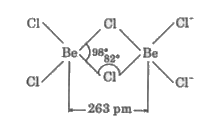 ` AICI_(3)` is also electron deficient. It exists as dimmer, i.e., `AI_(2) CI_(6)` 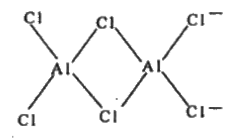
|
|
| 27. |
Discuss the consequences of high enthalpy of H-H bond in terms of chemical reactivity of dihydrogen. |
| Answer» SOLUTION :Due to high enthalpy of H-H bond, hydrogen is QUITE UNREACTIVE at room TEMPERATURE. However, at high temperatures or in presence of catalyst , it COMBINES with many metals and non-metals to form hydrides. | |
| 28. |
Discuss the consequences of high bond enthalpy of H-H bond in terms of chemical reactivity. |
| Answer» SOLUTION :High BOND ENTHAPY makes hydrogen inert at ordinary TEMPERATURES. However , `H_2` is active at higher temperatures or in PRESENCE of catalyst. | |
| 29. |
Discuss the consequence of high enthalpy of H-H bond in terms of chemical reactivity of dihydrogen. |
|
Answer» Solution : The chemical BEHAVIOUR of dihydrogen is determined, to a large extent, by bond dissociation enthalpy. The H-H bond dissociation enthalpy is the highest for a SINGLE bond between two atoms of any element. The dissociation of dihydrogen into its atoms is only ~ 0.081% around 2000K which increases to 95.5% at 5000K. It is relatively INERT at room temperature due to the high H-H bond enthalpy. Thus, the atomic hydrogen is produced at a high temperature in an electric arc or under ultraviolet RADIATIONS. Since its orbital is incomplete with `1s^1` electronic configuration, it does combine with almost all the elements. It accomplishes reactions by (i) loss of the only electron to give `H^+`. (ii) gain of an electron to form `H^(+)`, and (iii) sharing electrons to form a single covalent bond. Reaction with halogens: It reacts with halogens, `X_2` to give hydrogen halides, HX, `H_(2(g)) + X_(2(g)) to 2HX_((g))`[X=F , Cl, Br,I] While the reaction with fluorine occurs even in the dark, with iodine it requires a catalyst. Reaction with dioxygen : It reacts with dioxygen to form water. The reaction is highly exothermic. `2H_(2(g)) +O_(2(g)) underset"heating"overset"Cytalyst"to 2H_2O_((l)) DeltaH^(ө)=-285.9 "kJ mol"^(-1)` Reaction with dinitrogen : With dinitrogen it forms ammonia. `3H_(2(g)) + N_(2(g)) underset"Fe"overset"673K, 200atm"to 2NH_(3(g)) DeltaH^(ө)=-92.6 "kJ mol"^(-1)` This is the method for the MANUFACTURE of ammonia by the Haber process. Reactions with metals : With many metals it combines at a high temperature to yield the corresponding hydrides. `H_(2(g)) + 2M_((g)) to 2MH_((g))`, where M is an alkali metal Reactions with metal ions and metal oxides : It reduces some metal ions in aqueous solution and oxides of metals (less active than iron) into corresponding metals. `H_(2(g)) + Pd_((aq))^(2+) to Pd_((s)) + 2H_((aq))^(+)` `yH_(2(g)) + M_x O_(y(s)) to xM_((s)) + yH_2O_((l))` Reactions with organic compounds : It reacts with many organic compounds in the presence of catalysts to give useful hydrogenated products of commercial importance . For example : (i) Hydrogenation of vegetable oils using nickel as catalyst gives edible fats (margarine and vanaspati ghee) (ii) Hydroformylation of olefins yields aldehydes which further undergo reduction to give alcohols. `H_2+CO+RCH=CH_2 to RCH_2CH_2CHO` `H_2+RCH_2CH_2CHO to RCH_2CH_2CH_2OH` |
|
| 30. |
Discuss the comparison between Raoult's law and Henry's law. |
|
Answer» Solution :According to Raoult's LAW for solution containing a NONVOLATILE solute ` P_("solute ") =P^(@) _("solute ")X_("solute ") ` According to Henry's law " ` P_("solute ")=K_Hx_("solute in solution") ` The difference between the above two expressions is the proportionality CONSTANT `p^(@) _A ` (Raoult's Law ) and ` K_H ` (Henry ' s Law ) Henry 's law is applicable to solution containing gaseous solute in liquid solvent while the Roult's law is applicable to nonvolatile solid in a liquid solvent . If the solute is NON volatile then the Henry's law constnat will become equal to the vapour of the pure solvent `(P_A^(@) ) ` and thus Raoult's law becomes a special case of Henry 's law For very dilute solutionsthe solvent obeys Raoult's law and the solute obeys Henry 's law . |
|
| 31. |
Discuss the classification of hydrocarbons. Give two examples of each type. |
|
Answer» Solution :The simplest organic compounds are those COMPOSED of only two elements: carbon and hydrogen. These compounds are CALLED hydrocarbons. Hydrocarbons themselves are SEPARATED into two types: aliphatic hydrocarbons and aromatic hydrocarbons. Aliphatic hydrocarbons are hydrocarbons based on CHAINS of C atoms. Lower classifications: Aromatic compounds HIGHER Classifications: Organic compound |
|
| 32. |
Discuss the chemistry of Lassalgne's test |
|
Answer» Solution :Nitrogen (N), sulphur (S), Halogens (Cl, Br, I) and phosphorus (P) present in an organic compound are detected by "Lassaigne.s test... (a) The elements (N, X, S) present in the compound are converted from covalent form into the ionic from by fusing the compound with sodium metal. Following reactions take place (i) `Na + C + underset("Nitrogen")(N) overset(Delta)rarr underset("Sodium cyanide")(NaCN)` (ii) `2Na + underset("Sulphur")(S) overset(Delta)rarr underset("Sodium sulphide")(Na_(2)S)` (iii) `Na + underset("Halogen")(X ) overset(Delta)rarr underset("Sodium halide")(NaX) (X= Cl, Br or I)` Cyanide, sulphide and halide of sodium so formed on sodium fusion are extracted from the fused mass by boiling it with distilled water. This extract is known as sodium fusion extract. (B) Test for Nitrogen: Procedure: The sodium fusion extract is boiled with iron (II) sulphate and then acidified with concentrated SULPHURIC acid. The formation of Prussian blue colour confirms the presence of nitrogen. Sodium cyanide first reacts with iron (II) sulphate and forms sodium hexacyanido- ferrate (II).On heating with concentrated sulphuric acid some iron (II) ions are oxidised to iron (III) ions which react with sodium hexacyanidoferrate (II) to produce iron (III) hexacyanidoferrate (II) (ferriferrocyanide) which is Prussian blue in colour. `underset("Cyanide")(6CN_((aq))^(-)) + underset("Ferrous ion")(Fe_((aq))^(2+)) rarr underset("Hexacyanidoferrate-(II) iron")([Fe(CN)_(6)]_((aq))^(+))` `3[Fe(CN)_(6)]_((aq))^(-) + underset("Iron (III)")(4Fe^(3+)) overset(xH_(2)O)rarr underset(underset("Ferriferrocyanide")("Prussian blue"))(Fe_(4)[Fe(CN)_(6)]_(3). H_(2)O)` (c ) Test for sulphur: FOllowing two test are occurs for DETECTION of sulphur. (i) The sodium fusion extract is acidified with acetic acid and lead acetate is added to it. A black precipitate of lead sulphide indicates the presence of sulphur. `underset("Sulphide ion")(S_((aq))^(2-)) + underset("Lead")(Pb_((aq))^(2+)) rarr underset("Black precipitate (lead sulphide)")(PbS_((s)))` (ii) On treating sodium fusion extract with sodium nitroprusside, appearance of a violet colour further indicates the presence of sulphur. `underset("Sulphide ion")(S_((aq))^(2-)) underset("Nitroprusside ion")([Fe(CN)_(5)NO]_((aq))^(2-))rarr underset("Violet solution")([Fe(CN)_(5).NOS]_((aq))^(4-))` In case, nitrogen and sulphur both are present in an organic compound: In sodium thiocyanate (NaSCN) is formed `Na + C + N + S rarr NaSCN` Which is heated with iron (II) sulphate and BLOOD red colour complex but not prussian blue. Hear, the reaction occurs between iron (III) ion and thiocyanate ion `(SCN^(-))`. `underset("Ferric ion")(Fe_((aq))^(3+)) + underset("Thiocyanate ion")(SCN_((aq))^(-)) rarr underset("Ferric thiocyanate ion (Blood red)")([Fe(SCN)]^(2+))` Note: If sodium fusion is carried out with excess of sodium, the thiocyanate decomposes to yield cyanide and sulphide. Those ions give their usual tests. `NaSCN + 2Na rarr NaCN + Na_(2)S` (d) Test for halogens: The fusion of organic with sodium metal and form sodium halide (NaX). This solution is basic. This sodium fusion extract is acidified with NITRIC acid and them treated with silver nitrate, the percipitate of AgXis formed. `Ag^(+) + X^(-) rarr AgX darr` (i) If a white precipitate is formed and soluble in ammonium hydroxide shows the presence of chlorine. (ii) If a yellowish precipitate is form, sparingly soluble in ammonium hydroxide shows the presence of bromine and (iii) If a yellow precipitate, in soluble in ammonium hydroxide shows the presence of iodine. Note: If nitrogen or sulphur is also present in the compound, the sodium fusion extract is first boiled with concentrated nitric acid to decompose cyanide or sulphide of sodium formed during Lassaigne.s test. These ions would otherwise interfere with silver nitrate test for halogens. (e ) Test for Phosphorus: The compound is heated with an oxidising agent sodium peroxide `(Na_(2)O_(2))`. The phosphorus present in the compound, is oxidised to phosphate. The solution is boiled with nitric acid and then treated with ammonium molybdate. A yellow colouration or precipitate indicates the presence of phosphorus. `2P + 3Na_(2)O_(2) O_(2) overset(Delta)rarr 2Na_(3)PO_(4)` `Na_(3)PO_(4) + 3HNO_(3) overset(Delta)rarr H_(3)PO_(4) + 3NaNO_(3)` `H_(3) PO_(4) _ underset("Ammonium molybdate")(12(NH_(4))MoO_(4)) + 21HNO_(3)rarr underset("Ammonium phosphomolybdate (Yellow ppts)")((NH_(4))_(3)PO_(4). 12MoO_(3)) + 21NH_(4)NO_(3) + 12H_(2)O` |
|
| 33. |
Discuss the characteristics of cathode rays. |
|
Answer» Solution :The characteristics of cathode RAYS are:- (a) They travel in straight lines with high speed. (b) They exert mechanical pressure. (C) They produce heating effect when they strike then metal sheets. (d) They are negatively CHARGED PARTICLES. (e) They can penetrate their sheets of materials. |
|
| 34. |
Discuss the changes you observe in the reaction of synthesis of ammonia with preference to effect of pressure. |
|
Answer» Solution :The change in pressure has signicant eect only on equilibrium system with gaseous components When the pressure on system is increased, the volume decreases proportionately and the system responds by shifting the equilibrium in a direction that has fewer moles of gaseous molecules. Let US CONSIDER SYNTHESIS of AMMONIA from nitrogen and hydrogan. `N_(2)(g)+3H_(2)(g)hArr2NH_(3)(g)` Let the system be allowed to attain equilibrium in a cylinder with a piston. If we press the the piston down to increase the pressure, the volume decreases. The system responds to this sffect by reducng the number of gas molecules i.e. it favours the formation of ammonia. If we pull the piston upwards to REDUCE the pressure, the volume increases. It favours the decomposition of ammonia However, when the total number of the moles of the gaseous reactants and the gaseous products are equal, the change in pressure has no effect on system at equilibrium. 
|
|
| 35. |
Discuss the basic unit and structure of silicates. |
Answer» Solution :Silicates are the compounds in which the anions are present as either DISCRETE `SiO_(4)^(4-)` tetrahedral or a number of such UNITS joined together through corners. Silicates are basically made up `SiO_(4)^(4-)` tetrahedra ( as shown in the figure ) in which SILICON atom is bonded to four OXYGEN atoms in a tetrahedral MANNER. In the figure big circles indicate oxygen atoms and samall circle indicates silicon atoms. 
|
|
| 36. |
Discuss the aromatic nucleophilic substitutions reaction of chlorobenzene. |
|
Answer» Solution :Aromatic nucleiophilic substitution reactions Dow's process. (i) `underset("Chloro benzene")(C_(6)H_(5)Cl+NaOH) underset(300atm)oversset(350^(@)c)to underset("Phenol")(C_(6)H_(5)OH)+NaCl` (ii) `underset("Chloro benzene")(C_(6)H_(5)Cl+2NH_(3)) underset(50atm)overset(250^(@)c)to underset("aniline")(C_(6)H_(5)NH_(2))+NH_(4)Cl` (iii) `underset("Chloro benzene")(C_(6)H_(5)Cl+COCN) underset("PHENYL CYANIDE")overset(250^(@)c)to underset("Phenyl cyanide")(C_(6)H_(5)CN+CuCl)` |
|
| 37. |
Discuss the aromatic nucleophilic substitution reactions of chlorobenzene. |
|
Answer» Solution :Aromatic nucleophilic substitution reactions: Dow.s process (i) `underset("Chlorobenzene")(C_6H_5Cl) + NaOH underset("300 ATM")overset(350^@C) to underset("PHENOL")(C_6H_5OH) + NaCl` (ii) `underset("Chlorobenzene")(C_6H_5Cl) + 2NH_3 underset("50 atm")overset(250^@C) to underset("Aniline")(C_6H_5NH_2) + NH_4Cl` (iii) `underset("Chlorobenzene")(C_6H_5Cl) + CuCN underset("Phenyl cyanide")overset(250^@C)to underset("Phenyleyanide")(C_6H_5CN) + CuCl` |
|
| 38. |
Discuss step which involve liberation of proton from sigma-complex. |
Answer» Solution :In first slow step, electrophiles are attaches with benzene and form `-sigma`-complex. `sigma`-complex loses proton. Proton is donated to the NEGATIVE ion form in steps which gives electrophilic `sigma`-complex, and gives substitution product. <BR>  `A^(-) + H^(+) rarr H^(+)A^(-) + "Catalyst"` `FeCl_(4)^(-) + H^(+) rarr HCl + FeCl_(3) + C_(6)H_(5)Cl` `FeBr_(4)^(-) + H^(+) rarr HBr + FeBr_(3) + C_(6)H_(5)Br` `AlCl_(4)^(-)+ H^(+) rarr HCl+ AlCl_(3) + C_(6)H_(5)E` all carbons are `sp^(2)` in substituted product. Aromatic character is possessed by substituted product. `sp^(3)` carbon is converted into `sp^(2)` when substitution product is formed. Second step is not rate determining because it is fast step. At the end of second step, product is formed by attachment of electrophile in PLACE of H present in main compound. So mechanism is of electrohilic substitution type. |
|
| 39. |
Discuss reactivity of group 14 elements towards water and halogens. |
|
Answer» SOLUTION :Reactivity towards water: Carbon, silicon and germanium are not affected by water. Tin decomposes steam to form dioxide and dihydrogen gas. `Sn+2H_2O OVERSETDELTATO SnO_2 + 2H_2` Lead is unaffected by water probably because of protective oxide film formation. Reactivity towards halogen : These elements can form halides of formula `MX_2` and `MX_4` (where X=F,Cl,Br,I) Except carbon, all other members react directly with halogen under suitable condition to make halides. Most of the `MX_4` are covalent in nature. The central metal atom in these halides undergoes `sp^3` hybridisation and the molecule is tetrahedral in shape. Exceptions are `SnF_4` and `PbF_4`,which are ionic in nature. `PbI_4` does not exist because Pb-I bond initially formed during the reaction does not release enough energy to unpair `6s^2` electrons and excite one of them to higher orbital to have four unpaired electrons around lead atom. Heavier members Ge to Pb are able to make halides of formula `MX_2` Stability of dihalides INCREASES down the group. Considering the thermal and chemical stability, `GeX_4` is more stable than `GeX_2` where as `PbX_4` is more than `PbX_4` except `C Cl_4` other tetrachlorides are easily HYDROLYSED by water because the central atom can accommodate the lone pair of electrons from oxygen atom of water molecule in d-orbital. HYDROLYSIS can be understood by taking the example of `SiCl_4`. It undergoes hydrolysis by initially accepting lone pair of electrons from water molecule in d-orbitals of Si, finally leading to the formation of `Si(OH)_4` as shown below : 
|
|
| 40. |
Discuss properties difference observed in lithium and rest alkali metals. |
|
Answer» Solution :(i) Lithium is much harder. Its m.p. and b.p. are higher than the other alkali metals. (ii) Lithium is least reactive but the strongest reducing agent among all the alkali metals. On combustion in air it forms MAINLY monoxide, `Li_(2)O` and the nitride, `Li_(3)N` UNLIKE other alkali metals. (iii) LiCl is deliquescent and crystallises as a hydrate, `(LiCl * 2H_(2)O)` whereas other alkali metal chlorides do not form hydrates. (iv) Lithium HYDROGEN carbonate is not obtained in the solid form while all other elements form solid hydrogen carbonates. (v) Lithium unlike other alkali metals forms no ethynide on reaction with ethyne. (vi) Lithium nitrate when heated gives lithium oxide `(Li_(2)O)` whereas other alkali metal nitrates decompose to give the corresponding nitrite. `4LiNO_(3) to 2Li_(2)O+4NO_(2)+O_(2)` `2NaNO_(3) to 2NaNO_(2)+O_(2)` (vii) LiF and `Li_(2)O`are comparatively much less soluble in water than the corresponding compounds of other alkali metals. |
|
| 41. |
Discuss preparation of: Vic-dihalides. |
|
Answer» Solution :Vic-dihalides: Ethylene dichloride (1,2-Dichloro ethane) is PREPARED by the following methods. (a) Addition of chlorine to ethylene: `underset("Ethylene")(CH_(2)=CH_(2))+Cl_(2)to underset("Ethylene dichloride")(underset(Cl)underset(|)(C)H_(2)-underset(Cl)underset(|)(C)H_(2))`. (b) Action of `PCl_(5)` (or HCl) on ethylene glycol: `underset("Ethylene glycol")(underset(OH)underset(|)(C)H_(2)-underset(OH)underset(|)(C)H_(2))+2PCl_(5) to underset("Ethylene dichloride")(underset(Cl)underset(|)(C)H_(2)-underset(Cl)underset(|)(C)H_(2)+2POCl_(3))+2HCl` |
|
| 42. |
Discuss preparation of: Gem-dihalides: |
|
Answer» Solution :Gem-dihalides: Ethylidene dichloride (1,1-Dichloro ethane) is prepared by (a) TREATING aetaldehyde with `PCl_(5)` `UNDERSET("Acetaldehyde")(CH_(3)CHO +PCl_(5)) to underset("Ethylidene dichloride")(CH_(3)CHCl_(2)+POCl_(3))`. (b) Adding hydrogen chloride to ACETYLENE `underset("Acetylene")(HC-=CH)+HCl to underset("Vinylchloride")(CH_(2)=underset(Cl)underset(|)(C)Hoverset(HCl)to underset("Ethylidene dichloride")(CH_(3)-CHCl_(2))`. |
|
| 43. |
Discuss preparation and properties of silicones. |
|
Answer» SOLUTION :They are a group of organosilicon polymers, which have `(--R_2SiO--)`as a repeating unit. The starting materials for the manufacture of SILICONES are alkyl or aryl substituted silicon chlorides, `(R_n SiCl_((4-n)))`where, R is alkyl or aryl group. When methyl chloride reacts with silicon in the presence of copper as a catalyst at a temperature 570K various types of methyl substituted chlorosilane of formula (`MeSiCl_2, MeSiCl_2, Me_3 SiCl_2`) with small amount of `Me_4 Si` are formed. Hydrolysis of dimethyl dichlorosilane, `[(CH_3)_2SiCl_2]`followed by condensation polymerisation yields straight CHAIN polymers.  The chain length of the polymer can be controlled by adding `(CH_3)_3` SiCl which blocks the ends as shown below:  Silicones being surrounded by non-polar alkyl groups are water REPELLING in nature. They have in general high thermal STABILITY, high dielectric strength and resistance to oxidation and chemicals. |
|
| 44. |
Discuss oxidation states in group 14 elements . |
|
Answer» Solution :Elements of group 14 exhibit oxidation STATES of + 2 and + 4 . When `np^(2)` ELECTRONS are involved in BONDING they exhibit +2 oxidation state and + 4 oxidation state is exhibited when `ns^(3) np^(2)` electrons are involved in bonding . EG. : `SnCl_(2) , PB( NO_(3))_(2) ` They exhibit + 2 state and are ionic in character. |
|
| 45. |
Discuss isomerism in alkynes. |
|
Answer» Solution :(a) Chain isomerism: The ISOMERS differ in the arrangement of carbon atoms in parent chain. `CH_(3) underset("pent - 1 - yne")(CH_(2)CH_(2))C equiv CH CH_(3)-underset(3 - "METHYL But- 1 - yne")overset(CH_(3))overset(|)(CH) - C equiv CH` (B) Position isomerism : it is due to the difference in position of tirple bond in carbon chain. Ex: ` CH_(3) - underset("But-1-yne")(CH_(2)) - C equiv CH "" CH_(3) - underset("But-2-yne")(C equiv C) - CH_(3)` FUNCTIONAL isomerism: - Here alkynes and diene are function isomers. Because both have same molecular formula. Ex: `CH_(3) - underset(2-"Propyne")(C equiv C) - CH_(3) "" underset("ptop-1,2- diene(allene)") (CH_(2) = C = CH_(2))` |
|
| 46. |
Discuss industrial production of sodium hydroxide (NaOH - Caustic Soda) and mention its properties and uses. |
|
Answer» Solution :SODIUM hydroxide is generally prepared commercially by the electrolysis of sodium chloride in Castner-Kellner cell. A brine solution is electrolysed using a mercury cathode and a carbon ANODE. Sodium METAL discharged at the cathode combines with mercury to form sodium amalgam. Chlorine gas is evolved at the anode. Cathode : `Na^(+)+e^(-) overset(Hg)to Na` - amalgam Anode : `Cl^(-) to (1)/(2)Cl_(2)+e^(-)` The amalgam is treated with water to give sodium hydroxide and hydrogen gas. 2Na-amalgam `+2H_(2)O to 2NaOH +2Hg+H_(2)` Properties : Sodium hydroxide is a white, translucent solid. It melts at 591K. It is readily soluble in water to give a strong alkaline solution. CRYSTALS of sodium hydroxide are DELIQUESCENT. The sodium hydroxide solution at the surface reacts with the `CO_(2)`in the atmosphere to form `Na_(2)CO_(3)`. |
|
| 47. |
Discuss in detail about the variation of internal energy with respect to variation thermodynamic processes. |
|
Answer» Solution :Mathematics statement of the FIRST law of thermodynamics is `DeltaU=q+w` Case 1 : For a cyclic process involving isothermal expansion of an ideal gas `DeltaU=0 , :. Q=-w` In other words,during a cyclic process , the amount of heat absorbed by the system in EQUAL to work done by the system. Case 2 : For an isolated process ( no change in volume ) there is no work of expansion. `DeltaV=0, w=0 ,DeltaU=q_(v)` In other words , during isochoric process , the amount of heat supplied to the system is CONVERTED fl to its internal energy . Case 3 : For an adiabatic process there is no change in heat i.e. q = 0 . Hence `q=0,DeltaU=w` In other words, in a adiabatic process , the decrease in internet energy is exactly equal to the work done by the system on its surroundings. in the pressure . P remains constant . Hence `DeltaU=q+w` `DeltaU=q-PDeltaV` n other words , inan isolated process a part of heat absorbed by the system is used for PV expansion work and the remaining is added to the internal energy of the system. |
|
| 48. |
Discuss in detail about the gaseous air pollutants. |
|
Answer» Solution :Gaseous air pollutants `:` Oxides of sulphur, oxides of nitrogen, oxides of carbon, and hydrocarbons are the gaseous air pollutants. ( a) Oxides of Sulphur `:` (i) Sulphur dioxide and sulphur trioxide are produced by burning sulphur containing fossil fuels and roasting sulphide ores. Sulphur dioxide is a poisonous gas to both animals and plants. Sulphur dioxide causes eye irritation, coughing and respiratory diseases like asthma, bronchitis, etc. (ii) Sulphur dioxide is oxidised into more harmful sulphur trioxide in the presence of particulate matter present in POLLUTED air. `2SO_(2) + O_(2) overset("Particulate matter")(rarr) 2SO_(3)` (iii) `SO_(3)` combines with atmospheric water vapour to form `H_(2)SO_(4)` , which comes down in the form of acid rain. `SO_(3) + H_(2)O rarr H_(2)SO_(4)` (b) Oxides of nitrogen `:` (i) Oxides of nitrogen are produced during high temperature combustion processes, oxidation of nitrogen in air and from the combustion of fuels ( coal, diesel, petrol etc. ) `N_(2) + O_(2) overset( gt 1210^(@)C) (rarr) 2NO` `2NO + O_(2) overset( 1100^(@)C)(rarr) 2NO_(2)` `NO + O_(3) rarr NO_(2) + O_(2)` (ii)The oxides of nitrogen are converted into nitric acid which comes down in the form of acid rain. They also form reddish brown haze in heavy traffic. Nitrogen dioxide potentially damages plant leaves and retards PHOTOSYNTHEIS . `NO_(2)` is a respiratory irratant and it can cause asthma and lung injury . Nitrogen dioxide is also harmful to variuos textile figures and metals. (c ) Oxides of carbon `:` The major pollutants of oxides of carbon are carbon monoxide and carbon dioxides. (i) Carbon monoxide is a poisonous gas produced as a result of incomplete combustion of coal are firewood. It is released into the air mainly by automobile exhaust. It binds with haemoglobin and form carboxy haemoglobin which impairs normal oxygen transport by blood and hence the oxygen carrying capacity of blood is reduced . This oxygen deficiency results in HEADACHE, dizziness,tension, Loss of consciousness, blurring of eye sight and cardiac arrest . (ii) Carbon dioxide `:` Carbon dioxide is released into the atmosphere mainly by the process of respiration, burning of fossil fuels, forest fire, decomposition of limestone in cement industry etc. Green plants can convert `CO_(2)` gas in the atmosphere into carbohydrate and oxygen through a process called photosynthesis. ( d) Hydrocaron `:` (i) The compounds composed of carbon and hydrogen only are called hydrocarbons. They are mainly produced naturally (marsh gas ) andalso by incomplete combustion of automobile fuel. (ii) They are potential cancer causing ( carcinogenic ) agents. For example, polynuclear AROMATIC hydrocarbons ( PAH ) are carcinogenic , they cause irritation in eyes and mucous membranes. |
|
| 49. |
Discuss how many types and which reaction are given by alkyne ? |
|
Answer» Solution :Alkyne compounds gives following REACTIONS : (a) Acidic reaction of ALKYNES by terminal hydrogen (acid-base reaction). (B) Electrophilic reaction of alkyne : Alkyne gives electrophilic reaction with (i) `H_(2)` (ii) `X_(2)` (iii) HX (iv) `H_(2)O` (v) HOX (vi) `CH_(3)COOH` (vii) HCN (c) Polymerization reaction : (i) Linear and (ii) Cyclic polymerization (d) Oxidation reaction : (i) Bayer reaction (ii) reaction with ALKALINE `KMnO_(4)` at high temperature, (iii) Ozonolysis and (iv) complete combustion in air. |
|
| 50. |
Discuss diagonal relationship of lithium with magnesium. |
|
Answer» Solution : The similarity between lithium and magnesium is particularly striking and arises because of their SIMILAR sizes. Atomic radii : Li (152 pm) , Mg (160 pm) Ionic radii : `Li^(+)`(76 pm) , `Mg^(2+)` (72 pm) The main points of similarity are : (i) Both lithium and magnesium are harder and lighter than other elements in the respective groups. (ii) Lithium and magnesium react slowly with WATER. Their oxides and hydroxides are much less soluble and their hydroxides decompose on heating. Both form a nitride, `Li_(3)N` and `Mg_(3)N_(2)`, by direct combination with NITROGEN. (iii) The oxides, `Li_(2)O and MgO` do not combine with EXCESS oxygen to give any superoxide. (iv) The carbonates of lithium and magnesium decompose easily on heating to form the oxides and `CO_(2)`. SOLID hydrogen carbonates are not formed by lithium and magnesium. (v) Both LiCl and `MgCl_(2)` are soluble in ethanol. (vi) Both LiCl and `MgCl_(2)` are deliquescent and crystallise from aqueous solution as hydrates, `LiCl* 2H_(2)O`and `MgCl_(2)*8H_(2)O`. |
|