

Saved Bookmarks
This section includes 7 InterviewSolutions, each offering curated multiple-choice questions to sharpen your Current Affairs knowledge and support exam preparation. Choose a topic below to get started.
| 1. |
Epsom salt is..... |
|
Answer» `MgSO_(4)*7H_(2)O` |
|
| 2. |
Eplain how vacancies are introdcued in an ionic solid when a cation of higher valances is added as as impurity in it . |
| Answer» Solution :Two or more CATIONS of LOWER valency are replaced by a cation of higher valency to maintain electrical neurality . Hence, some cation vancancies are created. For example , if in the ionic solid, ` Na^(+)CL^(+) `, impurityof ` Sr^(2+)` is added (as ` SrCl_(2)` ) two ` Na^(+)`LATTICE sites will become vacant and one of these will be occupied by ` Sr^(2+)`ion and the other will remain vacant. | |
| 3. |
Epichlorohydrin is |
|
Answer» 3-Chloropropane 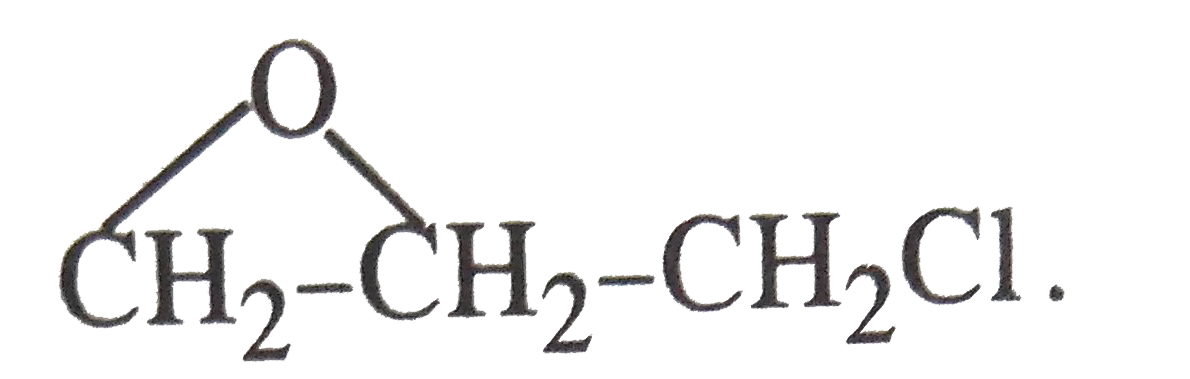
|
|
| 4. |
Eormation of Benzene from Acetylene is |
|
Answer» TRIMERISATION |
|
| 5. |
Enzymes usually are __________. |
|
Answer» carbohydrates |
|
| 6. |
Enzymes that utilize ATP in phosphate transfer require an alkaline earth metal (M) as the cofactor M is |
|
Answer» Ca |
|
| 7. |
Enzymes like phosphohydrolases and phosphotransferases contain |
|
Answer» `Mg^(+2)` |
|
| 8. |
Enzyme present in apple is ………………. . |
|
Answer» POLYPHENOL oxidase |
|
| 9. |
Enzyme present in apple is ............ |
| Answer» SOLUTION :POLYPHENOL OXIDASE | |
| 10. |
Enzyme hexokinase catalyzes the _________. |
|
Answer» conversion of SUCROSE of glucose and fructose |
|
| 11. |
Enzyme have high molecular mass ranging between __________. |
|
Answer» `10^(4)` to `10^(6)` amu |
|
| 12. |
Enzyme activity is maximum at |
|
Answer» 300K |
|
| 13. |
Environmental pollution affects |
|
Answer» BIOTIC COMPONENTS |
|
| 14. |
Enumerate different aromatic electrophilic substitution reactions and give the reactions which shows how the electrophiles (E^(+)) are formed. |
Answer» Solution :Aromatic compound like benzene can give different SIX reactions. The types of reactions, REQUIRED REACTANT and catalyst which are required to form electrophiles `(E^(+))` are given in the FOLLOWING table : 
|
|
| 15. |
Entropy of diamond is less than that of graphite.Whatconclusion do you draw from this ? |
| Answer» SOLUTION :Less entropy of DIAMOND meansless DISORDER,i.e.,allthe C-atoms are linked to form a network structure. Greater entropy of graphite implies some disorderwhich is DUE to presenceof free electronsand slipping of layers over each other. | |
| 16. |
Entropy of a perfectly crystalline solid istaken as zero at the absolute zero. This is a statement of "…............." |
| Answer» SOLUTION :THIRD LAW of THERMODYNAMICS | |
| 17. |
Entropy of a system depends upon |
|
Answer» <P>VOLUME only |
|
| 18. |
Entropy is a state function and its depends on two or three variable temperature (T), pressure(P) and volume (V). Entropy change for an ideal gas having number of moles (n) can be determined by the following equation: DeltaS=2.303nC_(v)" "log((T_(2))/(T_(1)))+2.303 nR" "log ((V_(2))/(V_(1))) DeltaS=2.303nC_(p)" "log((T_(2))/(T_(1)))+2.303 nR" "log ((P_(2))/(P_(1))) Since free energy change for a process or a chemical equation is a deciding factor of spontaneity, which can be obtained by using entropy change (DeltaS) according to the expression, Delta G=DeltaH-TDeltaS at a temperature T. Fora reaction M_(2)O(s) to 2M(s)+(1)/(2)O_(2)(g),DeltaH=30 kJ/mol and DeltaS=0.07kJ/K-mol at 1 atm. Calculate upto which temperature the reaction would not be spontaneous. |
|
Answer» `Tgt428.6K` |
|
| 19. |
Entropy is a state function and its depends on two or three variable temperature (T), pressure(P) and volume (V). Entropy change for an ideal gas having number of moles (n) can be determined by the following equation: DeltaS=2.303nC_(v)" "log((T_(2))/(T_(1)))+2.303 nR" "log ((V_(2))/(V_(1))) DeltaS=2.303nC_(p)" "log((T_(2))/(T_(1)))+2.303 nR" "log ((P_(2))/(P_(1))) Since free energy change for a process or a chemical equation is a deciding factor of spontaneity, which can be obtained by using entropy change (DeltaS) according to the expression, Delta G=DeltaH-TDeltaS at a temperature T. An isobaric process having one mole of ideal gas has entropy change 23.03J/K for the temperature range 27^(@)C " to "327^(@)C. What would be the molar specific heat capacity (C_(v))? |
|
Answer» `(10)/("LOG2")`J/Kmol |
|
| 20. |
Entropy is a state function and its depends on two or three variable temperature (T), pressure(P) and volume (V). Entropy change for an ideal gas having number of moles (n) can be determined by the following equation: DeltaS=2.303nC_(v)" "log((T_(2))/(T_(1)))+2.303 nR" "log ((V_(2))/(V_(1))) DeltaS=2.303nC_(p)" "log((T_(2))/(T_(1)))+2.303 nR" "log ((P_(2))/(P_(1))) Since free energy change for a process or a chemical equation is a deciding factor of spontaneity, which can be obtained by using entropy change (DeltaS) according to the expression, Delta G=DeltaH-TDeltaS at a temperature T. What would be the entropy change involved in thermodynamic expansion of 2 moles of a gas from a volume of 5 Lts to a volume of 50 Lts at 25^(@)C? [Given R=8.3 J/mole-K] |
|
Answer» 38.23J/K |
|
| 21. |
The enthalpy is maximum for |
|
Answer» METHANE |
|
| 22. |
Entropy increases with the increase of temperature. Why ? |
| Answer» SOLUTION :As the temperature increases their oscillation MOTION, linear motion and ROTATIONS increases and so randomness increases and ENTROPY also INCREASE. | |
| 23. |
Entropy changes for the process H_(2)O(l) to H_(2)O(g) at normal pressure and at 274 K are given below: DeltaS_(system) = -22.13, DeltaS_("surroundings") = +22.05 The process is non - spontaneous because |
|
Answer» `DeltaS_("SYSTEM")` is -ve `DeltaS_("universe") = -22.13 + 22.05 = -0.08 kJ` |
|
| 24. |
Entropy change for reversible phase transition at constant pressure P and temperatureT is calculated by the formula DeltaS=(DeltaH)/(T), where DeltaH is the enthalpy change for phase transition. For irreversible phase transition DeltaSgt(DeltaH)/(T). Consider a phase transition. Sn("white",s)iffSn("grey,s") DeltaH^(@) at 1 atm and 300K=-2 kJmol^(-1) The equilibrium temperature at 1 atm is 400 K. Assume C_(p,m) of Sn (white,s) and Sn(grey,s) are equal. DeltaG^(@) for above phase transition at 1 atm and 300K is : |
|
Answer» `-500J mol^(-1)` |
|
| 25. |
Entropy change for reversible phase transition at constant pressure P and temperatureT is calculated by the formula DeltaS=(DeltaH)/(T), where DeltaH is the enthalpy change for phase transition. For irreversible phase transition DeltaSgt(DeltaH)/(T). Consider a phase transition. Sn("white",s)iffSn("grey,s") DeltaH^(@) at 1 atm and 300K=-2 kJmol^(-1) The equilibrium temperature at 1 atm is 400 K. Assume C_(p,m) of Sn (white,s) and Sn(grey,s) are equal. DeltaS^(@) for above phase transition at 1 atm and 300K is : |
|
Answer» `-5JK^(-1)mol^(-1)` |
|
| 26. |
Entropy change involved in the conversion of1 mole of liquid water at 373 K to vapour at the same temperature will be ____ (DeltaH_"vap"=2.257 kJ g^(-1)) |
|
Answer» Solution :`DeltaH_"vap"=2.257 K J G^(-1)` 1 mole of `H_2O`=18 g `therefore DeltaH_"vap"` for a1 mole = `2.257xx18=40.626 k J g^(-1)` . `T_b` =373 K `DeltaS_"vap"=40.626/373=0.1089 "KJ mol"^(-1)` `=0.109 "kJ mol"^(-1)` |
|
| 27. |
Enthylene on combustion gives carbon diocxide and water. Its enthalpy of combustion is 1410.0kJ // mol.If the enthalpy of formation of CO_(2) and H_(2)O are 393.3kJ and 286.2 kJrespectively, calculate the enthalpy of formation of ethylene. |
|
Answer» (i) `C_(2)H_(4)(g) +(5)/(2) O_(2)(g) RARR 2CO_(2)(g) + 2H_(2)O(l), DeltaH = - 1410.0 kJ mol^(-1)` (ii) `C(s) + O_(2)(g) rarr CO_(2)(g), DeltaH= - 393.3kJ mol^(-1)` (iii) `H_(2)(g) + (1)/(2) O_(2)(g) rarr H_(2)O(l), DeltaH = - 286.2kJ mol^(-1)` Aim `: 2 C(s) + 2H_(2)(g) rarr C_(2)H_(4)(g) DeltaH = ?` ` 2 xx ` Eqn. (ii) `+ 2 xx `Eqn.(iii) - Eqn. (i) gives the REQUIRED result. |
|
| 28. |
Enthalpy of vaporization of water is 186.5 kJ/mol. What will be the entropy of vaporization of water ? |
|
Answer» 0.5 J/K MOL |
|
| 29. |
Enthalpy of vapourisation for water is 186.5 KJ "mole"^(-1). The entropy change during vapourisation is _____ KJ "mole"^(-1) |
|
Answer» `0.5` |
|
| 30. |
Enthalpy of sublimation of a substance is equal to |
|
Answer» ENTHALPY of FUSION + enthalpy of vaporisation |
|
| 31. |
Enthalpy of solution ofanhydrous CuSO_(4)(s) and hydrated salt,CuSO_(4).5H_(2)O(s)are - 66.5 kJ mol^(-1) and + 11.7 kJ mol^(-1) respectively. The enthalpyof hydration of CuSO_(4)(s) is "…......................" |
| Answer» SOLUTION :`-78.9 KJ MOL^(-1) , i.e., ( -66.5- 11.7 ) kJ mol^(-1)` | |
| 32. |
Enthalpy of sublimation is the sum of enthalpy of "….............." and enthalpy of "…..............." . |
| Answer» SOLUTION :FUSION, VAPORISATION | |
| 33. |
Enthalpy of solution of NaCl(s) is+ 4kJ mol^(-1) and enthalpy of hydration is -784kJ mol^(-1). Lattice enthalpy of NaCl(s) will be "…..............." kJ mol^(-1) |
| Answer» SOLUTION :`+ 788kJ MOL^(-1)( Delta_("sol") H = Delta_("lattice")H + Delta_(HYD) H ) ` | |
| 34. |
Enthalpy of solution ( Delta H ) for BaCl_(2). 2H_(2) O and BaCl_(2) are 8.8 and -20.6 kJ mol^(-1) respectively. Calculate the heatof hydration of BaCl_(2) to BaCl_(2). 2H_(2)O. |
|
Answer» Solution :We are given (i) `BaCl_(2).2H_(2)O(s) +aq rarr BaCl_(2)(aq), Delta_(sol) H^(@) = 8.8 kJ mol^(-1)` (II) `BaCl_(2)(s)+aq rarr BaCl_(2)(aq),Delta_(sol) H^(@) = - 20.6kJ mol^(-1)` We AIM at `BaCl_(2) (s) + 2H_(2)O rarr BaCl_(2).2H_(2)O(s) ,Delta_(hyd) H^(@) = ?`....(iii) Equation (ii) MAYBE written in two steps as `BaCl_(2) (s) + 2H_(2)O rarr BaCl_(2).2H_(2)O(s), DeltaH= Delta_(r)H_(1)^(@)(say) `....(iv) `BaCl_(2).2H_(2)O(s) +aq rarr BaCl_(2)(aq), DeltaH= Delta _(r) H_(2)^(@) `(say).....(v) Then accordingto Hess's law, `Delta_(r) H_(1)^(@)+Delta_(r)H_(2)^(@)= 20.6kJ` But`Delta_(r) H_(2)^(@) = 8.8 kJ mol^(-1)``[ :'`Equation (i) `=`Equation (v) ] `:. Delta_(r) H_(10^(@)) = - 20.6- 8.8 = - 29.4 kJ mol^(-1)` But Equation (iii) `=` Equation (iv) Hence, the heat of hydration of `BaCl_(2)` `Delta_(hyd) H^(@) =- 29.4 kJ mol^(-1)` 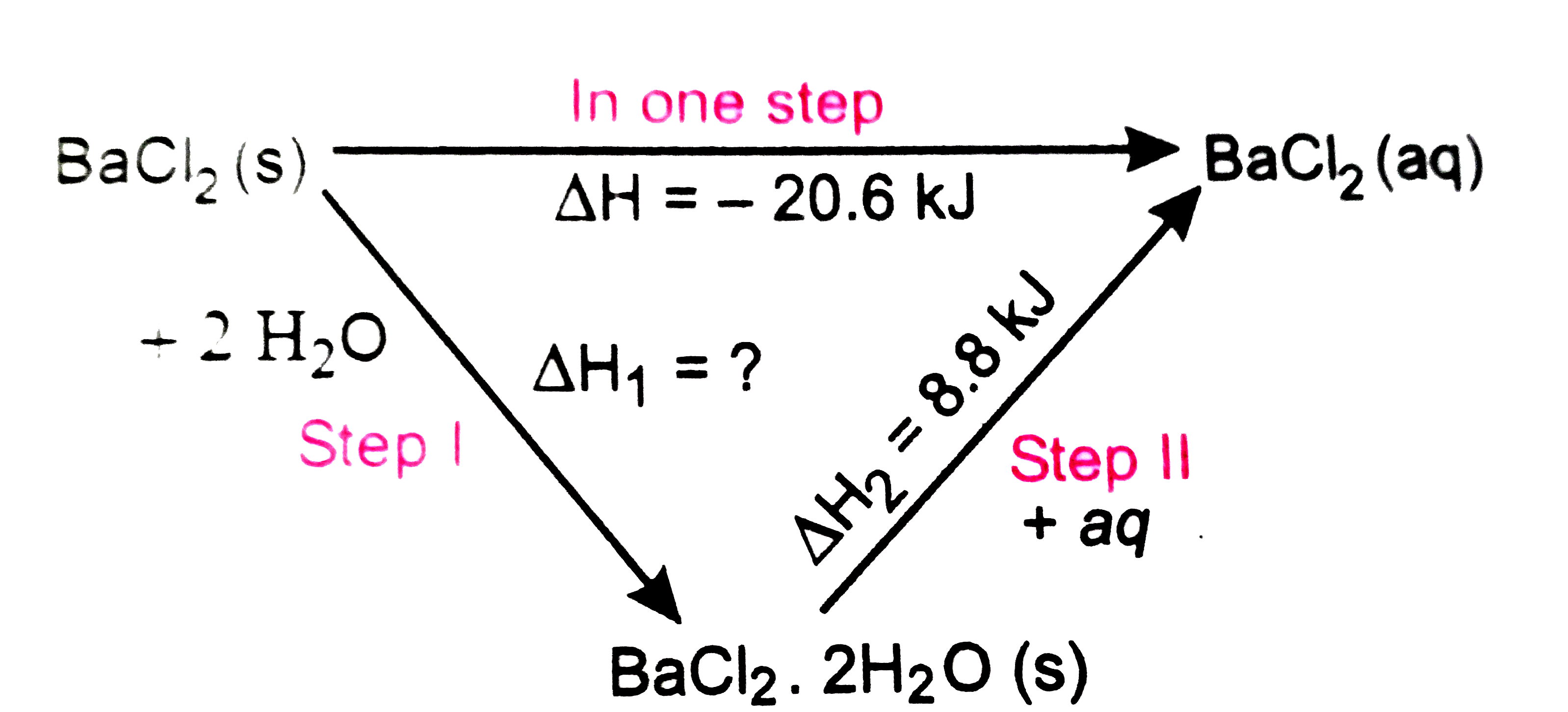 Alternativly, the DISSOLUTION in one step or in two stepsmay be represented as shown in the Fig. Applying Hess's law,`Delta H = Delta H_(1) + Delta H _(2)` `- 20.6 = Delta H_(1) = 8.8` or `Delta H _(1) = -20.6 - 8.8 kJ = - 29.4 kJ` |
|
| 35. |
Enthalpy of neutralization of NaOH with H_(2)SO_(4) is -57.3KJeq^(-1) and with ethanoic acid is -55.2KJ.eq^(-1) Which of thefollowing is the best explanation of this difference? |
|
Answer» Ethanioc acid is a WEAK acid and thus requires less NaOH for neutralization . |
|
| 36. |
Enthalpy of neutralization is defined as the enthalpy change when 1 mole of acid/base is completely neutralized by base/acid in dilute solution. For strong acid and strong base neutralization net chemical change is H_((aq))^(+) + OH_((aq))^(-) rarr H_(2)O_((l)), Delta H_(r )^(0)-= - 55.84 kJ//mol Under the same conditions how many mL of 0.1M NaOH and 0.05 M H_(2)A (strong diprotic acid) should be mixed for a total volume of 100mL to produce the highest rise in temperature: |
|
Answer» `25: 75` `rArr` eq. acid = eq base `rArr 0.05 xx y xx 2 = 0.1 xx X rArr (x)/(y) = (1)/(1)` i.e., `x=y rArr 50 : 50` |
|
| 37. |
Enthalpy of neutralization is defined as the enthalpy change when 1 mole of acid/base is completely neutralized by base/acid in dilute solution. For strong acid and strong base neutralization net chemical change is H_((aq))^(+) + OH_((aq))^(-) rarr H_(2)O_((l)), Delta H_(r )^(0)-= - 55.84 kJ//mol What is Delta H^(0) for complete neutralisation of strong diacidic base A(OH)_(2) " by" HNO_(3)? |
|
Answer» `-55.84 KJ` diacidic `rArr` 2eq `=2 XX (-55.84) = - 111.68kJ` |
|
| 38. |
Enthalpy of neutralization is always a constant when a strong acid is neutralized by a strong base: account for the statement. |
|
Answer» Solution :STRONG acids and strong bases exist in the fully ionised form inaqueous solution as below: `H_(3)O^(+)+Cl^(-)+Na^(+)+OH^(-)rarrNa^(+)+Cl+2H_(2)O` (or) `H_(3)O_((aq))^(+)+OH_((aq))^(-)rarr2H_(2)O(1)^(@)` `DeltaH^(@)=-57.32KJ.` The `H^(+)`ions produced in water by the ACID molecules exist as `H_(3)O^(+)` Thus enthalpy change change of NEUTRALIZATION is essentially due to enthalpy change per mole of water formed from `H_(3)O^(+) and OH-`. Therefore, irrespective of the chemical natural. the enthalpy of neutralization of the strong acid by Strong base is a constant value which is equal to -57 . 32 kJ. |
|
| 39. |
Enthalpy of hydrogenation of one mole benzene to cyclohexane is : [Given : Resonance energy of benzene=-70KJ/mol, Enthalpy of hydrogenation of cyclohexene =-100KJ/mol] |
|
Answer» `-170KJ` |
|
| 40. |
Enthalpy of neutralisation of all strong acids and strong bases has the same value because |
|
Answer» Neutralisation LEADS to the formation of a salt and water |
|
| 41. |
Enthalpy of hydrogenation of cyclohexene is -119-5 "kJ mol"^(-1). If resonance energy of benzene is - 150.4 kJ mol^(-1), its enthalpy of hydrogenation would be |
|
Answer» `-358.5 "kJ mol"^(-1)` =3 (-119.5)-(-150.4)=-208.1 kJ `mol^(-1)`. |
|
| 42. |
Enthalpy of hydrogenation of cyclohexene is -119Kj/mol and that of benzene is -208kJ/mol. Basedon these information, resonance energy of benzene can be calculated to be |
|
Answer» -119Kj/MOL  `DeltaH = -375kJ//mol` (theoretical ) ` DeltaH_(RE) = DeltaH_(Theo) - DeltaH_(EXP)` `=-357 - (208) = 149 KJ // mol` |
|
| 43. |
Enthalpy of formation of SO_(2) is 298 kJ calculate combustion enthalpy of 4 gm S. |
|
Answer» `+37` kJ `therefore` Enthalpy of combustion of 4 gm `S=(-298 XX 4)/( 32)` `=-37.25` kJ |
|
| 44. |
Enthalpy of formation values for fluorides of alkali metals become |
|
Answer» LESS negative |
|
| 45. |
Enthalpy of formation of ammonia is -46.0 kJ"mol"^(-1).The enthalpy change for the reaction: 2NH_(3)(g) to N_(2)(g) + 3H_(2)(g) |
|
Answer» `46.0 KJ"mol"^(-1)` Enthalpy CHANGE for the reaction = 92.0 kJ (`therefore` It is REVERSE reaction) |
|
| 46. |
Enthalpy of combustion of carbon to CO_2 is -393.5 "kJ mol"^(-1). Calculate the heat released upon formation of 35.2 g of CO_(2) from carbon and dioxygen gas. |
|
Answer» Solution :`C_((s)) + O_(2(g)) to CO_(2(g)) DeltaH = -393.5 "KJ mol"` `1 mol=44 gm` HEAT released when 44 gm `CO_(2)` is formed `DeltaH = 393.5 "kJ"` `therefore` When 35.2 gm `CO_2` formed than `= (393.5)/( 44) XX 35.2` `=314.8 "kJ"` |
|
| 47. |
Enthalpy of dissociation of H_(2)O molecules into H^(+) and OH^(-) ions is "…....................." kJ mol^(-1) |
| Answer» SOLUTION :`+57.1kJ MOL^(-1)` | |
| 48. |
Enthalpyof combustion of carbon to CO_(2) is -393.5 kJ mol^(-1) . Calculate the heat released upon formation of 35.2g of CO_(2) from carbon and dioxygen gas. |
|
Answer» SOLUTION :`C(s) + O_(2)(G) rarr CO_(2)(g), DeltaH = -393.5kJ mol^(-1)` ` 1 mol = 44G` HEAT released when 44 g`CO_(2)` is FORMED`= 393.5kJ` `:. `Heat released when `35.2g CO_(2)` is formed `= ( 393.5)/( 44) xx35.2kJ = 314.8 kJ` |
|
| 49. |
Enthalpy of combustion of benzene is -3267 kJ mol^(-1). Calculate enthalpy of formation of benzene, given enthalpy of formation of CO_(2) and water are - 393.5 kJ mol^(-1) and -285.83 kJ mol^(-1). |
|
Answer» Solution :`C_(6)H_(6)(l) + (15)/(2)O_(2)(g) rarr 6CO_(2)(g) + 3H_(2)O(l) , Delta H = -3267 kJ mol^(-1)` `Delta_(f)H^(@)` of `CO_(2) = -393.5 kJ mol^(-1)` `Delta_(r )H^(@)` of `H_(2)O = -285.83 kJ mol^(-1)` `Delta_(r )H^(@) = SigmaH_(p)^(@) - SIGMA - H_(R )^(@)` `Delta_(c )H^(@) = (6 xx H_(CO_(2))^(@) + 3 xx H_(2)O)^(@) - (H_(C_(6)H_(6))^(@) + (15)/(2) xx H_(O_(2))^(@))` `-3267 = (6 xx -393.5) + (3 xx -285.83) - [H_(C_(6)H_(6)) + (15)/(2) xx 0]` `-3267 = -2361.0 - 857.49 - H_(C_(6)H_(6))` `H_(C_(6)H_(6)) = -3218.49 + 3267` `H_(C_(6)H_(6)) =48.51 kJ mol^(-1)`. |
|
| 50. |
Enthalpy of combustion of C to CO_2 is -393.5 KJ mol^-1. Calcualte the heat released upon formation of 35.2 g of CO_2 from carbon and exygen gas. |
|
Answer» Solution :`C(s)+O_2(G)rarrCO_2(g) DeltaH=-393.5 KJ MOL^--` Heat released in the formation of 1 mol of `CO_2`=393.5 KJ `THEREFORE` Heat released in the formation of 35.2 g `CO_2`=`393.5/44xx35.2=314.8 kJ` `DeltaH` for the formaiton of 35.2g `CO_2=-314.8kJ` |
|