Saved Bookmarks
This section includes 7 InterviewSolutions, each offering curated multiple-choice questions to sharpen your Current Affairs knowledge and support exam preparation. Choose a topic below to get started.
| 1. |
From where does ozone come in the photochemical smog? |
|
Answer» SOLUTION :In PRESENCE of sunlight, `NO_2` present in the air UNDERGOES photolysis to FORM NO and atomic oxygen. The atomic oxygen then combines with the molecular oxygen to form OZONE `NO_2 overset"hv"to NO+(O), O+O_2 to O_3` |
|
| 2. |
From the thermochemical equation, C_(6)H_(6)(l) + 7(1)/(2) O_(2)(g) rarr3H_(2)O(l) + 6CO_(2)(g) , Delta_(c ) H = -3264.64kJ mol^(-1) calculate the energy evolved when39 g of C_(6)H_(6) are burnt in an open container. |
|
Answer» Solution :From the given EQUATION. When 1 mole of `C_(6)H_(6)(78G ` of `C_(6)H_(6))` is burnt, heat EVOLVED `= 3264.64kJ ` `:. `When 39 G of `C_(6)H_(6)`is burnt, heat evolved`= ( 3264.64)/(78) xx 39 = 1632.32kJ` |
|
| 3. |
From the redox reaction what is the value of x and y. As_(2)s_(5)+xHNO_(3)to5H_(2)SO_(4)+yNO_(2)+2H_(3)AsO_(4)+12H_(2)O |
|
Answer» 40, 40 |
|
| 4. |
From the NH_(3) and N_(2) which gas having high attraction force and volume ? (Van der Waals constant)(i) NH_(3) having more attraction than H Bond.(ii) Volume of N_(2) gas gt Volume of NH_(3) gas. |
|
Answer» Solution :(i) `NH_(3)` (II) `N_(2)` `because` (i) `NH_(3)` having more ATTRACTION than H bond. (ii) VOLUME of `N_(2)` gas `gt` Volume at `NH_(3)` gas. |
|
| 5. |
From the observations given below, suggest the relation between X, Y and Z |
|
Answer» Solution :In the EXPERIMENT `I, DeltaE =q-W=-100J = X ` In the experiment `II, DeltaE=4 + W = + 400J = Y ` In the experiment `III, DeltaE =-9-W = -500J = Z ` The relation between them is: Z |
|
| 6. |
From the graph the order of pressure of a gas is |
|
Answer» <P>`P_1 GT P_2gt P_3` |
|
| 7. |
From the graph the correct order of temperatures is |
|
Answer» `T_3 GT T_2 gt T_1` |
|
| 8. |
From the graph the correct order of temperatures is |
|
Answer» `T_3 gtT_2gt T_1` |
|
| 9. |
From the graph the order of pressure of a gas is |
|
Answer» `P_1 GT P_2 gt P_3` |
|
| 10. |
Fromthe graph the correct order of temperature is |
|
Answer» `T_1 LT T_2 lt T_3` |
|
| 11. |
From the graph the correct order of temperature is |
|
Answer» `T_1 lt T_2 lt T_3` `implies T_3 > T_2 > T_1`. |
|
| 12. |
From the given values which one is strong oxidising agent ? [Fe(CN)_(6)]^(-4)to[Fe(CN)_(6)]^(-3)+e^(-)E^(@)=-0.35"volt" Fe^(+2)toFe^(+3)+e^(-)E^(@)=-0.77"volt" |
|
Answer» |
|
| 13. |
From the given sets of quantum numbers the one that is inconsistent with the theory is |
|
Answer» `n=3, l=2,m=-3,s=+1//2` |
|
| 15. |
From the given potential identify metal which can completely dissociate from all solutions. E^(@)Zn^(+2)//Zn=-0.76"volt",E^(@)Cu^(+2)//Cu=+0.34"volt" E^(@)Ag^(+)//Ag=+0.80"volt",E^(@)Co^(+2)//Co=-0.28"volt" |
|
Answer» |
|
| 16. |
From the given graph,predict the compound which would be most easily purified by recrystallisation from aqueous solution: |
| Answer» Answer :D | |
| 17. |
From the followingf sets of quantum numbers,state which are possible.Explain why the other are not possible.(i)n=0,l=0,m_l=0,m_s=+(1)//(2)(ii)n=1,l=0,m_l=0,m_s=-(1)//(2)(iii)n=1,l=1,m_l=0,m_s=+(1)//(2))(iv)n=1,l=0,m_l=+1,m_s=+(1)//(2)(n=3,l=3m_l=-3,m_s=+(1)//(2)(vi)n=3,l=1,m_l=0,m_s=+(1)//(2) |
|
Answer» SOLUTION :(i)The set of quantum numbers is not possible because the minimum VALUE of n can beand not zero. (II)The set quantum numbers is possible. (iii)The et of quantum numbers is not possible because,For n=1,1 cannot be equal to 1. It can have O value. (iv)The set of quantum numbers is not possible because for `l=0,m_l` cannot be +1. it MUST be zero . (v) The set of quantum numbers is not possible,because,forn`=3,lcancel(=)3.` (vi)The set of quantum numbers is possible. |
|
| 18. |
From the following which reaction is not redox reaction ? |
|
Answer» `2H_(2)+O_(2)to2H_(2)O` |
|
| 19. |
From the following which reaction is redox reaction ? |
|
Answer» `NaOH_((aq))+HCl_((aq))toNaCl_((aq))+H_(2)O_((l))` |
|
| 20. |
From thefollowingwhichsetsofionsisisoelectronic ? |
|
Answer» `K^(+) ,CI^(-) ,Ca^(2) ,Sc^(3)` |
|
| 21. |
From the following which pair is unfair ? |
|
Answer» `H_(2)O_(2),Na_(2)O_(2)` |
|
| 22. |
From the following which option state mixture and compound respectively ? |
|
Answer» Sugar SOLUTION, Salt solution |
|
| 23. |
From the following which one is constant ? |
|
Answer» VALENCY |
|
| 25. |
From the following which one has least number of molecules ? |
|
Answer» `22.4 L CO_(2)` at STP |
|
| 26. |
From the following which compound shows different oxidation number of H ? LiAlH_(4),NaBH_(4),NaHCO_(3),MgH_(2) |
|
Answer» `MgH_(2)` |
|
| 27. |
From the following which one has least molecules ? |
|
Answer» 0.1 mole `CO_(2)` |
|
| 28. |
From thefollowingwhichequationis nottheformof de - broglisequation ? |
|
Answer» KINETICENERGY `(2hv )/( LAMBDA )` |
|
| 30. |
From the following which compound have -1 oxidation number of nitrogen ? |
|
Answer» `NH_(2)-NH_(2)` `rArrN+3-2=0` `rArrN=-1` |
|
| 31. |
From the following which compound has less oxidation state of Fe ? |
|
Answer» `K_(3)[FE(CN)_(6)]` |
|
| 32. |
From the following w hich pair is isotone and isobar respectively. |
|
Answer» III and I 
|
|
| 33. |
From the following values of dissociation constant of four acids which value represents the strongest acid ? |
|
Answer» `2 XX 10^(-2)` |
|
| 34. |
From the following table {:("Buffer solution ", "Vol .of 0.1 M weak acid ", "Vol. of . 0.1 M sodium salt of weak acid "),(I,4.0, 4.0 ),(II, 4.0,40.0 ),( III, 40.0 , 4.0),(IV, 0.1,10):} Which of the two sets of buffer solutions have least pH ? |
|
Answer» `I & II` Buffer -2 ` pH = P^(Ka)+log ""( 40)/(4)rArr pH=P^(Ka)+1` Buffer -3 ` pH =P^(Ka) +log ""(4)/(40 ) rArrpH =P^(Ka) -1 ` Buffer -4` pH =P^(Ka) +log ""(10)/(0.1)rArrpH= P^(Ka+2)` |
|
| 35. |
From the following thermochemical equations, calculate the standard enthalpy of formationof HCl(g) . (A) H_(2)(g) rarr 2H(g) , DeltaH^(0)= + 436.0 kJ mol^(-1)(B)Cl_(2)(g)rarr 2Cl(g), DeltaH^(0)= + 242.7 kJ mol^(-1) (C ) HCl(g) rarr H(g) + Cl(g) , DeltaH^(0) = + 431.8 kJ mol^(-1) |
|
Answer» |
|
| 36. |
From the following statements reagarding H_(2)O_(2). Choose the incorrect statements |
|
Answer» It has to be stored inplastic or wax linked glass bottles in dark. |
|
| 37. |
From the following statement regarding H_(2)O_(2), choose the incorrect statement. |
|
Answer» It has to the stored in PLASTIC or WAX lined glass bottles in dark |
|
| 38. |
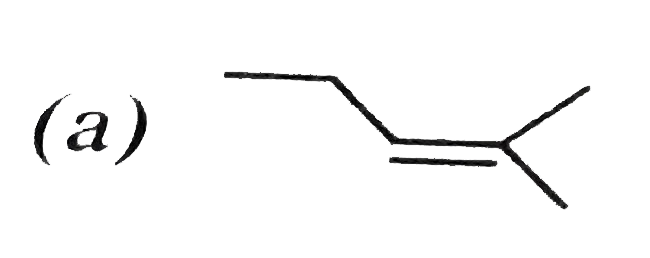
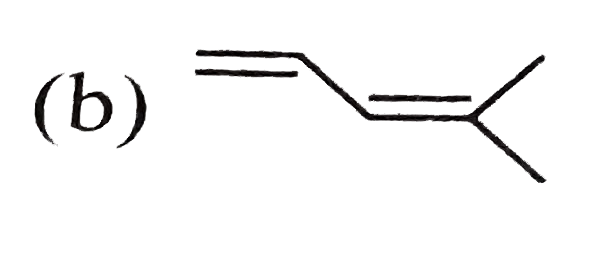
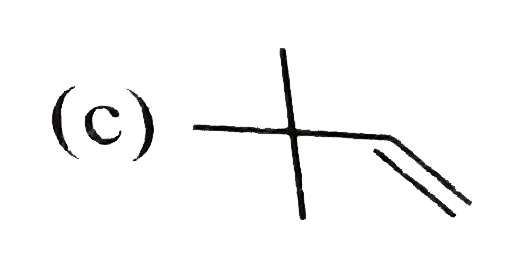
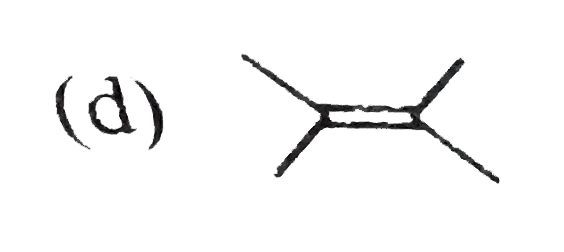
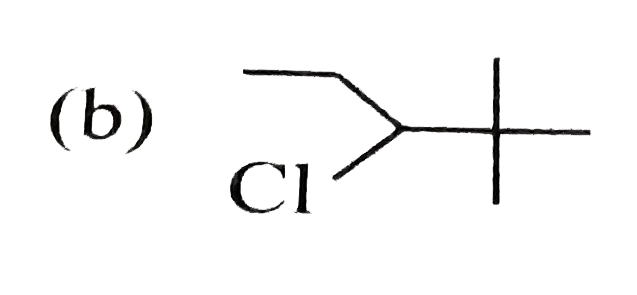
From the following sequence of reactions , [A] (C_(6)H_(12)) overset(HCl)(rarr) (B) (C_(6) H_(13)Cl)+ (C) (C_(6)H_(13)Cl) react with AgNO_(3) to give white ppt. [B]overset("Alc." KOH)(to) (D)(An isomer of A ) gives positive test with Br_(2)//C Cl_(4) [D] overset("Ozonelysis")(to)(E) gives positive iodoform test and negative Fehling's test . [A] overset("Ozonolysis")(to) (F) + (G) , both F and G give positive Tollen's test . [F] + [G] underset(Delta)overset("Conc." NaOH)(to) HCOONa + alcohol The reaction involve in F and G with the NaOH is : The structure of compound D is : |
|
Answer»
|
|
| 39. |
From the following sequence of reactions , [A] (C_(6)H_(12)) overset(HCl)(rarr) (B) (C_(6) H_(13)Cl)+ (C) (C_(6)H_(13)Cl) react with AgNO_(3) to give white ppt. [B]overset("Alc." KOH)(to) (D)(An isomer of A ) gives positive test with Br_(2)//C Cl_(4) [D] overset("Ozonelysis")(to)(E) gives positive iodoform test and negative Fehling's test . [A] overset("Ozonolysis")(to) (F) + (G) , both F and G give positive Tollen's test . [F] + [G] underset(Delta)overset("Conc." NaOH)(to) HCOONa + alcohol The reaction involve in F and G with the NaOH is : The reaction involve in the F and G with NaOH is : |
|
Answer» REIMER- Tiemann reaction |
|
| 40. |
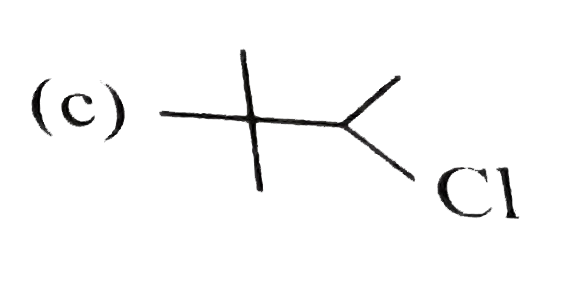
From the following sequence of reactions , [A] (C_(6)H_(12)) overset(HCl)(rarr) (B) (C_(6) H_(13)Cl)+ (C) (C_(6)H_(13)Cl) react with AgNO_(3) to give white ppt. [B]overset("Alc." KOH)(to) (D)(An isomer of A ) gives positive test with Br_(2)//C Cl_(4) [D] overset("Ozonelysis")(to)(E) gives positive iodoform test and negative Fehling's test . [A] overset("Ozonolysis")(to) (F) + (G) , both F and G give positive Tollen's test . [F] + [G] underset(Delta)overset("Conc." NaOH)(to) HCOONa + alcohol The structure of C is : |
|
Answer»
|
|
| 41. |
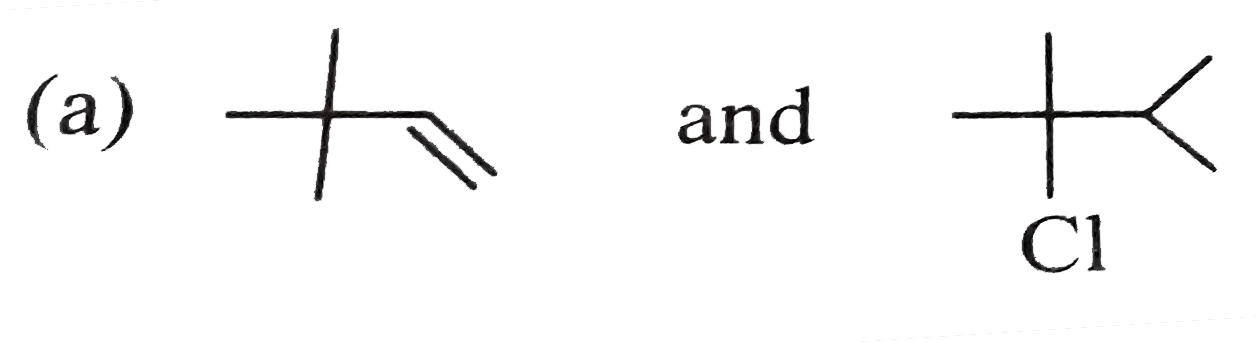
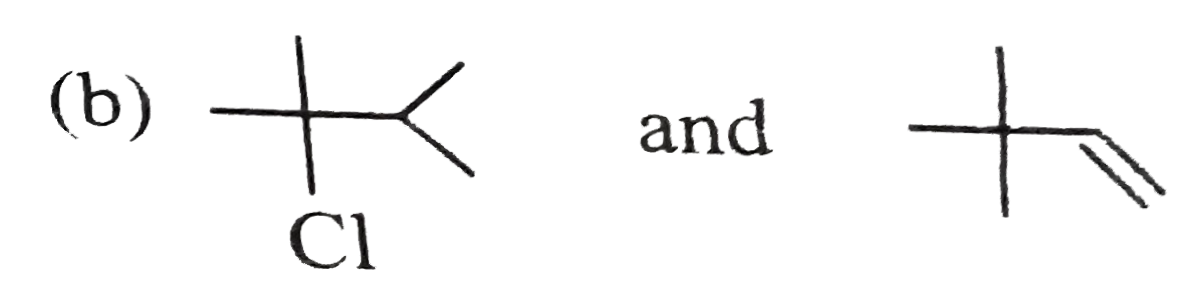
From the following sequence of reactions , [A] (C_(6)H_(12)) overset(HCl)(rarr) (B) (C_(6) H_(13)Cl)+ (C) (C_(6)H_(13)Cl) react with AgNO_(3) to give white ppt. [B]overset("Alc." KOH)(to) (D)(An isomer of A ) gives positive test with Br_(2)//C Cl_(4) [D] overset("Ozonelysis")(to)(E) gives positive iodoform test and negative Fehling's test . [A] overset("Ozonolysis")(to) (F) + (G) , both F and G give positive Tollen's test . [F] + [G] underset(Delta)overset("Conc." NaOH)(to) HCOONa + alcohol The structure A and B respectively are : |
|
Answer»
|
|
| 42. |
From the following select the correct order of negative (-I) effect |
|
Answer» `-NO_(2) gt -CN gt -COOH gt -F gt - OCH_(3)` |
|
| 43. |
From the following redox reaction, 2S_(2)O_(3)^(-2)+I_(2)toS_(4)O_(6)^(-2)+2I^(-) |
|
Answer» `S_(4)O_(6)^(-2)` is oxidation in `S_(2)O_(3)^(-2)`. |
|
| 44. |
From the following reaction which element.s oxidation number is not change ? 3MnO_(2)+4Feto3Mn+2Fe_(2)O_(3) |
|
Answer» Mn |
|
| 45. |
From the following reaction which substance act as reducing agent ? HCHO+AgOtoHCOOH+2Ag |
|
Answer» Solution :`underset(+0)underset(darr)(HCHO)+underset(+1)underset(darr)(AgO)tounderset(+2)underset(darr)(HCOOH)+underset(0)underset(darr)(2Ag)` Here, `Ag_(2)O` reduce into Ag while in HCHO it will be oxidised. So HCHO is REDUCING agent. |
|
| 46. |
From the following reaction which element.s oxidation number is decreases ? MnO_(4)^(-)+5Fe^(+2)+8H^(+)toMn^(+2)+5Fe^(+3)+4H_(2)O |
|
Answer» Mn |
|
| 47. |
From the following observations predict the type of orbital : Observation 1: x y plane acts as a nodal plane Observation 2: The angular function of the orbital intersect the three axis at origin only. Observation 3: R^2(r) vs r curve is obtained for the orbital is |
|
Answer» `5P_z` |
|
| 48. |
Fromthe followingorbitalsof whichelectronconfigurationviolatesAufbauprinciple ? |
|
Answer» |
|
| 49. |
From thefollowingin whichpairoforbitlashave moreattraction withnucleus (i) 4fand 5d (ii)4d and5 s(iii)7s and5 f ,(ii) 7p and5p( v)3dand3f |
|
Answer» Solution :(i) 4fhas mareattractionwithnuclear. 4F and5d : `(n+1)-=7` butin 4fin isless (ii) in5shas moreattraction (iii) in 7shas moreattraction 7S : (n+1)= 7,5f: (n+1) =8 (IV)in 5phas moreattractionn isless itssubshell issamebut VALUEOF n inspis LESS (v )Notpossible3fdoes not exist. |
|
| 50. |
From the following given statements (i) O………………..H hydrogen bond length is more than covalent O-H bond length. (ii) The ionic bond strength of CsF is more than that of NaF. (iii) The number of electrons present in all inner shells of sodium atom are 10. The correct combination is |
|
Answer» only i is CORRECT |
|