

Saved Bookmarks
This section includes 7 InterviewSolutions, each offering curated multiple-choice questions to sharpen your Current Affairs knowledge and support exam preparation. Choose a topic below to get started.
| 1. |
Haemoblobin is a Fe containing protein responsible for oxygen transport in the blood. The curves given below idicate the percentage suturation of haemoglobin by O_(2) as a funcion of partial pressure of O_(2). Which of the following statement/s is/are correct for the given curves? I. In presence of CO_(2), higher P_(O_(2)) is needed for a given percentage saturation. II. In presence of CO_(2), lower P_(O_(2)) is needed for a give percentage saturation. III. The maximum percentgae saturation is not affected by the presence of CO_(2) IV. In the absence of CO_(2), maximum saturation of haemoglobin occurs at lower p_(O_(2)). |
|
Answer» IA nd IV |
|
| 2. |
For the reaction H^(+) + OH^(-) + H_2O, DeltaH = -13.7 K. cal For H_3O^(+) + OH^(-) rarr 2H_2O, DeltaH will be |
|
Answer» `Q_1 + Q_2` |
|
| 3. |
Ha is an alphabetical symbol for |
|
Answer» halnium |
|
| 4. |
H_3S-O-O-SO_3H_((aq)) underset(H_2O)overset"hydrolysis"to 2H_2SO_4+X The product X is ……. |
|
Answer» `SO_2` `2HSO_(4(aq))^(-)OVERSET"ELECTROLYSIS"to HO_3 SOOSO_3H_((aq)) + 2E^(-) underset(H_2O)overset"Hydrolysis"toubrace(2HSO_(4(aq))^(-)+2H_((aq))^(+)+H_2O_(2(aq)))_(2H_2SO_4)` |
|
| 5. |
H_3PO_4 +H_2O hArr H_3O^(+) +H_2PO_4^(-) ,pK_1 =2.15 , H_2PO_4^(-)+H_2O hArr H_3O^(+) HPO_4^(-2) , pK_2 =7.20Hence pH of 0.01 M NaH_2PO_4 is |
|
Answer» ` 9.35` ` PH= (p^(Ka_1) +p^(Ka_2))/(2)= (2.15 +7.20)/(2) = 4.675` |
|
| 6. |
H_(3)PO_(4)+2KOHrarrK_(2)HPO_(4)+2H_(2)O Based on the above reaction equivalent weight of H_(2)PO_(4) is |
|
Answer» 196 |
|
| 7. |
H_(3)PO_(3) undergoes disprotionation reaction but H_(3)PO_(4) does not ? Explain. |
|
Answer» Solution :The maximum and minimumoxidation states of P are -3 and +5. But the OXIDATION STATE of P in `H_(3)PO_(3)` is +3. Therefore, it can increase its oxidation state to +5 in `H_(3)PO_(4)` and DECREASE its oxidation state to -3 in `PH_(3)`. Thus, `H_(3)PO_(3)` shows disproportionation reaction. `underset("Orthophoshorus acid")overset(+3)(4H_(3)PO_(3))overset("HEAT")tounderset("Phoshine")overset(-3)(PH_(3))+underset("Orthophosphoric acid")overset(+5)(3H_(3)PO_(4))` In contrast, the oxidation state of P in `H_(3)PO_(4)" is "+5`, therefore, it cannot increase its oxidation state beyond +5 and hence it does not show disproportionation reaction. |
|
| 8. |
H_(3)PO_(3) is diprotic (or dibasic). Why ? Or What is the basicity of H_(3)PO_(3) and why ? Or Draw the structure of dibasic oxoacid of phosphour. |
Answer» SOLUTION :Its structure is  Since it CONTAINS only TWO ionizable H-atoms which are present as OH groups, it BEHAVES as a DIBASIC aicd. |
|
| 9. |
H_(3)PO_(3) can he represented by structure 1 and 2shown below. Can these two structures betaken as the canonical forms of the resonance hybrid representing H_(3) PO_(3) ? If not, give reasons for the same . |
| Answer» Solution :These TWO structure cannot taken as the CANONICAL forms of the resonance HYBRID. Becausethe POSITION of nucleus of atom is change. In resonance form the position of nucleus is not changed. | |
| 10. |
H_(3)PO_(2)andH_(3)PO_(3) act as good reducing agents but H_(3)PO_(4) does not. Explain. |
Answer» Solution :The STRUCTURE of these xooacids depends upon the number of P-H bonds. Since `H_(3)PO_(2)` has two, `H_(3)PO_(3)` has one THEREFORE, both ACT as reducing agents. In CONTRAST `H_(3)PO_(4)` does not have any P-H bonds and hence it does not act as a reducing AGENT. 
|
|
| 11. |
H_(3)O^(+) or RN_(4)^(+) neither acts as an electrophile nor as a nucleophile. Explain why ? |
|
Answer» Solution :`H_(3)overset(..)(O^(+))` has a lone pair of electrons BU DUE to the presence of +ve charge, it cannot donate its electron pair and HENCE it does act as a nucleophile. `R_(4)N^(+)`, however, does not have a lone pair of electrons, therefore, it does not act as a nucleophile. `H_(3)overset(..)(O^(+))` has 8 electrons in the valence shell. It cannot expand its valence shell beyond 8 due to the absence of d-orbitals. Therefore, it does not act as an electrophile. Similarly, `R_(4)overset(+)(N)` also has 8 electrons in the valence shell. Like O, N also cannot expand its valence shell beyond 8 and hence it also does not act as an electrophile. Thus, `H_(3)O^(+)` or `RN_(4)^(+)` NEITHER acts as a nucleophile nor as an electrophile. |
|
| 12. |
H_(3)C- underset(underset(CH_(3))(|))(CH) - CH_(2) - underset(underset(CH_(3))(|))(CH) - underset(underset(CH_(3))(|))(CH) - CH_(3) (i) 2, 3, 5- Trimethyl hexane and (ii) 2, 4, 5-Trimethyl hexane which name is correct? Why? |
| Answer» SOLUTION :(i) NAME is correct. Because in (i) the SUBSTITUTION order is low then (ii) order. In first (i) is 2, 3 and in second is 2, 4 so, 2, 3 order is low | |
| 13. |
H_3C-undersetunderset(CH_3)|CH-CH=CH_2+HBr to AA (predominantly ) is |
|
Answer» `CH_3-undersetunderset(BR)|CH-undersetunderset(CH_3)|CH-CH_3` 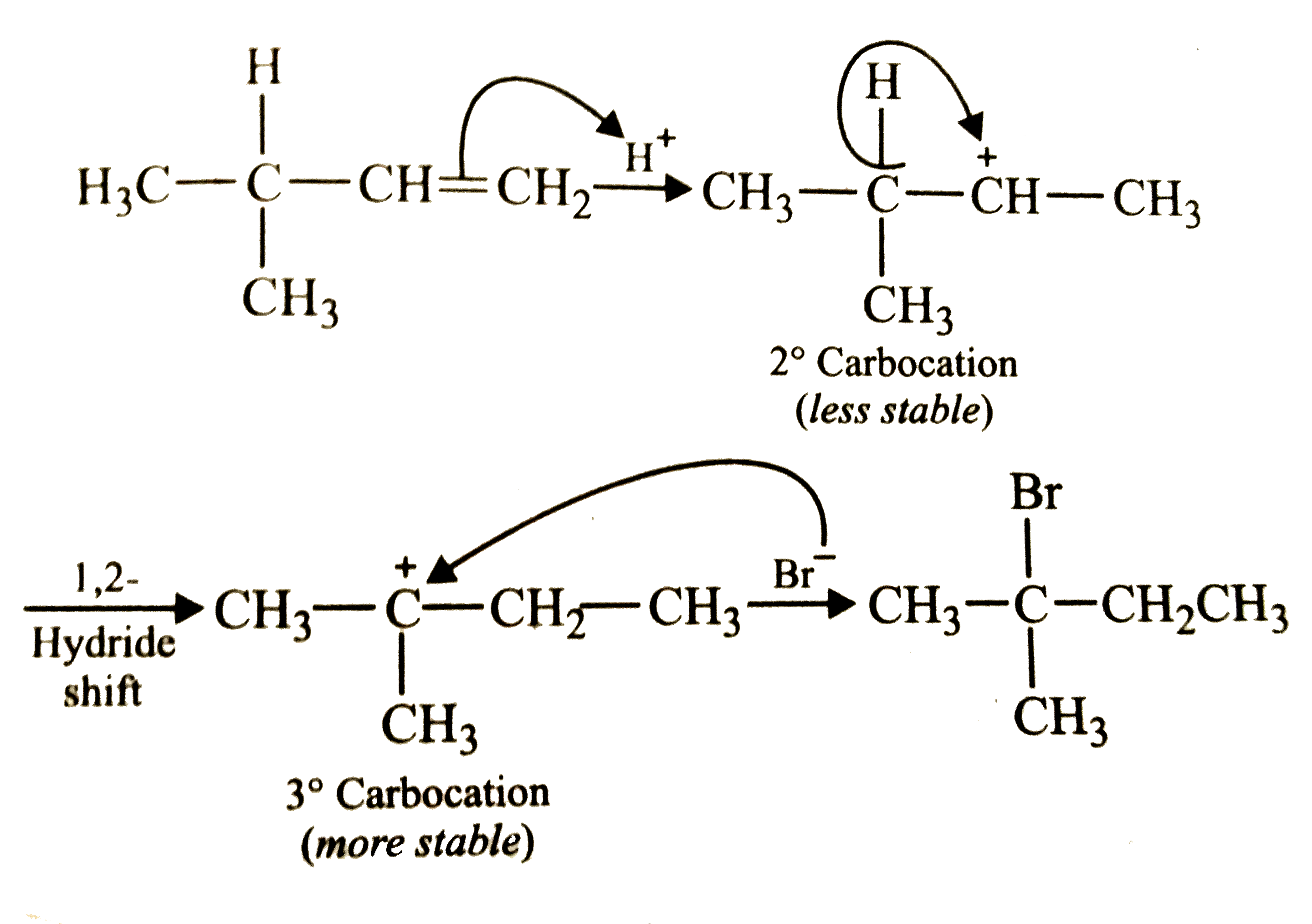
|
|
| 14. |
H_3C -underset(CH_3)underset(|) overset(CH_3)overset(|)C-H+ C Cl_4 underset(hv)overset(R_2O_2)to " Product": |
|
Answer» `H_3C - UNDERSET(CH_3)underset(|)OVERSET(CH_3)overset(|)C-Cl` |
|
| 15. |
H_(3)C-underset(C_(3)H_(7))underset(|)overset(C_(2)H_(5))overset(|)(C)-Cl+overset(ϴ)(O)H overset(S_(N^(2)))toH_(3)C -underset(C_(3)H_(7))underset(|)overset(C_(2)H_(5))overset(|)(C)-OH+overset(ϴ)(C)l What is the stereo chemistry of the above reaction? |
|
Answer» COMPLETE racimisation |
|
| 16. |
H_(3)C-overset(o+)CH-CH=CH_(2) does not involve : |
|
Answer» `sigma-p` OVERLAP |
|
| 17. |
H_(3)C-C=Choverset(NaNH_(2))rarrXoverset(Acetone)underset(H_(2)O)rarrYoverset(Conc.H_(2)SO_(4))underset(triangle)rarrZ: |
|
Answer» `X is H_(3)C-CH=CH-CH_(3)` 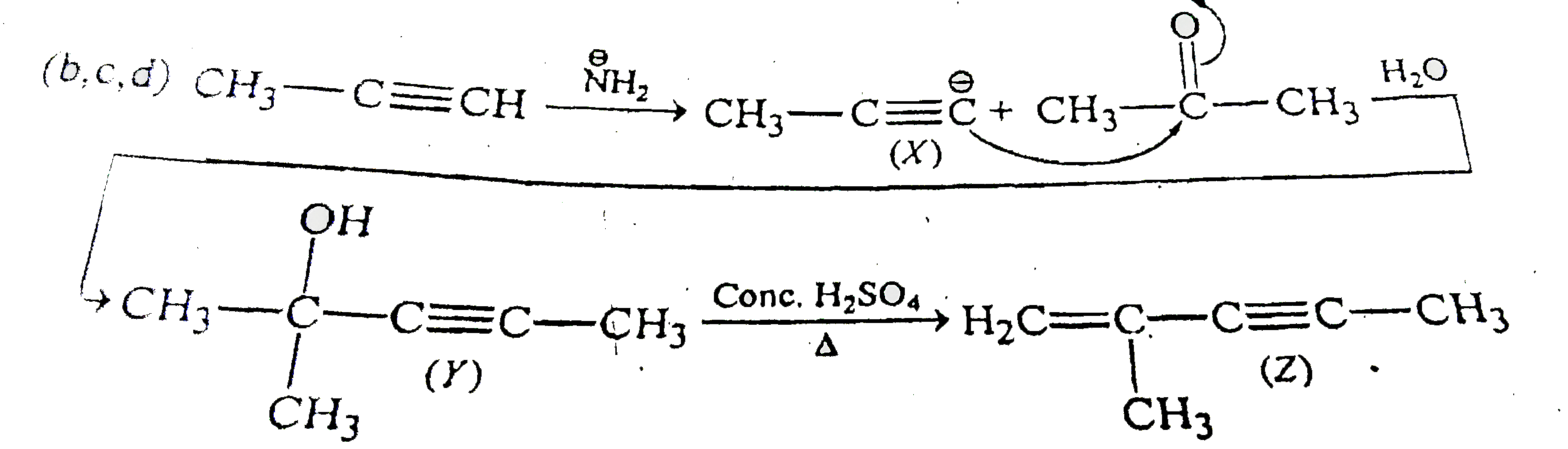
|
|
| 18. |
H_3C -C -= overset(Hg^(+2)// H_2SO_4) to X overset(KMnSO_4)to Y : |
|
Answer» X is ` H_3C -OVERSET(OH)overset(|)C=CH_2` |
|
| 19. |
H_(3)BO_(3)is |
|
Answer» Monobasic and WEAK Lewis ACID |
|
| 20. |
H_(3)BO_(3)overset("Red heat")rarr- X. 'X' in the reaction is |
|
Answer» `H_(2)B_(4)O_7` |
|
| 21. |
H_(3)BO_(3) when dissolved in heavy water gives |
|
Answer» `D_(3)O^(+)` ion |
|
| 22. |
H_(3)BO_(3) is |
|
Answer» monobasic and weak Lewis acid |
|
| 23. |
H_3Ais a weak triprotic acid(K_(a_1) =10^(-5),K_(a_2)=10^(-13)) . What is the value of pX of 0.1 M H_3 A(aq.)solution ? WherepX=- log X and X = ([A^(3-)])/([HA^(2-)]) |
|
Answer» `7` ` [H^(+) ] =sqrt(Ka_1 xx C) =sqrt( 10 ^(-6)) =10 ^(-3)M` ` X =([A^(3-)])/( [HA^(_2) ]) =(Ka_3)/([H^(+) ] )rArr X =10 ^(10)rArr PX =10 ` |
|
| 24. |
H_3 C - C -= CH underset(2. CH_3CH_2Br)overset(1. NaNH_2)to A underset(Pd-BaSO_4)overset(H_2)to B |
|
Answer» A is `H_3C -CH_2 - C -=CH` 
|
|
| 25. |
H_3 BO_3 overset("Red heat")to X. 'X' in the reaction is |
|
Answer» `H_2 B_4 O_7` |
|
| 26. |
H_(2)SO_(4) is added to 20% cold aqueous solution of BaO_(2). The product formed is: |
|
Answer» `H_(2)O_(2)` |
|
| 27. |
H_(2)O_(4) is added to 20% cold aqueous solution of BaO_(2). The product formed is |
|
Answer» `H_2SO_4` |
|
| 28. |
H_(2)S_((g))intially at a pressure of 10 atm anda temperature of 800K, dissociates as 2H_(2)S_((g)) hArr 2H_(2) +S_(2(g)) At equilibrium, the partial pressure of S, vapour is 0.02 atm. Thus, K_(p) is |
|
Answer» `3.23 xx 10^(-7)`  x=0.020 atm `PH_(2)S=10-2x=10-0.02 xx 2=9.96` atm `PH_(2)=x=0.02` `K_(P)=(PS_(2) xx PH_(2)^(2))/(P^(2)H_(2)S)=(0.02 xx (0.04)^(2))/((9.96)^(2))` `= 3.23 xx 10^(-7)` atm |
|
| 29. |
H_(2)S gas is passed into one dm^(3) of a solution containing 0.1 mole of Zn^(2+) and 0.01 mole of Cu^(2+) till the sulphide ion concentration reaches 8.1xx10^(-19) moles. Which one of the following statements is true ? (K_(sp) of ZnS and CuS are 3xx10^(-22) and 8xx10^(-36) respectively) |
|
Answer» Only ZnS precipitates Ionic product of `ZnS=[ZN^(2+)][S^(2-)]` `=0.1xx8.1xx10^(-19)=8.1xx10^(-20) gt K_(sp)` Ionic product of CuS `=[cu^(2+)][S^(2-)]` `=0.01xx8.1xx10^(-19)=8.1xx10^(-21) gt K_(sp)` Hence, both will precipitate. |
|
| 30. |
H_(2)S and NH_(3) gas evolved at same time form factory of cylinder than which gas can expand fast ? |
| Answer» Solution :`NH_(3)` gas can expand FAST because its MOLECULAR mass is 17 gm/mol and molecular mass of `H_(2)S` gas is 34 gm/mol so density of `NH_(3)` is less than `H_(2)S`. So `NH_(3)` gas expand fast than `H_(2)S`. | |
| 31. |
H_(2)S a toxic gas with rotten egg like smell, is used for the qualitative analysis. If the solubility of H_(2)S in water at STP is 0.195 m. Calculate Henry's law constant. |
|
Answer» Solution :Solubility of `H_(2)S` gas `=0.195 m` `=0.195` mole in 1 kg of the SOLVENT (water) 1 kg of the solvent (water) `= 1000 gh = (1000g)/(18gmol^(-1)) = 55.55` moles Mole fraction of `H_(2)S` gas in the solution `(X) = (0.195)/( 0.195 + 55.55) = (0.195)/(55.745) = 0.0035` Pressure at STP `=0.987` bar Applying Henry.s law `P_(H_(2)S) = K_(H) xx x _(H_(2)S)` ` K _(H) = (P _(H_(2)S))/(x_(H_(2)S))= (0. 987 b ar)/(0.0035) = 282` bar |
|
| 32. |
H_2overset(14)(C) = CH - CH_3 underset("or highi temp.")overset("low conc. of" Br_2)to (?) Product of the above reaction is : |
|
Answer» `H_2overset(14)C =CH - CH_2 - BR` `H_2 overset(14)C=CH-CH_2 - Br and H_2C = CH - overset(14)CH_2 - Br` |
|
| 33. |
H_2O_((s)) hArr H_2O_((l)) Explain. |
|
Answer» SOLUTION :It is equilibrium state At equilibrium the rate of fusion ice and rate of freezing water is some. Fusion and freezing both time take place at same with EQUAL rate. At this time both side ice and water quantity remain CONSTANT. The temperature at this time is MELTING point of ice and freezing point of water. It is SOLID - liquid type physical equilibrium. |
|
| 34. |
H_2O_((l)) hArr H_2O_((g))(con. T, closed vessel) At this time what is the pressure of vessel ? |
|
Answer» <P> Solution :The PRESSURE of VESSEL is CALLED VAPOUR pressure `(P_(H_2O))` |
|
| 35. |
H_(2)O_((g))rarrH_((g))+OH_((g))DeltaH=x_(1), OH_((g))rarrH_((g))+O_((g))DeltaH=x_(2) Based on these value, BE of O-H bond is |
|
Answer» `(x_(1)+x_(2))/(2)` |
|
| 36. |
H_(2)O_(3) solution used for hair bleachingm is sold as a solutionapproximately 5.0 g H_(2)O_(2) per 100 mL of the solution. The molecular mass of H_(2)O_(2) is 34. The molarity of this solution approximately : |
|
Answer» 0.15 M |
|
| 38. |
H_(2)O_(2) tums blackened lead paintings to white colour, In this reaction it oxidises Pbs to PbSO_(4). The number of moles of H_(2)O_(2) needed to oxidise one mole of PbS is |
| Answer» Solution :`PBS+4H_(2)O_(2) to PbS_(4)+4H_(2)O` | |
| 39. |
H_2O_2 turns acidified solution of the following to orange red |
|
Answer» `TiO_2` |
|
| 40. |
'H_(2)O_(2)' ---> 2H + O_(2) +2eThe above equation represents the following nature H_(2)O_(2) |
|
Answer» REDUCING |
|
| 41. |
H_(2)O_(2) reduces |
| Answer» Solution :`H_(2)O_(2)+Cl_(2) to 2HCO+O_(2)` | |
| 42. |
H_2O_2 reduce K_3 [Fe(CN)_6] in : |
|
Answer» neutral SOLUTION |
|
| 43. |
H_(2)O_(2) reacts repidly in |
|
Answer» ACIDIC MEDIUM |
|
| 44. |
H_2O_2 oxidises the following |
|
Answer» `[FE(CN)_6]^(4-)// OH^-` |
|
| 45. |
H_(2)O_(2) oxidised the following |
|
Answer» `(FE(CN)_(6))^(3-)//OH^(-)` |
|
| 46. |
H_2O_2 on treatment with chlorine gives : |
| Answer» SOLUTION :`H_2O_2` on treatment with chlorine gives oxygen | |
| 47. |
H_(2)O_(2)+O_(3) rarr H_(2)O+2O_(2) in this H_(2)O_(2) acts as |
|
Answer» OXIDIZING agent |
|
| 48. |
H_(2)O_(2) is reduced rapidlly by Sn^(2+) to give H_(2)O and Sn^(+)H_(2)O_(2) is decomposed slowly at room temperature so yield O_(2) and H_(2)O. 136g of % by mass of H_(2)O in water treated with 100 mL 3 M Sn^(2+) and then a mixture is allowed to stand until no further reaction occurs. The reactions involved are 2H^(o+)+H_(2)O_(2)+Sn^(2+) to Sn^(2+)+2H_(2)O: 2H_(2)O+O_(2) The valume strength of H_(2)O_(2) left after reacting with Sn^(2+) is |
|
Answer» `1.12V` no.of GEW.s of `Sn^(+2)=6xx0.1=0.6` no.of GEW.s of `H_(2)O_(2)` left over `=0.2` no.of GEW.s of `H_(2)O_(2)` consumed `=0.6` no.of `H_(2)O_(2)` left `=0.2xx(1000)/(100)2N` VOL strength `=11.2` |
|
| 49. |
H_(2)O_(2) is an unstable liquid . On standing or on heating it decomposes to H_(2)O and O_(2) . H_(2)O_(2) can acts as oxidising agent and reducing agent . The concentration of H_(2)O_(2) is expressed differently with volume strength and the concentration of H_(2)O_(2) at a particular time is measured by titrating it with acidified KMnO_(4) or by titrating liberated I_(2) from acidified KI and H_(2)O_(2)with hypo solution . A sample of H_(2)O_(2)has 3.4 g of H_(2)O_(2)in 100 mL solution . The bottle containing this sample was kept at 25^(0)C for 15 days then 20mL of this sample is treated with excess KI and the liberated iodine requires 50 mL , 0.2 M Na_(2)S_(2)O_(3) solution . Assume the volume of solution remains unchanged . The volume of H_(2)O_(2) sample (after 15 days ) that is required to reduce 40 mL of 0.2 M acidified KMnO_(4) solution is : |
| Answer» ANSWER :C | |

