

Saved Bookmarks
This section includes 7 InterviewSolutions, each offering curated multiple-choice questions to sharpen your Current Affairs knowledge and support exam preparation. Choose a topic below to get started.
| 1. |
How do you account for the following observations ? Though alkaline potassium permanganate and acidic potassium permanganate both are used as oxidants, yet in the manufacture of benzoic acid from toluene we use alcoholic potassium permanganate as an oxidant. Why? Write a balanced redox equation for the reaction. |
|
Answer» SOLUTION :If toluene is subjected to oxidation by using alkaline or acidic `KMnO_(4)`, it is difficult to control oxidation. This leads to the occurrence of side reactions and several other products along with the main product, i.e., benzoic acid may be obtained. THEREFORE, it is preferred to use alcoholic `KMnO_(4)` as an oxidant in place of acidic or alkaline `KMnO_(4)`. The redox reaction is as follows. `underset(("Average O.S.of "C=-(8)/(7)))underset("Toluene")(C_(6)H_(5)CH_(3))+2Koverset(+7)(Mn)O_(4)to2KOH+2overset(+4)(Mn)O_(2)+underset(("Average O.S. of" C=-(2)/(7)))underset("Benzoic acid")(C_(6)H_(5)COOH)` |
|
| 2. |
How do you account for formation of ethane during chlorination of methane ? |
Answer» SOLUTION :Chlorination of methane is a free radical reaction which OCCURS by the FOLLOWING mechanism : 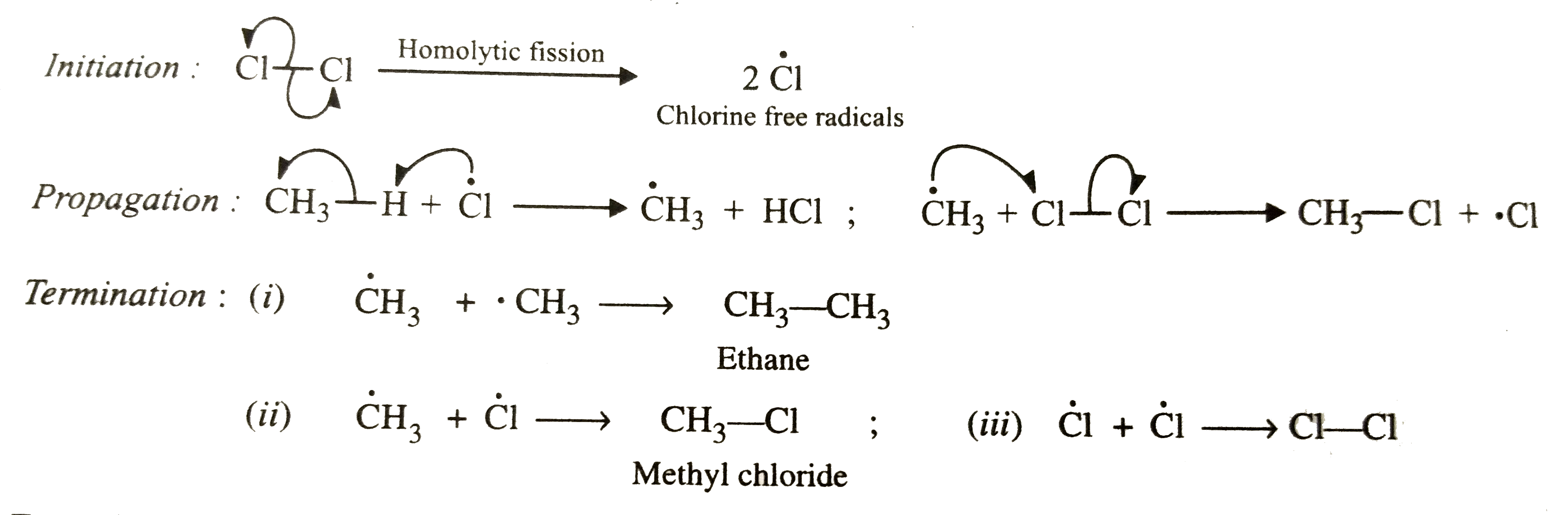 From the above mechanism, it is evident that during propagation step, `oversetdot(CH_3)` free radicals are produced which may undergo THREE reactions , i.e. (i)-(iii). In the chain termination step , the two `oversetdot(CH_3)` free radicals combine together to FORM ethane `(CH_3-CH_3)` molecules . |
|
| 3. |
How do we differentiate between Fe^(3+) and Cr^(3+) ions in group III ? |
|
Answer» By adding excess of `NH_(4)OH` solution |
|
| 4. |
How do we differentiate between Fe^(3+) and Cr^(3+) in group III^(rd)? |
|
Answer» By adding excess of `NH_(4)OH` solution `FE^(3+) overset(NH_(4)OH)underset("Excess")rarr underset(("Reddish brown ppt"))(Fe(OH)_(3)darr)` |
|
| 5. |
How do we differentiate between Fe^(3+)and Cr^(3+)in group III ? |
|
Answer» By taking excess of `NH_4 OH` |
|
| 6. |
How do the structures of quartz and quartz glass differ from each other? |
| Answer» Solution :Quartz is a crystalline solid in which constituent particles (`SiO_4` TETRAHEDRA) are arranged in a regular manner whereas glass is AMORPHOUS solid in which the `SiO_4` tetrahedra do not have a long range ORDER | |
| 7. |
How do the structures of quartz and quartz glass differ from each other ? |
| Answer» Solution :Quartz ISA crystalline SOLID in which constrituent particles (` SiO_(4)`TETRAHEDRA) are arranged in a regular manner WHEREASE glass is amorphous solid in which the `SiO_(4)` tetrahedra do not have a long range order. | |
| 8. |
How do the spacings of the three planes (100), (110) and (111) of cubic lattice vary? |
| Answer» SOLUTION :`1 : 1// SQRT2 : 1 // SQRT3` | |
| 9. |
How do the spacings of the three planes ( 100), ( 101) and ( 111) of simple cubic lattice vary ? |
| Answer» SOLUTION :`1 : 1// SQRT2 : 1 // SQRT3` | |
| 10. |
How do the spacings of the three planes (100), (101) and (111) of simple cubic lattice vary? |
| Answer» SOLUTION :`1 : 1// SQRT2 : 1 // SQRT3` | |
| 11. |
How do the spacings of the three planes (010), (110) and (111) of fcc lattice vary? |
| Answer» SOLUTION :`1//2 : 1 //2 SQRT2 : 1 // SQRT3` | |
| 12. |
How do the spacings of the three planes (001), (011) and (111) of bcc lattice vary ? |
| Answer» SOLUTION :`1//2 : 1// SQRT2 :1 //2 SQRT3` | |
| 13. |
How does the solubility of a solute vary with increase in temperature if the dissolution process is exothermic? |
| Answer» Solution :Solubilities of alkali EARTH sulphates and carbonate down the GROUP because lattice ENERGY DOMINATES over hydration energy . | |
| 14. |
How do the following properties vary on moving down the group 1? Atomic radii |
| Answer» SOLUTION :(i) INCREASES, (II) DECREASES, (III) Decreases | |
| 15. |
How do theelectronic configuration of the elements with Z= 107 - 109 differfromoneanother |
|
Answer» SOLUTION :Element with Z= 107 has fiveZ= 108has sixwhile Z=109has seven 6 d- ELEMENTS Thustheseelements differin THENUMBEROF ELECTRONS in the 6 d- subshell. |
|
| 16. |
The energy difference between the following two successive levels is minimum |
|
Answer» all energy GAPS are not SIMILAR |
|
| 17. |
How do the electrical conductivity and resistivity of the following classes of materials vary with temperature ? Semiconductors, metallic conductors, superconductors. |
| Answer» SOLUTION :With increase of temperature, electrical conductivity of semiconductors INCREASES , that of metallic CONDUCTORS and superconductors DECREASES. Electrical RESISTIVITY , being the reciprocal of conductivity , has the opposite behaviour. | |
| 18. |
How do the electrical conductivity and resistivity and resistivity of the following classes of materials vary with temperature ? Semiconductors, metallic conductors, superconductors. |
| Answer» SOLUTION :With increase of temperature, electrical CONDUCTIVITY of semiconductors INCREASES, that of metallic conductors and superconductors DECREASES. Electrical resistivity , being the reciprocal of conductivity, has the OPPOSITE behaviour. | |
| 19. |
How do the boiling points of butane, propane and ethane compare? |
|
Answer» The BOILING point of ethane is greatest |
|
| 20. |
How do the airbags installed in the dashboard of your car work? |
|
Answer» Solution :When accident occurs, the sensor provided in THECAR detects the collision. It sends an electrical singal which overheats and ignites sodium azide `(NaN_(3))` placed in the airbag. Sodium azide is a FAST burning FUEL that produces large amounts of `N_(2)` gas which goes through filters and fills the nylon airbag. The airbag then HITS your head and protects you from injury. `2NaN_(3)to2Na+3N_(2)` After your head hits the nitrogen filled bag. It deflates by releasing the gas thruogh tiny holes. The cloud of smoke that fills the vehicle is actually talcum POWDER or corm starch. The powder prevents the bag from sticking to itsefl, while it is folded inside the car. The `N_(2)` gas that is released is absolutely harmless because `N_(2)` constitutes about 79% of the air that we inhale. One just needs to open the doors or windows for the gas and powder to escape. |
|
| 21. |
How do polar solvents help in the first step in S_(N)1 mechanism ? |
| Answer» SOLUTION :The `S_(N)1` mechanism proceeds through the formation of carbocation. It involves breaking of C-halogen bond for which energy is obtained through the solvation of HALIDE ION with the proton of the protic solvent. Thus, polar solvents help in ionisation step by stabilizing the IONS by solvation. | |
| 22. |
How do paramagnetic substances differ from ferromagnetic ? |
| Answer» Solution :When placed in magnetic field, both GET MAGNETISED but in case of paramagnetic SUBSTANCE, they LOSE their magnetism when maganetic filed is removed whereas ferromagnetic substance REMAIN perpmanently magnetised even when magnetic field is removed. | |
| 23. |
How do metallic hydrides differ from molecular hydrides? |
Answer» SOLUTION :
|
|
| 24. |
How do measure wavelength of wave? |
| Answer» Solution :It is measured in ANGSTROM units [Å] (or) nanometers (NM). | |
| 25. |
How do isotopes of a element differ from one another? |
| Answer» SOLUTION :ATOMS having same atomic number but different atomic MASSES. OR ISOTOPES of an ELEMENT differ only in the number of protons. | |
| 26. |
How doatomic radiivaryin a period andin agroup ? How doyou explain thevariation ? |
|
Answer» SOLUTION :Withina group , the atomicradiusincreasesdown the group. Thisis because a newenergyshell (i.e., principal quantum numberincreasesby unity) is ADDED at each succeedingelementwhile thenumber OFELECTRONS in THEVALENCE shellremainsto be thesame. In otherwordsthe ELECTRONSIN thevalenceshell ofeachsucceedingelementliefartherand farther awayfrom thenucleus.As a resultthe force ofattraction of the nucleus for thevalenceelectronsdecreases andhencetheatomicsizeincreases. In contrast the atomicsize decreasesas wemovefrom leftto rightin a period. Thisis because thatwithin a period the outherelectrons remain in the sameshell but thenuclearchargeincreasesby oneunitat eachsucceedingelement . Dueto thisincreased nuclearcharge , the attraction of the numberfor theouther electrons increases and hencethe atomicsizedecreases. |
|
| 27. |
How do atomic radius vary in a period and in a group? How do you explain the variation. |
|
Answer» Solution :WITHIN a group atomic radius INCREASES down the group. Reason: This is due to CONTINUOUS increases in the number of electronic shells or orbit numbers in the structure of atoms of the elements down a group. Variation across PERIOD: Atomic radii: From left to right across a period atomic radii generally decreases due to increase in effective nuclear charge from left to right across a period. |
|
| 28. |
How did the depletion of ozone layer has created in the atmosphere over the Antarctica?Explain with reactions. |
|
Answer» Solution :In 1980s atmospheric scientists working in Antarctica reported about depletion of ozone layer commonly known as ozone hole. In summer season, NITROGEN dioxide and methane react with chlorine monoxide (reaction IV) and chlorine atoms (reaction V) forming chlorine SINKS. It preventing much ozone depletion. In winter, special type of clouds called polar STRATOSPHERIC clouds are formed over Antarctica. These clouds provide SURFACE on which chlorine nitrate formed (reaction IV) gets hydrolysed to form hypochlorous acid (reaction VI). It also reacts with hydrogen chloride a produced molecular chlorine. `Cloverset(*)O_((g)) + NO_(2(g)) to ClO NO_(2(g)) ""....(iv)` `overset(*)Cl_((g)) + CH_(4(g)) to overset(*)CH_(3(g)) + HCl_((g)) ""......(v)` `ClONO_(2(g)) + H_2 O_((g)) to HOCl_((g)) + HNO_(3(g)) "".....(vi)` `ClONO_(2(g)) + HCl_((g)) to Cl_(2(g)) + HNO_(3(g)) ""....(VII)` In spring, sunlight returns to the Antarctica. The sun.s warmth breaks up the could and HOCI and `Cl_2`are photolysed by sunlight, as given in reactions (viii) and (ix). `HOCl_((g)) overset(hv)to overset(*)OH_((g)) + overset(*)Cl_((g)) "".....(viii)` `Cl_(2(g)) overset(hv)to 2overset(*)Cl_((g))"".....(ix)` Thus, the chlorine radicals formed. It initiate the chain reaction for ozone depletion. |
|
| 29. |
How chemical wastes pollute wåter? |
|
Answer» Solution :(i) Awhole VARIETY of chemicals from industries, such as metals and solvents are poisonous to fish and other aquatic life. (ii) Toxic pesticides can accumulate in fish and SHELL fish and poison the people who eat them. (iii) Detergents and OIL float spoils the water BODIES. (iv) Acids from mine drainage and SALTS from various sources can also contaminate water. |
|
| 30. |
How carbon monoxide acts as a poison for human beings? |
|
Answer» Solution :Carbon monoxide is a poisonous gas because it COMBINES with HAEMOGLOBIN of RBC to form CARBOXYHAEMOGLOBIN as: CO + Haemoglobin` hArr `Carboxyhaemoglobin It INHIBITS the TRANSPORT of oxygen to different parts of the body. Thus the body becomes oxygen-starved |
|
| 31. |
How can you predict the following stages of a reaction by comparing the value of K_c and Q_c ? (i) Net reaction proceeds in the forward direction, (ii) Net reaction proceeds in the backward direction, (iii) No net reaction occurs. |
|
Answer» Solution :Prediction of the following stages of a reaction by COMPARING the VALUE of `K_c` and `Q_c` are (i) If `Q_c LT K_c` the reaction will proceed in the direction of the products (FORWARD reaction). (ii) If `Q_c gt K_c`, the reaction will proceed in the direction of reactants (reverse reaction). (iii) If `Q_c = K_c` the reaction mixture is already at equilibrium. |
|
| 32. |
How can you predict the following stages of a reaction by comparing the value of K_(c) and Q_(c)? (i) Net reaction proceeds in the forward direction. (ii) Netreaction proceeds in the backward direction. (iii) No net reaction occurs. |
|
Answer» Solution :When `Q_(c) LT K_(c)`, net reaction PROCEEDS in the forward DIRECTION. (ii) When `Q_(c) gt K_(c)`, net reaction proceeds in the BACKWARD direction. (iii) When `Q_(c) = K_(c)`, reaction is in equilibrium and no net reaction occurs. |
|
| 33. |
How can you explain the formation of NaCl according to kossel concept? |
|
Answer» Solution :`Na+Cirarr Na^(+)CI^(-)` `UNDERSET(darr)(3S^(1))underset(darr)(3s^(2))3p^(5) ` Na+CI`RARR Na^(+)CI^(-)` |
|
| 34. |
How can you explainhigher stability of BCl_(3) as compared to TlCl_(3) ? |
| Answer» SOLUTION :DUE to the poor shielding of the s-electrons of the valenceshell (6s) by the 3d-,4d-,5d and 4f-electronsinertpair effect is maximumin Tl. As a resultonly `6 p^(1)`electronsparticipates in BOND formation and contrast,due to theabsenceof d-andf-electrons , B does not SHOW inertpair effect. In other words, allthe three valenceelectrons(i.e, two 2s - and one 2p-) take part in bond formationand hence Bshowsanoxidationstate of +3 and thusforms`BCl_(3)`. thus,`BCl_(3)` is more stablethan `TlCl_(3)`. | |
| 35. |
Boron, Aluminium, Gallium, Indium and Thallium belong to group 13 of the periodic table of elements. How can you explain a higher stability of BCI_3 as compared to TiCI_3? |
|
Answer» |
|
| 36. |
How can you explain higher stability of BCl_(3) as compared to TlCl_(3) ? |
| Answer» SOLUTION :In the excited STATE, boron has three unpaired electrons in its valence shell which enter into covalent bond formation with three Cl atoms (e.g., Fig.) and FORM `BCl_3` molecule. In this COMPOUND, boron atom exhibits +3 oxidation state and is `sp^2` hybridised. The molecule is partly stabilised by `P pi-P pi` back bonding. On the other hand, due to inert pair effect, the `6s^2` ELECTRON pair in TI remains reluctant in bond formation. This is why the +1 oxidation state of TI is more stable than the +3 state. Hence, `TICI_3` formed in the +3 state is not much stable. Therefore, BCl3 is more stable as compared to `TICI_3`. | |
| 37. |
How can you explain higher stability of BCl_3 as compared to TlCl_3 ? |
|
Answer» Solution :Boron and thallium belong to group 13 of the PERIODIC table. In this group, the +1 oxidation state becomes more STABLE on moving down the group. `BCl_3` is more stable than `TlCl_3`, because the +3 oxidation state more stable than the +3 oxidation state of Tl. In Tl, the +3 state is highly OXIDISING and it reverts BACK to the more stable +1 state. |
|
| 38. |
How can you determine the atomic mass of an unknown metal if you know its density and the dimensions of its unit cell ? Explain your answer. |
| Answer» SOLUTION :(ATOMIC MASS , M`=(rhoxxa^3xxN_0)/Z`) . | |
| 39. |
How can you determine the atomic mass of an unknown metal if you know its density and the dimensions of its unit cell ? Explain your anwer. |
| Answer» Solution : ( Atomic mass , ` M = ( p XX a^(3) xx N_(0))/Z` ) | |
| 40. |
How can you define skew confirmation ? |
| Answer» Solution :There are infinite NUMBER of conformations of ethane. HOWEVER, there are two extreme cases. One such conformation in which hydrogen atoms ATTACHED to two carbons are as CLOSED together as possible is called eclipsed conformation and the other in which hydrogens are as far apart as possible is known as the staggered conformation. Any other intermediate conformation is called a skew conformation. | |
| 41. |
How can you convert NaCl structure into CsCl structure and vice versa ? |
| Answer» Solution :NACL structure can ve converted into CsCL structure by APPLICATION of PRESSURE while the reveres can be done by heating to 760 K . | |
| 42. |
How can you apply green chemistry for the following: to reduce use of synthetic detergents. |
| Answer» Solution :To reduce the use of synthetic DETERGENTS as cleaning AGENT, emphasis should be MADE on the use of soaps prepared of vegetable OILS. The vegetable oils are biodegradable while detergents do not undergo biodegradation. | |
| 43. |
How can you apply green chemistry for the following: to control photochemical smog. |
|
Answer» Solution :The most easy way to reduce the FORMATION of photochemical smog is to minimise the release of oxides of nitrogen and hydrocarbons in to the atmosphere. The following methods can be USED to minimise the oxides of nitrogen and hydrocarbons. (i) By spraying certain compound into the atmosphere which generate free radicals that readily combine with the free radicals that initiate the reactions forming toxic compounds of the photochemical smog. The compound diethyl hydroxylamine has been found to posses smog inhibiting property. (ii) Certain plants such as junipurus, irtis, pinus, pyrus etc., can metabolise oxides of nitrogen. (III) By FITTING efficient CATALYTIC converters in automobiles, so the harmful gases are converted catalytically into harmless gases. |
|
| 44. |
How can you apply green chemistry for the following: to avoid use of halogenated solvents in drycleaning and that of chlorine in bleaching. |
|
Answer» SOLUTION :Solvents used dryclean clothes are usually chlorinated compounds which are carcinogen. Suitable detergents which work in liquid `CO_2` have been DISCOVERED to replace the chlorinated compounds. For bleaching of clothes in laundry used. `H_2 O_2` and not `Cl_2`because it gives better results and is not harmful. EARLIER, `Cl_2`gas was used for bleaching paper. Chlorine is highly TOXIC in nature. It.s use has been REPLACED by `H_2 O_2`in presence of a suitable catalyst. |
|
| 45. |
How can you apply green chemistry for the following: (i) to control photochemical smog. (ii) to avoid use of halogenated solvents in dry cleaning and that of chlorine in bleaching (iii) to reduce use of synthetic detergents. (iv) to reduce the consumption of petrol and diesel. |
|
Answer» Solution :(i)In dry CLEANING, liquefied `CO_2` along with a suitable detergent is used and for BLEACHING hydrogen peroxide is used which gives better results and is not harmful (ii) Soaps should be used in place of detergents because soaps are 100% biodegradable and do not cause any pollution problem. Now a days, SOFT detergents are available which are biodegradable. They can beused in place of hard detergents which are non-biodegradable (iii)(a) CNG (CONDENSED Natural Gas) may be used as it causes much less pollution (B) Electrical vehicles should be used which have rero pollution. We expect a large number of electrical cars and two wheelers on the road in near future |
|
| 46. |
How can you apply green chemistry for the following: o reduce the consumption of petrol and diesel. |
| Answer» Solution :CNG and LNG are pollution fire fuels. So, instead of petrol and diesel, the use of CNG (CONDENSED NATURAL Gas) and LNG (Liquified Natural Gas) has been preferred. We can try the other sources LIKE HYDROGEN, ethyl alcohol, etc., in place of petrol and diesel. | |
| 47. |
How can you apply green chemistry for the following? (i ) To avoid the use of halogenated solvents in dry cleaning. (ii) To avoid the usage of Cl in paper bleaching. (iii) To reduce use of synthetic chemicals. (iv) To reduce the consumption of fuel. (v) To avoid the use of chemcial pesticides. |
|
Answer» Solution :Green Chemistry`:` (i) Green chemistry is a chemical philosophy encouraging the design of products and processes that reduce or eliminate the use and generation of hazardous substances. (ii) For this, scientist are trying to develop methods to produce eco-friendly compounds. This can be best understood by considering the following example in which styrene is produced both by traditional and greener routes. (iii) Traditional route `:` This method involves two steps. Carcinogenic benzene reacts with ethylene to form ethyl benzene. Then ethyl benzene on dehydrogenation using `Fe_(2) O_(3)//Al_(2) O_(3)` gives styrene. (iv) Greener route `:` To avoid carcinogenic benzene, greener route is to start with cheaper and environmentally safer xylenes. Green chemistry in day- to - day life `:` A few contribution of green chemistry in our day to day life is given below (i)Dry cleaning of clothes `:` Solvents like tetrachloroethylene used in dry cleaning of clothes, pollute the ground water and are carcinogenic. In the place of tetrachloroethylene, liquefied `CO_(2)` with suitable detergent, is an alternate solvent used. Liquified `CO_(2)` isnot harmful to the ground water. Now a DAYS `H_(2)O_(2)` used for bleaching clothes in laundry, gives better results and utilizese less water. (ii) Bleaching of paper `:` Conventional method of bleaching was done with CHLORINE. Now a days `H_(2)O_(2)` can be used for bleaching paper in presence of catalyst. (iii) Synthesis of chemicals `:` Acetaldehyde is no commercially prepared by one step oxidation of ethene in the presence of ionic catalyst in aqueous medium with `90%` yeild. `underset("Ethylene")(CH_(2) =CH_(2)) + O underset(Pd(II) //CU (II))overset("Catalyst")(rarr) underset("Acetaldehyde")(CH_(3)CHO)` (iv) INSTEAD of petrol , methanolis used as a fuel in automobiles. (v) Neem based pesticides have been synthesised which are more safer than the chlorinated hydrocarbons. Every individual has an important role for preventing POLLUTION and improving our environment.We are responsible for environment protection. Let us begin to save our environment and provide a clean earth for our future generations. |
|
| 48. |
How can we predict the elements in period, groups and block ? |
|
Answer» Solution :Periodic order of ELEMENT is depend UPON ELECTRONIC configuration and OUTER most orbital. It is depend upon last electron present in orbital. Number of electrons are present in outer most orbital (N-1) and total electrons of ns are same. (n = order of outer most orbital) |
|
| 49. |
How can we predict about order of boiling point ? |
|
Answer» Solution :If INTERMOLECULAR attraction force increases, boiling POINT increases. ORDER of intermollecular attraction force. ETHER `lt C.Cl_(4)lt` ETHANOL `lt H_(2)O` |
|