

Saved Bookmarks
This section includes 7 InterviewSolutions, each offering curated multiple-choice questions to sharpen your Current Affairs knowledge and support exam preparation. Choose a topic below to get started.
| 1. |
Howdoes themetallicand nonmetalliccharactervaryof movingfrom leftto rightin a period? |
|
Answer» Solution :On movingfrom LEFTTO right ina periodthe numberof valenceelectronicincreasesby oneat eachsucceedingelement butthe numberof shellsremains THESAME .As a resultthe nuclearchargeincreasesand thetendencyof the elementofloseelectronsdecreases and hencethe metalliccharacterdecreasesas wemove from leftto right in a period . conversely ,asthe nuclearcharge increase the tendencyof theelement togainelement increases andhence thenon- metallicincreases fromleft to ritght in a period. Alternatively metallic characterdecreases and non- metalliccharacter INCREASESAS wemovefrom lefttoright inaperiod.It is due toincreasesin ionizationenthalpyand NEGATIVE electrongainenthaply. |
|
| 2. |
How does the hard water affect the boilers? |
| Answer» SOLUTION :Hard water is harmful for BOILERS, because of DEPOSITION of salts in the FORM of scale. This reduces the EFFICIENCY of the boilers. | |
| 3. |
How does the hydration energy of alkali metal cations vary on moving down the group ? |
| Answer» SOLUTION :DECREASES | |
| 4. |
How does the haloalkanes react with metals? |
|
Answer» Solution :Haloalkane reacts with active-metals like SODIUM, LEAD etc in the presence of dry ether to form organo metallic compounds. `underset("Ethyl bromide")(CH_(3)CH_(2)+Br)+2Li OVERSET("Dry ether")tounderset("Ethyl Lithium")(CH_(3)CH_(2)Li)+LiBr` `underset("Ethyl bromide")(4CH_(3)CH_(2)Br) +underset("Sodium-lead alloy")(""^(-)4Na//Pb) overset("Dry ether")to underset("TETRA ethyl lead (TEL)")((CH_(3)CH_(2))4Pb+4NaBr)+3Pb` |
|
| 5. |
How does the electropositivity vary down the group of halogens? |
|
Answer» Solution :All halogens are non-metals. Electropositivity INCREASES down the group. FLUORINE does not exhibit positive oxidation states. Chlorine, BROMINE and iodine exhibit positive oxidation states. However, only iodine is known to FORM cation. It with REASONABLE stability. |
|
| 6. |
How does the effect of the process C_(2) to C_(2)^(+) + e^(-) affect the bond order ? |
|
Answer» Solution :`C_(2)^(+) : (sigma_(1s))^(2)(sigma_(1s)^(**))^(2) (sigma_(2s))^(2) (sigma_(2s)^(**))^(2) (pi_(2)p_(X))^(2) = (pi_(2)p_(y))^(1)` Bondorder ` = 1/2 (8 - 4) = 2` `C_(2)^(+) : (sigma_(1s))^(2) (sigma_(1s)^(**))^(2) (sigma_(2s))^(2)(sigma_(2s)^(**))^(2) (pi_(2)p_(x))^(2) = (pi_(2)p_(y))^(1)` BOND ORDER ` = 1/2 (7 - 4) = 1.5` ` :. ` The Bond order DECREASES by `1.5` during the process. |
|
| 7. |
Howdoes theelectrongain enthalpiesvaryacrossa periodand downa group ? |
|
Answer» Morepositiveacrossperiodand lesspositivedown a GROUP |
|
| 8. |
How does the degree of ionization of a weak electrolyte vary with concentration ? Give exact relationship. What is this law called ? |
| Answer» Solution :`alpha=sqrt(K_(i)//C)`. It is called OSTWALD's DILUTION law (`K_(i)` is ionization constant and C is molar CONCENTRATION of the eletrolyte). | |
| 9. |
How does the depletion of ozon layer done by chlorofluorocarbon ? |
|
Answer» Solution :The main reason of ozone layer depletion is belived to be the release of chlorofluorocarbon compounds (CFCs), also known as FREONS. These compounds are nonreaction non-flammable, non TOXIC organic MOLECULES. These are used in refrigerators, air conditioners in the production of plastic foam and by the electronic industry for cleaing computer parts. CFCs are released in the atmosphere, they mix with the normal atmospheric gases and eventually reach the STRATOSPHERE. In stratosphere, they get broken down by powerful UV radiations, releasing chlorine free radical. `CF_2 Cl_(2(g)) overset(UV)to overset(*)Cl_((g)) + overset(*)CF_2 CL_((g)) ""....(i)` The chlorine radical then react with stratospheric ozone to FORM chlorine monoxide radicals and molecular oxygen. `overset(*)Cl_((g)) + O_(3(g)) to Cloverset(*)O_((g)) + O_(2(g)) ""......(ii) ` Reaction of chlorine monoxide radical with atomic oxygen produces more chlorine radicals. `Cloverset(*)O_((g)) + O_((g)) to overset(*)Cl_((g)) + O_(2(g)) "".....(iii)` The chlorine radicals are continuously regenerated and cause the breakdown of ozone. Thus, CFCs are transporting agents for continuously generating chlorine radicals into the stratosphere and damaging the ozone layer. |
|
| 10. |
How does the degree of dissociation of a weak electrolyte vary with concentration of the solution . Give exact relationship. |
| Answer» Solution :`alpha=sqrt(K_(a)//C) or alpha PROP 1//sqrt(C)`, i.e., degree of dissociation is INVERSELY PROPORTIONAL to the square ROOT of molar concentration of the solution. | |
| 11. |
How does the change in velocity of a moving particle alter the wavelength related to the particles ? |
| Answer» SOLUTION :The WAVELENGTH of a MOVING particle is inversely proportional to its velocity. | |
| 12. |
How does the change in temperature pressure and concentration causes deviation from ideal behaviour ? |
|
Answer» Solution :(i)An increase in TEMPERATURE of the solution increase the average kinetic energy of the moleculespresent in the solution which causes decrease in the attractive force between them. (II ) At high pressure the molecules tend to say CLOSE to each other and therefore there will be an increase in their intermolecularattraction. (iii) When the concentration is increased by adding solute ,the solvent-solute INTERACTION BECOMES significant. |
|
| 13. |
How does the change in temperatue affectthe solubility of a solute in a liquid solvent and gaseous solute in liquid solvent ? Explain |
|
Answer» Solution :Solid solute in liquid solvent: Genrally ,the solubility of a solid solute in a liquid solvent increases with increases in temperature ,when the temperature is increased the average kinetic energy of the molecules of the solute and the solvent increase . The increase in kinetic energy facilitates the solvent molecules to break the intermolecular attractive forces that keep the solute molecules together and hence the solubility increases When a solid is added to a solvent it begins to dissolve . (i.e) the solute leaves from the solidstate (dissolution ) .After some time some of the dissolved solute returns back to the solid state (RECRYSTALLISATION ) .If there is excess of solid present the rate of both these processes becomes equal ata particular stage. At this stage an equilibrium is established between the solid solute molecules and dissolved solutemolecules Solute (solid )` rArr ` Solute (dissolved) According to Le-Chatelier principle if the dissolution process is endothermine the increase in temperature will shift the equilibrium towards right (i.e.) Solubility increase . For an exotermic reaction the increase in temperature DECREASES the solubility .The solubilities of ammonium nitrate . calciumchloride, ceric sulphate nano-hydrate and SODIUM CHLORIDE in water at different temperatures are given in the following graph. Gaseous solute in liquid solvent: In the case of gaseous solute in liquid solvent ,the solubility decreases with increase in temperatures . When a gaseous solute dissolves in a liquid solvent its molecules interact with solvent molecules with weak intermolecular forces , When the temperatures increases ,the average kinetic energy of the molecules present in the solution also increases. The increases in kinetic energy breaksthe weak intermolecular forces between teh gaseous solute and liquid solvent which results in the release of the dissolved gas molecules to the gaseous state. Moreover ,the dissolution of most of the gases in liquid solvents is an exothermic process and in such processes ,the increase in temperature decreases the dissolution of gaseous molecules. |
|
| 14. |
How does the Bohr theory of the hydrogen atom differ from that of Schrodinger? |
| Answer» Solution :Bohr.s THEORY does not consider the de-Broglie concept of dualnature of electron and ALSO contradicts with the Heisenberg.s UNCERTAINTY principle, while the SCHRODINGER equation is based on quatum mechanics which deals with the microscpic objects having both the particle as WELL as wave like character. | |
| 15. |
How does the atomic hydrogen or oxyhydrogen torch function for cutting and welding purposes ? Explain |
|
Answer» SOLUTION :Atomic hydrogen and oxy-hydrogen torches find use for cutting and welding purposes. Atomic hydrogen atoms (produced by dissociation of DIHYDROGEN with the help of an electric arc) are allowed to RECOMBINE on the surface to be welded to generate the TEMPERATURE of 4000 K. It is USED as a rocket fuel in space research. |
|
| 16. |
How does the atomic hydrogen or oxy-hydrogen torch function for cutting and welding purposes ? Explain . |
|
Answer» Solution :Atomic hydrogen is produced when molecular hydrogenelectrodes (3773-4273K). `H_(2)underset(3773-4273K) overset("Electric arc")to 2H, DeltaH=435.9 KJ "mol"^(-1)` The lifetime of atomic hydrogen is 0.3 sec . And hence it immediately gets converted into the molecular FORM liberating a large amount of ENERGY which is used for cutting and welding purposes in form of atomic hydrogen TORCH as shown in Fig. 9.13 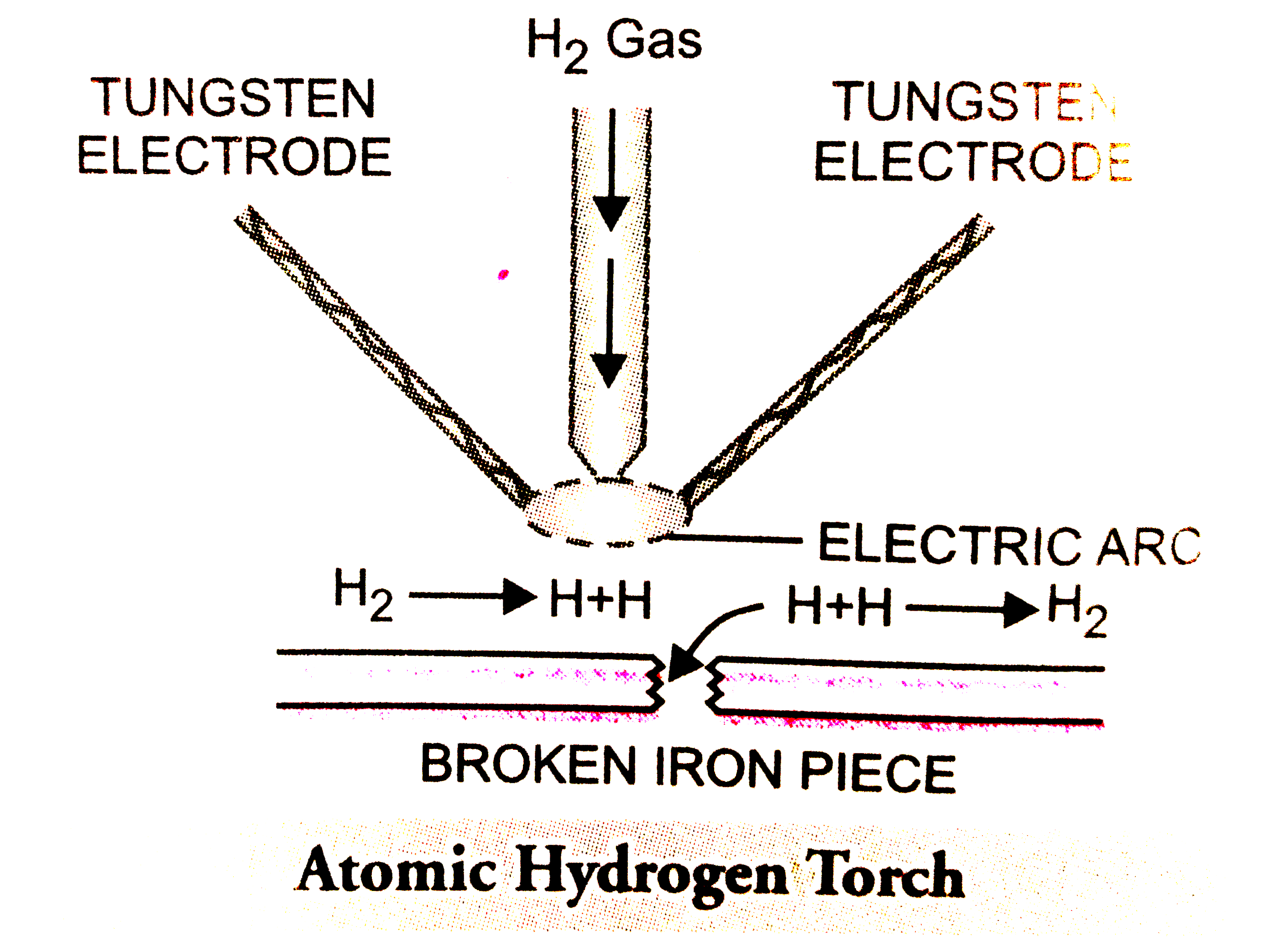
|
|
| 17. |
How does the alkali metals produce characteristic colour to the oxidising flame? |
|
Answer» Solution :The alkali metals and their salts impart characteristic colour to an oxidizing flame. This is because the HEAT from the flame EXCITES the valence electron to a higher energy level When the excited electron comes BACK to the ground STATE there is emission of radiation in the VISIBLE region. |
|
| 18. |
How does the atomic hydrogen or oxy-hydrogen torch function for cutting and welding purposes? Explain. |
| Answer» SOLUTION : When hydrogen is burnt in oxygen the reaction is highly exothermic, it produces very HIGH temperature nearly 4000°C which is used for CUTTING and welding PURPOSES. | |
| 19. |
How does the addition reaction affect the hybridisation of the substrale ? Give example . |
|
Answer» SOLUTION :During the addition REACTION the hybridisation of the substrate change (from ` sp^(2) to sp^(3)` in the addition reaction of alkenes or ` sp to sp^(2)` in the addition reaction of alkynes ) as only one bond BREAKS and two NEW bonds are formed . ` (##SUR_CHE_XI_V02_C12_E02_060_S01.png" width="80%"> |
|
| 20. |
How does sulphide and carbonates present in water toxic ? |
| Answer» Solution :Sulphide `(S^(2-))` and carbonate `(CO_3^(2))` UNDERGO ANIONIC hydrolysis to FORM weak acids `H_2S and H_2CO_3`. The pH of water increases. Water becomes alkaline and TOXIC. | |
| 21. |
How does silicon dioxide react with NaOH and HF ? |
|
Answer» Solution :(a) With NaOH : Silicon dioxide REACTS reacts with NaOH to form SODIUM SILICATE (Water glass) ` SiO_(2) + 2 Na OH overset ("HEAT") tounderset ("sodium silicate") (Na_(2) SiO_(3)) +H_(2) O` (b ) With HF : Silicon dioxide reacts with hydrogen fluoride to form silicon tetra fluoride . `SiO_(2) + 4HF to underset ("Silicon tetrafluoride ") (SiF_(4)) + 2 H_(2) O` |
|
| 22. |
How does ozone react with ethene and prop-1-ene? |
|
Answer» Solution :Ozonolysis : Ozonolysis is a method of oxidative CLEAVAGE of alkenes or alkynes using ozone and ketones. Alkenes react with ozone to form Ozonide and it is cleaved by `Zn//H_(2)O` to form SMALLER MOLECULES. This reaction is often used to IDENTIFY the structure of unknown alkene or alkyne by detecting the POSITION of double or triple bond. 
|
|
| 23. |
How does ozonolysis takes place in ethene? |
Answer» Solution :When ETHENE isadded to ozone molecule to carbon-carbon DOUBLE bond of ethene to FORM ethene ozonide. Further hydrolysis of ozonide by `H_(2)`O/Zn gives formaldehydle. 
|
|
| 24. |
How does oxygen exchanges between maternal and fetal is provided by the maternal blood in the placenta woman ? |
|
Answer» Solution : (i) In a pregnant women, the OXYGEN supply for the fetus is provided by the maternal blood in the placenta where the blood vessels of both mother and fetus are in close proximity. Both fetal and maternal hemoglobin binds to oxygen reversibly as follows. `Hb_"(mother)" + O_(2) hArr HbO_"(2 fetus )"` (ii). In the above two equilibrium, the equilibrium CONSTANT VALUE for the oxygenation of fetal hemoglobin is higher which is due to its higher affinity for oxygen compared to ADULT hemoglobin. HENCE in placenta, the oxygen from the mother.s blood is effectively transferred to fetal hemoglobin. |
|
| 25. |
How does nickel react with chloroform? |
| Answer» Solution :`underset("Chloroform")(CHCl_(3)) overset(H_(2)) underset(NI) (to) underset("Methylene chloride") (CH_(2) Cl_(2)) + HCL` | |
| 26. |
HowdoesNaBH_(4) reactwith iodine ? |
| Answer» Solution :Diboraneis produced : `2NaBH_(4) + I_(2) rarr B_(2) H_(6)+ 2Na L + H_(2)` | |
| 27. |
How does metallic character vary among group 14 elements ? How is it related to ionisation energy ? |
| Answer» Solution :Carbon and silicon are non metals . Germanium is a METALLOID and tin and lead are metals. Metallic character increases from carbon to lead . The change from non metallic to metallic character is due to the increase in atomic size from carbon to lead . CONSEQUENTLY the ionsiationpotential favouring ionic bonding especiallywith oxidation STATE +2 , whereas carbon and silicon show +4 oxidaiton state forming covalent bonding with electron SHARING. | |
| 29. |
How does Linde-Claude process to liquefy gases differ from Linde process ? |
|
Answer» The CONDENSED water is not removed. |
|
| 30. |
How does K affected for endothermic reaction if temperature is increased? |
|
Answer» |
|
| 31. |
How does ionisation enthalpy varies among group 13 elements . |
| Answer» Solution :The ionisation ENTHALPY should decrease down the group of the periodic table. However the decrease in ionisation enthalpy is sharp from boron to aluminium . This is due to the sharp increase to IMPERFECT SHIELDING effect of COMPLETELY filled 3d shell . | |
| 32. |
How does inductive effect influence the reactivity and acidity of carboxylic acids? |
|
Answer» Solution :(1) Reactivity : (i) When a highly electronegative atom such as halogen is attached to a carbon then it makes the `C-X` bond polar. (ii) In such cases the `-I` EFFECT of halogen facilitates the attack of an incoming nucleophile atthe polarized carbon and hence increases the reactivity.  (iii) If a `-i` group is attacher neared to a carbonyl carbon, it DECREASES the AVAILABILITY of electron density on the carbonyl carbon and hence increases the rate of the nucleophilic addition reaction. (2) Acidity of carboxylic acid: (i) When a halogen atom is attached to the carbon which is neared to the carboxylic acid group, its`-I` effect withdraws the bonded electrons towards itself and makes the ionization of `H^(+)` easy. (ii) The acidity of various chloro acetic acid is in the following order. `CI_(3)C-COOH gt CI_(2)CHCOOH gt CICH_(2)COOH` The strength of the acid increases with INCREASE in the -effect of the group attached to the CARBOXYL group. (iii) Similarly the following order of acidity in the carboxylic acids is due too the `+I` effect of alkyl group. `(CH_(3))_(3)CCOOH lt (CH_(3))_(2)CHCOOH lt CH_(3)COOH` |
|
| 33. |
How does hyper conjugation effect explain the stability of alkenes? |
|
Answer» Solution :(i)The relative stability of various clases of carbonium ions may be explained by the numberof no BOND resonance structures that can be written for them. (ii) Such structures are arrived by shifting the bonding ELECTRONS from an adjacent C-H bond to the electron deficient carbon. (iii) In this way, the positive charge originally on carbon is dispersed to the hydrogen. This manner of electron release by assuming no bond character in the adjaccentC-H bond is called hyper conjugation or Baker-Nathan effect. (IV) The greater the hyper conjugation, the greater will be the stability of the COMPOUND. The INCREASING order of stability can be shown as: `CH_3-CH=CH-CH_3 lt CH_3-underset(CH_3)underset(|)C=CH-CH_3 lt CH_3-underset(CH)underset(|)=underset(CH_3)underset(|)C-CH_3` (v) Alkyl group increases in the ` C=C` double bond carbon, hyper conjugation increases and stability of that organic compound also increases. |
|
| 34. |
How does hyper conjugation effect explain the stability of alkenes ? |
|
Answer» Solution :Therelative stability of various classes carbonium ions MAY be explained by the number of no bond resonance structures that can be written for them. (ii) Such structures are arrived by shifting the bonding electrons from an adjacent C-H bond to the electron deficient carbon. (iii) In this way the positive charge originally on carbon is dispersed to hydrogen. This manner of electron release by assuming no bond character in the adjacent C-H bond is called hyper conjugation or baker - Nathan EFFECT. (iv) the greater the hyper conjugation, the greater will be the stability of the compound. The increasing order of stability can be shown as : `CH_(3)-CH=CH-CH_(3)ltCH_(3)-underset(CH_(3))underset(|)(C)=CH-CH_(3)ltCH_(3)-underset(CH_(3))underset(|)(C)=underset(CH_(3))underset(|)(C)-CH_(3)` (v) Alkyl group INCREASES in the `C=C` double bond carbon, hyper conjugation increase and stability of that organic compound also increases. |
|
| 35. |
How does huckel rule jhelp to decide the aromatic character of a compound |
|
Answer» SOLUTION :A COMPOUNDIS saidto bearomaticif itobeysthe followingrules (i)Themolecule mustbe cyclic (ii)the moleculemust l be co-planar. (iii)Completedelocalisationof `pi-` electronicin the ring (iv)Presence of `(4n+ 2)pi`electrons in the ringn is aninteger`(n= 0,1,2)` THISIS knownas Hucketrule  (i)It iscyclicone(ii)it isa co- planarmolecular (ii)it hassixdelocalised`pi`electrons `(iv)4n+ 2=6` `4n= 4` `rArrn=` It obeyHucketrulewith `n=1` hencebenzeneis aromaticin nature |
|
| 36. |
How does HBr react with propene? |
|
Answer» Solution :Propene react with HBR and FOLLOWS Markovnikov.s rule . `CH_(3)- underset("Propene")(CH) = CH_(2) + HBr to underset("2- Bromopropane") (CH_(3)- underset(Br)underset(|)(C)H- CH_(3))` |
|
| 37. |
How does H_(2)O_(2) differ from O_(3) in its chemical action? |
|
Answer» In OXIDISING PbS to `PbSO_(4)` |
|
| 38. |
How does H_(2)O_(2) reduces iodine in reducing property ? |
|
Answer» Solution :`H_(2)O_(2)"REDUCES"I_(2)"to IODIDE ion"(I^(-))` in basic medium. `I_(2)+H_(2)O_(2)+2OH^(Theta)to2I^(Theta)+2H_(2)O+O_(2)` |
|
| 39. |
How does H_(2)O_(2) behave as a bleaching agent ? |
|
Answer» Solution :The bleaching action of `H_(2)O_(2)` is due to the nascent oxygen which it LIBERATES on decomposition. `H_(2)O_(2)to H_(2)O + O` The nascent oxygen combines with colouring matter which, in turn gets oxidised . THUS, the bleaching action of `H_(2)O_(2)` is due to the OXIDATION of colouring matter by nascent oxygen. It is USED for the bleaching of delicate materials like ivory, feather, SILK, wool, etc. |
|
| 40. |
How does H_(2)O_(2) behave as bleaching agent? |
|
Answer» SOLUTION :BLEACHING ACTION of `H_2O_2` is DUE to the oxidation of colouring matter by NASCENT oxygen. `H_2O_(2(l))toH_2O_((l))+O((g))` |
|
| 41. |
How does H_2O_2 behave as a bleaching agent ? |
|
Answer» Solution :(i) In daily life it is used as a hair bleach and as a mild disinfectant. As an antiseptic it is sold in the market as perhydrol. (ii) It is used to manufacture chemicals like sodium perborate and per-carbonate, which are used in high quality detergents. (iii) It is used in the synthesis of hydroquinone, tartaric ACID and certain food products and pharmaceuticals (cephalosporin) etc. (iv) It is employed in the industries as a bleaching agent for textiles, paper pulp, LEATHER, oils, fats, etc. (v) Nowadays it is also used in Environmental (Green) Chemistry. For example, in POLLUTION control treatment of domestic and industrial EFFLUENTS, oxidation of cyanides, RESTORATION of aerobic conditions to sewage wastes, etc. |
|
| 42. |
How does fluorine reacts with water in a non metal redox reaction? |
| Answer» Solution :More REACTIVE ELECTRONEGATIVE NON metals can displace LESS reactive non metals, Fluorine displaces dioxygen from WATER. `2F_2+2H_2Oto4HF+O_2` | |
| 43. |
How does entropy vary when external pressure is less than internal pressure of the gaseous system ? |
| Answer» Solution :In a gaseous SYSTEM . When external pressure is less than the internal pressure , the GAS EXPANDS SPONTANEOUSLY and the volume increases . Thereby increasing the DISORDERLINESS of gas molecules Hence entropy increase in such a system . | |
| 44. |
How does entropy change with (i) increase in temperature, (ii) decrease in pressure? |
|
Answer» SOLUTION :Entropy (i) increases with increases in TEMPERATURE. (ii) increases with DECREASE of PRESSURE(for gases). |
|
| 45. |
How does electron deficient compound BF_(3)achieveelectronic saturation i.e., fully occupied outer electron shells ? |
|
Answer» SOLUTION :By thefollowing two WAYS (i) Multiple bonding of `ppi-ppi`back bonding , e.g.,`BF_(3)`in which a lone pairof electrons present in `2p-`orbital of one of the fluorine atoms may betransferred to the vacantp-orbital one the boron atom. (II) Formation of COMPLEXES in which electronsare RECEIVED from a donor molecule e.g., `F_(3)Brarr NH_(3)`. Boron compounds, thus,behavesas Lewis acids. |
|
| 46. |
How does electron affinity change when we move from left to right in a period in the periodic table ? |
|
Answer» GENERALLY INCREASES |
|
| 47. |
How does diborane react with water ? |
|
Answer» SOLUTION :Diborane undergoes hydrolysis on reacting WIRTH water with liberation of hydrogen gas and boric ACID is formed . `B_(2)H_(6(g)) +6H_(2)O_((I)) to underset("boric acid") (2 H_(3)BO_(3("aq"))) +6H_(2(g))` |
|
| 48. |
How does diazonium salt (C_(6)H_(5)N_(2)^(+)Cl^(-)) decompose ? |
| Answer» Solution :both a & b | |
| 49. |
How does Cu_2O act as both oxidant and redcutant ? Explain with proper reactions showing the change of oxidation number in each case. |
|
Answer» Solution :In `Cu_2O` , COPPER is in +1 `(CU^(+))` oxidation state and it undergoes disproportionation to form `Cu and Cu^(2+)` as : `2Cu^(+)(aq)rarrCu(s)+Cu^(2+)(aq)` THUS, `Cu^(+) ` or `Cu_2O` acts both as an oxidant as WELL as a reluctant. For example, (i) When HEATED in air , `Cu_2O` is oxidised to CuO. `overset(+1"")(Cu_2O)+1/2O_2rarroverset(+2"")(2CuO)` Thus, `Cu_2O` acts as a reluctant and reduces `O_2` to `O^(2-)`. (ii) When heated with `Cu_2S` , it oxidises `S^(2-) " to " SO_2` and hence `Cu_2O` acts as an oxidant. `overset(+1"")(2Cu_2O)+overset(+1"")(Cu_2S)rarroverset(0"")(6Cu)+SO_2` |
|
| 50. |
How does Cu_(2)O acts as both oxidant and reductant ? Explain with proper reaction showing the change of oxidation number in each example |
Answer» Solution :`Cu^(+)` undergoes disproportination to form `Cu^(2+)` and Cu  Here `Cu^(2+) to Cu^(2+) therefore Cu^(+)` ACTS an OXIDANT Again `Cu^(+) "reduces" Cu^(+) "to" Cu therefore Cu^(+)` acts as a reductant THUS `Cu^(+) or Cu_(2)O` acts both as an oxidatn as well as a reductant (i)`Cu_(2)O` acts in AIR `Cu_(2)O` is oxidised to `CuO,Cu_(2)O + 1//2 O_(2) rarr 2CuO` (ii) When HEATED with `Cu_(2)S` it oxidises `S^(2-)` to `SO_(2)` and hence `Cu_(2)O` acts as an oxidant `2 Cu_(2)O+Cu_(2) rarr 6Cu+SO_(2)` |
|