Saved Bookmarks
This section includes 7 InterviewSolutions, each offering curated multiple-choice questions to sharpen your Current Affairs knowledge and support exam preparation. Choose a topic below to get started.
| 1. |
(I) CH_(3)-CH_(2)-CH_(2)-CH_(2)- overset(overset(O)(||))(C )-H (II) CH_(3)-CH_(2)-CH_(2)- overset(overset(O)(||))(C )-CH_(3) (III) CH_(3)-CH_(2)- underset(underset(O)(||))(C )-CH_(2)-CH_(3) (IV) CH_(3)- underset(underset(CH_(3))(|))(C )H-CH_(2)- underset(underset(O)(||))(C )-H Which of the following pairs are not functional group isomers? |
|
Answer» II and III (IV) `CH_(3)-underset(underset(CH_(3))(|))(C )H-CH_(2)-underset(underset(O)(||))(C )-H` is aldehyde but, (II) and (IV) are not positionisomer but they are GROUP isomers. (D) (I) `CH_(3)-CH_(2)-CH_(2)-CH_(2)-overset(overset(O)(||))(C )-H` is aldehyde. (II) `CH_(3)-CH_(2)-CH_(2)-overset(overset(O)(||))(C )-CH_(3)` is ketone. Both are group isomer. (III) and (IV) are not position isomer (A) (II) `CH_(3)-CH_(2)-CH_(2)- overset(overset(O)(||))(C )-CH_(3)` is ketone (III) `CH_(3)-CH_(2)-underset(underset(O)(||))(C )-CH_(2)-CH_(3)` is ketone Both are same 5 carbon containing ketone so they are position isomer, but not group isomer. (C ) (I) and (IV) both are aldehyde but not position isomers. The branch is PRESENT in (I), so (I) and (IV) not taken as position isomer. Inshort, (I) Aldehyde (II) Ketone (III) Ketone (IV) Aldehyde (A) II, III- They are not group isomers (B) II, IV- They are group isomers (C ) I, IV- They are not group isomers (D) I, II- They are not group isomers |
|
| 2. |
I. CH_(3)-CH_(2)-CH_(2)-CH_(2)-overset(O)overset(||)(C)-H II. CH_(3)-CH_(2)-CH_(2)-overset(O)overset(||)(C)-CH_(3) III. CH_(3)-CH_(2)-underset(O)underset(||)(C)-CH_(2)-CH_(3) IV. {:(CH_(3)-CH-CH_(2)-C-H),("|""||"),(""CH_(3)""O):} Which of the following pairs are position isomers ? |
|
Answer» I and II |
|
| 3. |
(I) CH_(3)-CH_(2)-CH_(2)-CH_(2)-OH (II) CH_(3)-CH_(2)-underset(underset(OH)(|))(C H)-CH_(3) (III) CH_(3)- underset(underset(OH)(|))overset(overset(CH_(3))(|))(C )-CH_(3) (IV) CH_(3)- underset(underset(CH_(3))(|))(C H)-CH_(2)-OH (V ) CH_(3)-CH_(2)-O-CH_(2)-CH_(3) (VI) CH_(3)-O-CH_(2)-CH_(2)-CH_(3) (VII) CH_(3)-O- underset(underset(CH_(3))(|))(C H)-CH_(3) Identify the pairs of compounds that represents chain isomerism |
|
Answer» Solution :The POSSESS same GROUP but different CARBON chain. (I) `underset("Butan-1-ol")(CH_(3)-CH_(2)-CH_(2)-CH_(2)-OH)` (II) `underset("2-methyl prop-2-ol")(CH_(3)-underset(underset(OH)(|))overset(overset(CH_(3))(|))(C )-CH_(3))` (II) `underset("Butan-2-ol")(CH_(3)-CH_(2)-underset(underset(OH)(|))(C H)-CH_(3))` (IV) `underset("2-methyl-propan-1-ol")(CH_(3)-underset(underset(CH_(3))(|))(CH)-CH_(2)-OH)` |
|
| 4. |
(I) CH_(3)-CH_(2)-CH_(2)-CH_(2)-OH (II) CH_(3)-CH_(2)-underset(underset(OH)(|))(C H)-CH_(3) (III) CH_(3)- underset(underset(OH)(|))overset(overset(CH_(3))(|))(C )-CH_(3) (IV) CH_(3)- underset(underset(CH_(3))(|))(C H)-CH_(2)-OH (V ) CH_(3)-CH_(2)-O-CH_(2)-CH_(3) (VI) CH_(3)-O-CH_(2)-CH_(2)-CH_(3) (VII) CH_(3)-O- underset(underset(CH_(3))(|))(C H)-CH_(3) Identify the pairs of compounds that represents position isomerism |
|
Answer» SOLUTION :In these, there are functional group same but the position of functional group is different. (I) and (II) are position isomers. (I) `underset("Butan-1-ol")(CH_(3)-CH_(2)-CH_(2)-CH_(2)-OH)` (II) `underset("Butan-2-ol")(CH_(3)-CH_(2)-underset(underset(OH)(|))(C H)-CH_(3))` In the following same function group present in both but the carbon CHAIN is different so, they are chain ISOMER (III) `underset("2-methyl prop-2-ol")(CH_(3)-underset(underset(OH)(|))overset(overset(CH_(3))(|))(C )-CH_(3))` (IV) `underset("2-methyl-propane-2-ol")(CH_(3)-underset(underset(CH_(3))(|))(CH)-CH_(2)-OH)` (VI) and (VII) both are ether but carbon chain is different so, (VI) and (VII) are chain isomers. (VI) `underset("Methoxy propane")(CH_(3)-O-CH_(2)-CH_(2)-CH_(3))` (VII) `underset("Methoxy isopropane")(CH_(3)-O-underset(underset(CH_(3))(|))(CH)-CH_(3))` |
|
| 5. |
(I) CH_(3)-CH_(2)-CH_(2)-CH_(2)-OH (II) CH_(3)-CH_(2)-underset(underset(OH)(|))(C H)-CH_(3) (III) CH_(3)- underset(underset(OH)(|))overset(overset(CH_(3))(|))(C )-CH_(3) (IV) CH_(3)- underset(underset(CH_(3))(|))(C H)-CH_(2)-OH (V ) CH_(3)-CH_(2)-O-CH_(2)-CH_(3) (VI) CH_(3)-O-CH_(2)-CH_(2)-CH_(3) (VII) CH_(3)-O- underset(underset(CH_(3))(|))(C H)-CH_(3) Identify the pairs of compounds which are functionat grop isomers |
|
Answer» Solution :In these group isomes, the molecular formula are same but finctional group is different `{:((I)and (V)),((I) and (VI)),((I) and (VII)):}}` are alcohol and ether respectively `{:((II)and (V)),((II) and (VI)),((II) and (VII)):}}` are alcohol and ether respectively `{:((III)and (V)),((III) and (VI)),((III) and (VII)):}}` are alcohol and ether respectively These all ISOMERS of `C_(4)H_(10)O` CONTAINING alcohol or ether functional group |
|
| 6. |
(I) CH_(3)-CH_(2)-CH_(2)-CH_(2)-OH (II) CH_(3)-CH_(2)-underset(underset(OH)(|))(C H)-CH_(3) (III) CH_(3)- underset(underset(OH)(|))overset(overset(CH_(3))(|))(C )-CH_(3) (IV) CH_(3)- underset(underset(CH_(3))(|))(C H)-CH_(2)-OH (V ) CH_(3)-CH_(2)-O-CH_(2)-CH_(3) (VI) CH_(3)-O-CH_(2)-CH_(2)-CH_(3) (VII) CH_(3)-O- underset(underset(CH_(3))(|))(C H)-CH_(3) Which of the above compounds form pairs of metamers? |
|
Answer» Solution :`{:((V) UNDERSET("Ethoxy ethane")(CH_(3)-CH_(2)-O-CH_(2)-CH_(3))),((VI) underset("Methoxy propane")(CH_(3)-O-CH_(2)-CH_(2)-CH_(3))):}}` Metamers `{:((VI) underset("Methoxy propane")(CH_(3)-O-CH_(2)-CH_(2)-CH_(3))),((VII) underset("Methoxy isopropane")(CH_(3)-O -underset(underset(CH_(3))(|))(CH)-CH_(3))):}}` Metamers The position of `-O-` is changed in (V) ethoxy ETHENE and (VI) Methoxy propane, so they are metamers In (VI) Methoxy propane and (VII) Methoxy isopropane the different in the no. of carbon on the either side of ether `-O-` |
|
| 7. |
(i) Carbon possess sp^(2) hybridisation in carbocation. (ii) Carbon possess sp^(3) hybridisation in carbocation. (iii) Carbocation is formed by homolytic fission of bond (iv) Carbocation are very stable |
| Answer» SOLUTION :`(i-T), (ii-F), (iii-F), (iv-T), (v-F)` | |
| 8. |
(i) Can a Vandrewaal's gas with a=0 be liquefied? Explain (ii) Deep sea divers ascend slowly and breath continuously by time they reach the surface. Give reason ? |
|
Answer» Solution :(i) 1. a=0 for a van der waals gas for a real gas. Van der waals constanta=0. It cannot be liquefied. 2 If a=0, there is a very less interaction between the molecules of gas. 3. "a" is the MEASURE of strength of Van der waals force of attractionbetween the molecules of the gas . 4. If a is equal to zero, the van der waals force of attraction is very less and the gascannot be liquefied. (ii)1. For every 10 m of depth a diver experiences an addtional 1 atm of pressure due to the WEIGHT of water SURROUNDING him. 2. At 20m, the diver ecperiences a total pressure of 3atm. So the most important RULE in diving is never hold breath. 3. Divers ,ust ascend slowly and breath continously allowing the regulator to bring the air pressure in their lungs to 1 atm by the time they reach the surface. |
|
| 9. |
(i) Calculate the totalnumberof electronpresentin onemoleof method (ii) Find(a ) thetotalnumberand ( b)the totalthat mass of neutron= 1.675 xx 10^(27)kg (iii) Find(a ) the totalnumberand ( b) the totalmass ofprotonsin 34of NH_(3) at STP Willthe answerchangeif thetemperatureand pressureare changed ? |
|
Answer» Solution :(i) Electronof 1 moleculeof `CH_(4)`methane = (oneof C+fourof H ) = 6 + 4 =10electron 6.022 `XX 10^(23) = (6.022 xx 10^(23) xx 10)/( 1)` `=6.022xx 10^(24) `ELECTRON `//` mole (II) (a )weight1 MOLEOF `.^(14)C` =14 GM numberof atomcarbon = 14 `=(7xx 10^(4))/(14) xx 6.022xx 10^(23)` (iii)Molecular mass of`NH_(3) - 14 _ 3` 34 mg = 34`xx 10^(-3) gm NH_(3)` |
|
| 10. |
(i) Calculate the uncertainty in the position of an electron, if the uncertainty in its velocity is 5.7 xx 10^5 "ms"^-1 (ii) What is the mass of glucose (C_6H_(12)2O_6) in it one litre solution hich is isotonic with 6 gl-^(-1) of uren (NH_2CONH_2)? |
|
Answer» Solution :(i) Uncertainty in VELOCITY `= Delta v = 5.7 xx 10^5 MS^(-1)` MASS of an electron `=m= 9.1 xx 10^(-31)` kg Uncertainty in position `= Delta x = ?` `Delta x. m. Delta v= (h)/(4pi)` `Delta x= (h)/(m. Delta v xx 4 PI) = (6.626 xx 10^(-34))/(9.1 xx 10^(-31) xx 5.7 xx 10^5 xx 4 pi)` `Delta x= (6.626 xx 10^(-34))/(9.1 xx 10^(31-) xx 5.7 xx 10^5 xx 4 xx 3.14) ` `= 0.010 xx 10^(-8) = 1 xx 10^(-10) m` Uncertainity in position `= 1 xx 10^(10)` m (ii) Osmotic pressure of urea solution `(pi_1) = CRT` `= (W_2)/(M_2V)RT = (6)/(60 xx 1) xx RT` Osmotic pressure of glucose solution `(pi_2) = (W_2)/(180 xx 1) xx RT` For isotomic solution `pi_1 = pi_2` `6/60RT = (W_2)/(180) RT RARR W_2 = 6/20 xx 180` |
|
| 11. |
(i) Calculate the total number of electrons present in one mole of methane (ii) Find (a) the total number and (b) the total mass of neutrons in 7 mg of .^(14)C (Assume that the mass of neutron = 1.675 xx 10^(-27) kg) (iii) Find (a) the total number and (b) the total mass of protons in 34 mg of NH_(3) at S.T.P. (Assume the mass of proton = 1.6726 xx 10^(-27) kg) Will the answer change if temperature and pressure are changed ? |
|
Answer» Solution :(i) 1 molecule of `CH_(4)` CONTAINS electrons `= 6 + 4 = 10` `:.` 1 mole, i.e., `6.022 xx 10^(23)` molecules will contain electrons `= 6.022 xx 10^(24)` (ii) (a) 1 G atom of `.^(14)C = 14g = 6.022 xx 10^(23)` atom `= (6.022 xx 10^(23)) xx 8` neutrons (as each `.^(14)C` atom has `14 - 6 = 8` neutrons) Thus, 14g or 14000 mg have `8 xx 6.022 xx 10^(23)` neutrons `:.` 7 mg will have neutrons `= (8 xx 6.022 xx 10^(23))/(14000) xx 7 = 2.4088 xx 10^(21)` (b) Mass of 1 neutrons `= 1.67 xx 10^(-27) KG` `:.` Mass of `2.4088 xx 10^(-21)` neutrons `= (2.4088 xx 10^(21)) (1.67 xx 10^(-27) kg) = 4.0347 xx 10^(-6) kg` (iii) (a) 1 mol of `NH_(3)` = 17 g `NH_(3) = 6.022 xx 10^(23)` molecules of `NH_(3)` `= (6.022 xx 10^(23)) xx (7 +3)` protons `= 6.022 xx 10^(24)` protons `:.` 34 mg i.e., `0.034 g NH_(3) = (6.022 xx 10^(24))/(17) xx 0.034 = 1.2044 xx 10^(22)` protons (b) Mass of one proton `= 1.6726 xx 10^(-27) kg` `:.` Mass of `1.2044 xx 10^(22)` protons `= (1.6726 xx 10^(-27)) xx (1.2044 xx 10^(22)) kg = 2.0145 xx 10^(-5) kg` There is no effect of temperture and pressure. |
|
| 12. |
(i) Calculate the number of electrons which will together weight one gram. (ii) Calculate the mass and charge of one mole of electrons |
|
Answer» SOLUTION :(i) Mass of one electron `= 9.11 xx 10^(-31) kg, " i.e., " 9.11 xx 10^(-31) kg = 1` electron `:. 1 g " i.e., " 10^(-3) kg = (1)/(9.11 xx 10^(-31)) xx 10^(-13)` ELECTRONS = `1.098 xx 10^(27)` electrons (ii) Mass of one electron `= 9.11 xx 10^(-31) kg` `:.` Mass of one MOLE of electrons `= (9.11 xx 10^(-31)) xx (6.022 xx 10^(23)) = 5.486 xx 10^(-7) kg` Charge on one electron `= 1.602 X 10^(-19)` coulomb `:.` Charge on one mole of electrons `= (1.602 xx 10^(-19)) xx (6.022 xx 10^(23)) = 9.65 xx 10^(4)` coulombs |
|
| 13. |
(i) Calculate the numberof electronswhichwilltogetherweigh onegram (ii)Calculatethemass andchargeof onemoleof electron . |
|
Answer» Solution :Massof 1 ELECTRON= 9.11`xx 10^(10)kg` `9.11 xx 10^(28) kg` CHARGEOF 1electron= 1.602`xx 10^(19) C` 1 mole=6.02`xx 10^(23)` (i) 9.11 `xx10^(31) kg `electron= 1 electron `(0.001 kg xx 1)/(9.11 xx 10^(31) kg) = (0.001 xx 10^(4))/(9.11 xx 10^(27))` (ii)Charge of 1 moleelectron `=1.602 xx 10^(19)c xx 6.022xx 10^(23)` `=96470 C ` charge= 9.647`xx 10^(4)` C mass of 1 moleelectron `=5.486xx 10^(7)kg =5.486 xx 10^(4) gamma ` |
|
| 14. |
(I) [Borax powder] overset("Heated")underset("strongly")rarr ubrace('A'+'B')_("Transparent glassy bead")+H_(2)O (II) B +CuO overset(Delta)rarr 'C' (Blue mass) (III) A +'C' +C ("coke") overset(Delta)rarr 'D' + 'E' +CO (uarr) The correct statement about step-(III) is/are: |
|
Answer» The COLOURED copper compound [C} may be reduced to colourless copper (I) metaborate. |
|
| 15. |
(I) [Borax powder] overset("Heated")underset("strongly")rarr ubrace('A'+'B')_("Transparent glassy bead")+H_(2)O (II) B +CuO overset(Delta)rarr 'C' (Blue mass) (III) A +'C' +C ("coke") overset(Delta)rarr 'D' + 'E' +CO (uarr) Compound 'C' may be: |
| Answer» Answer :A | |
| 16. |
I. Bleaching action of H_(2)O_(2) is its oxidising property II. H_(2)O_(2) oxidises benezene to phenol in the presence of Fenton's reagent III. Hydrogen gas is evolved if H_(2)O_(2) oxidises formaldehyde to formic acid IV. H_(2)O_(2) gives red colouration with ethereal solution of acidified K_(2)Cr_(2)O_(7) Then the incorrect statements is // are |
| Answer» Answer :A | |
| 17. |
(i) Beryllium halides are covalent whereas magnesium halides are ionic. Why? (ii) What happens when 1. Sodium metal is dropped in water? 2. Sodium metal is heated in free supply of air? 3. Sodium peroxide dissolves in water? |
|
Answer» Solution :(i) Beryllium ion `(Be^(2+))` is smaller in SIZE and it is involved in equal sharing of electrons with HALOGENS to form covalent bond, WHEREAS magnesium ion `(Mg^(2+))` is bigger and it is involved in TRANSFER of electrons to form ionic bond. (ii) 1.` 2Na+2H_(2)O+2NaOH+H_(2)` 2. `2Na+O_(2)toNa_(2)O_(2)` 3. `Na_(2)O_(2)+2H_(2)Oto2NaOH+H_(2)O_(2)` |
|
| 18. |
(i) Balnce the following equations by ion electron method. KMnO_(4) + SnCl_(2) + HCl rarr MnCl_(2) + SnCl_(4) + H_(2)O + KCl (ii) Boric acid, H_(3)BO_(3) is a mild antiseptic and often used as eye wash. A sample contains 0.543 mol H_(3)BO_(3). What is the mass of boric acid in the sample? |
|
Answer» Solution :(i) `KMnO_(4) + SnCl_(2) + HCl RARR MnCl_(2) + SnCl_(4) + H_(2)O + KCl` Oxidation half reaction: (loss of electrons) `overset(+2)(SnCl_(2)) rarr overset(+4)(SnCl_(4)) + 2e^(-)` ....(1) Reduction half reaction: (gain of electrons) `overset(+7)(KMnO_(4)) + 5e^(-) rarr overset(+2)(MnCl_(2))` ....(2) Add `H_(2)O` to balance oxygen atoms. `KMnO_(4) + 5e^(-) rarr overset(+2)(MnCl_(2)) + 4H_(2)O` ....(3) Add HCl to balance hydrogen atoms. `KMnO_(4) + 5e^(-) + 8HCl rarr MnCl_(2) + 4H_(2)O` ....(4) To equalize the number of electrons equation `(1) xx 5` and equation `(2) xx 2` `5SnCl_(2) rarr 5SnCl_(4) + cancel(10e)` `2KMnO_(4) + 16HCl + cancel(10e) rarr 2MnCl_(2) + 4H_(2)O + 2KCl` `2KMnO_(4) + 5SnCl_(2) + 16HCl rarr 5SnCl_(4) + 2MnCl_(2) + 4H_(2)O + 2KCl` (II) Molecular MASS of `H_(3)BO_(3)` = `(1 xx 3) + (11 xx 1) + (16 xx 3) = 62` Boric acid sample contains 0.543 mole. Mass of 0.543 mole of Boric acid = Molecular mass `xx` mole = `62 xx 0.543` = 33.66 g |
|
| 19. |
(I) Arrange the compounds (a0 in the order of decreasing boilling points and (b) in the order of decreasing solubility in water (A) (1) Ethanol (2) Propane, (3) Pentanol (B) (1) Butane (2) 1,2,3-Pentanetriol (3) Buty1 alcohol (C ) Pentane (2) Pentanol (3) Hexanol (II) Arrange the following in the decreasing order of their boilling points (A) (1) C_(3)H_(8) (2) C_(2)H_(5)OH , (3) (CH_(3))_(2)O (4) HOH_(2)C-CH_(2)OH (B) (1) 3-Pentanol, (2) n-Pentane, (3) 2,2 Dimethyl propanol, (4) n-pentanol (III) Arrange the following alcohols (a) in the decreasing order of their boiling points and (b) in the decreasing order of their boilling points and (b) in the decreasing order of their solubility in water (1) n-Buty1 alcohol (2) sec-Buty1 alcohol and (3) tert Buty1 alcohol (IV) Arrange the following compounds in the order their increasing boiling points (1) CH_(3)COCI,(2)(CH_(3)CO)_(2)O,(3) CH_(3)CONH_(2),(4)CH_(3)COOH . |
|
Answer» Solution :(a) The decreasing order of boiling points is Pentanol gt Ethanol gt Propane `(3gt1gt2)` Pentanol and ethanol have I have H-bonding, but molecular mass of pentanol is more than ethanol, so it has high boiling point Propane has the least boiling point due to non-polar character and weak van der Waals forces of attrction (b) The decreasing order of solubility in `H_(2)O` is Ethanol gt Petanol gt Propane `(1 gt 3 gt 2)` Both ethanol and pentanol have H-bonding but non polar part in pentanol is LARGER than non polar part in ethanol So ethanol is more soluble in `H_(2)O` than pentanol Propane is least soluble because of the non-polar character (B) The decreasing order of boiling point is 1,2,3-Pentanetriol gtButy1 alcoholgt Butane `(2gt3 gt1)` Due to three `(HO)` groups in compound (2) it has more H-bonding than in alcolhol (3) (b)Decreasing solubility in `H_(2) O: (2) gt(3) gt(1)` There is more H-bonding in compound (2) han in (3) hence it has more solubility in `H_(2)O` (C) The decreasing order of boiling point is Hexanol gt Pentanol gtPentane `(3gt2gt1)` Both alcohols have same H-bonding, but molecular mass of `(3)gt(2)` Hence the boiling point order is as given above (b) The decreasing order of solubility in `H_(2)O` PentanolgtHexanolgtPentane [Same explanation as in I (A) (b) above] (II) The decreasing order of boiling point is `HOCH_(2)-CH_(2)OHgtC_(2)H_(5)OHgt(CH_(3))_(2)OgtC_(2)H_(8)(4gt2gt3gt1)` (Same explanation as I (B) (a) above) (II) The decreasing order of boiling point is n -pentanol gt2,2 Dimethy1 propanol Alcohols n-pentanol is a straight-chain compound and has a larger surface area, so the highest boiling point Alcohol (3) is more sterically hindered than alcohol (1) hence it requires more energy to BOIL off Therefore boiling point of alcohol (3)gt alcohol (1) The decreasing order of boiling points is All alcohols have H-bonding but alcohol (1) has more surface area Alcohol (2) has less surface area due to branching and alcohol (3) has more breanching and less surface area than in alcohol (2) Hence the boiling point order is as given above Decreasing solubility order in `H_(2)O` t-Buty1 alcocholgtsec-Buty1 alcoholgtn-Buty1 alcohol `(3gt2gt1)` Lesser the surface area, greater is the solubility in `H_(2)O` Hence the solubility order is as given above (IV) `CH_(3)COOH` undergoes intermolecular H-bonding while `CH_(3)COCI` does not The boiling point of `CH_(3)COOH` in higher than that of `CH_(3)COCI` The molecular mass of `(CH_(3)CO)_(2)O` is much higher than that of `CH_(3)COOH` As a RESULT `(CH_(3)CO)_(2)`O has a higher boiling point than that of `CH_(3)COOH` due to stroger van der Waals forces of attraction Like `CH_(3)COOH,CH_(3)CONH_(2)` also forms intermolecular H-bonds whereas in `CH_(3)COOH` only cyclic DIMERS are formed In `CH_(3)CONH_(2)` intermolecular H-bonds lead to the association of a number of molecules. As a result, the boiling point of `CH_(3)CONH_(2)` is much higher than that of `CH_(3)COOH` Further, this higher degree of association of `CH_(3)CONH_(2)` molecules compensates for the effect of increased molecular size of `(CH_(3)CO)_(2)O` Consequently, boiling point of `CH_(3)CONH_(2)` is even higher than that of `(CH_(3)CO)_(2)O` . In ther words, the boiling points follows the sequence `CH_(3)COCI lt CH_(3)COOH lt (CH_(3)CO)_(2)O lt CH_(3)CONH_(2)` 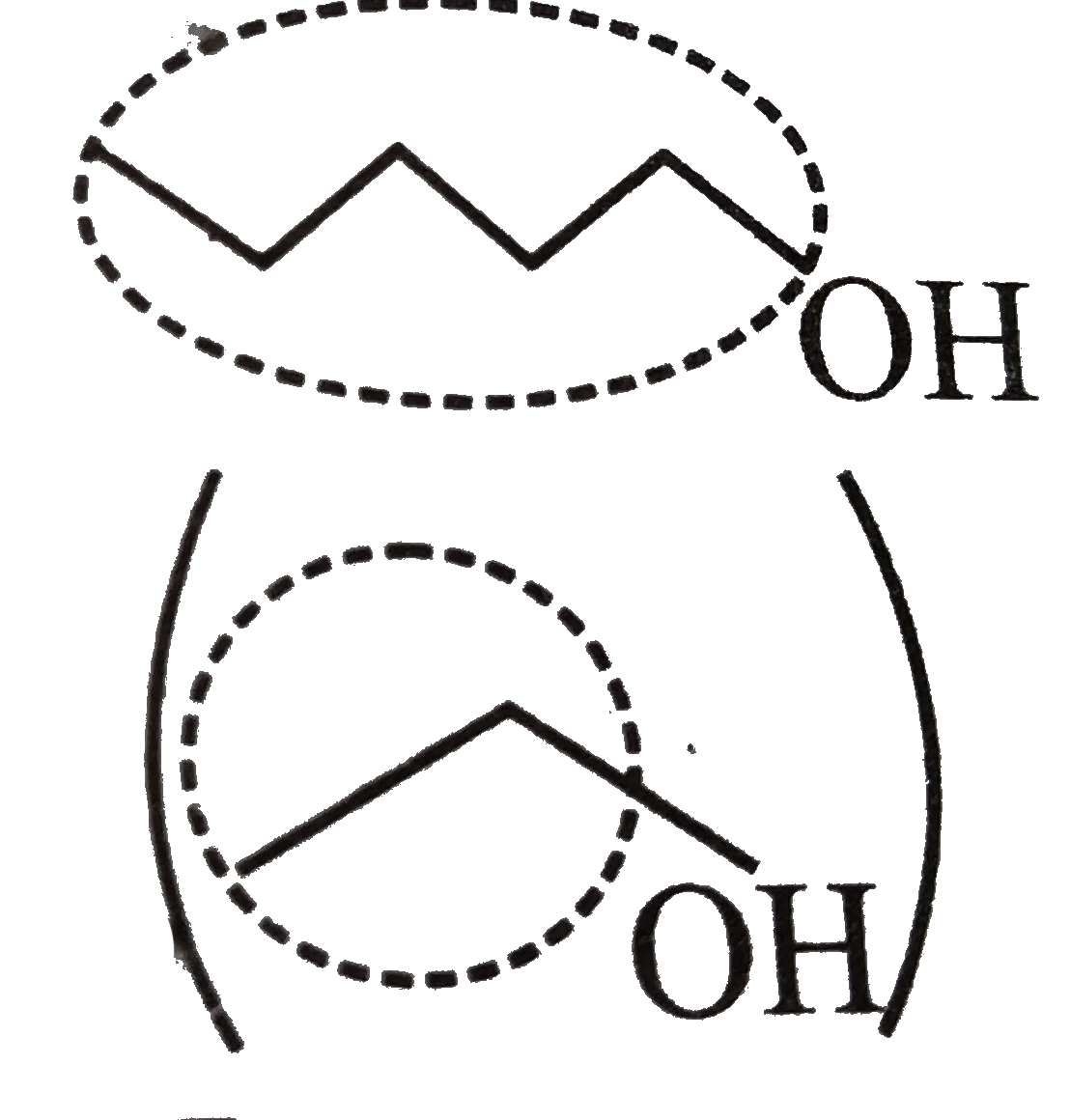 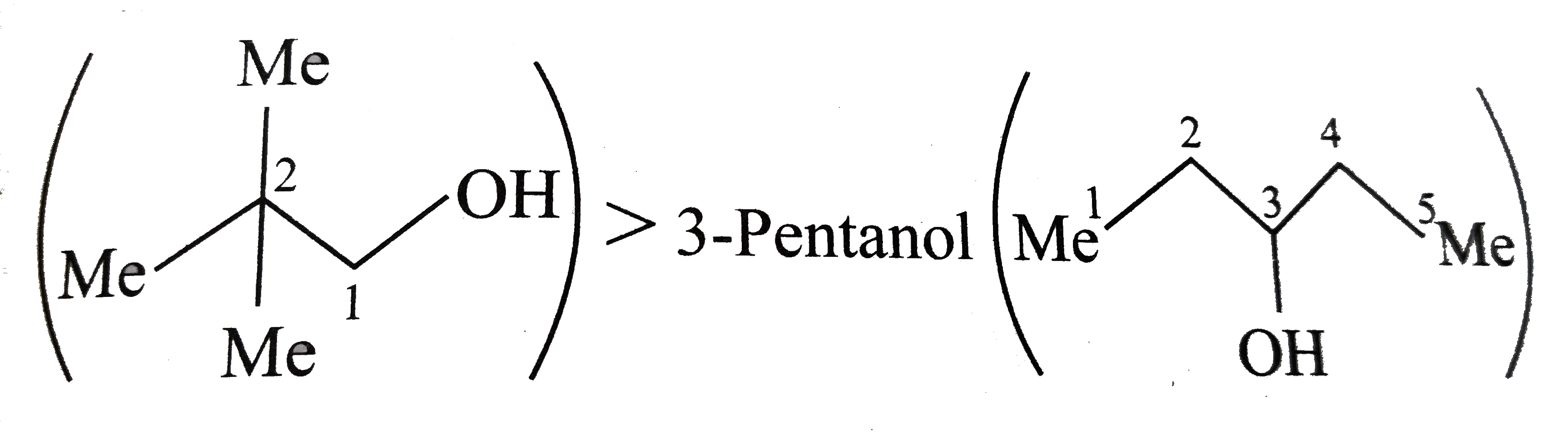 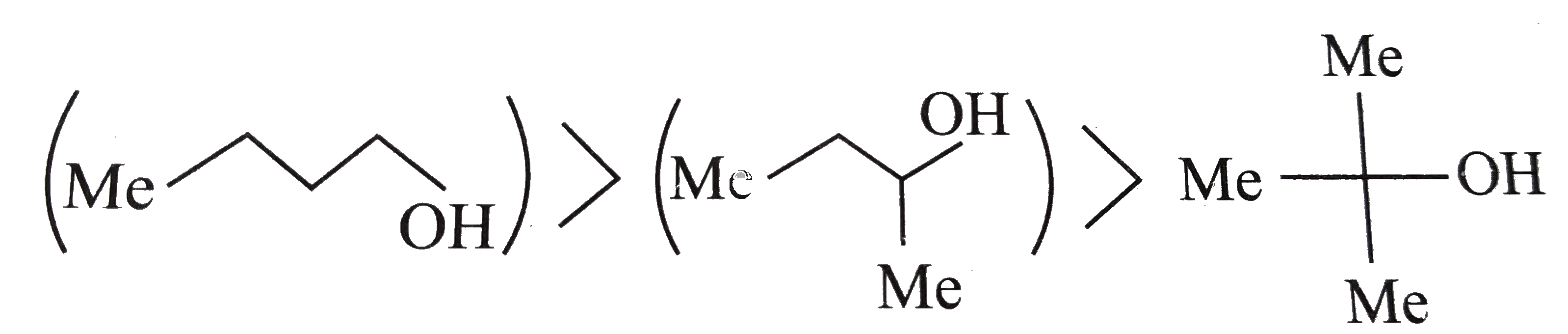 . .
|
|
| 20. |
(i) Arrange NH_(3)H_(2)O and HF in the order of increasing magnitude of hydrogen bonding and explain the basis for your arrangement. (ii) Can we use concentrated sulphuric acid and pure zinc in the preparation of dihydrogen? |
|
Answer» Solution :(i) 1. Increasing magnitude of HYDROGEN bonding among `NH_(3),H_(2)O` and HF is `HF>H_(2)O>NH_(3)` 2. The EXTENT of hydrogen bonding depends upon electronegativity and the number of hydrogen atoms available for bonding. 3. Among N, F and the increasing order of their electronegativities are N (ii) Conc. `H_(2)SO_(4)` cannot be USED because it acts as an oxidizing agent also and gets reduced to `SO_(2)`. `Zn+2H_(2)SO_(4)(Conc.)toZnSO_(4)+2H_(2)O+SO_(2)` Pure Zn is not used because it is non-porous and reaction will be slow. The impurities in Zn help in constitute of electrochemical couple and speed up reaction. |
|
| 21. |
(i) Aniline is become polar in its resonance structure. (ii) The separation of charge occurs in the resonance structure of aniline. (iii) The NH_(2) group of aniline is a electron donating. (iv) The NH_(2) group of aniline is a electron attracting in resonance (-R) |
| Answer» SOLUTION :`(i-T), (ii-T), (iii-T), (iv-F)` | |
| 22. |
(i) An organic compound (A) of a molecular formula C_(2)H_(4) which is a simple allllllklene. A reacts with dil H_(2)SO_(4) to give B. A again reacts with Cl_(2) to give C. A,B and C and write the equations. (ii) Why chloro acetic acid is stronger acid than acetic acid? |
|
Answer» Solution :(B) (i) 1 `C_(2)H_(4) " is " CH_(2)=CH_(2)` is a simple ALKENE. A is ethylene. 2. Ethylene (A) reacts with dil `H_(2)SO_(4)` to give ethanol (B) `UNDERSET("Ethylene" (A))(CH_(2)CH_(2)) overset(dil H_(2)SO_(4))rarr CH_(3) - underset("ethanol"(B))(CH_(2) - OH)` 3. Ethylene (A) reacts with `Cl_(2)` to GIVEN 1,2 dichloro ethane (C) `underset(underset(A)(("Ethylene")))(CH_(2) = CH_(2)) overset(Cl_(2))rarr underset(("1,2-dichloro ethene)(C)"))(underset(underset(Cl)(|))(CH_(2)) - underset(underset(Cl)(|))(CH_(2)))`  (ii) Chloro acetic acid: `Cl larr CH_(2) larr overset(overset(O)(||))(C) larr O larr H` Chloro acetic acid has Cl-group and it has high electronegatively and shown -I effect. Therefore Cl-atom to facilitate the dissociation of O-H bond very fastly. Whereas in the case of acetic acid, has `CH_(3)` group and it showns + I effect, therefore dissociation of O-H bond will be more difficult. Thus chloro acetic acid is STRONGER acid than acetic acid. |
|
| 23. |
(i) An organic compound (A) of molecular formula C_2H_6O_7 on heating with conc.H_2SO_4 gives compound (B). (B) on treating with cold dilute alkaline KMnO_4 gives compound (C). Identify (A). (B) and (C) and explain the reactions. (ii) A simple aromatic hydrocarbon (A) reacts with chlorine to give compound (B). Compound (B) reacts with ammonia to give compound (C) which undergoes carbylamine reaction. Identify (A), (B) and (C) and explain the reactions. |
Answer» Solution :`CH_(3)CH_(2) OH overset(Conce. H_2SO_4) rarr CH_(2) = underset("(ETHYLENE )(B)")(CH_(2) =CH_2) = overset(KMnO_4)underset(OH^-)rarr underset("(Ethylene glycol )(c)")(underset(OH)underset(|)CH_2 - underset(OH)underset(|)CH_2)` 
|
|
| 24. |
(i) An inorganic compound (A) is formed on passing a gas (B) through a concentrated liquor containing sodium sulphide and sodium sulphite. (ii) On adding (A) into a dilute solution of silver nitrate, a white precipitate appears which quickly changes into a black coloured compound (D). (iii) On adding two or three drops of ferric chloride into the excess of solution of (A), a violet coloured compound (D) is formed. this colour disappears quickly. (iv) On adding a solution of (A) into the solution of cupric chloride, a while precipitate is first fomred which dissolves on adding of (A) forming a compound (E). Identify (A) to (E) and give chemical equations for reactions at step (i) to (iv). |
| Answer» Solution :`A=Na_(2)S_(2)O_(3), B=I_(2), C=Ag_(2)S, D=[FE(S_(2)O_(3))_(2)]^(-), E=Na_(4)[Cu_(6) (S_(2)O_(3))_(5)]` | |
| 25. |
(i) An atomic orbital has n=3. What are the possible values of l and m_(l) ? (ii) List the quantum numbers (m_(l) and l) of electrons for 3d-orbital. (iii) Which of the following orbitals are possible ? 1p, 2s, 2p and 3f. |
|
Answer» <P> Solution :(i) When `n=3, l=0, 1, 2`.When `l=0, m_(l)=0`. When `l=1, m_(l)=-1, 0, +1`. When `l=2, m=-2, -1, 0, +1, +2` (II) For 3d-orbital, `n=3, l=2`, For `l=2, m_(l)=-2, -1, 0, +1, +2`. (iii) 1p is not possible because when `n=1, l=0` only (for p, l=1) 2s is possible because when `n=2, l=0, 1` (for s, l=0) 2P is possible because when `n=2, l=0, 1` (for p, l=1) 3f is not possible because when `n=3, l=0, 1, 2` (for f, l=3). |
|
| 26. |
(i) An atom of an element contains 35 electrons and 45 neutrons. Deduce 1. the number of protons 2. the electronic configuration for the element 3. All the four quantum numbers for the last electron (ii) How many unpaired electrons are present in the ground state of Fe^(3+) (z = 26), Mn^(2+) (z = 25) and argon (z = 18)? |
|
Answer» SOLUTION :(a) (i) An element X contains 35 electrons and 45 neutrons 3. The last electron i.e., `5^(th)` electron in 4p orbital has the following quantum numbers. n=4, l=1, `m= +1, s= -½` (ii) `Fe rarr Fe^(3+) + 3e^(-)` Fe (Z=26) `Fe^(3+)`= number of electrons =23 `1s^(2) 2s^(2) 2p^(6) 3s^(2) 3p^(6) 3d^(6) 4s^(2)` for F atom. `1s^(2) 2s^(2) 2p^(6) 3s^(2) 3p^(6) 3d^(5)` for `Fe^(3+)` ION. So, it contains 5 UNPAIRED electrons. Mn (Z=25). Electronic configuration is `1s^(2) 2s^(2) 2p^(6) 3s^(2) 3p^(6) 4s^(2) 3d^(5)` `Mn rarr Mn^(2+) + 2e^(-)` Number of unpaired electrons in `Mn^(2+) =5` Ar(Z=18) . Electronic configuration is `1s^(2) 2s^(2) 2p^(6) 3s^(2) 3p^(6)`. All orbials are completely filled. So, no unpaired electrons in it. |
|
| 27. |
(i) Aceton is a Propanone and there is amide group in it. (ii) Aceton is dimethyl ketone (iii) Formula of acetone is CH_(3)COCH_(3) (iv) Aceton possess carbonyl group |
| Answer» SOLUTION :`(i-F), (ii-T), (iii-T), (iv-T)` | |
| 28. |
(i) A student reported the ionic radii of isoelectronic species X^(3+), Y^(2) and Z as 136 pm, 64 pm and 49 pm respectively. Is that order correct? Comment.(ii) Explain any three factors which influence the ionization energy. |
|
Answer» <P> Solution :(b) (i) `X^(3+)`, `Y^(2+)`, Z are isoelectronic.`THEREFORE`Effective nuclear charge is in the order `(Z_(eff))_(Z)lt(Z_(eff))_(y^(2+))lt(Z_(eff)_(X^(3+))`and hence, ionic radii should be in the order `r_(Z^(-))gtr_(y^(2+))gtr_(X^(3+)` `therefore` The correct values are:  (ii) 1. Size of the atom: If the size of an atom is larger, the outermost electron shell from the nucleus is also larger and hence the outermost electrons experience lesser force attraction. Hence it would be more easy to remove an electron from the outermost shell Thus, ionization energy decreases with increasing atomic sizes. Ionization enthalpy`prop(1)/( "Atomic size")` 2. Magnitude of nuclear charge: As the nuclear charge increases, the force of attraction between the nucleus and valence electrons also increases. So, more energy is required remove a valence electron. Hence I.E increases with increase in nuclear charge. Ionization enthalpy `prop` nuclear charge 3. Screening or shielding effect of the inner electrons: The electrons of inner shells form cloud of negative charge and this shields the outer electron from the nucleus. This scree reduces the coulombic attraction between the positive nucleus and the negative outer electrons. If screening effect increases, ionization energy decreases. `"Ionization enthalpy" prop (1)/("Screening effects")` 4. Penetrating power of subshells s, p, d and F: The s-orbital penetrate more close to the nucleus as compared to p-orbitals. Thus, electrons in s-orbitals are more TIGHTLY held by the nucleus than electrons in p-orbitals. Due to this, more energy is required to remove a electron from an s-orbital as compared to a p-orbital. For the same value of .n., the penetration power decreases in a given shell in the orde sgtpgtdgtf. 5. Electronic configuration: If the atoms of elements have either completely filled exactly half filled electronic configuration, then the ionization energy increases. |
|
| 29. |
Complete the following chemical reactions and classify them into (a) hydrolysis (b) redox (c) hydration reactions. 1. KMnO_(4)+H_(2)O_(2)to2. CrCl_(3)+H_(2)Oto3 CaO+ H_(2)O |
|
Answer» SOLUTION :`2KMnO_(4)+3H_(2)O_(2)to2MnO_(2)+2KOH+3H_(2)O+3O_(2(g))` This reaction is a redox reaction. 2.`CrCI_(3)+6H_(2)OTO+[Cr(H_(2)O)_(6)]CI_(3)` This reaction is a hydration reaction. This reaction is a hydrolysis reaction. |
|
| 30. |
(i) 0.24 g of a gas dissolves in 1 L of water at 1.5 atm pressure. Calculate the amount of dissolved gas when the pressure is raised to 6.0 atm at constant temperature. (i) What is a vapour pressure of liquid? |
|
Answer» Solution :`P_(sides)=K_(H)x_("acid in solutions")` At PRESSURE 1.5 atm, `P_(1)=K_(H)x_(1)`.....(1) At pressure 6.0 atm, `P_(2)=K_(H)x_(2)`.....( 2) Dividing EQUATION (1) by (2) We get`(p_(1))/(p_(2))=(x_(1))/(x_(2))RARR(1.5)/(6.0)=(0.24)/(x_(2)0` Therefore`x_(2)=(0.24xx6.0)/(1.5)=0.96g//L` (ii) 1. The pressure of the vapour in equilibrium with its liquid is called vapour pressure of the liquid at the given temperature. 2. The relative lowering of vapour pressure is defined as the RATIO of lowering of vapour pressure to vapour pressure of PURE solvent. Relative lowering of vapour pressure = `(P_(solvent)-P_(solution))/(P_(solvent))` |
|
| 31. |
Hypo is the common name of sodium thiosulphate, with molecular formula Na_(2)S_(2)O_(3). It is used as intermediate in iodometric as well as in iodimetric titrations. Iodine and chlorine react with hypo in different ways as follows : 2na_(2)S_(2)O_(3)+I_(2) to 2NaI+Na_(2)S_(4)O_(6) Cl_(2)(g)+S_(2)O_(3)^(2-) to SO_(4)^(2-) + Cl^(-) +S Suppose, 50 mL of 0.01 M Na_(2)S_(2)O_(3) solution and 5xx10^(-4) mol of Cl_(2) are allowed to react according to the above equation. Hypo is also used in photography to dissolve AgBr, forming a complex compound. 2Na_(2)S_(2)O_(3) +AgBr to Na_(3)[Ag(S_(2)O_(3))_(2)]+NaBr Oxidation state of silver in Na_(3)[Ag(S_(2)O_(3))_(2)] is : |
| Answer» SOLUTION :N//A | |
| 32. |
Hypo is the common name of sodium thiosulphate, with molecular formula Na_(2)S_(2)O_(3). It is used as intermediate in iodometric as well as in iodimetric titrations. Iodine and chlorine react with hypo in different ways as follows : 2na_(2)S_(2)O_(3)+I_(2) to 2NaI+Na_(2)S_(4)O_(6) Cl_(2)(g)+S_(2)O_(3)^(2-) to SO_(4)^(2-) + Cl^(-) +S Suppose, 50 mL of 0.01 M Na_(2)S_(2)O_(3) solution and 5xx10^(-4) mol of Cl_(2) are allowed to react according to the above equation. Hypo is also used in photography to dissolve AgBr, forming a complex compound. 2Na_(2)S_(2)O_(3) +AgBr to Na_(3)[Ag(S_(2)O_(3))_(2)]+NaBr What is the molarity of Na_(2)SO_(4) formed in the reaction between Na_(2)S_(2)O_(3) and Cl_(2) ? |
|
Answer» 0.08 M |
|
| 33. |
Hypo is the common name of sodium thiosulphate, with molecular formula Na_(2)S_(2)O_(3). It is used as intermediate in iodometric as well as in iodimetric titrations. Iodine and chlorine react with hypo in different ways as follows : 2na_(2)S_(2)O_(3)+I_(2) to 2NaI+Na_(2)S_(4)O_(6) Cl_(2)(g)+S_(2)O_(3)^(2-) to SO_(4)^(2-) + Cl^(-) +S Suppose, 50 mL of 0.01 M Na_(2)S_(2)O_(3) solution and 5xx10^(-4) mol of Cl_(2) are allowed to react according to the above equation. Hypo is also used in photography to dissolve AgBr, forming a complex compound. 2Na_(2)S_(2)O_(3) +AgBr to Na_(3)[Ag(S_(2)O_(3))_(2)]+NaBr The process of photography, in which Na_(2)S_(2)O_(3) is used, is called |
|
Answer» DEVELOPING |
|
| 34. |
Hypo is the common name of sodium thiosulphate, with molecular formula Na_(2)S_(2)O_(3). It is used as intermediate in iodometric as well as in iodimetric titrations. Iodine and chlorine react with hypo in different ways as follows : 2na_(2)S_(2)O_(3)+I_(2) to 2NaI+Na_(2)S_(4)O_(6) Cl_(2)(g)+S_(2)O_(3)^(2-) to SO_(4)^(2-) + Cl^(-) +S Suppose, 50 mL of 0.01 M Na_(2)S_(2)O_(3) solution and 5xx10^(-4) mol of Cl_(2) are allowed to react according to the above equation. Hypo is also used in photography to dissolve AgBr, forming a complex compound. 2Na_(2)S_(2)O_(3) +AgBr to Na_(3)[Ag(S_(2)O_(3))_(2)]+NaBr The balanced chemical reaction with Cl_(2) is : |
|
Answer» `Cl_(2)+2Na_(2)S_(2)O_(3) to 2NaCl+Na_(2)S_(4)O_(6)` |
|
| 35. |
Hypo is the common name of sodium thiosulphate, with molecular formula Na_(2)S_(2)O_(3). It is used as intermediate in iodometric as well as in iodimetric titrations. Iodine and chlorine react with hypo in different ways as follows : 2na_(2)S_(2)O_(3)+I_(2) to 2NaI+Na_(2)S_(4)O_(6) Cl_(2)(g)+S_(2)O_(3)^(2-) to SO_(4)^(2-) + Cl^(-) +S Suppose, 50 mL of 0.01 M Na_(2)S_(2)O_(3) solution and 5xx10^(-4) mol of Cl_(2) are allowed to react according to the above equation. Hypo is also used in photography to dissolve AgBr, forming a complex compound. 2Na_(2)S_(2)O_(3) +AgBr to Na_(3)[Ag(S_(2)O_(3))_(2)]+NaBr Number of moles of S_(2)O_(3)^(2-) present in the sample is : |
|
Answer» 0.0005 |
|
| 36. |
Hypo is the aqueous solution of |
|
Answer» SODIUM chloride |
|
| 37. |
Hypo is another name for |
|
Answer» SODIUM sulphite |
|
| 38. |
Hypervalent compound is : |
|
Answer» `A =B gt C gt D` |
|
| 39. |
Hyperol among the following is |
|
Answer» `30%w//vH_(2)O_(2)` |
|
| 40. |
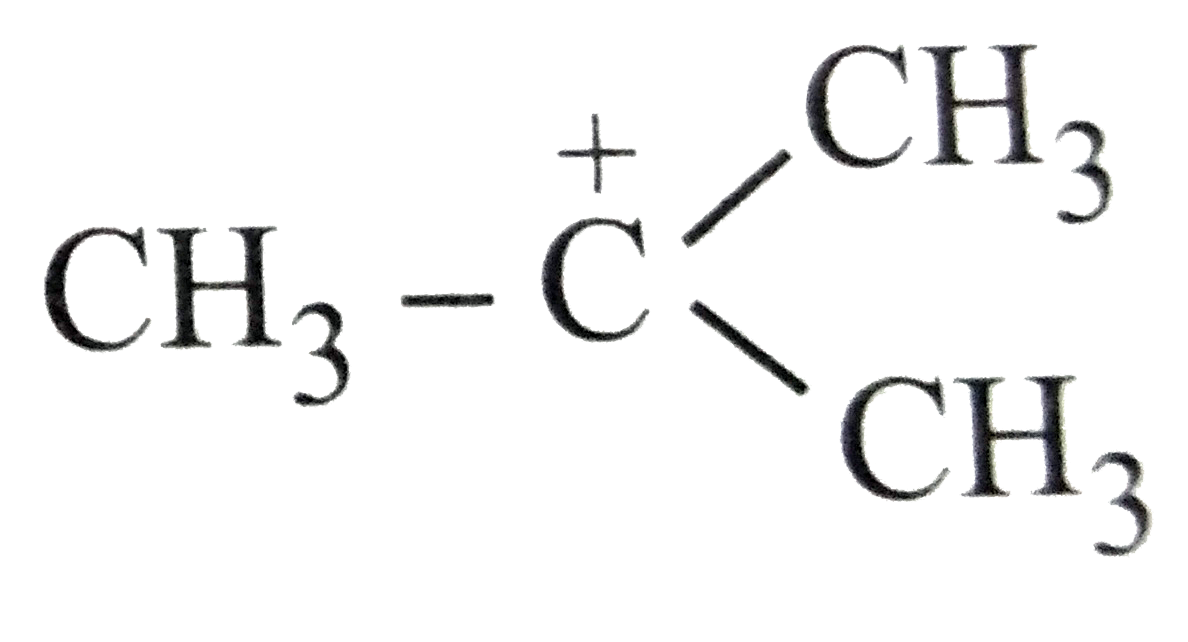
Hyperconjugation is most useful for stabilizing which of the following carbocations ? |
|
Answer» neopentyl |
|
| 42. |
Hyperconjugation is not possible in |
|
Answer» `CH_(3)-CH=CH_(2)` |
|
| 43. |
Hyperconjugation is best described as: |
|
Answer» Delocalisation of `pi` electrons into a nearby empty orbital. |
|
| 44. |
Hyperconjugation |
|
Answer» `SIGMA-pi" conjugation "` |
|
| 45. |
Hyperconjugation is |
|
Answer» `sigma-pi` conjugation |
|
| 46. |
Hyperconjugation involves overlap of the following orbitals |
|
Answer» <P>`SIGMA-sigma` |
|
| 47. |
Hyperconjugation involves overlap of the following orbitals : |
|
Answer» `SIGMA-sigma` |
|
| 48. |
Hyperconjugation involves delocalisation of ……. |
|
Answer» electrons of carbon-hydrogen bond of an ALKYL group DIRECTLY attached to an ATOM of unsaturated carbon |
|
| 49. |
Hyperconjugation involves delocalisation of............... . |
|
Answer» ELECTRONS of carbons-hydrogen `sigma` BOND of an alkyl group DIRECTLY attached to an atom of unsaturated system |
|
| 50. |
Hyperconjugation describes the orbital interactions between the p-systems and the adjacent s-bond of the substituent group(s) in organic compounds. Hyperconjugation is also called as Baker and Nathen effect. The necessary and sufficient condition for the hyperconjugation are : i) Compound should have at least on sp2 hybrid carbon of either alkene, carbocation or alkyl free radical. ii) A-carbon with respect to sp2 hybrid carbon should have at least one hydrogen. Hyperconjugation are of three types: (i) s(C-H), p-conjugation. (iii) s(C-H), positive charge conjugation iv) s(C-H), odd electron conjugation The hyperconjugation may be represented as Number of resonating structures due to hyperconjugation = (n + 1) where n is the number of a-hydrogen. Greateris the number of such forms, more is the stability of the species under considersation. Stability of saturated alkyl carbocations can be explained by |
|
Answer» INDUCTIVE EFFECT |
|