

Saved Bookmarks
This section includes 7 InterviewSolutions, each offering curated multiple-choice questions to sharpen your Current Affairs knowledge and support exam preparation. Choose a topic below to get started.
| 1. |
(i) How do you expect the metallic hydrides to be useful for hydrogen storage ? (ii) Write a note about ortho water and para water. |
|
Answer» Solution :(i) In metallic hydrides, hydrogen is absorbed as H-atoms. Due to the absortion of H atoms the metal lattice expands and become unstable. Thus, when metallic hydride is heated, it decomposes to form hydrogen and finely divided metal. The hydrogen evolved can be used as fuel. (ii) 1. Water exists in SPACE in the interstellar clouds, in proto - planetary disks, in the comets and ICY satellites of the solar system, and on the earth. 2. In particular, ortho-to-para RATIO (OPR) of water in space has recently received attention. Like hydrogen, water can be classified into ortho-`H_(2)O` and para-`H_(2)O`, in which the directions are antiparallel.  3. At the low temperature conditions of Earth (300K), the OPR of `H_(2)O` is 3. 4. At low temperature below `(LT 50 K)` the amount of para-`H_(2)O` increases. It is known that the OPR of water in interstellar clouds and comets has more para-`H_(2)O` (OPR = 2.5) than on Earth. |
|
| 2. |
H_(2) O (I) hArr H_(2) O(g)""II) I_(2)(s) hArr I_(2) (vap) "" III) H_(2) O(l) hArr H_(2) O (s) "IV)" CO_(2) (g) hArrCO_(2) (aq) Rise of T shifts equilibrium towards right in the case of |
|
Answer» I & IV |
|
| 3. |
(I) H_(2)O_(2)+O_(3) to H_(2)O+2O_(2) (II) H_(2)O_(2)+Ag_(2)O to 2Ag+H_(2)O+O_(2) Role of hydrogen peroxide in the above reactions is respectively |
|
Answer» OXIDISING in (I) and REDUCING in (II) |
|
| 4. |
I. H_(2)O_(2) + O_(2) to H_(2)O + 2O_(2) II. H_(2)O_(2)+ Ag_(2)O to 2Ag + H_(2)O + O_(2) Role of hydrogen peroxide in the above reactions is respectively |
|
Answer» OXIDISING in (I) and REDUCING in (II) |
|
| 5. |
(i) H_(2)O_(2)+O_(3)toH_(2)O+2O_(2) (ii) H_(2)O_(2)+Ag_(2)O to 2Ag+H_(2)O+O_(2) Role of hydrogen peroxide in the above reaction is respectively |
|
Answer» OXIDISING in (I) and reducing in (II) |
|
| 6. |
(I) Give the decreasing order of SN^2 reacivity of the following alkoxide nucleophile. Me_3 CO^(Ө), MeCH_2O^(Ө), Me_2CHO^(Ө) and (b) . |
|
Answer» Solution :(I) For solution, see to Section `11.17` (II) (a) 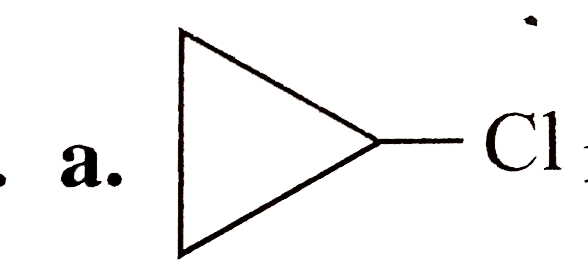 is less REACTIVE than is less REACTIVE than 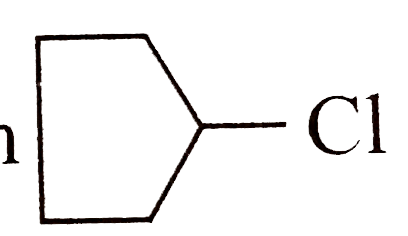 in both `SN^(1)` and `SN^2` reactions because the in both `SN^(1)` and `SN^2` reactions because the 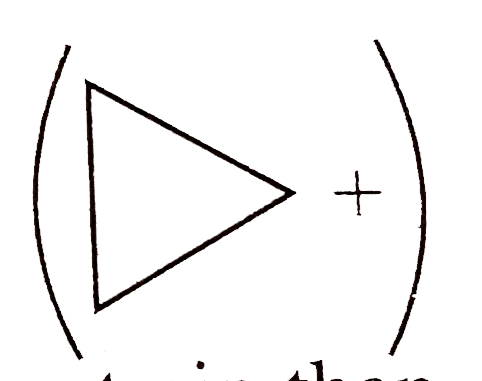 ion FORMED in the T.S. has more ring strain than the ion FORMED in the T.S. has more ring strain than the 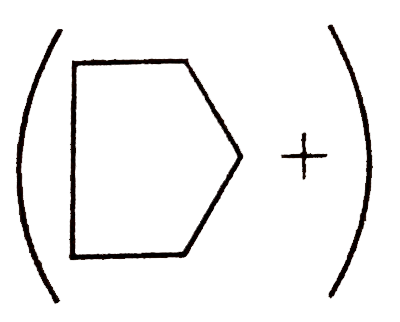 (B) The bridgehead halide in `(A)` is inert in both `SN^1` and `SN^2` reactions. A flat `R^(oplus)` cannot form at the bridgehead `C`, making `SN^1` impossible. Also three bridges prevent the back-side attrack for `SN^2` reaction and inversion is also impossible. `(B)` is a typical `3^@` halide and reacts via `SN^1` and less by `SN^2`. |
|
| 7. |
(i) Give reaction for bromination of ethane. (ii) Is this reaction suitable for pure bromoethane ? Why ? (iii) Give tha name of mechanism of reaction and name of stages occurred in reaction. (iv) Give reaction for first stage. (v) Which type of bond cleavage occurred in first stage ? |
|
Answer» Solution :(i) `C_(2)H_(6) + Br_(2) overset(hv)RARR C_(2)H_(5)Br + HBR` (ii) This reaction is not suitable for the preparation of pure bromoethane because by this reaction mixture of BROMOALKANE is obtained and their separation is too difficult. (iii) In free radical substitution reaction the various STAGE is initiation, propagation and termination. (iv) `Br_(2)rarr 2Br` (v) Homolysis of bond 
|
|
| 8. |
(i) Give a method for the manufacture of hydrogen peroxide and explain the reactions involved therein. (ii) Illustrate oxidising, reducing and acidic properties of hydrogen peroxide with equations. |
|
Answer» Solution :Industrially it is prepared by the auto-oxidation of 2-alklylanthraquinols. (2-ethyl anthraquinol) `underset(H_2//Pd)overset(O_2 "(air)") to H_2O_2` + (Oxidised product.) In this case 1% `H_2O_2` is formed. It is extracted with water and concentrated to ~30% (by mass) by distillation under reduced pressure. It can be further concentrated to ~85% by careful distillation under low pressure. The remaining water can be frozen out to OBTAIN PURE `H_2O_2`. (i)OXIDISING effect in acidic medium : `2Fe_((aq))^(2+) + 2H_((aq))^(+) + H_2O_(2(aq)) + H_2O_(2(aq)) to 2Fe_((aq))^(3+) + 2H_2O_((L))` `PbS_((s)) + 4H_2O_(2(aq)) to PbSO_(4(s)) + 4H_2O_((l))` (ii) Reducing effect in acidic medium : `2MnO_4^(-) + 6H^(+) + 5H_2O_2 to 2Mn_((aq))^(2+) + 8H_2O + 5O_2` `HOCl + H_2O_2 to H_3O^(+) + Cl^(-) + O_2` (iii) Oxidising effect in BASIC medium : `2Fe^(2+) + H_2O_2 to 2Fe^(3+) + 2OH^(-)` `Mn^(2+) + H_2O_2 to Mn^(4+) + 2OH^(-)` (iv) Reducing effect in basic medium : `I_2+H_2O_2 + 2OH^(-) to 2I^(-) + 2H_2O + O_2` `2MnO_4^(-) + 3H_2O_2 to 2MnO_2 + 3O_2 + 2H_2O + 2OH^(-)` |
|
| 9. |
If theu_(rms) of an ideal gas in a closed container is doubled, then which of the following statement correctly explains how the change is accomplished? |
| Answer» ANSWER :A | |
| 10. |
How many sigma bonds are there in oxalic acid ? |
| Answer» | |
| 11. |
(i) Find the number of neutrons in 5xx10^(-4) mol of ""^(14)C isotope. (ii) chloride of a metal (A) contains 55.90% of chlorine. 1.0g of metal (A) displaces 1.134g of a metal (B) from its salt. Determine the equivalent weights of (A) and (B). |
|
Answer» Solution :(ii) EQUIVALENT weight of `A=(44.1)/(55.9)xx35.5=28.006` Equivalent of `B=(1.134xx28.006)/(1)=31.7588` |
|
| 12. |
(i) Explain why hydrogen is not placed with the halogen in the periodic table. (ii) Complete the following reactions. Al_(4)C_(3) + D_(2)O rarr ? CaC_(2) + D_(2)O rarr ? Mg_(3)N_(2) + D_(2)O rarr ? Ca_(3)P_(2) + D_(2)O rarr ? |
|
Answer» Solution :(b) (i) 1. Hydrogen resembles alkali metals as well as halogens. 2. Hydrogen resembles more alkali metals than halogens. 3. Electron affinity of hydrogen is much less than that of halfogen atom. Hence the TENDENCY to form hydride ion is low compared to that of halogens. 4. In most of its compounds hydrogen exists in +1 oxidation state. THEREFORE it is reasonableto place the hydrogen in GROUP 1 along with alkali metals as shown in the latest periodic table published by IUPAC. (ii) `underset(underset("carbide")("Aluminium"))(Al_(4)C_(3)) + underset(underset("water")("Heavy"))(12 D_(2)O)rarr underset(underset("deuteroxide")("Aluminium"))(4Al(OD)_(3)) + underset(underset("Methane")("Deutero"))(3CD_(4))` `underset(underset("carbide")("Calcium"))(CaC_(2)) + 2D_(2)O rarr underset(underset("deuteroxide")("Calcium"))(Ca(OD)_(2)) + underset(underset("acetylen")("Deutero"))(C_(2)D_(2))` `underset(underset("Nitride")("Magnesium"))(Mg_(3)N_(2))+ 6D_(2)O rarr underset(underset("deuteroxide")("Magnesium"))(3Mg(OD)_(2)) + underset(underset("ammonia")("Deutero"))(2ND_(3))` `underset(underset("Phosphide")("Calcium"))(Ca_(3)P_(2)) + 6D_(2)D rarr underset(underset("deuteroxide")("Calcium"))(3Ca(OD)_(2)) + underset(underset("Phosphine")("Deutero"))(2PD_(3))` |
|
| 13. |
(i) Explain why the aquatic species are more comfortable in cold water during water season rather than warm water during the summber? (ii) What is osmosis? |
|
Answer» <P> Solution :(i) Total pressure=1 atm`P_(N_(2))=((80)/(100))xx"Total pressure"=(80)/(100)xx1atm=0.8atm` `P_(O_(2))=((20)/(100))xx1=0.2atm` According to Henry.s Law `P_("SOLUTE")=K_(H)x_("solute in solution")` `therefore P_(N_(2))=(K_(H))_("Nitrogen")xx`Mole fraction of Nitrogen solution `(0.8)/(8.5xx10^(4))=x_(N_(2))` `x_(N_(2))=9.4xx10^(-6)` similarly `x_(O_(2))=(0.2)/(4.6xx10^(4))=4.3xx10^(-6)` (ii) Osmosis is a spontaneous process by which the SOLVENT MOLECULES pass through a semipermeable membrane from a solution of lower concentration to the solution of higher concentration. |
|
| 14. |
(i) Explain the shape of s and p-orbital. (ii) The mass of an electron is 9.1xx10^(-31)kg. If its kinetic energy is 3.0xx10^(-25) J. |
Answer» Solution :(i) s-orbital: For Is orbital,l=0, m=0, `f(theta)=1//sqrt2` and `g(varphi)=1//sqrt2pi`.. Therefore, the angular distribution function is equal to `1//2sqrtpi`. i.e. it is INDEPENDENT of the angle 0 and Hence, the probability of finding the ELECTRON is independent of the direction from the nucleus. So, the shape of the s orbital is spherical. p-orbital: For p orbitals l=1 and the corresponding m values arc-1, 0 and +1.Th. three different m values indicates that there are three different orientations possible for orbitals. These orbitals are designated as `p_(s),p_(y)` and `p_(s)`. The shape of p orbitals are dum bell shape.  Step I. Calculate of the velocity of electron KINETIC energy `=1//2 mv^(2)=3.0xx10^(-25)J=3.0xx10^(-25) Kg m^(2)s^(-2)` `v^(2)=(2xxK.E)/(m)=(2xx(3.0xx10^(-25) Kg m^(2)s^(-2)))/(9.1xx10^(-31) kg)=65.9xx10^(4)m^(2) s^(-2)` `v=(65.9xx10^(4) ms^(-2))^(1//2)=8.12xx10^(2)ms^(-1)` Step II. Calculation ofwave LENGTH of theelectron AAccording to de Broglie.s equation , `lambda=(h)/(mv)=((6.626xx10^(-34)Kg m^(2)s^(-1)))/((9.1xx10^(-31) Kg)XX(8.12xx 10^(2) ms^(-1)))` `=0.08967xx10^(-5)m=8967xx10^(-10)m=8967A(:.1A=10^(-10)m)` |
|
| 15. |
(i) Explain the shape of following molecule by using VSEPR theory. (a) BeCl_(2) (b) NH_(3) (c) H_(2)O (ii) Which bond is stronger or sigma or pi ? Why? |
Answer» Solution :(i)  (ii) * Sigma bonds `(sigma)` are stronger than PI bonds `(pi)`. Because, sigma bonds are formed from bonding orbitals directly between the NUCLEI of the bonding ATOMS, resulting in greater overlap and a strong sigma BOND (axial overlapping). * Pi bonds results from overlap of atomic orbitals that are in contact through two areas of overlap (lateral overlapping). Pi bonds are more diffused bonds than sigma bonds. |
|
| 16. |
(i) Explain why AgCl is white in colour whereas AgI is yellow. (ii) if the degree of polarisation of the anion is (e.g. PbI_(2) is yellow) but if it is lower, then the compound is either white or colourless (e.g., PbCl_(2) is white)- why? |
|
Answer» Solution :(i) LARGER the ANIONIC radius, greater is its tendency to get polarised. The higher polarisability of `I^(-)` ion, owing to its larger radius, facilitates the transition of electron (from anion to metal ion) in the visible range, imparting yellow colour to AgI. on the other hand, lower polarisability of `Cl^(-)` ion, facilitates the transition of electron in the UV range. HENCE, AgCl appears white. (II) N/A |
|
| 17. |
(i) Explain the preparation of hydrogen using electrolysis. (ii) Why hydrogen gas is used as fuel? |
|
Answer» Solution :(i) High purity of HYDROGEN `(gt99.9%)` is obtained by the electrolysis of water containing traces of acid or alkali or electrolysis of aqueous solution of SODIUM hydroxide or potassium hydroxide using a NICKEL anode and iron cathode. This process is not economical for large scale production. At anode`: 2OH^(-)toH_(2)O+1//2O_(2)+2e^(-)` At cahotde: `2H_(2)O+2e^(-)to2OH+H_(2)` Overall reaction: `H_(2)OtoH_(2)+1//2O_(2)`. (ii) Hydrogen BURNS in air, virtually free from pollution and produces significant amount of energy. this reaction is used in fuel cells to generate electricity. `2H_(2_((g)))+O_(2_((g)))to2H_(2)O_((l))+`energy. |
|
| 18. |
(i) Explain the harmful effects of acid rain.(ii) What is Eutrophication? |
|
Answer» Solution :(i) 1. ACID rain causes damage to buildings made us of marbles. This attack on marble is termed as stone leprosy. `CaCO_(3)+H_(2)SO_(4)toCaSO_(4)+H_(2)O+CO_(2)uarr` 2. Acid rain AFFECTS PLANT and animal life in aquatic ecosystem. 3. It is harmful for agriculture, as it dissolves in the earth and removes the nutrients needed for the growth of plants. 4. It corrodes water pipes resulting in the leaching of heavy metals such as iron, lead and copper into drinking water which have toxic EFFECTS. 5. It causes respiratory ailment in humans and animals. (ii) Eutrophication: When the growth of algae increases in the surface of water, dissolved oxygen in water is greatly reduced. This PHENOMENON is known as eutrophication. Due to this growth of fishes gets inhibited. |
|
| 19. |
(i) Explain the factors influencing the solubillity of the solutes. (ii) Why the carbonate drinks are stored in a pressurised container? |
|
Answer» Solution :(i) Factors influencing solubility: Nature of solute and solvents readily dissolves in solute and solvent: Sodium chloride, an IONIC compound readily bent such as water but it does not dissolve in nonpolar solvent such as of the organic compounds dissolve in organic solvent and do not dissolve in Effect of temperature: Generally, the solubility of a solid solute in a liquid solvent increase in temperature. The dissolution of NaCl does not vary as the maximum solubility is achieved at normal temperature. The dissolution of ammonium nitrate is endothermic and the solubility increases with increase in temperature. The dissolution of ceric SULPHATE is exothermic and the solubility decreases with increase of temperature. In the case of gascos solute in liquid solvent the solubility decreases with increase in temperature. Effect of pressure: Generally the change in pressure does not have any significant effect in the solubility of solids and liquids as they are not compressible. However, the solubility of gases generally increases with increase of pressure. (ii) . The carbonated beverages CONTAIN `CO_2` dissolved in them. To dissolve the`CO_2`in these drinks, `CO_2` gas is bubbled through them under high pressure. • These containers are sealed to maintain the pressure. When we OPEN these containers at atmospheric pressure, the pressure of the `CO_2`drops to the atmospheric pressure level and hence bubbles of `CO_2` RAPIDLY escape from the solution and show effervescence. |
|
| 20. |
(i) Explain-The Bhopal Tragedy. (ii) What are the particulate that cause the pollutions in troposphere? |
|
Answer» Solution : (i) On 3rd Dec,1984 at Bhopal city in india by the early morning, an explosion at Union carbide pesticide plat released a cloud of toxix gas (Methyl isocyanate)`CH_(3)NCO` into the air Since the gas is twice as heavy as air, it did not drift away but formed a blanket over the SURROUNDING area. It attacked prople.s lungs and affect their breathing STAYING there or in the nearby area Thousands of people DIED and lives of many were ruined. The lungs, brain,eyes, MUSCLES as well as gastrointestinal, neurological and immune system of those people who survived were severely affected. (ii) 1. Viable particulates: The viable particules are the same size,living orgainisms such a bacteria , fungi, moles, algae,etc which are dispersed in air, some of the fungi cause allergy in human beings and disease in plants. 2. Non-viable particules: The non-viable particulates are smell particles and liquid droplets suspended in air . They help in the transpodting of particulates in the atmosphere, They are classified according to (i) smoke (ii)dust(iii)mists(iv)FUMES. |
|
| 21. |
(i) Explain the exchange reactions of deuterium. (ii) Explain the action of soap with hard water. |
|
Answer» Solution :(i) Deuterium can replace reversibly hydrogen in compounds either partially or completely depending upon the reaction conditions. These reactions occur in the presence of deuterium. `underset("Methane")(CH_(4))+2D_(2)tounderset("DEUTERO methane")(CD_(4)+2H_(2))` `underset("Ammonia")(2NH_(3))+3D_(2)+underset("Deutero ammonia")(2ND_(3)+3H_(2))` (ii) Action of soap with hard WATER: • The cleaning capacity of soap is reduced when used in hard water. • Soaps are sodium or potassium SALTS of long chain fatty acids. • When soap is added to hard water, the divalent magnesium and calcium cations present in hard water react with soap. • The sodium salts present in soaps are converted to their corresponding magnesium and calcium salts which are precipitated as scum or precipitate. `M^(2+)+2RCOONato(RCOO)_(2)M_((s))+2Na_((aq))^(+)`, Wher, M=Ca or Mg, `R=C_(17)H_(35^(+))` |
|
| 22. |
(i) Explain-Column chromatography. (ii) Give the structure fot the following compund. (a) Give the butyl iodide (b) 3-Chlorobutanol |
|
Answer» Solution :(i) Column Chromatography: 1. The principle BEHIND chromatography is selective distributaion of mixture of organic substance between two phases a stationary phaseand a moving phase. The stationary phase can be a solid or liquid , while the moving phase is a liquid or a gas. When the stationary phase is a solid, the moving phase is a liquidor gas 2. If the stationary phase is solid, the basis is adsorption, and when it is a liquid, the basis is partition. 3.Chromatography is defend s a techique for the separation of a mixture BROUGHT about by differential movement of the individual component through porous MEDIUM under the INFLUENCE of movingsolment. 4. In column chromatography the above principle is carried out in a long glass column (II) (a) Tertiary butyl iodide=`CH_(3)-underset(I)underset(|)overset(CH_(3))overset(|)(C)-CH_(3)` (b) 3-Chlorobutanol= `CH_(3)-underset(CI)CH-CH_(2)-CH_(2)-OH` |
|
| 23. |
(i) Explain-eletromeric effect. (ii) Give the example forbeta-elimination. |
|
Answer» Solution :(i) Electromeric effect. 1. The electromic eggect refers to the polarity produced in a multiple bonded compound when it is ATTACKED by a reagent when a double or triple bond is exposed to an attack by an electrophile the two `PI` electrons which from the `pi` bond are completely transferred to one atom or the other. 2. When a nucleophile approaches the carbonyl compound, the `pi`-electrons. between C and O is instantaneously shifed to the more wlwctrobegative oxygen, This make the carbon electron deficient and hus facilitating the formation of a new bond between the INCOMING nucleophile and the corbonyl carbon atom  . . 3. Wgen an electrophile such as `H^(+)` approacges an alkene molecule the `pi` electron are instantaneously shiftedto the electrophilr and a new bond is formed between carbon and hydrogen, This makes the other carbon electron deficient and hence it acquires a positive charge  4. This effect denotes as E-effect. (ii) ~beta~-elimination: Elimination reactions ibvolve the cleavage of a `sigma` bond and formation of a `pi` bond. A nicleophilic pair of electrons heads into a new `pi` bond as a leaving group departs. This process is called `beta`-elmination because the bond `beta` to the nuclwophilic pair of electrons BREAKS. Example: 1. n-propyl bromide on reaction with alcoholic KOH give propene. In this reaction hydrozen and Br are elimineted.  2. Acid-catalysed dehydration of alcohols 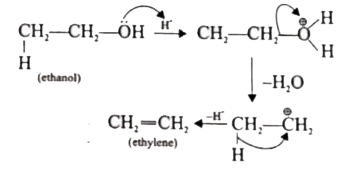 . .
|
|
| 24. |
(i) Explain about the procedure and calculation behind the carius method of estimation of sulphur. (ii) What is the differencebetween distillation, distillation under reduced pressure and stream distillation? |
|
Answer» Solution :(a) (i) Carius METHOD 1. Procedure: A known mass of the organic COMPOUND is taken in a clean carius tube and few mL of fuming `HNO_(3)` is added and then the tube is sealed. It is then placed in an iron tube and heated for 5 hours. The tube is allowed to cool and a hole is made to allow gases to escape. The carius tube is broken and the content collected in a beaker. EXCESS of `BaCl_(2)` is added to the beaker `H_(2)SO_(4)` formed is converted to `BaSO_(4)` (white ppt.) The precipitate is filtered, washed, dired and weight. From the mass of `BaSO_(4)`, percentage of S is calculated. 2. Calculation: Mass of organic compound =Wg Mass of `BaSO_(4)` formed =xg 233g of `BaSO_(4)` contains 32g of SULPHUR `:. x g` of `BaSO_(4)" contain " (32)/(233) xx x g` of sulphur Percentage of sulphur `= ((32)/(233) xx (x)/(w) xx 100)%` (ii) Distillation is used in case of volatile liquid mixed with a non-volatile impurities. Distillation under reduced pressure: The method is used to purify such liquids which have very high boiling points and which decompose at or below their boiling points. Steam distillation is used to purify steam volatile liquids associated with water immiscible impurities. |
|
| 25. |
(i) Explain about the classification of mater. (ii)What is combination reaction? Give an exanple. |
Answer» SOLUTION :(i) Classification of matter: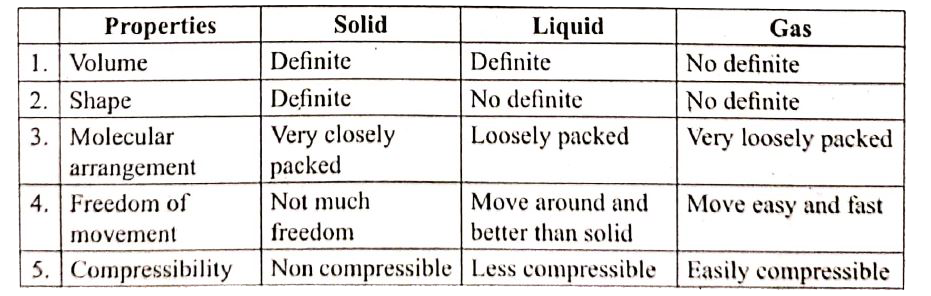 (ii) When two or more substance combine to form a SINGLE substance, the reaction are called combination reaction `A+B to C` EXAMPLE : `2Mg + O_2 to 2MgO` |
|
| 26. |
(i) Explain about green chemistry in day-to-day life. (ii) How acetaldehyde is commercially prepared by green chemistry? |
|
Answer» Solution :(i) 1. Dry cleaning of clothes: SOLVENTS like tetrachloroethylene USED in dry cleaning of clothes, pollute the ground water and are carcinogenic. In place of TETRACHLORO ethylene, liquefied CO, with suitable detergent is an alternate solvent used. Liquefied Co, is not harmful to the ground water. Nowadays `H_(2)O_(2)` is used for bleaching clothes in laundry, gives better result and utilises less water. 2. Bleaching of paper: Conventional method of bleaching was done with chlorine. Nowadays `H_(2)O_(2)` can be used for bleaching paper in the presence of catalyst. 3. Instead of petrol, methanol is used as a fuel in automobiles. 4. Neem BASED pesticides have been synthesised, which are more safer than the chlorinated hydrocarbons. (ii) Acetaldehyde is commercially prepared by one step oxidation of ethene in the presence of ionic catalyst in aqueous medium with 90% yield. `underset("Ethylane")(CH_(2)=CH_(2))overset("Catalyst")underset("Pd(II)/Cu(II)")tounderset("Acetaldehyde")(CH_(3)CHO)` |
|
| 27. |
(i) Ducuss orbital structure of methane. (ii) Discuss orbital structure of ethylene. (iii) Discuss orbital structure of acetylene. (iv) Discuss the hybridization of carbon atom in allene (C_(3)H_(4)) and show the pi-orbital overlaps. |
|
Answer» `(##GRB_ORG_CHM_P1_C01_E01_011_A01##)` |
|
| 28. |
(i) Draw the gas phase and solid phase structrue of H_(2)O_(2) (ii) H_(2)O_(2) is a better oxidising agent than water. Explain. |
|
Answer» Solution :(II) `H_(2)O_(2)` is a better oxidising AGENT than water as discussed below: (a) `H_(2)O_(2)`oxidises an ACIDIFIED solution of KI to give `I_(2)` which GIVES blue colour with starch solution but`H_(2)O` does not (b) `H_(2)O_(2)` turns black PbS to white `PbSO_(4)` but `H_(2)O` does not |
|
| 29. |
(i) Distinguish between ortho and para-hydrogens. (ii) What is the composition of ortho-and para hydrogens in ordinary hydrogen at room temperature ? Can this composition be changed? |
| Answer» SOLUTION :(II) For EFFECT of temperature on the compostion of ortho and para isomers. | |
| 30. |
(i) Discuss the three types of Covalent hydrides. (ii) Write the chemical reactions to show the amphoteric nature of water. |
|
Answer» Solution :(i) 1. They are the compounds in which hydrogen is attached to another element by sharing of electrons. 2. The most common examples of covalent hydrides are methane, ammonia, WATER and hydrogen chloride. 3. Mole cular hydrides of hydrogen are further classified into three categories as, `*` Electron precies `(CH_(4),C_(2)H_(6),SiH_(4),GeH_(4))` `*` Electron-deficient `(B_(2)H_(6))` and `*` Electron - rich hydrides `(NH_(3),H_(2)O)` 4. Since most of the covalent hydrides consist of discrete, small molecules that have relatively weak intermolecular forces, they are generally gases or volatile liquids. (ii) Water is amphpteric in nature and it behaves both as an acid as well as base. With acids stronger than itself (e.g., `H_(2)S`) it behaves as a base and with bases stronger than itself (e.g., `NH_(3)`) it acts as an acid. `*` As a base : `H_(2)O_((l))+H_(2)S_((aq))toH_(3)O_((Aq)+HS_((aq))^(-)` `*` As an acid : `H_(2)O_((l))+NH_(3_(aq))to OH_(aq)^(-)+NH_(4_(aq))^(+)` |
|
| 31. |
(i) Discuss the conceptof hydridisation . What are its different types in a carbon atom . (ii) What is the type of hyridisation of carbon atoms marked with star. (a) overset(**)CH_(2)= CH-overset(O)overset(**||)(C)-O-H (b) CH_(3)-overset(**)CH_(2)-OH (c) CH_(3) - CH_(2) - overset(O)overset(||**)C - H (d)overset(**)CH_(3)-CH=CH-CH_(3) (e) CH_(3) - overset(**)C-=CH. |
|
Answer» SOLUTION : (i) N/A (II) (a) 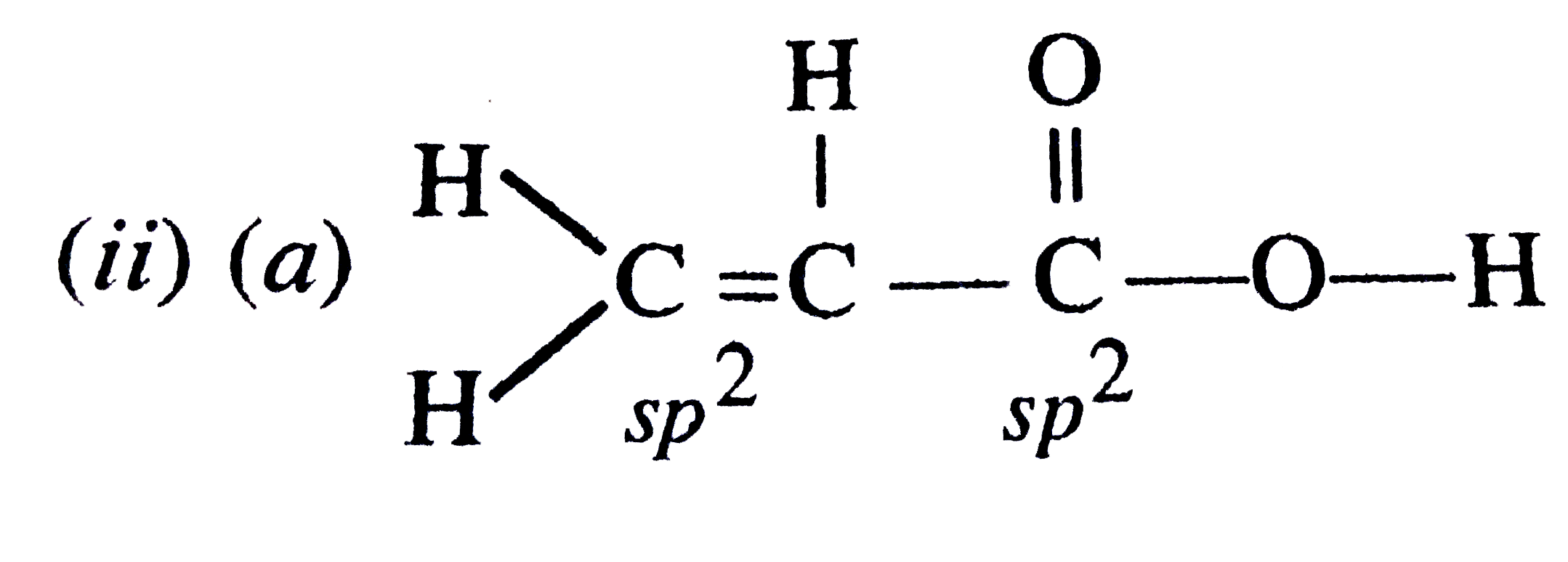 (b) `CH_(3) - underset(H)underset(|sp^(3))OVERSET(H) overset(|)C-O-H` (c)`CH_(3) - CH_(2) - overset(O)overset(||)underset(sp^(2))C-H` (d) 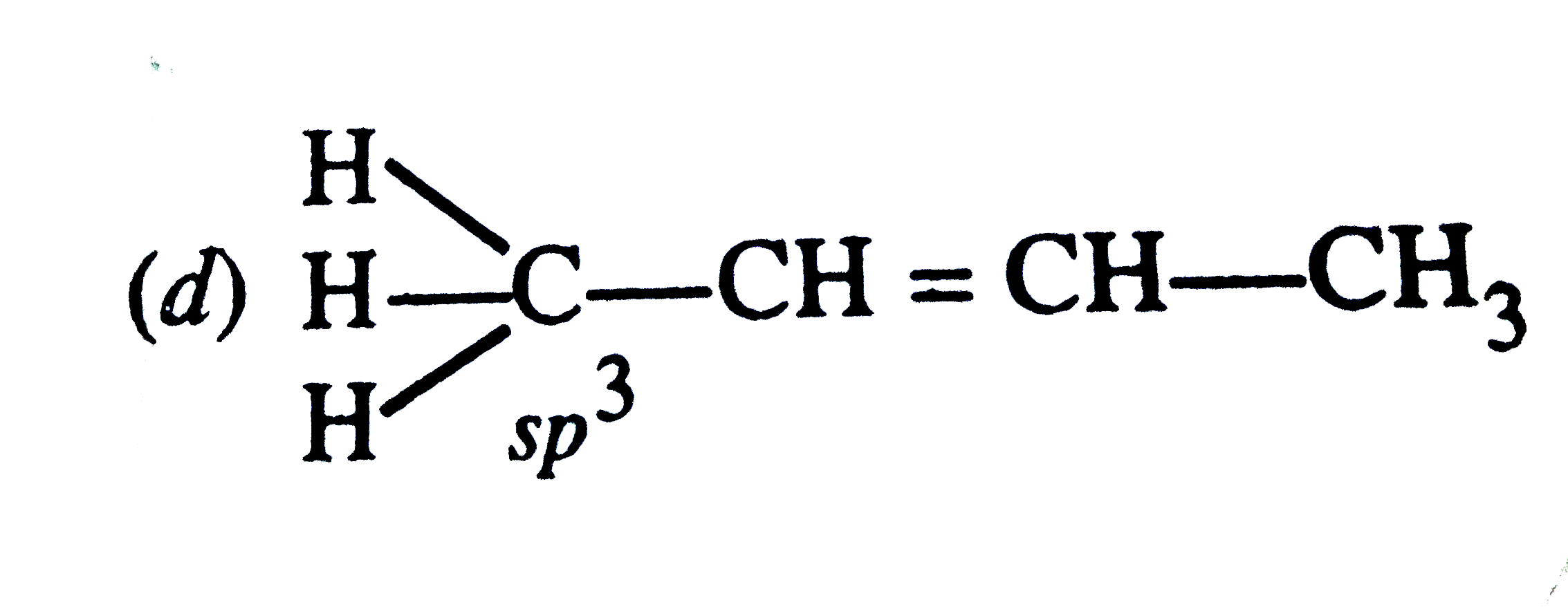 (E) ` CH_(3) - underset(sp)C-=CH` |
|
| 32. |
(i) Discuss the aromatic nucleophilic substitution reactions of chlorobenzene. (ii) C Cl_(4) gt CHCl_(3) gt CH_(2)Cl_(2) gt CH_(3)Cl is the decreasing order of boiling point in haloalkanes. Give reason. |
|
Answer» Solution :(b) (i) Aromatic nucleophilic substitution reactions: Dow.s process 1. `underset("Chlorobenzene")(C_(6)H_(5)Cl) + NaOH underset(300 atm)overset(350^(@)C)rarr underset("Phenol")(C_(6)H_(5)OH) + NaCl` 2. `underset("Chlorobenzene")(C_(6)H_(5)Cl) + 2NH_(3) underset(50 atm)overset(250^(@)C)rarr underset("ANILINE")(C_(6)H_(5)NH_(2)) + NH_(4)Cl` 3. `underset("Chlorobenzene")(C_(6)H_(5)Cl) + CuCN underset("Phenyl cyanide")overset(250^(@)C) rarr underset("Phenylcynanide")(C_(6) H_(5) CN + CuCl` (ii) The boiling point of chloro, bromo and iodoalkanes increases with increase in the number of halogen ATOMS. So the CORRECT decreasing order of boiling point of haloalkanes is: `C Cl_(4) gt CHCl_(3) gt CH_(2)Cl_(2) gt CH_(3)Cl` |
|
| 33. |
(i) Derive the relation between K_p and K_c for general homogeneous gaseous reaction. (ii) How do you measure heat changes of a constant pressure ? |
|
Answer» Solution :Consider a gerneral reaction in which all reactants and products are ideal gases. `xA + y B hArr lC + mD` The equilibrium costant `K_(c)` is `K_(c)=([C]^l[D])/([A]^X[B]^y)` `K_p = (p^lC xx p_D^m)/(p_A^x xx p_B^y)` The ideal gas equation is `PV = nRT or P= (n)/(V)RT` Since, Active mass=molar concentration `= m/v` P= Active mass `xx` RT Based on the above expressio, the partial pressure of the reacants and products can be expressred as, `p_(A)^x =[A]^x.[RT]^x , p_B^y=[B]^y.[RT]^y` `p_C^l=[C]^l.[RT]^l , P_D^m = [D]^m.[RT]^m` On substiutiono in equation (2), `K_p = ([C]^l[RT]^l[D]^m[RT]^m)/([A]^x[RT]^x[B]^y[RT]^y)` `K_(p)= ([C]^l[D]^m)/([A]^x[B]^y) xx RT^((l+m)-(x+y))` By comparing equation (1) and (4) ,we get `K_(p)=K_(c)(RT)^(Delta ng)` where `Delta n_g` is the difference between the sum of number of moles of products and the sum of number of moles of reactants in the gas phase. (i) If `Deltan_g =0, K_p = K_c(RT)^0 ` `K_p = K_c` Example : `H_(2)(g) + I_(2)(g) hArr 2HI(g)` (ii) when `Delta n_g = + ve` `K_p = K_c (RT)^(+ve) RARR K_(p)= K_(c)` Example `2NH_(3)(g) hArr N_2(g)+3H_(2)(g)` (iii) When `Delta n_g = -ve` `K_p = K_c(RT)^(-ve)` `K_p lt K_c` Example : `2SO_2(g) + O_(2)(g) hArr 2 SO_3 (g)` 1. Measurement of heat change at constant pressure can be DONE in a coffee cup calorimeter. 2 . We know that `Delta H=q_p` (at constant P) and therefore , heat absorbed or evoloved `q_r` constant pressure is also called tha heat of reaction or enthalpy of reaction `Delta H_r` 3. In an exothermic reaction, heat is evolved, and system loses heat to the surrounding. Therefore `q_p` will be NEGATIVE and `Delta H_r` will also be negative 4. Similarly in an endothermic reaction, heat is absorbed `q_p` is postive and `Delta H_r` will also be positive. 
|
|
| 34. |
(i) Derive ideal gas equation. (ii) CO_(2) gas cannot be liquified at room temperature. Give the reason. |
|
Answer» Solution :(i) Ideal gas equation: The gaseous state is described completely using the following four variables T, P, V and n. Each gas law RELATES one variable of a gaseous sample to another while the other two variables are held constant. THEREFORE, combining all equations into a single equation will enable to account for the CHANGE in any or all of the variables. Boyle.s law: `Vprop(1)/(P)` Charles. law: `V prop T` Avogadro.s law: `Vpropn` We can combine these equations into the following general equation that describes the physical BEHAVIOUR of all gases. `Vprop(nT)/(P)` `V=(nRT)/(P)`,where R =Proportionately constant. The above equation can be rearranged to give PV = nRT - Ideal gas equation. Where, R is also known as Universal gas constant. (ii) Only below the critical temperature, by the application of pressure, a gas can be liquefied. `CO_(2)` has critical temperature as 303.98 K. Room temperature means (30 + 273 K) 303 K. At room temperature, (critical temperature) even by applying large amount of pressure `CO_(2)` cannot be liquefied. Only below the critical temperature, it can be liquefied. At room temperature, `CO_(2)` remains as gas. |
|
| 35. |
(i) Derive a general expression for the equilibrium constant K_(p), and K_(c) for the reaction.(ii) Write the K_(p) and K_(C) for NH_(3) formation reaction. |
|
Answer» Solution : Consider a general REACTION in which all reactants and products are ideal gases. `xA+yBleftrightarrowIC+mD` The equilibrium constant `K_(C)`is `K_(C)=([C]’[D])/( [A]^(x)[B]^(y))`...(1) `K_(p)=(pcxxp_(D)^(m))/(p_(A)^(x)xxp_(B)^(m))`......(2) The ideal gas equation is PV = NRT or `Pprop(n)/(V)RT` Since, Active mass = molar concentration =`(n)/(V)` P=`Active massxxRT` Based on the above expression, the partial pressure of the reactants and products can be expressed as,  By comparing equation (1) and (4), we get `K_(p)=K_(C)(RT)^((Deltang))` ...(5) where `Deltan_(g)` is the difference between the sum of NUMBER of moles of products and the sum of number of moles of reactants in the gas phase. 1. If `Deltan_(g)=0` ,`K_(p)=K_(C)(RT)^(0)`, `K_(p)=K_(C)` Example: `H_(2)(g)+L(g)leftrightarrow2HI(g)` 2. When `Deltan_(g)=+ve` `K_(P)=K_(C)` Example: `2NH_(3)(g)leftrightarrowN_(2)(g)+3H_(2)(g)` 3. When `Deltan_(g)=-ve` `K_(R)=K_(C)(RT)^(-ve)` Example : `2SO_(2)(g)+O_(2)(g)leftrightarrow2SO_(3)(g)` (ii) `N_(2)+3H_(2)leftrightarrow2NH_(2)` `K_(p)=(P^(2)NH_(3))/(P_(N_(2))P^(3)H_(2))``K_(C)=([NH_(3)]^(2))/([N_(2)][H_(2)]^(3))` |
|
| 36. |
(i) Define-electronegativity. (ii) How Moseley determined the atomic number of an element using X-rays. |
|
Answer» Solution :(i) Electronegativity is the relative tendency of an element present in a covalently molecule to attract the SHARED pair of electrons towards itself. (ii)(1)HENRY Moseley studied the X-ray spectra of several elements and determined hai numbers (Z) (2) He discovered a CORRELATION between atomic number and the FREQUENCY generated by herharding an element with high energy of electrons 3. Moseley correlated the frequency of the X-ray emitted by an equation as `sqrt(V)`= a (Z-b) Where - Frequency of the X-rays emitted by the elements a and b - Constants 4. From the square root of the measured frequency of the X-rays emitted, he determined the atomic number of the clement. |
|
| 37. |
(i) Define mole fraction. (ii) Differentiate between ideal solution and non-ideal solution. |
|
Answer» Solution :(i) Mole fraction of a COMPONENT is the RATIO of NUMBER of moles of the component to the total number of moles of all components present in the solution. ` "Mole fraction"=("Total Number of moles of component")/("Total number of moles of all components present in the solution")` (II) 
|
|
| 38. |
(i) Define Solubility (ii) Explain about the factors that influences the solubility |
|
Answer» Solution :(i) The solubility orf a substance at a give temperature is DEFINED as the amount of the solute that can be dissolved in 100 g of the solvent at a given temperature to form a saturated solution. (II) Factor influencing solubility (a) Nature of solutte and slvent: Sodium chloride, an ionic compound readily dissolves in polar solvent such as water but it does not dissolve in non polar solvent such as benzene. Most of the organic compounds dissolve in organic solvent and do not dissolve in water. (B) Effect of temperature: Generally, the solubility of a SOLID solute in a liquid solvent increases with increase in temperaturte. The dissolutino of NACL does not very as the maximum solubility is achieved at normal temperature. The dissolution of ammonium nitrate is endothermic, the solubility increases with increase in temperature. The dissolution of ceric sulphate is exothermic and the solubility decreases with increase of temperature. In the case of gaseous solute in liquid solvent the solubility decreases with increase in temperature. Effect of pressure: Generally the change in pressure does not have any significant effect in the solubility of solids and liquids as they are not comporessible. However, the solubility of gases generally increases with increase of pressure. |
|
| 39. |
Define limiting reagent . |
| Answer» SOLUTION :LIMITING reagent : when a reactions is carried out using non-stoichiometric QUANTITIES of the reactants , the product yield will be determined by the reactant that is completely consumed. It limits the further reaction form TAKING PLACE and is called a the limiting reagent. | |
| 40. |
(i) Define coordinate covalent bond. (ii) strate the formation of coordinate covalent bond with a suitable example. |
|
Answer» Solution :(i) In the BOND formation, ONE of the combining atoms donates a pair of electrons 1.e., two CIectrons which are NECESSARY for the covalent bond formation and these electrons are SHARED by both the combining atoms, and the bond formed is called coordinate covalent bond. (ii) e combining atom which donates the pair of electron is called the donor atom and the Otner atom is called the acceptor atom. This bond is denoted by an arrow starting from the donor atom pointing towards the acceptor atom. (iii) For example, in ferricyanide ion `[Fe(CN)_(6)]^(4-)` each cyanide ion (CN) donates a pair of electrons to FORM a coordinate bond with iron `(Fe^(2+))` and these electrons are shared by`Fe^(2+) and CN^(-)` ions. (iv)  (v) Ammonia having a lone pair of electrons donates its pair to an electron deficient molecule such as `BF_(3)` toform a coordinate covalent bond. 
|
|
| 41. |
(I) CuSO_(4)+5H_(2) O to CuSO_(4)+5H_(2)O "" (II) PCl_(3)+3H_(2)O to H_(3)PO_(3)+3HCl the process I and II are respectively |
|
Answer» HYDRATION and DEHYDRATION |
|
| 42. |
I) CuSO_4 + 5H_2O to CuSO_4 . 5H_2O II) PCl_3 + 3H_2O to H_3PO_3+ 3HClThe processes I and II are respectively |
|
Answer» Hydration and dehydration hydrolysis - the chemical breakdown of a compound DUE to REACTION with water |
|
| 43. |
(i) CuCl is more covalent than NaCl. Give reason. (ii) Draw and explain the molecular orbital diagram of Boron molecule. |
|
Answer» Solution :(i) 1. Cations having `ns^(2)np^(6)nd^(10)` configuration show greater polarising power than the cations with `ns^(2)np^(6)` configuration. Hence they show greater covalent character. 2. `CuCl` is more covalent than `NaCl`. As compared to `Na^(+)(1.13Å),Cu^(+)(0.6Å)`is small and has `3S^(2)3p^(6)3d^(10)` configuration. 3. Electronic configuration of `Cu^(+)" :"[Ar]3s^(2)3p^(6)3d^(10)` electronic configuration of `Na^(+)" :" [He]2s^(2)2p^(6)` So `CuCl` is more covalent that `NaCl` (ii) 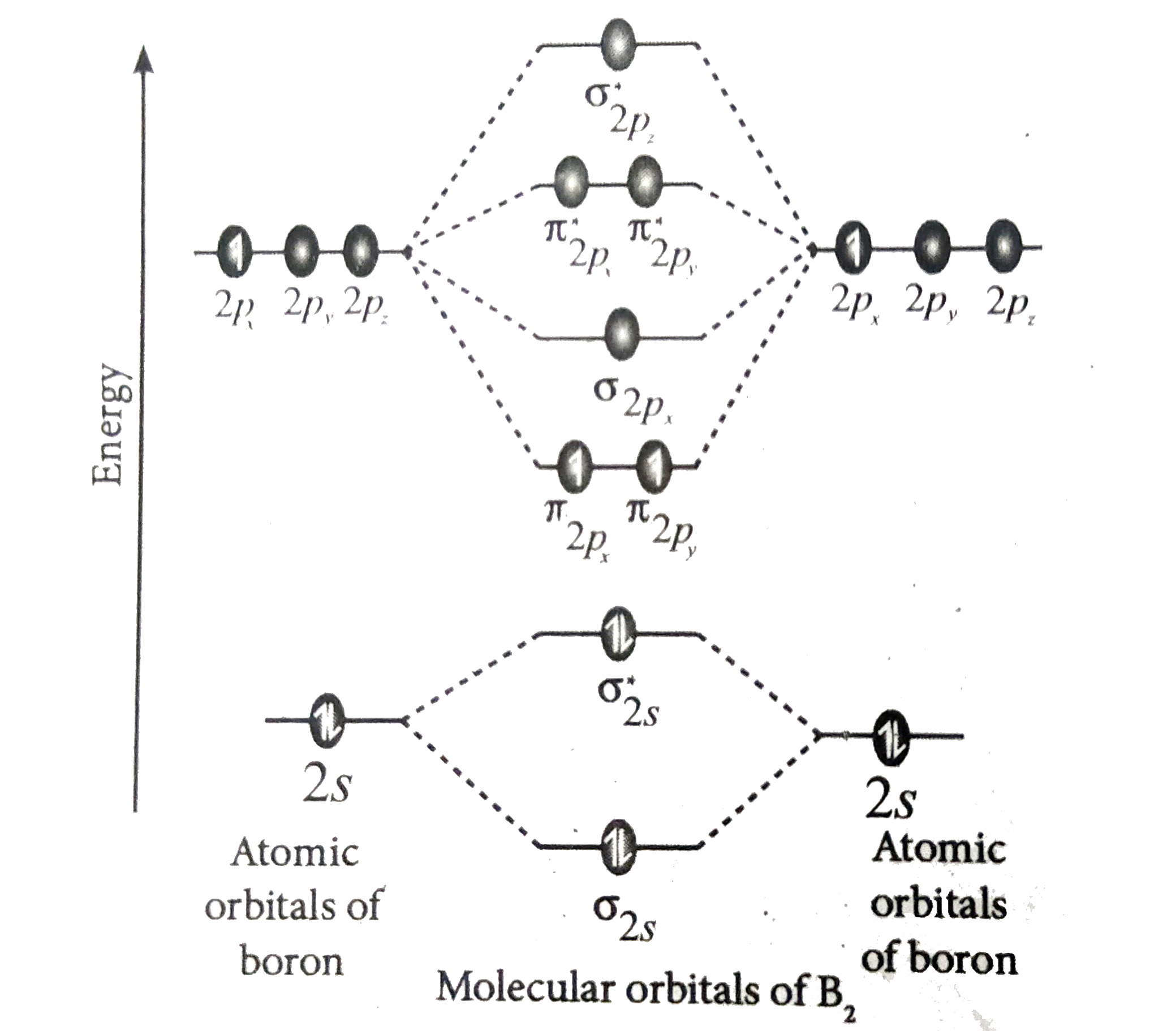 1. Electronic configuration of `B=1s^(2)2s^(2)2p^(3)` 2. Electronic configuration of `B_(2)=sigma1s^(2)sigma^(**)1s^(2)SIGMA2S^(2)sigma^(**)2s^(2)pi2p_(x)^(1)pi2p_(Z)^(1)` 3. Bond order `=(N_(b)-N_(a))/(2)=(6-4)/(2)=1` 4. `B_(2)` MOLECULE has two unpaired electrons hence it is paramagnetic. |
|
| 44. |
{:("(I) "CH_(3)O-CH=CH-NO_(2), "(II) "CH_(2)=CH-NO_(2)), ("(III) "CH_(2)=CH-Cl, "(IV) "CH_(2)=CH_(2)):} Which of the following is the correct order of C - C bond lengths among these compounds : |
|
Answer» `I GT II gt III gt IV` |
|
| 45. |
(i) CH_(3)COOH (ii) C_(2)H_(5)COOH (iii) C_(3)H_(7)COOH (iv) C_(6)H_(5)COOH are heated with sodalime, there is decarboxylation. The are heated in different test-tube with sodalime, write the reactions occurred in different test-tube. |
|
Answer» SOLUTION :(i) `CH_(3)COOH overset("Soda LIME" Delta)rarr CH_(4)` (Methane) (ii) `C_(2)H_(5)COOH overset("Soda lime" Delta)rarrC_(2)H_(6)` (Ethane) (iii) `C_(3)H_(7)COOH overset("Soda lime" Delta)rarr C_(3)H_(8)` Propane) (iv) `C_(6)H_(5)COOHoverset("Soda lime" Delta)rarr C_(6)H_(6)` (Benzene) (v) `C_(6)H_(5)(OH)COOH overset("Soda lime" Delta)rarr C_(6)H_(5)OH` (Phenol) In all the above decarboxylation `CO_(2)` gas released. |
|
| 46. |
(i) CH_(3) overset(+)(C )H_(2) is more stable than overset(+)(C )H_(3) (ii) CH_(3) overset(+)(C )H_(2) is less stable than overset(+)(C )H_(3) (iii) (CH_(3))_(3) overset(+)(C ) is less stable than overset(+)(C )H_(3) (iv) (CH_(3))_(3) overset(+)(C ) is more stable than overset(+)(C )H_(3) |
| Answer» SOLUTION :(i-T), (ii-F), (iii-F), (iv-T) | |
| 47. |
(i) CH_3-CH(CH_3)-CH(OH)-CH_(3)overset(H^(+)//Delta)to Aoverset(HBr)toB. IdentifyA and B (major products). (ii)Describe the mechanism of sulphonation of benzene. |
Answer» SOLUTION :(i)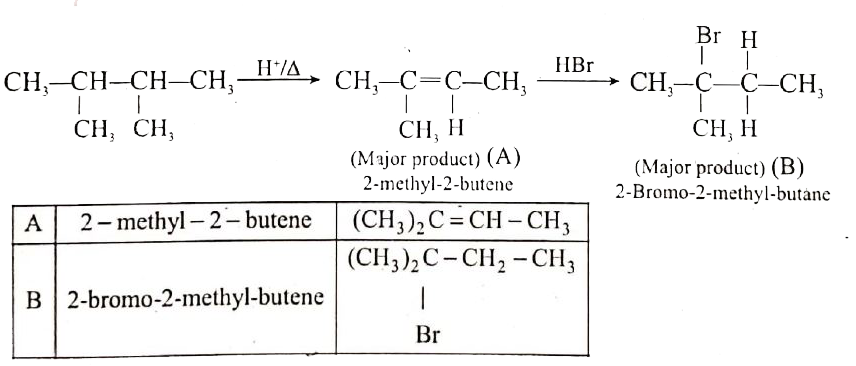 (ii) Step 1: Generation of `SO_(3)` electrophile : `2H_(2)SO_(4)toH_(3)O^(oplus)+SO_(3)+HSO_(4)^(Theta)` Step 2 : Attack of the electrophile on benzene RING to form areniumion:  Step 3: Rearomatisation of Arenium ion:  
|
|
| 48. |
I) CH_(3)-CH_(2)-CH_(2)CH_(2)-OHII) CH_(3)-CH_(2)-underset(OH)underset(|)CH-CH_(3)III) CH_(3)-underset(CH_(3))underset(|)overset(OH)overset(|)C-CH_(3) Among these , III is the chain isomer of |
|
Answer» I only |
|
| 49. |
(I) CH_(3)-CH_(2)-CH_(2)-CH_(2)- overset(overset(O)(||))(C )-H (II) CH_(3)-CH_(2)-CH_(2)- overset(overset(O)(||))(C )-CH_(3) (III) CH_(3)-CH_(2)- underset(underset(O)(||))(C )-CH_(2)-CH_(3) (IV) CH_(3)- underset(underset(CH_(3))(|))(C )H-CH_(2)- underset(underset(O)(||))(C )-H Which of the following pairs are position isomers? |
|
Answer» I and II (III) `CH_(3)-CH_(2) -UNDERSET(underset(O)(||))(C )-CH_(2)-CH_(3)` In these the POSITION of `-C = O` ketone is defferent. So they are position somer |
|
| 50. |
I. CH_(3)-CH_(2)-CH_(2)-CH_(2)-overset(O)overset(||)(C)-H II. CH_(3)-CH_(2)-CH_(2)-overset(O)overset(||)(C)-CH_(3) III. CH_(3)-CH_(2)-underset(O)underset(||)(C)-CH_(2)-CH_(3) IV. {:(CH_(3)-CH-CH_(2)-C-H),("|""||"),(""CH_(3)""O):} Which of the following are not functional group isomers ? |
|
Answer» II and III |
|