

Saved Bookmarks
This section includes 7 InterviewSolutions, each offering curated multiple-choice questions to sharpen your Current Affairs knowledge and support exam preparation. Choose a topic below to get started.
| 1. |
(i) The stability is explain by resonance effect and hyperconjugation. (ii) The resonance structure are drawn in resonance and hyperconjugation. (iii) Hyperconjugation is a bondless resonance. (iv) In resonance structure, there is movement of electron pair of only pi bond |
| Answer» SOLUTION :(i-T), (ii-F), (iii-T), (iv-F) | |
| 2. |
(i) The size of a weather balloon becomes larger and larger as it ascends up into larger altitude. (ii) Explain the graphical representation of Charles' law. |
|
Answer» Solution :(b) (i) The volume of the gas is inversely proportional to PRESSURE at a given temperature according to Boyle.s law. As the weather BALLOON ascends, the pressure tends to decrease. As as result, the volume of the gas inside the balloon or the size of the balloon is likely to increase. (ii) 1. Variation of volume of the gas sample with temperature at constant pressure. 2. Each line (ISO bar) represents the variation of volume with temperature at certain pressure. The pressure increase from `P_(1) " to " P_(5)`. 3. i.e. `P_(1) lt P_(2) lt P_(3) lt P_(4) lt P_(5)`. When these lines are extrapolated to ZERO volume, they intersect at a temperature of `-273.15^(@)C`. 4. All gases are becoming liquids, if they are cooled to sufficiently low temperature. 5. In other words, all gases occupy zero volume at absolute zero. So the voume of a gas can be measured over only a limited temperature RANGE. 
|
|
| 3. |
(i) The followig water gas shift reaction is an important industrial process for the production of hydrogen gas. CO(g)+H_(2)O(g)hArrCO_(2)(g)+H_(2)(g) At a given temperature K_(p)=2.7. If 0.13 mol of CO, 0.56 mol of water, 0.78 mol of CO_(2) and 0.28 mol of H_(2) are introduced into a 2L flask, find out in which direction must the reaction proceed to reach equilibrium. (ii) 2H_(2)O(g)hArr2H_(2)(g)+O_(2)(g)K_(c)=4.1xx10^(-48)" At 599 K" N_(2)(g)+O_(2)hArr2NO(g)K_(c)=1xx10^(-30)" at 1000 K" Predict the extent of the above two reactions. |
|
Answer» Solution :(i) `CO(g)+H_(2)O(g)hArrCO_(2)(g)+H_(2)(g)` Give `K_(p)=2.7` `[CO]=0.13" mol", [H_(2)O]=0.56" mol"` `[CO_(2)]=0.78" mol",[H_(2)]=0.28" mol"` `V=2L` `K_(p)=K_(c)(RT)^(Deltang)` `2.7=K_(c)(RT)^(0)` `K_(c)=2.7` `Q_(c)=([CO_(2)][H_(2)])/([CO][H_(2)O])=(((0.78)/(2))((0.28)/(2)))/(((0.13)/(2))((0.56)/(2)))` `Q=3` `QgtK_(c)`,Hence, the reaction proceed in the reverse direction. (ii) In the REACTIONS, decomposition of water at 500 K and oxidation of nitrogen at 1000 K the value of `K_(c)` is very less `K_(c)lt10^*(-3)`. So reverse reaction is favoured. `:.` Products `lt lt` reatants |
|
| 4. |
(i) The outermost electronic configuration of the atom of an element is 3s^(2)3p^(3). Mention its position of the element in the long periodic table. (ii) Why is electron gain enthalpy of oxygen less than that of sulphur. |
|
Answer» SOLUTION :(i) It is a p-block element. Hence its period no=principle quantum no. of the OUTERMOST shell=3 its group no=(total no. of ELECTRONS in s-and p-orbital)+10=2+3+10=15 (II) N/A |
|
| 5. |
(i) The purification of solid is by crystallisation. (ii) The crystalisation purify the solid and distillation is purify the solid. (iii) The liquid is purify by sublimation. (iv) To separate the mixture of ammonium chloride and sodium chloride, the distillation method is applied |
| Answer» SOLUTION :(i-T), (ii-F), (iii-F),(iv-F) | |
| 6. |
(i) The energy associated with the first orbit in the hydrogen atom is -2.18xx10^(-18)" J atom"^(-1). What is the energy associated with the fifth orbit ? (ii) Calculate the radius of Bohr's fifth orbit for hydrogen atom. |
|
Answer» Solution :(i) `E_(N)=- (2.18xx10^(-18))/n^(2) J :. E_(5)= - (2.18xx10^(-18))/5^(2) =-8.72xx10^(-20) J` (ii) For H-atom, `r_(n)=0.529xxn^(2) Å :. r_(5) =0.529xx5^(2)=13.225 Å=1.3225 NM` |
|
| 7. |
i) The formation of a cation from a neutral atom is favoured by small size of the atom ii) -bond does not exist between two atoms without o-bond iii) The formation of chemical bond isassociated with an increase in potential energy. The correct combination of the above statements is |
|
Answer» only i and II are CORRECT |
|
| 8. |
(i) The estimation of sulphur is detect by weight of BaSO_(4). (ii) The BaCl_(2) is added in estimation of sulphur (iii) The carius tube is used in estimation of sulphur. (iv) The magnesium mixture is added in estimation of sulphur |
| Answer» SOLUTION :(i-T), (ii-T), (iii-F), (iv-F) | |
| 9. |
(i) The electronic configuration of an atom is [Z](n-2)f^(14)(n-1)d^(1)ns^(2). What is the minimum position of the atom in the periodic table and correspondingly what is the atomic number of Z? (ii) Find the number of unpaired electrons in the atom of the element having atomic number 16. (iii) Which of the following ions does not obey Bohr's atomic theory? He^(2+),Li^(2+),B^(3+),Be^(3+). |
|
Answer» Solution :(i) electronic configuration of the given atom: `(n-2)f^(1-14)(n-1)d^(0-1)ns^(2)`. So, it can be stated that the given atom belongs to f-block. Hence, the ELEMENT is of group-III B and its electronic configuration is IDENTICAL with `""_(71)Lu` of the lanthanoids and `""_(103)Lr` of the ACTINOIDS. The lowest position available to the atom of the element is 6th period and group-IIIB(3). thus, it belong to the lanthanoids and has atomic number 71. (II) The electronic configuration of an atom of the element with atomic number 16 is `1s^(2)2s^(2)2p^(6)3s^(2)3p_(X)^(2)3p_(y)^(1)3p_(z)^(1)`. Thus, number of unpaired electrons is two. (iii) `B^(3+)` does not obey bohr's atomic theory because it is a 2-electron system. |
|
| 10. |
(i) The electronic configuration of an atom is one of the important factor which affects the value of ionization potential and electron gain enthalpy. Explain. (ii) Explain why cation are smaller and anions are larger in radii than their parent atoms? |
|
Answer» Solution :(i) 1. Electronic configuration of an atom affects the value of ionization potential and electron gain enthalpy. 2. HALF filled valence shell electronic configuration and completely filled valence shell electronic configuration are more stable than partially filled electronic configuration. 3. For e.g. Beryllium `(Z=4)1s^(2)2s^(2)`(completely filled electronic configuration) Nitrogen `(Z=7)1s^(2)2s^(2)2p_(x)^(1)2p_(y)1 2p_(z)^(1)` (half filled electronic configuration) Both beryllium and nitrogen have high ionization energy due to more stable nature. 4. In the case of beryllium `(1s^(2)2s^(2))`, nitrogen `(1s^(2)2s^(2)2p^(3))` the addition of extra electron will disturb their stable electronic configuration and they have almost zero electron affinity. 5. Noble gases have stable ns np configuration and the addition of further electron is UNFAVORABLE and they have zero electron affinity. (ii) A cation is smaller than the parent atom because it has fewer ELECTRONS while its nuclear charge remains the same. The size of anion will be larger than that of parent atom because the addition of one or more electrons would RESULT in increased repulsion among the electrons and a decrease in effective nuclear charge. |
|
| 11. |
(i) The boiling point of chloroform and aniline are 334K and 457K respectively. (iii) The vapour of chloroform is obtained ofter aniline in distillation. (iv) Chloroform is more volatile than aniline |
| Answer» SOLUTION :(i-T), (ii-T), (iii-F), (iv-T) | |
| 12. |
(i) Suggest a simple chemical test to distinguish propane and propane. (ii) Write a notes on Wurtz-fitting reaction. |
|
Answer» Solution :(i) CHEMICAL test to DISTINGUISH between propane and propene Bromine WATER test: Propene contains double bond, therefore when we pour the bromine water to propene sample, it decolourises the bromine water whereas propane which is a saturated hydrocarbon does not decolourise the bromine water. Baeyer.s test: When propene reacts with Bayer.s reagent it gives 1,2 dihydroxypropene. Propane does not react with Baeyer.s reagent. (a) `underset("Propene")(CH_(3)-CH=CH_(2))underset(H_(2)O,(O))overset(KMnO_(4)|Ooverset(Theta)(H))tounderset(("1,2-dihydroxy propene"))(CH_(3)-underset(OH)underset(|)(C)H-underset(OH)underset(|)(C)H_(2)` (b) `underset("Propene")(CH_(3)-CH_(2)-CH_(3))underset(H_(2)O,(O))overset(KMnO_(4)|Ooverset(Theta)(H))to`No reaction (ii) When a solution of bromobenzene and iodomethane in dry ether is treated with metallic sodium, toluene is formed. `underset(("Bromo benzene"))(C_(6)H_(5)Br)+2Na+underset("Iodomethane")(ICH_(3))overset("dry ether")to underset(("Toluene"))(C_(6)H_(5)CH_(3))+NaBr+NaI` |
|
| 13. |
(i) State the trends in the variation of electronegativity in period and group. (ii) The electron gain enthalpy of chlorine is 348" kJ mol"^(-1). How much energy in kJ is released when 17.5 g of chlorine is completely converted into Cl^(-) ions in the gaseous state ? |
Answer» Solution :(i) Variation of electronegativity in a PERIOD : The electronegativity increases across a period from left to right. Since the atomic radius decreases in period, the attraction between the valence electron and the nucleus increases. Hence the tendency to attract shared pair of ELECTRONS increases. Therefore, electronegativety increases in a period. 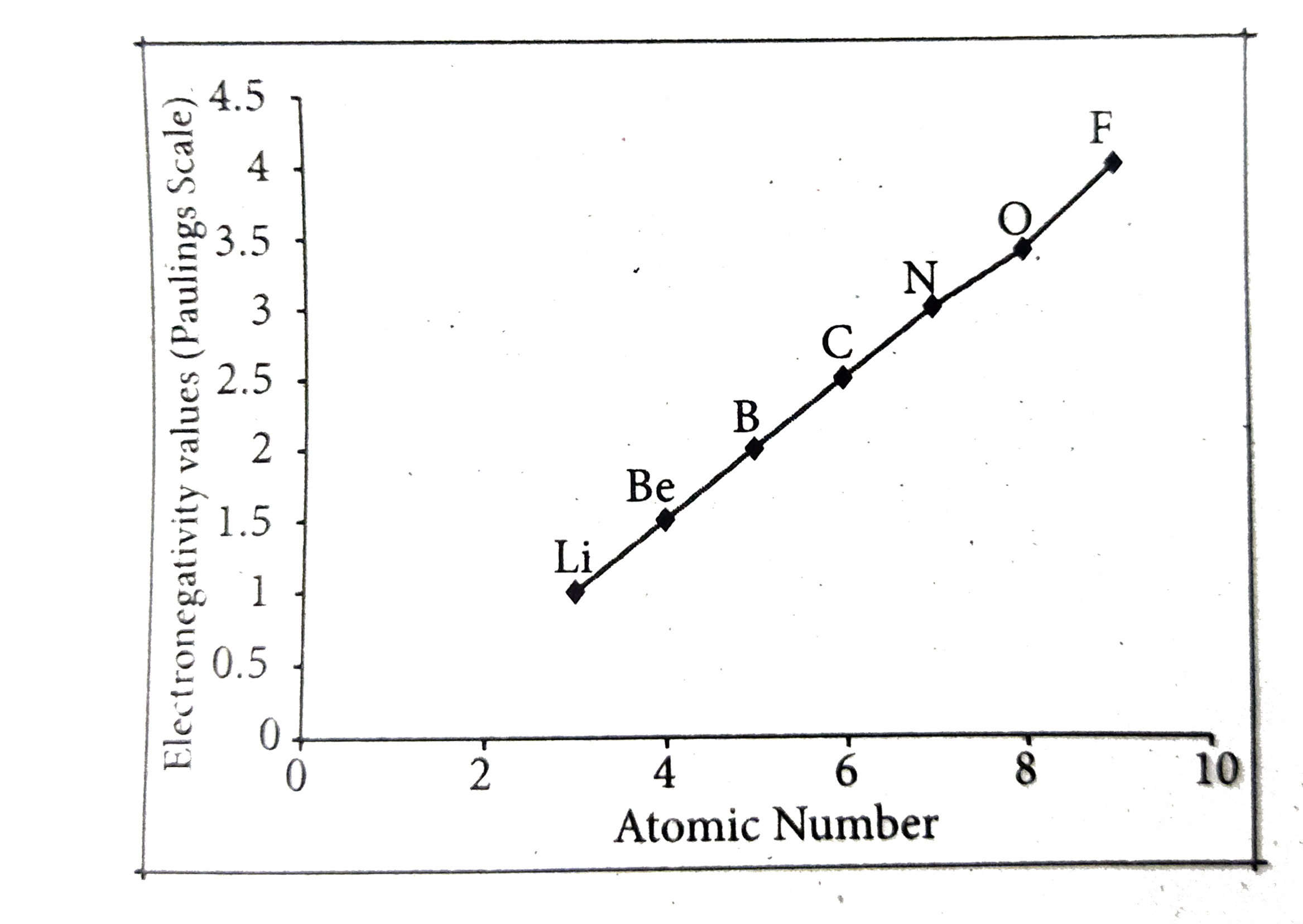 Variation of electronegativity in a group : The electronegativity decreases down FORCE on the valence electron decreases. Hence electronegativity decreases in a group. Variation of electronegativity in a group : The electronegativity decreases down FORCE on the valence electron decreases. Hence electronegativity decreases in a group. 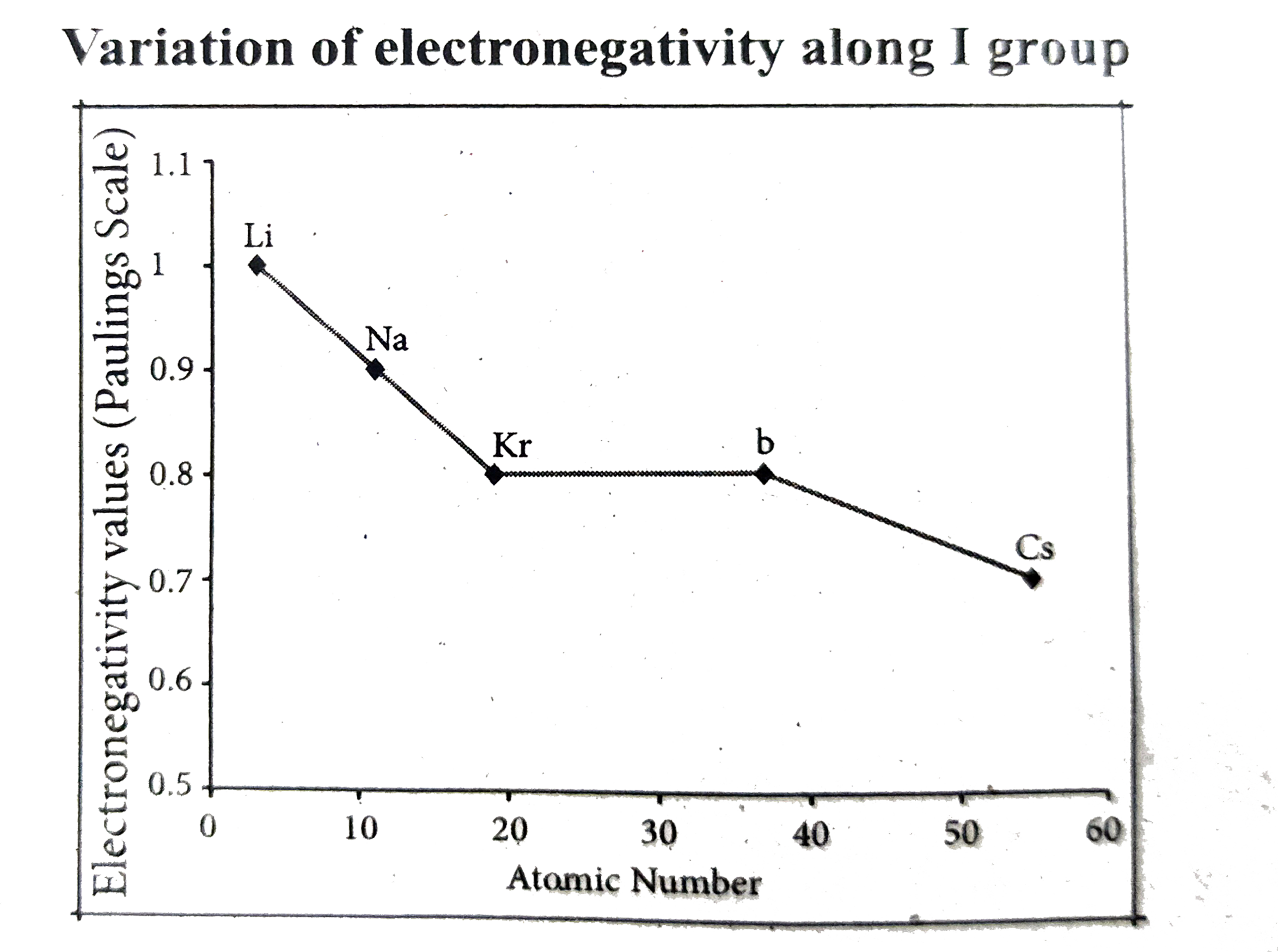 (II) `Cl(g)+e^(-)toCl^(-)(g)DeltaH=348" kJ mol"^(-1)` for ONE mole (35.5g) 348 kJ is released. `:.` For 17.5g chlorine `(348" kJ")/(35.5cancel(g))xx17.75cancel(g)` energy leased. `:.` The amount of energy released `=(348)/(2)=174kJ`. |
|
| 14. |
(i) State the group number in modern periodic table where solid, liquid and gaseous elements are present at room temperature. Identify solid, liquid element. (ii) Indicate the given elements as alkali metal, alkaline-earth metal, coinage metal, chalcogen: Li, Ca, S,Cu. |
|
Answer» Solution :(i) Group-17 of modernn PERIODIC table contain solid (iodine `I_(2)`), liquid (bromine, `Br_(2)`) and GASEOUS (chlroine, `Cl_(2)`) elements as the same time. (II) Li-alkali METAL, Ca-alkaline earth metal, S- chalcogen, Cu-coinage metal. |
|
| 15. |
State the third law of thermodynamics. |
|
Answer» Solution :(b) (i) (1) The third law of thermodynamics states that the entropy of pure crystalline substance at absolute zero is zero . (2) It can also be stated as it is IMPOSSIBLE to lower the temperature of an object to absolute zero in a FINITE number of STEPS. (3) Mathematically, `underset (Trarr0) lim` S=0 for a PERFECTLY ordered crystalline state. |
|
| 16. |
(i) Solubility of a solid solute in a liquid solvent increase with increase in temperature. Justify this statement. (ii) Explain How non-ideal solutions shows positive derivation from Raoult's law. |
|
Answer» Solution :(a) (i) When the temperature is increased, the average kinetic energy of the molecules of the solute and the solvent increases. The increase in the kinetic energy facilitates the solvent molecules to break the intermolecular attractive forces that keep the solute molecules together and hence the solubility increases. (ii) 1. Let us consider the positive deviation shown by a solution of ethyl alcohol and water 2. In this solution, the hydrogen bonding interaction between ethanol and water is weaker than those hydrogen bonding interactions AMONGST themselves (ethyl alcohol -ethyl alcohol and water -water interaction). 3. This RESULTS in the increased evaporation of both components from the aqueous solution of ethanol. 4. Consequently, the vapour pressure of the solution is GREATER than the vapour pressure PREDICTED by Raoult.s law 5. Here, the mixing process is endothermic i.e., D Hmixing `gt 0` and there will be a slight increase in volume (DV mixing `gt 0`) 6. 
|
|
| 17. |
(i) Silanes are good reducing agnet(ii) SiO_(2) is a giant tetrahedral polymer (iii) SnCl_(4) acts as bronsted base |
|
Answer» I and III are TRUE |
|
| 18. |
(i) Define solution. (ii) Explain the types of solutions with suitable example. |
|
Answer» Solution :(i) A solution is a HOMOGENEOUS MIXTUREOF two or more substances, CONSISTING of atoms, IONS or molecules. (II) Types and examples of solution.  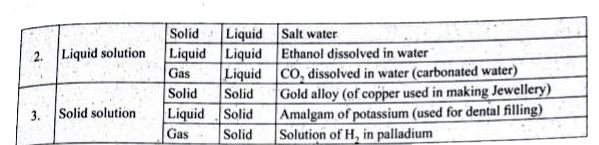
|
|
| 19. |
I^(-) reduces SO_(4)^(2-) to H_(2)S in acidic medium as per the reaction, 8KI+5H_(2)SO_(4) to 4K_(2)SO_(4)+4I_(2)+H_(2)S+4H_(2)O to produce 34.0 g H_(2)S, volume of 0.20 (M) H_(2)SO_(4) required is- |
|
Answer» 25.0 L |
|
| 20. |
(i) Positive and negative ion are formed by homolytic cleavage of covalent bond. (ii) Positive and negative ion formed by heterolytic cleavage of covalent bond. (iii) Only homolytic cleavage is possible in C-C -Cl bond of CH_(3)-Cl (iv) If the heterolytic cleavage of bond then there are ionic or polar types reaction occurs in it |
| Answer» SOLUTION :`(i-F), (ii-T), (iii-F), (iv-T)` | |
| 21. |
(i) Pb(NO_(3))_(2) on strong heating loses 32.6% of its mass. Calculate the relative atomic mass of Pb. (ii) 1 volume of a gaseous compoundd comosed of C, H and N, on combustion in air produces 3 volumes CO_(2), 4.5 volumes water vapour and 0.5 volumes N_(2) gas. find the molecularr formula of the compound. [all volumes are measured under identiacl conditions of temperature and pressure]. |
|
Answer» Solution :(i) Let, relative ATOMIC mass of Pb=x. `underset(x+2(14+3xx16)g=(x+124)g)(Pb(NO_(3))_(2)) overset(DELTA)to underset((x+16)g)(PbO)+2NO_(2)+O_(2)` On DISSOCIATION of (x+124)g of `Pb(NO_(3))_(2)`, the weight decreases =`(x+124-x-16)g=108g` So, for 100g `Pb(NO_(3))_(2)`, the weight decreases `=((108xx100)/(x+124))g` As, `(100xx108)/(x+124)=32.6` or, x=207.3 (ii) N/A |
|
| 22. |
(i) overset(+)(C )H_(3) and CH_(3) overset(+)(C )H_(2) both are primary carbocation. (ii) (CH_(3))_(3) overset(+)(C ) is a tertiry carbocation and all carbon are sp^(3) (iii) overset(+)(C )H_(3) is a trigonal planar (iv) CH_(4) is not a trigonal planar |
| Answer» SOLUTION :`(i-T), (ii-F), (iii-T), (iv-T)` | |
| 23. |
(i) Organic compound is first synthesised by F. Wohier (ii) Berzeiius stated that some mysterious force existing in the living organism. (iii) In 1882 Wohler prepared organic compound from inorganic compound at that time vital force they accepted. (iv) Kolbe prepared methane and Berthelot prepared acetic acid |
| Answer» SOLUTION :`(i-T), (ii-T), (iii-F), (iv-F)` | |
| 24. |
(i) Only carbocation form by homolytic cleavage of bond. (ii) By heterolytic cleavage of bond, the carbocation or carbanion are formed. (iii) The carbon of carbanion is sp^(2) and carbon of carbocation is sp^(3). (iv) Carbon of carbanion is sp^(3) and carbon of carbocation is sp^(2) |
| Answer» SOLUTION :`(i-F), (ii-T), (iii-F), (iv-T)` | |
| 25. |
(i) NH_(3) and HCl do not obey Henry's law why ? Write the structure of the following compounds (A) NH_(3) (B) BF_(3) |
Answer» Solution :Only the LESS soluble gases obeys Henry.s law. `NH_3` and HCI REACT with ( or soluble) water and HENCE does not obey Henry.s law. 
|
|
| 26. |
(I) (Na_(2)S+I_(3)^(-))+ Na_(2)SO_(3) underset("Boil")rarr Compound [A] +2NaI (II){:(A(aq)+AgNO_(3)rarr,"White ppt"[B]("unstable")),(,""darr"Turning dark on standing"),(,"Black compound"[C]):} (III) {:(A(aq)+FeCI_(3)rarr,"Dark-violet colouration"[E]),(,""darr),(,[F]"colour disappears on standing"):} The correct statement about the above observations is/are: |
|
Answer» Aqueous solution of 'A' on treatment with `AgNO_(3)` gives 'B' white ppt. of `Ag_(2)S_(2)O_(3)` |
|
| 27. |
I. NaHCO_(3) lt KHCO_(3) lt CsHCO_(3) order of solubility II . K_(2)CO_(3) lt Rb_(2) CO_(3) lt Cs_(2) CO_(3) : order of solubility III . KF lt KCl lt KBr lt KI : thermal stability order IV . Li_(3)N lt Na_(3)N gt K_(3)N : thermal stability order Consider the above statements and arrange in the order of true/false as given in the codes : |
|
Answer» TTTT |
|
| 28. |
(I) (Na_(2)S+I_(3)^(-))+ Na_(2)SO_(3) underset("Boil")rarr Compound [A] +2NaI (II){:(A(aq)+AgNO_(3)rarr,"White ppt"[B]("unstable")),(,""darr"Turning dark on standing"),(,"Black compound"[C]):} (III) {:(A(aq)+FeCI_(3)rarr,"Dark-violet colouration"[E]),(,""darr),(,[F]"colour disappears on standing"):} Compound 'A' is: |
|
Answer» `Na_(2)SO_(4)` |
|
| 29. |
(i) N_(2)(g)+O_(2)(g)hArr2NO(g), K_(1) (ii) ((1)/(2))N_(2)(g)+((1)/(2))O_(2)(g)hArrNO(g), K_(2) (iii) 2NO(g)hArrN_(2)(g)+O_(2)(g), K_(3) (iv) No(g)hArr((1)/(2))N_(2)(g)+((1)/(2))O_(2)(g), K_(4) Correct relation between K_(1),K_(2),K_(3) "and" K_(4) is//are: |
|
Answer» `K_(1)xxK_(3)=1` |
|
| 30. |
(i) N_(2)O_(4)(g) hArr 2NO_(2)(g) This reaction is carried out at 298 K and 20 bar. 5 moleseach of N_(2)O_(4) and NO(2) are taken initially . Given DeltaG_(N_(2)O_(4))^(@)= 100 kJ mol^(-1) , Delta G_(NO_(2))^(@)= 50 kJ mol^(-1) Find DeltaG for the reaction at 298 K under given condition . (ii) The reaction procees at an initial pressure of 20 bar. Find the direction in which the reaction proceedsto achieve equilibrium. |
|
Answer» Solution :(i) For the given reaction, `DeltaG^(@) = Delta_(f) G^(@) ` ( Products) `- Delta_(f)G^(@) `( Reactants) `= 2 xx 50 - 100 = 0` `DeltaG^(@)= - 2.303 RT log K_(p)` ,BRGT `:.log K_(p ) = 0, i.e.,K_(p) =1` Initially, as equal moles of `N_(2) O_(4)` and `NO_(2)` are taken, `p_(N_(2)O_(4))= p_(NO_(2))= 10` bar( `:'` total pressure `= 20 ` bar ) `:. Q_(p)` ( Initial) `= ( p_(NO_(2))^(2) )/p_(N_(2)O_(4)) = ((" 10 bar")^(2))/(1"10 bar" ) = 10 `bar Initial free energy of the reaction will be `DeltaG= DeltaG^(@) + 2.303 RT log Q_(p) ` `= 0 + ( 2.303 ) * 8.314 JK^(-1) MOL^(-1) ) ( 298 K ) ( log 10)` ` = 5705.8 Jmol^(-1) = 5.706 kJ mol^(-1)` (ii) As the initial Gibbs free energy change of the reaction is positive, so the reverse reaction will take PLACE. |
|
| 31. |
(i) Molecular formula of Anisole: C_(6)H_(5)OCH_(3) (ii) Acetone is a simple name of CH_(2)COCH_(3) (iii) Molecular formula of benzene is C_(6)H_(5) (iv) Formula of C_(2)H_(6) is methane (v) The formula of pentane and propane are C_(3)H_(8) and C_(5)H_(12) receptivity |
| Answer» SOLUTION :`(i-T), (ii-F), (iii-F), (iv-F), (v-F)` | |
| 32. |
One mole of A (g) is heated to 200^@ C in a one litre closed flask, till the following equilibrium is reached.A(g) leftrightarrow B(g)The rate of forward reaction, at equilibrium, is 0.02mol L^(-1) mi n^(-1). What is the rate (inmol L^(-1)mi n^(-1)) of the backward reaction at equilibrium? |
Answer»  `[B]=x=0.5 implies [A]=0.5` `K=(K_(f))/(K_(b))=(0.5)/(0.5)=1` `implies K_(b)=K_(f)=0.02=2xx10^(-2)` |
|
| 33. |
(i) MnO_(4)^(-) +Sn^(2+)to Mn^(2+)+Sn^(4+) |
Answer» Solution : EQUALISE the increase/ decrease in O.N by multiplying the oxidant and REDUCTANT by suitable numbers. `2MnO_(4)^(-) +5Sn^(2+) to 2Mn^(2+)+5Sn^(4+)` Balance all other atoms exceptO and H `2MnO_(4)^(-) +5Sn^(2+)to 2Mn^(2+)+5Sn^(4+)` Balance O atom by adding water on the SIDE falling short of oxygen atoms. `2MnO_(4)^(-)+5Sn^(2+) to 2Mn^(2+) +Sn^(4+)+8H_(2)O` Balance H atom by adding `H+` on the side falling short of hydrogen atoms. `2MnO_(4)^(-)+5Sn^(2+) 16 H^(+) to 2Mn^(2+) +5Sn^(4+)+8H_(2)O` |
|
| 34. |
(i) Mention two conditions for the linear combination of atomic orbitals. (ii)Write the electronic configuration of C_(2) moleuclar. What is its magnetic property? |
|
Answer» Solution :a. the combining ATOMIC orbitals must have the same or nearly the same ENERGY b. The combining atomic orbitals must have the same symmetry about the molecular axis. c. The combining atomic orbitals must everlap to the maximum extent. It is diamagnetic E.C. of `C_(2)` moleucle is `SIGMA 1s^(2) sigma***1s^(2) sigma 2s^(2) sigma *** 2s^(2) pi 2px^(2)=pi2py^(2)` |
|
| 35. |
(i) Mention the names of most electropositive and most electronegative stable elements in the periodic table. (ii) What is metalloid? Give one example. |
| Answer» Solution :(i) Most ELECTROPOSITIVE STABLE ELEMENT of periodic table is CESIUM (Cs) and the most electronegative stable element or periodic table is FLUORINE (F), (ii) N/A | |
| 36. |
(i) Mention any two anomalous properties of second period elements. (ii) Arrange Na^(+), Mg^(2+) and Al^(3+) in the increasing order of ionic radii. Gove reason. |
|
Answer» Solution :(i) Anomalous properties of SECOND period elements: 1. In the `1^(st)` group, lithium forms compounds with more covalent character while the other elements of this group form only ionic compounds. 2. In the `2^(nd)` group, beryllium forms compounds with more covalent character while the other elements of this family form only ionic compounds. (ii) `Na^(+), Mg^(2+)` and `Al^(3+)` are ISOELECTRONIC cations.  The CATION with the greater positive charge will have a smaller radius because of the greater ATTRACTION of the electrons to the nucleus. Hence the increasing order of ionic radii is, `r_(Na^(+)) gt r_(Mg^(2+)) gt r_(Al^(3+))`. |
|
| 37. |
(I) M+H_(2)SO_(4)to............+............ (where M=Group -i elements) (II) M_HCl to..........+............ (whereM=graup-Ielements) |
| Answer» | |
| 38. |
(i) Lithium forms monoxide with oxygen whereas sodium forms peroxide with oxygen why ? (ii) Write about the uses of strontium. |
|
Answer» Solution :(i) 1. The fact that a small cation can stabilize a small anion and a large cation can stabilize a large anion explains the formation and stability of the oxides. 2. The size of `Li^(+)` ion is very small and it has a strng POSITIVE field around it. If can combine with only small anion `O^(2-)` ion, resulting in the formation of monoxide `Li_(2)O`. 3. The `Na^(+)` ion is a larger cation and has a week positive field around it and can stabilize a bigger peroxide ion, `O_(2)^(2-)` or `[-O-O-]^(2-)` resulting in the formation of peroxide `Na_(2)O_(2)`. (ii) 1. `.^(90)"Sr"` is used in cancer therapy. 2. `.^(87)"Sr"//.^(86)` Sr ratio is used in marine investigators as well in teeth, TRACKING animal migrations or in criminal forensics. 3. Dating of rocks. 4. Strontium is used as a radioactive tracer in dterminining the source of archaeological materials such as timbers and coins. |
|
| 39. |
(i) LiCIO_(4) is more solublethan NaCIO_(4) Why? (ii) Explain-IE_(1) of alkaline earth metals are higher than that of alkali metal. |
|
Answer» Solution :(i) The small size of the `Li^(+)`ion means that it has a very high ENTHALPY of hydrogen and so lithium salts are much more soluble than the salts ofother group `LiCIO_(4)` is upto 12 times more soluble than `NaCIO_(4)` (ii) `IE_(1)` of alkaline earth metals`gtIE_(1)` of alkali metals . 2.`IE_(2)` of alkaline earth metals`ltIE_(2)` of alkali metals . 3. This occurs because in alkali metals the SECOND ELECTRON is to be removed from a cation which has already acquired a noble gas configuration. 4. In the case of alkaline earth metals, the second electron is to be removed from a monovalent cation, which still has one electron in the outermost shell. 5. Thus, the second electron can be removed more easily in the case of group 2 ELEMENTS than in group 1 elementss. |
|
| 40. |
(i) Is it possible to prepare methane by kolbe's electrolyte method. (ii) Explain how 2-butyne reacts with (a) Lindlar's catalyst (b) Sodium in liquid ammonia. |
|
Answer» Solution :(a) (i) Kolbe.s electrolytic method is SUITABLE for the preparation of symmetrical alkanes, that is alkanes containing even number of carbon atoms. Methane has only one carbon, hence it cannot be prepared by Kolbe.s electrolytic method. (ii) (a) 2-butyne reacts with Lindlar.s catalyst: 2-butyne can be reduced to cis-2 butene USING `CaCO_(3)` supported in Pd-metal partially deactivated with sulphur. This reaction is stereo specific giving only the cis-2butene.  (b) 2-butyne reacts with sodium in liquid ammonia: 2-butyne can ALSO be reduced to trans-2-butene using sodium in liquid ammonia. This reaction is stereospecific giving only the trans-2-butene. 
|
|
| 41. |
(i) In a period, atomic radius decreases and ionization enthalpy increases with the increase in atomic number of elements. (ii) Electronegativity increases with increase in atomic radius. (iii) Metallic properly decreases with decrease in electronegativity. (iv) Atomic radius generally increases with increase in metallic property of elements.If (T) stands for true and (F) for false statement the which-one from following is. true for above statements. |
|
Answer» TFFT (i) `LHS to RHS` ` to ` ATOMIC RADIUS decreases `to` ` :. ` Ionisation ENTHALPY increase ` :. ` (i) Is True (ii) In a Period : LHS to RHS Electronegativity increaes but in group decreaes. ` :. ` (ii) is False e.g. Li (1.0), Be (1.5) , B (2.0) , C (2.5), N (3.0) , O (3.5) F(4.0) in the period. (iii) Metallic property increases with decrease in electronegativity. ` :. ` (iii) is False (iv) Atomic radius generally increases with increase in metallic property eg. `Li to Na to K to Rb` elements in group and `F to O to N to C to Be to Na` in a Period. ` :. (iv) ` is True |
|
| 42. |
(i)In sulphur estimation , 0.157 g of organic compound gave 0.4813 g of BaSO_(4). What is the percentage of sulphur in organic compound ? (ii) 0.092 g of organic compound heating is carius tube and susequent ignition gave 0.111 g of Mg_(2)P_(2)O_(7) . calculate the percentage of phosphorus in organic compound. |
|
Answer» Solution :(i) Mass of `BaSO_(4) `=0.4813 g , mass of ORGANIC COMPOUND =0.157 g % S `=(32xxW_(BaSO_(4))XX100)/(233xxW_("Substance"))=(32xx0.4813xx100)/(233xx0.157) =42.10` (ii) Mass of organic compound =0.092 g , mass of `Mg_(2)P_(2)O_(7) `=0.111 g % of P =`(62xxW_(Mg_(2)P_(2)O_(7))xx100)/(22xxW_("Substance"))=(62xx0.111xx100)/(222x0.092)=33.69` |
|
| 43. |
(i) Identify less stable resonance structure and (ii) Give its reason in the following pairs. |
|
Answer» SOLUTION :(a) Structure (II) is less STABLES because there is the separation of CHARGE in it. (b) Structure (I) is less STABLE because there is the sepration of charge in it (c ) Structure (I) and (II) are equal stable because both have same structure. (d) Structure (I) is less stable because there is the separation of charge in it. (e ) Structure (II) is less stable because there is the separation of charge in it. |
|
| 44. |
(i) How would you define the terms atomic mass and molecular mass ? (ii) Nitrogen occurs in nature in the form of two isotopes with atomic masses 14 and 15 respectively. If the average atomic mass of nitrogen is 14.0067, what is the percent abundance of the two isotopes ? |
|
Answer» Solution :(ii) Suppose the percentage of `N^(14)`isotope is x `therefore` The percentage of `N^(15) = 100-x` The AVERAGE ATOMIC mass of nitrogen is 14.0067 `therefore 14.0067 = ((14 xx x) + 15(100-x))/100` which GIVES `x=99.33` Hence, the abundance of `N^(14)` isotope is 99.33% while that of `N^(15)` isotope is: `=10099.33 = 0.67 %` |
|
| 45. |
(i) How will you distinguish between electrophiles and nucleophiles? (ii) Complete the following reactions and identify the products ? |
Answer» Solution :(b) (i)  (ii) (a) `underset(("BROMO ETHANE"))(CH_(3) - CH_(2) - Br)overset(alc. KOH)rarr underset(("ETHYLENE"))(CH_(32) = CH_(2) + KBr + H_(2)O)` (b) `underset(("Bromo ethane"))(CH_(3) - CH_(2) - Br) overset(aq. KOH)(rarr) underset(("Ethanol"))(CH_(3) - CH_(2) - OH + KBr)` |
|
| 46. |
(i) How many unpaired electrons are present in the ground state of Fe^(3+) (z=26), Mn^(2+) (z=25) and argon (z=18)? Explain about the significane of de Broglie equation. |
|
Answer» Solution :(i) `Fe rarr Fe^(3+) + 3e^(-)` Fe(Z = 26)`Fe^(3+)` = number of electrons = 23 `2S^(2)2s^(2) 2p^(6) 3s^(2) 3p^(6) 3d^(6) 4s^(2)` for Fe atom. `1s^(2) 2s^(2) 2p^(6) 3s^(2) 3p^(6) 3d^(5)` for `Fe^(3+)` ion. So, it contain 5 UNPAIRED electrons. Mn (Z = 25). Electronic configuration is `1s^(2) 2s^(2) 2p^(6) 3s^(2) 3p^(6) 4s^(2) 3d^(5)` `Mn rarr Mn^(2+) + 2e^(-)` Number of unpaired electrons in `Mn^(2+) = 5` Ar (Z = 18). Electronic configuration is `1s^(2) 2s^(2) 2p^(6) 3s^(2) 3p^(6)` All orbitals are completely filled. So, no unpaired electrons in it. (ii) Significance of de Broglie equation: 1. `lamda = (h)/(mv)`This equation IMPLIES that a moving particle can be considered as a wave and a wave can exihibit the properties of a particle. 2. For a particle with high linear momentum (mv) the wavelength will be so small and cannot be observed. 3. For MICROSCOPIC particle such as an electron, the mass is the order of `10^(-31)` kg, hence the wavelength is much larger than the size of atom and it becomes significant. 4. For the electron, the de Broglie wavelength is significant and measurable while for the iron ball it is too small to MEASURE, hence it becomes insignificant. |
|
| 47. |
(i) How many radial nodes for 2s, 4p, 5d and 4f orbitals exhibit? How many angular nodes? (ii) How many unpaired electrons are present in the ground state of (a) Cr^(3+)+(Z = 24) (b) Ne (Z = 10) |
|
Answer» Solution :(i) Formula for total number of nodes = n-1 For 2s orbital: Number of radial nodes = 1. For 4p orbital: Number of radial nodes = n-1-1. = 4-1-1 = 2 Number of angular nodes = l `therefore` Number of angular nodes - 1. So, 4p orbital has 2 radial nodes and 1 angular NODE. For 5d orbital: Total number of nodes = n-1 = 5-1 = 4 nodes Number of radial nodes = n-l-1 = 5-2-1 = 2 radial nodes. Number of angular nodes = l = 2 `therefore` 5d orbital have 2 radial nodes and 2 angular nodes. For 4f orbital: Total number of nodes = n-1 = 4-1 = 3 nodes Number of radial nodes = n-l-1 = 4-3-1 = 0 node. Number of angular nodes =l = 3 nodes `therefore` 4f orbital have 0 radial node and 3 angular nodes. (II) (a) `Cr (Z=24)1S^(2)2s^(2)2P^(6)3s^(2)3p^(6)3d^(5)4s^(1)` `Cr^(3+)-1s^(2)2s^(2)2p^(6)3s^(2)3p^(6)3d^(4)`. It contains 4 unpaired electrons. (b) `Ne(Z=10)1s^(2)2s^(2)2p^(6)`. No unpaired electrons in it. |
|
| 48. |
(i) How many orbits are possible for n=4? (ii) What are the limitations of bohr's model of an atom? |
Answer» Solution :(i)If n=4, the possible numbers of orbitals are calculated as follows. 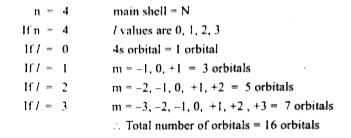 (ii) Limitations of Bohr.s atom model: 1. The bohr.s atom model is applicable only to SPECIES having one election such as hydrogen `Li^(2+)` etc and not applicable to multi-election atoms. 2. It was UNABLE to elpanation the splitting of SPECTRAL lines the presence of magnetic field (zeemeffect) or an electic field (STARK effect). 3. Bohr.s theory was unable to explan why the ELECTRON is restriced to revolve around the nucleus in a fixed orbit in which the anguler momentum of the electron is equal to `nh//2pi`. |
|
| 49. |
(i) How does Huckel rule help to decide the aromatic character of a compound? (ii) Draw cis-trans isomers for the following compounds (a) 2-chloro-2-butene (b) CH_(3)-C CI=CH-CH_(2)CH_(3) |
|
Answer» SOLUTION :(i) A compound is said to be aromatic, if it obeys the following rules: 1. The molecule MUST be cyclic. 2. The molecule must be co-planar. 3. Complete delocalisation of r-electrons in the ring. 4. Presence of `(4n+2)pi` electrons in the ring where n is an integer (n-0,1,2 ...) This is known as Huckel.s RULE.  (i) It is cyclic ONE. (ii) It is a co-planar molecule. (iii) It has six delocalised 7 electrons. (iv) 4n+ 2 = 6 4n = 6-2 4n = 4 implies n=1 It obey Huckel.s rule, with n = 1, hence benzene is aromatic in nature. (ii) (a) 2-Chloro-2-butene: 
|
|
| 50. |
(i) How inductive effect helps to explain reactivity and acidity of carboxylic acids? (ii) HCOOH is more acidic than CH_(3)COOH. Why? |
|
Answer» Solution :(i) Reactivity of carboxylic acid: 1. When a highly electronegative atom such as halogen is attached to a carbon then it makes the C-X bond polar. 2. In such CASES the -I effect of halogen facilitates the attack of an incoming nucleophile at the polarized carbon and hence INCREASES the reactivity.  3. If a -I group is attacher neared to a carbonyl carbon, it decreases the availability of electron density on the carbonyl carbon and hence increases the rate of the nucleophilic addition reaction. Acidity of carboxylic acid: 1. When a halogen atom is attached to the carbon which is neared to the carboxylic acid group, its -I effect withdraws the bonded electrons towards itself and makes the ionization of `H^(+)` easy. 2. The acidity of various chloro acetic acid is in the following order. `Cl_(3)C-COOH gt Cl_(2)CHCOOH gt ClCH_(2)COOH` The strength of the acid increases with INCREASE in the -effect of the group attached to the carboxyl group. 3. Similarly the following order of acidity in the carboxylic acids is due to the +I effect of alkyl group. `(CH_(3))_(3)C COOH lt (CH_(3))_(2)CHCOOH lt CH_(3)COOH`. (ii) `underset(("formic acid"))(H-overset(O)overset(||)(C)-O-H)""underset(("Acetic acid"))(CH_(3)-overset(O)overset(||)(C)-O-H)` Out of acetic acid and Formic acid, formic acid is conidered stronger because, `CH_(3)` group in acetic acid contributes electron density towards the O-H bond, making it harder to remove the `H^(+)` ion and making acetic acid a WEAKER acid that formic acid. `therefore`Formic acid is more acidic one. |
|