Saved Bookmarks
This section includes 7 InterviewSolutions, each offering curated multiple-choice questions to sharpen your Current Affairs knowledge and support exam preparation. Choose a topic below to get started.
| 1. |
Identify the wrong statement. |
|
Answer» AMONGST the isoelectronic species, smaller the positive charge on cation, smaller is the ionic radius |
|
| 2. |
Identify the worn statement in the following |
|
Answer» OZONE layer does not perit infrared radiation from the sun to reach the earth |
|
| 3. |
Identify the valence electron for CO_(3)^(2-) |
|
Answer» Solution :VALENCE electrons of `C= 4` , Valence electrons of `3 - 0 = 3 XX 6 = 18` unit negative charge = 2 ` :. ` Total number of valence electrons ` = 4 + 8 + 2 = 24`. |
|
| 4. |
Identify the type of redox reaction taking place in the following . 2overset(+1)Koverset(+5)CIoverset(-2)O_(3_((s)))to2overset(+1)Koverset(-1)CI_((s))+3overset(0)O_(2_((g))) |
| Answer» SOLUTION :DECOMPOSITION REACTION | |
| 5. |
Identify the type of reaction. (i) HCHO + HCN rarr CH_(2)(OH)CN (ii) CH_(3)Cl+KOH_((aq))rarrCH_(3)OH+KCl (iii) CH_(3)N=NCH_(3)overset(Heat)rarrCH_(3)-CH_(3)+N_(2) (iv) CH_(3)CH(Br)-CH(Br)-CH_(3)ZnrarrCH_(3)CH=CHCH_(3)+ZnBr_(2) |
|
Answer» (i) SUBSTITUTION, (ii) ADDITION, (iii) Elimination, (iv) Elimination |
|
| 6. |
Identify the type of isomerism exhibited by the following compounds ? C_5H_12 |
| Answer» SOLUTION :CHAIN ISOMERISM. | |
| 7. |
Identify the type of isomerism exhibited by the following compounds ?CH_3 - CH = CH - CH_2CH_3 |
| Answer» SOLUTION : GEOMETRICAL ISOMERISM and POSITION isomerism | |
| 8. |
Identify the type of energy change (ionization energy, energy of atomization, etc) show by each of these steps in the Born Haber cycle for potassium chloride. State with a reason whether the step is exothermic or endothermic. a) 1//2 CI_(2)(g) rarr CI(g) "" b) CI(g) rarr CI^(-)(g) ""c) K(s) rarr K (g) d) K(g) rarr K^(+) (g) + e^(-) "" e) K (s) +1//2 CI_(2) (g) rarr KCI (s) "" f) KCI (s) rarr K^(+) (g) + CI^(-) (g) |
|
Answer» Solution :(a)half of bond enthalpy(b) First electron affinity (c) Enthalpy of atomization(d) First IONIZATION ENERGY ( E) Enthalpy of formation(F) Lattice enthalpy - ENDOTHERMIC |
|
| 9. |
Identify the type of isomerism exhibited by the following compounds ? CH_3CH_2CH_2CH_3 |
| Answer» SOLUTION :CHAIN ISOMERISM | |
| 10. |
Identify the type of hybridisation present in c-atoms of diamond. |
|
Answer» Solution :The electronic configuration of CARBON is `1s^(2)2s^(2)2P^(2)` (ie) the valence electrons spread in s and p orbitals. In ORDER to create B COVALENT bonds in diamond, one s- orbital mixes with three p - orbitals to form `sp^(3)` hybridisation . |
|
| 12. |
Identify the substances undergoing oxidation and reduction in the following reactions. SO_(2)+2H_(2)Sto2H_(2)+3S |
| Answer» Solution :`H_(2)S` is UNDERGOING OXIDATION and `SO_(2)` is undergoing reduction. | |
| 13. |
Identify the substances undergoing oxidation and reduction in the following reactions. 2NaOH+Cl toNaCl+NaClO+H_(2)O |
Answer» SOLUTION :`Cl_(2)` is undergoing both oxidation and REDUCTION. 
|
|
| 14. |
Identify the substance oxidised reduced, oxidising agent and reducing agent for each of the following reactions : (a) 2AgBr_((s))+C_(6)H_(6)O_(2(aq))to2Ag_((S))+2HBr_((aq))+C_(6)H_(4)O_(2(aq)) (b) HCHO_((l))+2[Ag(NH_(3))_(2)]_((aq))^(+)+3OH_((aq))^(-)to2Ag_((s))+HCOO_((aq))^(+)+4NH_(3(aq))+2H_(2)O_((l)) ( c) HCHO_((l))+2Cu_((aq))^(2+)+5OH_((aq))^(-)toCu_(2)O_((s))+HCOO_((aq))^(-)+3H_(2)O_((l)) (d) N_(2)H_(4(l))+2H_(2)O_(2(l))toN_(2(g))+4H_(2)O_((l)) (e) Pb_((s))+PbO_(2(s))+2H_(2)SO_(4(aq))to2PbSO_(4(s))+2H_(2)O_((l)) |
Answer» SOLUTION :
|
|
| 15. |
Name the substance oxidised and the substance reduced, and also identify the oxidising agent and reducing agents in the following reactions : (a) 3MnO_(2) +4Al to 3Mn +2Al_(2)O_(3) (b) Fe_(2)O_(3) + 3CO to 2Fe + 3CO_(2) (c) SO_(2) + 2H_(2)S to 3S +2H_(2)O |
Answer» Solution :Writing the oxidation numbers of all atoms involved in the given REACTION, we have  From the above it is clear that the oxidation number of Al increases from 0 to +3. Hence, Al UNDERGOES oxidation and acts as a reducing agent. In `MnO_(2)`, the oxidation number of Mn decreases from +4 to 0. Therefore, `MnO_(2)` undergoes reduction and acts as an OXIDISING agent. |
|
| 16. |
Identify the substance undergoing oxidation, the substance undergoing reduction, the oxidising agent and the reducing agent in each of the following reactions. Cr_(2)O_(7)^(2-)+6Fe^(2+)+14H^(+)to2Cr^(3+)+6Fe^(3+)+7H_(2)O |
Answer» SOLUTION :For the given reaction, we have  From the above, it is clear that the OXIDATION number of `Fe^(2+)` ion increases form +2 to +3. THEREFORE, `Fe^(2+)` ion gets oxidised and acts as a reducing agent. In `Cr_(2)O_(7)^(2-)` ion, the oxidation number of Cr decreases from +6 or +3. Hence, `Cr_(2)O_(7)^(2-)` ion gets reduced and acts as an oxidising agent. |
|
| 17. |
Identify the substance oxidised and reduced, oxidising agent and reducing agent for each of the following reactions (a) 2AgBr(s)toC_(6)H_(6)O_(2)(aq)to2Ag(s)+2HBr(aq)+C_(6)H_(4)O_(2)(aq) (b) HCHO(l)+2[Ag(NH_(3))_(2)]^(+)(aq)+3OH^(-)(aq)to2Ag(s)+HCOO^(-)(aq)+4NH_(3)(aq)+2H_(2)O(l) (c ) HCHO(l)+2Cu^(2+)(aq)+5OH^(-)(aq)toCu_(2)O(s)+HCOO^(-)(aq)+3H_(2)O(l) (d) N_(2)H_(4)(l)+2H_(2)O_(2)(l)toN_(2)(g)+4H_(2)O(l) Pb(s)+PbO_(2)(s)+2H_(2)SO_(4)(aq)to2PbSO_(4)(s)+2H_(2)O(l) |
Answer» SOLUTION :
|
|
| 18. |
Identify the substance acting as oxidant or reductatant if any in the following: (i) AlCl_(3) + 3K rarr Al + 3KCl (ii) SO_(2) + 2H_(2)S rarr 3S + H_(2)O (iii) BaCl_(2) + Na_(2)SO_(4) rarr BaSO_(4) + 2NaCl (iv) 3I_(2)+ 6NaOH rarr NalO_(3) + 5Nal + 3H_(2)O |
|
Answer» (II) Oxidant `-SO_(2)`, Reducatn `- H_(2)S` (iii) NONE (IV) Oxidant`-I_(2)`, Reducant `- I_(2)` |
|
| 19. |
Identify the substance oxidised, reduced , oxidising agent and reducing agent for each of the following reactions : (a) 2AgBr(s)+C_6H_6O_2(aq) rarr2Ag(s)+2HBr(aq)+C_6H_4O_2(aq) (b) HCHO(l) +2[Ag(NH_3)_2]^(2+)(aq) +3OH^(-) (aq) rarr 2Ag(s) + HCOO^(-)(aq) +4NH_3(aq) +2H_2O(l) (c) HCHO(l)+2Cu^(2+)(aq)+5OH^(-)(aq) rarrCu_2O(s)+HCOO^(-) (aq)+3H_2O(l) (d) N_2H_4(l)+2H_2O_2(l)rarrN_2(g) +4H_2O(l) (e) Pb(s) + PbO_2(s) +2H_2SO_4(aq)rarr2PbSO_4(s)+2H_2O(l) |
Answer» Solution :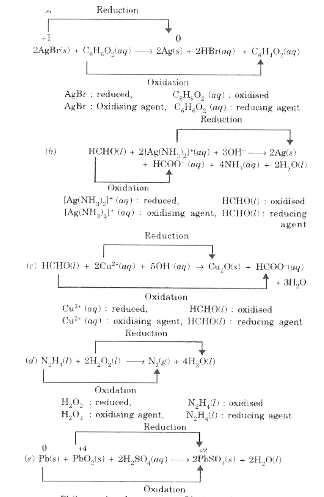 `PbO_2` : REDUCED `""Pb(s)` , oxidised `PbO_2(s)` : oxidising AGENT , `Pb(s)` : reducing agent |
|
| 21. |
Identify the structure of X : |
|
Answer» |
|
| 22. |
Identify the structure of amine. |
|
Answer» |
|
| 23. |
Identify the strongest and weakest reducing agents from the following list : Zn,Cu,Ag,Na,Sn. |
| Answer» SOLUTION :Strong reducing agent is Zn and the WEAKEST reducing agent is Ag. | |
| 24. |
Identify the strongest acid among the following |
|
Answer» `CH_(3)CN` |
|
| 25. |
Identify the state functions and path functions out of the following : enthalpy , entropy , heat, temperature, work , free energy. |
| Answer» Solution :State function `:` ENTHALPY, Entropy , TEMPERATURE, Free energy, PATH functions`:` HEAT, work. | |
| 27. |
Identify the state functions and path functions out of the following : enthalpy, entropy, heat, temperature, work, free energy. |
|
Answer» Solution :STATE functions are those VALUES which DEPEND only on the state of the system and not on how it is reached. e.g., enthalpy, ENTROPY, TEMPERATURE and free energy. Path functions are those values which depend on the path of the system e.g., heat and work. |
|
| 28. |
Identify the state functions and path functions out of the following enthalpy, entropy, heat, temperature, work, free energy |
| Answer» SOLUTION :State functions are those values which DEPEND only on the state of the SYSTEM and not on how it is reached e.g., ENTHALPY, entropy, temperature and free energy. Path functions are those values which depends on the path of the system e.g., heat and work | |
| 29. |
Identify the state and path functions out of the following: (a) Enthalpy (b)Entropy (c) Heat (d) Temperature (e) Work (f) Free energy. |
|
Answer» SOLUTION :STATE function: Enthalpy, entropy, temperature and FREE energy. PATH function: Heat and work. |
|
| 30. |
Identify the species in which iron has lowest oxidation state? |
|
Answer» `FE(CO)_5` |
|
| 31. |
Identify the set of "reagents" // "reaction" conditions 'X' and 'Y' in the following set of transformation : CH_(3)-CH_(2)-CH_(2)Br overset(X)to "Product" overset(Y)to CH_(3)-underset(Br)underset(|)CH-CH_(3) |
|
Answer» X = dilute AQUEOUS SOLUTION, `20^(@) C`, |
|
| 32. |
Identify the set of reagents/reactions conditions 'X' and 'Y' in the following set of transformations. CH_3-CH_2-CH_2Broverset(X)to"product"overset(Y)to CH_3-undersetunderset(Br)(|)CH-CH_3 |
|
Answer» X=concentrated alcoholic NaOH, `80^@C`, Y=HBr acetic acid , `20^@C` |
|
| 33. |
Identify the secondary pollutant among the following |
|
Answer» `CH_4` |
|
| 34. |
Identify the redox reaction out of the following reactions and identify the oxidising and reducing agents in them. (a) 3HCl_((aq))+HNO_(3(aq))toCl_(2(g))+NOCl_((g))+2H_(2)O_((l)) (b) HgCl_(2(aq))+2KI_((aq))toHgI_(2(s))+2KCl_((aq)) ( c) Fe_(2)O_(3(s))+3CO_((g))overset(Delta)to2Fe_((s))+3CO_(2(g)) (d) PCl_((l))+3H_(2)O_((l))to3HCl_((aq))+H_(2)PO_(3(aq)) (e) 4NH_(3(aq))+3O_(2(g))to2N_(2(g))+6H_(2)O_((g)) |
|
Answer» Solution :(a) `overset(-1)(3HCl_((AQ)))+overset(+5)(HNO_(3(aq)))tooverset(0)(Cl_(2(g)))+overset(+3)(NOCl_((g)))+2H_(2)O_((l))` Oxidation number of elements are change so this is redox reaction. HCl is reducing agent and `HNO_(3)` is oxidising agnet. (b) `Hgoverset(-1)(Cl_(2(aq)))+overset(-1)(2KI_((aq)))toHgoverset(-1)(I_(2(s)))+2Koverset(-1)(Cl_((aq)))` This is not redox reaction. ( c) `overset(+3)(Fe_(2))O_(3(s))+overset(+2)(3CO_((g)))tooverset(0)(2Fe_((s)))+overset(+4)(3CO_(2(g)))` Oxidation number of OXYGEN is changed so this is redox reaction. CO is reducing agent and `Fe_(2)O_(3)` is oxidising agnet. (d) `overset(+3)(P)overset(-1)(Cl_(3(l)))+3H_(2)O_((l))to3Hoverset(-1)(Cl_((aq)))+H_(2)overset(+3)(PO_(3(aq)))` This reaction is not redox reaction. (e) `overset(+3)(4NH_(3(aq)))+overset(0)(3O_(2(g)))tooverset(0)(2N_(2(g)))+6H_(2)overset(-2)(O_((g)))` This is redox reaction. `O_(2)` is oxidising agnet `NH_(3)` is reducing agent. |
|
| 35. |
Identify the redox reaction out of the following reaction and identify the oxidising and reducing agents in them (i)3HCI (aq) +HNO_(3)(aq) rarr CI_(2)(g)+NOcI(g)+2H_(2)O(l) (ii) HgCI(aq)+2 KI(aq)rarrHgI_(2)(s)+2 KCI(aq) (iii) Fe_(2)O_(3)(s)+3CO(g)rarr2Fe(s)+3CO_(2)(g) (iv) PcI_(3)(l)+3H_(2)O(l)rarr3 HCI(aq)+H_(3)PO_(3)(aq) (v) 4NH_(3)+3O_(2)(g)rarr2N_(2)(g)+6H_(2)O(g) |
|
Answer» Solution :(i) writing the O.Non each atom above its symbol we hve here the O.N of CI increase from -1 in HCI to 0 in `CI_(2)` THEREFORE `CI^(-)` is oxidised and HENCE HCI acts as the reducing agent The O.N of Ndecreases from +5 in `HNO_(3)` to +3 in NOCI therefore `HNO_(3)` acts as the oxidising agent thus reaction (i) is a redox rection ltbRgt (ii) writing the O.N of each atom abvoe its symbol we have therefore the O.N of none of the atoms undergo a change therefore raction (ii) is not a redox reaction (iii) here O.N of fe decreases from +3 in `Fe_(2)O_(3)` to O in Fe therefore `Fe_(2)O_(3)` acts as an oxidising agent further O.N of C increases from +2 in CO to +4 `CO_(2)` therefore reaction (iv) is not a redox reaction (v) writing the O.N of each atom above its symbol we have Here O.N of N increase from-3 to o in `N_(2)`therefore `NH_(3)` acts as a an reducing agent further O.N of O decrease from 0 in `O_(2)` to -2 in `H_(2)O` therefore `O_(2)` acts as a oxidsing agent thus reaction (v) isredox reaction |
|
| 36. |
Identify the reagents shown in bold in the following equations as nucleophiles or electrophiles (a) CH_(3)COOH + HO^(-) rarr CH_(3)COO^(-) + H_(2)O (b) CH_(3)COCH_(3) + .^(-)CN rarr (CH_(3))_(2)C(CN)(OH) (c) C_(6)H_(6) + CH_(3)overset(+)(C)O rarr C_(6)H_(5)COCH_(3) |
| Answer» SOLUTION :NUCLEOPHILES : (a) and (B) ELECTROPHILE : (C). | |
| 37. |
Identify the reagents shown in bracketts as nucleophile or electrophile CH_3COOH+[OH^-] rarr CH_3COO^-+H_2O |
|
Answer» |
|
| 38. |
Identify the reagents shown in bracketts as nucleophile or electrophile CH_3COCH_3+[CN^-] rarr (CH_3)_2C (CN)(OH) |
|
Answer» |
|
| 39. |
Identify the reagents shown in bracketts as nucleophile or electrophile C_6H_6+[CH_3-CO] rarr C_6H_5-CO-CH_3 |
|
Answer» |
|
| 40. |
Identify the reagents shown in boid in the following equations as nucleophiles or electrophiles: (a) CH_(3)COOH + HO^(-) rarr CH_(3)COO^(-) + H_(2)O (b) CH_(3)COCH_(3) + bar(C )N rarr (CH_(3))_(2)C(CN)(OH) (c ) C_(6)H_(5) + CH_(3) overset(+)(C )O rarr C_(6)H_(5)COCH_(3) |
|
Answer» SOLUTION :More suitable (c ) `C_(6)H_(5) + CH_(3) overset(+)(C )O rarr C_(6)H_(5)COCH_(3) + H^(+)` and (b) `CH_(3)COCH_(3) + H^(+) CN^(-) rarr (CH_(3))_(2) C(CN) (OH)` `because` Need to charge balance `{:("(a)" HO^(-)"is nucleophile reagent"),("(b)" ""^(-)CN "is NUCLEOPHILIC reagent"):}} {:("Because of (-)charge and octet so it is electron rich""):}` (c ) `CH_(3) overset(+)(C )O` is electrophilic because on CARBON sixtet, vacant orbital and electron deficient |
|
| 41. |
Identify the reagent which can easily distinguish between 1-butyne and 2-butyne. |
|
Answer» BROMINE water |
|
| 42. |
Identify the reagent from the following list which can easily distinguish between 1-butyne and 2-butyne |
|
Answer» bromine , `C Cl_4` |
|
| 43. |
Identify the reaction in which the heat liberated corresponds to the heat of formation (Delta H_(f)): |
|
Answer» `C _(("diamond")) + O _(2 (G)) to CO _(2(g)) +` heat |
|
| 44. |
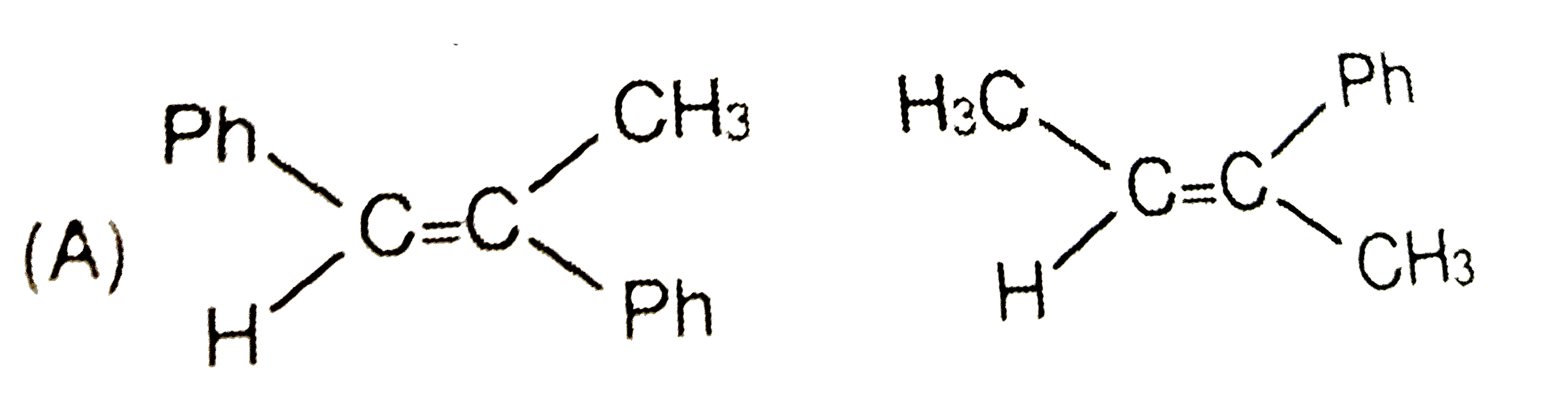
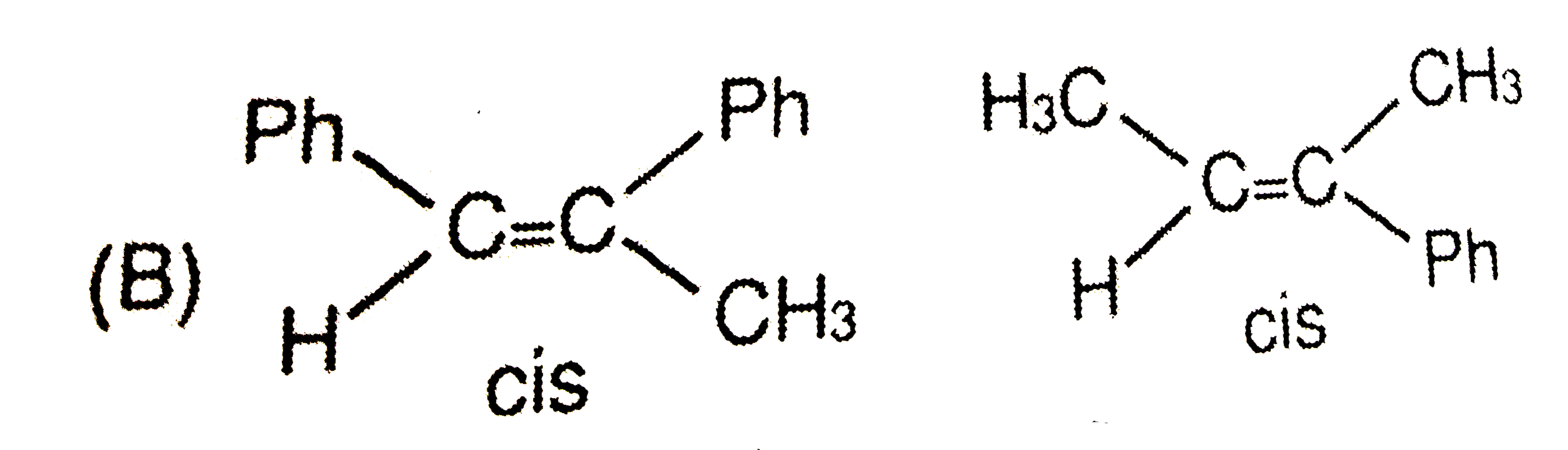
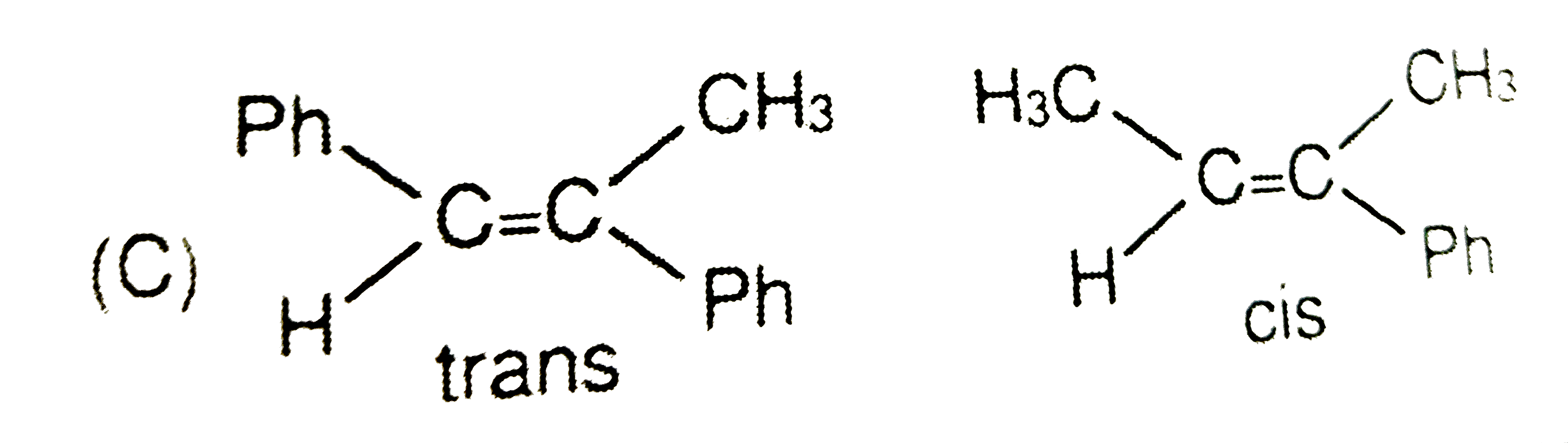
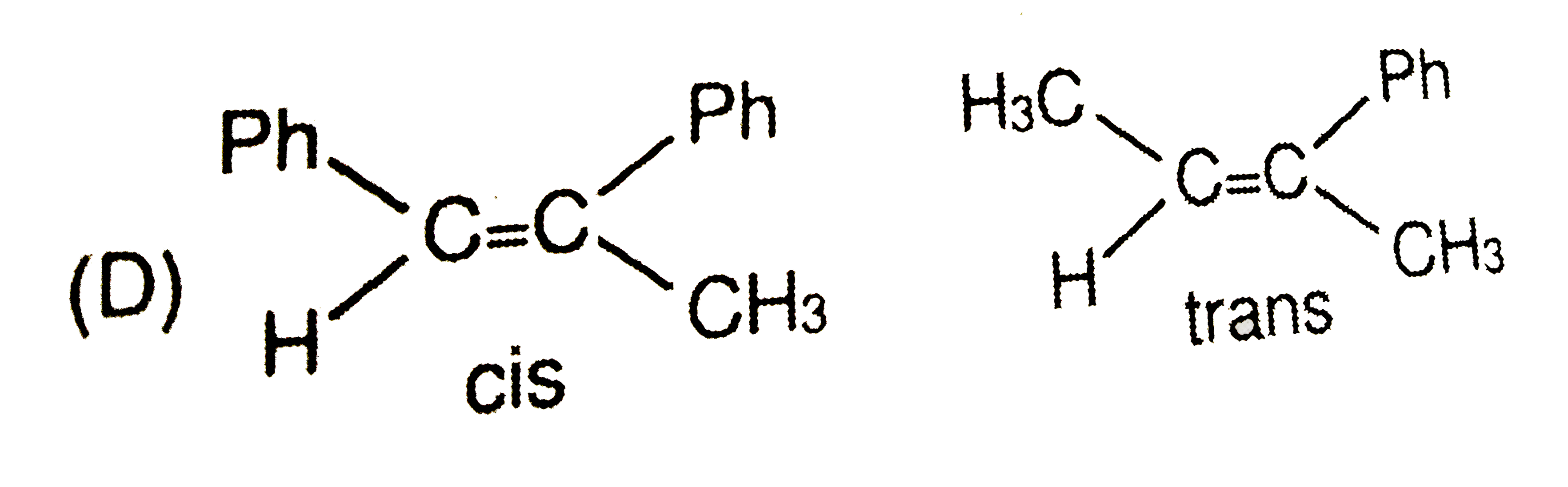
Identify the products in the following reactions giving their stereoisomers ( if any ) . a. (B) overset(H_(2)+Pt)rarrC ( No. of isomers ) b. (B)(from Problem A) overset(Baeyer's)underset(reag e nt)rarr (D)+(E)( Colour of precipitate) c. (B) overset(PhCO_(3)H)underset (+H_(2)o)rarr(D) d.(A)underset(Na+liq. ND_(3)+EtOH)rarr(F) overset(Alk. KMnO_(4))underset(OSO_(4)//NaHSO_(3) or PhCO_(3)H//H_(2)O)rarr(D) |
Answer» Solution :`a.`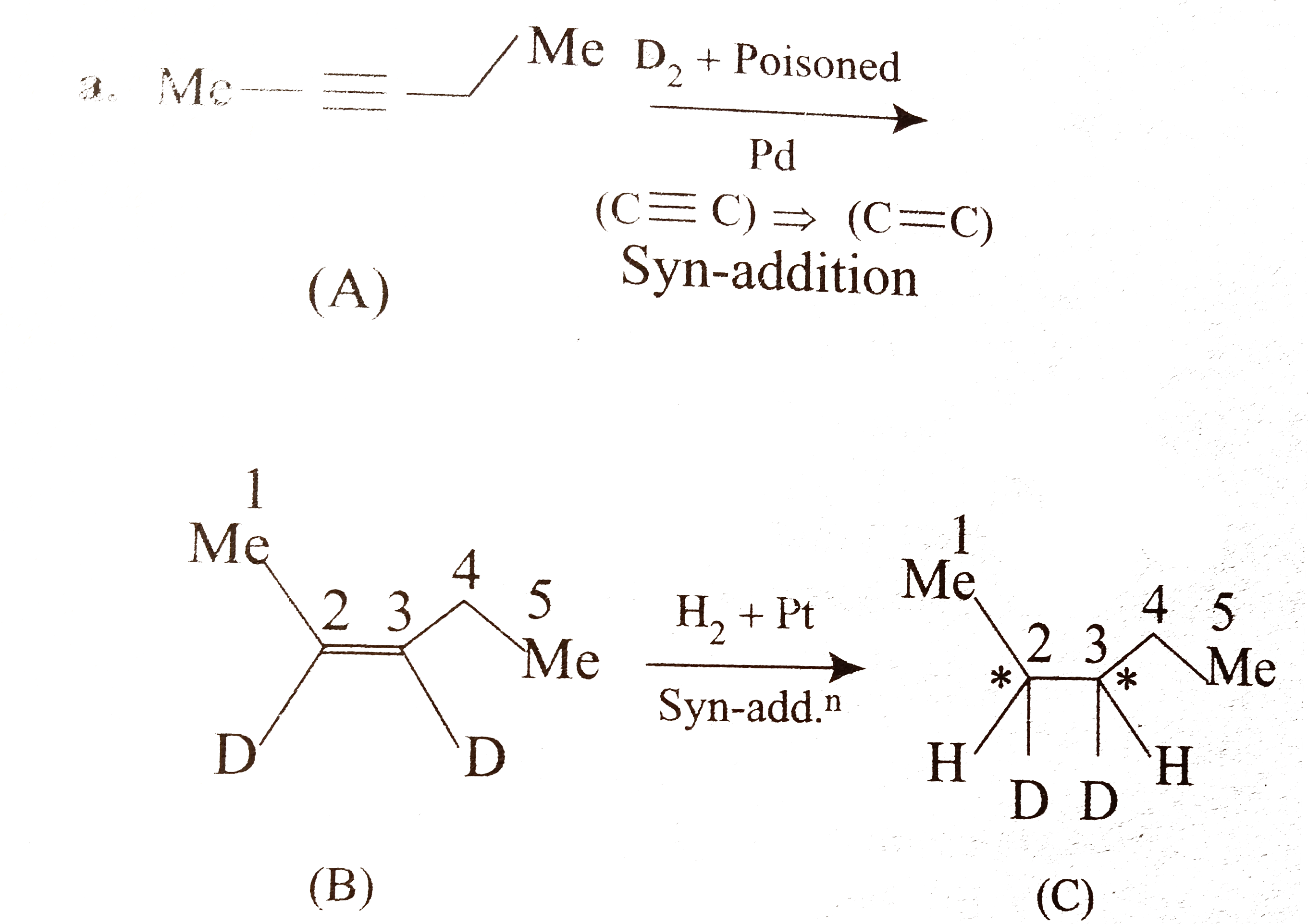 `(B)` is a cis compouind and the addition of `H_(2)+Pt` isalso syn. But `(B)` has two different `(R)` groups`(Me` and `Et)` , so the product `(C)` will not be meso but a racemic compound. Since `(C)`contains two chiral CENTRES, the number of OPTICAL isomers will be `2^(2)=4(` two pairs of entantiomers `).` These are `:` 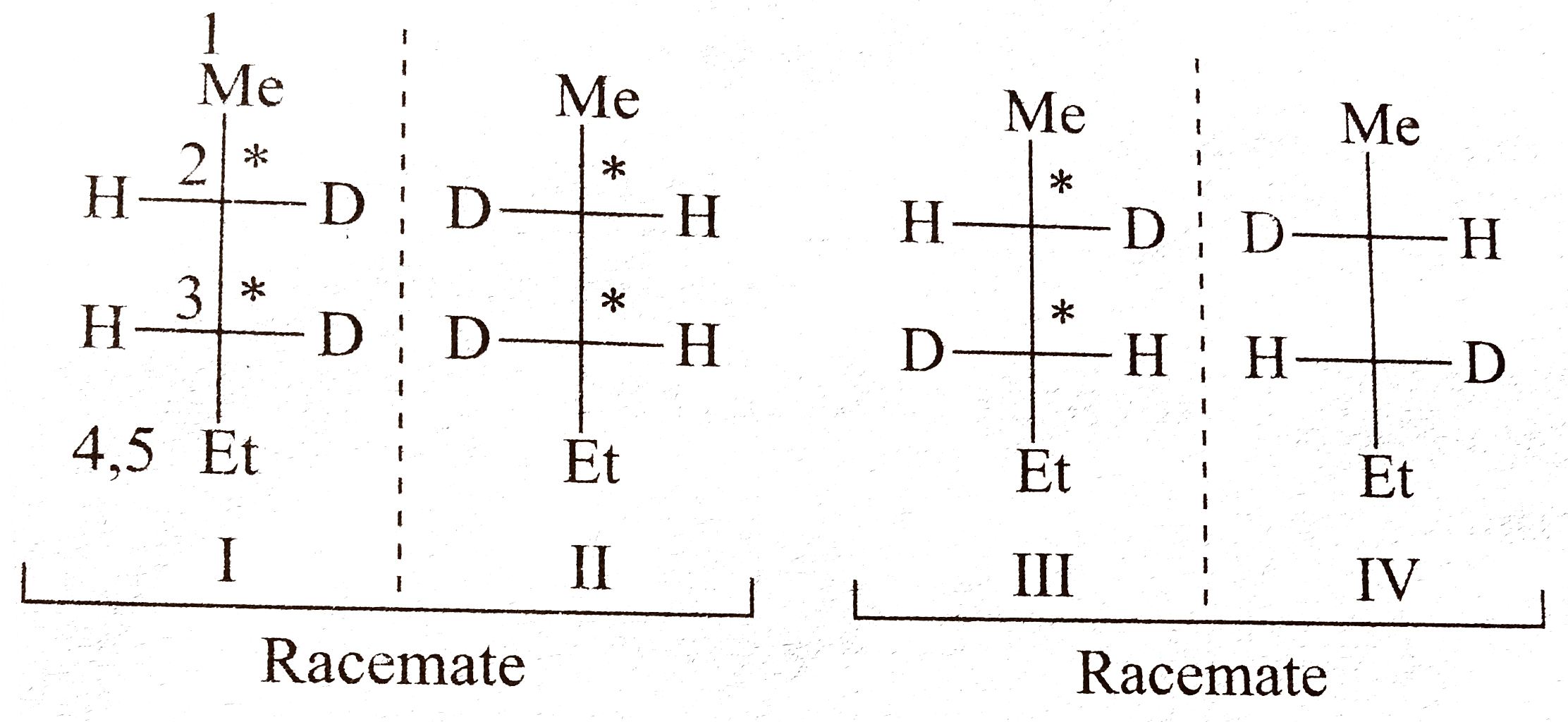 `I` and `II,III` and `IVimplies ` Pairs of enentiomers `(I, III), (I,IV),(II,IV)` and `(II,IV)implies ` Pairs of diastereomers. `b.` 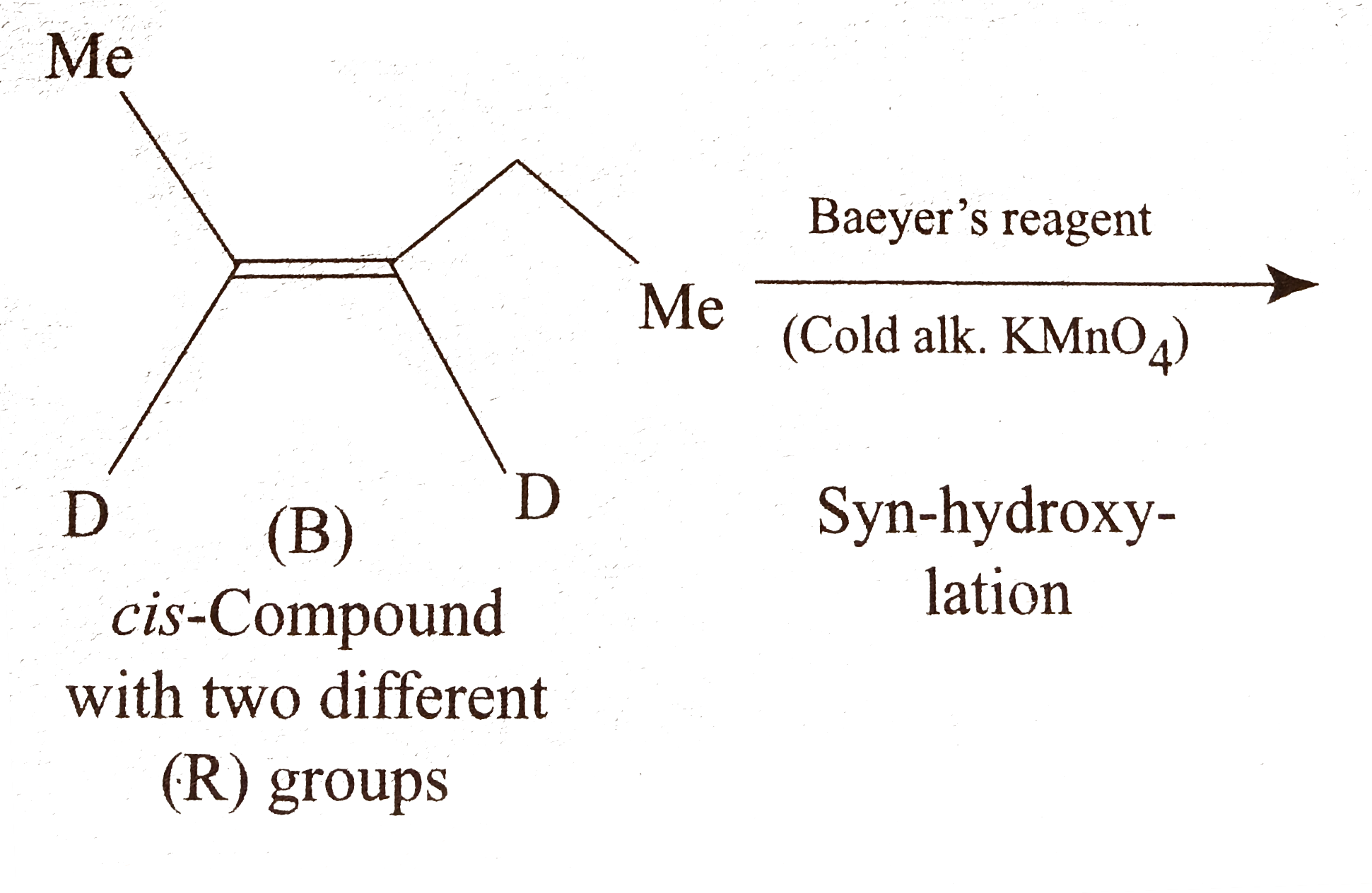 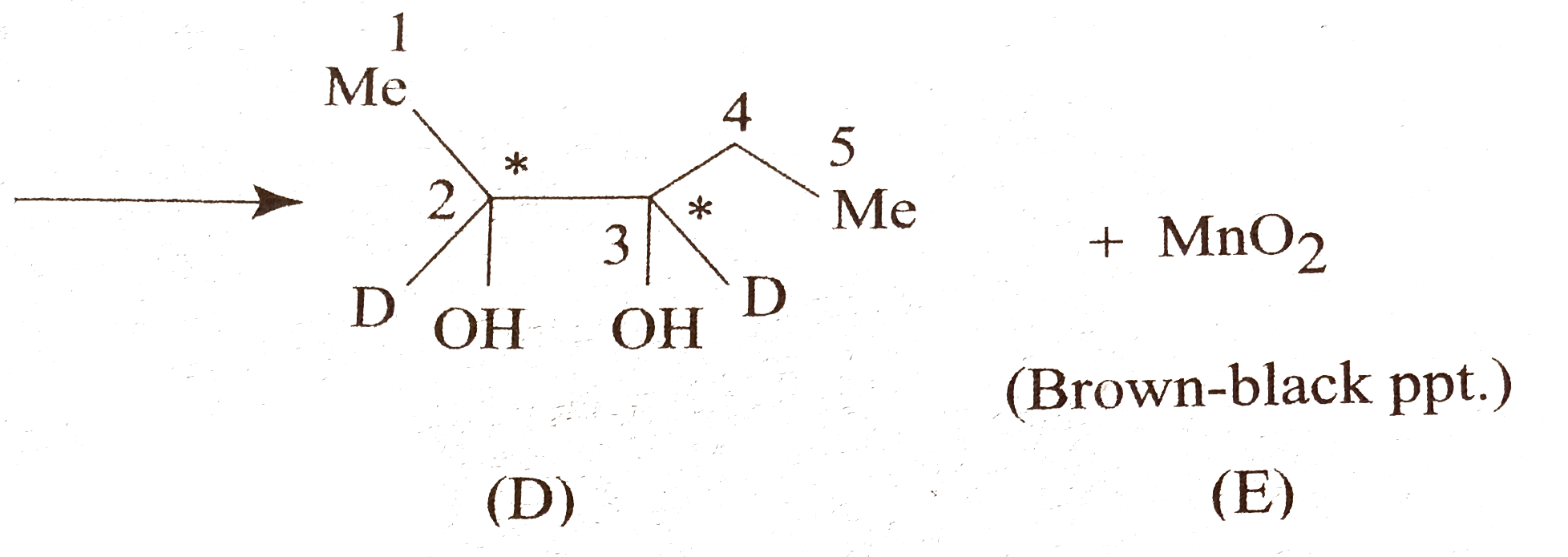 c.`UNDERSET("R groups")underset("with two different")underset("cis-Compound")((B))overset(PhCO_(3)H+H_(2)O)underset("Anti-hydroxylation")rarr(D)` [As in (b)] d. 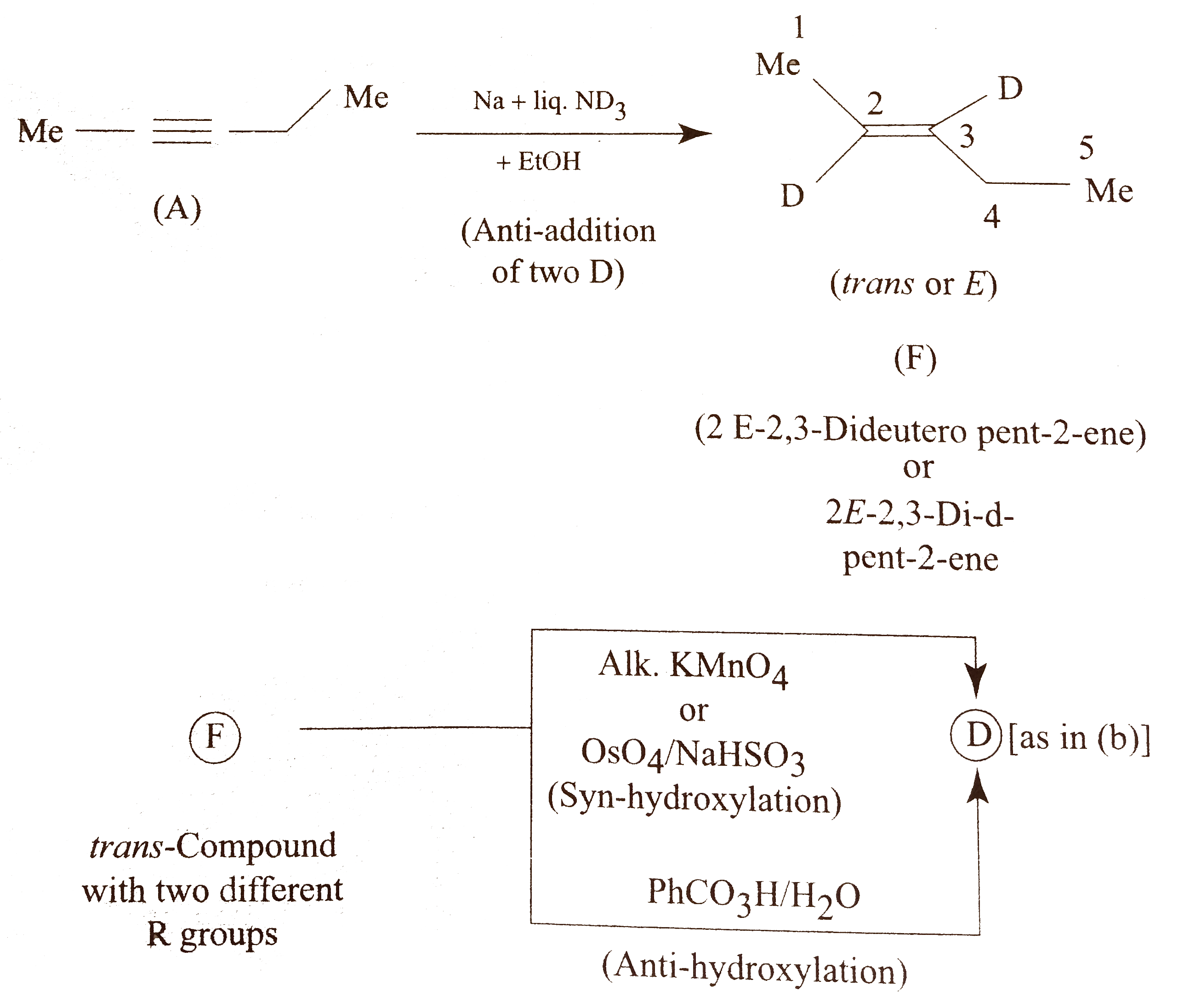
|
|
| 45. |
Identify the products among the following . |
|
Answer»
|
|
| 46. |
Identify the product S in the following series of operations : C_(2)H_(2) underset(Hg^(2+))overset(dil. H_(2)SO_(4))rarr (P) overset(K_(2) Cr_(2) O_(7) // H^(+))rarr (Q) overset(CaCO_(3))rarr (R) overset(Delta) rarr (S) |
|
Answer» Ethyl alcohol |
|
| 47. |
Identify the product of the following elimination reaction X and Y respectively with stereochemistry : |
|
Answer»
|
|
| 48. |
Identify the product of the following condensation reaction |
|
Answer»

|
|
| 49. |
Identify the product in the reaction PhC -=Cme overset(H_3O^(+), Hg^(2+)) to? |
|
Answer» `PhCH_2CH_2CHO` |
|
| 50. |
Identify the product in the following reaction. PhC-=C Me overset(H_3O^+, Hg^(2+))to |
Answer» Solution :First of all `Hg^(2+)` ions form a complex (I) with the alkyne. The complex formed here is , however UNSYMMETRICAL in which the +ve charge LIES on the carbon ATTACHED to the Ph ring since it is stabilized by resonance with the double bonds of the Ph ring. Later on nucleophilic attack of `H_2O` on this carbon ultimately leads to enol (II) which tautomerises to give ketone (III) .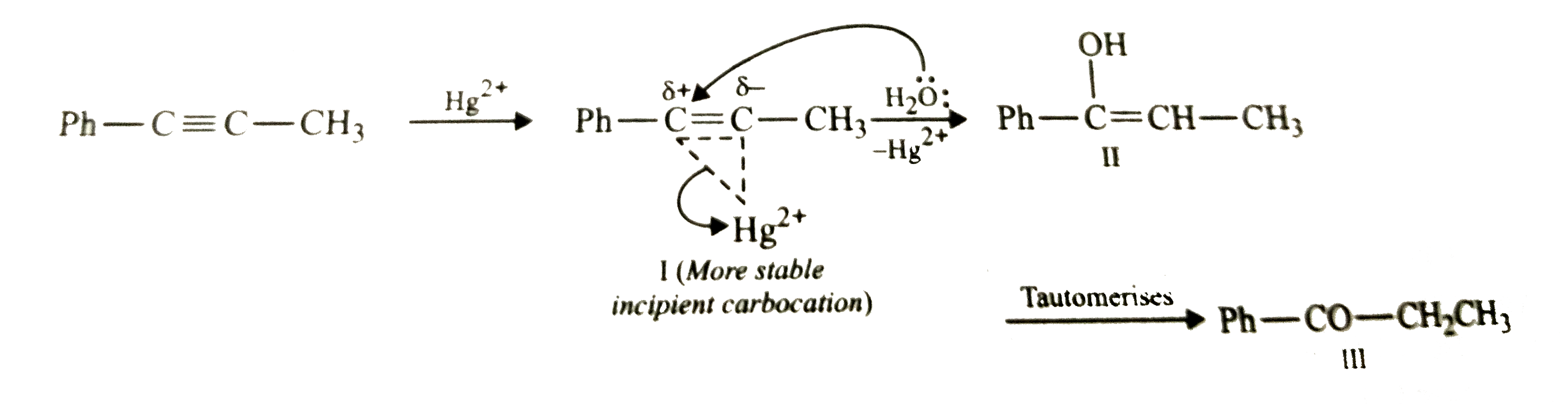
|
|