

Saved Bookmarks
This section includes 7 InterviewSolutions, each offering curated multiple-choice questions to sharpen your Current Affairs knowledge and support exam preparation. Choose a topic below to get started.
| 1. |
A yellow turbidity, sometimes appears on passing H_(2)S gas ever in the absence of the second group radicals. This happens because |
|
Answer» SULPHUR is present in the mixture as an impurity |
|
| 2. |
A x:1 molar mixture of He and CH_(4) is contained in a vessel as 20 bar pressure. Due to a hole in the vessel, the gas mixture leaks out.if the composition of the mixture effusing out initially is 8:1, then calculate the value of of x? |
|
Answer» 1 |
|
| 3. |
(a) Write the resonance structures of NO_2^(Ө) (nitrite) and NO_3^(Ө) (nitrate ion) in terms of : (i) outer shell overline e^, s with formal charges (ii) overlapping atomic orbitals. ( c) Compare the resonance (delocalisation) energy adn stabilities of NO_2^(Ө) and NO_3^(Ө). (b) (i) Write the resonance contributing and hybrid structures of (I) N_2 O (II) H_2 C - N_2 (diazomethane). (ii) Give the hybridised state of each atom in each structure. (iii) Discuss their bond length in each resonance contributing structure and compare with those in hybrid structures. |
Answer» Solution : 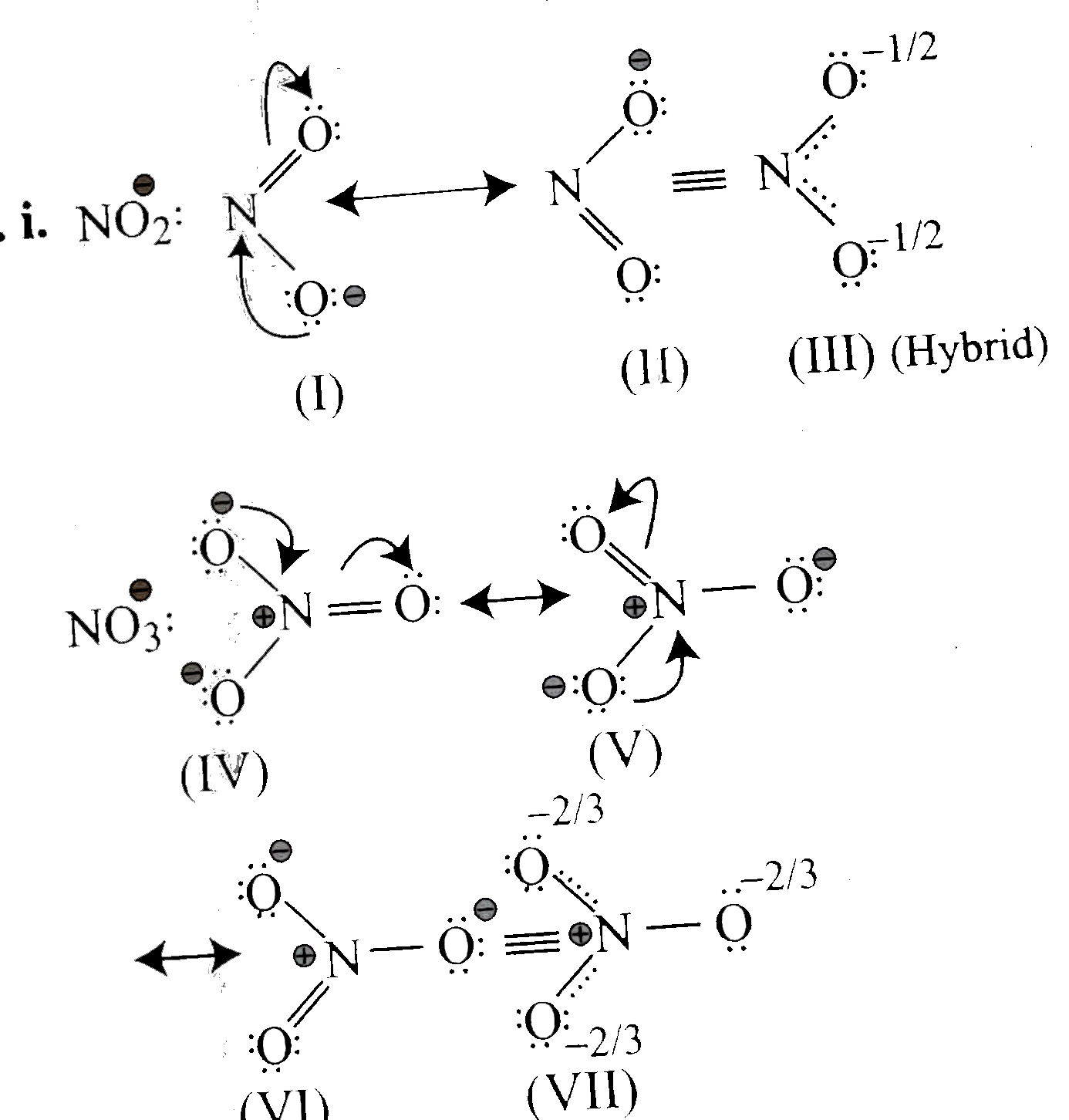 In the resonance hybrid structures, dashed-line bonds are used to indicate double or triple bond character between the bonded atoms. These partial multiple bonds represent the expanded `pi-bond` overlap. In each resonance contributing structures, the negative charge resides on a different `O` atom But in the hybrid structures, each `O` atom has a fractional negative charge. (ii) `NO_2^(Ө)` : In `NO_2^(Ө)`, `N` has three `sp^2` hybrid orbitals. Two of them from `sigma-bonds` with the two `O` atoms and third `sp^2` `HO` has `LP overline E^, s`. Its PURE `p-AO` overlaps laterally with a pure `p-AO` of each `O`atom, resulting in extended `pi-bond` overlap, comprising both the `O`atoms and the `N` atom, spreading charge over both the `O` atoms. 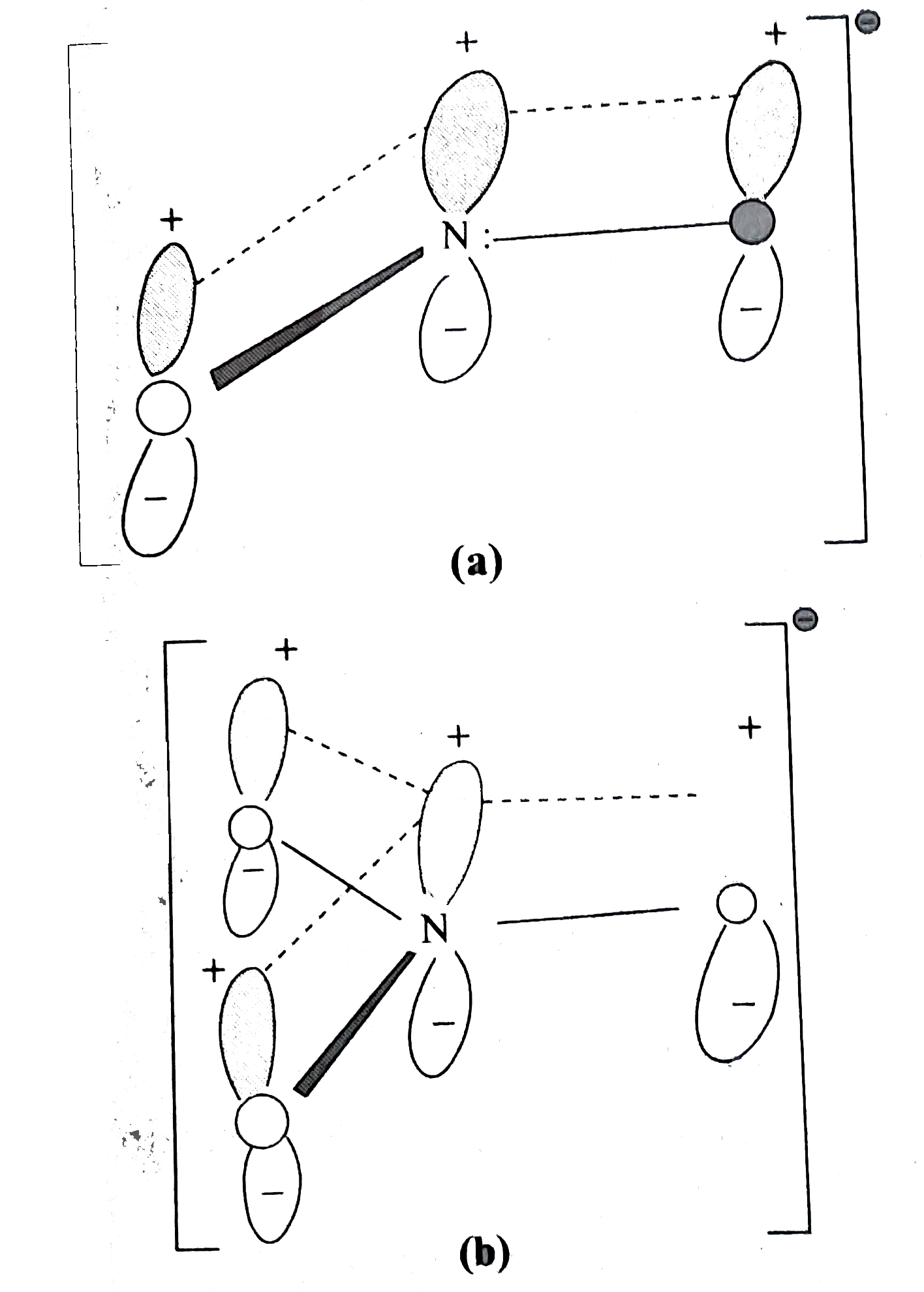 (FIg) Overlapping atomic orbitals `NO_3^(Ө)` is similar to `NO_2^(Ө)` except that a third `O` atom is involved in the extended `pi-bond` with the delocalisation of the negative charge over three `O` atoms, resulting a `(-2//3)` charge on each `O` atom [Fig. 4.16(b)] (iii) `NO_3^(Ө)` has more delocalisation (or resonance) energy and is more stable than `NO_2^(Ө). NO_3^(Ө)` has three resonating structures in which negative charge is delocalised over all the three `O` atoms, whereas `NO_2^(Ө)` has two resonating structures in which negative charge is delocalised over two `O` atoms. The energy of the hybrid is always lower than that of any cannonocal structures. The greater the number of resonance contributing structures with similar energies, the more stable and lower is the energy of the hybrid. More similar energy resonance contributing structures result in more extanded `pi-bonding`. Which allows the `overline e^, s` to move in a larger space and decreases `overline e^, s` repulsion. (b) (i) and (ii) Resonance structures of `(N_2O) (I)` : `underset((I))underset(sp)underset(uarr)( :N)-=underset(sp)underset(uarr)overset(o+)(N)-underset(sp^(3))underset(uarr)(ddotunderset(..)O:^(Theta))harr underset((II))underset(sp^(2))underset(uarr)( :overset(Theta)(N))=underset(sp)underset(uarr)overset(o+)(N)=underset((III)("HYBRIDE structures"))(underset(sp^(2))underset(uarr)ddotO:-=underset(sp)underset(uarr)overset(-delta)(N)overset(...)(=)underset(sp)underset(uarr)overset(o+)Noverset(...)(-) underset(sp^(2))underset(uarr)overset(-delta)underset(..)O: )` Resonance STRUCTURE of `(H_2 C-N_2)(II)` : `underset((IV))underset(sp)underset(uarr)( H_(2)C)-=underset(sp)underset(uarr)overset(o+)(N)-underset(sp^(2))underset(uarr)(ddotN:^(Theta))harr underset((V))underset(sp^(3))underset(uarr)(H_(2)overset(ddot(Theta))C)-underset(sp)underset(uarr)overset(o+)N-=underset((VI)("Hybrid structures"))(underset(sp)underset(uarr)ddotN-=underset(sp^(2))underset(uarr)overset(-delta)(H_(2)C)=underset(sp)underset(uarr)overset(o+)Noverset(...)(=)underset(sp)underset(uarr)overset(delta-)N: )` (iii) Bond lengths in hybrid structures are intermediate in value between those all the contributing structures (i.e., standard single, double, or driple bond (value). In `N_2O`, the `(O - N)` bond length in the hybrid (III) is shorter than the single bond in `(I)` but longer then the double bond in `(II)`. The `(N - N)` bond length in the hybrid `(III)` is longer than in `(I)` but shorter than in `(II)`. In `(H_2 C - N_2)`, the `(C - N)` bond length in the hybrid `(VI)` is longer than double bond in `(IV)` but shorter than the single bond in `(V)` The `(N - N)` bond length in the hybrid `(VI)` is shorter than double bond in `(IV)` but longer than the triple bond in `(V)`. The `(H - C - H)` bond angle expected form `(IV)` is `120^@` and from `(V)` is `105.5^@`. The actual bond angle has some intermediate value because the hybrid is a mixture of each resonating structure. For maximum extended `pi-`bonding, the atoms in the hybrid structure should have `p-AOs`. In other words, the hybrid orbitals used to form `sigma-`bonds should have less`p` character. Therefore, `C` should be `sp^2` - like rather than `sp^3`, and the terminal `N` should be `sp`- like rather than `sp^2` Since the resonating structure of both `N_2 O` (I and II) and `CH_2N_2` (IV and V) are equally stable, so the hybrid (III) (for `N_2 O`) and hybrid `(VI)` (for `H_2 CN_2`) is a good mixture (blend) of their corresponding resonating structures. |
|
| 4. |
(a) Writethe electronicconfigurations of theelementsgiven below: A (At. No=0), B(At. N=12) , C (At. No=29), D(At.No=54) , and E(At. No=58). (b) Also predict the period group numberand block to which they belong. ( C) Classify them as representativeelements , noble gases, transition and inner transitionelements. |
|
Answer» Solution :(a) Electronicconfiguration of the elements A,B ,C,D and Eare asfollows : `{:("Element ",,"At.No .",," Electronic configuration "),(A,,9,,1 s^(2) 2s^(2) 2p^(2)),(B,,12,,1 s^(2) 2s^(2) 2p^(6) 3s^(2)),(C,,29,,1s^(2) 2s^(2) 2p^(6) 3s^(2) 3P^(6) 3d^(10) 4s^(1)),(D,,54,,1s^(2) 2s^(2) 2p^(6) 3s^(2) 3p^(6) 3d^(10) 4s^(2) 4p^(6) 4d^(10) 5s^(2) 5p^(6)),(E,,58,,1s^(2) 2s^(2) 2p^(6) 3s^(2) 3p^(6) 3d^(10) 4s^(2) 4p^(6) 4d^(10) 5s^(2) 5p^(6) 6s^(2) 5d^(1) 4f^(1)):}` (b) Element Areceives the last electron in 2p-orbital it belong to p-blockelements and its group number = 10+ No.of electrons in thevalence shell =10+ 7=17. Further the period of theelement = No. of thenumberquantum numberof the valenceshell= 2nd. Element B receives the lastelectron in 3s-orbitalthereforeit belongto s-block elements and itsgroupnumber= No ofelectrons in the valenceshell=2 .Further the periodof theelement= No of theprincipal quantum number of the valenceshell=3rd Element C receives the lastelectron in the3d-orbital therforeit belong to d-block elements and its group number= No ofelectrons in the penultimate shelland valenceshell= 10+ 1= 11. Further the period OFTHE element= No of principal quantum number ofthe valence shell=4th. Element D receives its lastelectron in the4f-orbitaltherefore it belongto f-block elements and itsgroup number = 10+ No. Of electrons in teh valenceshell= 10+8=18. Furtherthe periodof theelement = No of theprincipal quantum numberof thevalenceshell= 5th. ElementE receives itslastelectron in 4f-orbital therforeit belong to f-blockelementsand itsgroup numberthat the fillingof 4f- orbitaloccursonly whenone electron has already entered 5d-orbital .Therefore element E belongto f-block elements and not to d-block elements .Sinceit belongto lanthanideseries thereforeas suchis does not haveany group number of its own but is usually considered to liein group 3 . However, its period= Noof theprincipalquantum numberof the valence shell=6th ( c) Elements A and Bare representative elements sincetheirlastelectron enters p- and s- orbitalrespectively. Elements C isa transitionelement sinceit receivesits lastelectronin thed- orbital Element D is a p- blockelementwithcompletely FILLED s- and p- orbitalof the valenceshell sucha typeofp- blockelementis calleda noblegas. Element E isan inner transitionelementsinceit receive its lastelectron in the f-orbital |
|
| 5. |
(a) Write IUPAC names of the following compounds : (i) CH_(3)-underset(CH_(3))underset(|)(CH)-COOH (ii) CH_(3)-C equiv C-C equiv C-CH_(3) (b) Define inductive effect. |
| Answer» Solution :(a) (i) 2-Methylpropanoic acid (ii) Hex-2, 4-diyne. (B) For the DEFINITION of INDUCTIVE effect, CONSULT section 12.22. | |
| 6. |
(a) Why is LiF least soluble in water among the fluorides of alkali metals ? Justify the given (b) Justify the given order of mobilites of the alkali mteal cations in aqueous solution: Li lt Na^(+) lt K^(+) lt Rb^(+) lt Cs^(+) (c) Lithium is the only alkali metal which forms a nitride directly. Explain . (d) E^(@) for M^(2+)(aq)toM(s)(where M=Ca,Sr or Ba) is nearly constant. Discuss. |
|
Answer» Solution :(a) Lithium fluoride (LiF) is of covalent nature because of the high polarising POWER of `Li^(+)` ion due to its very small SIZE and high effective nuclear charge. It destorts the electron cloud of the `F^(-)` ion the maximum as compared to the cations of other alkali metals. It is therefore, least soluble in water. On the other HAND, the fluorides of other alkali metals are generally ionic and are water soluble. (B) This is attributed to the hydration of the cation in water. As a result,size of the cation increases and its mobility decreases. Due to the smallest size, `Li^(+)` ion is hydrated to the maximum and exists as `Li^(+)` (aq) and has least mobility. `Cs^(+)` ion due to least hydration exists as `Cs^(+)` (aq) has maximum mobility. (c) Lithium is a very strong redcuing agent. As a result, it directly exists as `Cs^(+)` (aq) combines with nitrogen to form its nitride `(Li_(3)N)`. `3Li+N_(2) overset("Heat")toLi_(3)N_(2)` (d) The overall magnitude of reduction potential `(E^(@))` depends upon three factors. These are (i) sublimation enthalpy (ii) ionisation enthalpy and (iii) hydration enthalpy. In case of the metals listed, the overall magnitude of `E^(@)` values remain almost the same. Therefore, these metals have almost same reducing STRENGTH. |
|
| 7. |
(a) Why is hydrated barium peroxide used in the preparation of hydrogen peroxide instead of anhydrous barium peroxide ? (b) Phosphoric acid is preferred to sulphuric acid in the preparation of H_(2)O_(2) from barium peroxide. Explain. (c) Hydrogen peroxide acts both as an oxidising agent as well as reducing agent in alkaline solution towards certain first row transition metal ions. Illustrate both these properties of H_(2)O_(2) using chemical equatons. |
|
Answer» Solution :(a) If ANHYDROUS barium perioxide is used in the preparation of `H_(2)O_(2)` , the `BaSO_(4)` formed during the reaction forms an insoluble protective coating on the surface of solid barium PEROXIDE . This prevents `BaO_(2) (s) + H_(2)SO_(4)(aq) to BaSO_(4) (s) + H_(2)O_(2) (aq)` further action of the acid and utlimately the reaction stops. If, however, hydrated barium peroxide (in the form of thin paste) is used, the water of crystallization does not allow `BaSO_(4)` to deposit on the surface of `BaO_(2)` and the reaction goes to completion. (b) The aqueous solution of `H_(2)O_(2)` prepared by the action of dil. `H_(2)SO_(4)` on hydrate `BaO_(2)` has impurities of heavy metal ions LIKE `Ba^(2+),Pb^(2+), ` etc. These catalyse the decomposition of `H_(2)O_(2)` . Therefore, `H_(2)O_(2)` prepared by the action of dil. `H_(2)SO_(4)` on hydrated `BaO_(2)` does not have good keeping qualities . If, however, phosphoric acid is used, the impurities of heavy metal IOINS are precipitated as insoluble phosphates. As a RESULT, the resulting solution of `H_(2)O_(2)` has good keeping qualities. (c) Oxidising agent : `2 Cr(OH)_(3) + 4NaOH + 3H_(2)O_(2) to 2Na_(2)CrO_(4) + 8H_(2)O` Here, `Cr^(3+)` gets oxidised to `Cr^(6+)` Reducing agent : `2K_(3)[Fe(CN)_(6)]+2KOH + H_(2)O_(2) to 2K_(4)[Fe(CN)_(6)]+2H_(2)O+O_(2)` Here, `Fe^(3+)` gets reduced to `Fe^(2+)`. |
|
| 8. |
(a) Why is boric acid considered as a weak acid. (b) Discuss the structure of disborane? (c) What is borazin e? (d) what are silicones? |
|
Answer» SOLUTION :(a) Boric acid is a very weak monobasic acid. It is not a proton DONOR acid and acts as a Lewis acid. For details. Consult SECTION 11.4. (b) For the structure of DIBORANE, consult section 11.4. (c) For answer, consult section 11.4. (d) For answer, consult section 11.11. |
|
| 9. |
(a) Why does the solubility of alkaline earth metal hydroxides in water increase down the group.(b). Why does the solubility of alkaline earth metal carbonates and sulphates in water decrease doewn the group? |
|
Answer» Solution :a. Among alkaline earth metal hydroxides, the anion being common, the cationic RADIUS will influence the lattice enthalpy.Since lattice enthalpy decreases much more than the hydration enthalpy with increasing ionic size, the SOLUBILITY increases down the group `(darr)`. b. The size of anions being much LARGER as compared to cations, the lattice enthalpy will remain almost CONSTANT within a PARTICULAR group. Since the hydration enthalpy decreases down the group, solubility will decreases as found for alkaline earth metal carbonates and sulphates. |
|
| 10. |
(a) Why do alkali metals impart colour to the flame? (b) How is Na_(2)CO_(3) obtained by solvay ammonia process? (c ) Which compound of calcium is used in surgical bandages during fractured bone of the body ? |
|
Answer» Solution :(a) For ANSWER, consult section 10.1 (b) For answer,consult section 10.7 (C ) Plaster of Paris `(CaSO_(4).(1)/(2)H_(2)O)` is used in surgical bandages. |
|
| 11. |
(a) Why are haloarenes less reactive than haloalkanes? Explain. (b) Predict the alkenes that would be formed by dehydrohalogenation of the following halides with sodium ethoxide in ethanol and predict the major alkene: (i) 2-Chloro-2-methylbutane (ii) 3-bromo-2, 2, 3-trimethylpentane (c) How is chlorobenzene prepared from benzenediazonium chloride? |
|
Answer» SOLUTION :(a) `RB^(+) gt K^(+) gt Na^(+) gt Li^(+)` because of lesser hydration of ion as size increases. In other WORDS, hydrated radii of ions decrease as `Li^(+), Na^(+), K^(+), Rb^(+)`. (c) POTASSIUM carbonate cannot be prepared by Solvay process because potassium bicarbonate being more SOLUBLE than sodium bicarbonate does not get precipitated when `CO_(2)` is passed through a concentrated solution of KCl saturated with `NH_(3)`. |
|
| 12. |
(a) Why alkaline earth metals are harder, have higer melting ponts and higher densities than the alkali metals? (b). Why the atoms of alkaline earth metals are smaller than the corresponding alkali metals? (c ). Why alkaline earth metals have high electrical and thermal conductivities? (d). What is black ash? (e). Why the variation in physicalproperties of alkaline earth elements is not as regular as in the case of alkali metals? |
|
Answer» Solution :a. Alkaline earth metals have smaller SIZE and stringer metallic bonding as compared to alkai metals, which results in closer packing in the metalic lattice. Consequently, alkaline earth metals are harder, have higher melting points and densities as compared to alkali metals. b. Alkaline earth metals have smaller size and stronger metallic bonding as compared to alkali metals, lattice. consequently, alkaline earth metals are harder, have higher melting points and densities as compared to alkali metals. C. Due to the presence of two loosely bound electrons in the valence electrons in the VALANCE shell, which can freely move throughout the crystal lattice, alkaline earth metals have high thermal and electrical conductivities. d. Black ash is a mixture of `Na_(2)CO_(3)` and `CaS`. e. Since alkaline earth metals do not have the same crystal lattice structure, the variation in physical properties of alkaline earth elements is not as regular as in case of alkali metals. |
|
| 13. |
A white, water soluble polymeric solid ‘A’ on heating releases CO, gas. The residue is and reacts with acids to produce CO,. What is ‘A |
|
Answer» `NaHCO_(3)` `Na_(2)CO_(3)+2HCIrarr2NaCI+H_(2)O+CO_(2)` |
|
| 14. |
A white substance (A) reacts with dilute H_(2)SO_(4) to produce a colourless gas (B) and a colourless solution (C). The reaction between (B) and acidified K_(2)Cr_(2)O_(7) solution produces a green solution and a slightly coloured precipitate (D). Addition of aqueous ammonia or sodium hydroxide to (C) produces first a precipitate, which dissolves in the excess of teh respective reagent to produce a clear solution in each case. Which of the following statement is correct? |
|
Answer» The precipitate (D) on burning in air gives a colourless irritating gas. `H_(2)S +K_(2)Cr_(2)O_(7) rarr underset((D))(Sdarr)+ underset(("Green"))(Cr^(3+))` `ZnSO_(4)+ NH_(4)OH rarr [Zn(NH_(3))_(4)]^(2+)` `Zn^(2+) +K_(4)[Fe(CN)_(6)] rarr underset(("White/bluish ppt"))(K_(2)Zn_(3)[Fe(CN)_(6)]_(2)darr)` |
|
| 15. |
A white substance (A) reacts with dilute H_(2)SO_(4) to produce a colourless gas (B) and a colourless solution (C). The reaction between (B) and acidified K_(2)Cr_(2)O_(7) solution produces a green solution and a slightly coloured precipitate (D). Addition of aqueous ammonia or sodium hydroxide to (C) produces first a precipitate, which dissolves in the excess of teh respective reagent to produce a clear solution in each case. The metal cation of the white substance (A) is: |
|
Answer» `AI^(3+)` `H_(2)S +K_(2)Cr_(2)O_(7) rarr underset((D))(Sdarr)+ underset(("Green"))(CR^(3+))` `ZnSO_(4)+ NH_(4)OH rarr [Zn(NH_(3))_(4)]^(2+)` `Zn^(2+) +K_(4)[Fe(CN)_(6)] rarr underset(("White/bluish ppt"))(K_(2)Zn_(3)[Fe(CN)_(6)]_(2)darr)` |
|
| 16. |
A white substance (A) reacts with dilute H_(2)SO_(4) to produce a colourless gas (B) and a colourless solution (C). The reaction between (B) and acidified K_(2)Cr_(2)O_(7) solution produces a green solution and a slightly coloured precipitate (D). Addition of aqueous ammonia or sodium hydroxide to (C) produces first a precipitate, which dissolves in the excess of teh respective reagent to produce a clear solution in each case. The colourless gas (B) is: |
|
Answer» `H_(2)S` `H_(2)S +K_(2)Cr_(2)O_(7) rarr underset((D))(Sdarr)+ underset(("Green"))(Cr^(3+))` `ZnSO_(4)+ NH_(4)OH rarr [Zn(NH_(3))_(4)]^(2+)` `Zn^(2+) +K_(4)[Fe(CN)_(6)] rarr underset(("White/bluish ppt"))(K_(2)Zn_(3)[Fe(CN)_(6)]_(2)DARR)` |
|
| 17. |
A white solid X on heating gives a white solid Y and an acidic gas Z. Gas Z is also given out when X reacts with an acid. The compound Y is also formed if caustic soda is left open in the atmosphere. X, Y and Z are |
|
Answer» `{:(" "X," "Y,""Z), (NaHCO_(3), Na_(2) CO_(3), CO_(2)):}` `underset(X) (NAHCO_(3)) + HCl to NaCl+ underset(Z)(CO_(2)) +H_(2)O` `2NaOH+ underset("atmosphere")(CO_(2)) to underset(Y) (Na_(2) CO_(3)+ H_(2)O)` |
|
| 18. |
A white solid X on heating gives a white solid Y and an acid gas Z. gas Z is also given out when X reacts with an acid. The compound Y is also formed if caustic soda is left open in the atmosphere. X, Y and Z are |
|
Answer» `X-NaHCO_(3),Y-Na_(2)CO_(3),Z-CO_(2)` `underset((X))(NaHCO_(3))+HCl to NaCl+ underset((Z))(CO_(2))+H_(2)O` `underset(("atmosphere"))(2NaOH+CO_(2)to underset((Y))(Na_(2)CO_(3))+H_(2)O` |
|
| 19. |
A white solid is either Na_(2)O or Na_(2)O_(2) . A piece of red litmus paper turns white when it is dipped into a freshly made aqueous solution of the white solid. (i) Identify the substance and explain with balanced equation. (ii) Explain what would happen to the red litmus if the white solid were the other compound . |
|
Answer» SOLUTION :(i) `Na_(2)O_(2) + 2H_(2)O to 2NaOH + H_(2)O_(2)` `H_(2)O_(2)` thus produced turns red litmus PAPER white due to its bleaching action. (ii) `Na_(2)O + H_(2)O to 2NaOH` NaOH thus produced will turn red litmus blue. |
|
| 20. |
A white solid is either Na_(2)O or Na_(2)O_(2). A piece of red litmus turns white when it is dipped into a freshly made aqueous solution of the white solid. What is the white solid ? |
|
Answer» |
|
| 21. |
A white precipitate (X) is formed when a mineral of Boron (W) is bolied with Na_(2)CO_(3) solution. The precipitate is filtered and the filtered contains two compounds (Y) and (Z). The compound (Y) is removed by crustallization. By passing CO_(2) through (Z) changes to (Y). The compound (Y) on strong heating gives |
|
Answer» `NaAlO_(2)+Al_(2)O_(3)` |
|
| 22. |
A white precipitate (X) is formed when a mineral of Boron (W) is bolied with Na_(2)CO_(3) solution. The precipitate is filtered and the filtered contains two compounds (Y) and (Z). The compound (Y) is removed by crustallization. By passing CO_(2) through (Z) changes to (Y). 'W' is |
|
Answer» Colemanite |
|
| 23. |
A white precipitate (X) is formed when a mineral of Boron (W) is bolied with Na_(2)CO_(3) solution. The precipitate is filtered and the filtered contains two compounds (Y) and (Z). The compound (Y) is removed by crustallization. By passing CO_(2) through (Z) changes to (Y). 'X' is |
|
Answer» `Al(OH)_(3)` |
|
| 24. |
A white crystalline substance dissolves in hot water. On passing H_(2)S in this solution, black precipitate is obtained. The black precipitate dissolves completely in hot HNO_(3). On adding a few drops of conc. H_(2)SO_(4), a white precipitate is obtained. this substance is : |
|
Answer» `BaSO_(4)` `PbCl_(2) + H_(2)S RARR underset(("Black ppt"))(PbS) + 2HCl` PbS dissolves in hot conc. `HNO_(3)` and gives white ppt on adding conc. `H_(2)SO_(4)` |
|
| 25. |
A white crystalline solid A dissolves in water to give an alkaline solution . On heating A first loses water molecules and swells up . On further heating it turns into a transparent liquid which solidifies into a glossy bead . Name it. |
|
Answer» Solution :A is Borax i.e., `Na_(2) [B_(4)O_(5)(OH)_(4)].8H_(2)O`which is also written as `Na_(2)B_(4)O_(7).10H_(2)O` The reactions are as follows : `Na_(2)B_(4)O_(7)+7H_(2)O rarr underset("ALKALINE")(2NaOH)+underset("Orthyoboric acid")(4H_(3)BO_(3))` On heating : `Na_(2)B_(4)O_(7).10H_(2)Ooverset("HEAT ")rarr Na_(2)B_(4)B_(4)O_(7) overset("heat")rarr underset("Transparent glossy bead")underset("SODIUM metaborate ")(2NaBO_(2)+B_(2)O_(3))` |
|
| 26. |
A white crystalline salt [A] reacts with dilute HCl to liberate a suffocatig gas [B] and also forms a yellow precipitate. The gas [B] turns potassium dichromatic acidified with dilute H_(2)SO_(4) to a green coloured solution [C]. The compound A, B and C are respectively |
|
Answer» `Na_(2)SO_(3), SO_(2), Cr_(2)(SO_(4))_(3)` `UNDERSET([A])(Na_(2) S_(2) O_(3)) + 2HCl RARR 2NaCl + underset([B])underset(("Yellow"))(SO_(2))+ S + H_(2)O` `K_(2)Cr_(2)O_(7) + H_(2)SO_(4) + 3SO_(2) rarr K_(2)SO_(4) + underset([C])underset(("Green"))(Cr_(2) (SO_(4))_(3)) + H_(2)O` |
|
| 27. |
(a) Which of these have higher bond dissociation energy and why ? (i) N_(2)^(+)(ii)O_(2)^(+) (b) What kinds of molecular forced exist between the species in the following pairs of particles and why ? (i)He and N_(2)(ii) Cl_(2)and NO_(3)^(-)(iii)NH_(3)and CO. |
|
Answer» |
|
| 28. |
(a) Which of the following are position isomers ? {:((i)" "CH_(2)=CH""(ii)" "CH_(3)-C-CH_(3)""(iii)" "CH_(3)-CH=C-CH_(3)),("|""||""|"),(""CH_(2)-CH_(3)""CH_(2)""CH_(2)):} (b) Write the IUPAC name of the functional isomer of CH_(3)CH_(2)CH_(2)CH_(2)CHO. (c) Which type of structural isomerism is shown by the following pair of compounds ? {:(""Br""CH_(3)),("|""|"),(CH_(3)-CH-CHBr_(2) and Br_(2)CH-CH-Br):} |
|
Answer» Solution :(a) Structure (i) and (ii) REPRESENT position ISOMERS as they differ in the position of the double bond. Structure (iii) has different molecular formula. It is therefore, not an ISOMER. (b) `CH_(3)-overset(O)overset("||")(C)-CH_(2)-CH_(2)CH_(3)` : Pentan-2-one. (c) These represent the same compound. Their IUPAC name is ALSO same i.e., 1, 1, 2-tribromopropane. |
|
| 29. |
(a). Which alkaline earth metals do not give characteristic colour to the Bunsen flame? (b). Why alkaline earth metals do not form tripositive ions? (c ). Why alkaline earth metals are diamagnetic, but alkali metals are paramagnetic? (d). Why the first inonisation enthaply pf alkaline earth matals is higher than those of corresponding alkali metals? (e). Why alkaline earth metals are less electropositive than corresponding alkali metals? |
|
Answer» Solution :a. `Be` and `Mg` do not give characteristic colour to the bunsen flame. B. General electronic configuration of alkaline earth metals is `ns^(2)` preceded by NOBLE gas core. After the removal of two electrons, bipositive cation formed acquires a STABLE noble gas configuration. for the removal of the third electron, a very large amount of energy is required and that is why alkaline earth metlas do not form tripositive ION, `M^(3+)`. `underset(2p^(6)3s^(2))(Mg)overset(IE_(1))underset(-e^(Θ))(rarr)underset(2p^(6)3s^(1))(Mg^(o+))overset(IE_(2))underset(-e^(Θ))(rarr)underset(2p^(5)3s^(0))underset(Mg^(3+))underset(-e^(Θ)darrIE_(3))underset("Stable noble gas configuration")underset(2p^(6)3s^(0))(Mg^(2+))` c. In case of alkaline earth metals, the general electronic configuration is `ns^(2)`. Due to the presence of paired electons in their atoms, alklaline earth metals are diamagnetic. In case of alkali metals, general electronic configuration is `ns^(1)`. Due to the presence of unpaired electron, alklai metals are paramagnetic. d. Alkalineearth metals have smaller size as compared to corresponding alkali metals due to increases charge, as a result the higer amount of energy is required for the removal of an electorn from the valence shell. that is why the first ionisation enthalpy of alklaline earth metal is higher than the corresponding alklai metal. e. Alkaline earth metals have smaller size as compared to alkali metals. Hence, valence shell electronsare more tightly bound to the nucles and ionisation entyhalpy of alkaline earth metals is more is more as compared to alkali metals. consequently, they have less tendency to lose valence shell electrons and are less electropositive as compared to alkali metals. |
|
| 30. |
(a) What type of semiconductor is obtained when silicon is doped with boron ? (ii) What type of magnetism is shown in the following alignment of magnetic moments ?uarr uarr uarr uarrWhat type of point defect is produced when AgCl is doped with CdCl_(2) ? |
|
Answer» (B) N/A |
|
| 31. |
a. What is the relative abstraction of H and D ? b.Why free-radical chlorination of CH_(4) is nearly 11 times faster than CD_(4) ? |
|
Answer» SOLUTION :a.i.Number of H atoms abstracted by D =5 and PERCENTAGE of compound formed `=93%` .Therefore, REACTIVITY factor for replacement of H atoms `=93//5 =18.6` ii.Number of D abstracted by C1 = 1 and percentage of compound formed `=7%`.Therefore, relative factor for D replacement `=7//1 =7` iii. Relative reactivity of H : Dabstraction `=18.6//7 =2.7 : 1`, i.e., each H is abstracted `2.7` times FASTER than D. b.Chemically, H and D are identicsl but (C ----D) bonds are slightly stronger than (C----H) bonds,therefore, the energy of activation of D is greater than that of H. Since abstraction is a slow STEP, removal of H will be faster. Relative abstraction of `H : D = 2.7 : 1` Relative abstractionof `4H : D ~~ 10.8 : 1` `~~ 11 : 1` |
|
| 32. |
(a) What is the normality of a 96 per cent solution of H_(2)SO_(4) of specific gravity 1.84 ? (b) How many mL of 96 per cent sulphuric acid solution is necessary to prepare one litre 0.1 N H_(2)SO_(4) ? ( c) To what volume should 10 mL of 96 per cent H_(2)SO_(4) be diluted to prepure 2 N solution ? |
|
Answer» Solution :MASS of 1 LITRE of `H_(2)SO_(4)` solution `="VOL."xx"Density"` `=1000xx1.84=1840 g` Mass of `H_(2)SO_(4)` present in one litre 96% `H_(2)SO_(4)` solution `= (96)/(100)xx1840=1766.4 g` Strength of `H_(2)SO_(4)` solution `=1766.4 g//L` (a) Normality `=("Strength")/("Eq. mass")=(1766.4)/(49)=36.05 N` (b) Let the volume taken be `V_(1)` mL Applying `"" N_(1)V_(1)=N_(2)V_(2)` `N_(1)=36.05 N, V_(1) = ?, N_(2)=(N)/(10), V_(2)=1000` mL `36.05xxV_(1)xx1000` So, `V_(1)=(1000)/(36.05xx10)=2.77` mL i.e., 2.77 mL of `H_(2)SO_(4)` is DILUTED to one litre. (c ) ` underset("Before dilution")(N_(B)V_(B))= underset("After dilution ")(N_(A)V_(A))` `10xx36.05=V_(A)xx2` `V_(A)=180.25` mL i.e., 10 mL of given `H_(2)SO_(4)` is diluted to 180.25 mL. |
|
| 33. |
(a) What is the maximum and minimum oxidation states of nitrogen in its compounds ? Given one example each . (b) What is the oxidation number of N in each of the following ? (i) NH_3 (ii) N_2H_4 (iii) HN_3 (iv) NO_2^(-) (v) N_2O (vi) HCN (vii) N_2 (viii) NH_2OH (ix) HNO_3 (x) NO_2. (c) What is the oxidation state of hydrogen in each of the following ? (i) H^+ (ii) H_2 (iii) LiAlH_4 (iv) HCl (v) LiH |
|
Answer» Solution :(a) +5 equal to group number (e.g. `N_2O_5` ) and -3 equal to the group number minus 8 (e.g. `NH_3` ) (B) (i) -3 (ii) -2 (iii) `-1//3` (iv) +3(v) +1 (vi) -3 (vii) 0 (viii) -1 (IX) +5 (x) +4 (C) (i) +1 (ii) 0 (iii) -1 (iv) +1 (v) -1 |
|
| 34. |
(a) What is slaked lime ? (b) Beryllium and magnesium do not give colour to flame. Why? (c ) How is NaOH prepared hy castner-kellner method? |
|
Answer» Solution :Slaked lime is CALCIUM HYDROXIDE `CA(OH)_(2)` and is formed by droping water on quick lime (CaO). This is known as slaking of lime. `CaO + H_(2)O to Ca(OH)_(2)` (b) for answer, consult section 10.12 (c ) For the process, consult section 10.9 |
|
| 35. |
(a) What is required in chemical synthesis ? What will be done for that ? (b) Write Le-Chatelier's principle. |
|
Answer» Solution :ONE of the principal goals of chemical SYNTHESIS is (i) to maximize the products (ii) minimizing the expenditure of energy. This implies maximum yield of products at mild temperature and pressure conditions. If it does not happen, then the experimental conditions need to be adjusted. For example, in the Haber process for the synthesis of ammonia from `N_2` and `H_2`, the choice of experimental conditions is of real economic importance. Equilibrium constant, `K_c` is independent of initial concentrations. But if a system at equilibrium is subjected to a change in the concentration of one or more of the reacting substances, then the system is no longer at equilibrium, and net REACTION takes place in some direction until the system returns to equilibrium once again. If a change in temperature or pressure of the system may also alter the equilibrium. In order to decide what course the reaction adopts and make a qualitative prediction about the effect of a change in conditions on equilibrium Le-Chatelier.s PRINCIPLE is used. Le-Chatelier.s principle: "Change in any of the factors that determine the equilibrium conditions of a system will cause the system to change in such a manner so as to reduce or to COUNTERACT the effect of the change." This is applicable to all physical and chemical equilibria. |
|
| 36. |
(a) What is linear combination of atomic orbitals ? (b) llustrate bonding and antibonding moleular orbitals based on homonuclear dihydrogen molecule. |
|
Answer» |
|
| 37. |
(a) What is Lassaigne's extract? Will NaCN give a positive Lassaigne's test for nitrogen? (b) Which colour will appear in the Lassaigne's test if the compound contains both nitrogen and sulphur. (c) Why is Lassaigne's extract prepared in distilled water? Can we detect oxygen in a compound by Lassaigne's test? |
|
Answer» Solution :(a) When organic compounds is fused with sodium metal and then extracted by water it is called Lassaigne.s EXTRACT. Yes. (b) Blood red COLOUR (c) Lassaigne.s extract is prepared in distilled water SINCE tap water contains `CT^(-)` ions. No, OXYGEN cannot be detected by Lassaigne.s test. |
|
| 38. |
(a) What is chromatography ? (b) What is inductive effect ? |
|
Answer» SOLUTION :(a)For ANSWER, CONSULT SECTION 12.40. (B)For answer, consult section 12.22 |
|
| 39. |
(a) What are the frequency and wavelength of a photon emitted during transition from n = 5 state to n = 2 state in the hydrogen atom ? (b) In which region of the electromagnetic spectrum will this radiation lie ? |
|
Answer» Solution :(a) According to Rhdberg formula, `bar(v) = R ((1)/(n_(1)^(2)) - (1)/(n_(2)^(2)))` Here, `R = 109, 677 cm^(-1), n_(2) = 5, n_(1) = 2` `:. bar(v) 109,677 ((1)/(2^(2)) - (1)/(5^(2))) cm^(-1) = 109,677 xx (21)/(100) cm^(-1) = 23032.2 cm^(-1)` `lamda = (1)/(v) = (1)/(23032.2 cm^(-1)) = 434 xx 10^(-7) cm= 434 xx 10^(-9) m = 434 NM` `v = (c)/(lamda) = (3 xx 10^(8) ms^(-1))/(434 xx 10^(-9)m) = 6.91 xx 10^(15) s^(-1)` (b) The wavelength, as calculated above, lies in the visible region. Otherwise too, as the jump is on the 2ND orbit, the line will belong to Balmer series and hence lie in the visible region. Alternatively, as discussed later under BOHR's MODEL, on page 2//31, energy of an electron in the nth shell is given by `E_(n) = (-21.8 xx 10^(-19))/(n^(2))J` `:.` Energy released when electron undergoes transition from n = 5 to n = 2, will be `Delta E = E_(5) - E_(2) = (-21.8 xx 10^(-19))/(5^(2)) - (- (21.8 xx 10^(19))/(2^(2))) J = -21.8 xx 10^(-19) ((1)/(25) - (1)/(4)) J` `= 21.8 xx 10^(-19) xx (21)/(100) J = 4.58 xx 10^(-19)J` But`Delta E = hv " " :. v = (Delta E)/(h)= (4.58 xx 10^(-19)J)/(6.626 xx 10^(-34)Js ) = 6.91 xx 10^(14) s^(-1) or Hz` `lamda = (c)/(v) = (3.0 xx 10^(8) ms^(-1))/(6.91 xx 10^(14) s^(-1)) = 434 xx 10^(-9) m = 434nm` |
|
| 40. |
(a) What are silicones ? States the uses of silicones (b) What are boranes ? Give chemical equation for the preparation of diborane. |
|
Answer» Solution :(a) SILICONES are a group of organosilicon polymers, which have `(R_(2)SiO)` as a repeating unit. These may be lineart silicones, cyclic silicones and cross-liked silicones. These are prepared by the hydrolysis of alkyl or aryl derivatives of `SiCl_(4)`, like `RSiCl_(3),R_(2)SiCl_(2) and R_(3)SiCl` and polymerisation of alkyl or aryl hydroxy dervatives obtained by hydrolysis. 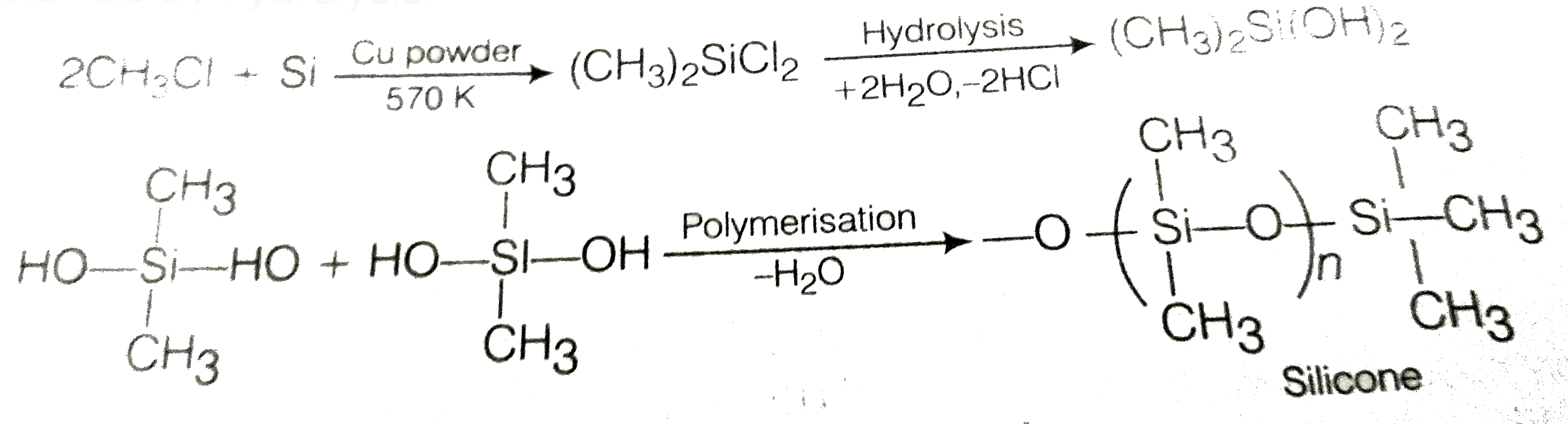 Uses These are used as sealant, greases, electrical unsulators and for water proofing of fabrics. These are ALSO used in sugrical adn cosmetic plants (b) Boron forms a number of covalent hydrides with general formulae `B_(n) H_(n+4) and B_(n) H_(n+6)`. These are called BORANES `B_(2)H_(6) and B_(4)H_(10)` are the representative compounds of the two series respectively. Preparation of Diborane It is prepared by treating boron trifluoride with `LiAlH_(4)` in diethyl ether `4BF_(3)+3LiAlH_(4)rarr2B_(2)H_(6)+3LiF+3AlF_(3)` On industrial scale it is prepared by the reaction of `BF_(3)` with sodium hydride `2BF_(3)+6NaH overset(450K)(rarr)B_(2)H_(6)+6NaF`. |
|
| 41. |
(a) What are electrophiles ? Give example. (b) Describe the chemistry of Lassaigne's test for the detection of halogens. |
|
Answer» SOLUTION :(a) For ANSWER, CONSULT SECTION 12.31. (B)For answer, consult section 12.45. |
|
| 42. |
A well stoppered thermos flask contains some ice cubes. This is an example of |
|
Answer» CLOSED system |
|
| 43. |
A welding fuel gas contains carbon and hydrogen only.Burning a small sample of it in oxygen gives 3.38 g carbon dioxide, 0.690 g of water and no other products. A volume of 10.0 L (measured at STP) of this welding gas is found to weigh 11.6 g. Calculate (i) empirical formula, (ii) molar mass of the gas, and (iii) molecular formula. |
|
Answer» Solution :Amount of carbon in 3.38 g `CO_(2) = 12/44 xx 3.38 = 0.9218 g` Amount of HYDROGEN in 0.690 g `H_(2)O =2/18 xx 0.690 = 0.0767 g` As the fuel gas contains only carbon and hydrogen, total mass of the gas burnt =` 0.9218 + 0.0767 = 0.9985` g `therefore` of C in the fuel gas = `(0.9218)/0.9985 xx 100 = 92.318` % of H in the fuel gas = `0.0767/0.9985 xx 100 = 7.682` (i) Calculation of empirical formula:  `therefore` Empirical formula = CH (ii) Calculation of molar mass: `therefore 10.0 L` of the gas at STP weigh = 11.6 g `therefore 22.4 L` of the gas at STP will weigh `=11.6/10.0 xx 22.4 = 25.984 g = 26 g` Molar mass of the gas `=26 g "mol"^(-1)` (III) Calculation of molecular formula : `n=("Molar mass")/("Empirical formula mass") = 26/(12 + 1) = 26/13 = 2` `therefore` Molecular formula of the gas `=2 xx (CH) = C_(2)H_(2)` |
|
| 44. |
A welding fuel gas contains carbon and hydrogen only. Burning a small sample of it in oxygen gives 3.38 g carbon dioxide,0.690 g of water and no other products. A volume of 10.0 L ( measured at STP) of this weldinggas is found to weight 11.6g. Calculate : (i) empirical formula, (ii) molar mass of the gas, and (iii) molecular formula. |
|
Answer» `3.38 g CO_(2) = (?)` `=(12)/(44) xx 3.38g = 0.9218` g carbon `18 g H_(2)O = 2g H_(2)` `0.69 g H_(2)O = (2)/(18) xx 0.69` `= 0.0767` g HYDROGEN Total mass of COMPOUND `= 0.9218+0.0767` `= 0.9985g` Masspercent of `C = (0.9218)/(0.9985) xx 100 = 92.32%` Mass PERCENT of `H=(0.0767)/(0.9985) xx 100 = 7.68%`  Empirical formula `= CH` mass of 10 L gas at STP `= 11.6g` mass of 22.4 L at STP `=(11.6xx22.4)/(10) = 25.984` Molar mass `=25.984 g/mol ~=26 g/mol` Empirical formula mass `= 12 +1= 13` `:.n = ("Molar mass")/("Empirical formula mass")` `=(26)/(13)=2` Molecular formula `=n xx` Empirical formula `=2xxCH=C_(2)H_(2)` |
|
| 45. |
A weather balloon has a volume of 175 L when filled with hydrogen at a pressure of 1.000 atm. Calculate the volume of the balloon when it rises to a height of 2000 m, where atmospheric pressure is 0.8000 atm. Assume that temperature is constant. |
|
Answer» Solution :When balloon is at the earth surface, `P_1 = 1.000 atm"" V_1 = 175 L` At a height of`2000 m, "" P_2 = 0.8000 " atm "V_2` = ? SINCE, the temperature is ASSUMED to be constant, we have (according to Boyle.s law) `P_1 V_1 = P_2 V_2` or`P_2 = (P_1 V_1)/(P_2) = (1.000 xx 175)/(0.8000)=218.7 L` HENCE, at a height of 2000 m, the volume of the balloon will be 218.7 L. |
|
| 46. |
A weak monobasic acid is 1% ionized in 0.1 M solution at 25^(@)C. The percentage ionization in its 0.025 M solution is |
|
Answer» 1 `K=Calpha^(2)=0.1xx((1)/(100))^(2)=10^(-5)` When `C=0.025,alpha=sqrt((K)/(C))=sqrt((10^(-5))/(0*025))=0*02` `:.%" ionization "=2%`. |
|
| 47. |
A weak electrolyte obeys Ostwald's dilution law. Select the correct statements. |
|
Answer» A DECREASE in concentration of weak acid shows an incrase in its degree of dissociation `(alpha) ` |
|
| 48. |
A weak base BOH is tirated against 0.1 M of HCl solution. The following table indicates the volumes of HCl added and pH of solution. From this data the pK_b of base may be. |
|
Answer» `4.74` ` 14- 10.04 = pK_b +log ""( 0.1 xx 5 )/(40 B -0.1 xx 5) ` ` rArr 3.96 =pK_b +log ""( 0.5 )/(40 B -0.5 )......(1) ` ` 14- 9, 14 =pK_b +log"" ( 0.1 xx 20)/( 40 B -0.1 xx 20 ) ` `rArr 4.86 = pK_b +log ""( 2)/(40B - 2) ....(2) ` ` 0.9 = log"" ( 2)/( 40 B-2) xx ( 40 B -0.5 )/( 0.5 ) ` ` 8 = 4xx ( 40 B-0.5)/( 40 B -2) rArr 80 B -4 =40 B -0.5` ` 40 B =3.5 rArr B =(3.5)/(40) ` substituting in (1) ` 4.86 =pKb+ log"" (2)/(3.5-2 )rArr pK_b =4.74` |
|
| 49. |
A weak acid of dissociation constant 01^(-5) is being titrated with aqueous NaOHsolution. The pH at the point of one-third neutralization of the acid will be |
|
Answer» 5LOG 2 - log 3 `pH = pK_(a) + log. (["Salt"])/(["Acid"])` 1/3rd NEUTRALISATION of the acid meansout of 1 mole of the acid , salt formed = 1/3 mole and acid left = 2/3 mole Hence, `pH = - log(10^(-5))+log.(1//3)/(2//3)` `=5+ log .(1)/(2) = 5 - log2`. |
|