

Saved Bookmarks
This section includes 7 InterviewSolutions, each offering curated multiple-choice questions to sharpen your Current Affairs knowledge and support exam preparation. Choose a topic below to get started.
| 1. |
Although fluorineis moreelectronegativethan chlorinebutchlorinecan beconvertedintochlorideion moreeasily as comparedto fluorideion fromfluorine. Explain. |
|
Answer» SOLUTION :Sinceelectrongainenthalpyof C1 ISMORE negativethan thatof F, thereforemoreenergyis releasedwhen `C1 toC1^(-)` as compared towhen `F to F^(-)` |
|
| 2. |
Although every element is different from every other element, yet some elements have certain similarities. Based upon these similarities, the scientists after numerous attempts were are given. Based upon these multiple choice questions are ultimately sucessful in arranging the various elements into groups or chemical families in such a way that similar elements were put together. This arrangement of elements is calledclassification of elements and this led to the formulation of a periodic table. The periodic table is the most organising principle in chemistry. If you know the properties of any element in a group, or of the columns, of the periodic table, you can make a good guess atthe properties of every other element in the same group and even the elements in the neighbouring groups. The first break through in the classification of elements, was provided by Russian chemist Dmitri lunovich Mendeleev. Taking thechemistry of the elements as his primary organising principle, he arranged the known elements by atomic mass and grouped them together according to their chemical reactivity He also observed that there occurred recurrence of elements with similar physical and chemical properties after certain regular intervals. On the basis of these similarities Mendeleev proposed his periodic law which states that physical and chemical properties of lementsare a periodic function of their atomic masses Moseley suggested that atomic number was a better fundamental property of an element than its atomic mass. This forms the basis of the Modern periodic law. Thus, modern periodiclaw states that physical and chemical properties of the elements are a periodic function of their atomic numbers.In the modern long form of periodic table the elements are arranged in the increasing orderof their atomic numbers and the elements with similar properties repeat after regular intervals. Repetition of chemical properties of elementsat regular intervals when arranged in a definiteorder is called periodicity of properties. This is due the recurrence of similar outer electronic configuration at certain regular intervals. The long form of periodic table may be divided into four main blocks known as s, p, d and f blocks depending upon the type of orbitals being filledup with the increase in atomic number in atoms of the elements. The nature of the block to which an element belongs depends upon the type of subshell which receives the last electron. What is the maximum number of electrons which can be accommodated in an atom in which the highest principal quantum number is 4? |
|
Answer» 10 |
|
| 3. |
Although every element is different from every other element, yet some elements have certain similarities. Based upon these similarities, the scientists after numerous attempts were are given. Based upon these multiple choice questions are ultimately sucessful in arranging the various elements into groups or chemical families in such a way that similar elements were put together. This arrangement of elements is calledclassification of elements and this led to the formulation of a periodic table. The periodic table is the most organising principle in chemistry. If you know the properties of any element in a group, or of the columns, of the periodic table, you can make a good guess atthe properties of every other element in the same group and even the elements in the neighbouring groups. The first break through in the classification of elements, was provided by Russian chemist Dmitri lunovich Mendeleev. Taking thechemistry of the elements as his primary organising principle, he arranged the known elements by atomic mass and grouped them together according to their chemical reactivity He also observed that there occurred recurrence of elements with similar physical and chemical properties after certain regular intervals. On the basis of these similarities Mendeleev proposed his periodic law which states that physical and chemical properties of lementsare a periodic function of their atomic masses Moseley suggested that atomic number was a better fundamental property of an element than its atomic mass. This forms the basis of the Modern periodic law. Thus, modern periodiclaw states that physical and chemical properties of the elements are a periodic function of their atomic numbers.In the modern long form of periodic table the elements are arranged in the increasing orderof their atomic numbers and the elements with similar properties repeat after regular intervals. Repetition of chemical properties of elementsat regular intervals when arranged in a definiteorder is called periodicity of properties. This is due the recurrence of similar outer electronic configuration at certain regular intervals. The long form of periodic table may be divided into four main blocks known as s, p, d and f blocks depending upon the type of orbitals being filledup with the increase in atomic number in atoms of the elements. The nature of the block to which an element belongs depends upon the type of subshell which receives the last electron.The element with atomic number 57 belongs to |
|
Answer» s-block |
|
| 4. |
Although every element is different from every other element, yet some elements have certain similarities. Based upon these similarities, the scientists after numerous attempts were are given. Based upon these multiple choice questions are ultimately sucessful in arranging the various elements into groups or chemical families in such a way that similar elements were put together. This arrangement of elements is calledclassification of elements and this led to the formulation of a periodic table. The periodic table is the most organising principle in chemistry. If you know the properties of any element in a group, or of the columns, of the periodic table, you can make a good guess atthe properties of every other element in the same group and even the elements in the neighbouring groups. The first break through in the classification of elements, was provided by Russian chemist Dmitri lunovich Mendeleev. Taking thechemistry of the elements as his primary organising principle, he arranged the known elements by atomic mass and grouped them together according to their chemical reactivity He also observed that there occurred recurrence of elements with similar physical and chemical properties after certain regular intervals. On the basis of these similarities Mendeleev proposed his periodic law which states that physical and chemical properties of lementsare a periodic function of their atomic masses Moseley suggested that atomic number was a better fundamental property of an element than its atomic mass. This forms the basis of the Modern periodic law. Thus, modern periodiclaw states that physical and chemical properties of the elements are a periodic function of their atomic numbers.In the modern long form of periodic table the elements are arranged in the increasing orderof their atomic numbers and the elements with similar properties repeat after regular intervals. Repetition of chemical properties of elementsat regular intervals when arranged in a definiteorder is called periodicity of properties. This is due the recurrence of similar outer electronic configuration at certain regular intervals. The long form of periodic table may be divided into four main blocks known as s, p, d and f blocks depending upon the type of orbitals being filledup with the increase in atomic number in atoms of the elements. The nature of the block to which an element belongs depends upon the type of subshell which receives the last electron. Which of the following pairs of elements belongs to the same period of the periodic table ? |
|
Answer» NA,Ca |
|
| 5. |
Although every element is different from every other element, yet some elements have certain similarities. Based upon these similarities, the scientists after numerous attempts were are given. Based upon these multiple choice questions are ultimately sucessful in arranging the various elements into groups or chemical families in such a way that similar elements were put together. This arrangement of elements is calledclassification of elements and this led to the formulation of a periodic table. The periodic table is the most organising principle in chemistry. If you know the properties of any element in a group, or of the columns, of the periodic table, you can make a good guess atthe properties of every other element in the same group and even the elements in the neighbouring groups. The first break through in the classification of elements, was provided by Russian chemist Dmitri lunovich Mendeleev. Taking thechemistry of the elements as his primary organising principle, he arranged the known elements by atomic mass and grouped them together according to their chemical reactivity He also observed that there occurred recurrence of elements with similar physical and chemical properties after certain regular intervals. On the basis of these similarities Mendeleev proposed his periodic law which states that physical and chemical properties of lementsare a periodic function of their atomic masses Moseley suggested that atomic number was a better fundamental property of an element than its atomic mass. This forms the basis of the Modern periodic law. Thus, modern periodiclaw states that physical and chemical properties of the elements are a periodic function of their atomic numbers.In the modern long form of periodic table the elements are arranged in the increasing orderof their atomic numbers and the elements with similar properties repeat after regular intervals. Repetition of chemical properties of elementsat regular intervals when arranged in a definiteorder is called periodicity of properties. This is due the recurrence of similar outer electronic configuration at certain regular intervals. The long form of periodic table may be divided into four main blocks known as s, p, d and f blocks depending upon the type of orbitals being filledup with the increase in atomic number in atoms of the elements. The nature of the block to which an element belongs depends upon the type of subshell which receives the last electron. An element with electronic configuration 1s^2 2s^2 2p^6 3s^2 3p^6 3d^3 4s^2 can be placed in thegroup |
|
Answer» fifth |
|
| 6. |
Although every element is different from every other element, yet some elements have certain similarities. Based upon these similarities, the scientists after numerous attempts were are given. Based upon these multiple choice questions are ultimately sucessful in arranging the various elements into groups or chemical families in such a way that similar elements were put together. This arrangement of elements is calledclassification of elements and this led to the formulation of a periodic table. The periodic table is the most organising principle in chemistry. If you know the properties of any element in a group, or of the columns, of the periodic table, you can make a good guess atthe properties of every other element in the same group and even the elements in the neighbouring groups. The first break through in the classification of elements, was provided by Russian chemist Dmitri lunovich Mendeleev. Taking thechemistry of the elements as his primary organising principle, he arranged the known elements by atomic mass and grouped them together according to their chemical reactivity He also observed that there occurred recurrence of elements with similar physical and chemical properties after certain regular intervals. On the basis of these similarities Mendeleev proposed his periodic law which states that physical and chemical properties of lementsare a periodic function of their atomic masses Moseley suggested that atomic number was a better fundamental property of an element than its atomic mass. This forms the basis of the Modern periodic law. Thus, modern periodiclaw states that physical and chemical properties of the elements are a periodic function of their atomic numbers.In the modern long form of periodic table the elements are arranged in the increasing orderof their atomic numbers and the elements with similar properties repeat after regular intervals. Repetition of chemical properties of elementsat regular intervals when arranged in a definiteorder is called periodicity of properties. This is due the recurrence of similar outer electronic configuration at certain regular intervals. The long form of periodic table may be divided into four main blocks known as s, p, d and f blocks depending upon the type of orbitals being filledup with the increase in atomic number in atoms of the elements. The nature of the block to which an element belongs depends upon the type of subshell which receives the last electron. Which of the following sets of atomic numbers belong to that of alkali metals (group I)? |
|
Answer» 12,30,4,62 |
|
| 7. |
Although every element is different from every other element, yet some elements have certain similarities. Based upon these similarities, the scientists after numerous attempts were are given. Based upon these multiple choice questions are ultimately sucessful in arranging the various elements into groups or chemical families in such a way that similar elements were put together. This arrangement of elements is calledclassification of elements and this led to the formulation of a periodic table. The periodic table is the most organising principle in chemistry. If you know the properties of any element in a group, or of the columns, of the periodic table, you can make a good guess atthe properties of every other element in the same group and even the elements in the neighbouring groups. The first break through in the classification of elements, was provided by Russian chemist Dmitri lunovich Mendeleev. Taking thechemistry of the elements as his primary organising principle, he arranged the known elements by atomic mass and grouped them together according to their chemical reactivity He also observed that there occurred recurrence of elements with similar physical and chemical properties after certain regular intervals. On the basis of these similarities Mendeleev proposed his periodic law which states that physical and chemical properties of lementsare a periodic function of their atomic masses Moseley suggested that atomic number was a better fundamental property of an element than its atomic mass. This forms the basis of the Modern periodic law. Thus, modern periodiclaw states that physical and chemical properties of the elements are a periodic function of their atomic numbers.In the modern long form of periodic table the elements are arranged in the increasing orderof their atomic numbers and the elements with similar properties repeat after regular intervals. Repetition of chemical properties of elementsat regular intervals when arranged in a definiteorder is called periodicity of properties. This is due the recurrence of similar outer electronic configuration at certain regular intervals. The long form of periodic table may be divided into four main blocks known as s, p, d and f blocks depending upon the type of orbitals being filledup with the increase in atomic number in atoms of the elements. The nature of the block to which an element belongs depends upon the type of subshell which receives the last electron. In the periodic table, the element with atomic number 16 will be placed in the group |
|
Answer» fourteen |
|
| 8. |
Although every element is different from every other element, yet some elements have certain similarities. Based upon these similarities, the scientists after numerous attempts were are given. Based upon these multiple choice questions are ultimately sucessful in arranging the various elements into groups or chemical families in such a way that similar elements were put together. This arrangement of elements is calledclassification of elements and this led to the formulation of a periodic table. The periodic table is the most organising principle in chemistry. If you know the properties of any element in a group, or of the columns, of the periodic table, you can make a good guess atthe properties of every other element in the same group and even the elements in the neighbouring groups. The first break through in the classification of elements, was provided by Russian chemist Dmitri lunovich Mendeleev. Taking thechemistry of the elements as his primary organising principle, he arranged the known elements by atomic mass and grouped them together according to their chemical reactivity He also observed that there occurred recurrence of elements with similar physical and chemical properties after certain regular intervals. On the basis of these similarities Mendeleev proposed his periodic law which states that physical and chemical properties of lementsare a periodic function of their atomic masses Moseley suggested that atomic number was a better fundamental property of an element than its atomic mass. This forms the basis of the Modern periodic law. Thus, modern periodiclaw states that physical and chemical properties of the elements are a periodic function of their atomic numbers.In the modern long form of periodic table the elements are arranged in the increasing orderof their atomic numbers and the elements with similar properties repeat after regular intervals. Repetition of chemical properties of elementsat regular intervals when arranged in a definiteorder is called periodicity of properties. This is due the recurrence of similar outer electronic configuration at certain regular intervals. The long form of periodic table may be divided into four main blocks known as s, p, d and f blocks depending upon the type of orbitals being filledup with the increase in atomic number in atoms of the elements. The nature of the block to which an element belongs depends upon the type of subshell which receives the last electron. According to the periodic law of elements, thevariation in properties of elements is related to their |
|
Answer» ATOMIC NUMBERS |
|
| 9. |
Although every element is different from every other element, yet some elements have certain similarities. Based upon these similarities, the scientists after numerous attempts were are given. Based upon these multiple choice questions are ultimately sucessful in arranging the various elements into groups or chemical families in such a way that similar elements were put together. This arrangement of elements is called classification of elements and this led to the formulation of a periodic table. The periodic table is the most organising principle in chemistry. If you know the properties of any element in a group, or of the columns, of the periodic table, you can make a good guess atthe properties of every other element in the same group and even the elements in the neighbouring groups. The first break through in the classification of elements, was provided by Russian chemist Dmitri lunovich Mendeleev. Taking the chemistry of the elements as his primary organising principle, he arranged the known elements by atomic mass and grouped them together according to their chemical reactivityHe also observed that there occurred recurrence of elements with similar physical and chemical properties after certain regular intervals. On the basis of these similarities Mendeleevproposed his periodic law which states that physical and chemical properties of elementsare a periodic function of their atomic masses Moseley suggested that atomic number was a better fundamental property of an element than its atomic mass. This forms the basis of the Modern periodic law. Thus, modern periodic law states that physical and chemical properties of the elements are a periodic function of their atomic numbers. In the modern long form of periodic table theelements are arranged in the increasing order their atomic numbers and the elements with similar properties repeat after regular intervals. Repetition of chemical properties of elements at regular intervals when arranged in a definite order is called periodicity of properties. This is due the recurrence of similar outer electronic configuration at certain regular intervals. Thelong form of periodic table may be divided into four main blocks known as s, p, d and f blocks depending upon the type of orbitals being filled up with the increase in atomic number in atoms of the elements. The nature of the block to which an element belongs depends upon the type of subshell which receives the last electron. Long form of periodic table is based on the properties of the elements as a function of their |
|
Answer» ATOMIC MASS |
|
| 10. |
Although every element is different from every other element, yet some elements have certain similarities. Based upon these similarities, the scientists after numerous attempts were are given. Based upon these multiple choice questions are ultimately sucessful in arranging the various elements into groups or chemical families in such a way that similar elements were put together. This arrangement of elements is called classification of elements and this led to the formulation of a periodic table. The periodic table is the most organising principle in chemistry. If you know the properties of any element in a group, or of the columns, of the periodic table, you can make a good guess atthe properties of every other element in the same group and even the elements in the neighbouring groups. The first break through in the classification of elements, was provided by Russian chemist Dmitri lunovich Mendeleev. Taking the chemistry of the elements as his primary organising principle, he arranged the known elements by atomic mass and grouped them together according to their chemical reactivityHe also observed that there occurred recurrence of elements with similar physical and chemical properties after certain regular intervals. On the basis of these similarities Mendeleevproposed his periodic law which states that physical and chemical properties of elementsare a periodic function of their atomic masses Moseley suggested that atomic number was a better fundamental property of an element than its atomic mass. This forms the basis of the Modern periodic law. Thus, modern periodic law states that physical and chemical properties of the elements are a periodic function of their atomic numbers. In the modern long form of periodic table theelements are arranged in the increasing order their atomic numbers and the elements with similar properties repeat after regular intervals. Repetition of chemical properties of elements at regular intervals when arranged in a definite order is called periodicity of properties. This is due the recurrence of similar outer electronic configuration at certain regular intervals. Thelong form of periodic table may be divided into four main blocks known as s, p, d and f blocks depending upon the type of orbitals being filled up with the increase in atomic number in atoms of the elements. The nature of the block to which an element belongs depends upon the type of subshell which receives the last electron. In the long form of periodic table, all the non-metals are collectively placed in |
|
Answer» s-block |
|
| 11. |
Although dihydrogen is the third most abundant element on the surface of the globe yet it is not found in our atmosphere . Why so ? |
| Answer» Solution :EARTH does not process ENOUGH gravitation pull to RETAIN light `H_(2)` MOLECULES. | |
| 12. |
Although dihydrogen can be prepared by electrolysis of water but in fertilizer industry, dihydrogen needed for making urea is prepared froom natural gas or naphtha. Why so ? |
|
Answer» Solution :MANUFACTURING of `H_(2)` by electrolysis of water is a HIGHLY expensive process, therefore, in INDUSTRY , it is manfactured by partial oxidation of natural gas or NAPHTHA. `underset("Natural gas")(CH_(4)(g)) + underset("NI")(1270K)to underset("Syn gas")ubrace (CO(g) + 3H_(2)(g))` `underset("Naphtha")(C_(n)H_(2n+2))+ underset("Steam")(nH_(2)O) underset(Ni) overset(1270K)to nCO + (2n+1)H_(2)` CO is then removed from syn gas by water gas shift reaction. |
|
| 13. |
Although D_(2)O resembles H_(2)O chemically yet is is a toxic substance . Explain. |
| Answer» SOLUTION :`D_(2)O` is toxic SINCE , `D^(+)` reacts at a MUCH slower rate as compared to `H^(+)` in enzyme-catalyzed REACTIONS. | |
| 14. |
Although carbocations are alwaysplanar but carbanions and free radicals can assume either planar or pyramidal geometry. Why is it so ? Explain. |
Answer» Solution :The simple alkyl carbanions are pyramidal. For example,  However, carbanions in which the C-atom carrying the NEGATIVE charge is adjacent to a double bond or a benzene ring, are planar due to stabilization by RESONANCE. Thus, allyl and benzyl carbanions are planar. 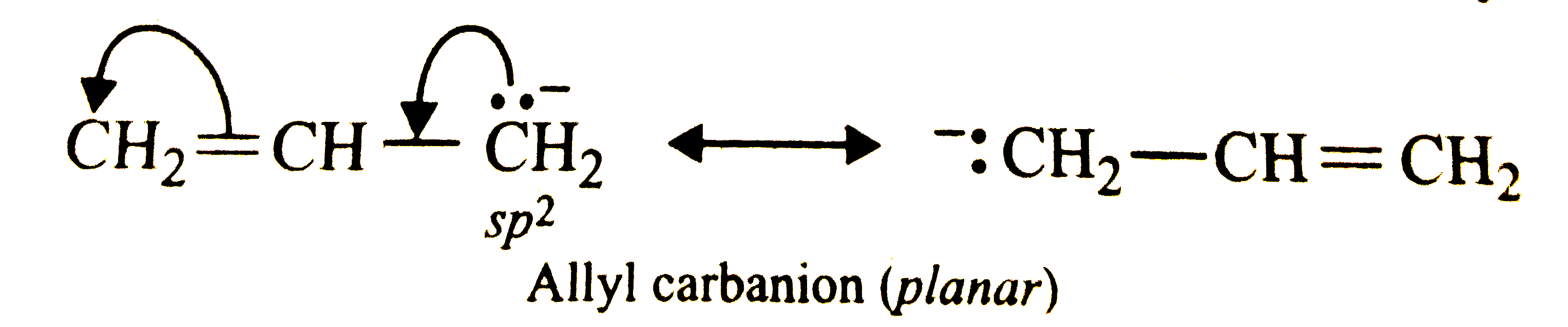 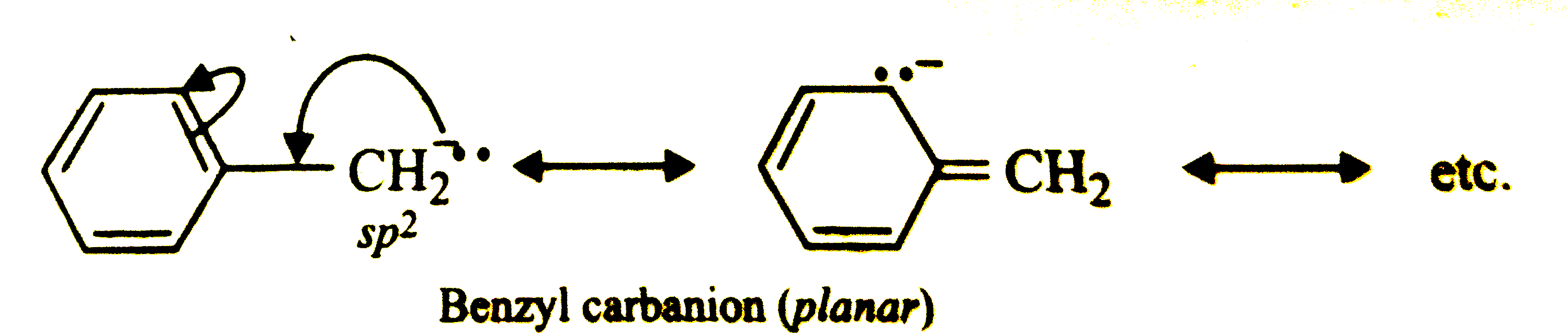 Most of the free radicals are planar but free radicals in which the carbon atom carrying the ODD ELECTRON is connected to a bridge head carbon or highly electronegative element are pyramidal. For examples. `CF_(3)` has pyramidal shape. |
|
| 15. |
Although C-D bond is stronger than C-H bond, yet (CH_(3))_(3)C^(+)(i) is more stable than (CD_(3))_(3)C^(+) (ii) Why so ? |
Answer» Solution :Both carbocations (i) and (ii) are stabilized by hyperconjugation as shown below: 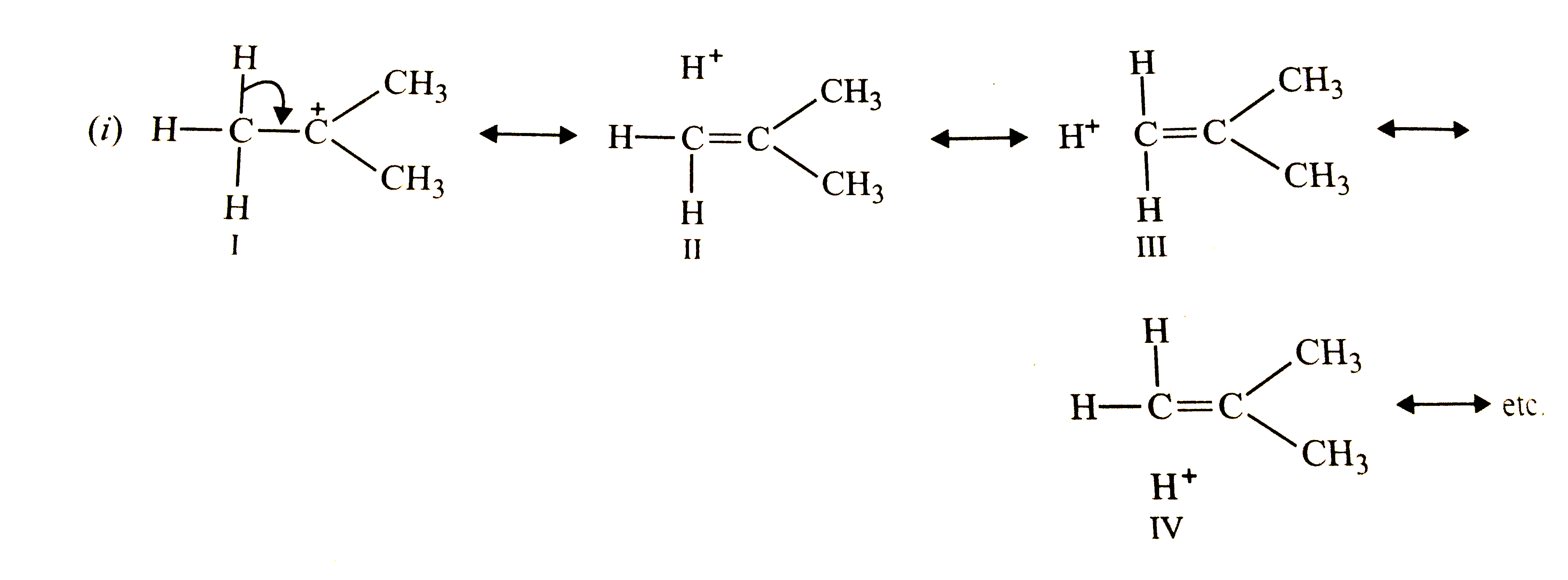 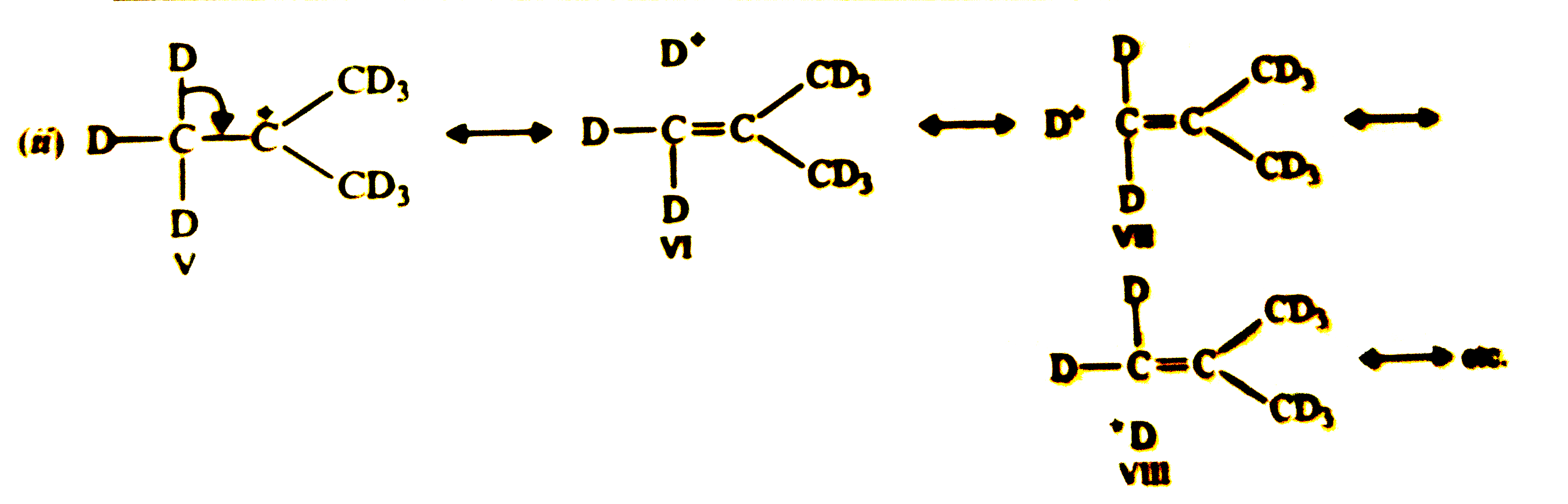 Due to stronger C-D bond, CONTRIBUTION of STRUCTURES (V-VIII) towards stability of carbocations, `(CD_(3))_(3)C^(+)` is less than those of structures (I-IV) for carbocation, `(CH_(3))_(3)C^(+)`, therefore, carbocation (i) is more stable than carbocation (ii). This effec is also sometimes called as `beta-` or secondary isotope EFFECT. |
|
| 16. |
Although bothCO_2and H_2 O are triatomic molecules, the shape of H_2 O molecule is bent while that of CO_2 is linear. Explain this on the basis of dipole moment ? |
| Answer» Solution :`CO_2` is a linear in which the two C = are oriented in the opposite directions at an angle of `180^@`. The DIPOLE moment of C =0 is 2.3 D due to linear structure of `CO_2` the bond DIPOLES of two C = O bonds cancel with each other. Therefore resultant `mu`is zero. On the other HAND, `H_2 O` is polar molecule having dipole moment 1.54 D. Actually `H_2 O` molecule has BENT structure in which O-H bonds are oriented at an angle of `104^(0) 5^(1)` and dont cancel the bond moments of each other. | |
| 17. |
Although both CO_2 and H_2O are triatomic molecules.,the shape of H_2O molecular is bent while that of CO_2 is linear. Explain these on the basis of dipole moment. |
| Answer» SOLUTION :Experimental measurement has shown that the DIPOLE moment of `CO_2` is zero. This is possible only if `CO_2` is linear molecule. The two BOND DIPOLES cancel each other giving it a net dipole moment value of zero. | |
| 18. |
CO_(2) and H_(2)Oboth are triatomic molecules but their dipole moment values are different.Why? |
|
Answer» Solution :In `CO_(2)` there are two C-0 bonds. Each C=O bond is a POLAR bond. The net dipole moment of `CO_(2)` molecule is zero. This is possible only if `C_(2)` is a linear molecule.(O = C = O). The bond dipóles of two C = 0 bonds CANCELS the dipole moment of each other. Whereas, `H_(2)O` molecule has a net dipole moment (1.84 D). `H_(2)O` molecule has a bent structure because here the O - H bonds are ORIENTED at an angle of `104.5^(@)` and do not cancel the bond dipole moments OS each other. |
|
| 19. |
Although both CO_(2) and H_(2)O are triatomic molecules,the shaep of H_(2)O molecule is bent while that of CO_(2) is linear. Explain this on the basis of dipple moment? |
|
Answer» Solution :`CO_(2)` is a linear in which the two C=O are oriented in the OPPOSITE directions at an angle of `180^(@)`. The dipole moment of C=O is 2.3 D due to linear STRUCTURE of `CO_(2)` the bond DIPOLES of two C=O bonds CANCEL with each other. Therefore resultant `mu` is zero. On the other hand `H_(2)O` is polar molecule having dipole moment 1.54 D. Actually `H_(2)O` molecule has bent structure in which O-H bonds are oriented at an angle of `104^(@)5^(1)` and dont cancel the bond moment of each other. |
|
| 20. |
Although bothCO_(2) and H_(2) Oare triatomic molecules, the shape of H_(2)Omolecule is bent while that ofCO_(2) is linear . Explain these on the basis of dipole mement. |
|
Answer» Solution :The dipole mement STUDIES show that the dipole moment of `CO_(2)`molecule is zero . This is POSSIBLE only if ` CO_(2)`is a linear molecule ` ((O = C=O))` so that diple moment of C-Oare equal and opposite and HENCE cancel out . On the other hand, `H_(2) O ` molecule is found to have a net dipole moment (1.84 D) thought it contains 2 O-H bonds . This shows that it is a bent molecule 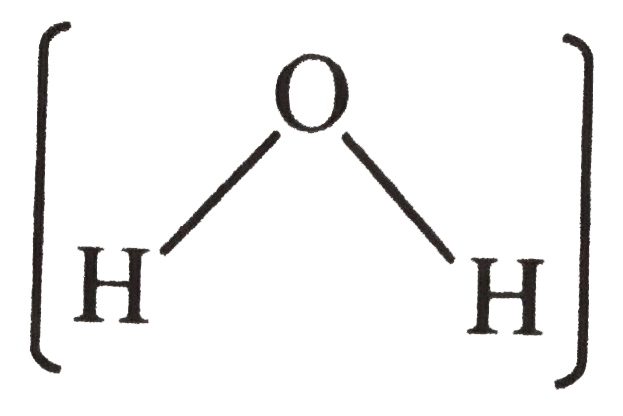
|
|
| 21. |
Although both CO_(2) and H_(2)O are triatomic molecular , the shape of H_(2)O molecule is bent while that of CO_(2) is liner. Explain this on the bases of dipole moment. |
|
Answer» Solution :ALWAYS, POLARITY of molecule = `({:("The vecotr sum "),("of the dipole"),("moments of "),("various bonds"):})` Shape of `CO_(2) `: the shpae of `CO_(2)` is linear so its become nonpolar. Practically `CO_(2)` is nonpolar. `(mu = 0 )` Polarity of molecule = Vectro addition of Dipole moment of all bands inmolecule `CO_(2)` is linear molecule so it is nonpolar experiment `CO_(2)` is NON polar `(mu = 0 ) CO_(2)` is nonpolar it is indirect thus it shape must be like this vector addition of DIPOLAR becomes zero. In `CO_(2) " two C" OVERSET(rarr)(_)` Obonds are same but if the are in opposite direction than nullify the effect of each other . `O overset(larr)(_) " C " overset(rarr)(_) O equiv [""^(-delta)O -overset(-2 delta)(C) - O^(-delta) ]^(0)` `therefore mu = 0 "so , "CO_(2)` is non polar `H_(2)O : H_(2) O ` is angular `mu` = 1.85 D so it is polar . IN `H_(2) `O .O. is more electronegative than H. `therefore H - O` bond is polar . `H^(+) o O^(-delta) and H overset(rarr)(_)` son bond has dipole . The sharp of `H_(2)`O should be like this the net dipole not become zero. So the arrangement of bond must be angular . Bond angle is `1.4.5^(@) " net " mu = 1.85 D ` 
|
|
| 22. |
Although benzene is highly unsaturated it does not undergo addition reactions. The explanation of this can be suggested as |
|
Answer» `PI`-ELECTRONS of BENZENE RING are delocalised |
|
| 23. |
Although benzene is highly unsaturated , it does not undergo addition reactions |
| Answer» SOLUTION :Because of extra STABILITY due to delocalization of `pi`-electrons, the double BONDS of benzene usually do not undergo ADDITION reactions. | |
| 24. |
Although aluminium is above hydrogen in the electrochemical series, it is stable in air and water Why? |
|
Answer» Solution :The THIN protective film of oxide, `Al_2O_3` is FORMED on the surface of aluminium. This PROTECTS the metal from further ATTACK of air and water. Thus the metal is stable in air and water. |
|
| 25. |
alpha - D glucose undergoes mütarotation to beta-D glucose in an aqueous solution. If at 298 K there is 60% conversion of alpha - D glucose overset(H_(2)O)(harr) beta-D glucose, then find correct statement |
|
Answer» the CONVERSION is spontaneous  `K=(0.6)/(0.4)=1.5` `Delta G^(@)= -RT LNK = -1.005 kJ` `Delta G^(@) lt 0 implies` spontaneous |
|
| 26. |
alpha-D-Glucopyanose and beta-D-Glucopyranose are: |
|
Answer» STEREOISOMERS |
|
| 27. |
Alomost the entire mass of an atom is concentrated in the ________. |
|
Answer» proton |
|
| 28. |
Almost the entire mass of an atom is concentrated in the ____ |
|
Answer» Proton |
|
| 29. |
Almost the entire mass of an atom is concentrated in the __________. |
|
Answer» proton |
|
| 30. |
Almost all compounds of carbon form covalent bonds. Give reason. |
| Answer» Solution :Carbon (Z = 6) have electronic configuration of `1S^(2) 2s^(2) 2p^(2)` . It is not possible for the carbon to form EITHER `C^(4+)` or `C^(4-)` ions to attain the nearest noble gas configuration as it requires large amount of energy. This implies that carbon cannot form IONIC bond. So almost in all compounds of carbon, it form four covalent bonds. | |
| 31. |
Almost all amides exist in the |
|
Answer» SOLID STATE |
|
| 32. |
Allylic bromination of an olefin is : |
|
Answer» Nucleophilic SUBSTITUTION |
|
| 33. |
Allyl chloride is hydrolysed more readily than n-propyl chloride. Why? |
Answer» Solution :ALLYL chloride shows high REACTIVITY because the CARBOCATION formed by hydrolysis is STABILISED by resonance while no such stabilisation of carbocation EXISTS in the case of n-propyl chloride. 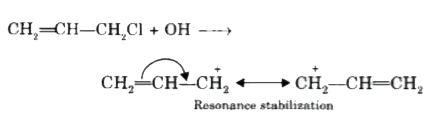
|
|
| 34. |
Allyl alcohol + Br_2// C Cl_4 to ? |
|
Answer» `UNDERSET(Br)underset(|)CH_2 - underset(Br)underset(|)CH-underset(OH)underset(|)CH_2` |
|
| 35. |
Alloys are which type of mixture ? |
|
Answer»
|
|
| 36. |
Allotropy is the occurence of same element in two or more different physical forms having more or less similar chemical properties but different physical properties. The different forms of the element are called allotropes. Allotropy is due to the difference in the arrangement of atoms in solid state. Allotropes may be crystalline or amorphous Which among the following statements are correct ? |
|
Answer» Aquadag and oildag are made up of graphite |
|
| 37. |
Allotropy is the occurence of same element in two or more different physical forms having more or less similar chemical properties but different physical properties. The different forms of the element are called allotropes. Allotropy is due to the difference in the arrangement of atoms in solid state. Allotropes may be crystalline or amorphous Among the following statements are incorrect statement(s) is / are |
|
Answer» Of all the elements carbon EXHIBIT maximum catenation power |
|
| 38. |
Allotropy is the occurence of same element in two or more different physical forms having more or less similar chemical properties but different physical properties. The different forms of the element are called allotropes. Allotropy is due to the difference in the arrangement of atoms in solid state. Allotropes may be crystalline or amorphous In which of the following all the atoms are not sp^(3) hybridization |
|
Answer» Diamond |
|
| 39. |
Allene is an example of |
|
Answer» CONJUGATED diene |
|
| 40. |
Alltransitionelement ared- block elementbut all d- blockelementare nottransition elements Explain. |
| Answer» Solution :Elementin whichthe last electron ENTERS any one of the five d- orbitalsof theirrespec tive penultimateshells arecalledd-blockelements. Inthe light of thisdefinition Zn ,CD,Hg and CN cannot beregarded asd- blockelementsincelast electron inthementersthe s-orbital of their respective ultimate shells ratherthan the d- orbital oftheir respectivepenultimate shells . thereforethese elementshouldberegardedas s- BLOCKELEMENT.Butthe propertiesof theseelementresemblemore the d-blockratherthan s- blockelement( referto ANS to Q.1 page `3//61`) . Thereforeto makethe studyof periodicclassification ofelementmorerationalthey arestudied along withd-blockelement. Thuson thebasisof properties alltransitionelementare d-blockelementbut on thebasisof electronicconfigurationall d-blockelementare not a transitionelements | |
| 41. |
All titration which involves the direct titration of Iodine with a reducing agent are grouped under lodimetry. Iodimetry is employed to determine the strength of reducing agent such as sodium thio sulphate I_(2) + 2Na_(2)S_(2)O_(3) rarr 2I^(-)+S_(4)O_(6)^(-) If iodine is liberated as a result of chemical reaction involving oxidation of an idodide ion by a strong oxidizing agent in neutral or acidic medium the liberated iodine is then titrated with reducing agent. This titration is called lodometry. Todometry is used to estimate the strength of oxidizing agent. For example the estimation of Cu^(++)with thiosulphate. Cu^(+ +) +I^(-) Cu_(2)I_(2)+I_(2) , I_(2)+S_(2)O_(3)^(-) rarrS_(4)O_(6)^(-) +I^(-) Starch used as indicator near the end point which form blue colour complex with I_(3)^(-) . The blue colour disappears when10 mL of H_2O_2solution on treatment with KI and titration of liberated I_2required 10 mL of 1 Nhypo . Thus H_2O_2 is : |
|
Answer» 1 N No. of milli equivalents of hypo `10xx N = 10 xx 1 , N = 1N` Volume strength =` 5.6 xx N = 5.6 ` `N = W/(CrEW)XX1` `W = N xx GEW = 1 xx 17 = 17 g `.lit |
|
| 42. |
All transition elements are d-block elements, but all d-block elements are not transition elements. Explain. |
|
Answer» Solution :ELEMENTS in which the last electron enters in the d-orbitals are called d-block elements or transition elements. General outer ELECTRONIC configuration is `(n-1) d^(1-10) - ns^(2)`. Electron configuration of Zn, Cd and Hg is `(n-1)d^(10)ns^(2)` dlons, which do not shows the most of the properties of the d-block elements. The d-orbitals in these elements are completely FILLED in the GROUND state as WELL as in their common oxidation states. Therefore, they are not regarded as transition elements. Thus, on the basis of properties, all transition elements are d-block elements but on the basis of electronic configuration, all d-block elements are not transition elements. |
|
| 43. |
All titration which involves the direct titration of Iodine with a reducing agent are grouped under lodimetry. Iodimetry is employed to determine the strength of reducing agent such as sodium thio sulphate I_(2) + 2Na_(2)S_(2)O_(3) rarr 2I^(-)+S_(4)O_(6)^(-) If iodine is liberated as a result of chemical reaction involving oxidation of an idodide ion by a strong oxidizing agent in neutral or acidic medium the liberated iodine is then titrated with reducing agent. This titration is called lodometry. Todometry is used to estimate the strength of oxidizing agent. For example the estimation of Cu^(++)with thiosulphate. Cu^(+ +) +I^(-) Cu_(2)I_(2)+I_(2) , I_(2)+S_(2)O_(3)^(-) rarrS_(4)O_(6)^(-) +I^(-) Starch used as indicator near the end point which form blue colour complex with I_(3)^(-) . The blue colour disappears whenWhen 159.50g of CuSO_4in a solution is reacted with KI, then the liberated iodine required 100 ml 1 M Na_(2)S_(2)O_3for complete reaction, then what is the percentage purity of sample used in making the solution. |
|
Answer» SOLUTION :eqt.of `CuSO_4` = eqt.of Hypo `w/(159.5)=(100xx1)` w = 15.9 G `:. % ` purity `=(15.95)/(159.5)xx100=10%` |
|
| 44. |
All titration which involves the direct titration of Iodine with a reducing agent are grouped under lodimetry. Iodimetry is employed to determine the strength of reducing agent such as sodium thio sulphate I_(2) + 2Na_(2)S_(2)O_(3) rarr 2I^(-)+S_(4)O_(6)^(-) If iodine is liberated as a result of chemical reaction involving oxidation of an idodide ion by a strong oxidizing agent in neutral or acidic medium the liberated iodine is then titrated with reducing agent. This titration is called lodometry. Todometry is used to estimate the strength of oxidizing agent. For example the estimation of Cu^(++)with thiosulphate. Cu^(+ +) +I^(-) Cu_(2)I_(2)+I_(2) , I_(2)+S_(2)O_(3)^(-) rarrS_(4)O_(6)^(-) +I^(-) Starch used as indicator near the end point which form blue colour complex with I_(3)^(-) . The blue colour disappears when In the reaction, 2CuSO_(4) +4KI rarrCu_(2)I_(2) + 2K_(2)SO_(4)+I_2the ratio of equivalent weight of CuSO_4to its molecular weight is: |
|
Answer» `1//8` |
|
| 45. |
All the s-block elements of the periodic table are placed in the groups… |
|
Answer» IA and IIA |
|
| 46. |
All the s-block and p-block elements excluding 18th group are called .................. elements |
|
Answer» transition |
|
| 47. |
All the orbitals used by carbon for the formtion of CH_(4) have |
|
Answer» <P>same % `P_(X)` - CHARACTER |
|
| 48. |
All the naturally occurring processes proceed spontaneously in a direction which leads to |
|
Answer» DECREASE in entropy |
|
