

Saved Bookmarks
This section includes 7 InterviewSolutions, each offering curated multiple-choice questions to sharpen your Current Affairs knowledge and support exam preparation. Choose a topic below to get started.
| 1. |
Assertioin: Platinum and gold occur innative state. Reason: Platinum and gold are expensive metals. |
|
Answer» Both A and R ar TRUE and R is the correct EXPLANATION of A |
|
| 2. |
Asseriton (A) : covalent bonds are stronger than ionic bonds . Reson (R) :covalant bonds are stronger than ionic bonds . |
|
Answer» if both (A) and ® are correct , and ® is correct explanartion of (A |
|
| 3. |
Aspirin is widely used as an analgesic drug. It is optically inactive. The structure of aspirin is Which of the following is not correct name for Aspirin? |
|
Answer» 2-O-Acetyl SALICYLIC ACID |
|
| 4. |
Aspirin is widely used as an analgesic drug. It is optically inactive. The structure of aspirin is Ratio of SP:SP^2 : SP^3carbon hybrid orbitals in the Aspirin is |
|
Answer» `0:6:1` |
|
| 5. |
Aspirin is known as |
|
Answer» PHENYL salicylate |
|
| 6. |
Aspirin is known as : |
|
Answer» ACETYL salicylic ACID |
|
| 7. |
Aspirin is |
|
Answer» ACETYL SALICYLIC ACID 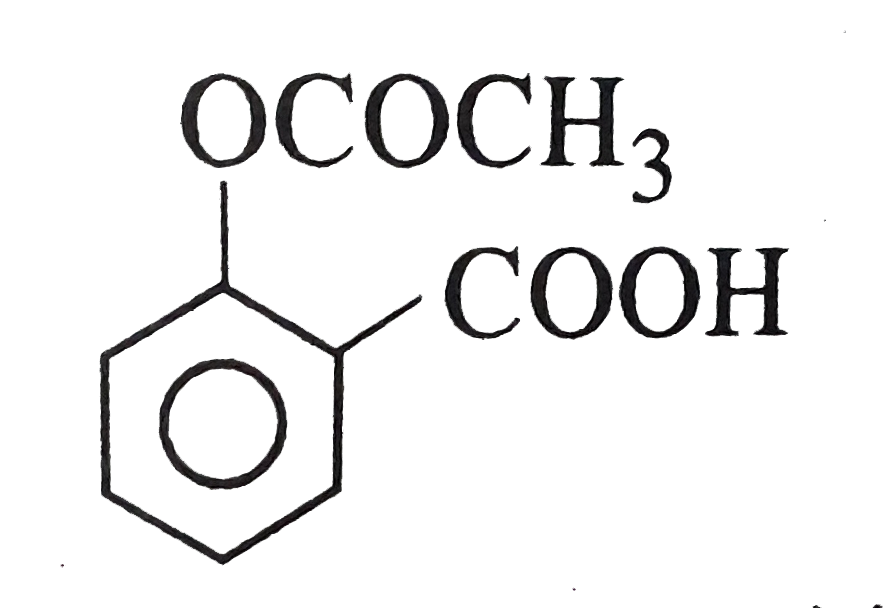 Acetyl salicylic acid (ASPIRIN) |
|
| 8. |
Aspirin (acetyl salicyclic acid, molar mass 180 g "mol"^(-1)) used as analgesic has pK_(a) value of 2. Two tablets of aspirin eachweighing 90 mg are dissolved in 100 mL of water. The pH of the solution is |
|
Answer» 0.5 `pH=(1)/(2)[pK_(a)-log c]` Here, `c=2xx0.09 g "in " 100 ML = 1.8 g L^(-1)` `=(1.8)/(180)M=0.01 M` `:. pH=(1)/(2) [2-log 0.01]=(1)/(2)[2-(-2)]=2` |
|
| 9. |
Aspartame an artificial sweetner contains 9.52% by weight of nitrogen. There are two nitrogen atoms per molecule, then the molecular weight of aspartame is: |
|
Answer» 588 |
|
| 10. |
Asnwer the following queestion based o given reaction. How many fractions are present in fractions distiallation? |
|
Answer» 4 |
|
| 11. |
Asnwer the following queestion based o given reaction. Total number of theretically products (includeing stereo ) are : |
|
Answer» 4 |
|
| 12. |
Asnwer the following queestion based o given reaction. How many products are resolvable? |
|
Answer» 2 |
|
| 13. |
A(s)hArrB(g)+C(g) K_(P)=40atm^(2) X(s)hArrB(g)+E(g) Above equilibrium is allowed to attain in a closed container and pressure of B was found to be 10 atm. Calculate standard Gibb's free energy change for X(s)hArrB(g)+E(g) "at" 300K (takeR=2 cal//k//mol) |
|
Answer» `3.5 Kcal//mol` |
|
| 14. |
As_(2)S_(2) sol |
|
Answer» POSITIVE colloid |
|
| 15. |
As_(2)O_(5) is …………..while Sb_(2)O_(5) is …………. |
|
Answer» |
|
| 16. |
As we move down the group , the electro positive character of elements _______. |
|
Answer» Increases |
|
| 17. |
As we move down the group covalent character decreaes, solubility increases and thermal stability increases for which of the following? |
|
Answer» Fluorides of alkali metal |
|
| 18. |
As we move down in group 13 elements increase in atomic size is comparatively very less. Explain. |
| Answer» SOLUTION :It is due to the poor SHIELDING effect of d and f - electrons as a RESULT of which effect nuclear charge increases. | |
| 19. |
As we go up above the earth's surface , does temperature decrease continuously ? Explain |
| Answer» Solution :No, temperature does not DECREASE CONTINUOUSLY , From 0-11 km (called troprosphere) , temperature decreases.From 11-50 km (called STRATOSPHERE), temperature increases . From 50-85 km (calledmesosphere ) , temperature again decreases and finally from 85-100 km (called THERMOSPHERE) , temperature again increases. | |
| 20. |
As the temperature is raised from 20^(@)C to 40^(@)C the average kinetic energy of neon atoms changes by a factor of which of the following ? |
|
Answer» `1//2` `:. (E_(40.))/(E_(20.))=(T_(40.))/(T_(20.))=(40+273)/(20+273)=(313)/(293)`. |
|
| 21. |
As the temperature is raised from 20^@C " to " 40^@C, the average kinetic energy of neon atoms changes by a factor of which of the following? |
|
Answer» `1/2` |
|
| 22. |
As the temperature is raised from 20^(@)C to 40^(@)C the average kinetic energy of neon atoms changes by a factor |
|
Answer» 2 |
|
| 23. |
As the temperature increases, average kinetic energy of molecules increases. What would be the effect of increase of temperature on pressure provided the volume is constant ? |
|
Answer» INCREASES |
|
| 24. |
As the temperature increases, average kinetic energy of molecules increases. What would be the effect of increase of temperature on pressure provided the volume isconstant ? |
|
Answer» Increases |
|
| 25. |
As the s-character of a hybrid orbital increases the bond angle |
|
Answer» INCREASES |
|
| 26. |
As the oxidation state for any metal increases, the tendency to show ionic nature |
|
Answer» Decreases |
|
| 27. |
As the molecular weight of alkanes increases, how do the boiling point and melting point change? |
|
Answer» BOILING POINT INCREASES, melting point increases |
|
| 28. |
As regards magnetic behaviour, TiO_2is _______ |
|
Answer» |
|
| 29. |
As per the graph what is K_c of A harr nB |
|
Answer» 1.25 M  `:.` A reacted =0.5, B FORMED =1.0 `implies` n = 2 `K_(C)=([B]^(2))/([A])=(1^(2))/(0.8)=1.25` |
|
| 30. |
As per the first law of theromdyamics, which of the following statements would be appropriate? |
|
Answer» Energy of system remains CONSTANT |
|
| 31. |
As per second law of thermodynamics a process taken place spontaneously if and only if the entropy of the universe increases due to the process. Change in entropy is given by Delta S = (Q_(rev))/(T) What is the change in entropy of the universe due to the following reaction occuring at 27^(@)C ? A + 2B rarr C + 2D, Delta H = +1.8 kJ mol^(-1) Molar entropy values of A, B, C and D are 1,2,3 and 4 JK^(-1) mol^(-1) respectively. |
|
Answer» 0 `= (Sigma S_(P)- Sigma S_(R )) + ((-Delta H_("system"))/(T))` `= (2(4) + 3-2(2)-1) + ((-1.8 xx 10^(3))/(300))` `= 6-6 = 0` |
|
| 32. |
As per second law of thermodynamics a process taken place spontaneously if and only if the entropy of the universe increases due to the process. Change in entropy is given by Delta S = (Q_(rev))/(T) A gas C_(V) = (0.2 T) Cal K^(-1). What is the change in its entropy when one mole of it is heated from 27^(@)C to 127^(@)C at constant volume ? |
|
Answer» `20 "cal "K^(-1) mol^(-1)` For the GIVEN condition `Delta S= underset(T_(1))overset(T_(2))int (n C_(v)dT)/(T) = (0.2T)/(T) dT` `= 02 (T_(2) - T_(1)) = 20` cal/mol- k |
|
| 33. |
As per MO theory last electron of N_(2) filled in which molecular orbitaJ ? |
|
Answer» `sigma_(MO)` |
|
| 34. |
As per law of mass action, for NH_(4) HS(s) hArrNH_(3)(g) + H_(2) S(g) ratio of rate constants of forward (K_(f)) & backword (K_(b))reactions at equilibrium equals ot |
|
Answer» <P>`[NH_4HS]` |
|
| 35. |
As per Aufbau principle, arrange the orbitals in increasing order of energy. |
|
Answer» `4p GT 4D gt 5S gt 5p` |
|
| 36. |
As one moves along a given row in the periodic table, ionisation energy |
|
Answer» Remains same |
|
| 37. |
As observed from Andrew's isothermals of CO_(2), critical temperature of CO_(2) is "_____________"""^(@)C |
|
Answer» 13.1 |
|
| 38. |
As O_(2) (l)is colled at 1 atm pressure ,it freezes to form solid Iat54.5 K.At a lowertemperature, solid I rearrangesto solid II which has a different crystalstructure. Thermal measurementsshow thatform the phase transition of solidI to solid II, DeltaH =- 743.1J //mol and DeltaS= - 17.0 JK^(-1)mol^(-1).At what temperature aresolidsI andII in equilibrium ? |
|
Answer» 2.06K |
|
| 39. |
As its melting point, ice is lighter than water because: |
|
Answer» `H_(2)O` molecules are more closely packed in the SOLID state |
|
| 40. |
As it passes into food chain the concentration of DDT |
|
Answer» Reamins same |
|
| 41. |
As ester is treated with excess of methyl magnesium bromide and after subsequent hydrolysis, the product formed is isopropyl alcoho. The ester can be |
|
Answer» METHYL formate 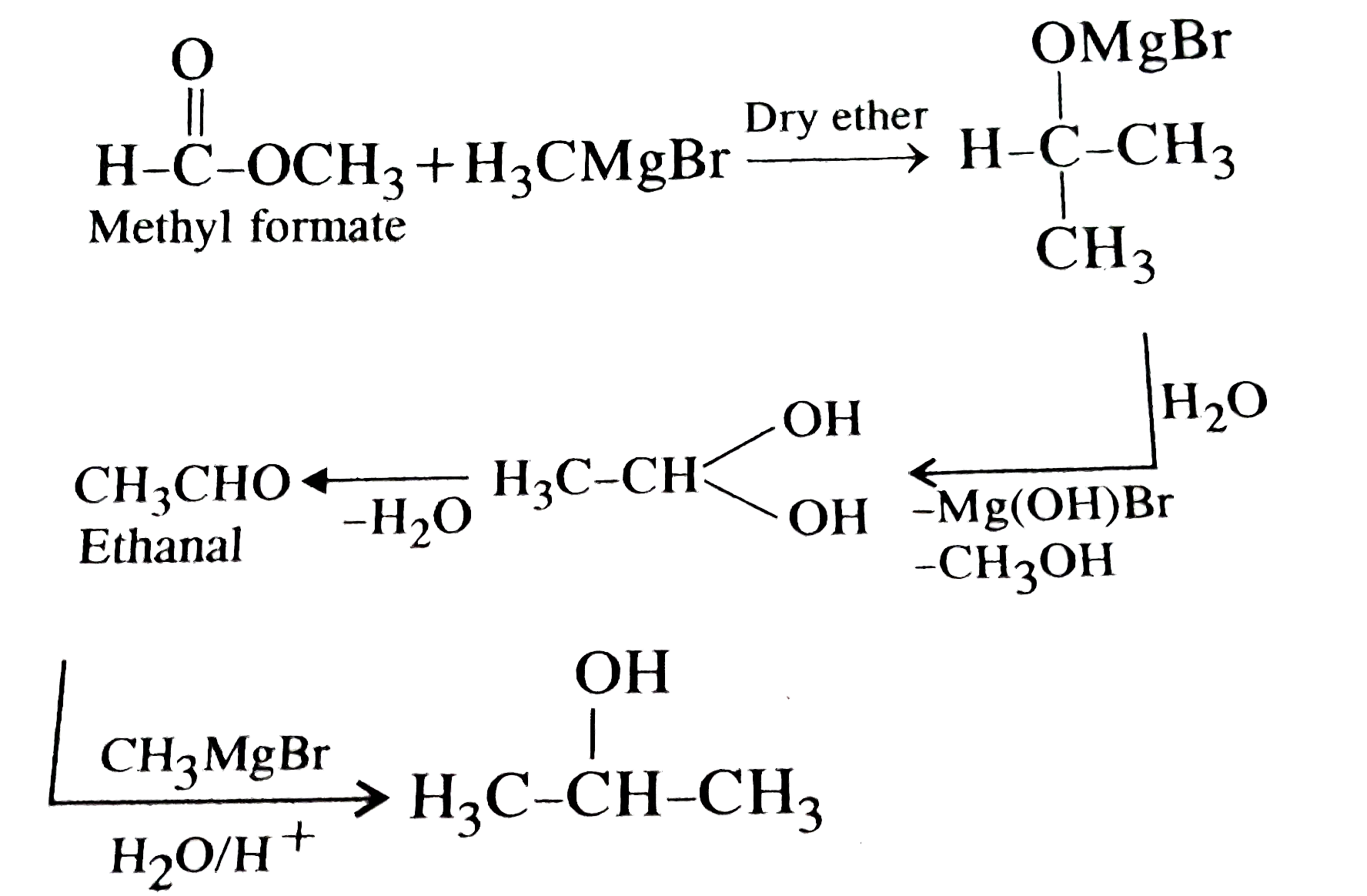
|
|
| 42. |
As electron moves away from the nucleus , its potential energy |
|
Answer» Increases |
|
| 43. |
As electron moves away from the nucleus, its |
|
Answer» K.E. DECREASES by P.E. increases |
|
| 44. |
As DeltaG^(circ) for a reaction changes form a large negative value to a large positive value, K for the reaction will change form : |
|
Answer» a LARGE POSITIVE value to a large negative value. |
|
| 45. |
Ascomparedtopotassium ,sodiumhas______. |
|
Answer» LOWER electronegativily |
|
| 46. |
A_((s))+B_((g)) +" heat "Leftrightarrow 2C_((s))+2D_((g)). At equilibrium the concentration of B is doubled. By what factor the concentration of D should change to retain the equilibrium |
|
Answer» Solution :`K_(p)=(P_(D)^(2))/(P_(B)) ........(1), K_(P)=(x.P_(D))^(2)/(2P_(B)) .........(2)` on solving `x=sqrt2` |
|
| 47. |
A_((s)) + B_((g)) + "heat" hArr 2C_((s)) + 2D_((g)) . At equilibrium the pressure of 'B is doubled. By what factor the concentration of 'D' should change, to reattain the equilibrium |
|
Answer» `sqrt(2)` |
|
| 48. |
As an electron is brought from an infinite distance close to nucleus of atom, the energy of electron |
|
Answer» Increases to a GREATER +ve value |
|
| 49. |
As an oxidising agent, hydrogen peroxide reacts rapidly in |
|
Answer» ACIDIC MEDIUM |
|
| 50. |
As a rubber band is stretched, it gets warmer, when released, it gets cooler. The correct sign of thermodynamic parameters for stretching of rubber band is |
|
Answer» `Delta H = -ve` |
|