

Saved Bookmarks
This section includes 7 InterviewSolutions, each offering curated multiple-choice questions to sharpen your Current Affairs knowledge and support exam preparation. Choose a topic below to get started.
| 1. |
Balance the following equation by oxidation number method: |
Answer» Solution :(i)` K_(2)Cr_(2)O_(7) + KCl+H_(2)SO_(4)rarrKHSO_(4)+CrO_(2)Cl_(2)+H_(2)O` Step 2 `K_(2)Cr_(2)O_(7)+KCl+KHSO_(4)+CrO_(2)Cl_(2)+H_(2)O` Step 3 to balance Cl atoms, KCl is multiplied by 4 `K_(2)Cr_(2)O_(7)+4KCl+H_(2)SO_(4)rarr2CrO_(2)Cl_(2)+KHSO_(4)+H_(2)O` Step 4. To balance K ATOM, `KHSO_(4)`is multiplied by 6. `K_(2)Cr_(2)O_(7)+4KC1+H_(2)SO_(4)rarr2CrO_(2)Cl_(2)+6KHSO_(4)+H_(2)O` Step 5. To balance O and H atoms, `H_(2)SO_(4)`is multiplied by 6, `H_(2)O` is multiplied by 3. `K_(2)Cr_(2)O_(7)+4KCl+6H_(2)SO_(4)rarr2CrO_(2)Cl_(2)+6KHSO_(4)+3H_(2)O` (ii) P+`HNO_(3)rarrH_(3)PO_(4)+NO_(2)+H_(2)O` 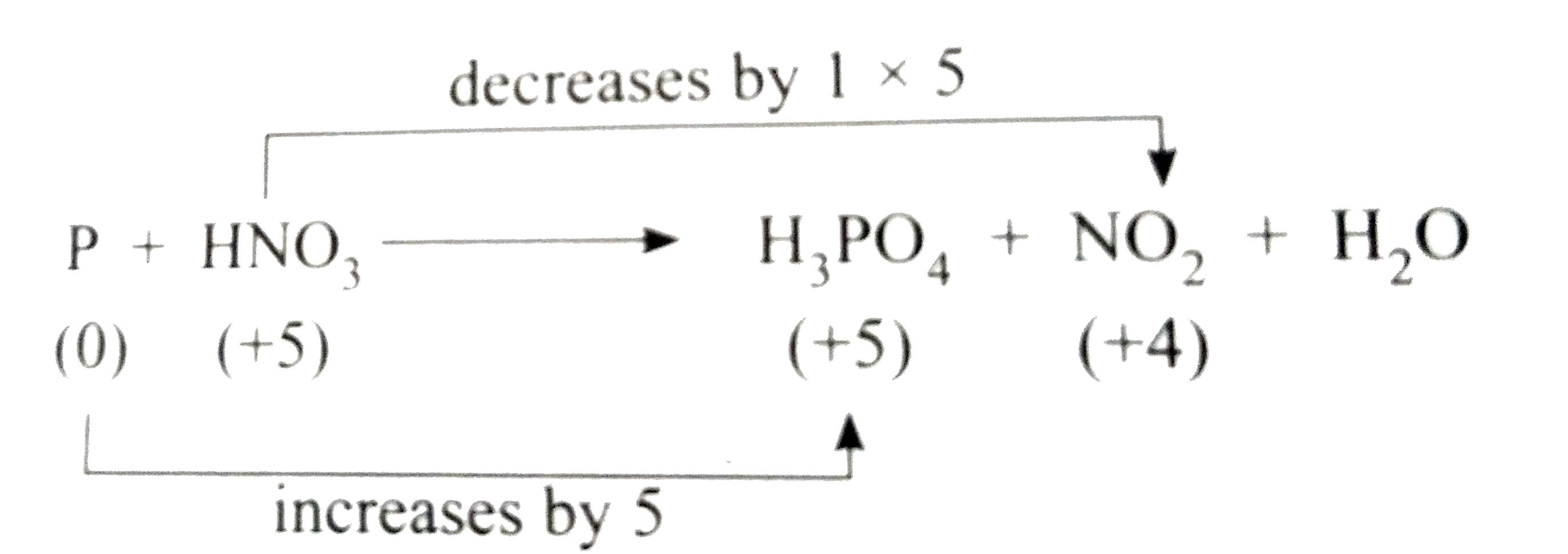 Step 2 P+`5HNO_(3)rarrH_(3)PO_(4)+5NO_(2)+H_(2)O` (iii) CuO+`NH_(3)rarrCu+N_(2)+H_(2)O` 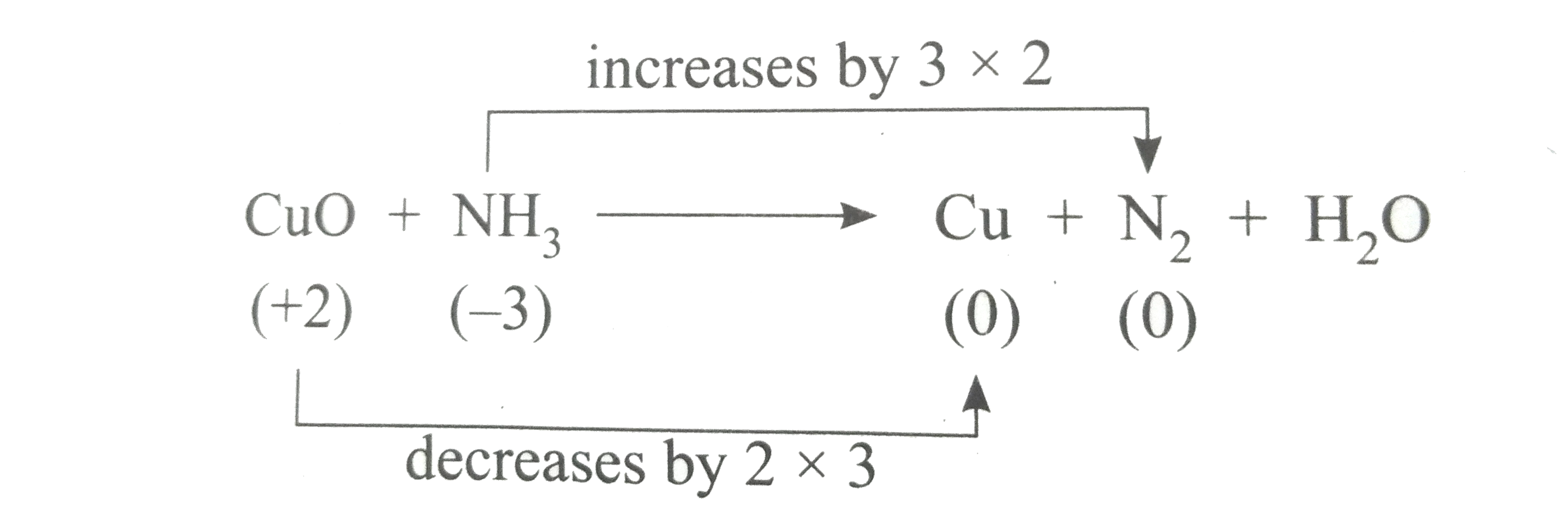 Step 2.3CuO +`2NH_(3)rarr3Cu+N_(2)+H_(2)O` Step 3. To balance O and N, water is multiplied by 3. 3CuO+`2NH_(3)rarr3Cu+N_(2)+3H_(2)O` (iv) Zn+`HNO_(3)rarrZn(NO_(3))_(2)+NH_(4)NO_(3)+H_(2)O` 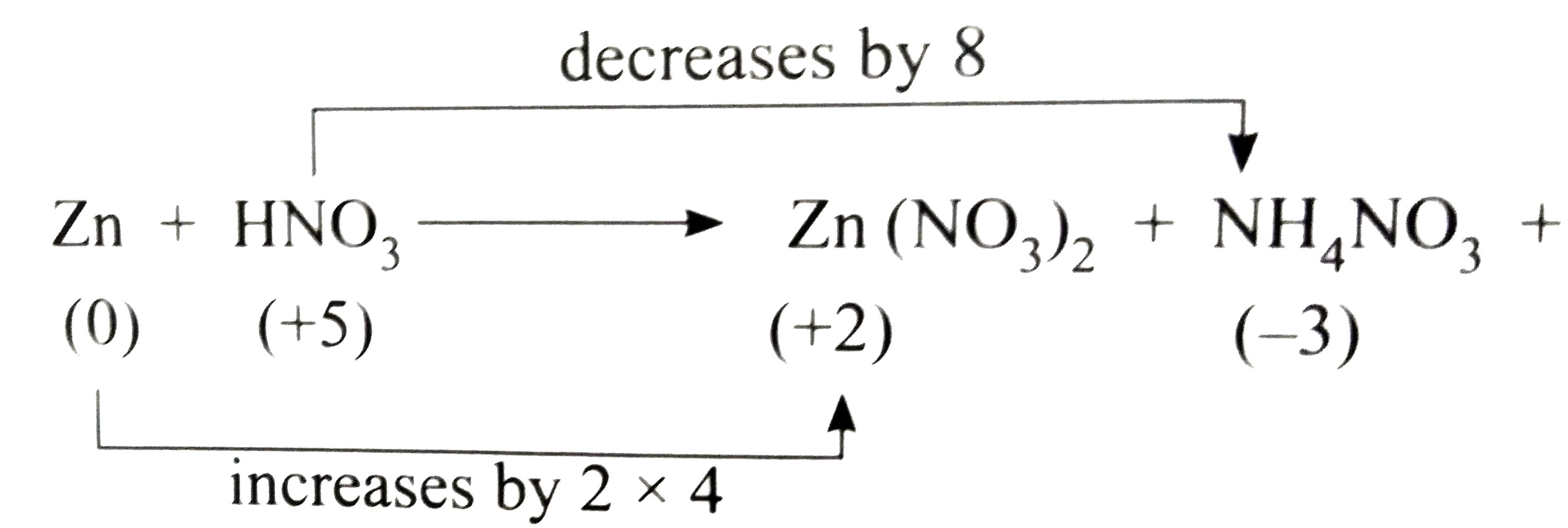 Step2. 4Zn+`HNO_(3)rarr4Zn(NO_(3))_(2)+NH_(4)NO_(3)+H_(2)O` Step 3. To balance N, `HNO_(3)` is multiplied by 10 4Zn+`10HNO_(3)rarr4Zn(NO_(3))_(2)+NH_(4)NO_(3)+3H_(2)O` Step 4. To balance oxygen, `H_(2)O` is multiplied by 3 4Zn+`10HNO_(3)rarr4Zn(NO_(3))_(2)+NH_(4)NO_(3)+3H_(2)O` |
|
| 2. |
Balance the following equation by ion electron method in the acidic medium. Cr_(2)O_(7)^(2-)+C_(2)O_(4)^(2-)+H^(+)toCr^(3+)+CO_(2)+H_(2)O |
|
Answer» SOLUTION :Step 1. The given equation is `Cr_(2)O_(7)^(2-)+C_(2)O_(4)^(2-)+H^(+)toCr^(3+)+CO_(2)+H_(2)O` Step 2. Writing the oxidation numbers of all atoms, we have `overset(+6-2)(Cr_(2)O_(7)^(2-))+overset(+3-2)(C_(2)O_(4)^(2-))+overset(+1)(H^(+))tooverset(+3)(CR^(3+))+overset(+4-2)(CO_(2))+overset(+1-2)(H_(2)O)` Step 3. The half REACTION corresponding to reduction process is `C_(2)O_(7)^(2-)toCr^(3+)` while the half reaction corresponding to oxidation is `C_(2)O_(4)^(2-)toCO_(2)` Step 4. (a) Balancing of reduction half reaction : (i) Balancing Cr atoms, we get `C_(2)O_(7)^(2-)to2Cr^(3+)` (ii) Since the reaction proceeds in acidic medium,oxygen atoms can be balanced by the addition of seven `H_(2)O` molecules at the right hand side. `Cr_(2)O_(7)^(2-)to2Cr^(3+)+7H_(2)O` Hydrogen atoms can be balanced by the addition of `14H^(+)` on left. `Cr_(2)O_(7)^(2-)+14H^(+)to2Cr^(3+)+7H_(2)O` (III) At this stage, we have +14 - 2 = +12 charge onleft and `+3xx2=+6` charge on the right. The charge on the two sides can be balanced by the addition of six electrons on the left hand side. This gives the balanced half equation for the reduction process. `Cr_(2)O_(7)^(2-)+14H^(+)+6e^(-)to2Cr^(3+)+7H_(2)O` (b) Balancing of oxidation half reaction : (i) Balancing C atoms, we get `C_(2)O_(4)^(2-)to2CO_(2)` (ii) Oxygen atoms are already balanced in it. (iii) The equation contains no hydrogen atom. (iv) The charge can be balanced by ADDING two electrons on the right hand side. This gives the balanced half equation for the oxidation process. `C_(2)O_(4)^(2-)to2CO_(2)+2e^(-)` Step 5. The oxidation half reaction contains 6 electrons while the reduction half reaction has 2 electrons. These electrons can be cancelled by multiplying the oxidation half reaction by 3 and then adding it to the reduction half reaction as shown. `{:(Cr_(2)O_(7)^(2-)+14H^(+)+6e^(-)to2Cr^(3+)+7H_(2)O),(""[C_(2)O_(4)^(2-)to2CO_(2)+2e^(-)]xx3),(bar(Cr_(2)O_(7)^(2-)+3C_(2)O_(4)^(2-)+14H^(+)to2Cr^(3+)+6CO_(2)+7H_(2)O)):}` This is the final balanced equation in acidic medium. Note that in this equation, all atoms and charge are completely balanced. |
|
| 3. |
Balance the following equation by ion-electron method. |
|
Answer» Solution :`S_(2)O_(3)^(2-)+I_(2)rarrS_(2)O_(4)^(2-)+SO_(2)+I^(-)` Oxidation half REACTION: `underset(+2)(S_(2)O_(3)) RARR underset(+3)(S_(2)O_(4)^(2-)) + cancel(2e^(-))` ................(1) Reduction half reaction: `I_(2)+cancel(2e^(-))rarr2I^(-)` ................(2) Add equation (1) + (2) `S_(2)O_(3)^(2-) + I_(2) rarr S_(2)O_(4)^(2-)+2I^(-)` To balance, `SO_(2)` is added on RHS of the equation. `S_(2)O_(3)^(2-)+I_(2)rarrS_(2)O_(4)^(2-)` To balance oxygen atom, `S_(2)O_(3)^(2-)` and `SO_(2)` is MULTIPLIED by 2. `2S_(2)O_(3)^(2-) + I_(2) rarr S_(2)O_(4)^(2-)+2I^(-)+2SO_(2)` (ii) `Sb^(3+) + MnO_(4)^(-) rarr Sb^(5+) + Mn^(2+)` Oxidation half reaction: `Sb^(3+)rarr Sb^(5+) + 2e^(-)` .................(1) Reduction half reaction: `underset((+7))(MnO_(4)^(-))+ 5e^(-)rarr Mn^(2+)` .................(2) In equation (2),` H_(2)O` is added on LHS to balance oxygen atom. `MnO_(4)^(-) +5e^(-) rarr Mn^(2+) + 4H_(2)O` .................(3) To balance Hydrogen atoms, `H^(+)` is added on RHS. `MnO_(4)- + 5e^(-) + 8H^(+) rarr Mn^(2+) + 4H_(2)0` .................(4) Equation (4) is multiplied by 2 and equation (1) is multiplied by 5 to equalise the electrons gained and electrons lost. (1) `=gt 5Sb^(3+) rarr 5Sb^(5+)+ 10e^(-)` .................(5) (4)`=gt 2MnO_(4)^(-)+ 10e^(-) + 16H^(+) rarr 2Mn^(2+) + 8H_(2)O` ...........(6)Add (5) and (6) `5Sb^(3+) +2MnO_(4)^(-) "+ 16H^(+) rarr 5Sb^(5+)+ 2Mn^(2+)+ 8H_(2)O` (iii) `MnO_(4)^(-) + I^(-) rarr MnO_(2) + I_(2)` Oxidation half reaction: `2I^(-)+2e^(-)rarrI_(2)` ................ (1) Reduction half reaction: `MnO_(4)^(-) rarr MnO_(2) + 3e^(-)` ................(2) Equation (1) is multiplied by 3. `6I^(-) + cancel(6e^(-)) rarr 3I_(2)` ...........(3) Equation (2) is multiplied by 2. `2MnO_(4)^(-) rarr 2MnO_(2) + cancel(6e)` .....................(4) `2MnO_(4)^(-)+6I^(-) rarr 2MnO_(2) + 3I_(2)` To balance oxygen and hydrogen atoms, `H^(+)` RHS and `H_(2)O `is added on LHS. `2MnO_(4)^(-)+6I^(-)+4H^(+)rarr2MnO_(2)+2I_(2)+2H_(2)O` I acidic medium (iv) `MnO_(4)^(1)+Fe^(2+)rarrMn^(2+)+Fe^(3+)` Oxidation half reaction: `Fe^(2+)RARRFE^(3+)+e^(-)`.....................(1) Reduction half reaction: `underset((+7))(MnO_(4)^(-))+5e^(-)rarrMn^(2+)`...........(2) `(1)xx5 =gt 5Fe^(2+)rarr5Fe^(3+)+cancel(5e^(-))` (2)`=gtMnO_(4)^(-)+ cancel(5e^(-))rarrMn^(2+)`.......Add equation (1) and (2) `MnO_(4)^(-)+5Fe^(2+)rarrMn^(2+)+5Fe^(3+)` To balance oxygen, `H^(+)` is added on RHS and `H_(2)O` is added on LHS `MnO_(4)^(-)+5Fe^(2+)+8H^(+)rarrMn^(2+)+5Fe^(3+)+4H_(2)O` (v) `Cr(OH)_(4)^(-) + H_(2)O_(2) rarr CrO_(4)^(2-)` Oxidation half reaction: `underset((+3))(Cr(OH)_(4)^(-)) rarr underset((+1))(CrO_(4)^(2-)) + 3e^(-)` ...........................(1) Reduction half reaction: `underset((+2))(H_(2)O_(2)) + e^(-) rarr underset((+1))(H_(2)O)`..............(2) `(2)xx3=gt3H_(2)O_(2)+cancel(3e^(-))rarr3H_(2)O` (1)`=gtCr(OH)_(4)^(-)rarrCrO_(4)^(2-)+3e^(-)`Adding Equation (1) and(2) `Cr(OH)_(4)^(-) + 3H_(2)O_(2)rarrCrO_(4)^(2-)+3H_(2)O` To balance oxygen and hydrogen atoms, `OH^(-)` and `H_(2)O` are added `2Cr(OH)_(4)^(-) + 3H_(2)O_(2)+2OH^(-)rarr2CrO_(2)^(2-)+8H_(2)O` |
|
| 4. |
Balance the following equation by choosing the correct option xKNO_3 + yC_12H_22O_11 rightarrow pN_2 + qCO_2 + rH_2O + sK_2 + CO_3. |
|
Answer» `{:(X,y,p,Q,r,s),(36,55,24,24,5,48):}` |
|
| 5. |
Balance the following equaitons by ion electron method. (iv) Zn+NO_(3)^(-)to Zn^(2+)+NO(in acid medium) |
Answer» SOLUTION :
|
|
| 6. |
Balance the following equaitons by ion electron method. (iii) Na_(2)S_(2)O_(3)+I_(2)to Na_(2)S_(4)O_(6)+NaI |
Answer» SOLUTION :
|
|
| 7. |
Balance the following equactions: (a) BaCrCO_(4) + KI +HCI rarr BaCl_(2) + I_(2) + KCl + CrCl_(3) + H_(2)O (b) SO_(2) + Na_(2) CrO_(4) + H_(2)SO_(4) rarr Na_(2)SO_(4) + Cr_(2) (SO_(4))_(3) + H_(2)O (c) C_(2) H_(5) OH + I_(2) + PH^(-) rarr CHI_(3) + HCO_(2)^(-) + H_(2)O + underset(("Basic"))(I^(-) (d) As_(2)S_(3) + HNO_(3) rarr H_(3)AsO_(4) + H_(2) SO_(4) + underset(("Acid"))(NO) (e) ....+ HC_(2)O_(4) rarr CO_(3)^(2+) + CI^(-) (f) HgS + HCl + HNO_(3) rarr H_(2) HgCl_(4) + NO+ S + H_(2)O (g) Mn_(2)O_(7) rarr MnO_(2) + O_(2) |
|
Answer» (b) `3S_(2) + 2Na_(2) CrO_(4) + 2H_(2) SO_(4) rarr 2Na_(2) SO_(4) + Cr_92) (SO_(4))_(3) + 2H_(2)O` (b) `3SO_(2) + 2Na_(2)CrO_(4) + 2H_(2)SO_(4) rarr 2Na_92) SO_(4) + Cr_(2) (SO_(4))_(3) + 2H_(2)O` (c) `C_(2) H_(5) OH + 4I_(2) + 6OH^(-) rarr CHI_(3) + HCO_(2)^(-) + 5I^(-) + 5H_(2)O` (d) `4H_(2)O + 3As_(2)S_(3) + 28HN)_(3) rarr 6H_(3) AsO_(4) + 9H_(2)SO_(4) + 28NO` (e) `Cl_(2) + HC_(2)O_(4)^(-) + 2H_(2)O rarr 2Cl^(-) + 2CO_(3)^(2-) + 5H^(+)` (F) `3HgS + 2HNO_(3) + 12HCl rarr 3H_(2) HgCl_(4) + 3S + 2NO + 4H_(2)O` (g) `2Mn_(2) O_(7) rarr 4MnO_(2) + 3O_(2)` |
|
| 8. |
Balance the following equaitons by ion electron method. (ii) C_2O_(4)^(2-) +Cr_(2)O_(7)^(2)to Cr^(3+) +CO_(2) (in acid medium). |
Answer» SOLUTION :
|
|
| 9. |
Balance the following equaitons by ion electron method. (i) KMnO_4 +SnCI_(2)+HCI to MnCI_(2)+SnCI_(4)+H_2O+KCI |
Answer» SOLUTION :
|
|
| 10. |
Balance the following chemical reactions (by ion electron method) (a) C_(2)H_(5)OH+MnO_(4)^(Ө) rarr CH_(3)COO^(Ө) +MnO_(2)+H_(2)O+overset(Ө) (OH) (b) [Fe(CN)_(6)]^(3-_ + N_(2)H_(4) + overset(Ө) (OH)rarr [Fe(CN_(6))]^(4-) + N_(2)+H_(2)O (c ) CN^(Ө)+ MnO_(4)^(Ө) +H_(2)O rarr MnO_(2)+CNO^(Ө)+ overset(Ө) (OH) (d) CuO+NH_(3) rarr Cu+N_(2)+H_(2)O (e) HI+HNO_(3) rarr I_(2) + NO+H_(2)O (f) H_(2)S+SO_(2)rarrS+H_(2)O |
|
Answer» `4H_(2)O+cancel(3E^(-))+MnO_(4)^(ө)rarrMnO_(2)+2H_(2)O+4overset(ө)OH]xx4` `{:(x-8,-1,x-4,=,0),(x,7,x,=,4):}` `5overset(ө)OH+H_(2)O+C_(2)H_(5)OHrarrCH_(3)COO^(ө)+cancel(4e^(-))+5H_(2)O]xx3` ` {:(2X+6-2=0,,2x+3-4=-1,,),(x=7,-,2x=0,,):}/ul(4MNO_(4)^(ө)+3C_(2)H_(5)OHrarr4MnO_(2)+3CHOO^(ө)+overset(ө)OH+4H_(2)O` b. Basic medium `4overset(ө)OH_N_(2)H_(4)rarrN_(2)+cancel(4e^(-))+4H_(2)O` `{:(2x+4=0,,2x=-0,,),(2x=-4,-,2x=0,,):}` `cancel(E^(-))+[Fe(CN)_(6)]^(3)rarr [Fe(overset(-1)(CN_(6)))]^(4)]xx4` `ulbar(4overset(ө)OH+N_(2)H_(4)+4[Fe(CN)_(6)]^(3-)rarrN_(2)+4[Fe(CN)_(6)]^(4-)+4H_(2)O` c. `4H_(2)Ocancel(3e)+MnO_(4)^(ө)rarrMnO_(2)+2H_(2)O+4overset(ө)OH]xx2` `{:(x-8=-1,x-4=0,,,),(x=7,x=4,,,):}` `2overset(ө)OH+H_(2)O+CN^(ө)rarrCNO^(ө)+cancel(2e)+2H_(2)O]xx3` `{:(x-3=-1,x-3=-2=-1,,,),(x=2,x=4,,,):}` `ulbar(H_(2)O+2MnO_(4)+3CN^(ө)rarr2MnO_(2)+3CNO^(ө)+2overset(ө)OH)` d. `2NH_(3)-ltN_(2)+cancel(6e^(-))+cancel(6H^(o+))` `2x+6=0, 2x=0` `2x= -6` `cancel(2H^(o+))+cancel(2e^(-))+CuOrarrCu+H_(2)O]xx3` `x-2=0, x=0` `x=2` `ulbar(2NH_(3)+3CuOrarrN_(2)+3Cu+3H_(2)O)` e. `2HIrarrI_(2)+cancel(2e^(-))+cancel(2H^(o+))]xx3` `2+2x=0,2x=0` `2x= -2` `3H^(o+)+3e^(-)+HNO_(3) -lt NO+2H_(2)O]xx2` `1+x-6=0, x-2=0` `x=5, x=2` `ulbar(6HI+2HNO_(3)rarr3I_(2)+2NO+4H_(2)O)` F. `H_(2)SrarrS+cancel(2^(e-))+cancel(2H^(o+))]xx2` `2+x=0, x=0` `x=-2` `calcel(4H^(o+))+cancel(4e^(-))+SO_(2)rarrS+2H_(2)O` `x-4=0, x=0` `ulbar(2H_(2)S+SO_(2)rarr3S+2H_(2)O`. |
|
| 11. |
Balance the following chemical equations by partial method indicating the partial equations involved {:((a),H_(2)S+HNO_(3)rarrNO+H_(2)O+S),((b),Cu+H_(2)SO_(4)rarrCuSO_(4)+SO_(2)+H_(2)O),((c),C+H_(2)SO_(4)rarrCO_(2)+SO_(2)+H_(2)O),((d),I(2)+HNO_(3)rarrHIO_(3)+NO_(2)+H_(2)O):} |
|
Answer» |
|
| 12. |
Balance the following chemical equations by the oxidation number method (i) CuO+NH_(3)rarrCu+N_(23)+H_(2)O (ii) C_(6)H_(6)+O_(2)rarrCO_(2)+H_(2)O (iii)SnO_(2)+CrarrSn+CO (iv) Fe_(2)O_(3)rarrFe+CO (v) P+HNO_(3)rarrHPO_(3)+NO+H_(2)O (vi) FeS_(2)+O_(2)rarrFe_(2)O_(3)+SO_(2) |
|
Answer» Solution :`(i) CuO+NH_(3)rarrCu+N_(2)+H_(2)O` The balancing is done in the folowing STEPS: 1. write the O.N of each atom in the skeleton equation. `overset(+2)Cuoverset(-2)O+overset(-3)Noverset(+1)H_(3)rarrCoverset(0)u+overset(0)N_(2)+overset(+1)H_(2)overset(-2)O` 2.Identify the atoms which undergo change in O.N. `overset(+2)CuO+overset(-3)NH_(3)rarroverset(0)Cu+overset(0)Cu+overset(N_(2))+H_(2)O` 3.Calculate the increaseand decrease in O.N w.r.t reactant atoms  4.Equate the increase and decreasein O.N on the reactant side. `3CuO+2NH_(3)rarrCu+N_(2)+H_(2)O` 5. Balance the number of Cu and N atoms on both sides of the equation `3CuO+2NH_(3)rarr3Cu+N_(2)+H_(2)O` 6. Now balacne H and O atoms byu HIT and trial method `3CuO +2NH_(3)rarr3Cu+N_(2)+3H_(2)O` `(ii) C_(6)H_(6)+O_(2)rarrO_(2)rarrCO_(2)+H_(2)O` The balancing is done in the folowing steps: 1.Write the O.N of each atom in the skeleton equation `overset(-1)C_(6)overset(+1)H_(6)+overset(0)_(2)rarroverset(+4)CO_(2)+H_(2)overset(-2)O_(2)` 3. Calculate the total increase and decrease in O.N w.r.t reactant atoms  4. Equate the increase and decrease in O.N onthe reactatn side after taking out a commonfactor of 2 `2C_(6)H_(6)+15O_(2)rarrCO_(2)+H_(2)O` 5. Balance the number of C an d O atoms on both sides of the equation `2C_(6)H_(6)+154O_(2)rarr12CO_(2)+6H_(2)O` The H atoms are already balanced in the above equation `(iii) SnO_(2) +Crarrsn+CO` The balancing is done int the following steps: 1. Write the O.N of each atom in the skeleton equation `overset(+4)SnO_(2)+overset(0)CrarrSoverset(0)n+overset(+2)CO` 3. Calculate the increase and decrease in O.N w.r.t reactant atoms.  4. Equate the increase and decrease in O.N on the reacttant side after taking out a common factor of 2 `SnO_(2)+2CrarrSn+CO` 5. Balance the number of Snand C atoms onboth sides of the equation `SnO_(2)+2CrarrSn+2CO` The O atoms are already balanced in the equation `(IV) Fe_(2)O_(3)+CrarrFerarrCO` The balancing is done in the following steps: 1. Write the O.N of each atyom in the skeleton equation `overset(+3)Fe_(2)overset(-2)O_(3)+overset(0)Crarroverset(0)Fe+overset(0)Fe+overset(+2)CO` 3. Calculate the increase and decreasein O.N w.r.t reactant atoms  4.Equate the inccrease and decrease in O.N on the reacttnt side. `3P+5HNO_(3)rarrHPO_(3)+NO+H_(2)O` 5. Balance the P amd N atoms on both sides of the equation `3P+5HNO_(3)rarr3HPO_(3)+5NO+H_(2)O` The O and H atoms are already blanced in the equation. `(vi) FeS_(2)+O_(2)rarrFe_(2)O_(3)+SO_(2)` The balacning is done in the following steps: 1. Write the O.N of each atom in the skeleton equation `overset(+2)Feoverset(-1)S_(2)+overset(0)O_(2)rarroverset(+3)Fe_(2) overset(-2)O_(3)+overset(+4)S Ooverset(-2)O_(2)` 2.Identify the atoms which undergo change in O.N `overset(+3)Fe_(2)overset(-2)O_(3)+overset(0)Crarroverset(0)Fe+overset(0)Fe+overset(+2)CO` 3. Calculate the increase and decreasein O.N w.r.t reactant atoms  4.Equate the inccrease and decrease in O.N on the reacttnt side. `3P+5HNO_(3)rarrHPO_(3)+NO+H_(2)O` 5. Balance the P amd N atoms on both sides of the equation `3P+5HNO_(3)rarr3HPO_(3)+5NO+H_(2)O` The O and H atoms are already blanced in the equation. `(vi) FeS_(2)+O_(2)rarrFe_(2)O_(3)+SO_(2)` The balacning is done in the following steps: 1. Write the O.N of each atom in the skeleton equation `overset(+2)Feoverset(-1)S_(2)+overset(0)O_(2)rarroverset(+3)Fe_(2) overset(-2)O_(3)+overset(+4)S Ooverset(-2)O_(2)` 3.Calculate the increase and decrease in O.N w.r.t reactant atoms.  4. Equate the increase and decrease in O.Nin the reactant side. `2[Cr(OH)_(4)]^(-)+3H_(2)O_(2)rarr(CrO_(4))^(2-)+H_(2)` 5.Balance the number of Cr atoms in the equation `2[Cr(OH)_(4)]^(-)+3H_(2)O_(2)rarr(CrO_(4))^(2-)+H_(2)` 6.In order to blalnce the number of oxygen atoms, ADD five `H_(2)O` molecules on the product side `2[Cr(OH)_(4)]^(-)+3H_(2)O_(2)rarr2(CrO)_(4)^(2)+6H_(2)O` 7.As the reaction is carried in the basic medium in order to blance the number of negative charges add two OH ions on the reatant sides and two `H_(2)O` molecules on the product side. `2[Cr(OH)_(4)]^(-)+3H_(2)O_(2)rarr2(CrO)_(4)^(2)+6H_(2)O+2H_(2)O` or `2[Cr(OH)_(4)]^(-)+3H_(2)O_(2)rarr2(CrO)_(4)^(2)+8H_(2)O` (iii) `MnO_(4)^(-)+Fe^(2)rarrMn^(2)+Fe^(3)+H_(2)O`(Acidic medium) The balancing is done in the following steps: 1. Write the O.N of each atom in the skeleton equation `(overset(+7)(Mn)overset(-2)O_(4)) + (overset(+2)Fe)^(2+)rarr(overset(+2)Mn)^(2+)+(overset(+3)Fe)^(3+)+overset(+1)H_(2)overset(-2)O` 2. Identify the atoms which undergo change in O.N. `(overset(+7)(Mn)O_(4))^(-) + (overset(+2)Fe)^(2+)rarr(overset(+2)Mn)^(2+)+(overset(+3)Fe)^(3+)+H_(2)O` 3. Calculate the increase and decrease in O.N w.r.t reactant atoms. 4.Equate the increase and decrease in O.N on the reactant side. `MnO_(4)^(-) + (5Fe)^(2+)rarrMn^(2+)+Fe^(3+)+H_(2)O` 5. Balance Mn and Fe atoms on both sides of the equation `MnO_(4)^(-) (3+)+H_(2)O` 6.As the reaction is carried in the acidic mediium to balace O atoms, add three `H_(2)O` molecules on the product side `MnO_(4)^(-) + (5Fe)^(2+)rarrMn^(2+)+Fe^(3+)+H_(2)O` 7.In order to balance H atoms, add `8H^(+)` on the reactant side. `MnO_(4)^(-) + (5Fe)^(2+)rarrMn^(2+)+Fe^(3+)+H_(2)O` The final equation is balaced w.r.t charge also. |
|
| 13. |
Balance the following chemcial reaction. MnO_(4)^(-)+SO_(3)^(2-)+H^(+) to Mn^(2+)+SO_(4)^(2-)+H_(2)O. The coefficient of MnO_4^(-), SO_(3)^(-) and H^(+) in balanced reaction are …………, …………….. and ………….. respectively. |
|
Answer» 5,2,6 |
|
| 14. |
Balance the equations in the basic medium by ion electron method and oxidation number methods. Identify the oxidant and reductant Cl_2O_7 (g) + H_2O_2 (aq) to ClO_2^(-)(aq) + O_2 (g) + H^+ |
| Answer» SOLUTION :`Cl_2O_7 (G) + 4H_2O_2 (AQ) + 2OH^(-) (aq) to 2ClO_2^(-) (aq) +4O_2 (g) + 5H_2O (L)` | |
| 15. |
Balance the equations in the basic medium by ion electron method and o0XIdation number methods. Identify the o0XIdant and reductant N_2H_2 (l) + ClO_3^(-) (aq) to NO (g) + Cl^(-) (g) |
| Answer» SOLUTION :`3N_2H_4 (L) + 4ClO_3^(-)(AQ) to 6NO (G) + 4Cl^(-) (aq) + 6H_2O (l)` | |
| 16. |
Balance the equations in the basic medium by ion electron method and oxidation number methods. Identify the oxidant and reductant P_4 (s) + OH^(-)(aq) to PH_3 (g) + H_2PO_2^(-) (aq) |
| Answer» SOLUTION :`P_4(s) + 3OH^(-) (AQ) + 3H_2O (L) to PH_3(G) + 3H_2PO_2^(-) (aq)` | |
| 17. |
Balance the equation Mg(aq)+HNO_(3)(aq)rarrMg(NO_(3))_(2)(aq)+N_(2)O(g)+H_(2)O(l) |
Answer» Solution :Step Find out the elemnts which undergo a change in oxidation nukber (O.N)  Here O.N of MG increases form 0 in Mg metal to +2 in `Mg(NO_(3))_(2)` and htat of N decreases form +5 `HNO_(3) "to" +1 "in" N_(2)O` Step 2 Find oiut the total increase and decrease in O.N Since there is only ONE Mg atom on either side of Eq (i) therefore total increase in O.N of Mg is 2 Further since there are two N atoms in `N_(2)O` on R.H.S and only one in `HNO_(3)` on L.H.S of Eq (i) therefore multiple `HNO_(3)` on L.H.S of Eq (i) by 2 and thus the total decrease in O.N of N is `2xx4=8` Step 3 Balance increse/decrease in O.N sine the total incrase in O.n is 2 and decrease is 8 therefore multiply Mg on the L.H.S of Eq (i) by combining steps 2 and 3 above we HVE step 4 Balance all atoms other than O and H To balance Mg on either side of Eq (ii) multiply `Mg(NO_(3))_(2)(aq) + N_(2)O(g)+H_(2)O(l)` Now there are 10 nitrogne atoms on rhs of equy (iii) nd only 2 on L.H.S therefroe to balance N atom change the coeffiecient of `HNO_(3)` form 2 OT 10 on L.H.S of Eq (iii) we have `4 Mg (s) +10 HNO_(3) (aq)` to `4 Mg (NO_(3))_(2)(aq)+N_(2)O(g)+H_(2)O(l)` Step 5 Balance O and H atoms by hit and trial method since there are 30 oxygen atoms on L.H.S but only 26 oxygen atoms on R.H.S of Eq (iv) thereforeto balacne O atoms change hte coeffiecent of `H_(2)O` from 1 to 5 we have `4 Mg (S) + 10 HNO_(3)(Aq) to Mg (BO_(3))_(2)(aq)+N_(2)O(g)+5H_(2)O(l)` the H atoms get automatically balaced Thus Eq (v) repersents hte correct balanced equation |
|
| 18. |
Balance the equation in acidic medium : (a) "When chloride ion" CI^(-)" is oxidised to " CI_(2) " by " MnOoverset(4) (b) "Chlorate ion" CIOoverset(3) "oxidies" Mn^(2+) to MnO_(2)(s) |
|
Answer» Solution :(a) The skeleton equation is: `CI^(-)+MnO_(4)rarrCI_(2)+Mn^(2+)` step I. Separation of the equation in two half reactions: (i) Write the O.N of the atoms involvedin the skeleton equation `overset(-1)(CI)^(-)+overset(+7)((Mnoverset(-2)O_(4))^(-)rarroverset(0)CI_(2)+overset(+2)((Mn)^(2+)` (ii) Identify the atoms which undergo change in O.N `overset(-1)(CI)^(-)+(overset(+7)MnO_(4))^(-)rarroverset(0)CI_(2)+overset(+2)(Mn)^(2+)` (III) Find outthe species INVOLVED in the oxidation and reduction half reactions  The tow half reactions are: Oxidation half reaction :L `CI^(-)rarrCI_(2)` Reduction half reactio : `MnO_(4)^(-)rarrCI_(2)+Mn^(2+)` Step II. Balancing of oxidation half reaction : The oxidation half reaction is : `2CIrarrCI_(2)` (i) As the increase in O.N per atom as a result of Oxidation is 1, therefore, add two `e^(-)` on the product side to balance change in O.N. `2CI^(-)rarrCI_(2)+2e^(-)` Thus oxidation half reaction is balanced. Step III Balancing of reduction half reaction: The reduction half reactionis : `CIO_(3)^(-)rarrCI^(-)` (i) As the decrease in O.N is 6, add SIX `e^(-)` on the reactant side to balance change in O.N `CIO_(0)^(-)+6e^(-)rarrCI^(-)` (ii) In order to balance oxygen atoms add three molecules of `H_(2)O` on the product side. Then add `6H^(+)` ions on the reactant side to balance the hyudrogen atoms `CIO_(3)^(-)6H^(+)+6e^(-)rarrCI^(-)+3H_(2)O` The reduction half reaction is balanced. Step IV. ADDING the two half reaction: In order to equyate the electrons,. multiply equation (i) by 3 and add to equation (ii) `({:(""Mn^(2)+2H_(2)OrarrMnO_(2)+4H^(+)+2e^(-)"]"xx3),(CIO_(3)^(-)+6H^(+)+6e^(-)rarrCI^(-)+3H_(2)O):})/(3Mn^(2)^(+)+CIO_(3)^(-)+3H_(2)Orarr3MnO_(2)+6H^(+)+CI^(-))` Step I. Swparation of the equation in two half reactions: (i) Write theO.N of all the atoms involved in the equation: `Toverset(+5)CIoverset(+2)O_(3)^(-)+overset(+2)(Mn)^(2+)rarroverset(+4)Mnoverset(-2)O_(2)+overset(-1)(CI)` (ii) Identify in atoms which undergo change in O.N M `overset(+5)(CIoverset(-2)O_(3))^(-)+overset(+2)(Mn)^(2+)rarroverset(+4)MnO_(2)+overset(-1)(CI)^(-)` (iii) Find out the species involved in the oxidation and reduction half reaction the two hal,f reactions are: oxidtion half reaction : `CIO_(3)rarrCI_(-)` Reduction j half reaction: `CIOO_(3)^(-)rarrCI^(-)` |
|
| 19. |
Balance the equation. (i) Cu_(2)S + O_(2) rarr Cu_(2)O + SO_(2) (ii) Ca_(3) (PO_(4))_(2) + 2H_(2) SO_(4) rarr Ca(H_(2)PO_(4))_(2)+CaSO_(4) |
|
Answer»
(ii) `Ca_(3)(PO_(4))_(2) +H_(2)SO_(4) rarr CA(H_(2)PO_(4))+2CaSO_(4)` |
|
| 20. |
Balance the equation by oxidation number method Mg+HNO_(3) to Mg(NO_(3))_(2)+N_(2)O+H_(2)O |
|
Answer» SOLUTION :STEP -1,2 `M overset(0)(g)+H overset(+5)(N) O_(3) to M overset(+2) (g) (overset(+5)(g) O_(3))_(2) +N_(2)^(+1) O+H_(2)O` Step -3 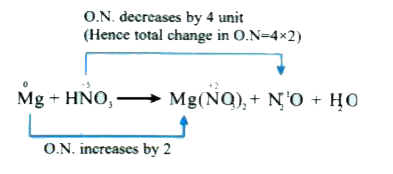 Step -4 Mg equation is multipled by 4 and `HNO_(3)` equation is multiplied by 2. Now, `4Mg+2HNO_(3) to 4Mg(NO_(3))_(2)+N_(2)O+H_(2)O` Step -5: Balance all atoms other than O and H. `4Mg+10HNO_(3) to 4Mg(NO_(3))_(2)+N_(2)O+H_(2)O` Step -6 : Balance H and O by adding `H_(2)O` MOLECULES. `4Mg+10HNO_(3) to 4Mg(NO_(3))_(2)+N_(2)O+5H_(2)O` |
|
| 21. |
Balance the equation As_(2)(s)+NO_(3)^-)(aq)+H^(+)(aq)rarrAsO_+(4)^(3-)(aq)+S(s)NO(g)+H_(2)O(l) |
|
Answer» Solution :To identify the atoms whose oxidation number have undergone a chage writing the oxidatin number of each atom above its symbol we have Herer the oxidation number of As has increased fro +3 to 5 and that of S has increased form -2 to 0 while that of N has decreased form +5 to +2 in other words both As and S have been oxidised when`NO_(3)^(-)` ahs been reduced since As nand S must maintain theri atoimic ration of 2:3 (as in `As_(2)S_(3)` therefore the change in oxidation numbers of these two atoms must be considered to gether keeping in view these points the above redox reaction can be split up unto the FOLLOWING two HALF reaction Oxidation half equation : `As_(2)S_(3)^(-2)(s)rarrAsO_(4)^(3-)(aq)+S(s)` Reduction half equation : `NO_(3)^(-)(aq) rarr NO(g)` Step 2 To BALACE the oxidation half Eq (i) (a) Balance all the atoms otherthan O Multiply As `O_(4)^(3-)` by 2 and S by 3 on R.H.S of Eq (i) We have `overset(+3)As_(2)overset(-2)S_(3) rarr 2 AsO_(4)^(3-)+3S(s)` (b)Balance the oxidain number by adding electron s since each as atom loses two electrons and there are two as atoms therefore due to the oxidation of As alone add `4 e^(-)` R.H.S of Eq (iii) further since each s atom loses two electron and there are three S atoms therfroe due to the oxiation of S alone add `6 e^(-)` to R.H.S of Eq (iii) Combing these two oxidation steps together and `10 e^(-)` to R.H.S of Eq (iii) we have (c )Balance charge by adding `H^(+)` ions The total charge on R.H.S of Eq (iv) is 16 nad zero on the L.H.S therefore add `16 H^(+)` to R.H.S of Eq (iv) we have (d) Balance O atoms by adding `H_(2)O` Step 3 To balance the reductionn half eq (ii) (a) Balance oxidaton number byu adding electron oxidation number of N in `NO_(3)^(-)` is +5 on L.H.S while it is +2 in no on R.H.S therefore add 3 `e^(-)` L.H.S of Eq (ii) we have (b) Balance charge by adding `H^(+)` ions The total charge of L.H.S is -4 while it is zero on R.H.S therefore add4 `H^(+)` to L.H.S of Eq (VII) We have `NO_(3)^(-)(aq)+4H^(+)(aq)+3e^(-)rarrNO(g)` step 4 To balance the electrons lost in Eq (vi) and gained in Eq (ix) multiply Eq (ix) by 10 Eq (vi) by 3 and add we have |
|
| 22. |
Balance the following redox reaction by half reaction method. Fe^(2+)(aq)+Cr_(2)O_(7)^(2-)(aq)toFe^(3+)(aq)+Cr^(3+)(aq) (In acid medium) |
Answer» Solution :STEP 1: (LEO= Loss of Electron Oxidation)  (GER= Gain of Electron Reduction) Step 2: `Fe^(2+)+Fe^(3+).....(1)(2to3=1 unitON)` `Cr_2O_7^(2-)to2Cr^(3+)....(2)(+6to+3=3 units 2 sets IMPLIES 6 units ON)` Step 3: Cross Multiplication i.e., (1) `times`6 and (2) `times` 1 `(1)times6to6Fe^(2+)to6Fe^(3+)......(3)` `(2)times1toCr_2O_7^2to2Cr^(3+).....(4)` Step 4: Add (3)+(4) `to6Fe^(2+)+CrO_7^(2-)to 6FE^(3+)+2Cr^(3+)` Step 5: Balance oxygen and then hydrogen `6Fe^(2+)+CrO_7^(2-)+14H^(+) to 6Fe^(3+)+2Cr^(3+)+7H_2O` |
|
| 23. |
Balance by oxidation number method: Mg+HNO_(3)toMg(NO_(3))_(2)+NO_(2)+H_(2)O. |
Answer» SOLUTION : Step 2. `Mg+2HNO_(3)toMg(NO_(3))O_(2)+NO_(2)+H_(2)O` Step 3. To balance the NUMBER of oxygen ATOMS and hydrogen atoms `2HNO_(3)` is MULTIPLIED by, `Mg+4HNO_(3)toMg(NO_(3))_(2)+2NO_(2)+H_(2)O` Step 4. To balance the number of hydrogen atoms, the H,O MOLECULE is multiplied by 2. `Mg+4HNO_(3)toMg(NO_(3))_(2)+2NO_(2)+2H_(2)O` |
|
| 24. |
Balance by oxidation number method: Mg + HNO_(3) rarr Mg(NO_(3))_(2) + NO_(2) + H_(2)O. |
Answer» Solution :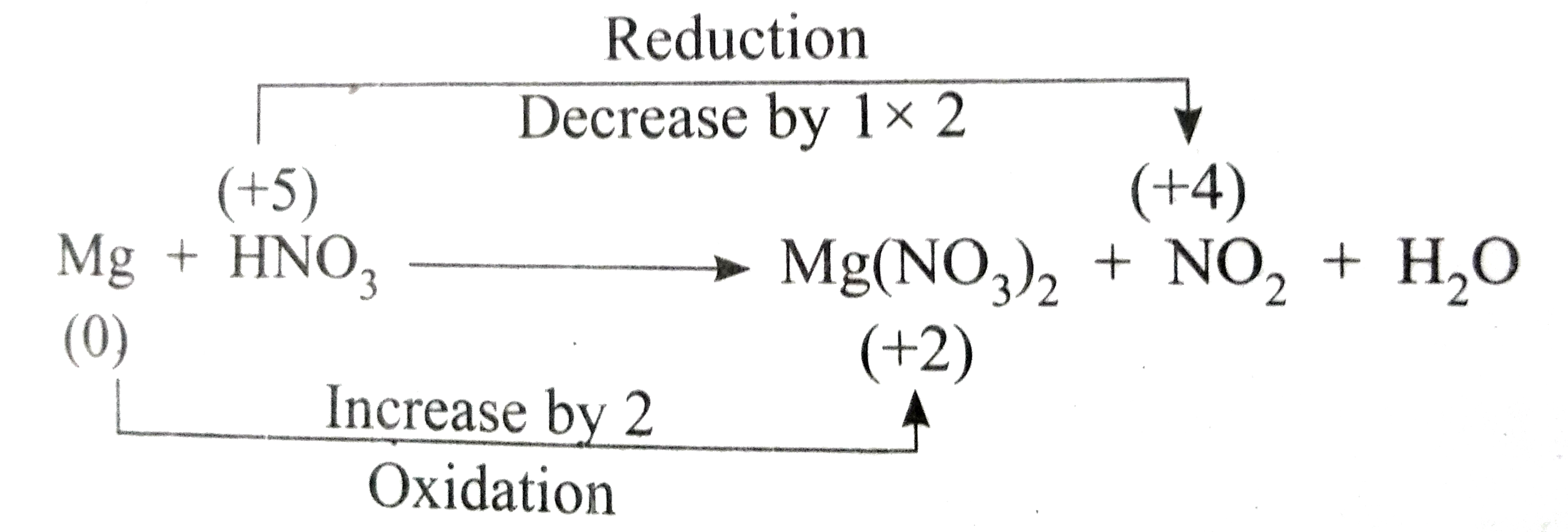 Step 1 Step 2. `MG + 2HNO_(3) rarr Mg(NO_(3))_(2) + NO_(2) + H_(2)O` Step 3. To balance the number of OXYGEN atoms and HYDROGEN atoms `2HNO_(3)` is multiplied by 2 Mg + `4HNO_(3) rarr Mg(NO_(3))_(2)+2NO_(2_ + H_(2)O` Step 4. To balance the number of hydrogen atoms, the `H_(2)O` MOLECULE is multiplied by 2 Mg + `4HNO_(3) — Mg(NO_(3))_(2) + 2NO_(2) + 2H_(2)O` |
|
| 25. |
Baking soda is |
|
Answer» SODIUM bisulphate |
|
| 26. |
Baeyer's reagent oxidises ethylene to |
|
Answer» ETHYLENE chlorohydrn |
|
| 27. |
What is Baeyer's reagent ? |
|
Answer» ALKALINE permanganate SOLUTION |
|
| 28. |
Baeyer's reagent is |
|
Answer» Alkaline `KMnO_(4)` |
|
| 30. |
Back bonding in BF_(3) does not afect |
|
Answer» PLANARITY, lewis acidic STRENGTH and BOND angle |
|
| 31. |
B^(3+)and A^(2+) ions are present in: |
|
Answer» TETRAHEDRAL voids |
|
| 32. |
B_2O_3 have which property ? |
|
Answer» Acidic |
|
| 33. |
B_(2)O_(3) can be converted to BCl_(3) by heating |
|
Answer» `B_(2)O_(3)` with `Cl_(2)` gas in the presence of `SiO_(2)` |
|
| 34. |
B_(2)H_(6)+NH_(3)overset(120^(@)C)rarr X. Where X is |
|
Answer» `[BH_(2)(NH_(3))_(2)]^(+)[BH_(4)]^(-)` |
|
| 35. |
Boverset(alc. KOH) larr C_2H_5 Cl underset(C_2H_5OH)overset(Zn-Cu)to A . Here A and B are |
|
Answer» `CH_4 , C_2H_4` |
|
| 36. |
B +NaOH rarrDirty green ppt. overset(NH_(3))underset(("excess"))rarr Insoluble Which of the following statements is/are correct regarding (B)? |
|
Answer» It is a soluble salt `FeI_(2)+2NaOH rarr underset(("DIRTY green PPT"))(Fe(OH)_(2)darr+2NaI)` `Fe^(3+) +[Fe(CN)_(6)]^(4-)` gives same blue COLOURATION as `Fe^(2+) +[Fe(CN)_(6)]6(3-)` |
|
| 37. |
B +NaOH rarrDirty green ppt. overset(NH_(3))underset(("excess"))rarr Insoluble Find the option where blut ppt is obtained. |
|
Answer» When A is treated with `K_(4)[FE(CN)_(6)]` `FeI_(2)+2NaOH rarr underset(("Dirty green ppt"))(Fe(OH)_(2)darr+2NaI)` `Fe^(3+) +[Fe(CN)_(6)]^(4-)` gives same blue colouration as `Fe^(2+) +[Fe(CN)_(6)]6(3-)` |
|
| 38. |
'B' is a weak basic aqueous NH_(3) solution |
|
Answer» `NH_(4)OH` |
|
| 39. |
(b) (ii) Analyse the deviation observed in the solution of phenol and aniline. |
|
Answer» Solution :(ii) Let us consider a solution of phenol and aniline Both phenol and aniline from hydrogen bonding interactions amongst themselves. However, when mixed with aniline, the phenol molecue froms hydrogen bonding interaction with aniline, which are stronger than the hydrogen bonds formed amongst themselves. Formating of new hydrogen bonds considerably reduce the escaping tendency of phenol and aniline from the solution . As a result the VAPOUR PRESSURE of the solution is LESS and there is a slight decrease in volume `(Delta V` mixing `lt 0)` on mixing . During this process evolution of heat takes place (i.e) `Delta H` mixing `lt 0` (exothermic) Examples for non-ideal solutions showing negative deviation : Acetone + CHLOROFORM. Chloroforme +diethyl ether, Acetone + aniline , Chloroform + Benzene. 
|
|
| 40. |
(b) (ii) How does the Bohr theory of the hudrogen atom differ from that of Schrodinger ? |
| Answer» Solution :(b) (ii) Bohr.s theory does not consider the de-Broglie CONCEPT of dual nature of electron and also contradicts with the Heisenberg.s uncertainty PRINCIPLE , while the Schrodinger equation is based on quantum mechanics which deals with the MICROSCOPE objects having both the PARTICLE as well as wave LIKE character. | |
| 41. |
(b) (i) Why do you classify mesomeric effect (M- effect ) into .^(+)M and .^(-)M effect ? |
| Answer» SOLUTION :(B) (i) Similar to the other electron displacement EFFECT, mesomeric effect is ALSO classied into positive mesomeric effect `(+M or + R)` and negative mesomeric effect `(-M of -R)` based on the NATURE of the function group present adjective to the multiple bond. | |
| 42. |
(b) (i) When does a non-ideal solution is said to show a negative deviation ? |
| Answer» Solution :(b) (1) The escaping tendency of A and B will be lower when compared with an ideal solution formed by A and B. Hence the vapour pressure of such SOLUTIONS will be lower than the sum of the vapour pressure of A and B is TYPE of DEVIATION is called NEGATIVE deviation. For the negative deviation `pA lt overset (@)(p) AXXA` and `pB lt overset (@)pBxxB.` | |
| 43. |
(b) (i) The effect of uncertainty principle is significant only for motion of microscopic particles. Justify the statement with the help of a suitable example. (ii) How does the Bohr theory of the hudrogen atom differ from that of Schrodinger ? |
|
Answer» Solution :(b) (i) If yncertainty principle is applied to an object of mass say about a milligram `(10^(-6) kg)`, then `Delta v Delta x =(h)/(4pim)` `DELTAV. DELTAX =(6.626xx10^(-34)kg m^(2) s^(-1))/(4xx3.14xx10^(-6)kg)` `=0.52xx10^(-28) m^(2) s^(-1)` The value of `Deltav. Deltax` obtained is extremely small and is insignificant . Therefore , for milligram SIZED of heavier objects, the associated UNCERTAINTIES are hardly of any real consequence. |
|
| 44. |
B-H-B bridge in B_(2)H_(6) is formed by sharing of number of electrons equal to............ |
|
Answer» |
|
| 46. |
(b) Explain the following observations (d) The size of a weather balloon becomes larger and larger as it ascends up into larger altitude |
|
Answer» Solution :(d) The size of a weather balloon becomes LARGER and larger as it ASCENDS up into larger ALTITUDE: According to Boyle.s law, the VOLUME of a gas is inversely proportional to the pressure at a given temperature. As the weather balloon ascends, atmospheric pressure is less , pressure of the gas tends to decrease and so volume as well as the size of the balloon INCREASES. |
|
| 47. |
(b) Explain the following observations (c) The tyre of an automobile is inflated to slightly lesser pressure in summer than in winter |
|
Answer» SOLUTION :(C) The tyre of an automobile is inflated to slightly lesser pressure in summer than in winter : Air pressure is directly proportional to TEMPERATURE . During summer, increase in temperature increase pressure of air in the tube which causes the tube to burst. So TYRES are inflated to lesser pressure in summers than in winter . |
|
| 48. |
(b) Explain the following observations (b) Liquid ammonia bottle is cooled before opening the seal |
|
Answer» Solution :(b) Liquid ammonia bottle is cooled before opening the seal : At room TEMPERATURE, vapour pressure of liquid ammonia is very HIGH and so will evaporate. If the bottle is OPENED, the sudden decrease in pressure will LEAD to increase in volume of the gas and CAUSE breakage of the bottle . Cooling decreases the vapour pressure and maintains the liquid in the same state . Hence, the bottle is cooled before opening. |
|
| 49. |
(b) Explain the following observations (a) Aerated water bottles are kept under water during summer |
|
Answer» Solution :(b) (a) AERATED water bottles are kept under water during summer : In aerated water bottles, `CO_(2)` gas is passed through the aqueous solution under PRESSURE SINCE solubility of the gas in water is not very high . In summer , the solubility of the gas in water is likely to decrease since RISE in temperature decrease. Pressurebecomes too highfor the glass bottle to with stand and so explodes. To avoid this, bottle are kept under water. |
|
