

Saved Bookmarks
This section includes 7 InterviewSolutions, each offering curated multiple-choice questions to sharpen your Current Affairs knowledge and support exam preparation. Choose a topic below to get started.
| 1. |
Balance the followingequations in basic medium by ion-electron method and oxidation number methods and identify the oxidising agent and the reducing agent. (a) P_(4)(s) + overset(Θ)(OH)(aq) rarr PH_(3)(g) + H_(2)PO_(2)^(Θ) (b) N_(2)H_(4)(l) + ClO_(3)^(Θ)(aq) rarr NO(g) + Cl^(Θ)(g) ( c) Cl_(2)O_(7)(g) + H_(2)O_(2)(aq) rarr ClO_(2)^(Θ)(aq) + O_(2)(g) + H^(o+) |
Answer» Solution :a. 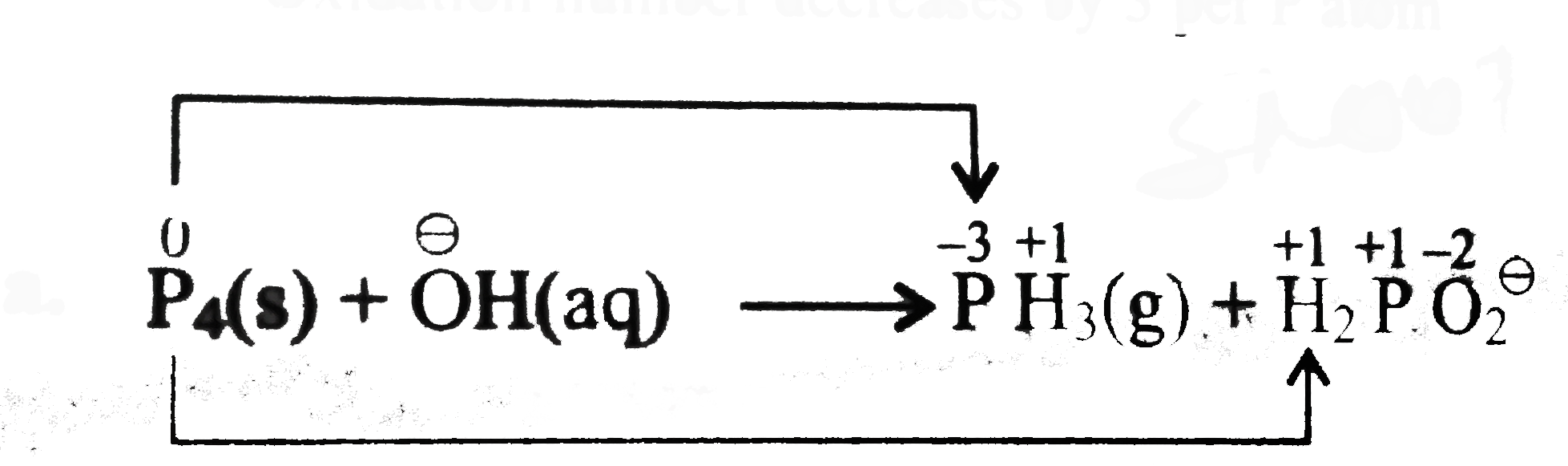 `P_(4)` acts both as an oxidising as well as a reducing agent. Oxidising number method: Total decrease in oxidation number of `P_(4)` in `PH_(3)= 3xx4=12` Total increase in oxidation number of `P_(4)` in `H_(2)PO_(2)^(Θ)=1xx4=4` Therefore, to BALANCE increase`//`decreases in oxidation numer multiply `PH_(3)` by `1` and `H_(2)PO_(2)^(Θ)` by `3`, we have, `P_(4)(s)+overset(Θ)OH(aq)rarrPH_(3)(g)+3H_(2)PO_(2)^(Θ)(aq)` To balance `H` atoms, add `3H_(2)O` to L.H.S and `3overset(Θ)OH` to the R.H.S we have, `P_(4)(s)+6overset(Θ)OH+3H_(2)O(l)rarrPH_(3)(g)+3H_(2)PO_(2)^(Θ)(aq)+3overset(Θ)OH(aq)` or `P_(4)(s)+3overset(Θ)OH(aq)+3H_(2)O(l)rarrPH_(3)(g)+3H_(2)PO_(2)^(Θ)(aq)`....(i) Thus, Eq (i) represents the correct balanced equation. Ion electron method: Oxidation half equation `P_(4)(s)rarrH_(2)PO_(2)^(Θ)(aq)`....(ii) Balancing `P` atoms, we have, `overset(0)(P_(4)(s)rarr4H_(2)overset(+1)(PO_(2)^(Θ)(aq)` Balancing oxidation number by adding electrons, `P_(4)(s)rarr4H_(2)PO_(2)^(Θ)(aq)+4e^(-)` balance charged by adding `overset(Θ)OH` ions `P_(4)(s)+8overset(Θ)OH(aq)rarr4H_(2)PO_(2)^(Θ)(aq)+4e^(-)`....(iii) `O` and `H` get automatically balanced. Thus, equation (iii) represents the balanced oxidation half reaction. Reduction half equation `overset(0)P_(4)(s)rarroverset(-3)(PH_(3))(g)`.....(i) Balancing `P` atoms, we have, `P_(4)(s)rarr4PH_(3)(g)` Balance oxidation numberby adding electrons, `P_(4)(s)+12e^(-)rarr4PH_(3)(g)+12overset(Θ)OH(aq)`....(v) To cancel out electrons, multiply equation (iii) by `3` and add it to equation (v) we have, 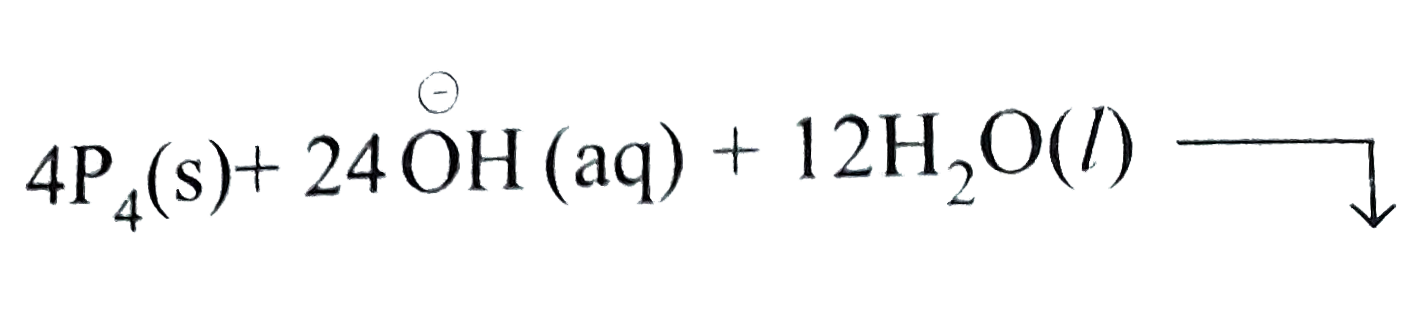 or `P_(4)(g)+3overset(Θ)OH(g)+3H_(2)O(l)rarrPH_(3)(aq)+3H_(2)PO_(2)^(Θ)(aq)`....(vi) Thus, equation (vi) represents the correct balanced equation. 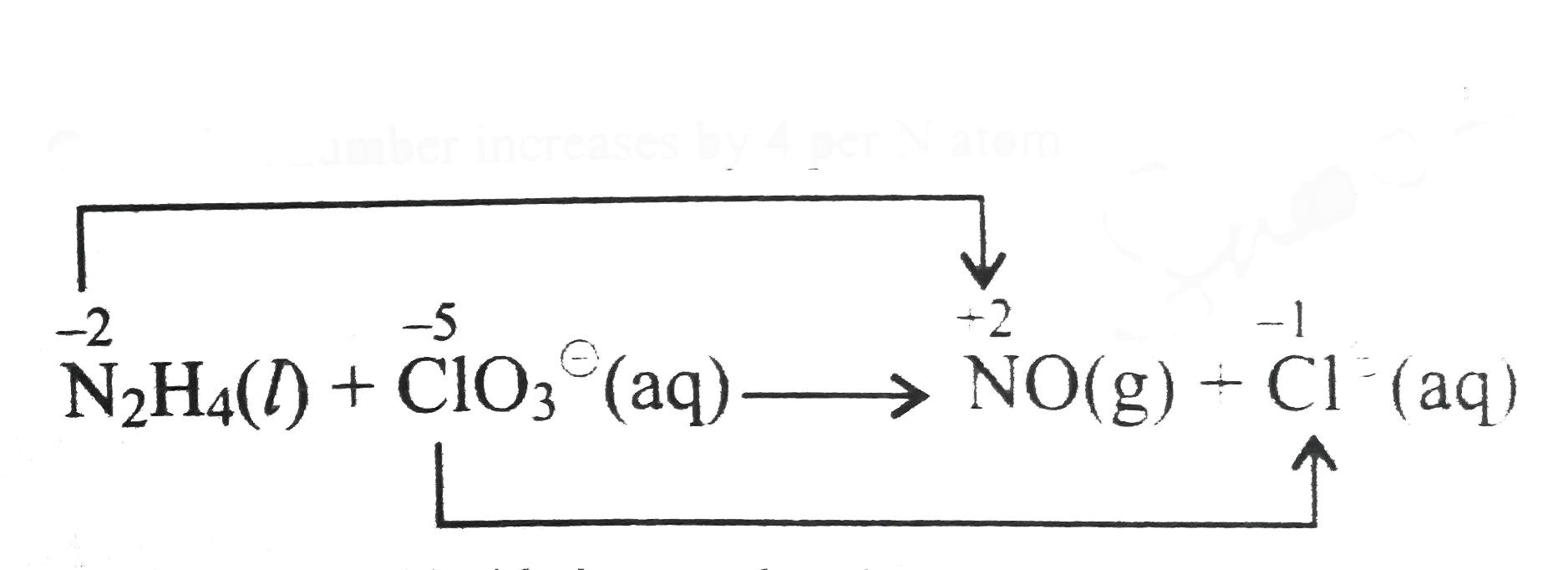 Therefore, `N_(2)H_(4)` acts as the reducing agent while `ClO_(3)^(Θ)` acts as the oxidising agent. Oxidation number method: Total increase in oxidation number of `N=2xx4=8` Total decrease in oxidation number of `Cl= 1xx6=6` Therefore, to balance the increase`//`decrease in oxidation number multiply `N_(2)H_(4)` by `3`and `ClO_(3)^(Θ)` by `4` we have, `3N_(2)H_(4)(l)+4ClO_(3)^(Θ)(aq)rarr6NO(g)+Cl^(Θ)(aq)` To balance `N` and `Cl` atoms, multiply `NO` by `6` and `Cl^(Θ)` by `4` we have, `3N_(2)H_(4)(l)+4ClO_(3)^(Θ)(aq)rarr6NO(g)+4Cl^(Θ)(aq)` Balance `O` atoms by adding `6H_(2)O`, `3N_(2)H_(4)(l)+4ClO_(3)^(Θ)(aq)rarr6NO(g)+4Cl^(Θ)(aq)+6H_(2)O(l)`....(i) `H` atoms get automatically balanced and thus equation (i) represents the correct balanced equation. Ion electron methd. Oxidation half equation `overset(-2)N_(2)(l)rarroverset(+2)NO(g)` Balance `N` atoms, `N_(2)H_(4)(l)rarr2NO(g)+8e^(-)` Balance charge by adding `overset(Θ)OH` ions. `N_(2)H_(4)(l)+8overset(Θ)OH(aq)rarr2NO(l)+8e^(-)` Balance `O` atoms by adding `6H_(2)O`, `N_(2)H_(4)(l)+8overset(Θ)OH(aq)rarr2NO(g)+6H_(2)O(l)+8e^(-)`....(ii) Thus, equation (ii) represents the correct balanced oxidation half equation. Reduction half equation `overset(+5)(ClO_(3)^(Θ))(aq)rarroverset(-1)(Cl^(Θ))(aq)` Balance oxidation number by adding electrons, `ClO_(3)^(Θ)(aq)+5e^(-) RARR Cl^(Θ)(aq)` Balance charge by adding `overset(Θ)(O)H` ions, `CiO_(3)^(Θ)(aq)+6e^(-) rarr Cl^(Θ)(aq)+6 overset(Θ)(O)H(aq)` Balance `O` atoms by adding `3H_(2)O`, `ClO_(3)^(Θ)(aq)+3H_(2)O(l)+6^(-) rarr Cl^(Θ)(aq)+6overset(Θ)(O)H(aq) ...(iii)` Thus, equation (iii) reprsents the correct balanced reduction half equation. To cancel out electrons gained and lost, multiply equation out electrons gained and lost, multiply equation (ii) by 3 and equation (iii) by `4` and add, we have, `3N_(2)H_(4)(l)+4ClO_(3)^(Θ)(aq)rarr 6NO(g)+4Cl^(Θ)(aq)+6H_(2)O(l)` This represents the correct balanced equation c. 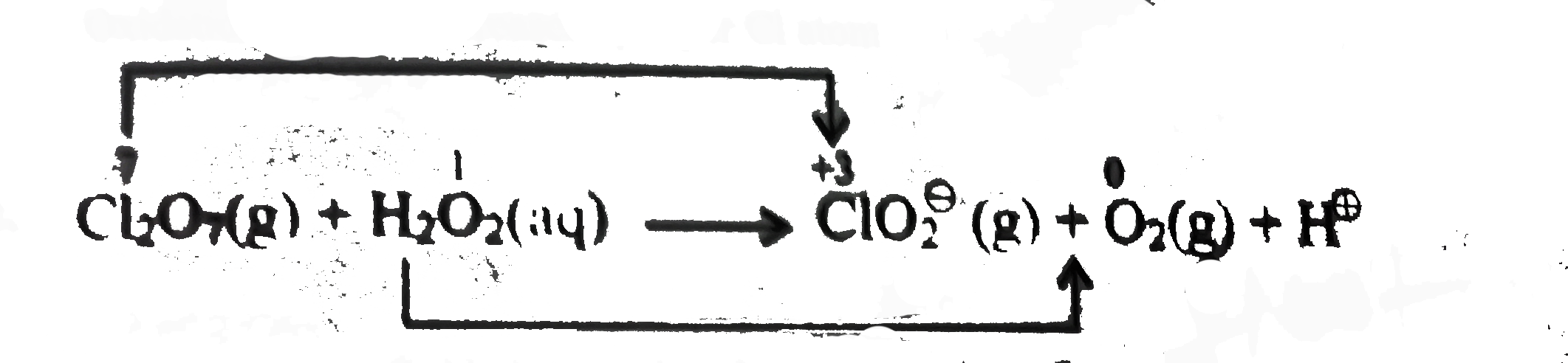 Thus, `Cl_(2)O_(7)(g)` acts an oxidising agent while `H_(2)O_(2)(aq)` as the reducing agent. Oxidation number method: Total decrease in oxidation number of `Cl_(2)O_(7) =4xx2=8` Total increase on oxidation number of `H_(2)O_(2)=2xx1=2` Therefore to balance the increase//decrease in oxidation number multiply `H_(2)O_(2)` and `O_(2) by 4`, we have, `Cl_(2)O_(7)(g)+4H_(2)O_(2)(aq)rarr ClO_(2)^(Θ)(aq)+4O_(2)(g)` To balance `Cl` atoms multiply `ClO_(2)^(Θ)` by `2`, we have, `Cl_(2)O_(7)(g)+4 H_(2)O_(2)(aq)rarr 2ClO_(2)^(Θ)(aq)+4O_(2)(g)` To balance `O` atoms, add `3H_(2)O` to `RHS`, we have `Cl_(2)O_(7)(g)+4H_(2)O_(2_(aq) rarr 2ClO_(2)^(Θ)(aq)+40_(2)(g)+3H_(2)O(l)` To balance `H` atoms, add `2H_(2)O` to `R.H.S` and `2overset(Θ)OH` to L.H.S, we have  This represents the balanced redox equation. Ion electron method: Oxidation half equation `H_(2)overset(-1)O_(2)(aq)rarroverset(0)O_(2)(g)` Balance oxidation number by adding electrons, `H_(2)O_(2)(aq)rarrO_(2)(g)+2e^(-)` Balance charge by adding `overset(Θ)OH` ions. `H_(2)O_(2)(aq)+2overset(Θ)OH(aq)rarrO_(2)(g)+2H_(2)O(l)+2H_(2)O(l)+2e^(-)` Balance `O` atoms by adding `H_(2)O` `H_(2)O_(2)(aq)+2overset(Θ)OH(aq)rarrO_(2)(g)+2H_(2)O(l)+2e^(-)`....(i) Reduction half equation: `overset(+7)(Cl_(2))O_(7)(g)rarroverset(+3)(Cl)O_(2)^(Θ)(aq)` Balance `Cl` atoms `Cl_(2)O_(7)(g)rarr2ClO_(2)^(Θ)(aq)` Balance oxidation number by adding electrons, `Cl_(2)O_(7)(g)+8e^(-)rarr2ClO_(2)^(Θ)(aq)`....(ii) Add `overset(Θ)OH` ions to balance charge `Cl_(2)O_(7)(g)+8e^(-)rarr2ClO_(2)^(Θ)(aq)+6overset(Θ)OH` Balance `O` atom by adding `3H_(2)O` to L.H.S, we have, `Cl_(2)O_(7)(g)+3H_(2)O(l)+8e^(-)rarr2ClO_(2)^(Θ)(aq)+6overset(Θ)OH(aq)`..(ii) To cancel out electrons, multiply equation (i) by `4` and add it to equation (ii), we have , `4H_(2)O_(2)(aq)+8overset(Θ)OH(aq)+Cl_(2)O_(7)(g)Cl_(2)O_(7)(g)+3H_(2)O(l)rarr2ClO_(2)^(Θ)+(aq)+6overset(Θ)OH(aq)+4O_(2)(g)+8H_(2)O(l)` 
|
|
| 2. |
If the elemental composition of butyric acid is found to be 54.4% C, 9.13% H, and 36.5% O, determine the empirical formula. |
|
Answer» Solution : Balance these equations according to the steps DISCUSSED in and. The balanced equations, oxidising and reducing agents are as follows. `Cl_(2)O_(7)(g)+4H_(2)O_(2)(aq)+2OH^(-)(aq)to2ClO_(2)^(-)(aq)+4O_(2)(g)+5H_(2)O(l)` `Cl_(2)O_(7)` acts as an oxidising agent as it GETS reduced to `CIO_(2)^(-)`, whereas `H_(2)O_(2)` acts as a reducing agent because it gets oxidised to `O_(2)`. |
|
| 3. |
Balance the following equations in basic medium by ion electron method and oxidation number method and identify the oxidising agent and the reducing agent. N_(2)H_(4)(l)+ClO_(3)^(-)(aq)toNO(g)+Cl^(-)(g) |
|
Answer» Solution : Balance these equations according to the steps discussed in and. The balanced equations, oxidising and REDUCING agents are as follows. `3N_(2)H_(4)(l)+4ClO_(3)^(-)(aq)to6NO(g)+4Cl^(-)(aq)+6H_(2)O(l)` `N_(2)H_(4)` acts as a reducing agent as it gets oxidised to NO, whereas `CIO_(3)^(-)` acts as an oxidising agent as it gets REDUCED to `CL^(-)` |
|
| 4. |
Balance the following equations in basic medium by ion electron method and oxidation number method and identify the oxidising agent and the reducing agent. P_(4)(s)+OH^(-)(aq)toPH_(3)(g)+H_(2)PO_(2)^(-)(aq) |
|
Answer» Solution : Balance these EQUATIONS according to the steps discussed in and. The balanced equations, OXIDISING and reducing agents are as follows. `P_(4)(s)+3OH^(-)(aq)+3H_(2)O(l)toPH_(3)(G)+3H_(3)PO_(2)^(-)(aq)` `P_(4)` acts both as an oxidising as well as reducing agents as it gets reduced to PH3 and at the same time gets oxidised to `H_(2)PO_(2)^(-)`. |
|
| 5. |
Balance the following equations : (i) Fe_2O_3+C rarr Fe+CO (ii) Fe^(2+) + Cr_2O_7^(2-) +H^(+) rarr Fe^(3+) +Cr^(3+) +H_2O (iii) Zn+HNO_3rarr NO_2+H_2O (iv) C_6H_6+O_2 rarrCO_2+H_2O |
|
Answer» Solution :1. The skeleton equation along with oxidation number of each atom is : `overset(+3)(Fe_2)overset(-2)O_3+overset(0)Crarroverset(0)(Fe)+overset(+2)Coverset(-2)0` 2. The oxidation number of C increases from 0 tp +2 while that of Fe decreases form +3 to 0 . Therefore , the equation may by written as 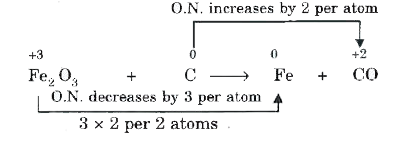 3. To balance increase or decrease multiply C by 3 and `Fe_2O_3` by 1 as : 4. Balancing all other ATOMS , we get `Fe_2O_3 +3C RARR 2Fe+3CO` (ii) `Fe^(2+) +Cr_2O_7^(2+) +H^(+)rarr Cr_2O_7^(2-)+H^(+) rarr Cr^(3+) +Fe^(3+)+H_2O` 1. The akeleton equation along with oxidation number of each atom `overset(+2)Fe^(2+)+overset(+6-2)([Cr_2O_7]^(2-))+overset(+1)(H^+)rarroverset(+3)Fe^(3+)+overset(+3)Cr^(3+)+overset(+1-2)(H_2O)` 2. The oxidation number of chromium decreases from +6 in `Cr_2O_7^(2-)" ot " +3 " in "Cr^(3+)` . The total decrease for two chromium atoms in `Cr_2O_7^(2-) " to " Cr^(3+) ` is 6. On the other hand , the oxidation number of iron increases from +2 (in `Fe^(2+)` ) to +3 (in `Fe^(3+)` ) . Therefore , the equation can be written as : 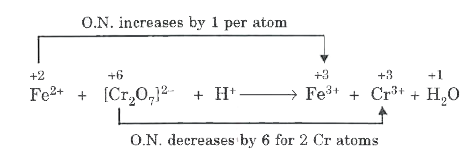 3. To balance increase and decrease of oxidation numbers , multiply `Fe^(2+)` by 6 and `Cr_2O_7^(2-)` by 1. Then we get `6FE^(2+) +Cr_2O_7^(2-) +H^(+) RARRFE^(3+) +Cr^(3+)+H_2O` 4. On counting and equating atoms on both sides, we get the balanced equation as : `6Fe^(2+)+Cr_2O_7^(2-)+14H^(+) rarr6Fe^(3+)+2Cr^(3+)+7H_2O` (iii) `Zn + HNO_3 rarr Zn (NO_3)_2+NO_2+H_2O` 1.The skeleton equation along with oxidation number of various atoms is `overset(0)Zn+overset(+1+5-2)(HNO_3)rarroverset(+2+5-2)(Zn(NO_3)_2)+overset(+4-2)(NO_2)+overset(+1-2)(H_2O)` 2. 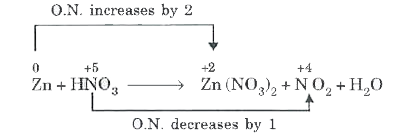 (iii) Multiply `HNO_3` by 2 `Zn+2HNO_3 rarr Zn(NO_3)_2+NO_2+H_2O` It has been observed that PART of nitrogen undergoes no change in oxidation number in forming `Zn(NO_3)_2` . However , in order to balance additional two `NO_3^(-)` ions , add `2HNO_3` more on the left hand side as : `Zn+4HNO_3 rarr Zn(NO_3)_2+NO_2+H_2O` 4. Balance all other atoms . `Zn+4NHO_3rarrZn(NO_3)_2+2NO_2+2H_2O` (iv) `C_6H_6 +O_2 rarr CO_2+H_2O` 1. The skeleton equation along with oxidation number of each atom : `overset(-1+1)(C_6H_6)+overset(0)O_2rarroverset(+4-2)(CO_2)+overset(+1-2)(H_2O)` O.N. increases by 5 per atom. 2. 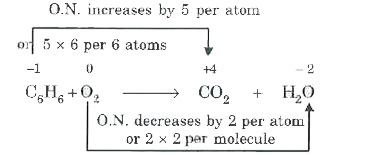 3. Multiply `C_6H_6` by 2 and `O_2` by 15 to balance increase and decrease in O.N. `2C_6H_6+15O_2rarrCO_2+H_2O` 4. Balance all atoms `2 C_6H_6 +15O_2 rarr 12CO_2 +6 H_2O` |
|
| 6. |
Balance the following equations. (i) H_(3)PO_(3) to H_(3)PO_(4) + PH_(3) (ii) Ca + H_(2)O to Ca(OH)_(2) + H_(2) (iii) Fe_(2)(SO_(4))_(3) + NH_(3) +H_(2)O to Fe(OH)_(3) + (NH_(4))_(2)SO_(4) |
|
Answer» Solution :(i) This equation can easily be balanced by hit and TRIAL method as follows. The formula `H_3PO_4` contains maximum number of atoms. Therefore, it can be selected to START with. On multiplying `H_(3)PO_(4)`by 3 and `H_(3)PO_(3)`by 4, we get: `4H_(3)PO_(3) to 3H_(3)PO_(4) + PH_(3)` In this equation, the atoms of each kind are the same on both sides of the equation. Hence, the equation is balanced. (ii) This equation can be balanced by hit and trial method. Writing hydrogen in the atomic FORM, we get `Ca + H_(2)O to Ca(OH)_(2) + H` `Ca(OH)_(2)` can be selected to start with because it contains maximum number of atoms. Oxygen present in it can be balanced by multiplying `H_2O` by 2 and hydrogen can be balanced by multiplying H by 2. Thus, we have: `Ca + 2H_(2)O to Ca(OH)_(2) + 2H` On writing the equation in the molecular form, we get the following balanced equation: `Ca + 2H_(2)O to Ca(OH)_(2) + H_(2)` (iii) This is a bit complicated equation. HOWEVER, it can be balanced by partial equation method. The partial equations corresponding to the probable steps of the given reaction are as follows. `Fe_(2)(SO_(4))_(3) + H_(2)O to Fe(OH)_(3) + H_(2)SO_(4)`.....(i) `NH_(3) + H_(2)SO_(4)to (NH_(4))_(2)SO_(4)` ..........(ii) On balancing these partial equations by hit and trial method, we get: `Fe_(2)(SO_(4))_(3) + 6H_(2)O to 2Fe (OH)_(3) + 3H_(2)SO_(4)`..........(iii) `2NH_(3) + H_(2)SO_(4) to (NH(4))_(2)SO_(4)`..........(iv) The intermediate species, i.e., H2S04 can be cancelled by multiplying Eq. (iv) by 3 and adding it to Eq. (iii). `Fe_(2)(SO_(4))_(3) + 6H_(2)O to 2Fe(OH)_(3) + 3H_(2)SO_(4)` `[2NH_(3) + H_(2)SO_(4) to (NH_(4))_(2)SO_(4)] xx 3` ------------------------------------------------------------------------ `Fe_(2)(SO_(4))_(3) + 6NH_(3) + 6H_(2)O to 2Fe(OH)_(3) + 3(NH_(4))_(2)SO_(4)` This is the final balanced equation. |
|
| 7. |
Balance the following equations by using oxidation number method. K_(2)Cr_(2)O_(7)+KI +H_(2)SO_(4)toK_(2)SO_(4)+Cr_(2)(SO_(4))_(3)+I_(2)+H_(2)O |
Answer» SOLUTION :`K_(2)Cr_(2)O_(7)+KI +H_(2)SO_(4)toK_(2)SO_(4)+Cr_(2)(SO_(4))_(3)+I_(2)+H_(2)O`  Step 2.`K_(2)Cr_(2)O_(7)+6KI +H_(2)SO_(4)toK_(2)SO_(4)+Cr_(2)(SO_(4))_(3)+3I_(2)+H_(2)O` Step 3. To balance other atoms `K_(2)Cr_(2)O_(7)+6KI +H_(2)SO_(4)toK_(2)SO_(4)+Cr_(2)(SO_(4))_(3)+3I_(2)+H_(2)O` Step 4. To balance oxygen and hydrogen, `H_(2)O` and `H_(2)SO_(4)` are multiplied by 7 `K_(2)Cr_(2)O_(7)+6KI +7H_(2)SO_(4)toK_(2)SO_(4)+Cr_(2)(SO_(4))_(3)+3I_(2)+H_(2)O` |
|
| 8. |
Balance the following equations. C_(2)H_(5)OH+l_(2)+OH^(-)toCHl_(3)+HCOO^(-)+I^(-)+H_(2)O (basic medium) |
|
Answer» Solution :Following are only the hints to balance the given equations. Students are advised to elaborate the steps as given in the text. (i) Balancing the given EQUATION by oxidation number method : Step 1. `C_(2)H_(5)OH+l_(2)+OH^(-)toCHl_(3)+HCOO^(-)+l^(-)+H_(2)O` Step 2. `overset(-2+1-2+1)(C_(2)H_(5)OH)+overset(0)(l_(2))+overset(-2+1)(OH^(-))tooverset(+2+1-1)(CHl_(3))+overset(+1+2-2)(HCOO^(-))+overset(-1)(l^(-))+overset(+1-2)(H_(2)O)` Setp 3. C in `C_(2)H_(5)OH` is getting oxidised while `l_(2)` is getting reduced Step 4. `C_(2)H_(5)OH+2l_(2)+OH^(-)toCHl_(3)+HCOO^(-)+l^(-)+H_(2)O` (balancing I atoms) Step 5. `underset(4e^(-))underset(DARR)(C_(2)H_(5)OH)+underset(1e^(-))underset(uarr)(2l_(2))+OH^(-)toCHl_(3)+HCOO^(-)+l^(-)+H_(2)O` Number of electrons gained by two C atoms `=4xx2=8` Number of electrons lost by four I atoms `=1xx4=4` Step 6. Coefficient for `C_(2)H_(5)OH=1` Coefficient for `l_(2)=2` Step 7. `C_(2)H_(5)OH+4l_(2)+OH^(-)toCHl_(3)+HCOO^(-)+5l^(-)+H_(2)O` (Eight I atoms on the right should be distributed as required by the equation.) Step 8. Other atoms are balanced. Step 9. The reaction proceeds in basic medium, therefore, `C_(2)H_(5)OH+4l_(2)+OH^(-)+OH^(-)toCHl_(3)+HCOO^(-)+5l^(-)+H_(2)O` (balancing O atom) `C_(2)H_(5)OH+4l_(2)+OH^(-)+OH^(-)+4OH^(-)toCHl_(3)+HCOO^(-)+5l^(-)+H_(2)O+4H_(2)O` (balancing H atoms) or `C_(2)H_(5)OH+4l_(2)+6OH^(-)toCHl_(3)+HCOO^(-)+5l^(-)+5H_(2)O` the final balanced equation in the basic medium. |
|
| 9. |
Balance the following equations by the oxidation number method. (a) Fe^(+2)+H^(+)+Cr_(2)O_(7)^(-2)toCr^(+3)+Fe^(+3)+H_(2)O (b) I_(2)+NO_(3)^(-)toNO_(2)+IO_(3)^(-) ( c) I_(2)+S_(2)O_(3)^(-2)toI^(-)+S_(4)O_(6)^(-2) (d) MnO_(2)+C_(2)O_(4)^(-2)toMn^(+2)+CO_(2) |
Answer» Solution :(a)  Balance by oxidation number. `6Fe^(+2)+H^(+)+Cr_(2)O_(7)^(-2)to2Cr^(+3)+6Fe^(+3)+H_(2)O` Balance charges. `6Fe^(+2)+14H^(+)+Cr_(2)O_(7)^(-2)to2Cr^(+3)+6Fe^(+3)+H_(2)O` Balance O and H. `6Fe^(+2)+14H^(+)+Cr_(2)O_(7)^(-2)to2Cr^(+3)+6Fe^(+3)+7H_(2)O` (B) `I_(2)+NO_(3)^(-)toNO_(2)+IO_(3)^(-)`  Balance by oxidation no. `I_(2)+10NO_(3)^(-)to10NO_(2)+2IO_(3)^(-)` Balance charges. `I_(2)+10NO_(3)^(-)+8H^(+)to10NO_(2)+2IO_(3)^(-)` Balance H and O. `I_(2)+10NO_(3)^(-)+8H^(+)to10NO_(2)+2IO_(3)^(-)+4H_(2)O` ( c) `I_(2)+S_(2)O_(3)^(-2)toI^(-)+S_(4)O_(6)^(-2)`  `I_(2)+2S_(2)O_(3)^(-2)to2I^(-)+S_(4)O_(6)^(-2)` (d) `MnO_(2)+C_(2)O_(4)^(-2)toMn^(+2)+CO_(2)`  `MnO_(2)+C_(2)O_(4)^(-2)+4H^(+)toMn^(+2)+2CO_(2)` `MnO_(2)+C_(2)O_(4)^(-2)+4H^(+)toMn^(+2)+2CO_(2)+2H_(2)O` |
|
| 10. |
Balance the following equations by the oxidaiton number method . (i) Fe^(2+)+H^(+)+Cr_(2)O_7^(2-)rarrCr^(3+)+Fe^(3+)+H_2O (ii) I_2+NO_3^(-) rarr NO_2+IO_3^(-) (iii) I_2+S_(2)O_(3)^(2-)rarr I^(-) +S_(4)O_(6)^(2-) (iv) MnO_(2)+C_(2)O_(4)^(2-)rarrMn^(2+)+CO_2 |
|
Answer» SOLUTION :Try yourself Balanced equation are (i) `6Fe^(2+)+Cr_2O_(7)^(2-)+14H^(+) rarr 2Cr^(3+)+6Fe^(3+)+7H_2O` (II) `I_2+10NO_3^(-)+8H^(+)rarr 10NO_2+2IO_(3)^(-)+4H_2O` (iii) `I_2+2S_2O_3^(2-)rarr2I^(-)+S_4O_(6)^(2-)` (IV) `MnO_2+C_2O_4^(2-) +4H^(+)rarrMn^(2+)+2CO_2+2H_2O` |
|
| 11. |
Balance the following equations by the oxidation number method |
|
Answer» `Fe^(2+) +H^(+) +Cr_(2)O_(7)^(2)rarrCr^(3)+Fe^(3+)+H_(2)O`  Step 2 find out the total increase and decrease in O.N since there is only fe atom on either side of Eq (a) therefore total increase in O.N is 1 further since there are two cr atoms in `Cr_(2)O_(7)^(2-)` on L.H.S and only in `Cr^(3+)` oin L.H.S of Eq (a) therefore total decrease in O.N=`2xx3=6` step 3 balance increase / decrease in O.N sincethe total increase in O.N is 1 and decrease is 6 therefore multiply `Fe^(2+)` on the L.H.S of Eq (a) by 6 we have `6FE^(2+)+h^(+)+r_(2)O_(7)^(2-)rarrCr^(3+)+6Fe^(3+)+H_(2)O` step 4 balance all atoms other than O and H To balance Cr on either side of Eq (b) multiply `Cr^(3+)` by 2 on R.H.S of Eq (b) we have `6Fe^(2+)+H^(+)Cr_(2)O_(7)^(2+)rarr 2Cr^(3+)+6Fe^(3+)+H_(2)O` Step 5 balance O and H atoms by hit and trial method to balance H multiply `H^(+)` pmL.H.S of Eq (d) by 14we have `6Fe^(2+)+14H^(+)+Cr_(2)O_(7)^(2-) rarr 6 Fe^(3+)+2 Cr^(3+)+7H_(2)O` step 1 find out the element which undergo a change in O.N  step 2 find out the total increase/ decrease in o.n since there are tow I atoms of the L.H.S of eq since there is only one N atom on either side of Eq (a) therefore total decrease in O.N =`1xx1=1` step 3 balance increase /decrease in O.N since total increase in O.N is 10 and decrease is only 1 therefore multiply `NO_(3)^(-)` on L.H.S of Eq (a) 10 we have step 4 balance all atoms otehr than O and H sincethere are tow I atoms on L.H.S and only 1 On R.H.S of Eq (b) therefore multiple `IO_(3)^(-)` by 2 combining these two steps we have step 5 balance O and H atoms by hit and trial method to balance O atoms on either side of eq (c ) add 4 `H_(2)O` to the R.H.S and tobalance H atoms add 8 `H^(+)` the L.H.S of Eq we have (iii) SETP 1 find out the element which undergo a change in O.N  step 2 findout the total increase / decrease in O.N since there are two I atoms on L.H.S of Eq (a) and only on R.H.S therefore the total decrease in O.N =`2xx1=2` further since there are two s atoms on L.H.S and four S atoms on the R.H.S of eq (IV) step 1 find outthe element which undergo a change in O.N  step 2 find out the total increase / decrease in o.n since there is only ione mn atoms on either side ofEq (a) there fore total decrease in o.n =`1xx2=-2` further sincethere are two c atoms on the L.H.S and only one on the r.H.s of eq (a) there foretotal increase in O.N `=2xx1=2` step 3 balance increase / decrease in O.N the totalincrease or decrease in O.N is already balanced step 5 balance all atoms other than o and h atoms since there are six o atoms on L.H.S and onlyfour on the R.H.S of Eq (b) add 2 `H_(2)O` to the R.H.s of R.H.S eq (c ) we have thus eq (d) represent the CORRECT balanced equation |
|
| 12. |
Balance the following equations by partial equation method: (i) NaOH + Cl_(2) to NaCl + NaClO_(3) + H_(2)O (ii) H_(2)S + HNO_(3) to NO + H_(2)O + S (iii) C + H_(2)SO_(4) to CO_(2) + SO_(2) + H_(2)O (iv) I_(2) + HNO_(3) to NO_(2) + HIO_(3) + H_(2)O (i) P_(4) + HNO_(3) to H_(3)PO_(4) + NO_(2) + H_(2)O |
|
Answer» |
|
| 13. |
Balance the following equations by oxidation number method. KMnO_(4)+H_(3)AsO_(3)+HCl toKCl+MnCl_(2)+H_(3)AsO_(4)+H_(2)O |
| Answer» Solution :`3 xx 55.85 g , 3 xx 6.022 xx 10^(23) "atoms"(3FE) + UNDERSET("4 moles" 4 xx 18.016 g 4 xx 6.022 xx 10^(23) "MOLECULES")(4H_(2)O) to underset("one MOLE" 231.55 g, 6.022 xx 10^(23) "molecules")(Fe_(3)O_(4)) + underset("4 moles" 4 xx 22.4 L "at S.T.P.") (4 xx 6.022 xx 10^(23) "molecules")` | |
| 14. |
Balance the following equations by oxidation number method KMnO_(4)+H_(2)C_(2)O_(4)+H_(2)SO_(4)rarrK_(2)SO_(4)+MnSO_(4)+CO_(2)+H_(2)O |
|
Answer» Solution :`underset(5e^(-))underset(darr)overset(+7)(KMnO_(4))+underset(L E^(-)xx2)underset(UARR)overset(+3)(H_(2)C_(2)O_(4))+H_(2)SO_(4)rarrK_(2)SO_(4)+overset(+2)(M)nSO_(4)+overset(+4)(C)O_(2)+H_(2)O` `2KMnO_(4)+5H_(2)C_(2)O_(4)+H_(2)SO_(4)rarrMnO_(2)` `+Na_(2)SO_(4)+KOH` `2KMnO_(4)+5H_(2)C_(2)O_(4)+H_(2)SO_(4)rarrK_(2)SO_(4)` `+2MnSO_(4)+10CO_(2)+H_(2)O` `2KMnO_(4)+5H_(2)C_(2)O_(4)+3H_(2)SO_(4)rarr` `K_(2)SO_(4)+2MnSO_(4)+10CO_(2)+8H_(2)O` |
|
| 15. |
Balance the following equations by oxidation number method K_(2)Cr_(2)O_(7)+KI+H_(2)SO_(4)rarrK_(2)SO_(4)+Cr_(2)(SO_(4))_(3)+I_(2)+H_(2)O |
|
Answer» SOLUTION :`underset(2xx3e^(-))underset(uarr)overset(+6)(K_(2)Cr_(2)O_(7))+underset(1E^(-))overset(-1)KI+H_(2)SO_(4)rarrK_(2)SO_(4)+overset(+3)(Cr_(2))(SO_(4))_(3)+overset(0)(I_(2))+H_(2)O` `K_(2)Cr_(2)O_(7)+6KI+H_(2)SO_(4)rarrK_(2)SO_(4)+` `Cr_(2)(SO_(4))_(3)+I_(2)+H_(2)O` `K_(2)Cr_(2)O_(7)+6KI+H_(2)SO_(4)rarrK_(2)SO_(4)+` `Cr_(2)(SO_(4))_(3)+3I_(2)+H_(2)O` `K_(2)Cr_(2)O_(7)+6KI+7H_(2)SO_(4)rarr4K_(2)SO_(4)+` `Cr_(2)(SO_(4))_(3)+3I_(2)+7H_(2)O` |
|
| 16. |
Balance the following equations by oxidation number method KMnO_(4)+Na_(2)SO_(3)rarrMnO_(2)+Na_(2)SO_(4)+KOH |
|
Answer» Solution :`UNDERSET(3e^(-))OVERSET(+7)(KMnO_(4))+underset(2E^(-))overset(+4)(Na_(2)SO_(3))rarroverset(+4)(M)nO_(2)+Na_(2)overset(+6)(S)O_(4)+KOH` `implies2KMnO_(4)+3Na_(2)SO_(3)rarrMnO_(2)+` `Na_(2)SO_(4)+KOH` `implies2KMnO_(4)+3Na_(2)SO_(3)rarr2MnO_(2)+` `3Na_(2)SO_(4)+KOH` `implies2KMnO_(4)+3Na_(2)SO_(3)+H_(2)Orarr2MnO_(2)` `+3Na_(2)SO_(4)+2KOH` |
|
| 17. |
Balance the following equations by oxidation number method (iii) Cu+HNO_(3)to Cu(NO_3)_2+NO_(2)+H_2O |
Answer» SOLUTION : `CU+2HNO_3 to Cu(NO_3)_2 +NO_2_H_2O` `Cu+2HNO_3+2HNO_3 to Cu(NO_3)_2+2NO_2+2H_2O` `Cu+2HNO_3 to Cu(NO_3)_2+2NO_2+2H_2O` |
|
| 18. |
Balance the following equations by oxidation number method (i) Kr_(2)Cr_(2)O_(7) + KI + H_(2)SO_(4) to K_(2)SO_(4) + Cr_(2)(SO_(4))_(3) + I_(2) + H_(2)O (ii)KMnO_(4) + Na_(2)SO_(3) to MnO_(2) + Na_(2)SO_(4) + KOH (iii)Cu + HNO_(3) to Cu(NO_(3))_(2) + H_(2)O (iv)KMnO_(4) + H_(2)C_(2)O_(4) + H_(2)SO_(4) to K_(2)SO_(4) + MnSO_(4) + CO_(2) + H_(2)O |
|
Answer» Solution :(i)`Kr_(2)Cr_(2)O_(7) + KI + H_(2)SO_(4) to K_(2)SO_(4) + Cr_(2)(SO_(4))_(3) + I_(2) + H_(2)O` Step 1 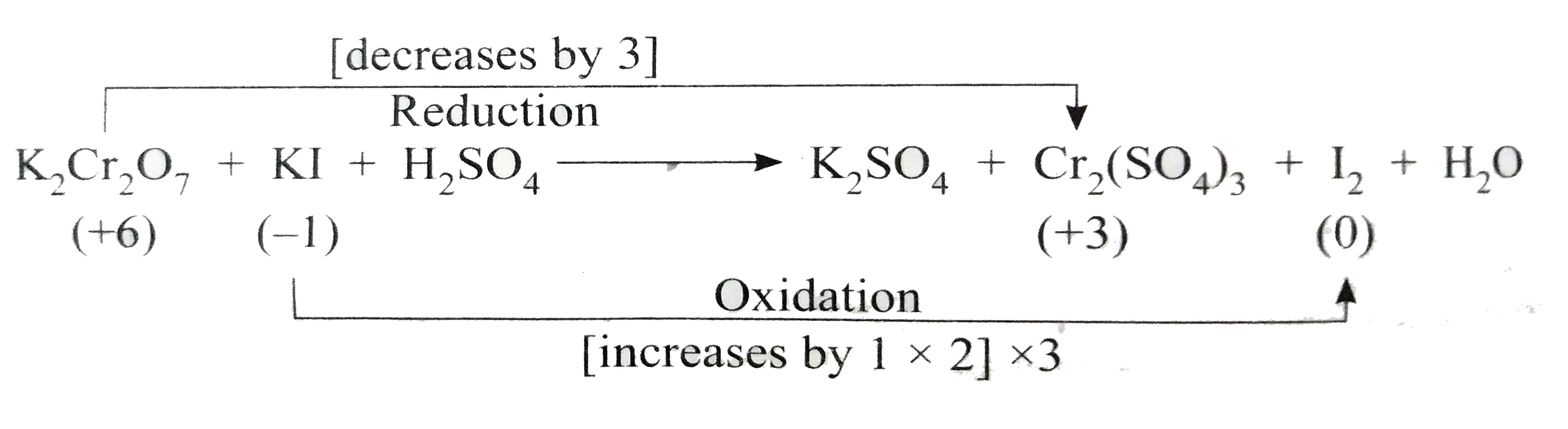 Step 2. `K_(2)Cr_(2)O_(7) + 6KI + H_(2)SO_(4) to K_(2)SO_(4) + Cr_(2)(SO_(4))_(3) + 3I_(2) + H_(2)O` Step 3. To balance other atoms `K_(2)Cr_(2)O_(7) + 6KI+ H_(2)SO_(4) to 4K_(2)SO_(4) + Cr_(2)(SO_(4))_(3) + 3I_(2) + H_(2)O` Step 4. To balance oxygen and hydrogen, `H_(2)O` and `H_(2)SO_(4)` are multiplid by 7 `K_(2)Cr_(2)O_(7) + 6KI + 7H_(2)SO_(4) to 4K_(2)SO_(4) + Cr_(2)(SO_(4))_(3) + 3I_(2) + 7H_(2)O` (ii) `KMnO_(4) + Na_(2)SO_(3) to MnO_(2) + Na_(2)SO_(4) + KOH` 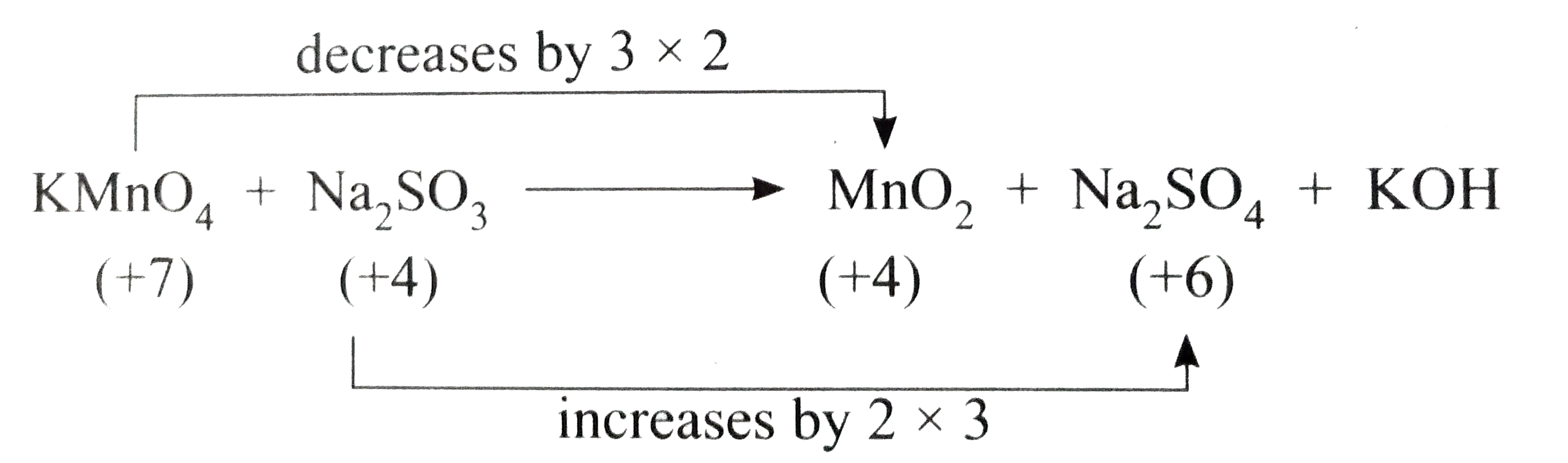 Stpe 2:`2KMnO_(4) + 3Na_(2)SO_(3) to 2MnO_(2) + 3Na_(2)SO_(4) +KOH` Step 3. BALANCING potassium KOH is multiplies by 2 `2KMnO_(4) + 3Na_(2)SO_(3) to 2MnO_(2) + 3Na_(2)SO_(4) + 2KOH` Step 4. To balance H atom, `H_(2)O` is added on reactant side. `2KMnO_(4) + 3Na_(2)SO_(3) + H_(2)O to MnO_(2) + 3Na_(2)SO_(4) + 2KOH` (III) `Cu + HNO_(3) to Cu(NO_(3))_(2) + NO_(2) + H_(2)O` Step 1. 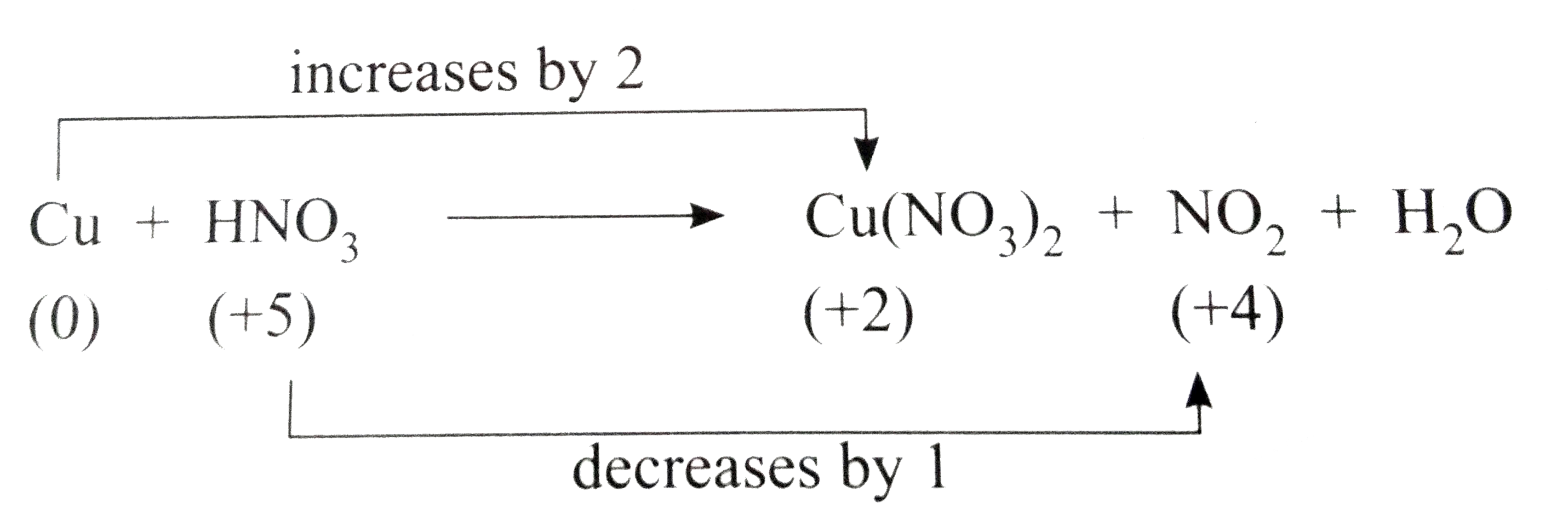 Stpe 2. `Cu + 2HNO_(3) to Cu(NO_(3))_(2) +NO_(2) + H_(2)O` Step 3. To balance Nitrogen `2HNO_(3)` is multiplies by 2 and `NO_(2)` is multiplies by 2 `Cu + 4HNO_(3) to Cu(NO_())_(2) + 2NO_(2) + H_(2)O` Step 4. To balance oxygen, `H_(2)O` is multiplied by 2 `Cu + 4HNO_(3) to Cu(NO_(3))_(2) + 2NO_(2) + 2H_(2)O` (iv) `H_(2)C_(2)O_(4) + KMnO_(4) + H_(2)SO_(4) to K_(2)SO_(4) + MnSO_(4) + CO_(2) + H_(2)O` Step 1 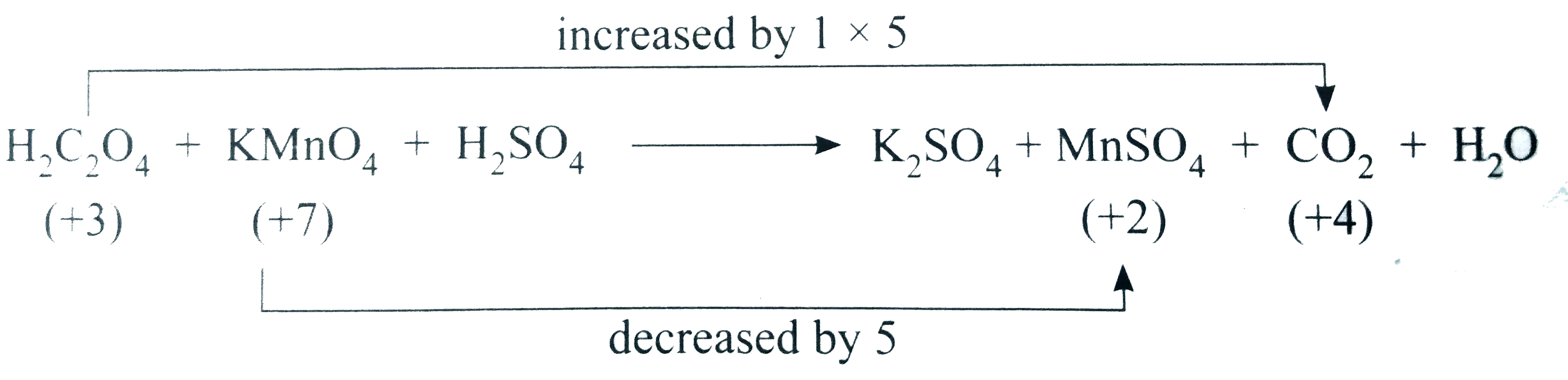 Step 2. `5H_(2)C_(2)O_(4) + KMnO_(4) + H_(2)SO_(4) to K_(2)SO_(4) + MnSO_(4) + 10CO_(2) + H_(2)O` STEP3. To balance K, `KMnO_(4) ` and `MnSO_(4)` are multiplied by 2 `5H_(2)Cr_(2)O_(4) + 2KMnO_(4) + H_(2)SO_(4) to K_(2)SO_(4) + 2MnSO_(4) + 10CO_(2) + H_(2)O` Step 4. To balance O and H, `H_(2) O` and `H_(2)SO_(4)` are multiplies by 3 and 6 `5H_(2)C_(2)O_(4) + 2MnSO_(4) + 10CO_(2) + 8H_(2)O` |
|
| 19. |
Balance the following equations by oxidation number method : {:((i),H_2S+HNO_3,rarr,H_2O+NO+S),((ii),""NH_3+O_3,rarr,NO+H_2O),((iii),Cu+HNO_3,rarr,Cu(NO_3)_2+NO+H_2O):} |
|
Answer» (II) `""4NH_3+5O_2 rarr 4NO+3S+4H_2O` (III) `3Cu+8HNO_3 rarr 3Cu(NO_3)_2+2NO+4H_2O` |
|
| 20. |
(i) K_(2)Cr_(2)O_(7)+KI+H_(2)SO_(4)to K_(2)SO_(4)+Cr_(2)(SO_4)_3+I_(2)+H_(2)O. |
Answer» Solution : `K_(2)Cr_(2)O_7+6KI+H_(2)SO_4 to K_(2)SO_4+Cr_(2)(SO_4)_3+I_(2)+H_(2)O` `K_(2)Cr_(2)O_7+6KI+H_2SO_4 to K_2SO_4+Cr_(2)(SO_4)_3+3I_2+H_2O` `K_(2)Cr_(2)O_7+6KI+7H_(2)SO_4 to 4K_(2)SO_(4)+Cr_(2)(SO_4)_(3)+3I_(2)+7H_2O`. |
|
| 21. |
Balance the following equations by oxidation number method Cu+HNO_(3)rarrCu(NO_(3))_(2)+NO_(2)+H_(2)O |
|
Answer» SOLUTION :`underset(2e^(-))underset(DARR)overset(0)(Cu)+underset(1E^(-))underset(uarr)overset(+5)(HNO_(3))rarrCoverset(+2)u(NO_(3))_(2)+overset(+4)(N)O_(2)+H_(2)O` `Cu+2HNO_(3)rarrCu(NO_(3))_(2)+NO_(2)+H_(2)O` `Cu+2HNO_(3)+2HNO_(3)rarrCu(NO_(3))_(2)+` `2NO_(2)+2H_(2)O` `Cu+4HNO_(3)rarrCu(NO_(3))_(2)+2NO_(2)+2H_(2)O` |
|
| 22. |
Balance the following equations by ion electron method. (i) KMnO_(4) + SnCl_(2) + HCl to MnCl_(2) + SnCl_(4) + H_(2)O + KCl (ii)C_(2)O_(4)^(2-) + Cr_(2)O_(7)^(2-) to Cr^(3+) + CO_(2) (in acidic medium) (iii) Na_(2)S_(2)O_(3) + I_(2) to Na_(2)S_(4)O_(6) + NaI Zn + NO_(3)^(-) to Zn^(2+) + NO(in acidic medium) |
|
Answer» Solution :Oxidation half reaction: (loss of electrons) `overset(+2)(SnCl_(2)) to overset(+4)(SnCl_(4)) + 2e^(-)`(i) Reduction half reaction: (gain of electrons) `overset(+7)(KMnO_(4)) + 5E^(-) to overset(+2)(MnCl_(2))`(2) Add `H_(2)O` to balance hydrogen atoms. `KMnO_(4) + 5e^(-) to overset(+2)(MnCl_(2)) + 4H_(2)O`......(3) Add HCl to balance hydrogen atoms `KMnO_(4) + 5e^(-) + 8HCl to MnCl_(2) + 4H_(2)O`........(4) To equalize the number of ELECTRON equation `(1)xx5` and equation `(2)xx2` `5SnCl_(2) to 5SnCl_(2) + cancel(10e^(-))` `2KMnO_(4) + 16HCl + cancel(10e^(-)) to 2MnCl_(2) + 4H_(2)O + 2KCl` `2KMnO_(4) + 5SnCl_(2) + 16HCl to 5SnCl_(4) + 2MnCl_(4) + 2MnCl_(2) + 4H_(2)O + 2KCl` (ii)`C_(2)O_(4)^(2-) + Cr_(2)O_(7)^(2-) to Cr^(+3) + CO_(2)` (in acidic medium) Oxidation half reaction: `UNDERSET(+3)(C_(2)O_(4)^(2-)) to underset(+4)(2CO_(2)) + 2e^(-)` ......(1) Reduction half reaction: `underset(+6)(Cr_(2)O_(7)^(2-)) + 6e^(-) to 2Cr^(+3)`.....(2) To balance oxygen atoms, `H_(2)O` is added on RHS of equation (2) `Cr_(2)O_(7)^(2-) + 6e^(-) to 2Cr^(+3) + 7H_(2)O`......(3) To balance Hydrogen atom, `H^(+)` is added on LHS of equation (1) `C_(2)O_(4)^(2-) + 14H^(+) to 2CO_(2) + 2e^(-)`.....(4) To equalize the number of electrons gained and lost, multiply the equation `(4) xx 3`. (4) `=gt 3C_(2)O_(4)^(2-) + 14H^(+) to 6CO_(2) + cancel(6e^(-))` `Cr_(2)O_(7)^(2-) + cancel(6e^(-)) to 2Cr^(3+) + 7H_(2)O` `Cr_(2)O_(7)^(2-) + 3C_(2)O_(4)^(2-) 14H^(+) to 2Cr^(3+) + 6CO_(2) + 7H_(2)O` (iii) `Na_(2)S_(2)O_(3) + I_(2) to Na_(2)S_(4)O_(6) + NaI`(in acid medium) Oxidation half reaction: (Loss of electron) `Na_(2)S_(2)O_(3) to Na_(2)S_(4)O_(6) + 2e^(-)`......(i) Reduction half reaction: (Gain of electron) `I_(2) + 2e^(-) to 2NaI`.....(2) Adding (1) and (2) `Na_(2)S_(2)O_(3) to Na_(2)S_(4)O_(6) + cancel(2e^(-))` `I_(2) + cancel(2e^(-)) to NaI` `Na_(2)S_(2)O_(3) + I_(2) to Na_(2)S_(4)O_(6) + 2NaI` To balance oxygen, `2Na_(2)S_(2)O_(3) + I_(2) to Na_(2)S_(4)O_(6) + 2NaI` In acidic medium (iv)`Zn + NO_(3)^(-) to Zn^(2+) + NO` Half reaction medium `overset(o)(Z)n to Zn^(2+)`.....(1) `overset(+5)(N)O_(3)^(-) to overset(+2)(N)O`.....(2) `(1)=gt Zn to Zn^(2+) + 2e^(-)`.....(3) `(2)=gtNO_(3)^(-) + 4H^(+) to NO + 2H_(2)O`.....(4) `(3)xx3=gt3Zn to 3Zn^(2+) cancel(6e^(-))`....(5) `(4)xx2=gt 2NO_(3)^(-) + cancel(6e^(-)) + 8H^(+) to 2NO + 4H_(2)O`.....(6) `3Zn + 2NO_(3)^(-) + 8H^(+) to 3Zn^(2+) + 2NO + 4H_(2)O` |
|
| 23. |
Balance the following equations by ion electron (half reaction ) method : {:((i) ,H_2S+MnO_4^(-)+H^(+),rarr,S+Mn^(2+)+H_2O),((ii) ,Cr_2O_7^(2-)+H^(+)+Fe^(2+),rarr,Cr^(3+)+Fe^(3+)+H_2O),((iii),""AsO_3^(3-)+IO_3^(-),rarr,AsO_4^(3-)+I^(-)),((iv),""SnO_2+C,rarr,Sn+CO):} |
|
Answer» (II) `6FE^(2+)+Cr_2O_7^(2-) +14H^(+)rarr 6Fe^(3+)+2Cr^(3+) +7H_2O` (iii) `""3AsO_3^(3-)+IO_3^(-) rarr 3AsO_4^(3-) +I^(-)` (iv) `""SnO_2+2CrarrSn+2CO` |
|
| 24. |
Balance the following equations: a. BaCrO_(4) + KI+HClrarrBaCl_(2)+I_(2)+KCl+CrCl_(3)+H_(2)O b. SO_(2)+Na_(2)CrO_(4)+H_(2)SO_(4)rarrNa_(2)SO_(4)+Cr_(2)(SO_(4))_(3)+H_(2)O c. C_(2)H_(5)OH+I_(2)+overset(ө)OHrarrCHI_(3)+HCO_(2)^(ө)+H_(2)O+I^(ө) (Basic) d. As_(2)S_(3)+HNO_(3)rarrH_(3)AsO_(4)+H_(2)SO_(4)+NO e. ......+HC_(2)O_(4)^(ө)rarrCO_(3)^(2-)+Cl^(ө) (Acidic) f. HgS+HCl+HNO_(3)rarrH_(2)NO_(3)rarrH_(2)HgCl_(4)+NO+S+H_(2)O g. Mn_(2)O_(7)rarrMnO_(2)+O_(2) |
Answer» Solution :a. First write the equation in ionic from as shown below. 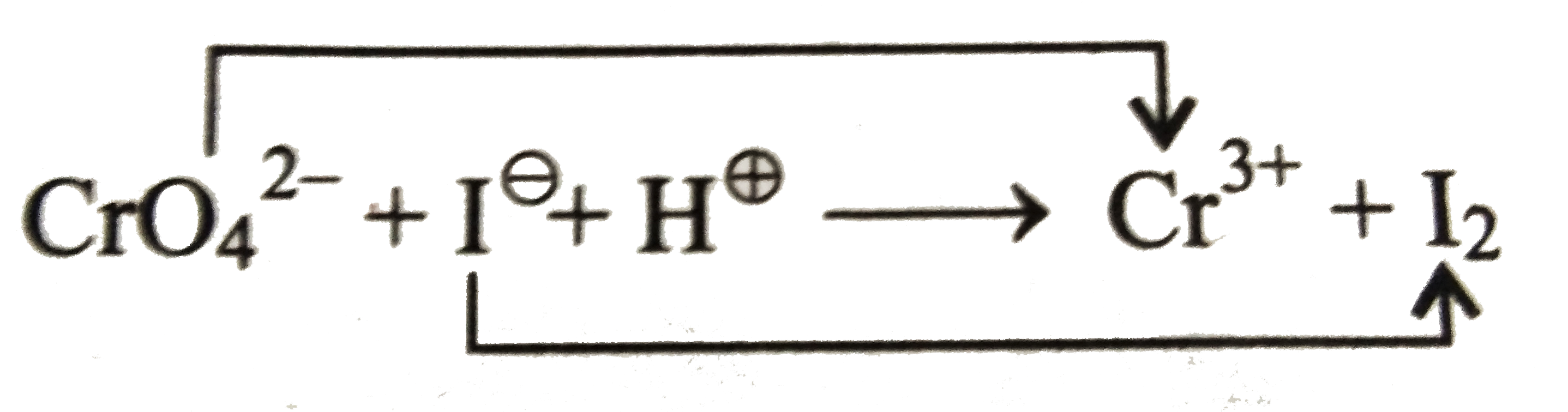 Ion electron method i. `3e^(-)+CrO_(4)^(2-)rarrCr^(3+)` `x-8 = -2, x=3` 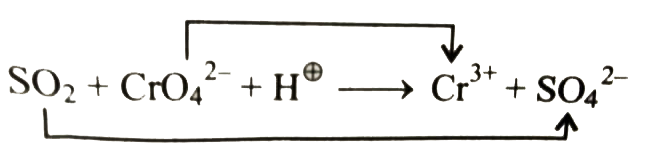 ii. Balance `O` ATOM by adding `H_(2)O` to `RHS` and then balance `H` atom by adding `H^(o+)` ions ( acidic medium) to `LHS`. `3e^(-)+8H^(o+)+CrO_(4)^(2-)rarrCr^(3+)+4H_(2)O`....(i) Similarly, balance `I^(ө)` to `I_(2)`. `2I^(ө)rarrI_(2)+2e^(-)`.....(ii) iii. Multiply equation (i) by `2` and equation (ii) by `3`. `cancel(6e^(-))+16H^(o+)+2CrO_(4)^(2-)rarr2Cr^(3+)+8H_(2)O` `6I^(ө)rarr3I_(2)+cancel(6e^(-))` `ulbar(16H^(o+)+2CrO_(4)^(2-)+6I^(ө)rarr2Cr^(3+)+8H_(2)O+3I_(2))` Now add the other ions to both sides. `LHS[[2Ba^(2+)],[6K^(+)],[16Cl^(ө)]]RHS[[2Ba^(2+)],[6K^(+)],[16Cl^(ө)]]` Net equation is `2BaCrO_(4)+6KI+16HClrarr2CrCl_(3)+3I_(2)+2BaCl_(2)+6KCl+8H_(2)O` b. First write the equation in ionic form as shown below: 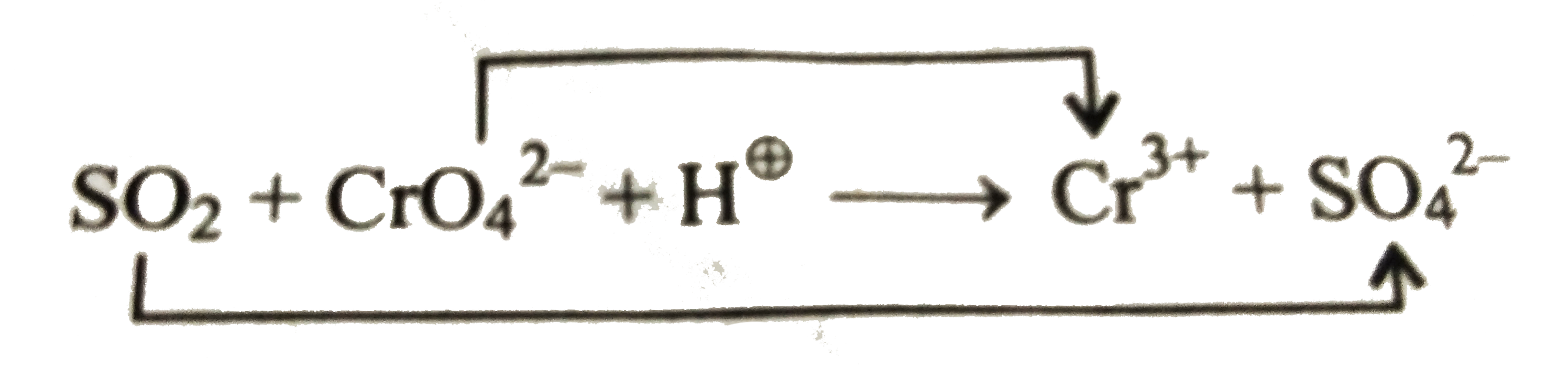 Ion electron method: (As in (a)) `16H^(o+)+6e^(-)+2CrO_(4)^(2-)rarr2Cr^(3+)+8H_(2)O`.....(i) `SO_(2)+2H_(2)OrarrSO_(4)^(2-)+2e^(-)+4^(o+)`....(ii) `x-4=0 x-8= -2` `x=4 x=6` 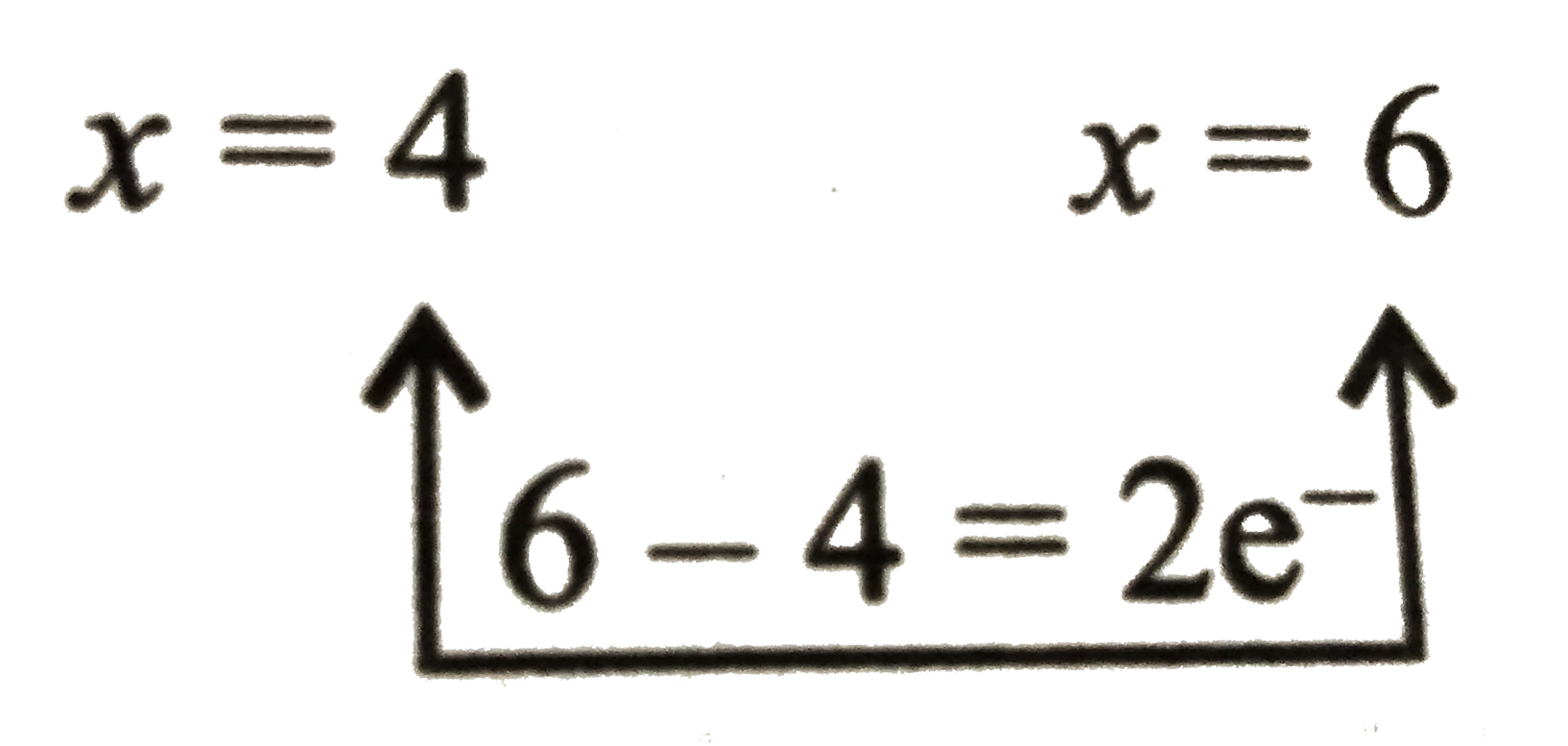 Multiply equation (ii) by`3` add eqations (i) and (ii) `{:(16H^(o+)+cancel(6e^(-))+2Cr_(4)^(2-)rarr2Cr^(3+)+8H_(2)O),(3SO_(2)+6H_(2)Orarr3SO_(4)^(2-)+cancel(6e^(-))+12H^(o+)),(ulbar(4H^(o+)+3SO_(2)+2CrO_(4)^(2-)rarr2Cr^(3)+2SO_(4)^(2-)+2H_(2)O)):}` It is a balanced redox equation Now add others ions to both sides. `LHS[[4Na^(o+)],[2SO_(4)^(2-)]],RHS[[4Na^(o+)],[2SO_(4)^(2-)]]` Net equation is: 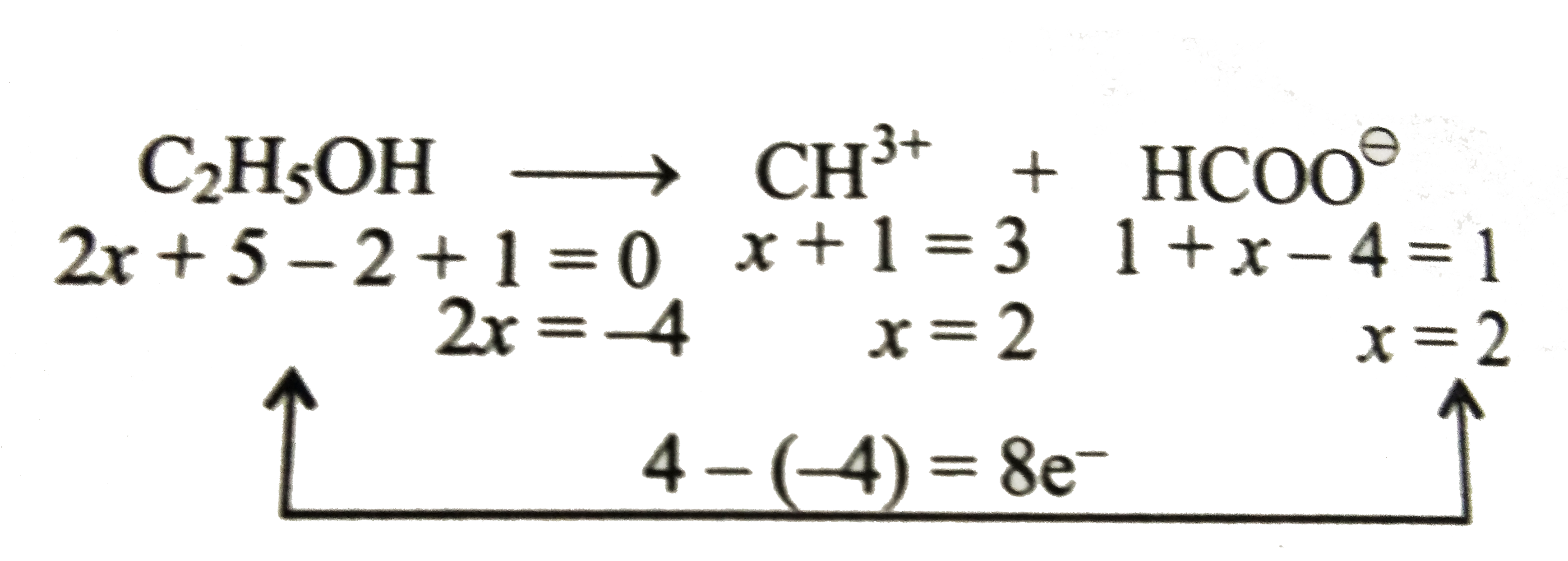 C. In this reaction, `C_(2)H_(5)OH` is changing to `CHI_(3)(i.e.,overset(+2+1)(CH)overset(-1xx3)(I_(3)))` and `HCOO^(ө)` ion. `C_(2)H_(5)OHrarrCH^(3+)+HCOO^(ө)` `2x+5-2+1=0 x+1=3 1+x-4=1` 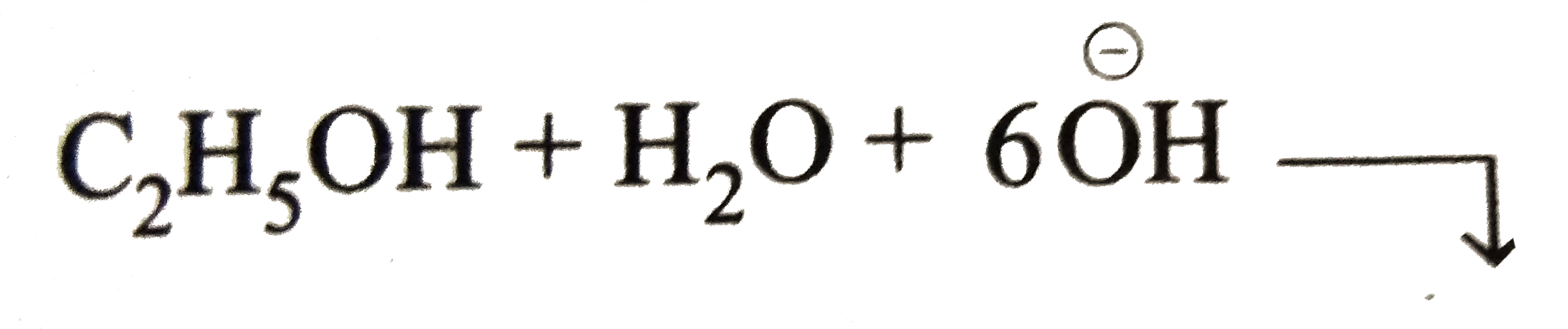 Balance `O` and `H` in basic medium. Balancing of `O` atom by adding `H_(2)O` to `LHS C_(2)H_(5)OH+H_(2)OrarrCH^(3+)+HCOO^(ө)+8e^(-)` Balancing of `H` atom by adding `6H_(2)O` to `RHS` and simulatneously add `6overset(ө)OH` to `LHS` 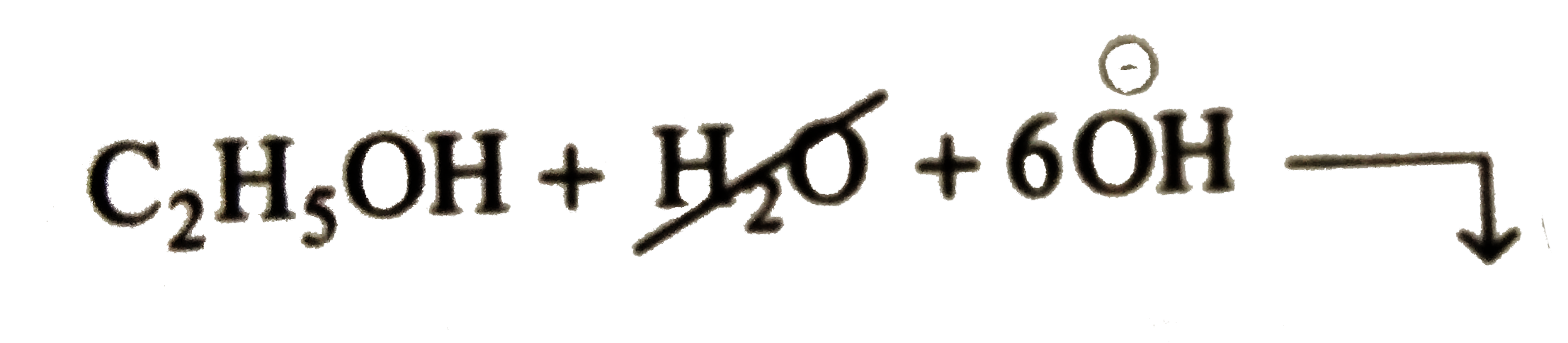 It is a balanced equation. Similarly, balance the reduction reaction. `2e^(-)+I_(2)rarr2I^(ө)`....(ii) Multiply equation (ii) by `4` and add equation (i) and (ii) 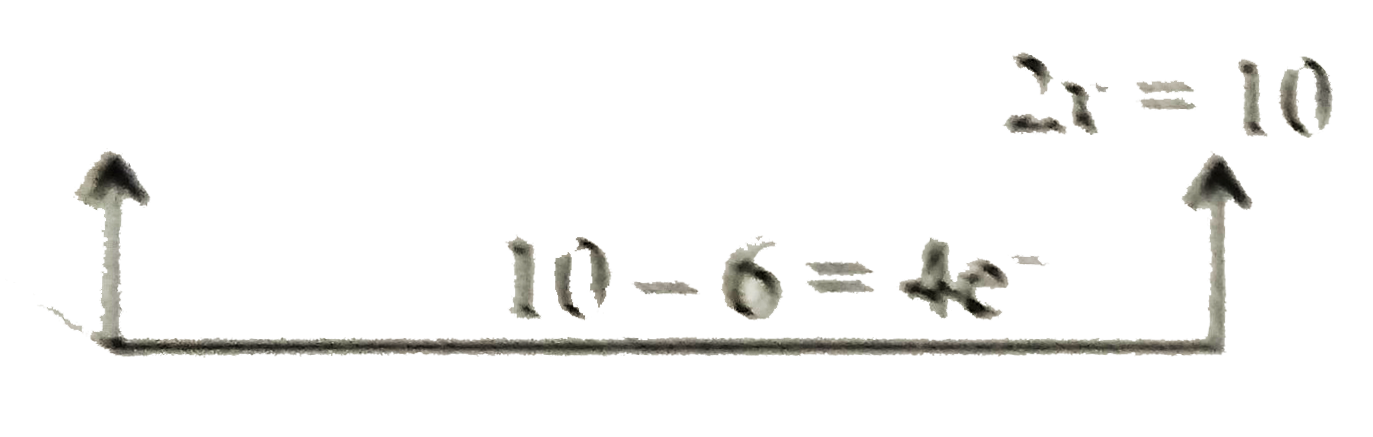 `{:(8e^(ө)+4I_(2)rarr8I^(ө))""(ulbar(C_(2)H_(5)OH+6overset(ө)OHrarrCH^(3+)+HCOO^(ө)5H_(2)+8I^(ө))):}` `CH^(3+)` is combined with `3I^(ө)` to form `CHI_(3)`. So net balanced equation is: `ulbar(C_(2)H_(5)OH+6overset(ө)OHrarrCHI_(3)+HICOO^(ө)+5I^(ө)+5H_(2)O)` d. Here, `As_(2)S_(3)` (i.e, `overset(+3xx2`) `(As_(2))overset(-2xx3)S)` is split into two parts `As_(2)^(6+)` and `S_(3)^(6-)` in which `As_(2)^(6+)` (i.e., `H_(2)SO_(4)`) `As_(2)^(6+)impliesH_(3)AsO_(4)` i. Balanced As atom by multiplying `RHS` by `2` and then add proper number of electrons. 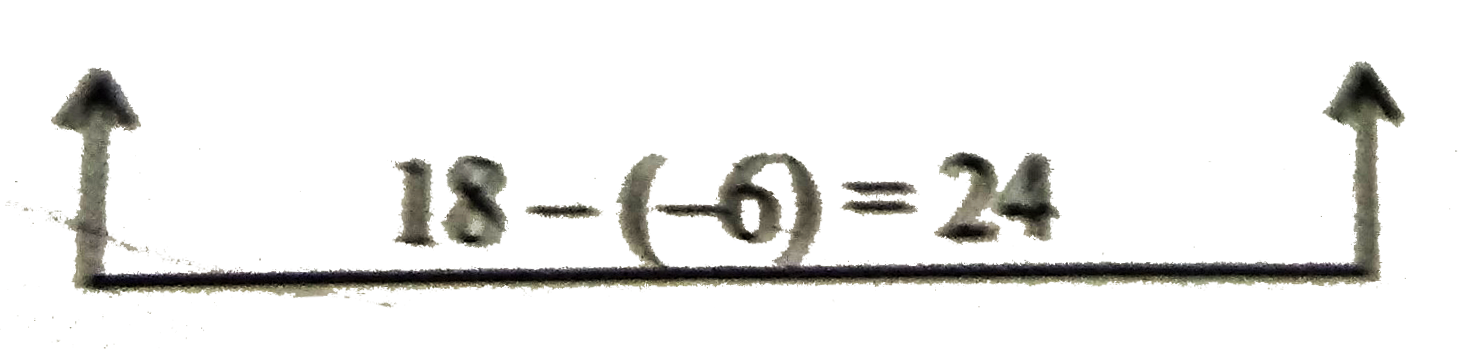 ii. Balance `O` and `H` atoms. `8H_(2)O+As_(2)^(6+)rarr2H_(3)AsO_(4)+4e^(-)+10H^(o+)`....(i) iii. Similarly, balance `S_(3)^(6-)` to `H_(2)SO_(4)`.  iv. Add equation (i) and (ii) `20H_(2)O+As_(2)S_(3)rarr2H_(3)AsO_(4)+3H_(2)SO_(4)+28H^(o+)+28e^(-)`.....(iii) v. Now balance reduction reaction of `HNO_(3)` to `NO`. 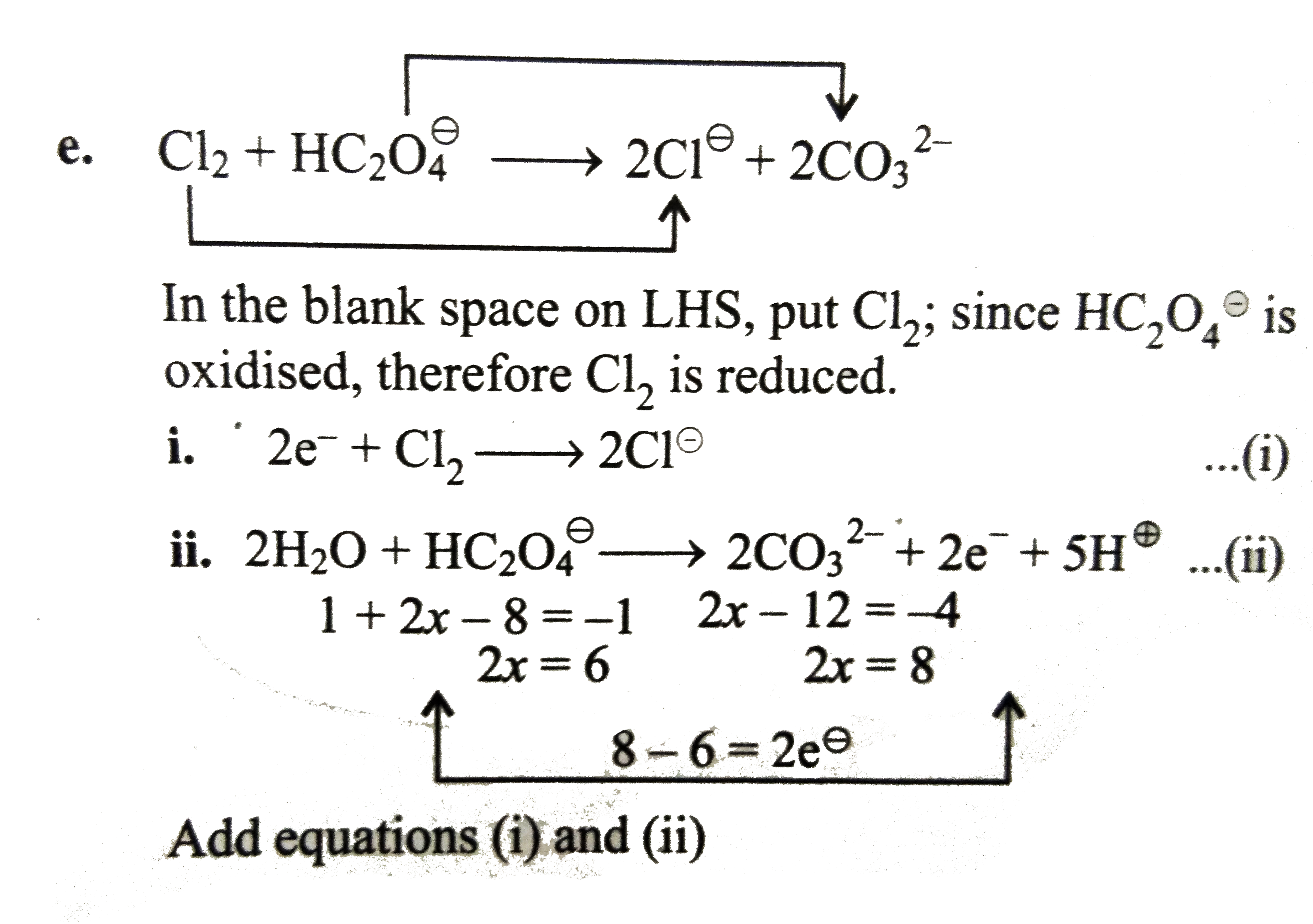 vi. Multiply equation (iii) by `3` and equation (iv) by `28` and then add both the equation. `{:(60H_(2)O+3As_(2)S_(3)rarr 6H_(3)AsO_(4)+9H_(2)SO_(4)),(""+cancel(84H^(o+))+cancel(84e^(-))....(v)):}` `ulbar(cancel(84H^(o+))+cancel(84e^(-))+27HNO_(3) rarr 28NO +56H_(2)O....(vi)` `4H_(2)O+3As_(2)S_(3)+28HNO_(3)rarr6H_(3)AsO_(4)+(H_(2)SO_(4)+9H_(2)SO_(4)+28NO` It is a balanced redox equation. 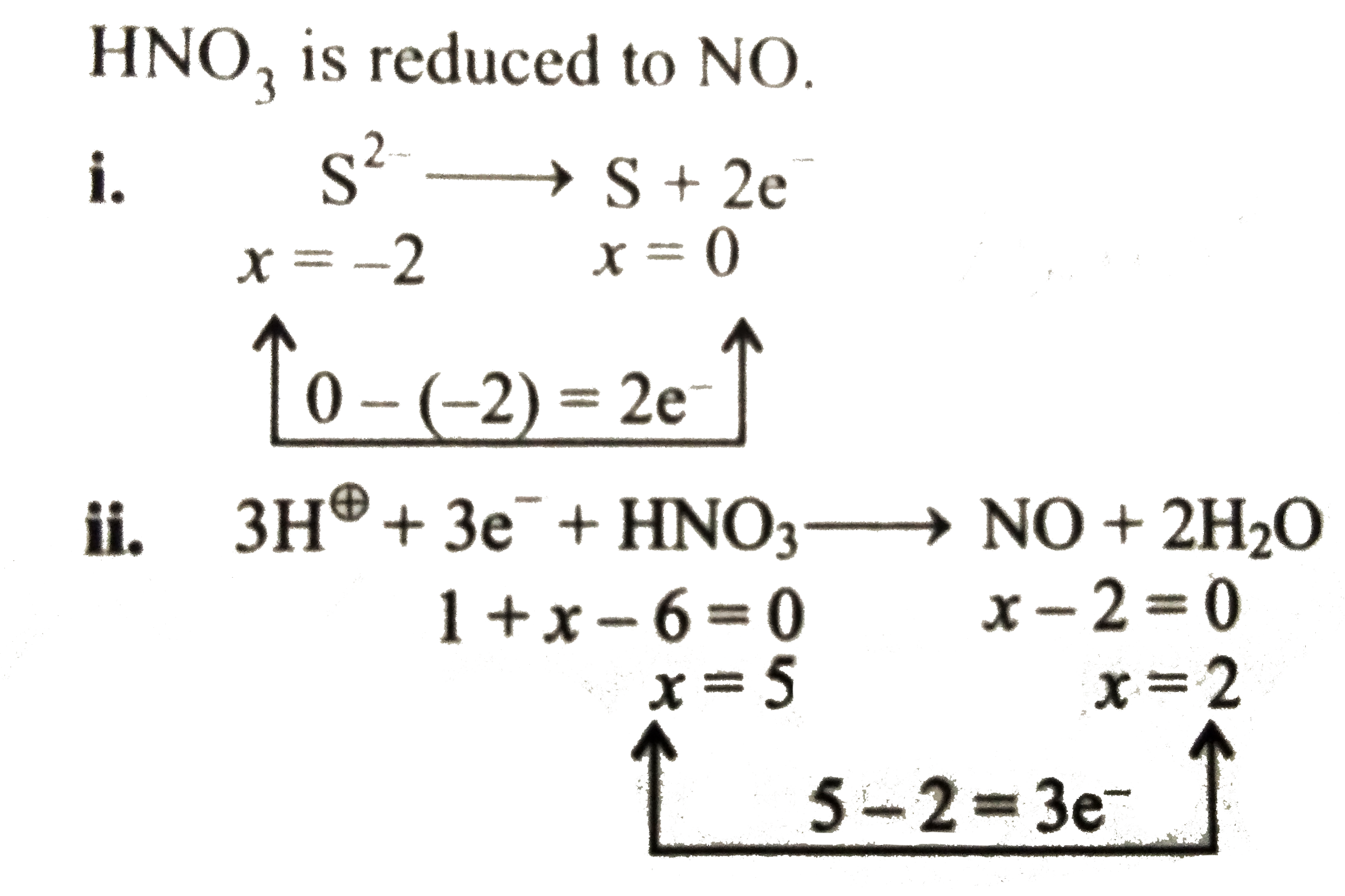 In the blank space on `LHS`, put `Cl_(2)`, since `HC_(2)O_(4)^(ө)` is oxidised, therefore `Cl_(2)` is REDUCED. i. `2e^(-)+CI_(2)rarr2Cl^(ө)`.....(i) ii. 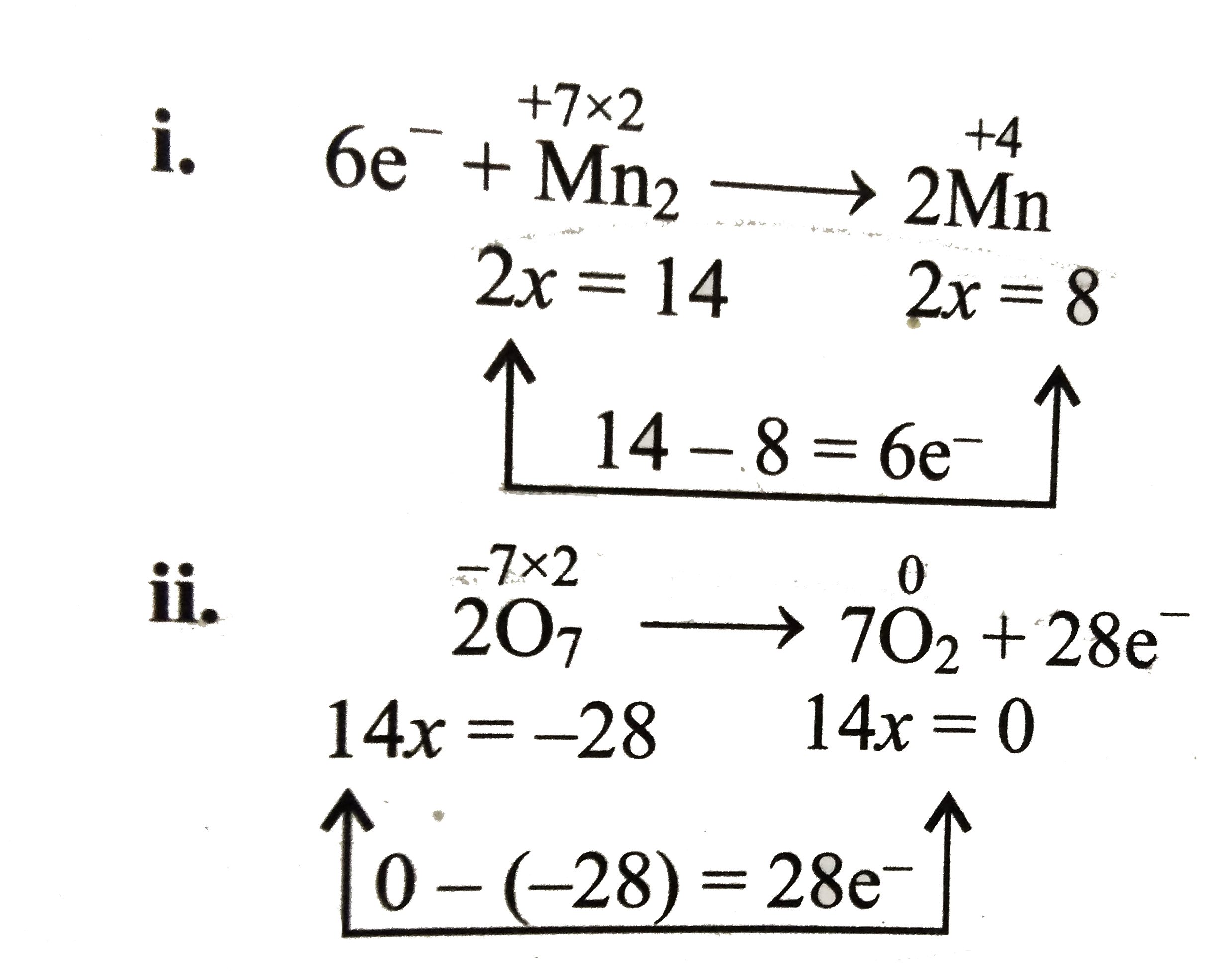 Add eqution (i) and (ii) `{:(cancel(2e^(-))+Cl_(2)rarr2Cl^(ө)),(2H_(2)O+HC_(2)O_(4)^(ө)rarr2CO_(3)^(2-)+cancel(2e^(-))+5H^(o+)),(ulbar(Cl_(2)+HC_(2)O^(ө)+2H_(2)Orarr2H_(2)Orarr2Cl^(ө)+2CO_(3)^(2-)+5H^(o+))):}` It is a balanced equation. f. Here, `HgS` (i.e., `Hg^(2+)S^(2-)`) is split into two parts `Hg^(2+)` and `S^(2-)` in which only `S^(2-)` (sulphide ion) is oxidised to `S`, whereas `Hg^(2+)` is uncharged in `(overset(+1xx2)(H_(2))overset(+2)(Hg)overset(-1xx4)(Cl_(4)))` `HNO_(3)` is reduced to `NO`. iii. Multiply equation (i) by `3` and equation (ii) by `2` and then add both the equation. `{:(3S^(2-)rarr3S+cancel(6e^(-))),(6H^(o+)+cancel(6e^(-))+2HNO_(3)rarr2NO+4H_(2)O),(ulbar(6H^(o+)+3S^(2-)+2HNO_(3)rarr3S+2NO+4H_(2))):}` It is balanced equation. iv. Now add other ions to both sides. `LHS {:[(3Hg^(2+),,,,,),(6H^(oplus),,,,) (12Cl^(ө),,,,)]:}"" RHS{:[(3Hg^(2+),,,,,),(6H^(oplus),,,,),(12Cl^(ө),,,,)]:}` Net equation is `12HCl+3HgS+2HNO_(3)rarr3H_(2)HgCl_(4)+3S+2NO+4H_(2)O` g. `overset(+7xx2)(Mn_(2))overset(-2xx7)(O_(7))rarroverset(+4)(Mn)overset(-2xx2)(O_(2))+overset(0)(O_(2))` `Mn_(2)O_(7)` is splitted into two parts `(overset(+7xx2)(Mn_(2))` and `overset(-2xx7)(O_(7)))` iii. Multiply equation (i) by `28` and equation (ii) by `6` and add them. `{:(cancel(28xx6e^(-))+28Mn_(2)^(7+)rarr56Mn^(4+)),(12O_(7)^(2-)rarr42O_(2)+cancel(28xx6e^(-))),(ulbar(28Mn_(2)^(7+)+12O_(7)^(2-)rarr56Mn^(4+)+42O_(2))):}` or `28Mn_(2)O_(7)+12Mn_(2)O_(7)rarr56MnO_(2)+42O_(2)` iv. Balance `Mn` atom except `H` and `O`. `40Mn_(2)O_(7)rarr56MnO_(2)+24MnO_(2)+42O_(2)` v. Balance `O` atom `40Mn_(2)O_(7)rarr 80MnO_(2)+42O_(2)+18O_(2)` or `2Mn_(2)O_(7)rarr4MnO_(2)+3O_(2)`. |
|
| 25. |
Balance the following equation xH_(2)S+yHNO_(3) to zNO +omegaS+H_(2)O The coefficients omega, x ,y, z" are" (1) x=3, y=2, z=2, omega=3 (2) x=2, y=2, z=3, omega=3 (3) x=3, y=3, z=2, omega=3 (4) x=3, y=2, z=3, omega=3 |
|
Answer» Solution :Step -(i) The two half reaction of the equation are: Oxidation : `H_(2)S to S` REDUCTION `NO_(3)^(-) to NO` Step (II) A. Balancing of the oxidation half reaction (a) It is balanced by adding `2H^+` on the R.H.S. `H_(2)S to S+2H^(+)` (b) For equalising charge on both sides, add two ELECTRONS on the R.H.S. of the above equation. `H_(2)S to S+2H^(+) +2e^(-) ......(i)` B. Balancing of the reduction half reaction. `NO_(3)^(-) to NO` (a) For balancing oxygen atoms, add `2H_2O` to R.H.S. `NO_(3)^(-) to NO+2H_(2)O` (b) For balancing H atoms, add `4H^+` to L.H.S. of the above equation `NO_(3)^(-)+4H^(+) to NO+2H_(2)O` (C) For balancing charge on both sides of the above equation, add `3e^-` to L.H.S. `NO_(3)^(-) + 4H^+ + 3e^- to NO+2H_(2)O .........(ii)` From (i) & (ii) we get, `H_(2)S to S+2H^(+) +2e^(-) ] xx 3` `NO_(3)^(-)+4H^(+)+3e^(-) to NO+2H_(2)O] xx 2` `2H_(2)S+8H^(+)+2NO_(3)^(-) to 3S+2NO+4H_(2)O+6H^(+)` Step (III) On cancelling the common terms, the final balanced equation becomes `3H_(2)S+2HNO_(3) to 2NO+3S+4H_(2)O` |
|
| 26. |
Balance the following equation using oxidation number method.S + HNO_(3) rarr H_(2)SO_(4) + NO_(2) + H_(2)O |
Answer» Solution :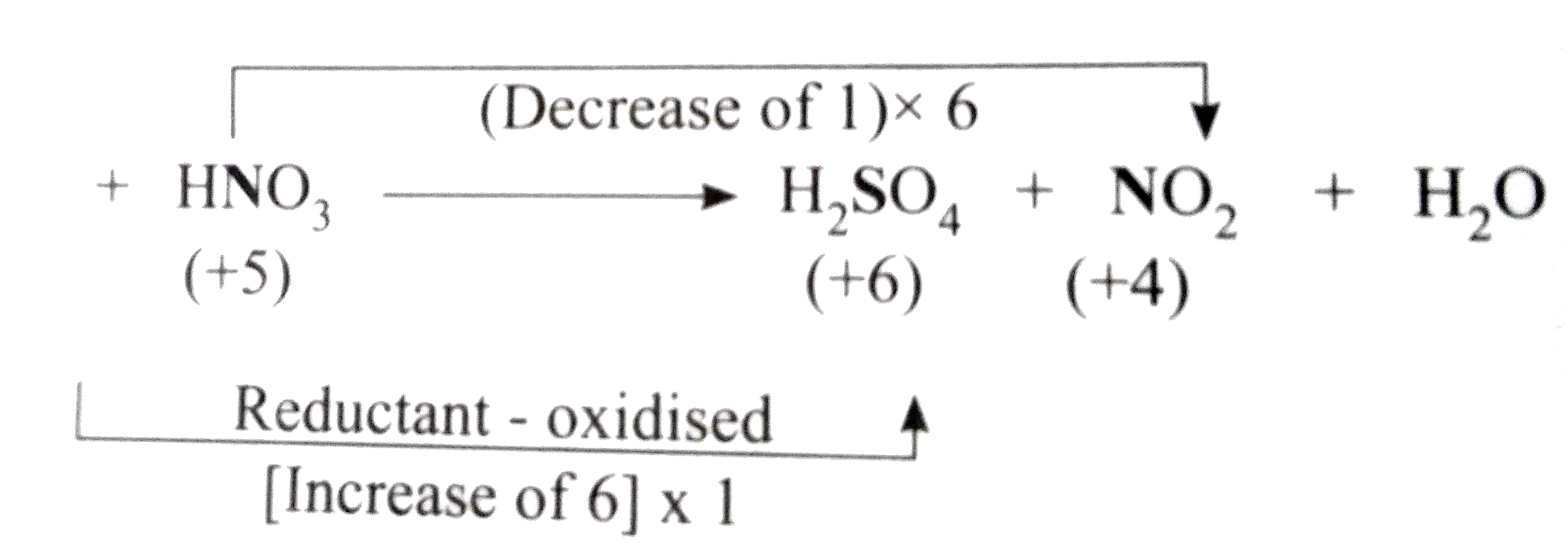 2. S + `6HNO_(3) rarr H_(2)SO_(4) + NO_(2) + H_(2)O` 3. BALANCE the equation (except O and H) S + `6HNO_(3) rarr H_(2)SO_(4) + 6NO_(2) + H_(2)O` 4. Balance O atoms by adding `2H_(2)O` S + `6HNO_(3) rarr H_(2)SO_(4) + 6NO_(2) + 2H_(2)O` |
|
| 27. |
Balance the following equation using oxidation number methodAs_(2)S_(3)+HNO_(3)+H_(2)O rarr H_(3)AsO_(4)+H_(2)SO_(4)+NO |
|
Answer» Solution : `As_(2)S_(3)+HNO_(3)+H_(2)OrarrH_(3)AsO_(4)+H_(2)SO_(4)+NO` `overset(+3)(As_(2)S_(3))+overset(+5)(HNO_(3))+H_(2)O RARR overset(+5)(H_(3)AsO_(4))+H_(2)SO_(4)+overset(+2)(NO)` 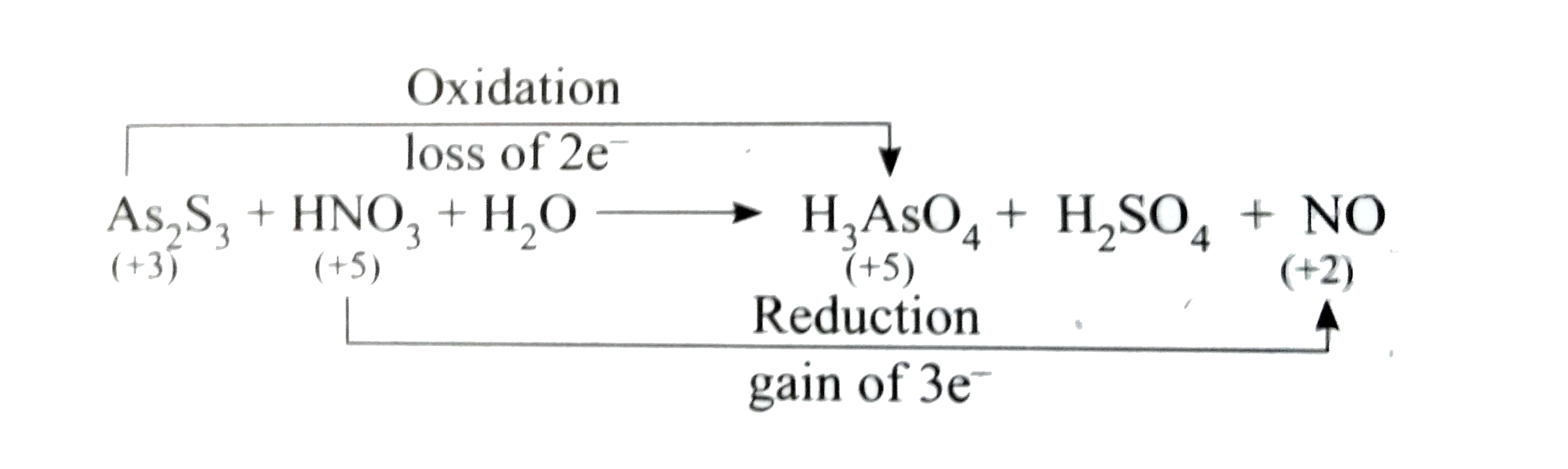 `As_(2)S_(3)rarrH_(3)AsO_(4)+2e^(-)xx3` `HNO_(3)+3e^(-)rarrNOxx2` `3As_(2)S_(3)rarr 3H_(3)AsO_(4)+cancel(6e^(-))` `3As_(2)S_(3)+2HNO_(3)rarr6H_(3)AsO_(4)+2NO` To balance oxygen and SULPHUR, `H_(2)O` and `H_(2)SO_(4)`are added. `3As_(2 S_(3) + 2HNO_(3)+H_(2)O rarr 6H_(3)AsO_(4)+2NO+H_(2)SO_(4)` `3As_(2)S_(3)+28HNO_(3)+4H_(2)O rarr 6H_(3)AsO_(4)+28NO+9H_(2)SO_(4)` |
|
| 28. |
Balance the following equation : Kl + H_(2)SO_(4) + H_(2)O_(2) to K_(2)SO_(4) + I_(2) + H_(2)O |
|
Answer» Solution :The given equation can be split into following probable partial equations. `H_(2)O_(2) to H_(2)O + O`………….(i) `Kl + H_(2)O + O to KOH + I_(2)`…….(ii) `KOH + H_(2)SO_(4) to K_(2)SO_(4) +H_(2)O`………(iii) On balancing these partial equations by hit and trial method, we GET: `H_(2)O_(2) to H_(2)O + O`........(iv) `2Kl + H_(2)O + O to 2KOH + I_(2)`......(v) `2KOH + H_(2)SO_(4) to K_(2)SO_(4) + 2H_(2)O`.......(vi) The INTERMEDIATE SPECIES O and KOH can be cancelled simply by ADDING these equations. `H_(2)O_(2) to H_(2)O + O` `2Kl + H_(2)O + O to 2KOH + I_(2)` `overset(2KOH + H_(2)SO_(4) to K_(2)SO_(4) + 2H_(2)O)underset(2Kl + H_(2)SO_(4) +H_(2)O_(2) to K_(2)SO_(4) + I_(2) + 2H_(2)O) (------------)` |
|
| 29. |
Consider the following series of reactions : Cl_(2)+2NaOH to NaCl+NaClO+H_(2)O 3NaClO to 2NaCl+NaClO_(3) 4NaClO_(3) to 3NaClO_(4)+NaCl How much Cl_(2) is reqired to prepare 122.5 g of NaClO_(4) by above sequencial reactions ? |
|
Answer» SOLUTION :The PARTIAL EQUATIONS corresponding to the probable steps of this reaction are as follows : `Cl_(2) + H_(2)O to HCl + HClO`………(i) `NaOH + HCl to NaCl + H_(2)O`…….(ii) `NaOH + HClO to NaClO + H_(2)O`……..(iii) `HClO to HCl + O`……(iv) `NaClO + O to NaClO_(3)`.........(v) On balancing these equations by hit and trial METHOD, we get `Cl_(2) + H_(2)O to HCl + HClO`.....(vi) `NaOH + HCl to NaCl + H_(2)O`......(vii) `NaOH + HClO to NaClO + H_(2)O`......(vii) `HClO to HCl + O`.....(ix) `NaClO + 2O to NaClO_(3)`.......(x) The intermediate species HCI, HClO, NaCIO, and O can be cancelled by multiplying Eq. (vi) by 3, Eq. (vii) by 5, and Eq. (ix) by 2 and adding all partial equations together. Thus, we have `[Cl_(2) + H_(2)O to HCl + HClO] xx 3` `[NaOH + HCl to NaCl + H_(2)O] xx 5` `NaOH + HClO to NaClO + H_(2)O` `[HClO to HCl + O] xx 2` `NaClO + 2O to NaClO_(3)` The final equation is `6NaOH + 3Cl_(2) to 5NaCl + NaClO_(3) + 3H_(2)O` |
|
| 30. |
Balance the following equation : KClO_(3) to KCl + O_(2) |
|
Answer» Solution :The given equation is a SIMPLE equation and can be balanced by hit and trial method. On changing the ELEMENTARY gas `O_2` into atomic form, we get `KClO_(3) to KCl + O_(2)` `KClO_(3)` contains maximum number of atoms. Let us SELECT it to start the balancing of equation. K and CI atoms are already balanced. Oxygen can be balanced by multiplying O by 3. Thus, we get: 3O` All the atoms are now balanced. In order to change the equation in molecular form, it should be multiplied by 2. This gives `2KClO_(3) to 2KCL + 6O` or `2KClO_(3) to 2KCl + 3O_(2)` This is the final balanced equation. |
|
| 31. |
Balance the following equation in basic medium. Cr(OH)_(3)+IO_(3)^(-)toCrO_(4)^(2-)+I^(-) |
|
Answer» Solution :Step 1. The GIVEN equation is `Cr(OH)_(3)+IO_(3)^(-)toCrO_(4)^(2-)+I^(-)` Step 2. WRITING the oxidation number of ATOMS, we have `overset(+3-1+2)(Cr(OH)_(3))+overset(+5-2)(IO_(3)^(-))tooverset(+6-2)(CrO_(4)^(2-))+overset(-1)(I^(-))` Obviously, Cr(OH)3 is undergoing oxidation (the O.N. of Cr is increasing from +3 to +6 ) and `IO_(3)^(-)` is undergoing reduction (the O.N. of I is decreasing from +5 to -1). Step 3. The given reaction can be split up in the following two half reactions. `Cr(OH)_(3)toCrO_(4)^(2-)` (oxidation half reaction) `IO_(3)^(-)toI^(-)` (reduction half reaction) Step 4. (a) Balancing of oxidation half reaction : (i) The atoms other than H and O, i.e., Cr are already balanced. (ii) The given reaction proceeds in basic medium. Therefore, O atoms should be balanced by adding `OH^(-)`. They can be balanced as shown below. `Cr(OH)_(3)+OH^(-)toCrO_(4)^(2-)` The right hand side is deficient in 4H atoms. H atoms can be balanced by adding four `H_(2)O` molecules on the right and four more `OH^(-)` on the left as shown below. `Cr(OH)_(3)+OH^(-)+4HO^(-)toCrO_(4)^(2-)+4H_(2)O` or `Cr(HO)_(3)+5OH^(-)toCrO_(4)^(2-)+4H_(2)O` (iii) The right hand side is deficient in three negative CHARGES. Therefore, charge can be balanced by adding three electrons on the right. `Cr(OH)_(3)+5OH^(-)toCrO_(4)^(2-)+4H_(2)O+3e^(-)` This is the balanced oxidation half reaction. (b) Balancing of reduction half reaction (i) The iodine atoms are already balanced. (ii) Oxygen atoms can be balanced by adding three `OH^(-)` ions on the right. The left hand side is deficient in three H atoms. Therefore, adding three `H_(2)O` molecules on the left and three `OH^(-)` on the right, we have `IO_(3)^(-)+3H_(2)OtoI^(-)+3OH^(-)+3OH^(-)` `IO_(3)^(-)+3H_(2)OtoI^(-)+6OH^(-)` (iii) The charge can be balanced by adding 6 electrons on the left. `IO_(3)^(-)+3H_(2)OtoI^(-)+6OH^(-)` This is the balanced reduction half reaction. Step 5. The oxidation half reaction contains 3 electrons on the right while the reduction half reaction contains 6 electrons on the left. Electrons can be CANCELLED by multiplying the oxidation half reaction by 2 and adding it to the reduction half reaction as shown below. `{:([Cr(OH)_(3)+5OH^(-)toCrO_(4)^(2-)+4H_(2)O+3e^(-)]xx2),(IO_(3)^(-)+3H_(2)O+6e^(-)toI^(-)+6OH^(-)),(bar(2Cr(OH)_(3)+IO_(3)^(-)+100H^(-)+3H_(2)Oto2CrO_(4)^(2-)+I^(-)+6OH^(-)+8H_(2)O)),(or2Cr(OH)_(3)+IO_(3)^(-)+4OH^(-)to2CrO_(4)^(2-)+I^(-)+5H_(2)O):}` This is the final balanced equation in basic medium. |
|
| 32. |
Balance the following equation in basic medium by ion electtron method and oxidation number method and identify th oxidsing agent and the reducing agent (a) P_(4)(s)+OH^(-)(aq)rarrPH(3)(g)+H_(2)PO^(-)(aq) (b) N_(2)H_(4)(l)+CIO_(3)^(-)(aq)rarrNO(g)+CI^(-) (c )CI_(2)O_(7)(g)+H_(2)O_(2)(aq)rarrCIO_(2)^(-)(aq)+O_(2)(g)+H^(+) |
Answer» Solution : `P_(4)` acts both as an oxidising as well as a REDUCING agent Oxidation number method total decrease in O.N of `P_(4)` in `PH_(3)=3xx4=12` total increase in O.N of `P_(4)` In `H_(2)PO_(2)^(-)=1xx4=4` therefore to balance increase / decreases in O.N multiply `PH_(3)` by 1 and `H_(2)PO_(2)^(-)` by 3 we have `P_(4)(s)+OH^(-)(aq)rarrPH_(3)(g)+3H_(2)PO_(2)^(-)` (aq) To balance O atoms multiply `OH^(-)` by 6 we have `P_(4)(s)+6 OH^(-)(aq)rarrPH_(3)(g)(g)+3H_(2)PO_(2)^(-)(aq)` To balance H atoms add `3H_(2)O` to L.H.S and `3OH^(-)` to the R.H.S we have `P_(4)(s)+6OH^(-)(aq)+3 H_(2)O(l)rarrPH_(3)(g)+3H_(2)PO_(2)^(-)(aq)+3OH^(-)(aq)` To `P_(4)(s)+3OH^(-)(aq)+H_(2)O(l)rarrPH_(3)(g)+3H_(2)PO_(2)^(-)(aq)` thus equ (i) represent the correct balanced equation Ion electron method split the GIVEN redox reaction in to two half reaction (ii) and (iii) and balance them s described below To CANCEL out ELETRONS multiply Eq (iii) by 3 and add it to q we have thus eq (vi) represetns the correct balanced equation  oxidation number method total increase in O.N of `N=2xx4=8` total decrease in O.N of CI `=1xx6=6` therefore to balance increase / decrease in O.N multiply `N_(2)H_(4)` by 3 and `CIO_(3)^(-)` by 4 we have`3N_(2)H_(4)(l)+4CIO_(3)^(-)(aq)rarrNO(g)+CI^(-)(aq)` oxdation number method total increase in O.N of `N=2xx4=8` total decrease in O. Nof `CI=1xx6=6` therefore to balance increase / decrease in O.N mutiply `N_(2)H_(4)` by 3 and `CIO_(3)^(-)` by 4 have `3N_(2)H_(54)(l)+4CIO_(3)^(-)rarrNO(g)+CI^(-)(aq)` to balance N and CI atoms multiply NO by 6 and `CI^(-)`by 4 we have `3N_(2)H_(4)(l)+4 CIO_(3)^(-)(aq)rarr NO(g)+4CI^(-)(aq)+6H_(2)O(l)` H atom get automatically balanced and thus eq (i) represent the correct balanced equation Iron electron method thus eq (iii) represent the correct balacned reductional half equation `3N_(2)H_(4)(l)+4CIO_(3)^(-)rarr 6NO(g)+45CI^(-)(aq)+6H_(2)(l)` Thuseq (iv) represetn the correct balanced equation  thus `CI_(2)O_(7)` (g) acts an oixdising agent while `H_(2)O_(2)` (aq) as thereducing agent oxidation number method Total decrease in O.N of 1 `CI_(2)O_(7)=4xx2=8`total increase in O.N of `H_(2)O_(2)=2xx1=2` `therefore`To balanced increase / decrease in O.N multiply `H_(2)O_(2)` and `O_(2)` by 4 we have `CI_(2)O_(7)(g)+4H_(2)O_(2)(aq)rarrCIO_(2)(aq)+4O_(2)(g)` to balance CI atoms multiply `CIO_(2)^(-)` by 2 we have `CI_(2)O_(7)(g)+4 H_(2)O(aq)rarr2CIO_(2)^(-)(aq)+45O_(2)(g)` to balance H atoms add `2H_(2)O (g)+2 OH^(-)(aq)rarr2cIO_(2)^(-)(aq)+4O_(2)(g)+5H_(2)O` on electron method oxidation half reaction `H_(2)^(-1)O_(2)(aq)rarrO_(2)(g)` balancecharge by adding `2OH^(-)ions H_(2)O_(2)(aq)+2OH^(-)(aq)rarrO_(2)(g)+2e^(-)` balance O atoms by adding`2H_(2)O, H_(2)O_(2)(aq)+2 OH^(-)(aq)rarrO_(2)(g)+2H_(2)(l)+2e^(-)` reduction half rection `CI_(2)O_(7)(g)rarCIO_(2)^(-)(aq)` balance O atom s by adding `3 H_(2)O(l) +8e^(-)rarr2CIO_(2)^(-)(aq)+6OH^(-)(aq)` to cancel out electrons multiply eq (i) by 4 and add it to eq (ii) we have `4H_(2)O_(2)(aq)+8OH^(-)(aq)+CI_(2)O_(7)(g)+3H_(2)O(l)rarr2CIO_(2)(aq)+6OH^(-)(aq)+6OH^(-)(aq)+4O_(2)(g)+8H_(2)O(l)` `CI_(2)O_(7)g)+4H_(2)(aq)+2OH^(-)rarr2CIO_(2)+4O_(2)(aq)+4O_(2)+5H_(2)O(l)` |
|
| 33. |
Balance the following equation in basic medium by ion-electron method and oxidation number methods & Identify the oxidising agent of & the reducing agent. CI_(2)O_(7)(g)+H_(2)O_(2)(aq)toCIO(2)^(-)(aq)+O_(2)(g)+H^(+) |
|
Answer» Solution :Ion -electron method : Oxidation reaction: `H_(2)O_(2)(aq)toO_(2)(g)` Adding `2OH^(-)`ions to the left hand side in ORDER to balance H and O-atoms on both sides ,we have `H_(2)O_(2)(aq)+2OH^(-)(aq)to2H_(2)O(l)+O_(2)(g)` Balancing charge on both sides ,we have `H_(2)O_(2)(aq)+2OH^(-)(aq)to2H_(2)O(l)+O_(2)(g)+2e` Reduction reactions : `CI_(2)O_(7)(g)toCIO_(2)^(-)` Balancing CI-atoms ,we have `CI_(2)O_(7)(g)to2CIO_(2)^(-)(aq)` To balancing O-atoms we add `3OH^(-)` to the right hand side : `CI_(2)O_(7)(g)to2CIO_(2)^(-)(aq)+3OH^(-)(aq)`. To balance H- atoms ,we add `3H_(2)O` tothe left hand side and `3OH^(-)` to the right hand side . `CI_(2)O_(7)(g)+3H_(2)O(l)to2CIO_(2)^(-)(aq) +6OH^(-)(aq)` Balancing charge on both sides we,have `CI_(2)O_(7)(g)+3H_(2)O(l)+8eto2CIO_(2)^(-)(aq)+6H^(-)(aq)` Multiplying equation (1) by 4 and then adding it to equation (2),we have `CI_(2)O_(7) (g)+4H_(2)O_(2)(aq)+2OH^(-)(aq)to2CIO_(2)^(-)(aq)+5H_(2)O(l)+4O_(2)(g)` This is the balanced equation for the reaction. Oxidation number method : `overset(+7)(C)I_(2)O_(7)(g)+overset(-1)H_(2)O_(2)(aq)tooverset(+3)CIO_(2)^(-)(aq) +overset(0)O_(2)(g)` In the reaction toal decrease in oxidation number for 2CI atoms is `2xx4=8 ` unit and total increases in oxidation number for 2O atoms is 2xx1=3 unit So ,the ratio of increases to decreases in oxidation number is 2:8=1:4 To balance the increase and decrease in oxdation number ,we MULTIPLY `H_(2)O_(2)`by 4. `CI_(2)O_(7)(g)+4H_(2)O_(2)(aq) toCIO_(2)^(-)(aq)+O_(2)(g)` Balancing CI- atoms ,we have `CI_(2)O_(7)(g)+4H_(2)O_(2)(aq) to2CIO_(2)^(-)(aq)+O_(2)(g)` To balancing H- atoms ,we add `2OH^(-)` to the left hand side and `5H_(2)O` to the right hand side. `CI_(2)O_(7)(g)+4H_(2)O_(2)(aq)+2OH^(-)(aq) to 2CIO_(2)^(-)(aq)+5H_(2)O(l)+4O_(2)(g)` balancing o-atoms ,we have `CI_(2)O_(7)(g)+4H_(2)O_(2)(aq)to2CIO_(2)^(-)(aq)+5H_(2)O(l)+4O_(2)(g)` This is the balanced equation for the reaction. |
|
| 34. |
Balance the following equation in basic medium by ion-electron method and oxidation number methods & Identify the oxidising agent of & the reducing agent. N_(2)H_(4)(l)+CIO_(3)^(-)(aq)toNO(g)+CI^(-)(g) |
|
Answer» SOLUTION :Ion -electron : Oxidation REACTION `N_(2)H_(4)(l)to2NO(g)` Balancing N- atoms on both sides ,we have `N_(2)H_(4)(l)to2NO(g)` To balance H and O -atoms we ,add `8OH^(-)` to the left hand side and `6H_(2)O` to the RIGHT handside `N_(2)H_(4)(l)+8OH^(-)(aq)to2NO(g)+6H_(2)O(l)` To balance the change ,we add 8 electron to the right side `N_(2)H_(4)(l)+8OH^(-)(aq)to2NO(g)+6H_(2)O(l)+8e` Reduction reaction : `CIO_(3)^(-)(aq)toCI^(-)(aq)` Balancing O-atoms and charge on both sides we have `3N_(2)H_(4)(l)+4CIO_(3)^(-)(aq)to6NO(g)+4CI^(-)(aq)+6H_(2)O(l)` This is the balanced equation for the reaction. Oxidation number method : `overset(-2)N_(2)H_(4)(l)+overset(=5)CIO_(3)^(-)(aq)overset(+2)NO(g)+overset(-1)CI^(-)(aq)` In the reacation ,total oxidation number for two N- atoms increases by 2xx4=8 unit and total oxidation number of CI -atom decreases by 6 unit So ,the ratio of increase to decrease in oxidation number =8:6=4 To balance the increase and decrease in oxidation number ,we multiply `N_(2)H_(4)by2and CIO_(3)^(-)BY4.` `3N_(2)H_(4)(l)+4CIO_(3)^(-)(aq)to6NO(g)+4CI^(-)(aq)` To balance H and O-atoms on both sides ,we add `6H_(2)O`to the right hand side. `3N_(2)H_(4)(l)+4CIO_(3)^(-)(aq)to6NO(g)+4CI^(-)(Aq)+6H_(2)O(l)` This is the balanced equation for the reaction. |
|
| 35. |
Balance the following equation in basic medium by ion-electron method and oxidation number methods & Identify the oxidising agent of & the reducing agent. P_(4)(s)+OH^(-)(aq)toPH_(3)(g)+H_(2)PO_(2)^(-)(aq) |
|
Answer» Solution :Ion-electron method Oxidantion reaction : `P_(4)(s)toH_(2)PO_(2)^(-)(aq)` Balancing P atoms on both sides, we have `P_(4)(s)toH_(2)PO_(2)^(-)(aq)` Balancing H and O atoms on both sides ,we have `P_(4)(s)+8OH^(-)(aq)to4H_(2)PO_(2)^(-)(aq)` `P_(4)(s)+8OH^(-)(aq)to4H_(2)PO_(2)^(-)(aq)+4E` Reduction reaction : `P_(4)(s)toPH_(3)(g)` Balancing P-atoms on both sides ,we have `P_(4) (s)toPH_(3)(g)` Balancing H- atoms and then charge on both sides `P_(4)(s)+12H_(2)O(l)+12eto4Ph_(3)(g)+12OJ^(-)(aq)` MULTIPLYING equation (1) by (3) and then added equation (2),we have `4P_(4)(s)+12H_(2)o(l)+12OH^(-)(aq)to4PH_(3)(g)+12H_(2)O_(2)^(-)(aq)` i.e., `P_(4)(s)+3H_(2)O(l)+3OH^(-)(aq)toPH_(3)(g)+3H_(2)PO_(2)^(-)(aq)` This is the BALANCED equation for the reaction . Oxidation number method : `overset(0)P_(4)(s)+OH^(-)(aq)tooverset(-3)(P)H_(3)(g)+H_(2)overset(+1)(P)O_(2)^(-)(aq)` In the reaction `P_(4)`acts both as an OXIDANT as well as a reductant because the oxidation numer of P decreases as well as increases In the change `PtoPH_(3)` ,the oxidation number of P decrease by 3 units and in the change `PtoH_(2)PO_(2)^(-)`,the oxidation number P increases by 1 unit . To balance the increase and the decrease in oxidation numbers, three P-atoms are required for oxidation and one P-atomsis requiredfor reduction .In the reduction ,oxidation of P produces `H_(2)PO_(2)^(-)` and reduction of P produces `PH_(3)`Therefore ,three `H_(2)PO_(2)^(-)`inos are produced for the oxidation of three P-atoms and one `PH_(3)` molecule is produced for the reduction of one P-atoms .So we can write `P_(4)(s)+OH^(-)(aq)toPH_(3)(g)+3H_(2)PO_(2)^(-)(aq)` To balance the O -atoms on both sides we add 5OH- to the left hand side . `P_(4)(s)+6OH^(-)(aq)toPH_(3)(g)+3H_(2)PO_(2)^(-)(aq)` To balance the O- atoms on both sides we add `3H_(2)O`to the left hand side and `3OH^(-)` to the right hand side . `P_(4)+3H_(2)O(l)+6OH^(-)(aq)toPH_(3)(g)+3H_(2)PO_(2)^(-)(aq)+3OH^(-)(aq)` i.e., `P_(4)(s)+3H_(2)O(l)+3OH^(-)(aq)toPH_(3)(g)+3H_(2)PO_(2)^(-)(aq)` |
|
| 36. |
Balance the following equation in acidic medium by boht oxidation numbr and ion electron methods nad identify the oxidatns and the reductants (i) MnO_(4)^(-)(aq)+C_(2)H_(2)O_(4)(aq) to Mn^(2+)(aq)+CO_(2)(g)+H_(2)O(l) (ii) H_(2)S(aq)+CI_(2)(g) to S(s)+CI^(-)(aq) (iii)MnO_(4)^(-)(aq)+C_(2)H_(5)OH(aq) to Mn^(2+)(aq)+CH_(3)COOH(aq) (iv)Bi(s)+NO_(3)^(-)(aq) to Bi^(3+)(aq)+NO_(2)(g) (v)Cr_(2)O_(7)^(2-)(aq)+c_(2)H_(4)O(aq)to Cr^(3+)(aq)+C_(2)H_(4)O_(2)(aq) (vi)MnO_(4)^(-)(q)+Br^(-)(aq) to Mn^(2+)(q)+Br_(2)(aq) (vii)Cu(Aq)+NO_(3)^(-)(aq) to Cu^(2+)(aq)+NO_(2)(g) (viii)H_(2)S(g)+Fe^(3+)(aq) to Fe^(2+)(aq)+S(s)+H^(+)(aq) (ix)I^(-)(aq)+O_(2)(g)+H_(2)O(l) to I_(2)(aq)+(OH)^(-)(aq) (x)Zn(s)+NO_(3)^(-)(aq)+H^(+)(aq) to Zn^(2)(aq)+N_(2)O(g)+H_(2)O(l) (xi) As(s)+NO_(3)^(-)(aq)+H^(+)(aq) to AsO_(3)^(3-)(aq)+NO_(2)(g)+H_(2)O(l) (xii)MnO_(4)^(-)(aq)+Fe^(2+)(aq) to Mn^(2+)(aq)+Fe^(3)(aq) (xiii)S+HNO_(3) to SO_(2)+NO_(2)+H_(2)O |
|
Answer» Solution :(i)`2MnO_(4)^(-)(AQ)+6 H^(+)(aq)+5C_(2)H_(2)O_(4)(aq)rarr2Mn^(2+)(aq)+10CO_(2)(g)+8H_(2)O(l)` (ii) `H_(2)S(aq)+CCI^(-)(aq)+2H^(+)(aq)` (iii)`4MnO_(4)^(-)(aq)+5C_(2)H_(5)OH(aQ)+12H^(+)(aq)rarr4Mn^(2+)+5CH_(3)COOH(aq)+11H_(2)O(l)` (iv)`Bi(s)+3NO_(3)^(-)(aq)+3C_(2)H_(4)(aq)+8H^(+)(aq)rarrBi^(3+)(aq)+3NO_(2)(g)+2H_(2)O(l)` `(v)Cr_(2)O_(7)^(2-)(aq)+3C_(2)H_(4)O(aq)+8H^(+)(aq)rarr2 Cr^(3+)(aq)+3 C_(2)H_(4)O_(2)(aq)+4H_(2)O(l)` (vi) `2MnO_(4)^(-)(aq)+10 Br^(-)(aq)+16 H^(+)(aq)rarr2Mn^(2+)(aq)+5Br_(2)(aq)+8H_(2)O(l)` (vii)`Cu(s)+2NO_(3)^(-)(aq)rarrCu^(2+)(aQ)+2NO_(2)(g)+2H_(2)O(l)` (viii)`H_(2)S(g)+2Fe^(3+)(aQ)rarr2Fe^(2+)(aq)+S(s)+2H^(+)(aq)` (ix)`5I^(-)(aQ)+IO_(3)^(-)(aq)+6H^(+)(aq)rarr3I_(2)(aQ)+3H_(2)(l)` (x)`4I^(-)(aQ)+O_(2)(g)+2H_(2)O(l)rarr2I_(2)(aq)+4OH^(-)(aq)` (XII)`4Sn(s)+2NO_(3)^(-)(aq)+10H^(+)(aq)rarr4Sn^(2+)+NH_(4)^(+)(aq)+3H_(2)O(l)` (XIII)`3Cu(s)+2NO_(3)^(-)(aq)+58 H^(+)(aq)rarr3Cu^(2+)(aq)+2NO(g)+5H_(2)O(l)` (xv)`Sn(s)+4NO_(3)^(-)(aq)+2H^(+)(aq)rarrSnO_(3)^(2-)(aq)+4NO_(2)(g)+5H_(2)O(l)` (xvi)As`(s)+5NO_(3)^(-)(aq)+2H^(+)(aq)rarrAsO_(4)^(3-)(aq)+5NO_(2)(g)+H_(2)O(l)` (xviii)`MnO_(4)^(-)(aq)+5Fe^(2+)(aq)+8H^(+)(aq)(rarrMn^(+)(aq)+5Fe^(3+)(aq)+4H_(2)O(l)` (xix)`S+4HNO_(3)rarrSO_(22)+4NO_(2)+2H_(2)O` |
|
| 37. |
Balance the following equation in basic medium by both oxidation number and ion electron method identify the reducatants and the oxidants (i) P_(4)NaOH+H_(2)O to PH_(3)+3NaH_(2)PO_(2) (ii)N_(2)H_(4)(g)+CIO_(3)^(-)(Aq) to NO(g)+CI^(-)(aq) (iii)CI_(2)O_(7)(g)+H_(2)O_(2)(aq) to CIO_(2)^(-)(aq)+O_(2)(g) (iv) Cr(OH)_(4)^(-)(aq)+H_(2)O(aq)to H_(2)O_(2)(aq) to CrO_(4)^(2-)(aq)+H_(2)O(l) (v)Zn(s)+NO_(3)^(-)(aq) to Zn^(2+)(aq)+NH_(4)^(+)(aq) (vi)AI(s)+NO_(3)^(-)(aq) to AI(OH)_(4)^(-)(aq)+NH_(3)(g) (vii)PbO_(2)(s)+CI^(-)(aq) to Pb(OH)_(3)^(-)(aq)+CIO^(-)(aq) viii)Fe(OH)_(3)(aq)+H_(2)O_(2)to Bi(s)+SnO_(3)^(2-)(aq) (ix) Bi(OH)_(3)(s)+SnO_(21)^(2-)(aq) to Bi(s)+SnO_(3)^(2-)(aq) (x)Cr (S)+CIO_(4)^(-)(aq) to Cr(OH)_(3)(s)+CIO_(3)(aq) |
|
Answer» Solution :(i)`P_(4)(s)+3NaOH(AQ)+3H_(2)O(l)rarrPH_(3)(g)+3 NaH_(2)PO_(2)(aq)` (ii)` 3N_(2)H_(4)(g)+4CIO_(3)^(-)(aq)rarr6NO(g)+4CI^(-)(aq)+6H_(2)O(l)` (iii)`CI_(2)O_(7)(g)+4H_(2)O_(2)(aq)+3H_(2)O_(2)(aq)rarr2CI_(2)^(-)(aq)+4O_(2)(g)+5H_(2)O(l)` (iv)`2cr(OH)_(4)^(-)(aq)+2OH^(-)(aq)+3H_(2)O_(2)(aq)rarr2CrO_(4)^(-)(aq)+4 O_(2)(g)+5H_(2)O` `(v)4Zn(s)+3NO_(3)^(3)(aq)+7H_(2)O(l)rarr4Zn^(2+)(aq)+NH_(4)^(+)(aq)+10 OH^(-)(aq)` (vii)`PbO_(2)(s)+CI^(-)(aq)+H_(2)O(l)+OH^(+)(aq)rarr8AI(OH)_(4)^(-)(aq)+3NH+(3)(g)` (VIII)`2BI(OH)_(3)(s)3SnO_(2)^(-)(aq)rarr2Bi(s)+3SnO_(3)^(2-)(aq)+3H_(2)O(l)` (ix)`2Bi(OH)_(3)(s)+3SnO_(2)^(2-)(aq)rarr2Bi(s)+3SnO_(3)^(2-)(aq)+3H_(2)O(l)` (x)`2Cr(s)+3CIO_(4)^(-)(aq)+3H_(2)Orarr2Cr(OH)_(3)(s)+3CIO_(3)^(-)(aq)` |
|
| 38. |
Balance the following equation Cr_(2)O_(7)^(2-)+C_(2)O_(4)^(2-)+H^(+) to Cr^(3+)+CO_(2)+4H_(2)O and determine the coefficient for H^(+) ion in balanced equation. |
|
Answer» 14 |
|
| 39. |
Balance the following equation by oxidation number method.MnO_(4)^(-)+Fe^(2+)rarrMn^(2+)+Fe^(3+) (acidic medium) |
Answer» Solution :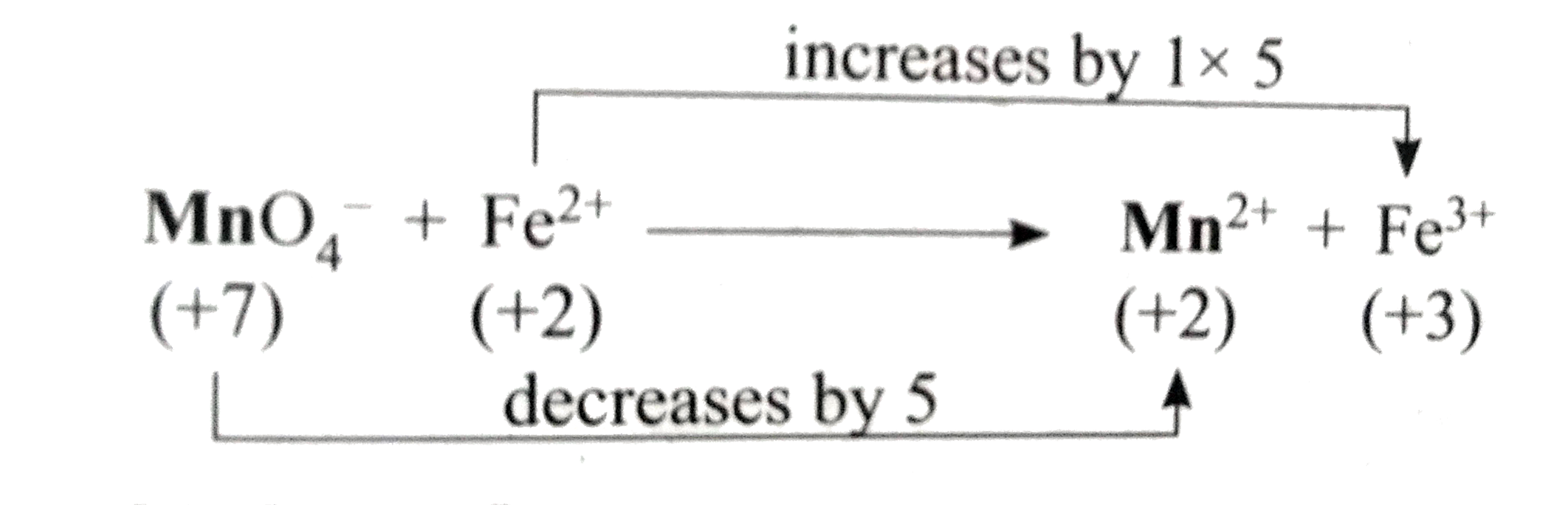 To balance O and H atoms, H2O and `H^(+)` are added. `MnO_(4)^(-) + 5Fe^(2+) + 8H^(+) rarr 5Fe^(3+) + MN^(2+) + 4H_(2)O` |
|
| 40. |
Balance the following equation by oxidation number method.KMNO_(4)+HClrarrKCl+MnCl_(2)+H_(2)O+Cl_(2) |
Answer» SOLUTION :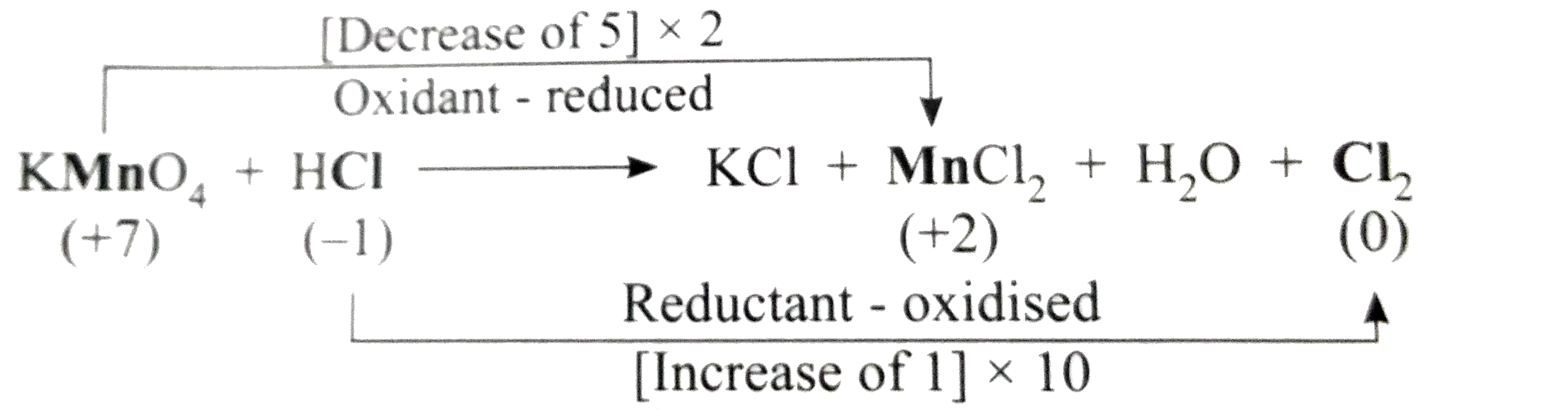 (ii) `2KMnO_(4)` + 10HC1 `rarr` KCl + `MnCl_(2) + H_(2)O + Cl_(2)` (iii) Balance the equation atomically (except O and H). `2KMnO_(4) `+ 10HCl `rarr`2KCl + `2MnCl_(2) + H_(2)O + Cl_(2)` (iv) Balance chlorine atoms by ADDING HCl and MULTIPLYING `Cl_(2)` by 5. `2KMnO_(4)` + 16HCl to 2KCl + `2MnCl_(2) + H_(2)O + 5Cl_(2)` (v) To balance O and H, `H_(2)O` is MULTIPLIED by 8. `2KMnO_(4)` + 16HCl rarr 2KCl + `2MnCl_(2) + 8H_(2)O + 5Cl_(2)` . |
|
| 41. |
Balance the following equation by oxidation number method . (i)Zn+HNOrarrZn(NO_(3))_(2)+NO+H_(2)O (ii) MnO_(4)^(-)+Fe^(2+)rarrMn^(2+)+Fe^(3+) (iii) MnO_(2)+HCIrarrMnCI_(2)+CI_(2)+CI_(2)+H_(2)O (iv) I_(2)+HNO_(3)rarrHIO_(3)+NO_(2)+H_(2)O |
|
Answer» (ii) `MnO_(4)^(-)+5Fe^2++8H^(+)rarrMn^(2+)+5Fe^(3+)+4H_(2)O` (iii) `MnO_(2)+ 4HCI rarr MnCI_(2)+2H_(2)+CI_(2)` (iv) `I_(2)+10 HNO_(3) rarr 10 HNO_(3) rarr 2HIO_(3) rarr 2HIO_(3)+10NO_(2)+4H_(2)O` |
|
| 42. |
Balance the following equation by oxidation number method. KMnO_(4)+H_(2)SO_(4)+H_(2)C_(2)O_(4)toK_(2)SO_(4)+MnSO_(4)+CO_(2)+H_(2)O |
|
Answer» Solution :Step 1. The given equation is `KMnO_(4)+H_(2)SO_(4)+H_(2)C_(2)O_(4)toK_(2)SO_(4)+MnSO_(4)+CO_(2)+H_(2)O` WRITING the OXIDATION numbers of all atoms, we have `overset(+1+7-2)(KMnO_(4))+overset(+1+6-2)(H_(2)SO_(4))+overset(+1+3-2)(H_(2)C_(2)O_(4))tooverset(+1+6-2)(K_(2)SO_(4))+overset(+2+6-2)(MnSO_(4))+overset(+4-2)(CO_(2))+overset(+1-2)(H_(2)O)` Step 3 : The atoms showing change in oxidation number are Mn (from + 7 to + 2) and C (from +3 to +4). Thus, `KMnO_(4)` is the oxidising AGENT and `H_(2)C_(2)O_(4)` is the reducing agent. Step 4. The atoms of Mn are equal on both sides. In order to equalise the atoms of `C,CO_(2)` should be multiplied by 2. Therefore, we have `KMnO_(4)toH_(2)SO_(4)+H_(2)C_(2)O_(4)toK_(2)SO_(4)+MnSO_(4)+2CO_(2)+H_(2)O` Step 5. In `KMnO_(4)`, an atom of Mn should gain 5 electrons to decrease its oxidation number from +7 to +2, and in `H_(2)C_(2)O_(4)` each atom of C should lose one electron to increase its oxidation state from +3 to +4.Therefore, `underset(5e^(-))underset(uarr)(KMnO_(4))+H_(2)SO_(4)+underset(1e^(-))underset(darr)(H_(2)C_(2)O_(4))toK_(2)SO_(4)+2MnSO_(4)+2CO_(2)+H_(2)O` Total number of electrons gained by 1 atom of Mn = 5. Total number of electrons lost by 2 atoms of `C=1xx2=2`. Step 6.In order to equalise the total electrons gained and total electrons lost, `KMnO_(4)` should be multiplied by 2 and `H_(2)C_(2)O_(4)` by 5. Hence, the coefficient for Mn is 2 and that for C is 5. Step 7. Multiplying KMnO4 and MnSO4 by coefficient 2 and multiplying `H_(2)C_(2)O_(4)` and `CO_(2)` by coefficient 5, we have `2KMnO_(4)+H_(2)SO_(4)+5H_(2)C_(2)O_(4)toK_(2)SO_(4)+2MnSO_(4)+10CO_(2)+H_(2)O` Balancing the above equation with respect to atoms other than H and O, we have `2KMnO_(4)+3H_(2)SO_(4)+5H_(2)C_(2)O_(4)toK_(2)SO_(4)+2MnSO_(4)+10CO_(2)+H_(2)O` On balancing H and 0, we get the final balanced equation. `2KMnO_(4)+3H_(2)SO_(4)+5H_(2)C_(2)O_(4)toK_(2)SO_(4)+2MnSO_(4)+10CO_(2)+8H_(2)O` |
|
| 43. |
Balance the following equation by oxidation number method.KMnO_(4)+FeSO_(4)+H_(2)SO_(4)rarrK_(2)SO_(4)+MnSO_(4)+Fe_2(SO_(4))_(3)+H_(2)O |
Answer» Solution :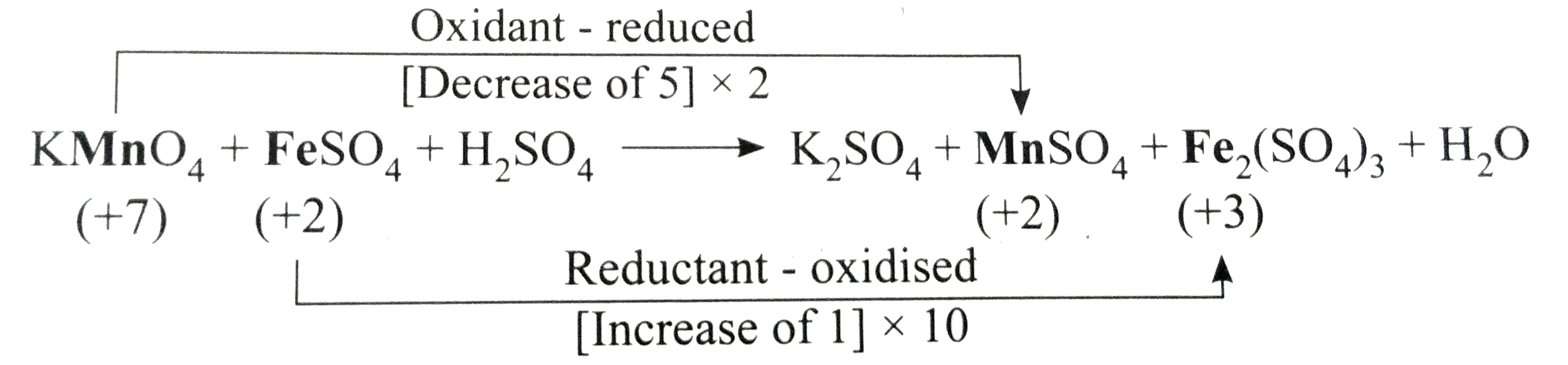 (ii) `2KMnO_(4) + 10FeSO_(4) + H_(2)SO_(4) rarr K_(2)SO_(4) + MnSO_(4) + Fe_(2)(SO_(4))_(3) + H_(2)O`. (III) Balance the equation atomically (except O and H) and sulphate IONS. `2KMnO_(4) + 10FeSO_(4) + 8H_(2)SO_(4) rarr K_(2)SO_(4) + 2MnSO_(4) + 5Fe_(2)(SO_(4))_(3) + H_(2)O` (iv) Balance O atoms by multiplying `H_(2)O` by 8. `2KMnO_(4) + 10FeSO_(4) + 8H_(2)SO_(4) rarr K_(2)SO_(4) + 2MnSO_(4) + 5Fe_(2)(SO_(4))_(3) + 8H_(2)O` |
|
| 44. |
Balance the following equation by oxidation number method: K_(2)Cr_(2)O_(7)+FeSO_(4)+H_(2)SO_(4) to Cr_(2)(SO_(4))_(3)+Fe_(2)(SO_(4))+K_(2)SO_(4)+H_(2)O |
|
Answer» `Cr_(2)O_(7)^(2-)+14H^(+)+6Fe^(2+)rarr 6 Fe^(3+)+2Cr^(3+)+7H_(2)O` In ionic form : `2K^(+)+Cr_(2)O_(7)^(2-)+14H^(+)+7SO_(4)^(2-)+6Fe^(2+)+6SO_(4)^(2-)rarr 6 Fe^(3+)+9SO_(4)^(2-)+2Cr^(3+)+3SO_(4)^(2-)+2K^(+)+SO_(4)^(2-)+7H_(2)O` Eliminating the common SPECIES : `Cr_(2)O_(7)^(2-) + 14H^(+)+6Fe^(2+)rarr 6 Fe^(3+)+2Cr^(3+)+7H_(2)O` |
|
| 45. |
Balance the following equation by oxidation number method in acidic medium. Cr_(2)O_(7)^(2-)+Fe^(2+)+H^(+)toCr^(3-)+Fe^(3+)+H_(2)O |
|
Answer» Solution :Step 1. The GIVEN equation is `Cr_(2)O_(7)^(2-)+Fe^(2+)+H^(+)toCr^(3-)+Fe^(3+)+H_(2)O` Step 2. Writing the oxidation NUMBERS of all atoms, we have `overset(+6-2)(Cr_(2)O_(7)^(2-))+overset(+2)(Fe^(+))+overset(+1)(H^(+))tooverset(+3)(Cr^(3+))+overset(+3)(Fe^(3+))+overset(+1-2)(H_(2)O)` Step 3. The atoms showing change in oxidation number are Cr(+6 to +3) and Fe (+2 to +3). Step 4. MULTIPLYING `Cr^(3+)` by 2 to balance the number of Cr atoms on both sides, we have `Cr_(2)O_(7)^(2-)+Fe^(2+)+H^(+)to2Cr^(3+)+Fe^(3+)+H_(2)O` Step 5. In `Cr_(2)O_(7)^(2-)` ion, an atom of Cr gains 3 electrons to decrease its oxidation number from +6 to `+3Fe^(+)` loses one electron to increase its oxidation number from +2 to +3. Thus, `underset(3e^(-))undersetuarr(Cr_(2)O_(7)^(2-))+underset(1e^(-))underset(darr)(Fe^(2+))+H^(+)to2Cr^(3+)+Fe^(3+)+H_(2)O` `:.` Total number of electrons gained by 2 atoms of `=3xx2=6`. Total number of electrons lost by `1Fe^(2+)=1`. Step 6. In order to equalise the total number of electrons gained and total number of electrons lost, `Cr_(2)O_(7)^(2-)` and `Fe^(2+)` ions should be multiplied by coefficients 1 and 6 respectively. Hence, the coefficient for `Cr_(2)O_(7)^(2-)` ion is 1 and that for `Fe^(2+)` ion is 6. Step 7. Multiplying `Cr^(2)O_(7)^(2-)` and `Cr^(3+)` ions by coefficient 1 and multiplying `Fe^(2+)` and `Fe^(3+)` ions by coefficient 6, we have `Cr_(2)O_(7)^(2-)+6Fe^(2+)+H^(+)to2Cr^(3+)+6Fe^(3+)+H_(2)O` Step 8. Atoms other than H and O are already balanced. Since the reaction proceeds in acidic solution, we should add 6 more `H_(2)O` molecules on the right hand side to balance O atoms. `Cr_(2)O_(7)^(2-)+6Fe^(2+)+H^(+)to2Cr^(3+)+6Fe^(3+)+7H_(2)O` Hydrogen can now be balanced by ADDING additional `13H^(+)` on the left hand side as the reaction is taking place in acidic medium. This gives the final balanced equation. `Cr_(2)O_(7)^(2-)+6Fe^(2+)+14H^(+)to2Cr^(3+)+6Fe^(3+)+7H_(2)O` |
|
| 46. |
Balance the following equation by oxidation number method. Cu+HNO_(3)toCu(NO_(3))_(2)+NO+H_(2)O |
|
Answer» Solution :Step 1. The given equation is `Cu+HNO_(3)toCu(NO_(3))_(2)+NO+H_(2)O` Step 2. Writing the oxidation numbers of all atoms, we have `overset(0)(Cu)+overset(+1+5-2)(HNO_(3))tooverset(+2+5-2)(Cu(NO_(3))_(2))+overset(+2-2)(NO)+overset(+1-2)(H_(2)O)` Step 3. The atom showing change in oxidation number are Cu (from 0 to +2) and N (+5 to +2 in NO). It is to be noted that nitrogen appearing in `Cu(NO_(3))_(2)` is not undergoing any change in oxidation number. Step 4. The atoms showing a change in oxidation number are already BALANCED. Step 5. An atom of Cu loses two electrons to increase its oxidation number from 0 to +2. In `HNO_(3)`, an atom of N should gain three electrons to reduce its oxidation number from +5 to +2. `underset(2e^(-))undersetdarr(Cu)+underset(3e^(-))underset(uarr)(HNO_(3))toCu(NO_(3))_(2)+NO+H_(2)O` TOTAL number of electrons lost by 1 atom of Cu = 2 Total number of electrons gained by 1 atom of N = 3 Step 6. In order to equalise the total number of electrons gained and total number of electrons lost, Cu and `HNO_(3)` should be multiplied with coefficients 3 and 2 respectively. Hence, the coefficient for Cu is 3 and that for `HNO_(3)` is 2. Step 7. Multiplying Cu and `Cu(NO)(3))_(2)` by coefficient 3 and multiplying `HNO_(3)` and NO by coefficient 2, we have `3Cu+2HNO_(3)to3Cu(NO_(3))_(2)+2NO+H_(2)O` Step 8. Since a part of nitrogen belonging to HNO3 appears as `Cu(NO_(3))_(2)` without showing any change in oxidation number, 6 MOLECULES of `HNO_(3)` (corresponding to `3Cu(NO_(3))_(2)` ] should be added on the left hand side. Thus, we have `3Cu+2HNO_(3)+6HNO_(3)to3Cu(NO_(3))_(2)+2NO+H_(2)O` or `3Cu+8HNO_(3)to3Cu(NO_(3))_(2)+2NO+H_(2)O` Step 9. On balancing the H and O atoms, we get the final balanced equation. `3Cu+8HNO_(3)to3Cu(NO_(3))_(2)+2NO+4H_(2)O` |
|
| 47. |
Balance the following equation by oxidation number methodCu + HNO_(3) to Cu(NO_(3))_(2)+NO_(2) +H_(2) O |
|
Answer» SOLUTION :`CU+HNO_(3) to Cu (NO_(3))_(2) + NO_(2)+H_(2)O` `Coverset (0) underset(2e^(-))underset(darr)(u)+Hoverset(+ 5)underset(IE)underset(UARR)(N)0_(3)rarrCoverset(+2)(u)(No_(3))_(2)+overset(+4)(N)0_(2)+H_(2)0` `Cu+ 2HNO_(3) to cu(NO_(3))_(2) + NO_(2)+H_(2)O` `Cu+2HNO_(3) +2HNO_(3) to Cu(NO_(3))_(2) +2NO_(2) + 2H_(2)O` `Cu+ 4 HNO_(3) to Cu(NO_(3))_(2) + 2NO_(2) + 2H_(2) O` |
|
| 48. |
Balance the following equation by oxidation number method Al+KMnO_(4)+H_(2)SO_(4) to Al_(2)(SO_(4))_(3)+K_(2)SO_(4)+MnSO_(4)+H_(2)O |
|
Answer» Solution :Writing oxidation numbers of all atoms, `overset(0)(Al)+overset(+1 +7 -2)(KMnO_(4))+overset(+1 +6 -2)(H_(2)SO_(4)) to overset(+3 +6 -2)(Al_(2)(SO_(4))_(3))+overset(+1 +6 -2)(K_(2)SO_(4))+overset(+2 +6 -2)(MnSO_(4))0+overset(+1 -2)(H_(2)O)` The oxidation numbers of Al and Mn have changed `overset(0)(Al) to overset(+3)(Al_(2))(SO_(4))_(3)....(i)` `overset(+7)(KMnO_(4)) to overset(+2)(MnSO_(4))....(II)` Increase in Ox. no. of Mn=5 units per `KMnO_(4)` molecule Multiply eq. (i) by 10 and eq. (ii) by 6 as to make increase and decrease equal. `10Al+6KMnO_(4) to 5Al_(2)(SO_(4))_(3)+6MnSO_(4)+3K_(2)SO_(4)` To balance `SO_(4)^(2-)` ions, `24H_(2)SO_(4)` molecules be added on LHS. `10Al+6KMnO_(4)+24H_(2)SO_(4) to 5Al_(2)(SO_(4))_(3)+6MnSO_(4)+3K_(2)SO_(4)` To balance hdyrogen and oxygen, 24 `H_(2)O` molecules be added on RHS. Hence, the balanced equation is `10Al+6KMnO_(4)+24H_(2)SO_(4) to 5Al_(2)(SO_(4))_(3)+6MnSO_(4)+3K_(2)SO_(4)+2H_(2)O` |
|
| 49. |
Balance the following equation by oxidation number methodC_(6)H_(6)+O_(2)rarrCO_(2)+H_(2)O |
Answer» Solution :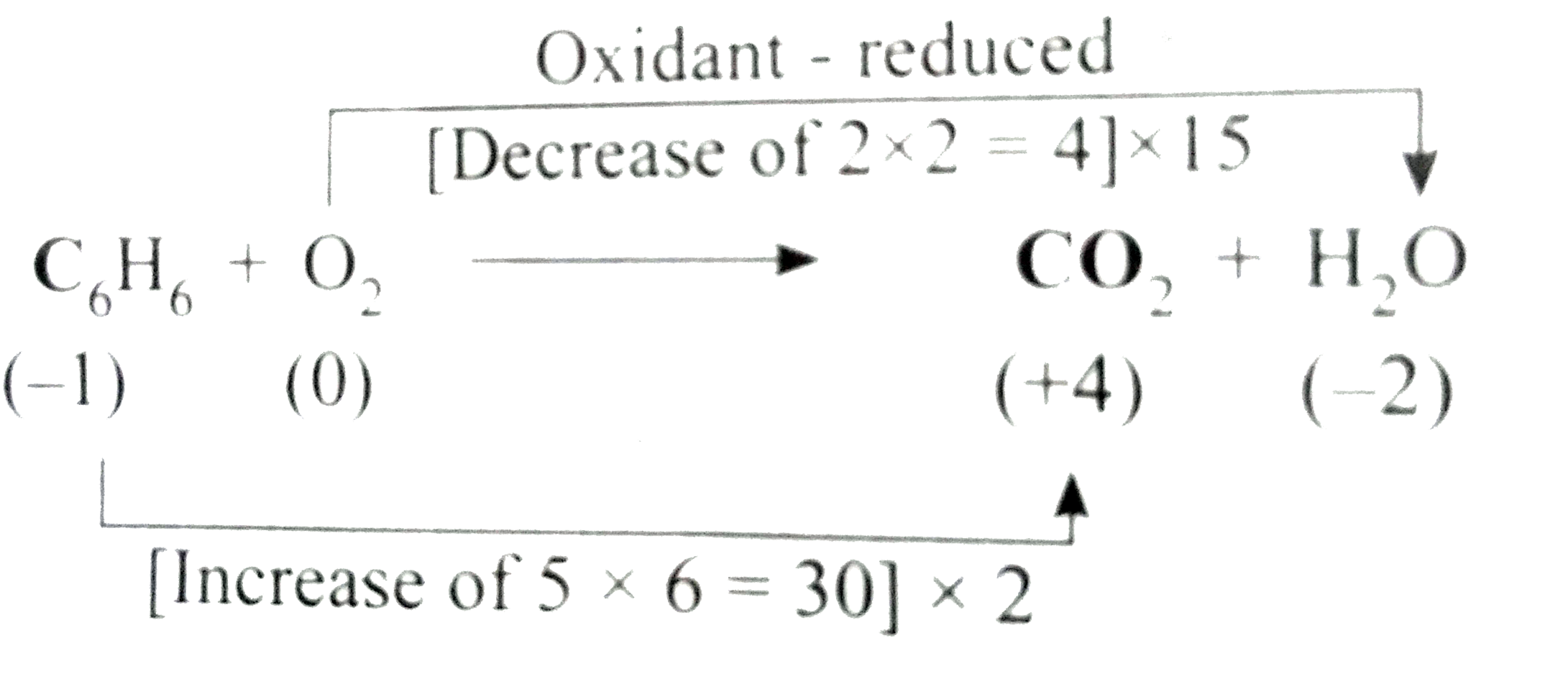 (ii) BALANCE the changes in O.N. by multiplying the oxidant and reductant by suitable numbers `2C_(6)H_(6)+15O_(2)rarrCO_(2)+H_(2)O` (iii) Balance the equation atomically (except O and H). `2C_(6)H_(6)+15O_(2)rarr 12CO_(2) + H_(2)O` (iv) Balance O atoms by ADDING one `H_(2)O` MOLECULE to the RHS for making the number of molecules of `H_(2)O` to be 6. `2C_(6)H_(6)+15O_(2)rarr12CO_(2)+6H_(2)O` |
|
| 50. |
Balance the following equation by ion electron method (i) FeCI_(3)+H_(2)SrarrFeCI_(2)+HCI+S (ii) Cu+HNO_(3)rarrCu(NO_(3))_(2)+NO+H_(2)O (iii)KI+CI_(2)rarrKCI+I_(2) (iv) MnO_(2)+HCIrarrMnCI_(2)+H_(2)O+CI (iv) H_(2)S+HNO_(3)rarrH_(2)SO_(4)+NO_(2)+N_(2)O |
|
Answer» (ii) `3Cu+8HNO_(3)rarr3Cu(NO_(3))_(2)+2NO+4H_(2)O` (iii)`2KI+CI_(2)rarr2KCI+I_(2)` `MnO_(2)+4HCI rarr MnCI rarr MnCI_(2)+CI_(2)+2H_(2)O` (v)`H_(2S+8HNO_(3))rarrH_(2)SO_(4)+8NO_(2)+4H_(2)O` |
|