

Saved Bookmarks
This section includes 7 InterviewSolutions, each offering curated multiple-choice questions to sharpen your Current Affairs knowledge and support exam preparation. Choose a topic below to get started.
| 1. |
Dissolution of which of the following in water is endothermic ? |
|
Answer» `NAOH` |
|
| 2. |
Dissolution of ammonium nitrate increases with increase in temperature. why ? |
| Answer» Solution :The dissolution process of AMMONIUM nitrate is endothermic. So the SOLUBILITY INCREASES with INCREASE in TEMPERATURE. | |
| 3. |
Dissociation of water takes place in two steps : H_(2)OrarrH+OH,""DeltaH=+497.8kJ OH rarr H+O,""DeltaH=428.5kJ Water is the bond energy of O-H bond ? |
|
Answer» `"463.15 KJ MOL"^(-1)` |
|
| 4. |
Dissociation of NH_(3)(g)oversolid platinum follows zero order kinetics. 2NH_(3)(g) to N_(2)(g)+3H_(2)(g) The rate of reaction is 2xx10^(-3)Msec^(-1). Also at 300K, thermodynamic data are: Delta H_(f)^(@)NH_(2)=-45kJ/moleS_(N_(2))^(@)=190J/K mole S_(NH_(3))^(@)=200J/K mole,S_(H_(2))^(@)=130J/K mole From the above data and the assumption that DeltaH_("Rxn")^(@) are independent of temperature, anwer the question that follows. [Take Rxx300kJ] The temperature at which dissociation of ammonia attains equilibrium at 1 bar pressure is given by? |
|
Answer» 500K |
|
| 5. |
Dissociation of PCI_(5) takes place on heating as follows: PCl_(5(g)) harr PCl_(3(g))+Cl_(2(g)) 'D' is the vapour density of PCI_(5) initially and 'd' is the vapour density of the equilibrium mixture. Which of the following graph is correct (alpha = degree of dissociation). |
|
Answer»
|
|
| 6. |
Dissociation of NH_(3)(g)oversolid platinum follows zero order kinetics. 2NH_(3)(g) to N_(2)(g)+3H_(2)(g) The rate of reaction is 2xx10^(-3)Msec^(-1). Also at 300K, thermodynamic data are: Delta H_(f)^(@)NH_(2)=-45kJ/moleS_(N_(2))^(@)=190J/K mole S_(NH_(3))^(@)=200J/K mole,S_(H_(2))^(@)=130J/K mole From the above data and the assumption that DeltaH_("Rxn")^(@) are independent of temperature, anwer the question that follows. [Take Rxx300kJ] What is the rate at which heat is absorbed at time t=50 sec. if volume of vessel is kept at 1 litre? |
|
Answer» 0.18kJ`SEC^(-1)` |
|
| 7. |
Dissociation of NH_(3)(g)oversolid platinum follows zero order kinetics. 2NH_(3)(g) to N_(2)(g)+3H_(2)(g) The rate of reaction is 2xx10^(-3)Msec^(-1). Also at 300K, thermodynamic data are: Delta H_(f)^(@)NH_(2)=-45kJ/moleS_(N_(2))^(@)=190J/K mole S_(NH_(3))^(@)=200J/K mole,S_(H_(2))^(@)=130J/K mole From the above data and the assumption that DeltaH_("Rxn")^(@) are independent of temperature, anwer the question that follows. [Take Rxx300kJ] If initially [NH_(3)]=3M , then what will be its concentration after 100 sec if it is performed in rigid vessel as 300K: |
| Answer» Answer :a | |
| 8. |
Dissociation of CH_(3),COOH is supressed by adding |
|
Answer» HCL |
|
| 9. |
Dissociation of an indicator can be considered as Hin hArr H^(+) + In ^(-)Colours of Hin and In^(-)ae differect. Which statement is correct ? |
|
Answer» Solution ASSUMES colour of Hin when`p ^(K_(In) )+ 1` When `pH lt PK_(In) - 1 , `Colour of Hin |
|
| 10. |
PCl_(5) in solid state exists as PCl_(4)^(+) and PCl_(6)^(-) and also in some solvents it undergoes dissociation as 2PCl_(5) hArr PCl_(4)^(+) +PCl_(6)^(-) Which statement is wrong ? |
|
Answer» Solution assumes colour of HIN when`p ^(K_(In) )+ 1` When `pH LT PK_(In) - 1 , `Colour of Hin |
|
| 11. |
Dissociation enthalpy of diatomic molecules XY, X_(2) and Y_(2) are too in the ratio of 1:1:0.5 the value. Enthalpy of formation of XY. Delta_(f) H= - 200 kJ mol""^(-1). Final the dissociation enthalpy of X_(2) ? |
|
Answer» 200 kJ mol`""^(-1)` Dissociation enthalpy `= 1: 0.5 : 1[X_(2) : Y_(2) :XY]` `= 1X" " 0.5x" " 1x` `DeltaH_(f) (XY) = [(1)/(2) ("Dissociation enthalpy of"x_(2) ) + (1)/(2) ("Dissociation enthalpy of"y)]-("Dissociation enthalpy"XY)` `therefore - 200 = [ ( (1)/(2) (X) + (1)/(2) (0.5x)- x)]` `therefore - 200 = (x)/(2) = (x)/(4) - x = - (1)/(4) x` `therefore x= -2 00 (-(4)/(1) ) = + 800 "kJ"` `therefore` Dissociation enthalpy of `X_(2) = 800 "kJ" = x` |
|
| 12. |
Dissociation enthalpies of methane, ethane and ethylene are respectively 400, 680 and 540 k cal mol^(-1) . Calculate sigmaC-H,sigma C-C and piC-C bond energies. |
|
Answer» Solution :Methane has four `sigma C-H` bonds. `sigma C-H` bond ENERGY `=400/4=100 "kcal "MOL"^(-1)` Ethane has six `sigma C-H` bonds AR one `sigmaC-C` bond. `sigmaC-C` bond energy `=680=(6xx100)=80k"cal mol"^(-1)`. Ethylene has for `sigmaC-H` bonds, one `sigmaC-C` bond and one `pi C-c` bond. `pi C-C` bond energy `=540-[(4xx100)+80]` `=60 "kcal mol"^(-1)` |
|
| 13. |
Dissociation constants of CH_3 COOH and NH_4 OH are respectively 1.8 xx 10^(-5) and 2 xx 10^(-5). What is the nature of aqueous ammonium acetate solution ? Explain. |
| Answer» SOLUTION :SLIGHTLY BASIC NATURE | |
| 14. |
Dissociation constat of weak acid HA is 1.8 xx 10^(-4) calculate Dissociation constant of its conjugate base A^- |
| Answer» SOLUTION :`5.5xx10^(-9)` | |
| 15. |
Dissociation constant of water at 25^(@)C is |
|
Answer» `1.0 xx 10 ^(-14) ` |
|
| 16. |
Dissociation constant of benzoic acid, p-nitro benzoic acid and p-hydroxy benzoic acid are 6.3 xx 10^(-5), 36 xx 10^(-5) " and ", 2.5 xx 10^(-5) respectively. Explain |
Answer» Solution : (i) `NO_(2)` group is an electron withdrawing group and tends to stabilise the carboxylate anion more than the benzoate ion after the RELEASE of `H^(+)` ion. Thus, `p-`nitrobenzoic acid is a stronger acid than benzoic acid. (ii) OH group is an electron releasing group and tends to DESTABILISE the carboxylate anion more than the benzoate ion after the release of `H^(+)`ion. Thus, `p-`hydroxybenzoic acid is a WEAKER acid than benzoic acid. The relative order of acidic STRENGTHS is, thus, justified |
|
| 17. |
Dissociation constant of formic acid is 4 xx 10^(-4). It is desired to prepare two liters buffer solution of pH value 4.4, using HCOOH and HCOOK. What is the concentration ratio of components to be maintained ? |
|
Answer» SOLUTION :Dissociationconstantof `HCOOH, K_a = 4 XX 10^(-4)` `pK_a=- logk_a= 4- log =4- log4 - 4 - 0.6= 3.4 ` Henderson.sequation`pH = pK_a+ log([ HCOOK])/([HCOOH])` ` log ""([HCOOK])/([ pHCOOH]) =pH-pK_a = 4.4 -3.4=1` the rationof concentrationto bemaintained,`([HCOOK])/([HCOOH])=10` |
|
| 18. |
Dissociation constant of CH_2 CICOOHin water is 1.35 xx10^(-3). What is the pH of (a) 0.1M CH_2 CICOOH and (b) 0.1M CH_2 CICOOK ? |
| Answer» SOLUTION :`1.94and7.94 ` | |
| 19. |
The dissociation constant of a weak acid is 10^(-6) . Then the P^(H)of 0.01 Nof that acid is |
|
Answer» Solution :Given` pH = 4, [H^(+)] = 10^(-4)`M `[H^(+) ]=sqrt(K_a C), 10^(-4)= sqrt( 10^(-7) C )` INITIAL CONCENTRATION of the WEAK acid, HA = C = 0.1 mol `L^(-1)` Final concentration of the acid` HA=( 10 xx 0.1 ) /( 1000 ) = 10^(-3) mol L^(-1)` Final `[H^(+) ]= sqrt(K_a C) =sqrt(10^(-7) xx 10^(-3)) = 10^(-5) M` Final `pH = -log 10^(-5)` = 5. |
|
| 20. |
Dissociatin enthalpies of methane, ethane and ethylene are respectively 400, 680 and 540 kcal mol^(-1). Calculate sigmaC - H,sigma C -C and pi C - C bond energies. |
|
Answer» Solution :Methane has four `sigmaC - H` bonds. `=400/4 = 100` `sigmaC - H` bond energy kcal `mol^(-1)` Ethane has six `SIGMA C - H` bonds and one `sigma C - C`bond. `sigma C- C` bond energy `= 680-(6 xx 100)` `= 80 k CAL mol^(-1)`. Ethylene has four `sigmaC - H` bonds one `sigma C -C` bond and one `PI C - C` bond. `:. pi C - C` bond energy `= 540 - [(4 xx 100) + 80]` `=60 kcal mol^(-1)` |
|
| 21. |
Dissociated constant of weak acid CH_3COOH is 1.8xx10^(-5) . In 0.1 M solution calculate concentration CH_3COO^- and H^+ . Calculate pH of solution. If 0.1 M HCl added to this solution than calculate degree of dissociation of CH_3COOH. |
|
Answer» SOLUTION :Calculation of `[H^+]` and `[CH_3COO^-]` : Suppose in initial 0.1 `CH_3COOH` is dissociated in `alpha` amount. So, dissociated `[CH_3COOH]=0.1 alpha` M and `[CH_3COO^-]=[H^+]=alphaM` `{:("Equili.:",CH_3COOH_((aq))+H_2O_((L))hArr ,CH_3COO_((aq))^(-)+,H_3O_((aq))^(+)),("Initial:",0.1 M,0 M,0M),("Change in equilibrium :",-0.1 alpha,0.1 alpha,0.1 alpha),("Concen. of equili. :",=0.1(1-alpha),,):}` `K_a=([CH_3COO^-][H_3O^+])/([CH_3COOH])` `therefore 1.8xx10^(-5) ((alpha)(alpha)0.1^2)/(0.1(1-alpha))=(0.1alpha^2)/(1-alpha)` But, `1 GT gt alpha` so, `(1-alpha)`=1 take `1.8xx10^(-5)=0.1 alpha^2` `therefore alpha^2 = 1.8xx10^(-4)` `therefore alpha=1.3416xx10^(-2)` `[H^+]=[CH_3COO^-]` =`0.1alpha=0.1(1.3416xx10^(-2))` `=1.3416xx10^(-3)` Calculation of pH : `pH=log [H^+]= -log (1.3416xx10^(-3))` =-log (0.0013416) =2.8724=2.87 Dissociation degree in 0.1 HCL : `{:(HCl to, H_((aq))^(+) +, Cl_((aq))^(-)),(0.1 M,0.1 M,0.1M):}` `{:(CH_3COOH_((aq)) (H_2O)hArr, H_3O_((aq))^(+)+, CH_3COO_((aq))^(-)),(,0.1 alpha,0.1 alpha) :}` `therefore` Total `[H_3O^+]=[H_3O^+]` of HCl + `[H_3O^+]` of `CH_3COOH` `=(0.1+0.1 alpha)` `approx` 0.1 M (Because `alpha lt lt` 0.1) Now , `K_a=([CH_3COO^-][H^+])/([CH_3COOH])` `therefore 1.8xx10^(-5)=((0.1 alpha)(0.1))/(0.1(1-alpha))[ 1 gt gt gt alpha therefore 1-alpha approx 1]` `1.8xx10^(-5)=0.1 alpha` `therefore alpha = 1.8xx10^(-4)` |
|
| 22. |
Displacement of electron in C-Cl bond towards Cl atom is called |
|
Answer» INDUCTIVE EFFECT |
|
| 23. |
Disilane, Si_(2)H_(X) is analysed and found to contain 90.32% silicon by mass. What is the value of X? [Si = 28] |
|
Answer» 3 |
|
| 24. |
Disease caused by excess of flourides in water is |
|
Answer» MINAMITA |
|
| 25. |
Disease caused by eating fish found in water contaminated with industrial waste having mercury is |
|
Answer» Minamata DISEASE |
|
| 26. |
Discuss value of first ionisation enthalpy in same period and why? |
Answer» Solution :Generally, we go left to right in PERIODIC table ionisation enthalpy at elements are increases. Ionisation enthalpy and Atomic radius are related to each other. In period left to right atomic radius of elements DECREASES so attraction of nucleus and ELECTRON of outer most orbital increases. So ionisation enthalpy increases. When we go left to right in period clectron is ADD in some orbit so shielding effect is not so much increase. In this situation effective nuclear charge an electron of outer most orbit is increases that shielding effect. So, in period outer most electrons are strongly BONDED with nucleus, so ionisation enthalpy in increases when we go left to right in period. |
|
| 27. |
Discuss uses of caustic soda. |
| Answer» Solution :Uses : (i) The manufacture of soap, paper, artificial silk and a number of CHEMICALS, (ii) In petroleum refining, (iii) In the PURIFICATION of bauxite, (IV) In the textile industries for mercerising cotton fabrics, (v) For the preparation of pure fats and OILS, and (vi) As a laboratory reagent. | |
| 28. |
Discuss uses (importance) of plaster of paris. |
| Answer» SOLUTION : Uses : (i) The largest use of Plaster of Paris is in the BUILDING industry as WELL as plasters. (ii) It is used for immoblising the affected part of organ where there is a bone fracture or sprain. (iii) It is also employed in dentistry, in ornamental WORK and for making CASTS of statues and busts. | |
| 29. |
Discuss use of quick lime. |
| Answer» Solution :Uses : (i) It is an important primary material for manufacturing cement and is the cheapest form of alkali. (ii) It is used in the manufacture of sodium CARBONATE from caustic soda. (III) It is employed in the purification of SUGAR and in the manufacture of dye STUFFS. | |
| 30. |
Discuss the various reactions that occur in the Solvay process. |
|
Answer» Solution : Sodium carbonate `(Na_(2)CO_(3)*10H_(2)O)` : Sodium carbonate is generally prepared by Solvay process. In this process, advantage is taken of the low SOLUBILITY of sodium hydrogen carbonate whereby it gets precipitated in the reaction of sodium chloride with ammonium hydrogen carbonate. The LATTER is prepared by PASSING `CO_(2)`to a concentrated solution of sodium chloride saturated with ammonia, where ammonium carbonate followed by ammonium hydrogen carbonate are formed. The equations for the complete process may be written as: `2NH_(3)+H_(2)O+CO_(2) to (NH_(4))_(2)CO_(3)` `(NH_(4))_(2)CO_(3)+H_(2)O+CO_(2) to 2NH_(4)HCO_(3)` `NH_(4)HCO_(3)+NaCl to NH_(4)Cl+NaHCO_(3)` Sodium hydrogen carbonate crystal separates. These are HEATED to give sodium carbonate. `2NaHCO_(3) to Na_(2)CO_(3)+CO_(2)+H_(2)O` In this process NH, is recovered when the solution containing `NH_(4)Cl` is treated with `Ca(OH)_(2)`. Calcium chloride is obtained as a by-product. `2NH_(4)Cl+Ca(OH)_(2) to 2NH_(3)+CaCl_(2)+H_(2)O` |
|
| 31. |
Discuss the various reactions that occur in the Solvancy process. |
|
Answer» Solution :In Solvay AMMONIA process , `CO_(2)` is passed through brine , (i.e., a concentrated solution of NaCl) saturated with ammonia when sodium bicarbonate being sparingly soluble GETS precipitated . `NaCl + NH_(3) +CO_(2) + H_(2)O to NaHCO_(3) darr + NH_(4)Cl "" ... (i) ` Sodium bicarbonate THUS formed is filtered , dried and then heated when sodium carbonate is obtained . `2NaHCO_(3) overset(Delta)(to) Na_(2)CO_(3) + CO_(2) + H_(2)O` `CO_(2)` needed for the reaction shown in Eq. (i) is prepared by heating calcium carbonate and the quick lime , CaO thus formed is dissolved in water to form slaked lime , `Ca(OH)_(2)` `CaCO_(3) overset(Delta)(to) CaO + CO_(2) "" ... (ii) ` `CaO + H_(2)O to Ca(OH)_(2) "" ... (iii)` `NH_(3)` needed for the purpose is prepared by heating `NH_(4)Cl` obtained in Eq. (i) with `Ca(OH)_(2)` obtained in Eq. (iii) `2NH_(4)Cl + Ca(OH)_(2) to 2NH_(3) + CaCl_(2) + 2H_(2)O` Therefore , the only by product of the reaction is calcium chloride , `CaCl_(2)`. |
|
| 32. |
Discuss the types of redox reactions in detail ? |
|
Answer» Solution :(a) Combination reaction : A combination reaction may be denoted in the manner. `A+BtoC` Either A and B or both A and B must be in the elemental form for such a reaction to be a redox reaction. `C_((s))+O_(2(g))overset(Delta)toCO_(2(g))` `3Mg_((s))+N_(2(g))overset(Delta)toMg_(3)N_(2(s))` `CH_(4(g))+2O_(2(g))overset(Delta)toCO_(2(g))+2H_(2)O_((l))` (b) Decomposition reaction : Decomposition reactions are the opposite of combination reactions. Precisely, a decomposition reaction leads to the break down of a compound into two or more components at least one of which must be in the elemental state. `2H_(2)O_((l))overset(Delta)to2H_(2(g))+O_(2(g))` `2NaH_((s))overset(Delta)to2Na_((s))+H_(2(g))` `2KClO_(3(s))overset(Delta)to2KCl_((s))+3O_(2(g))` All the decomposition recations are not redox. `CaCO_(3(s))overset(Delta)toCaO_((s))+CO_(2(g))` ( c) Displacement reaction : In a displacement reaction, an ion (or an atom) in a compound is replaced by an ion (or an atom) of another element it may be denoted as : `X+YZtoXZ+Y` Displacement reaction fit into two categories metal displacement and non-metal displacement. (i) Metal displacement : A metal in a compound can be displaced by another metal in the uncombined state. We have already discussed about this class of the reactions under section. Metal displacement reactions find many applications in metallurgical processes in which pure metals are obtained from their COMPOUNDS in ores. A few such examples are : `CuSO_(4(aq))+Zn_((s))overset(Delta)toCu_((s))+ZnSO_(4(aq))` `V_(2)O_(5(s))+5Ca_((s))overset(Delta)to2V_((s))+5CaO_((s))` `TiCl_(4(l))+2Mg_((s))overset(Delta)toTi_((s))+2MgCl_(2(s))` In each case, the reducing metal is a better reducing agent than the one that is being reduced which evidently shows more capability to lose electrons as compared to the one that is reduced. (ii) Non-metal displacement : The non-metal displacement redox reactions include hydrogen displacement and a rarely occurring reaction involving oxygen displacement. All alkali metals and some alkaline earth metals (Ca, Sr, and Ba) which are very good reductants, will displace hydrogen from cold water. `2Na_((s))+2H_(2)O_((l))overset(Delta)to2NaOH_((aq))+H_(2(g))` `Ca_((s))+2H_(2)O_((l))overset(Delta)toCa(OH)_(2(aq))+H_(2(g))` Less active metals such as magnesium and iron react with steam to produce dihydrogen gas. `Mg_((s))+2H_(2)O_((l))overset(Delta)toMg(OH)_(2(s))+H_(2(g))` `2Fe_((s))+3H_(2)O_((l))overset(Delta)toFe_(2)O_(3(s))+3H_(2(g))` Many metals, including those which do not react with cold water, are capable of displacing hydrogen from acids. Dihydrogen from acids may even be produced by such metals which do not react with steam. Cadmium and tin are the examples of such metals. A few examples for the displacement of hydrogen from acids are : `Zn_((s))+2HCl_((aq))toZnCl_(2(aq))+H_(2(g))` `Fe_((s))+2HCl_((aq))toFeCl_(2(aq))+H_(2(g))` `Mg_((s))+2HCl_((aq))toMgCl_(2(aq))+H_(2(g))` This reactions are used to prepare dihydrogen gas in the laboratory. Here, the reactivity of metals is reflected in the rate of hydrogen gas evolution, which is the slowest for the least active metal Fe, and the fastest for the most reactive metal, Mg. Very less active metals, which may occur in the native state such as silver (Ag), and gold (Au) do not react even with hydrochloric acid. We have already discussed that the metals - zinc (Zn), copper (Cu) and silver (Ag) through tendency to lose electrons show their reducing activity in the order `ZngtCugtAg`. Like metals, activity series also exists for the halogens. The power of these elements as OXIDISING agents decreases as we move down from fluorine to iodine in group 17 of the periodic table. This implies that fluorine is so reactive that it can replace chloride, bromide and iodide ions in solution. In fact, fluorine is so reactive that it attacks water and displaces the oxygen of water : `2H_(2)O_((l))+2F_(2(g))to4HF_((aq))+O_(2(g))` It is for this reason that the displacement reactions of chlorine, bromine and iodine using fluorine are not generally carried out in aqueous solution. On the other hand, chlorine can displace bromide and iodide ions in an aqueous solution as shown below : `Cl_(2(g))+2KBr_((aq))to2KCl_((aq))+Br_(2(l))` As `Br_(2)andI_(2)` are coloured and dissolve in `C Cl_(4)`, can easily be identified from the colour of the solution. The above reactions can be written in ionic form as : Reactions form the basis of IDENTIFYING `Br^(-)andI^(-)` in the laboratory through the test popularly known as .Layer Test.. It may not be out of place to mention here that bromine likewise can displace iodide ion in solution: `Br_(2(l))+2I_((aq))^(-)to2Br_((aq))^(-)+I_(2(s))` The halogen displacement reactions have a direct industrial APPLICATION. The recovery of process, which is represented by: `2X^(-)toX_(2)+2e^(-)` Here X denotes a halogen element. Whereas chemical means are available to oxidise `Cl^(-),Br^(-)andI^(-)`, as fluorine is the strongest oxidising agent, there is no way to convert F. Ions to `F_(2)` by chemical means. The only way to achieve `F_(2)` from `F^(-)` is to oxidise electrolytically, the details of which you will study at a later stage. (d) Disproportionation reaction : In a disproportionation reaction an element in oneoxidation state is simultaneously oxidised and reduced. It can exist in at least three oxidation states. The element in the form of reacting substance isin the intermediate oxidation state and bothhigher and lower oxidation states of that elementare formed in the reaction. `overset(-1)(2H_(2)O_(2(aq)))tooverset(-2)(2H_(2)O_((l)))+overset(0)(O_(2(g)))` Here, oxidation number of oxygen of peroxide is (-1) which is converted into `O_(2)andH_(2)O` having oxidation number of oxygen is 0 and -2respectively. e.g., `overset(0)(P_(4(s)))+3OH_((aq))^(-)+3H_(2)O_((l))tooverset(-3)(PH_(3(g)))+overset(+1)(3H_(2)PO_(2(aq))^(-))` `overset(0)(Cl_(2(aq)))+2OH_((aq))^(-)tooverset(+1)(ClO_((aq))^(-))+overset(-1)(Cl_((aq))^(-))+H_(2)O_((l))` It is of interest to mention here that whereas bromine and iodine follow the same trend as, chlorine, but fluorine shows deviation from this behaviour when it reacts with alkali. The reaction that takes place in the case of fluorine is shown variation : `2F_(2(g))+2OH_((aq))^(-)to2F_((aq))^(-)+OF_(2(g))+H_(2)O_((l))` This departure shows by fluorine is not surprising for us as we know the LIMITATION of fluorine that,being the most electronegative element, it cannotexhibit any positive oxidation state. This means that among halogens, fluorine does not show a disproportionation tendency. |
|
| 33. |
Discuss the trend of the following: Thermal stability of carbonates of Group-2 elements. |
|
Answer» Solution :THERMAL stability increases down the group. On heating, these CARBONATES give `CO_(2)`and oxide of the respective ELEMENT of group-2. `BeCO_(3) lt MgCO_(3) lt CaCO_(3)lt SrCO_(3) lt BaCO_(3)` `BeCO_(3)`is unstable and made stable in the ATMOSPHEREOF `CO_(2)`. `BeCO_(3) hArr BeP+CO_(2)` |
|
| 34. |
Discuss the trend of the following: The solubility and the nature of oxides of Group-2 elements. |
|
Answer» SOLUTION :All oxides are basic and ionic in nature except Be which is amphoteric and covalent. Lattice energy of oxides decreases as the size of cation increases in oxide. Basic nature increases down the group. Except Beo and MGO, all are soluble in WATER and on dissolving produce large amount of heat. Beo and Mgo, DUE to high lattice energy, are insoluble in water. |
|
| 35. |
Discuss the trend of the following : (i) Thermal stability of carbonates of Group 2 elements . (ii) The solubility and the nature of oxides of Group 2 elements . |
|
Answer» Solution :(ii) All alkaline earth metals react with `O_(2)` to form their respective oxides (MO) , their reactivity , however , increases down the group with increase in atomic size . Solubility in water . BeO being covalent is insoluble in water , MgO is only sparingly soluble in wate but all other oxides , i.e. , CaO , SrO and BaO dissolve in water with EVOLUTION of heat forming their corresponding hydroxides . `CaO + H_(2)O to Ca(OH)_(2) + ` heat The solubility of these oxides/hydration increase down the group because both the their lattice enthalpies and hydration enthalpies decrease down the group but their lattice enthalpies decrease more rapidly than their hydration enthalpies . Nature of oxides . Due to SMALL size and somewhat high ionization enthalpy of Be, BeO is amphoteric and dissolves in both acids and alkalies . `BeO + 2HCl to BeCl_(2) + H_(2)O , BeO + 2 NaOH to underset("Sodium berrylate")(Na_(2)BeO_(2)) + H_(2)O` All other oxides are basic in nature and their basic character increases down the group . |
|
| 36. |
Discuss the three types of Covalent hydrides |
|
Answer» Solution :(i) They are the compounds in which hydrogen is ATTACHED to another element by sharing of electrons. (ii) The most COMMON EXAMPLES of covalent hydrides are METHANE, ammonia, water and hydrogen chloride. (iii) Molecular hydrides of hydrogen are further classified into three categories as • Electron precise `(CH_(4),C_(2)H_(6),SiH_(4), GeH_(4))` • Electron-deficient `(B_(2)H_(6))` and • Electron-rich hydrides `(NH_(3).H_(2)O)` (iv) Since most of the covalent hydrides consist of discrete, small molecules that have relatively weak intermolecular forces, they are generally gases or volatile liquids. |
|
| 37. |
Discuss the stepwise determination of the (Lewis) structure of nitric acid . |
|
Answer» Solution :Let us draw the Lewis structure for nitric acid . 1. Skeletal structure `{:(H,O,N,O),(,,O,):}` 2. Total number of valence electrons in `HNO_(3)` ` = [1 xx 1 "(HYDROGEN )"] + [1 + 5 "(nitrogen)"]` `+ [3 xx 6 "(OXYGEN)"] = 1 + 5 + 18 = 24` 3. Draw single bonds between atoms. Four bonds can be drawn as shown in the figure for `HNO_(3)` which account for eight electrons (4 bond pairs ). `H- O - UNDERSET(O)underset(|)N-O` 4. Distribute the remaining sixteen `(24 - 8 = 16)` electrons as eight lone pairs startingfrom most electrongative atom, the oxygen. Six lone pairs are distributed to the two terminal oxygens ( THREE each ) to satisfy their octet and two pairs are distributed to the oxygen that is connected to hydrogen to satisfy its octet . H- underset(* *) overset(* *)O-underset( :underset(* *)(O: ))underset(|) N -underset(* *)overset(* *) (O):` 5. VERIFY wheather all the atoms have octet conguration . In the above distribution , the nitrogen has one pair short for octet . Therefore, move one of the lone pair from the terminal oxygen to form another bond with nitrogen. The Lewis structure of nitric acid is given as `H - underset(* *) overset(* *)O - underset( : underset(* *)O: )underset(|)N = underset(* *) overset(* *)O` |
|
| 38. |
Explain Sp^(2) hybridisation taking boron trichloride (BCl_(3)) as an example. |
|
Answer» Solution :Boron (5) Electronic configuration `1-s^(2)2-s^(2) 2p^(1)` 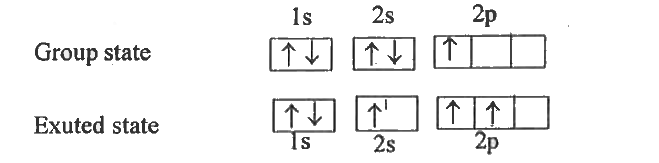 Here one 2s and two 2p half filled orbitals undergo HYBRIDIZATION to GIVE three `sp^(2)` HYBRID orbitals with these hybrid orbitals. The P-orbitals of chlorine MOLECULE overlap to form `pi` bonds. 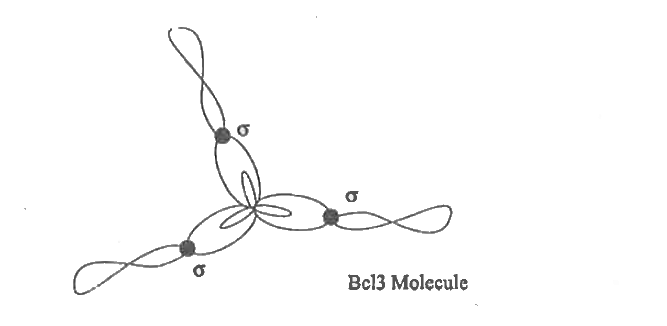
|
|
| 39. |
Discuss the similarities and differences between a 1s and 2s orbital |
|
Answer» Solution :Similarities : (i) Both have spherical shape (ii) Both have same angular momentum as it is `= sqqrt(l (l +1)) (H)/(2PI)` DIFFERENCE, (i) 1S has no node while 2s has one node. (ii) Energy of 2s is greater than that of 1s (iii) SIZE of 2s is larger than that of 1s |
|
| 40. |
Discuss the significances of osmotic-pressure over other colligative properties. |
|
Answer» SOLUTION :Unlike elevation of boiling point ( for 1 molal solution the elevation in boiling point is ` 0.512^(@) C ` for water ) and the depression in freezing point ( for 1 molal solution the depression in freezing point is ` 1.86 ^(@) C ` for water ) , the magnitude of osmotic PRESSURE is large The osmotic pressure can be measured at ROOM TEMPERATURE enables to determine the molecular mass of biomoleculeswhich are unstable at HIGHER temperature . Even for a very dilute solution , the osmotic pressure is large. |
|
| 41. |
Discuss the shpaes of the following molecules using the VSEPR mode : BeCl_(2), BCl_(3),SiCl_(4), AsF_(5), H_(2)S,PH_(3). |
|
Answer» SOLUTION :(i)`BeCl_(2) = Cl :Be : C: `. The central atom has only two bond PAIRS and no lone pair,i.e., it is of the TYPE `AB_(2)` . Hence, shape is linear (ii) `BCl_(3) = Cl :overset(cdotcdot)B:Cl`. The central atom has only 3 bondpairs and no lone pair ,i.e., it of the type ` AB_(3)` .Hence, shape is TRIANGULAR planar (iii)` SiCl _(4)= Cl :overset(Cl)overset(cdotcdot )underset( Cl)underset(cdotcdot )Si:Cl` Bond pairs = 4 ,lone pairs = 0 ,i.e. it is of the type `AB_(4)`Shape = Tetrahedral (iv)  Bond pairs = 5 . lone pair= 0 , i.e., it is of the type `AB_(5)`. Shape = Trigonal bipyramidal Bond pairs = 5 . lone pair= 0 , i.e., it is of the type `AB_(5)`. Shape = Trigonal bipyramidal(v) ` H_(2) S = H:underset (cdotcdot )overset(cdotcdot )S:H` . Bond pairs = 2, lone pairs = 2 , i.e., it is of the type ` AB_(2) L_(2)`. Shape = Bent/V-shaped (vi) `PH_(3) = H:underset (H )underset (cdotcdot )overset(cdotcdot )(P):H`Bond pairs = 3, lone pair = 1, i.e., it is of the type ` AB_(3) L`. Shape = Trigonal pyramidal |
|
| 42. |
Discuss the significance/applications of dipote moment. (ii) Represent diagrammatically the bond moments and the resultant dipole moment in CO_(2), NF_(3) and CHCl_(3), |
|
Answer» SOLUTION :(i) N/A (II) 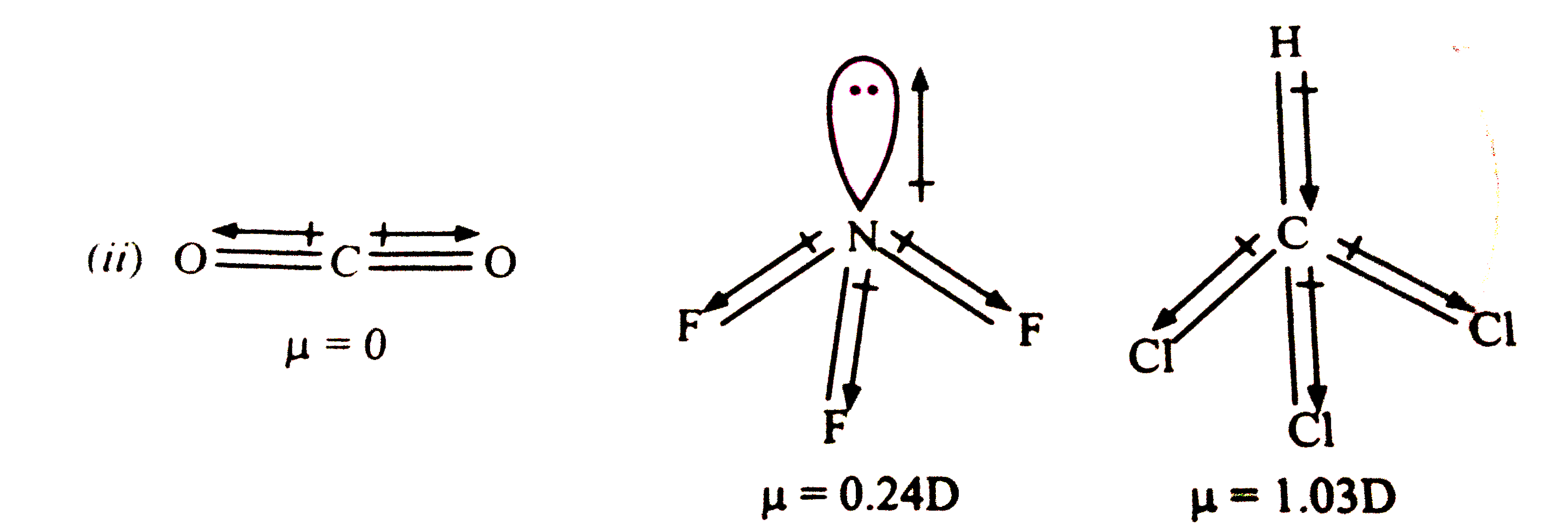
|
|
| 43. |
Discuss the significance/ applications of dipole moment. |
|
Answer» Solution :The APPLICATIONS of dipole MOMENT are (i) The dipole moment helps to predict whether a molecule is polar or non-polar. As `MU = q xx d ` , greater is the magnitude of dipolemoment, higher will be the polarity of the bond. For non-polar molecules, the dipole moment is zero. (ii) The PERCENTAGE of ionic character can be calculated as percentage of ionic character ` (mu "observed ")/(mu_("ionic")) xx 100` (iii) Symmetrical molecules have zero dipole moment although they have two or more polar bonds (in determination of symmetry). (iv) It helps to distinguish between cis and trans isomers. Usually cis-isomer has higher dipole moment than trans isomer. (v) It helps to distinguish between ortho, meta and para isomers. Dipole moment of para isomer is zero. Dipole moment of ortho isomer is greater than that of meta isomer. |
|
| 44. |
Discuss the shape of the following molecules using the VSEPR model. BeCl_(2), BCl_(2), SiCl_(4) , AsF_(5), H_(2)S, PH_(3) |
|
Answer» Solution :Shape of `BeCl_(2)` : Be (Z = 4) `[He]^(2) 2s^(2)` and CL (z = 17) `[Ne]^(10) 3s^(2) 3p^(5)` `BeCl_(2)` is `AB_(2)` type molecule. In it two Be - Cl bond and two-two bonding electron pair. So two bonding pair remain at maximum distance so repulsion between then is minimum and so the shape is linear.  Shape of `BCl_(3)` : In `BCl_(3)` , B is central atom and three Cl in and . So, three B - Cl bond in `BCl_(3)`. B (Z = 5 ) , Thus `[He]^(2) 2s^(2)2p^(1)` . Three valence cell electron of B form covalent bond with three Cl. Non bonding electron is not present on B. three boding pair arrange at maximum distance and form planar trigonal arrangement . Shape of `SICl_(4)` :  In `SiCl_(4)` Si is central atom. Four Cl atom join with Si and form four Si - Cl bond. Si (Z =14) , So , `[Ne]^(10) 3s^(2)3p^(2) `. In Si four valence cell electrons and bonding pair with four Cl. So, non bonding electron pair is not present on Si. Si has all four bonding pair so arrange at maximum distance at `109^(@)28.` and give TETRAHEDRAL arrangement. Shape of `AsF_(5)`:  As is central atom. In it five bonding electron pair with five AS - F bond. As present in 17 (VB) group so, according to`ns^(2)np^(3)` in valence cell five electrons and no nonbonding electrons. As per VSEPR five bonding pair arrange at maximum distance `ltF `- As - F = `120^(@)` remain planar and `ltF - ` As - F = `90^(@)` So remain perpendicular & give trigonal bipyramidal arragement.  Shape of `H_(2)`S : In `H_(2)`S, S is central atom & two H in end so , two S - H bond present. In periodic table S in 16 (VI B) group , so electron configuration `ns^(2)np^(4)`. Two electron participate in bond and two electron act as nonboding `e^(-)` pair on S. Two bonding pair S - H arrange in such a way that there will be least repulsion between two lone pair. As a result this is not linear but the is angular so `H_(2)S " is " AB_(2)E_(2)` type molecule.  Shape of `PH_(3)` : In `PH_(3)` central atom P and negative H in end, so , three P - H bond in `PH_(3)`. POSITION of P in 17 0/ B) group, so electron configuration `ns^(2)np^(3)` and total 5 electrons in outer cell of P. In `PH_(3)` three bonding electron pair of three P - H and one nonboding electron present on P. In `PH_(3)` three boding electron pair of three P - H and one nonbonding electron present on P. These electron pair arrange at maximum distance so arragnement of electron pair is tetrahedral & shape is trigonal pyramidal. 
|
|
| 45. |
Discuss the shapes of d orbitals. |
|
Answer» Solution :d - orbitals : For .d. orbital 1 = 2 and the corresponding m values are -2, -1, 0, + 1, +2. The SHAPE of the d orbital looks LIKE a .clover leaf.. The FIVE m value gives rise to five d orbitals namely `d_(xy), d_(yz) , d_(zy), d_(x^2 - y^2) and d_z^2` The 3d orbitals contain two nodal PLANES. 
|
|
| 46. |
Discuss the salient features of VBT. |
|
Answer» Solution :(i) When half FILLED orbitals of two ATOMS overlap, a covalent bond will be formed between them. (ii) The resultant overlapping orbital is occupied by the two electrons with opposite spins. For example, when `H_(2)` is formed, the two 1s electrons of two hydrogen atoms get paired up and occupy the overlapped orbital . (iii) The strength of a covalent bond depends upon the extent of overlap of atomic orbitals . Greater the overlap, larger is the energy released and stronger will be the bond formed. (IV) Each atomic orbital hasspecfic direction (except s -orbital which is spherical )and hence orbital overlap takes place in the direction that maximizes overlap. |
|
| 47. |
Discuss the role of Lewis acids in the preparation of aryl bromides and chlorides in the dark. |
|
Answer» Solution :Lewis ACIDS help to generate electrophile during the bromination and chlorination. `CI_(2) + FeCl _(3) to FeCl_(4)^(-) + underset(underset("(Electrophile)")("Chloronium ion"))(Cl^(+))` `Br_(2)+ FeBr_(3) to FeBr_(4)^(-) + underset(underset("(Electrophile)")("Bromonium ion"))(Br^(+))` The electrophile then attacks the benzene ring to FORM a CARBOCATION, which loses a PROTON to form aryl CHLORIDE or aryl bromide. |
|
| 48. |
Discuss the reason behind the classification of inductive effect into +I and -I effect . |
|
Answer» Solution :The inductive effect represents the ability of a particular atom or a group to either withdraw or donate electron density to the attached carbon +I groups and -I groups . Their ability to relese or withdraw the electron through sigma covalent bond is caled -I effict and -I effect respectively. Higher the electronegativity of the substitutent greater is the -I effect . The order of the the -I effect of some groups ae GIVEN below ` NH_(3) gt NO_(2) gt CN gt SO_(3) H gt CHO ` Highly electropositive atoms and atoms are groups which carry a negative charge are electron donating or + I groups . Example : Alkali metals , ALKYL group such METHYL , ethyl , negatively charged group such as ` CH_(3) O , C_(2) H_(5) O , COO ` ETC . Lesser the electronegative of the elements , greater is the + I effect . The relative order of +I effect of some alkyl groups below `-C (CH_(3))_(3) gt - CH(CH_(3))_(2) gt - CH_(2) CH_(3) gt - CH_(3)` |
|
| 49. |
Discuss the possibility of the atom for existing in the following electronic configurations : (i) 1s^(2)2s^(2)2p_(x)^(1) (ii) 1s^(2)2s^(1)2p_(x)^(1)2p_(y)^(1) 2p_(z)^(1) (iii) 1s^(2)2s^(1)2p_(x)^(2) 2p_(y)^(1) (iv) 1s^(2)2s^(2) 3s^(2) |
|
Answer» Solution :(i) This electronic CONFIGURATION is correct since it is in accordance with the rules for filling up of various orbitals. (ii) This electronic configuration is wrong because it violates aufbau principle which states that an orbital with lower energy, i.e., 2s in the present case should be completely filled before the electrons go to HIGHER energy subshell, i.e. 2p in the present case. (iii) This electronic configuration is not correct since it violates HUND's rule. according to this rule, all the three 2p orbitals must have electron each before the PAIRING occurs. But in the present case `2p_(x)` orbital has two electrons while `2p_(Z)` orbital is empty. (iv) This electronic configuration is wrong since after filling 2s-orbital, the electrons should go to 2p-orbital rather than 3s-orbitals. |
|
| 50. |
Discuss the principle and method of softening of hard water by synthetic ion-exchange resins. |
|
Answer» Solution :Synthetic ion exchange resins are of two TYPES : Cation exchange resins and anion exchange resins. Cation exchange resins are either carboxylic acids or sulphonic acids having the general formula, R-COOH or R-`SO_(2)OH` where R represents the giant HYDROCARBON framework. These resins exchange their `H^(+)` ions with `Ca^(+)` and `Mg^(2+)` ions present in hard water. `UNDERSET("Cation exchange resin")(2R-COO^(-)H^(+))+ underset("From hard water")(CaCl_(2))to underset("Exhausted resin")((RCOO)_(2)Ca) + 2H^(+) + 2Cl^(-)` `underset("(Cation exchange resin)")(2R-SO_(2)O^(-)H^(+))+underset("(From hard water)")(MgSO_(4)) to underset("(Exhausted resin)")((RSO_(2)O)_(2)Mg)+2H^(+)+SO_(4)^(2-)` Anion exchange resins, on the other hand, are substituted ammonium hydroixdes having the general formula , `R+overset(+)NH_(3)OH^(-)` where R denotes the giant hydrocarbon framework. These resins exchange their `OH^(-)` ions with `Cl^(-)` and `SO_(4)^(2-)` ions present in hard water. `underset("(Anion exchange resin)")(R+overset(+)NH_(3)OH^(-))+underset("(from hard water)")(Cl^(-))to underset("(Exhausted resin)")(R-overset(+)NH_(3)Cl^(-))+OH^(-)` `underset("(Anion exchange resin)")(2R-overset(+)NH_(3)OH^(-))+underset("(From hard water)")(SO_(4)^(2-)) to underset("(Exhuasted resin)")((R-overset(+)NH_(3))_(2)SO_(4))+2OH^(-)` Simultaneously , the `H^(+)` ions produced from cation exchange resins and `OH^(-)` ions produced from anion exchange resins combine to FORM `H_(2)O` Process. The hard water is first passed through cation exchanged resin and then through anion exchange resin. The resulting water is FREED from both cations and anions and hence is called demineralised water or deionised water and is as good as distilled water. |
|


