

Saved Bookmarks
This section includes 7 InterviewSolutions, each offering curated multiple-choice questions to sharpen your Current Affairs knowledge and support exam preparation. Choose a topic below to get started.
| 1. |
Explain : Proton (H^+) does not exist in aqueous solution. |
|
Answer» Solution :Hydrogen ion `(H^+)` by itself is a bare (i) PROTON with very small size (~`10^(-15)`m radius) (ii) proton intense electric field. So, proton binds itself with the water molecule at one of the two AVAILABLE LONE pairs on it by coordinate BOND and giving `H_2O^+`.  This hydronium ion is `H_3O^+`species and contain trigonal pyramidal geometry. This `H_3O^+` species has been detected in many compounds like `H_3O^(+)Cl^-`in solid state. Similarly the hydroxyl ion is hydrated to give several ionic species like `H_5O_2^(+), H_7O_3^(+) , H_9O_4^(+)` etc. `H_2O overset(H^+)to H_3O_((aq))^(+) overset(+H_2O)to H_5O_2^+ overset(+H_2O)to H_7O_(3(aq))^(+) overset(+H_2O)to H_9O_(4(aq))^(+)`  So, proton does not exist independent in aqueous solution, but it exist as hydronium ion or oxonium ion. |
|
| 2. |
Explain property of H_(2)O_(2)"with"MnO_(4)^(-) in acidic medium. |
|
Answer» Solution :Hydrogen peroxide reduces pink coloured `KMnO_(4)` solution to colourless manganous SULPHATE. The ionic EQUATION for this reaction is written as `underset("pink")(2MnO_(4)^(-)(aq))+6H^(+)(aq)+5H_(2)O_(2)(aq)tounderset("colourles")(2MN^(2+))(aq)+8H_(2)O(I)+5O_(2)(g)` |
|
| 3. |
Explain properties of sodium carbonate. |
|
Answer» Solution : Sodium carbonate is a white CRYSTALLINE solid which exists as a decahydrate, `Na_(2)CO_(3)*10H_(2)O`.This is also called washing soda. It is READILY soluble in water. On heating, the decahydrate loses its water of crystallization to FORM monohydrate. Above 373K, the monohydrate becomes completely anhydrous and changes to a white powder called soda ash. `Na_(2)CO_(3)*10H_(2)O overset(375K)to Na_(2)CO_(3)*H_(2)O+9H_(2)O` `Na_(2)CO_(3)*H_(2)O overset(gt 373K)to Na_(2)CO_(3)+H_(2)O` Carbonate part of sodium carbonate gets hydrolysed by water to form an ALKALINE solution. `CO_(3)^(2-) +H_(2)O to HCO_(3)^(-)+HO^(-)` |
|
| 4. |
Explainproperties of electromagneticwave. |
|
Answer» Solution :Electromagneticwavemotionis complexin nature. Itssimplepropertiesare ASUNDER : (i) Theoscillatingelectricand magneticfieldsproducedby oscillatingchargedparticleare perpendicularto eachotherand bothareperpendicularto thedirectionof propagation Simplifieldpicutreof electromagneticwaveis SHOWNIN FIGURE  (ii) Unlikesoundwavesor waterwaveselectronwavesdo ntorequiremediumandcan move invacuum. (iii) THEREARE manytypesof electromagneticradiationswhichdifferefrom oneanotherin wavelength.There consitute what is calledelectromagneticspectrum. |
|
| 5. |
Explain properties of carbon monoxide and give its uses |
|
Answer» Solution :Properties : (i) Carbon monoxide is a colourless, odourless and almost water insoluble gas. (ii) The highly poisonous nature of CO arises because of its ability to form a complex with hemoglobin which is about 300 times more stable than the oxygen hemoglobin complex This PREVENTS hemoglobin in the red BLOOD corpuscles from carrying oxygen round the body and ultimately resulting in death. (iii) On combustion it GIVES light blue colored flame. `CO+1/2O_(2) to CO_2`+ Energy (iv) Reduction character : It reacts with many METAL oxides and reduces to corresponding metals. `ZnO_((s)) + CO_((g)) to Zn_((s)) + CO_(2(g))` `CuO + CO to Cu+CO_(2)` `Fe_2O_(3(s)) + 3CO_((g)) to 2Fe_((s)) + 3CO_(2(g))` (v) Formation of metal carbonyl character: CO combines as ligand with many transitional metals, such as Ni, Fe, Co etc. and forms metal carbonyl complex compounds. `Ni+4CO overset"333K - 343 K"to underset"Nickel tetracarbonyl"([Ni(CO)_4])` `Fe+ 5CO oversetDeltato [Fe(CO)_5]`Iron pentacarbonyl Uses : (i) CO is useful for extraction of some metals from their oxide. e.g., used in blast furnace. `Fe_2O_3 + 3CO to 2Fe+ 3CO_2` (ii) CO is used to prepare tetracarbonyl nickel in Mond.s carbonyl process to obtain pure nickel metal from impure nickel metal. `Ni_((s)) + 4CO_((g)) oversetDeltato [Ni(CO)_4]_((g))` (iii) In industrial field CO is used as a FUEL in the form of water gas and producer gas. (iv) It is used in manufacturing of methyl alcohol and formic acid. (v) It is used in manufacturing of magnetic tapes (Iron carbonyl) for tape recorder. |
|
| 6. |
Explain product of reaction CH_(3)CH=CH_(2)+HCl overset("Peroxide")rarr |
|
Answer» Solution :`CH_(3)CHCl-CH_(3)` : 2-Chloropropane HCl doesn.t give anti markovnikov addition REACTION in PRESENCE of peroxide, because to break H-Cl BOND it REQUIRE high energy of `403.5 kJ MOL^(-1)`. |
|
| 7. |
Explain principle of estimation of oxygen in organic compound |
|
Answer» Solution :(a) The percentage of oxygen in an organic compound is usually found by difference between the total percentage composition 100 and the sum of the percentage of all the other elements. % O= 100- (sum of % of all the other elements) (b) A definite mass of an organic compound is decomposed by heating in a steam if nitrogen gas. The mixture of gaseous products containing oxygen is passed over red-hot coke when all the oxygen is converted to carbon monoixde. (CO). This mixture is passed through VORM iodine pentoxide `(I_(2)O_(5))` when carbon monoxide is oxidised to carbon dioxide producing iodine `(I_(2))` compound `= underset(Delta)overset("heat")rarr underset(1373K darr +"cock" 2C)(O_(2)) +` other GASES (A) `2C + O_(2) overset(1373K)rarr 2CO` ...(A) (B) `I_(2)O_(5) + 5CO rarr I_(2) + 5 CO_(2)` ...(B) Now eq. (A) `xx 5: 10C + 5O_(2) rarr 10CO`....(C ) eq. (B) `xx 2 : 2 I_(2)O_(5) + 10CO rarr 2I_(2) + 10 CO_(2)` ....(D) `(C + D) : 10 C + 5O_(2) + 2I_(2) O_(5) = 2I_(2) + 10 CO_(2)` `THEREFORE` 5 mole `O_(2) rarr 100 "mole " CO_(2)` `therefore` 1 mole `O_(2) rarr 2 "mole " CO_(2)` So, 32gm `O_(2) rarr 88gm CO_(2)` In oxygen estimation method ..32 gm oxygen is converted into 88gm carbon dioxide... (c ) Calculation: Initially take compound = m gm and weight of produced `CO_(2)= m_(1)gm` `therefore` weight of O in `m_(1) gm CO_(2) = (32 xx m_(1))/(88) gm O_(2)` `therefore % (O) =(32)/(88) xx (m_(1))/(m) xx 100` (d) Presently the estimation of elements in an organic compound is carried out by using micro quantities of substance and AUTOMATIC experimented techniques. The elements carbon (C) , HYDROGEN (H) and nitrogen (N) present in a compound are determined by an apparatus known as CHN elemental analyzer. The analyzer requires only a very small amount of the substance (1-3gm) and displays the values on a screen within a short time. |
|
| 8. |
Explain preparation of sodium carbonate by Solvay process with chemical reactions. |
|
Answer» Solution : Sodium carbonate `(Na_(2)CO_(3)*10H_(2)O)` : Sodium carbonate is generally prepared by Solvay process. In this process, advantage is taken of the low solubility of sodium hydrogen carbonate whereby it gets PRECIPITATED in the reaction of sodium chloride with ammonium hydrogen carbonate. The latter is prepared by passing `CO_(2)`to a concentrated solution of sodium chloride saturated with ammonia, where ammonium carbonate followed by ammonium hydrogen carbonate are formed. The EQUATIONS for the complete process may be written as: `2NH_(3)+H_(2)O+CO_(2) to (NH_(4))_(2)CO_(3)` `(NH_(4))_(2)CO_(3)+H_(2)O+CO_(2) to 2NH_(4)HCO_(3)` `NH_(4)HCO_(3)+NACL to NH_(4)Cl+NaHCO_(3)` Sodium hydrogen carbonate crystal separates. These are heated to give sodium carbonate. `2NaHCO_(3) to Na_(2)CO_(3)+CO_(2)+H_(2)O` In this process NH, is recovered when the solution containing `NH_(4)Cl` is treated with `Ca(OH)_(2)`. CALCIUM chloride is obtained as a by-product. `2NH_(4)Cl+Ca(OH)_(2) to 2NH_(3)+CaCl_(2)+H_(2)O` |
|
| 9. |
Explain preparation of hydrogen using electrolysis. |
|
Answer» Solution :Hydrogen is OBTAINED by electrolysis of water. (i) Electrolyte : water containing teraces of acid or ALKALI or the electrolysis of aqueous solution of sodium hydroxide or POTASSIUM hydroxide. (II) Anode : Nickel (iii) Cathode : Iron (iv) At anode : `2OH^-toH_2O+1//2O_2+2e^-` (v) At cathode : `2H_2O+2e^-to2OH^-+H_2` (vi) OVERALL reaction : `H_2OtoH_2+1//2O_2` |
|
| 10. |
Explain preparation of acidic buffer solution with example. |
|
Answer» Solution :With the help of `pK_a` and `pK_a` of acid and base the ratio of salt acid or salt and base regulated and buffer solution is prepare . For preparation of acidic butter weak acid HA and its salt with strong base is taken , the pH of solution is given by - `pH=pK_a + "log" ([A^-])/([HA])` If `[HA]=[A^-]` than log `([A^-])/([HA])`= log 1=0 `therefore pH=pK_a` Hence if weak and CONJUGATE base have same concentration than pH is equal to `pK_a`. "So to prepare buffer with desire pH SELECT such acid whose `pK_a` value is near to pH value." The `pK_a` of acetic acid is 4.76 . Therefore the pH of buffer SOLUTIONWHICH made by same molar concentration containing solution of acidic acid and sodium acetate , is approximately NEARER to 4.76 To PRODUCE buffer solution, take the concentration of weak acid and its conjugate base equal. |
|
| 11. |
Explain position direciton properties of groups in mono substituted benzene. With suitable examples. |
|
Answer» Solution :While second substitution of GROUP s caried out in mono substituted benzene then the position of news group is directed by previously attached gorup such PROCESS is known as DIRECTIONAL PROPERTIES of first group. The position of second substitution in benzene is depends on nature of first substituted group of benzene but it is not depends on second group. There are two types of directional properties OBSERVED for second substitution in benzene by first substituted group. 
|
|
| 12. |
Explain polymerization of alkyne. |
|
Answer» Solution :A large number of alkyne molecules combine with each other and form giant molecule which is called as polymerization of alkyne. There are mainly two types of alkyne polymerization : Linear polymerization and cyclic polymerization. (a) Linear polymerization of alkyne : Under suitable conditions linear polymerization of ethyne takes PLACE ot produce polyacetylene or polyethyne which is a high molecular WEIGHT polyene containing repeating units of `[CH=CH-CH=CH]` and can be represented as `(-CH=CH-CH=CH-)_(n)`. Under special conditions, this polymer conduts electricity. Thin film of polyacetylene can be used as electrodes in batteries. These films are good conductors, lighter and cheaper than the metal conductors. (b) Cyclic polymerization : Ethyne on passing through red hot IRON tube at 873 K undergoes cyclic polymerization. Three molecules polymerise to form benzene which is the starting molecule for the preparation of derivative of bezene, DYES, drugs and large number of other organic compounds. This is the BEST route for entering from aliphatic to aromatic compounds as discussed below : 
|
|
| 13. |
Explain position isomerism with example. |
|
Answer» Solution :COMPOUNDS having same molecular formula but differ in the POSITION of FUNCTIONAL group. Eg: `underset("Propan-1-ol")(CH_(3)CH_(2)CH_(2)OH)""underset("Propan-2-ol")underset(OH)underset(|)(CH)-CH_(3)` |
|
| 14. |
Explain polybasic acids and polyacidic bases with examples. |
|
Answer» Solution :Acids having more than one ionisable PROTON per molecule are known as polybasic or polyprotic acids. Carbonic acid, PHOSPHORIC acid, oxalic acid, hydrogen SULPHIDE and sulphurous acid are polybasic weak acids. Polybasic acids ionise in stages. Therefore, they have more than one ionisation constant values. Example: (i) `H_(2)CO_(3)`, carbonic acid is a dibasic acid. It has two ionisation constant values. `H_(2)CO_(3)hArrH^(+)+HCO_(3)^(-),,K_(a_(1))=([H^(+)][HCO_(3)^(-)])/([H_(2)CO_(3)])=3xx10^(-7)` FIRST ionisation constant. `HCO_(3)^(-)hArrH^(+)+CO_(3)^(2-),K_(a_(2))=([H^(+)][CO_(3)^(2-)])/([HCO_(3)^(-)])=6xx10^(-11)` Second ionisation constant. (ii) `H_(2)S`, hydrogen sulphide is also dibasic in nature `H_(2)ShArrH^(+)+HS^(-)` `K_(a_(1))=([H^(+)][HS^(-)])/([H_(2)S])=9xx10^(-8)` First ionisation constant. `HS^(-)hArrH+S^(2-)` `K_(a_(2))=([H^(+)][S^(2-)])/([HS^(-)])=1xx10^(-15)` Second ionisation constant. (iii) `H_(3)PO_(4)`, orthophoshoric acid is a tribasic weak acid. The stepwise ionisation of it is shown below `H_(3)PO_(4)hArrH^(+)+H_(2)PO_(4)^(-)""K_(a_(1))=1.1xx10^(-2)` `H_(2)PO_(4)^(-)hArrH^(+)+HPO_(4)^(2-)""K_(a_(2))=2.0xx10^(-7)` `HPO_(4)^(2-)hArrH^(+)+PO_(4)^(3-)""K_(a_(3))=3.6xx10^(-12)` (Similar discussion and conclusions hold good for polyacidic bases also.) |
|
| 15. |
Explain physical properties of alkaline earth metals (Group-2). |
|
Answer» Solution :The alkaline earth metals, in general, are SILVERY white, lustrous and relatively soft but harder than the alkali metals. Beryllium and magnesium appear to be somewhat greyish. The melting and boiling points of these metals are higher than the corresponding alkali metals due to smaller sizes. The trend is, however, not systematic. Because of the low ionisation enthalpies, they are strongly electropositive in nature. The electropositive character increases down the group from Be to Ba, Calcium, strontium and barium impart characteristic brick red, CRIMSON and apple green colours respectively to the flame. In flame the electrons are excited to higher energy levels and when they drop back to the ground state, energy is EMITTED in the form of visible light. The electrons in beryllium and magnesium are too strongly bound to get excited by flame. Hence, these ELEMENTS do not impart any colour to the flame. The flame test for Ca, Sr and Ba is helpful in their detection in qualitative analysis and estimation by flame photometry. The alkaline earth metals like those of alkali metals have high electrical and THERMAL conductivities which are typical characteristics of metals. |
|
| 16. |
Explain Planks quantum theory. |
| Answer» Solution :Electromagnetic radiations are emitted, ABSORBED and propagated discontinuously in the form of small packet of energy CALLED PHOTON. A BODY emits (ABSORBS) radiations in the integral niultiples of ' photon'. | |
| 17. |
Explain physical properties of group 14 elements. |
|
Answer» Solution :Electronic Configuration The valence shell electronic configuration of these elements is `ns^2 np^2`. COVALENT Radius: There is a considerable increase in covalent radius from C to Si, there after from Si to Pb a SMALL increase in radius is observed. This is due to the presence of completely filled d and f orbitals in heavier members. Ionization Enthalpy : The first ionization enthalpy of GROUP 14 members is higher than the corresponding members of group 13. The influence of inner core electrons is visible here also. In general the ionisation enthalpy decreases down the group. Small decrease in `Delta_iH` from Si to Ge to Sn and slight increase in `Delta_iH` from Sn to Pb is the CONSEQUENCE of poor SHIELDING effect of intervening d and forbitals and increase in size of the atom. Electronegativity Due to small size, the elements of this group are slightly more electronegative than group 13 elements. The electronegativity values for elements from Si to Pb are almost the same. |
|
| 18. |
Explain physical characteristic of group 13 elements . |
|
Answer» Solution :Boron is non-metallic in nature. It is extremely hard and black coloured solid. It exists in many allotropic forms. Due to very strong crystalline lattice, boron has ususually HIGH MELTING point. Rest of the members are soft metals with low melting point and high electrical conductivity . It is worthwhile to NOTE that gallium with unusually low melting point (303 K) , could exist in liquid state during summer . Its high boiling point (2676 K) makes it a useful material for MEASURING high temperature .Density of the ELEMENTS increases down the group from boron to thallium. |
|
| 19. |
Explain physical and chemical properties of borax. |
|
Answer» Solution :Borax: It is the most important compound of boron. Formula : `Na_2B_4O_7 . 10H_2O` In FACT it contains the tetra nuclear units of `[B_4O_5(OH)_3]^(2-)` CORRECT formula : `Na_2[B_4O_5(OH)_4] . 8H_2O` Borax dissolves in water to GIVE an alkaline solution. `Na_2B_4O_7 + 7H_2O to 2NaOH + UNDERSET"Orthoboric acid"(4H_3BO_3)` |
|
| 20. |
Explain : Photoelectriceffect. |
|
Answer» SOLUTION :EINSTEIN (1905)wasableto explainthe photoelectriceffect usingplankquantum theoryof electromagneticradiation . Shiminga beamof lighton TOA metalsurfacecanthereforebe viewedas shooting a beam ofparticlethe photons.Whena PHOTON ofsufficientenergystrikesan electronin theatomof the metalittransfers it energy instantaneouslyto theelectronduringthe collisionand theelectronis ejectedwithout any timelag ordelay A moreintensebeamof lightconsistsof largernumberof photonsconsequently the numberof electronsejectedis alsolarger. |
|
| 21. |
Explainphotoelectric effect. |
Answer» Solution :Photoelectriceffect : Electrons(roelectriccurrent )wereejected whencertain metals(for examplepotassium rubidiumcaesium etc) wereexposedto abeam oflight . Thephenomenon is calledphotoelectriceffect.  Light of aparticularfrequencystrikes a cleanmetalsurfaceinsidea vacuumchamberElectronsare ejected from themetaland arecountedby adetectorthatmeasurestheir kineticenergy. Experimentalresults andassumption : (i) Theelectronsareejected FROMTHE metalsurfaceas soonas thebeamof ligthstrikesthe surface Assumption :Thereis no time lgbetween thestrikingof lightbeamand theejectionofelectrionfromthe METALSURFACE Assumption : (number of electron `prop` INTENSITY (III) Thresholdfrequency: Thereis a characteristicminimumfrequency`v_(0)` belowwhichphotoelectriceffectis notobservedis Assumption : Below`v_(0)`photoelectriceffect iscome outwithcertainkineticenergyThekineticenergiesof theseelectronsincreasewith theincreaseof frequencyof the lightused. Exampleof thresholdenergy Red light `(v= 4.3xx 10^(4) Hz)`of anybrightness(intensity )mayshineon apieceof potassium metal forhoursbut notphotoelectronsare ejected. Averyweakyellowlight `(v=5.1 ` to `5.2 XX 10^(4))` photoelectriceffectis observed. Thethresholdfrequency `(v_(0))` forpotassiummetalis`5.0 xx 10^(4)Hz` Note : Theenergycontentof thebeamof lightnumberof electricejecteddoesdependupon the brightnessof lightthe kineticenergyof the ejectedelectronsdoesnot. |
|
| 22. |
Explainphenomenon of blackbodradiation . |
|
Answer» Solution :The firstconcreteexplanationfor thephenomen of the blackbodyradiationwas givenby Maxplanck in 1900 . When solidsare heatedthey emitradiation over awiderangeof wavelength . ExampleWhenan ironrodis HEATED aprogresivelybecmoesmore andmore REDAS theis CHANGED . BLACKBODY : Theidealbodywhichemitsandabsorbsradiationsof allfrequencesiscalled ablackbody andthe radiationemitted by suchabodyblackbodyradiationis notableto explainbyelectrmagneticradiatin theorybut explainbyPlankthery. 
|
|
| 23. |
Explain periodicity of valence or oxidation states and explain Na_(2)O " and " OF_(2). |
|
Answer» Solution :The valence is the most characteristic property of the elements and can be understood in terms of their electronic configurations. Ex. : In `OF_(2)` OXYGEN `(+2)` but in `Na_(2)O`oxygen is `( -2)`. EXPLANATION in `OF_(2)"and "Na_(2)O` : The order of electronegativity of the three elements involved in these compounds is `F gt O gt Na`. Each of the atoms of fluorine, with OUTER electronic configuration `2s^(2)2P^(5)`, shares one ELECTRON with oxygen in the `OF_(2)` molecule. Being highest electronegative element, fluorine is given oxidation state` -1`. There are two fluorine atoms in this molecule, oxygen with outer electronic configuration `2s^(2)2p^(4)` shares two electrons with fluorine atoms and thereby exhibits oxidation state `+2`. In `Na_(2)O`,oxygen being more electronegative accepts two electrons, one from each of the two sodium atoms and, thus, shows oxidation state` -2`. On the other hand sodium with electronic configuration `3s^(1)`loses one electron to oxygen and is given oxidation state `+1`. So in `Na_(2)O " and " F_(2)O`compound oxidation number of oxygen is `(-2)" and " (+2)` respectively. |
|
| 24. |
Explain pH scale and pH. |
|
Answer» Solution :pH Scale Hydronium ion concentration in molarity is more conveniently expressed on a logarithmic scale known as the pH scale. Defination of pH : pH of a solution is defined as the magnitude of the negative power to which 10 must be raised to express the activities of `H^+` ion (`a_H +`) concentration. Activities a have no unit `a_H + = [H^+] "mol L"^(-1)` This definition of pH is written as following. `pH=-LOG a_H +` ....(Eq.-i) `=-log [[H^+]/("mol L"^(-1))] [ THEREFORE a_H + = [H^+] / "mol L"^(-1)]` If mol `L^(-1)` = 1 So, pH=-log `[H^+]` ...(Eq.-ii) The pH scale is only for dilute solution in which pH method is suitable for solution whose concentration of `[H^+]` is less than 1 M. The CHANGE with temperature the variations in pH with temperature are so SMALL that we often ignore it. It should be noted that as the pH scale is logarithmic a change in pH by just one unit also means change in `[H^+]` by a factor of 10, e.g. `[H^+]=1xx10^(-2)` So, pH=2 and `[H^+]=1xx10^(-3)` =0.001 So, pH=3 |
|
| 25. |
Explain peroxide effect. |
| Answer» Solution :In presence of peroxide, addition of hydrogen bromide to unsymmetrical alkenes takes place against the MARKOWNIKOFF rule [i.e. Antimarkownikoff rule]. This reaction is restricted to addition of HBr alone but not with hydrogen CHLORIDE or hydrogen iodide. This is known as peroxide effect or kharash effect. <BR> `CH_(3) - underset("Propene")(CH = CH_(2)) + HBr overset("peroxide")(rarr)underset(1 - "bromopropane (major)") (CH_(3) - CH_(2) - CH_(2)Br)` | |
| 26. |
Explain periodicity of valence or oxidation state of s and p block elements. |
|
Answer» SOLUTION :a )Vacation of valence across a period: As we more across a period from left to RIGHT , the number of valence electrons increase from1 to 8 The valence with RESPECT to hydrogen or chlorine first increases from 1 to 4 and then decrease from 4 to 0 . However, valence with respect to oxygen increase from 1 to 7Ex:Element , of 2nd and 3rd periods. b) Vacation of valence down a group : on moving down a group , the number valence electronsremain the same , and therefore , the elements in a group showthe same valiancy . Examples : All the elements of group 1 are monovalent ( valiancy = 1 ) andall the elements of group 2 are divalent ( valiancy = 2 ) |
|
| 27. |
Explain periodicity of element of electron gain enthalpy in periodic table. |
|
Answer» Solution :Less irregularity observed in electron gain enthalpy compared to ionization enthalpy. When we go left to right in period electron gain enthalpy increases with ATOMIC number. Because in period we go left to right effective nuclear charge increase so `e^(-)` easily add in small atom and added e is nearest to POSITIVELY charge nucleus.  Electron gain enthalpy in group : We go top to bottom value of electron gain enthalpy becomes less negative.`[S(-200), Se(-195), " Te"(-190), " Po" (-174)]" and " [Cl (-349), " Br" (-325), I (-295) , " At" (-270)]`. Atomic volume increases and added electron becomes away from the centre. Note: Electron gain enthalpy of oxygen is less negative than sulphur. Electron gain enthalpy fluorine is more than chlorine element. Because when `e^(-)` is enter in to oxygen and fluorine added `e^(-)` is more in low energy level (n = 2) and suffers significant repulsion from the other electron present in this level. For the n = 3 quantum level (S or CI): The added electron occupies a larger region of space and the electron repulsion is much less. |
|
| 28. |
ExplainPauliexclusionprincipleby example. |
|
Answer» Solution :Thenumber of electronto befilledin variousorbitalsis restricited bythe exclusion principlegiven by theaustrianscientistwolfgangPauli(1926) Rule:No twoelectrons inatom can have thesamesetof fourquantumnumbers. Secondmethod :Only twoelectronmayexisthaveoppositespin. Used: pauliexclusionprincipleon the numbercapacityof electronto bepresent in anysubshell. Subshellincomprisesof oneorbitaland thus themaximumnumberof electronpresentin 1ssubshellcan be TWO Sub shell 4hadfiveorbitalsso itcan ACCOMODATE 10electrons  ifprinciplequantumnumbern thus numberoforbitalsin N=`n^(2)` Maximumnumberof electronin n= `2n ^(2)` Example: The electronconfigurationof He is`1s^(2) ` forthis twoelectronthe VALUEOF `n,1,m` is1,0,0,itsspin quantumnumber`+(1)/(2)` and`(1)/(2) `are differ from eachotherwithoppositespin |
|
| 29. |
Explain oxidation states of group 14 elements. |
|
Answer» Solution :The group 14 elements have four electrons in outermost shell. The common oxidation states exhibited by these elements are +4 and +2. Carbon also exhibits negative oxidation states. Since the sum of the first four ionization enthalpies is very high, compounds in +4 oxidation STATE are generally covalent in NATURE. In heavier members the tendency to show +2 oxidation state increases in the sequence Ge `lt` Sn `lt` Pb. It is due to the inability of `ns^2` electrons of valence shell to participate in bonding. The relative stabilities of these TWO oxidation states vary down the group. Carbon and silicon mostly show +4 oxidation state. Germanium forms stable compounds in +4 state and only few compounds in +2 state. Tin forms compounds in both oxidation states (Sn in +2 state is a reducing agent). Lead compounds in +2 state are stable and in +4 state are strong oxidising agents. In tetravalent state the number of electrons AROUND the central atom in a molecule (e.g., carbon in `C Cl_4`) is eight. Being electron precise molecules, they are normally not expected to act as electron acceptor or electron donor species. Although carbon cannot exceed its covalence more than 4, other elements of the group can do so. It is because of the presence of d-orbital in them. Due to this, their halides undergo hydrolysis and have tendency to form complexes by accepting electron pairs from donor species. For example, the species LIKE, `SiF_6^(-2) , [Ge(Cl_6)]^(-2) , [Sn(OH)_6]^(2-)` exist where the hybridisation of the central atom is `sp^3d^2`. |
|
| 30. |
Explain the step involvedin paperchromatography . |
|
Answer» Solution :Paper chromatography: (i) It is an example of partition chromatography. A strip of paper acts as an adsorbent. This method involves continues differential partioning of components of a mixture between stationary and MOBILE phase. In paper chromatography, a special QUALITY paper known as chromatographic paper is used. This paper act as a stationary phase. (ii) A strip of chromatographic paper spotted at the base with the solution of the mixture is suspended in a suitable solvent which acts as the mobile phase. The solvent rises up and flows over the spot. The paper selectivity retains different components according to their different partition in the two phases where a chromatogram is developed. (iii) The spots of the separated coloured components are visible at different HEIGHTS from the position of initial spots on the chromatogram. The spots of the separated colourless compounds may be observed either under ultraviolet light or by the use of an appropriate SPRAY REAGENT |
|
| 31. |
Explain oxidation of Ethene. |
|
Answer» SOLUTION :When ethene is treated with BAEYER's reagent gives ethane - 1,2, - diol. `underset("Ethene")(CH_(2))= CH_(2)+ H_(2)O+[O] underset("solution")OVERSET("KMNO"_(4))(rarr) underset("Ethane"-1,2-diol)(underset(OH)underset(|)(CH_(2))- underset(OH)underset(|)(CH_(2)))` |
|
| 32. |
Explain overlapping of atomic orbitals with diagram. |
|
Answer» Solution :When orbitals of two ATOMS come close to formbond, their overlap may be positive, negative or zero depending upon the sign and direction of orientation of amplitude of orbital wave function in space. (see figure) Positive and negative sign on boundary surfacediagrams in the fig show the sign of orbital wave function and are not related to charge. Difference between positive and negative overlapping. Zero overlapping : If the wave function are not overlapping on AXIS or PARALLEL to other and PERPENDICULAR to the axis then the zero overlapping take place. 
|
|
| 33. |
Explain ortho and para directing group influencing in benzene. |
|
Answer» Solution :Ortho and para direacting groups: the groups which direct the incominggroups to ortho and para POSITIONS are called ortho and pam directing groups. Examples:- OH, - OR, -`NH_(2), `- NHR, - `NR_(2)`, - R, - X Let use discuss the DIRECTIVE influence of - OH group in phenol. BACAUSE of resonance effect, electron increases at ortho para positions in the benzene ring. Due to - I effect of the OH group, electron density of benzene ring decreases. However, + R effect is stronger than - I effect which activates the benzene ring for electrophilic substitution. these groups are called activating groups which result in ortho and para substitution products. in the case of ARYL halides, halogens are deactivating because - I effect is stronger than +R effect. Hence, overall electron denstiy of the benzene ring decreases. Hence, in aryl halides, though substitution takes lace in ortho and para positions, the ringis deactivated. 
|
|
| 34. |
Explain original properties of an elements and its reactivity trends in periodic table. |
|
Answer» Solution :ORDER of Periodic TRENDS and Reasons : When we go left to right atomic radius and ionic radius decreases. So, ionisation enthalpy increases in period and value of electron gain enthalpy becomes more negative. So, we can say that in period ionisation enthalpy is very less in left side and electron gain enthalpy is very high and negative in right side. (Exception : Noble GAS) Elements are more reactive in both of the side and elements are less reactive in middle in periodic table. Elements are situated very left side (Alkali metals) have tendency to lose one electron and elements are situated right side (Halogen) have tendency to gain one electron and becomes negative. Periodic Properties in Periods: (1) Reactivity of OXIDATION and Reduction : EXTREMELY left elements of periodic table are reducing agent and extremely right elements of periodic table are oxidising agent. (2) Metallic and non-metallic Properties : We move left to right in a period metallic property decreases and non-metallic property increases. (3) Reactivity with Oxygen : Elements on two extremes of a period easily combine with oxygen to from oxides. The normal oxide formed by the element on extreme left is the most basic. `(e.g. Na_(2)O)` The element on extreme right is the most acidic. `(e.g. Cl_(2)O_(7))` Oxides of elements in the centre are amphoteric. `(e.g. Al_(2)O_(3) , As_(2)O_(3))` or neutral `(e.g. CO, NO, N_(2)O)`. Amphoteric oxides behave as acidic with bases and as basic with acids, whereas neutral oxides have no acidic or basic properties. (4) Transition elements are known as metals they are less electropositive than group-1 and group-2. |
|
| 35. |
Explain original properties and its reactivity trends in periodic table. |
|
Answer» SOLUTION :In a group the increase in atomic & ionic radii with increase in atomic number generally results in a gradual DECREASE in ionization enthalpies and a regular decreases (with exception in same third period elements) The metallic character increases down the group and non-metallic character decreases. This trend can be related with their reducing and oxidising property which you will learn later. In the case of TRANSITION elements however a reverse trend is observed. This can be explained in terms of atomic size and ionization ENTHALPY. |
|
| 36. |
Explain origin source of group 14 elements. |
|
Answer» SOLUTION :Carbon, silicon, germanium, tin, lead and flerovium are the members of group 14. C: Carbon is the seventeenth most abundant element by mass in the earth.s crust. It is widely distributed in nature in free as well as in the combined STATE. In ELEMENTAL state it is available as coal, graphite and diamond, however, in combined state it is present as metal CARBONATES, hydro carbons and carbon dioxide gas (0.03%) in air. One can emphatically say that carbon is the most versatile element in the world. Its combination with other elements such as dihydrogen, dioxygen, chlorine and sulphur provides an astonishing array of materials ranging from living TISSUES to drugs and plastics. Organic chemistry is devoted to carbon containing compounds. It is an essential constituent of all living organisms. Naturally occurring carbon contains two stable isotopes : `.^12C` and `.^13C`. In addition to these, third isotope, `.^14C` is also present. It is a radioactive isotope with half-life 5770 years and used for radiocarbon dating. Si : Silicon is the second (27.7 % by mass) most abundant element on the earth.s crust and is present in nature in the form of silica and silicates. Silicon is a very important component of ceramics, glass and cement. Ge : Germanium exists only in traces. Sn: Sn (Tin) occurs mainly as Cassiterite `(SnO_2)`. Pb : Lead as galena, PbS. Flerovium is synthetically prepared radioactive element. |
|
| 37. |
Explain optical isomerism or Geometrical isomerism with example. |
|
Answer» Solution :(a) Geometrical isomerism : The restricted rotation of atoms or groups around the doubly bended carbon atoms gives rise to different geometries of such compounds. The stereoisomers of these types are CALLED stereoisomers. E.g., Cis and trans isomers have different geometry therefore, they are geometrical isomers. (b) Geometrical isomers and isomerism : In alkene, there is  group attached to carbon (1) and carbon (2) attached to it have YXC = CXY different geometry are of two types. group attached to carbon (1) and carbon (2) attached to it have YXC = CXY different geometry are of two types.  Cis-isomer : In which two IDENTICAL atoms or groups lie on the same side of the double bond is called cis isomers. Trans-isomers : In which identical atoms or groups lie on the OPPOSITE sides of the double bond is called trans isomers. Cis and Trans isomer : Groups or molecules arranged in different geometry known as geometrical isomers. Due to the arrangement REACTION for the Cis and Trans isomers : YXC = CXY has two different structure a and b, then at the group C=C, their is no rotation of groups there is restricted rotation on around C=C therefore, there are different arrangement on the C=C bond. Therefore they are geometrical isomers. ON rotation of molecule a and b `180^(@)`, C=C bond should be broken, due to which `a harr b` do not convert each other, therefore they are different isomers. Different geometry : Due to different arrangement of atoms or groups in space, these isomer differ in their properties like melting point, boiling point, dipole moment, solubility etc. XYC = CXY or XYC = CXZ and XYC = CZW alkene has different geometrical structures. (i) Alkene XYC = CXY e.g. : HCl = CHCl (ii) Alkene XYC = CZWe.g. : CHCl = C Cl Br (iii) Alkene XYC = CXZ e.g. : CHCl = CHBr Here possibilities of geometrical isomers. Cis and trans are two geometrical isomers. Cis and trans are two geometrical isomers, in which cis are on the same side atoms or groups substituted and trans they are on opposite side. In cis and trans, there is restricted rotation around C=C. Rotation is only possible on breaking the bond between C=C. |
|
| 38. |
Explain order of ionisation enthalpy of alkali metal when we go top to bottom. |
|
Answer» Solution : Ionisation enthalpy and atomic radius are corelated with each other. When we go TOP to bottom in group ionisation enthalpy decreases and atomic radius increases.  In same group when we go top to bottom outer most electron is arranged more distance with NUCLEUS so SHIELDING effect becomes more. In this situation, when we go top to bottom in same group shielding effect is more important than effective nuclear charge so LESS energy required to lose electron. So due to shielding effect ionisation enthalpy is decreases. |
|
| 39. |
Explain on the basis of molecular orbital theory why He_(2) does not exist. |
| Answer» SOLUTION :BOND ORDER for `He_(2) = 0 ` . | |
| 40. |
Explain occurrence of hydrogen. |
|
Answer» Solution :a. Hydrogen is present in the combined state in water to an EXTENT of `11.1%` by MASS. b. It is also present in all organic COMPOUNDS well as biomoleculdes. C. It is also present in all stars because nuclear fusion reactions involve hydrogen isotpes. About `70%` of the universe is made up of hydrogen. d. Hydrogen is also present in coal, petroleium, vegetable and animal matter. e. It is present in the EARTH's crust to an extent of `0.9%.` |
|
| 41. |
Explain : Non polar and polar covalent bond. |
|
Answer» Solution :The existence of a hundred percent ionic or covalent bond represents an ideal situation. In reality no bond or a COMPOUNDS is either completely covalent or ionic. Even in case ofcovalent bond between two hydrogen atomsthere is some ionic character. Non polar covalent bond : When covalent bond is formed between two similar atoms. The shared pair of electron, is equally attracted by the two atoms. As a result electron pair is SITUATED exactly between the two identical nucleus. The bond so formed is called nonpolar covalent bond. Example: Nonpolar covalent bond in `H_(2),N_(2),O_(2),F_(2),Cl_(2)`.  Sub Q. : Explain with the help of suitable example polar covalent bond. Polar covalent bond : When the atom of two different ELEMENTS (heteronuclear atom) COMBINE by covalent bond them the electron pair in bond is attracted by more ELECTRONEGATIVE (element) atom and so it get partial negative - charge `(-delta)` and other atom gat partial positive charge `(+ delta)` such covalent bond is called polar covalent bond. In AB molecule A is less electronegative and B is more electronegative. So A - B bond will be`A^(+delta) - B^(-delta)`polar bond. 
|
|
| 42. |
Explain Nomenclature of elements having atomic number more than 100. |
|
Answer» Solution :(A) Old method of nomenclature & controversy: The naming of the new elements had been traditionally the privilege of the discoverer and the suggested name was ratified by the IUPAC. In recent years this has led to some controversy. The new elements with very high atomic numbers are so unstable that only minute quantities, sometimes only a few atoms of them are obtained. Their synthesis and characterisation, therefore, require highly sophisticated costly equipment and laboratory. Such work is carried out with competitive spirit only in some laboratories in the world. Scientists before collecting the reliable data to claim for its discovery. For example both American and soviet scientists claimed credit for discovering element 104. The Americans named it Rutherfordium whereas soviets named it Kurchatovium. To avoid such problems, the IUPAC has made recommendation that until a new elements discovery is proved and its name is officially recognized, a systematic nomenclature be derived directly from the atomic number of the element USING the numerical roots for 0 and number 1-9. The roots are put together in order of DIGITS which make up the atomic number and "ium" is added at the end. The IUPAC names for elements with Z above 100 are shown in table. ( B) Digit Name Abbreviation :   Thus, the new element first gets a temporary name, with symbol consisting of three letters. Later permanent name and symbol are given by a vote of IUPAC representatives from each country. The permanent name might reflect the country in which the element was discovered, or PAY tribute to a notable scientist. As of now elements with atomic numbers up to 112, 114 and 116 have been discovered. Elements with atomic numbers 113, 115, 117 & 118 are not yet known. |
|
| 43. |
Explain(n +1)rulesfor energyof orbital byexample . |
|
Answer» Solution :Energyof electronin orbitalis BASEDON valueofn and L Rule1 : The orbitalwhichhas lowvalueof(N+1)hasless ENERGY Rule -2: if twoorbitalshavesame(n+1)thanthe orbitalwhichhas less valueof n haslessenergy e.g.Energyof 3porbitalis lessthan 4p for4s :n=4l =0(n+ l)= (4+0) =4 Energyof `4sgt 3P` |
|
| 44. |
Explain Modern Periodic Law and The present form of the periodic table. |
|
Answer» Solution :(A) Work of Moseley and Modern PERIODIC Rules: When Mandeleev developed his periodic table, chemists knew nothing about the internal STRUCTURE of atom. The beginning of the 20th century witnessed profound developments in theories about sub-atomic particles. In 1913, the ENGLISH Physicist, Henry Moseley observed regularities in the characteristic X-ray spectra of the elements. Where, v = Frequency of X-ray emitted. Z = atomic number of element. (i) `sqrt v to Z`straight line obtained (ii) `v to Z`not obtained straight line He thereby showed that the atomic number is a more fundamental property of an element than its atomic mass. Modern Periodic Law : "The physical and chemical properties of the elements are periodic functions of their atomic numbers." (B) Modern Periodic table : Modern periodic table contains 7 period and 18 Groups. Period : Horizontal line is known as period. First period contain two elements (Hydrogen and Helium).  Groups : "Vertical columns in periodic table is known as Groups." According to the recommendation of INTERNATIONAL union of PURE and applied chemistry (IUPAC) the groups are numbered from 1 to 18 replacing the older notation of groups. In to VIII-A, VII-m, IB to VII-B. |
|
| 45. |
Explain microscopic model of gases. |
|
Answer» Solution :Assumption of kinetic molecular theory is related to atoms and molecules. We can not see molecules or atoms. So, it is called assumption of kinetic is mictoscopic model of gas. Gas is very compressible and point masses :GASES consist of large number of identical particles (atoms or molecules) that are so SMALL and so far apart on the average that the actual volume of the molecules is negligible in comparison to the empty space between them. They are considered as .point masses.. This assumption explains the great compressibility of gases. Gases expand and occupy space : There is no force of attraction between the particles of a gas at ordinary temperature and pressure. The support for this assumption comes from the fact that gases expand and occupy all the space available to them. Molecule of stable gas having fixed shape :Particles of a gas are always in CONSTANT and random motion. If the particles were at rest and occupied fixed positions, then a gas would have had a fixed shape which is not observed. Gases have its own pressure : Particles of a gas move in all possible directions in straight lines. During their random motion, they collide with each other and with the walls of the container. Pressure is exerted by the gas as a result of collision of the particles with the walls of the container. Gases colid each other but their individual energies may changes but the sum of their energies remains constant : Collisions of gas molecules are perfectly elastic. This means that total energy of molecules before and after the collision remains same. There may be exchange of energy between colliding molecules, their individual energies may change, but the sum of their energies remains constant. It there were loss of kinetic energy, the motion of molecules will stop and gases will settle down. This is contrary to what is actually observed. The distribution of speeds remains constant at a particular temperature : At any particular time, different particles in the gas have different speeds and hance different kinetic energies. This assumption is reasonable because as the particles collide, we EXPECT their speed to change. Even if INITIAL speed of all the particles was same, the molecular collisions will disrupt this uniformity. Consequenctly the particles must have different speeds, which go on changing constantly. It is possible to show that though the individual speeds are changing, the distribution of speeds remains constant at a particular temperature. On heating the ga, kinetic energy, collision and pressure increases : If a molecule has variable speed, then it must have a variable kinetic energy. Under these circum - stances, we can talk only about average kinetic energy. In kinetic theory it is assumed that average kinetic energy of the gas molecule is directly proportional to the absolute temperature. It is seen that on heating a gas, at constasnt volume, the pressure increases. On heating the gas, kinetic energy of the particles increases and these strike the walls of the container more frequently thus exerting more pressure. Uses : Kinetic theory of gases allows us to derive theoretically, all the gas laws studied in the previous sections. Calculations and predictions based on kinetic theory of gases agree very well with the experimental observations and thus establish the correctness of this model. |
|
| 46. |
Explain metal displacement redox reaction of copper sulphate solution and zinc metal. |
| Answer» Solution :`CuSO_4(aq)+Zn(s) toCu(s)+ZnSO_4(aq)`. Here ,ZINC displaces COPPER from copper sulphate solution. In the REACTION, zinc is oxidised to `Zn^(2+)` ions whereas `Cu^(2+)` ions are reduced to copper metal. | |
| 47. |
Explain meta direacting groups influencing in benzene. |
|
Answer» SOLUTION :Meta directing groups: the groups which direct the incoming group to the meta position are CALLED meta directing groups. Examples: `- NO_(2), - CN, - CHO, - CO - COOH, - COOR and - SO_(3)H` let us discuss the directive influence of into group in nitrobenzene. Because of resonance EFFECT, electron density decreases at ortho and para positions in the BENZENE ring. Due to - I effect of the `NO_(2)` group also electron density of benzene ring decreases, hence, these groups are called deactivating groups. therefore, the electrophilic subsitution takes place to the comparatively electron rich meta position. 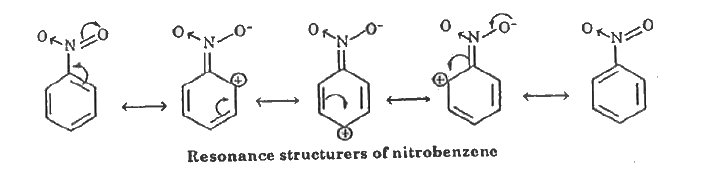
|
|
| 48. |
Explain mesomeric and inductive effects present in vinyl chloride. |
Answer» Solution :The resonace structures of VINYL chloride are:  The inductive and mesomeric effects, when PRESENT together, may act in the same direction or oppose each other. The mesomeric EFFECT is more powerful than inductive effect. In vinyl chloride, CHLORINE atom should develop a negative charge due to `-I` effect but on account of mesomeric effect, it has POSITIVE charge. |
|
| 49. |
Explain Mechanism or working of an acid buffer: |
|
Answer» Solution :Consider the acidic buffer mixture, `CH_(3)COOHhArrCH_(3)COO^(-)+H^(+),CH_(3)COONatoCH_(3)COO^(-)+Na^(+)` Here, acetic acid is a WEAK electrolyte and its solution there exists equilibrium between its ions and molecules, whereas SODIUM acetate completely dissociates into its ions. Therefore, the buffer mixture contains large number of `CH_(3)COO^(-)` ions followed by `Na^(+),H^(+),CH_(3)COOH`. Case (i) When an acid is added to this solution: `H^(+)` ion of the acid COMBINES with `CH_(3)COO^(-)` ion in the buffer solution and makes equilibrium forming acetic acid. `CH_(3)COO^(-)+H^(+)hArrCH_(3)COOH` As a result pH remains constant Case (ii) When a BASE is added to this solution: `OH^(-)` ion of the base combines with `H^(+)` ion in the buffer solution to form a water MOLECULE `H^(+)+OH^(-)toH_(2)O` As a result pH remains constant. |
|
| 50. |
Explain mechanism of first step of general electrophilic substitution reaction for benzene. |
Answer» Solution :In first step of ELECTROPHILIC reaction of BENZENE, the destruction of stable `pi`-electron cloud of benzene ring is occur which can form intermediate product.  Intermediate product is known as `SIGMA`-complex or arenium ION. Due to breaking of `sigma`- bond is carried out in this step and also for the formaiton of `sigma`- complex more energy is required and hence, this step is slower in nature. One carbon of `sigma`-complex is `sp^(3)` HYBRIDIZED, so it is not an aromatic compound, it is less stable although it has proven its presence. It is proven that resonance is possible in intermediate `sigma`-complex. A, B, C are the resonance structure of ` sigma`-complex and (D) is its hybrid form. Rate is slow for the formation of intermediate carbocation or `sigma`-complex or arenium ion and in this reaction bond is broken down and form electrophile, so this reaction mechainsm is of "Electrophilic" type. 
|
|