

Saved Bookmarks
This section includes 7 InterviewSolutions, each offering curated multiple-choice questions to sharpen your Current Affairs knowledge and support exam preparation. Choose a topic below to get started.
| 1. |
Explain speed of molecule of gas and average speed (u_(av)). |
|
Answer» Solution :Speed of MOLECULES and energy : Molecules are made up of particles of the substance having gaseous state. These particles are for away from each other in a large area. These particles are continuously moving in all direction. The continuous moving particles collide with each other and with the wall of container. At that time the speed and DIRECTIONS are CHANGED, so that all particles in a container do not have same speed, but have different SPEEDS which are continuously charging. However at one temperature the DISTRIBUTION of speed of molecules is same. Average molecule speed `(u_(av))` : Suppose, molecules of gas in .n. and its individual speed is `u_(1),u_(2)...u_(n)`. Average speed is `u_(av)`. `therefore u_(av)=(u_(1)+u_(2)+.......u_(n))/(n) ""`....(Eq. -i) |
|
| 2. |
Explain sp^(3)d^(2) hybridization SF_(6) molecule. |
|
Answer» Solution :Sulphur hexafluoride has one sulphur and six fluorine atoms, Sulphur atoms has six unpaired electrons in the excited state. S (ground state) `: [Ne] 3s^(1) 3p_(x)^(1), 3p_(x)^(1), 3p_(y)^(1), 3d_(xy)^(1), 3d_(xy)^(1)`  During the formation `SF_(6), 3s` three 3p and two 3d orbitals mix to form `sp^(3)d^(2)` HYDRID orbital. Thesehybrid orbitals are oriented towares six corners of an octahedron. 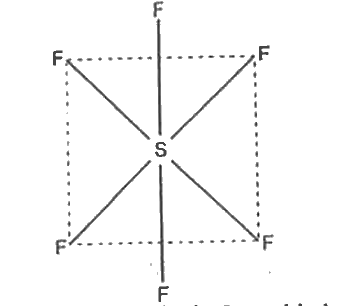 The six hybrid ortbihals of sulphur overlpa with six `2p_(x)` orbitals fluorine to form six-covalent bonds. HENCE the molecule of `SF_(6)` octahedral STRUCTURE. |
|
| 3. |
Explain standard enthalpy of formation (Delta_(f)H^(@)). |
|
Answer» Solution :It is defined as the change in enthalpy accompanying the formation of one MOLE of a compound in its STANDARD state from the ELEMENTS in their standard states. Example : `H_(2(G)) + (1)/(2)O_(2(g)) rarr H_(2)O_((l)) , Delta_(f)H^(@) = -285.8 kJ mol^(-)1`. |
|
| 4. |
Explain sp^(3)d hybridization PCl_(5) molecule. |
|
Answer» Solution :A molecule of phosphorus pentachloride has one phosphorus atom 5 chlorine atoms. Phosphorous atom has five electrons in thevelence shell and chlorine atom has one electron to share. P (ground state) : `[Ne] 3s_(2) 3p_(3)` P (EXCITED state) : `[Ne] 3s^(1) 3p_(x)^(1),3p_(y)^(1), 3p_(x)^(1), 3d^(1)` 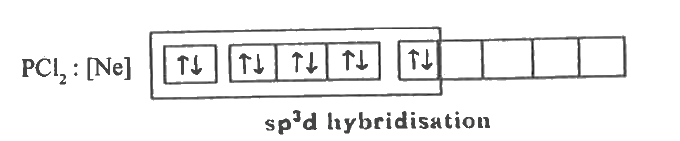 During the formation `PCl_(3), 3s` three one 3d orbitals mix to form `sp^(3)` d hbrid orbitals. The `sp^(3)d` hybrid orbitals are towares five corners of trigonal bipyramid. Three covalent bonds are formedon one plane at an angle of `120^(@)`. Two more covalent bonds are formed at RIGHT angles to the palne. These are axial bons. The exail bonds are weaker than equatorial bonds because axial electrons suffer morerepulsion from quatorial electrons. HENCE `PCl_(5)` is more reactive Axial P-Cl bond length is 219 pm and equatorial P-Cl bond lenth is 204 pm. 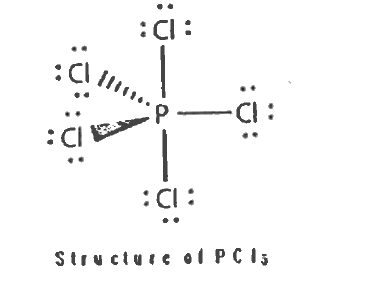 |
|
| 5. |
Explain sp^(3) d hybridisation with a suitable example. |
|
Answer» Solution :(i) In the `PCl_(5)` molecule, the CENTRAL atom phosphorous is covalently bonded to five chlorine atoms. Here the atomic of phosphorous undergoes `sp^(3) d^(2)` hybridisation which involves its one 3s orbital, three 3p orbitals and one vacant 3d orbital `(d_(z)^(2)).` (ii) The ground state electronic configuration of phosphorous is `[Ne]3s^(2)" "3p_(x)^(2)" "3p_(y)^(1)" "3p_(z)^(1)`  (iii) One of the paired electrons in the 3s orbital of f phosphorous is promoted to one of its vacant 3d orbital `(dz^(2))` in the excited state.  (iv) The `3p_(z)` orbitals of the five chlorine atoms inearly overlap ALONG the axis with the five `sp_(3)` dhybridised orbitals of phosphorous to form the five `P - CL SIGMA` bonds as follows. 
|
|
| 6. |
Explain SP^2 hybridisation in ethene molecule. |
|
Answer» Solution :The molecular of ethene is `C_(2)H_(4)` Electronic configuration of C is ground state `-1s^(2)2s^(2)2p^(3)` Electronic configurationof C is exicted state `-1s^(2)2s^(2)p^(3)` Valence orbital REPRESENTATION 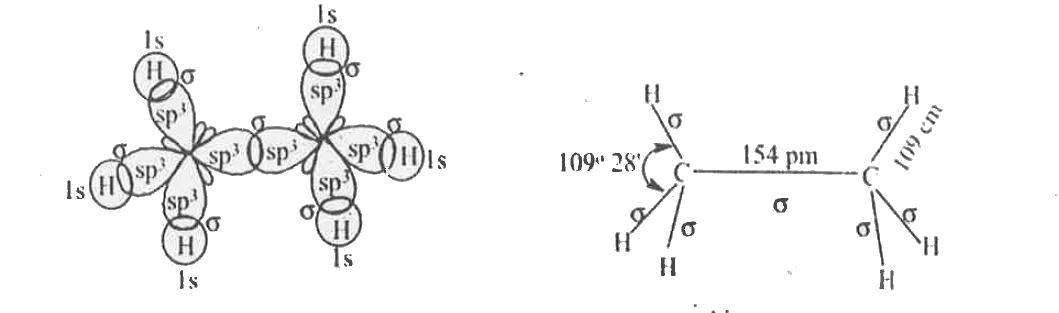 `sp^(2)` hybridization involves 2 carbon ATOMS combines with 4 atoms of hydrogen. In ethanemolecule, there is 5 sigma and 1 PI b OND. The angle of `sp^(2)` hybridized ethane is `120^(@)`. |
|
| 7. |
Explain sp^(2) hybridization BF_(3) molecule. |
|
Answer» Solution :`BF_(3)` molecule ELECTRONIC configuration of `B-1s^(2)2s^(2)3p^(1)` Valance orbital representation 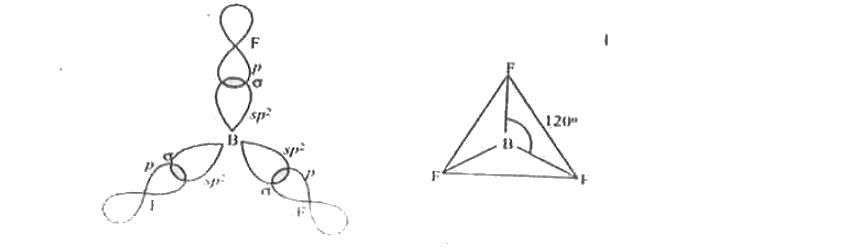 Electronic fonfiguration of `F-1s^(2)2s^(2)2p^(5)` Valance orbital representation Only one unpaired electrons in fluorine. Hence only `2p_(z)` orbital of fluorine involved in bond formation. |
|
| 8. |
Explain sp^(2) hybridisation in BF_(3). |
|
Answer» <P> Solution :`sp^(2)` hybridisation in boron trifluoride: Boron atom B:Electronic configuration `[H_(2)]2s^(2)p^(1).`  (II) In boron, the s orbital and two p orbitals in the valence shell hybridises to generate THREE equivalent `sp^(2)` orbitals. These 3 orbitals LIE in the same y plane and the angle between any two orbitals is equal to `120^(@)` (iii) The 3 `sp^(2)` hybridised orbitals of boron now overlap with the `2p_(z)` orbitals of fluorine (3 atoms) This overlap takes place along the axis. 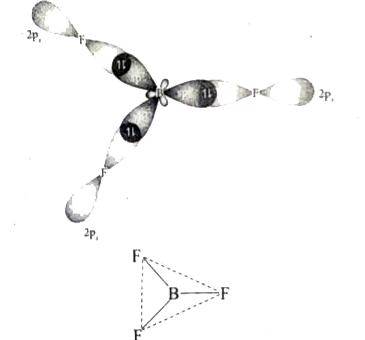
|
|
| 9. |
Explain sp hybridisation with an example. |
|
Answer» SOLUTION :`C_(1)H_(2)`-ethyne ofacetylene Electronic CONFIGURATION of C excited state `-1s^(2)2s^(2)2p^(3)` Valance orbital representation 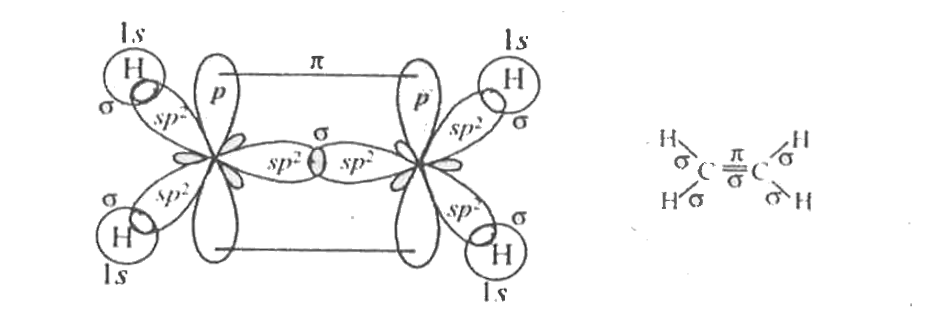 Sp hybridised, C contains 2 unpaired electron and one each in py and pz two sp hybridised C combines with two `1s^(1)` orbital of H. Two more hybrid orbitals each carbon with 1 s atomic orbitals ofhydrogen to FORM sigmabonds. The unhybrised 2pz orbitals of both the carbon atoms now overlap sideways to form carbon-carbon pi-bond. |
|
| 10. |
Explain sp-hybridisation in BeCl_2 molecule. |
Answer» Solution :ELECTRONIC configuration of `Be:` 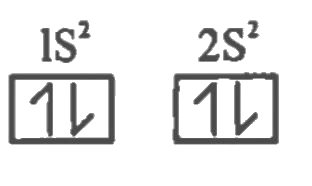 [Ground STATE] [Ground STATE] Electronic configuration fo Be in excited state: 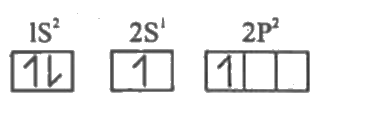 One 2S and One 2P orbital of BERYLLIUM undergoes SP hybridisation giving rise to two SP hybrid orbitals of same energy. Which has linear structure. Two SP hybrid orbitals of Beryllium OVERLAPS with 2P orbital of Chlorine to form two Be-Cl covalent bonds with a bondd angle of `180^(@0`. 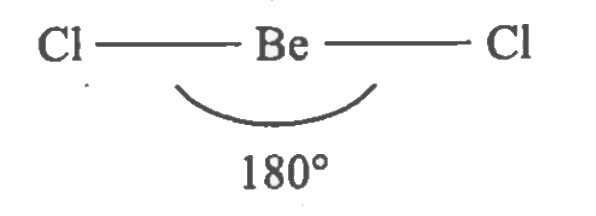
|
|
| 11. |
Explain solubility of salt in presence of common ion. |
|
Answer» Solution :The solubility of sparingly soluble SALT is decrease in presence of common ion. Common ion increase meanspositive ion or negative ion any one ions increase more in solution. e.g. In saturated solution of AgCl if NaCl is ADDED `Cl^(-1)` ion is common and if `AgNO_3` is added `Ag^+` ion is common so concentration of that ions increases. So precipitation take place and solubility of sparingly soluble salt decreases. eg.-1 : In saturated solution of NaCl is HCl gas is passed than concentration of `Cl^-` increases and solid NaCl increases so solubility of NaCl decreases. In the first example solid AgCl increases and solubilities of AgCl decreases. e.g.-2 : In the solution of sparingly soluble salt AgCl,when NaCl is added , the concentration of common ion `Cl^-` increases or by adding `AgNO_3`, concentration of `Ag^+` increases. Due to increase of `Cl^(-1)` or `Ag^+` , solid AgCl increases and solubility of AgCl decreases. |
|
| 12. |
Explain solid-liquid equilibrium by giving example. |
|
Answer» Solution :Ice and water kept in a perfectly insulated thermos flask at 273 K and 1 atmospheric pressure are in equilibrium state and the system shows following. `UNDERSET"Ice"(H_2O_((s))) overset"1 atm, 273 K"hArr underset"Water"(H_2O_((l)))` (Eq.-i) The mass of ice and water do not change with time and the temperature REMAINS constant. However, the equilibrium is not STATIC. The intense activity can be noticed at the boundary between ice and water. Molecules from the liquid water collide against ice and ADHERE to it and some molecules of ice escape into liquid phase. There is no change of mass of ice and water, as the rates of transfer of molecules from ice into water and of reverse transfer from water into ice are equal at atmospheric pressure and 273 K. (i) Both the opposing processes OCCUR simultaneously. (`H_2O_((s)) to H_2O_((l))` and `H_2O_((l)) to H_2O_((s))` ) (ii)Both the processes occur at the same rate so that the amount of ice and water remains constant. `H_2O_((s)) to H_2O_((l))` rate `to r_1` `H_2O_((l)) to H_2O_((s))` rate `to r_2` So, `r_1=r_2, H_2O_((s)) hArr H_2O_((l))` |
|
| 13. |
Explain solid-vapour equilibrium by example. |
|
Answer» SOLUTION :At constant temperature in closed vessel the systems where solids sublime to vapour phase, this situation is known as solid-vapour equilibrium. `"Matter"_((s)) HARR "Matter"_((g))` (constant T) ….(i) Ex.-1 : If we place solid iodine (`I_2`) in a closed vessel, after sometime the vessel gets filled up with violet vapour and the intensity of colour increases with time. After CERTAIN time the intensity of colour becomes constant and at his stage equilibrium is attained. Hence solid iodine sublimes to GIVE iodine vapour and the iodine vapour condenses to give solid iodine. Properties, colours etc. becomes constant. The equilibrium can be represented as, `UNDERSET"violet solid"(I_(2(s))) hArr underset"violet vapour"(I_(2(g)))`....(constant T) Other examples showing this kind of equilibrium are, (i)`"Camphor"_((s)) hArr` Camphor ....(constant T) (ii)`NH_4Cl_((s)) hArr NH_4Cl_((g))` ....(constant T) |
|
| 14. |
Explain : 'Sodium carbonate solution is basic.' |
|
Answer» Solution :It is a SALT of strong base NaOH and weak ACID `H_2CO_3` therefore solution BECOME basic. `Na_2CO_3 to 2Na^(+) +CO_3^(2-)` `NA^+` is not hydrolyses `CO_3^(2-)` is hydrated `CO_3^(2-) + 2H_2O hArr H_2CO_3 + 2OH^(-)` Here, `[OH^-]` INCREASES so solution is basic. |
|
| 15. |
Explain S_(N^(2)) mechanism with suitable examples. |
|
Answer» Solution :(i) `S_(N^(2))` reaction means BIMOLECULAR nucleophilic substitution reaction of second order. (ii) The RATE of `S_(N^(2))` reaction depends upon the concentration of both alkyl halides and the nucleophile. (iii) The carbon at which substitution occurs has inverted configuration during the course of reaction just as an umbrella has the tendency to invert in a wind-storm. this inversion of configuration is called WALDEN inversion.  . .
|
|
| 16. |
Explain S_(N^2) mechanism with suitable example. |
|
Answer» Solution :(i) `S_(N^2)` reaction means biomolecular nucleophilic SUBSTITUTION reaction of second order ? (II) This reaction involves the FORMATION of a transition state in which both the reactant molecualrs are partially bonded to each other. The ATTACK of nucleophile OCCURS from the back side. (iii) This reaction involves the formation of a transition state in which both the reactant molecuales are partially bonded to each otehr. The attack of nucleophile occure from the back side. (iv) The carbon at which substitution occurs has inverted configurationduring the course of reaction just as an umbrella has the tendency to invert in a wind - storm. This inversion of configuration is called walden inversion. 
|
|
| 17. |
Explain simplicity of gases. |
|
Answer» Solution :Simplicity of GASES is due to the fat that the forces of interaction between their molecules are negligible. Their behaviour is governed by same COMMON general laws, which were discovered as a result of their experimental studies. These laws are relationships between measurable PROPERTIES of gases. Some of these properties like PRESSURE, volume , temperature and mass are very important because relationships between these variables DESCRIBE state of the gas. |
|
| 18. |
Explain situation of ideal gas behaviour of gas. |
|
Answer» <P> Solution :Real gases show ideal behaviour when conditions of temperature and PRESSURE are such that the intermolecular forces are practically negligible.If Z = 1 then it shows ideal behaviour. If volume of gas is more than volume of MOLECULE which is negligible at that situation gas shows ideal behaviour. When pressure decreases then behaviour of real gas is near to ideal gas. Real gas shows ideal behaviour which is DEPEND upon of gas and temperature at lower pressure. At low pressure and high temperature real gas shows ideal behaviour. This conditions are different for different gases. If gas shows ideal behaviour then,`V_("ideal")=(nRT)/(p)` Which can follow Ideal gas laws at real pressure at that temperature. |
|
| 19. |
Explain silicon dioxide. |
|
Answer» Solution :95% of the earth.s crust is MADE up of silica and silicates. Silicon dioxide, commonly known as silica, occurs in several crystallographic forms. Silica is found in the form of quartz, CRISTOBALITE and tridymite. Silicon dioxide is a covalent, three-dimensional network solid in which each silicon atom is covalently bonded in a tetrahedral manner to four oxygen atoms. Each oxygen atom in turn covalently bonded to another silicon atoms. The entire crystal may be considered as giant molecule in which eight membered rings are formed with alternate silicon and oxygen atoms.  Silica in its normal form is ALMOST non-reactive because of very high Si - O bond enthalpy. It resists the attack by halogens, dihydrogen and most of the acids and metals even at elevated temperatures. `SiO_2` REACTS with HF and NaOH. `SiO_2 + 2NaOH to Na_2SiO_2 + H_2O` `SiO_2 + 4HF to SiF_4 + 2H_2O` |
|
| 20. |
Explain seconds steps of general electrophilic substitution reaction of benzene. |
Answer» Solution :In first slow step, electrophiles are attaches with benzene and form `-sigma`-complex. `sigma`-complex loses proton. Proton is donated to the negative ion form in steps which gives electrophilic `sigma`-complex, and gives substitution product. <BR>  `A^(-) + H^(+) rarr H^(+)A^(-) + "Catalyst"` `FeCl_(4)^(-) + H^(+) rarr HCl + FeCl_(3) + C_(6)H_(5)Cl` `FeBr_(4)^(-) + H^(+) rarr HBr + FeBr_(3) + C_(6)H_(5)Br` `AlCl_(4)^(-)+ H^(+) rarr HCl+ AlCl_(3) + C_(6)H_(5)E` all carbons are `SP^(2)` in substituted product. Aromatic character is possessed by substituted product. `sp^(3)` carbon is converted into `sp^(2)` when substitution product is formed. Second step is not rate determining because it is fast step. At the end of second step, product is formed by attachment of electrophile in place of H present in main compound. So mechanism is of electrohilic substitution TYPE. |
|
| 21. |
Explain Scientific Notation method of measurement. |
|
Answer» A chemist has to deal with numbers as large as 602, 200, 000, 000, 000, 000, 000, 000 for the molecules of 2 g of hydrogengas or as small as 0.00000000000000000000000166 g mass of a H atom. SIMILARLY other constants such as Planck.s constant, speed of light, charges on particles etc., involve numbers of the above magnitude. This problem is SOLVED by using scientific notation for such numbers, i.e., exponential notation in which any number can be represented in the form `Nxx10^(n)` where n is an exponent having positive or negative VALUES and N is a number ( called digit term) which VARIES between 1.000... and 9.999... e.g. : we can write 232.508 as `2.32508 xx 10^(2)` in scientific notation. Similarly, 0.00016 can be written as `1.6xx10^(-4)`. Multiplication and Division : These two operation follow the same rules which are there for exponential numbers. e.g. :1 `(5.6xx10^(5))xx(6.9xx10^(8))=(5.6xx6.9)(10^(5)+8)` `=(5.6xx6.9) xx10^(13)` `=38.64xx10^(13)` `3.864xx10^(14)` e.g.: 2 `(2.7xx10^(-3))/(5.5xx10^(-4))=(2.7 div 5.4)(10^(-3 -4))` `=4.909xx10^(-8)` Addition and substraction : For these two operations, first the numbers are written in such a way that they have same exponent. e.g. : Adding `6.65xx10^(4)` and `8.95xx10^(3), 6.65xx10^(4)+0.895xx10^(4)` exponent is made same for both the number. Then, these number can be added as follows, `(6.65+0.895) xx10^(4)=7.545xx10^(4)` Similarly,the substraction of two numbers can be done as shown below. `2.5xx10^(-2)-4.8xx10^(-3)=(2.5xx10^(-2))-(0.48xx10^(-2))` `=(2.5-0.48)xx10^(-2)` `=2.02xx10^(-2)` |
|
| 22. |
Explain shielding effect with example. Also explain 2s - 2p approach in group and period. |
|
Answer» Solution :In multielectron atoms the OUTERMOST electrons are shielded or screened from the NUCLEUS by the inner electrons. This is known as shielding or screening effect . Due to shielding effect, the valence ELECTRON from the nucleus by the intervening core electrons. For example : 2s electron in lithium is shielded from the nucleus by the inner core of 1s electrons. As a result the valence electron experience a net positive charge which is less than the ACTUAL charge of `+3`. Group : Shielding effect is more effective in group. If inner orbitals are completely filled in atom then shielding effect is more. Ex. Alkali metals. Period : In period, inner orbital are not increasing so effect of shielding effect is less than nuclear charge. So, 2p electrons experiencing more shielding effect than 2s electrons. |
|
| 23. |
Explain Shape of sp, sp^(2) and sp^(3)hybrid orbitaJs |
Answer» Solution :sp orbital : The two sp hybrids point in the opposite direction along the z-axis with PROJECTING POSITIVE lobes and very small negative lobes. `sp^(2)` orbital : There `sp^(2)` HYBRID orbitals are oriented in a trigonal planar arrangement symmetrically at `120^(@)` angle between them .  `sp^(3)` HYBRIDIZATION : The four `sp^(3)` hybrid orbitals are directed towards the four comers of the tetrahedron. The angle between `sp^(3)` hybrid orbital is `109^(@)`28.. 
|
|
| 24. |
ExplainSchrodingerwaveequationand alsoexplainsigmaand sigma ^(2)oneelectronsystem. |
|
Answer» Solution :WhenSchrodingerequationis solved forhydrogenatom. (i) The solutiongivesthe possibleenergylevelscorrespondingwavefunction ( s)of theeletronassociatedwith eachenergylevel. (II) Thesequantizedenergystatesandcorrespondingwavefunction WHICHARE numberhydrogendependonlyupon. (iii)Whenanelectronis in anyenergystatethe wavefunctioncorrespondingto thatenergystatecontainsall informationabouttheelectron. thequantummechanicalresultsof thethe hydrogenatomspectrumincludingsomephenomenathat COULDNOT beexplainedby the bohr MODEL. foroneelectron species the ENERGYOF orbitalsbased uponprinciplequantumnumbern |
|
| 25. |
Explain Saytzeff's rule with an example. |
Answer» Solution :ALKYL halide UNDERGO DEHYDROHALOGENATION in more than one WARY, the preferred ALKENE is one which is more alkylated. 
|
|
| 26. |
Explain saw horse projection with examples. |
|
Answer» Solution :In alkane, C-C bond around explain by saw horse as below : (i) In this projection, the molecule is viewed along the molecular axis. It is then projected on paper by drawing the central C-C bond as a SOMEWHAT longer straight line. (ii) Upper end of the line slighty little towards RIGHT or LEFT hand side. (iii) The front carbon is shown at the LOWER end of the line, whereas the rear carbon is shown at the upper end. (iv) Each carbon has three lines attached to it corresponding to three hydrogen atoms. (V) The lines are inclined at an angle of `120^(@)` to each other. (vi) Sawhorse projection of eclipsed and staggered conformation of ethane are as follows : 
|
|
| 27. |
Explain Sandmeyer's reaction . |
Answer» SOLUTION :Sandmeyer.s reaction : The reaction in which BENZENE- diazonium chloride is CONVERTED to chlorobenzene on heating it with `Cu_(2) Cl_2//HCl` is known as Meyer.s reaction . 
|
|
| 28. |
ExplainRutherfordnuclearmodelof atom |
|
Answer» Solution :Rutherford and hisstudents(Hansgeiger andErnestMarsden ) GIVE `ALPHA`-particlescatteringexperiment In thisexperimenttheybombarded `alpha` particleson very thingoldfoil. Theexperiment is SHOWNBELOW.  Highenergy`alpha`-particlefrom a RADIOACTIVE sourcewas directionatthinfoilof goldmetal A fluoresecentzincsulphidescreen waskeptaroundthe thingoldfoilthen `alpha` particlesstruckthisscreenthey producedfluorescenceeffect. |
|
| 29. |
Explain : Rutherfordatomicmodelcan notexplainstabilityof anatom |
|
Answer» Solution :Rutherfornuclear modelof ANATOMIS like asmallscalesolarsystemwith thenucleusplayingthe roleof themassivesunand theelectronsbeingsimilar to thelighterplanets Nowbetweenelectronand thenucleus coulombforce` = k (q_(1)q_(2))/( r^(2))` r= DISTANCEOF separationof charges k=proportionallyconstant Gravitationforce `G (m_(1) m_(2))( r)` Where`m,_(1)` and`m_(2)`masses G= gravitationalconstant r=distanceof sepration of themasses Whenclassicalmechanics (i)isapplied tothesolarsystem(iiitshowsthat theplanetstheorycan alsocalculateprecisely the planetaryorbitsand THESEARE inagreementwiththeexperimentalmeasurements Thesimilarybetweenthe solarsystemand nuclearmodelsuggetsthat electronsshouldmovearoundthe nucleusin welldefinedorbitsHoweverwhena BODY ismovingin anbody itundergoesaccelerationmovingwith aconstantspeedinan orbitit mustaccelerationbecauseof changingdirection. Thusanelectronin thenuclearmodeldescribingplanetlikeorbitsisunderacceleration . Accordingto theelectromagnetictheoryofMaxwellchargeparticlewhenacceleratedshouldemitelectromagneticradiation(thisfeaturedoes notexistforplanetssincetheyareuncharged. Atomremainstable . thusRutherformode,lcannotexplainthe stabilityof ANATOM. |
|
| 30. |
Rutherfords atomic model accounts for : |
|
Answer» Solution :RUTHERFORD proposed a model of an atom as follows: a. An atom contains small but heavy, positively charged body called the nucleus, at its centre. B. The nucleus is surrounded by extremely small, negatively charged ELECTRONS at relatively large distances from the nucleus. The size of the nucleus is very small compared to that of the atom. c. Electrons are revolving round the nucleus, at high velocity in closed ORBIT, just as the planets revolve round the sun. d. The nucleus and the electrons are held together by electrostatic ATTRACTION forces. |
|
| 31. |
Explain root mean square speed (C or U_(rms)) |
|
Answer» Solution :It is square root of the arithmatic mean of the squares of SPEEDS of various MOLECULES of the gas at a GIVEN temperature. If `v_(1), v_(2), v_(3),...` are speeds of `n_(1), n_(2), n_(3)`.... Molecules respectively c or `u_(RMS)= sqrt((n_(1)v_(1)^(2)+n_(2)n_(2)^(2)+....)/((n_(1)+n_(2)+....0)))` RMs speed is related to T,P, V and M `:. c or u_(rms)= sqrt((3RT)/(M)) or sqrt((3PV)/(M)` |
|
| 32. |
Explain ring chain isomerism with the formula C_(4)H_(8). |
|
Answer» Solution :In RING chain isomerism, compounds have the same molecular formula but DIFFER in TERMS of bonding of carbon atoms to FORM open chain and cyclic structures `C_(4)H_(8)` : 
|
|
| 33. |
Explain resonance with reference to carbonate ion. Lewis structure of CO_(3)^(2-) |
Answer» Solution :(i) For the above structure, we can draw two additional lewis structures by moving the lone pairs from the other two oxygen atoms `O_(B) and O_(C)` and thus CREATING three similar structures in which the relative positive of the atoms are same. 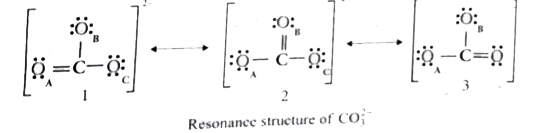 RESONANCE structure of `CO_(3)^(2-)` (ii) They only differ in the position of bonding and lone pair of electrons. Such structures are called resonance structures and this phenomenon is called resonance. (iii) It is evident from the experimental results that all carbon-oxygen bonds in carbonate ion are equivalent. The actual structure of the molecule is said to be a resonance hybrid. an AVERAGE of these 3 resonance forms. The FOLLOWING structure gives a qualitative idea about the CORRECT structure of `CO_(3)^(2-)` (carbonate) ion. 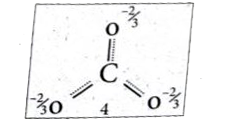
|
|
| 34. |
Explain resonance concept. |
| Answer» Solution :According to concept of resonance When a covalent molecule is respresented by more than one LEWIS structures and when non of them describes the molecule accurately then the correct STRUCTURE of the molecule is the hybrid of all the lewis structures called canonical STRUCTURS. | |
| 35. |
Explain resonance and stability of benzene. |
|
Answer» Solution :The actual structure of BENZENE is a combination of all these structures called RESONANCE hybride and structures contributing to this hybrid structure are known as resonance structures. Benzene is a resonance hybrid of the following resonance structures. KEKULE's structures CONTRIBUTE to resonance hybrid to the extent of 80% hence they EXPLAIN most of the reactions of benzene. the energy difference between kekule structrure and resonance hybrid is called resonance energy which accounts for unsual stability of benzene. 
|
|
| 36. |
Explain-Resonace. |
|
Answer» Solution :(i) Certain organic compounds can be represented by more than one structure and they differ only in the position of bonding and LONE pair of electrons. Such structures are called resonance structure and this PHENOMENON is called as resonance. This phenomenon is also called as mesomerism or mesomeric EFLECT. (ii)For example, the structure of aromatic COM like 1.3 butadiene cannot be represent hy a single structure and their observed properties be explained on the base of a resonance hybrid. (iii) Resonance structure of benzene. 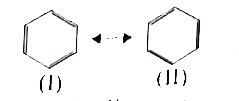 (1) and (II) are called as resonance HYBRIDS of benzene. (iv) For 1,3 butadiene:  (I), (III) and (III) are called as resonance hybrids of 1,3 butadiene. |
|
| 37. |
Explain relation of solubility (S) and K_(sp). |
|
Answer» <P> Solution :`M_x^(p+) X_y^(q-)` is a sparingly SOLUBLE salt and solubility is S mol `L^(-1)`. The amount of this salt is dissolve in solution is totally in the form of ions. In solution 1 MOLECULE `xM^(p+)` positive ion and `yX^(q-)` negative ion and form , from this salt and ionic equation is as follows .`M_x^(p+) X_(y(s))^q hArr xM_((aq))^(p+) +yX_((aq))^(q-)` ...(Eq.-i) Where `(x XX p^(+) = yxxq^(-))` The concentration of solid salt MIX with `K_(sp)`, So solubility product is as follows . `K_(sp)=[M^(p+)]^x [X^(q-)]^y` But applying stoichiometry and S `K_(sp)=(x S)^x (S)^y` `=x^x xx y^y (S)^((x+y))`...(Eq.-ii) `therefore (S)^((x+y)) = K_(sp)/(x^x y^y)` `therefore S=K_(sp)/((x^x xx y^y)^(1//x+y))`....(Eq.-iii) |
|
| 38. |
Explain relation between pressure - volume and density of gases. |
| Answer» SOLUTION :On the basis of his EXPERIMENTS Robert Boyle reaches to the CONCLUSION which is known as Boyle.s LAW. | |
| 39. |
Explain relation between Fluid State, Liquid - Gas State, Critical temperature and Vapour form of substances. |
|
Answer» Solution :Thus there is continuity between the gaseous and liquid state. The term fluid is USED for either a liquid or a gas to recognise this continuity. Thus a liquid can be viewed as a very dense gas. Thus (i) a liquid and gas can be DISTINGUISHED only when the fluid is below its critical TEMPERATURE and (ii) its pressure and volume lie under the dome.Since in that situation liquid and gas are in equilibrium and a surface separating the two phases is visible. In the absence of this surface there is no fundamental way of distinguishing between two states. At critical temperature, liquid PASSES into gaseous state imperceptibly and continuously, the surface separating two phases disappears. Substance of (CARBON dioxide of) vapour : Gas below the critical temperature can be liquified by applying pressure, and is called .substance vapour. of the substance. ..Carbon dioxide gas below its critical temperature is called carbon vapour... 
|
|
| 40. |
Explain relation between, moles of gas volume and density of gas. |
|
Answer» Solution :Calculation of moles of gas : Gaseous mole `(n)=("Weight of gas (GM)n")/("MOLECULAR mass of gas (M)")` `therefore n = (m)/(M) ""`…..(EQ. - i) where, m = weight of gas M = molecular mass of gas According to Avogadro law of FORMULA : `V = k_(4) n ""`.....(Eq. - ii) `therefore V = k_(4)(m)/(M) ""`...(Eq. - iii) Thus, `M=k_(4)((m)/(V)) ""`......(Eq. -iv) but, `(m)/(V)=` density of gas = d `therefore M = k_(4)d ""`.....(Eq. -v) Derivation : ..Density of gas is directly proportional to its molecular mass... |
|
| 41. |
Explain redox reaction of electrodes with example of denied cell. |
|
Answer» Solution :In a beaker, copper sulphate solution is TAKEN, in which CU rod is dipped and in other beaker zinc sulphate solution is taken and zinc rod is dipped into the beaker. Now reaction takes PLACED in either of the beakers and at the interface of the metal and its salt solution in each beaker both the reduced and oxidized form of the same species are present. These represent the species in the reduction and oxidation half reaction. A redox couple is defined as having together the oxidized and reduced forms of a substance taking part in an oxidation an oxidation of reduction half reaction. This is represented by separating the oxidized form from the reduced form by a vertical line or a slash representing an interface. For example in this experiment the two redox couples are represented as `Zn^(+2)//ZnandCu^(+2)//Cu` in both cases, oxidised form is put before the reduced form. We connect the solutions in two beakers by a salt bridge. Salt bridge : a U-tube containing the solution of pottassium chloride or ammonium nitrate usually solidified by boiling with agar-agar and taken cooling to a jelly like substance. (i) The transfer of electrons now does not takes place directing from Zn to `Cu^(+2)` but through the metallic wire connecting the two rods as in apparent from the arrow which indicates the flow of current. (ii) The electricing from solution in one beaker to solution in the other beaker flows by the migration of IONS through the salt bridge. How of current is possible only if there is a potential difference between the copper and zinc rods. The potential associated with each electrode is known as electrode potential. The concentration of each species taking part in the electrode reaction is unity and further the reaction is carried out at 298 K, then the potential of each electrode is said to be the standard electrode potential. By convention, the standard electrode potential of hydrogen electrode is 0.0 volts. The electrode potential value for each electrode process is a measure of the relative tendency of the active species in the process to remain in the oxidised/reduced form. A negative `E^(-)` means redox couple is a stronger reducing agnet than the `H^(+)//H_(2)` couple. Table : The Standard Electrode Potentials at 298 K Ions are present as aqueous species and `H_(2)O` as liquid, gases and solids are shown by g and s respectively.  (i) Negative `E^(-)` means redox couple is strong, reducing agent than `H^(+)//H_(2)` couple. Positive `E^(-)` means redox couple weak reducing agent than `H^(+)//H_(2)` couple. |
|
| 42. |
Explain Real gases do not completely follow Boyle.s law, Charle.s law and Avogadro.s law under all conditions. |
|
Answer» Solution :(A) According of Boyle.s Law, Explanation of graph of `pV to p` (CONSTANT) : Theoretical VALUE is `pV to nRT`. At constant temperature and all PRESSURE, parallel to X - axis line is obtained for graph `pV to p`. Because parallel to X - axid straight line obtained. According to Boyle.s law for graph `pV to p`. But in real graph for `pV to p` is not obtained straight line. In figure (graph) against are shown ast constant temperature `pV to p`. This grpah is not straight line for ideal gas and shows DEVIATION with ideal gas.  More over it is not parallel to X - axis as an ideal gas. Graph Type - 1 : Graph of Dihydrogen and Helium are strasight line and pV increases with increasing pressure. Graph Type - 1 : The real gas Carbon monoxide (CO) and Methane `(CH_(4))` shows different type of curve. According to curve, CO and `CH_(4)` gas shows negative deviation with Ideal gas. Value of pV decreases with increasing in pressure. Vaslue of pV decreases with increasing in pressure and reached at minimum value. After that value of pV increases with increasing in pressure and it intercept line of ideal gas and deviation becomes zero. Value of pV increases with increasing in pressure and continuously positive deviation observed. So real gases do not follow ideal gas equation in each energy condition. (B) According of Boyle.s LAw, Explanation of deviation of graph of `p to V` (T constant ):Graph of `p to V` of real gas shows deviation than ideal gas is shown in graph, `p to V` curve is given according to Boyle.s Law and some experimental information.  This graph indicate that, (i) MEASURED volume at high pressure (volume of real gas is higher than ideal gas). (ii) Volume of real gas measured at low pressure it will be nearest thans volume of ideal gas. From result of A & B. Prove that real gases do not follow Boyle.s Law, Charle.s Law and Avogradro.s Law. |
|
| 43. |
Explain redox reactions on the basic of electron transfer. Give suitable examples. |
|
Answer» Solution :`2Na_((s))+Cl_(2(g))to2NaCl_((s))` `4Na_((s))+O_(2)to2Na_(2)O` `2Na+StoNa_(2)S` Given reactions are redox reactions all the reactions Na is converting into`NaCl,Na_(2)OandNa_(2)S`. At this TIME Na is attached to elements having more electronegative so Na form OXIDATION and chlorine, OXYGEN and sulphur attached to electropositive element so it form reduction. NaCl, `Na_(2)OandNa_(2)S` ionic compounds so it will the INDICATED as `Na^(+)Cl^(-),(Na^(+))_(2)O^(-2)and(Na^(+))_(2)S^(-2)`. Above three reaction can be indicated as reduction by `2e^(-)`.   This reactions are redox reaction so electron transfer are element to another element. During oxidation reaction `e^(-)` LOSES then positive ion is obtained and during reduction `e^(-)` receive so if reactant is positive then its positive. Charge decreases if reactant is neutral then it will give negative ion. The reagent loses `e^(-)` is known as reducing agent, the reagent accept `e^(-)` is known as oxidising agent. |
|
| 44. |
Explain Real gases showing deviations from ideal gas with correction of pressure and volume and derive van der Waal.s equation. |
|
Answer» Solution :Molecules of gases interact with each other this type of attraction ..changes pressure and repulsion can change volume... Interaction attraction process at higher temperature and correction in pressure : At high pressures molecules of gases are very CLOSE to each other. Molecular interactions start operating. At high pressure, molecules do not strike the walls of the container with FULL IMPACT because these are dragged back by other molecules due to molecular attractive forces. This affects the pressure exerted by the molecules on the walls of the container. THUS, the pressure exerted by the gas is lower than the pressure exerted by the ideal gas. `therefore p_("ideal")=(p_("real"))+((an^(2))/(V^(2)))""`....(Eq. - i) `= (("Experimental observed"),("Pressure"))+(("Correction in pressure of"),("interactive molecules"))` where, a = constant + (Van der Waals constant as correction of pressure.) = magnitude of measurement of Alteraction force of gas. `therefore` Value of a is independent to pressure. Value of a is independent to temperature and pressure. Interaction repulsive forces and correction of volume high pressure : Repulsive forces also become significant. Repulsive interacrtions are short - range interactions and are significant when molecules are almost in contact. This is the situation at high pressure. The repulsive forces cause the molecules to behave as small but impenetrable spheres. The volume occupied by the molecules also becomes significant because instead of moving in volume V, these are now RESTRICTED to volume (V - nb) where (nb) is approximately the total volume occupied by the molecules themselves. Effect volume of gas = (V - nb).....(Eq. - ii) (real volume) (correction of volume) Van der Waals equation : Equation of common ideal gas pV = nRT For equation of pressure (i) and volume (ii), put in ideal gas equation then equation can be written as under, `(p+(an^(2))/(V^(2)))(v-nb)=nRT ""`.....(Eq. - iii) This equation is known as van der Waals equation. Where, p = real pressure, V = real volume a, b = van der Waal.s constant. Value of a, b is depend upon characteristics of gas. Value of a, b are magnitude of measurement of intermolecular attraction and repulsive force respectively. They are independent to temperature and pressure. |
|
| 45. |
Explain reactivity of group 14 elements towards oxygen. |
|
Answer» Solution :All members when heated in oxygen form oxides. There are mainly two types of oxides, i.e., MONOXIDE and dioxide of formula MO and `MO_2` respectively. Sio only exists at high temperature. Oxides in higher oxidation states of ELEMENTS are generally more acidic than those in lower oxidation states. Acidic oxides: `CO_2 , SiO_2 , GeO_2` Amphoteric oxides : `SnO_2 , PbO_2` AMONG MONOXIDES, CO is neutral, GeO is distinctly acidic whereas SNO and PbO are amphoteric. |
|
| 46. |
Explain reactivities of physical and chemical trends of elements of group and period. |
|
Answer» Solution :Chemical reactivity in period : Within a period, chemical reactivity trends to be high in Group 1 metals, lower in elements towards the middle of the table and increased to a MAXIMUM in the Group 17 non-metals. Chemical Reactivity in Group : Within a group of representative metals reactivity increases on MOVING down the group, where as with a group of non-metal (Halogens) reactivity decreases down the group. Physical and chemical properties of elements of periodicity is DIRECTLY proportional to number of electrons and ENERGY level. |
|
| 47. |
Explain reactivity of alkene towards electrophilic. |
Answer» Solution :In alkene, carbon-carbon has weak `pi`-bond.  Electrons of `pi`-bonds shows weak dynamic electrons. This type of `pi`-electrons SOURCE is present in alkene. So such type of reactant and compounds attack on `pi`-bond and alkene and break `pi`-bond easily and forms compounds having single bond. So alkane compounds easily GIVES addition reaction. `pi`-bond because alkene is more reactive and LESS STABLE than alkanes. So, strength of C-C in alkane (bond ethalpy `384 kJ mol^(-1)`), is less then strength of C-C in alkene (bond ENTHALPY 681 kJ/mol). |
|
| 48. |
Explain reaction quotient and prediction the direction of the reaction. |
|
Answer» Solution :The equilibrium constant of `K_c` and `K_p` helps in predicting the direction in which a given reaction will proceed at any stage. For this, calculate the reaction quotient Q (`Q_c` = molar concentration and `Q_p` = partial pressures). It is DEFINED in the same `Q_c` way as the `K_c` except that the concentrations in `Q_c` are not necessarily equilibrium values. For a general reaction : a A+ b B `hArr` c C + d D `Q_c=([C]^c [D]^d)/([A]^a[B]^b)`=(reaction quotient) (i) If `Q_c gt K_c` , the reaction will proceed in the direction of reactants (reverse reaction). (ii) If `Q_clt K_c` , the reaction will proceed in the direction of the products (forward reaction). (iii) If `Q_c = K_c`, the reaction mixture is ALREADY at equilibrium. The figure given below predict the direction by comparing `Q_c` and `K_c`.  Example : Consider the gaseous reaction of `H_2` with `I_2`. `H_(2(g)) + I_(2(g)) to2HI_((g)) , K_c`= 57.0 at 700K. The molar concentration `[I]_t` = 0.1 M, 112, 0.2 M and `[HI]_2` = 0.40 M the concentrations were MEASURED at some arbitrary TIME t, not necessarily at equilibrium. `Q_c=[HI]^2/([H_2][I_2])=(0.40)^2/((0.1)^2(0.2)^2)=8.0` and `Q_c lt K_c`, So (i) equilibrium is not OCCUR and (ii) Reaction is forward and HI form from `H_2` and `I_2`, So, `Q_c=K_c` . |
|
| 49. |
Explain rate of reaction with its mathematical forms. |
|
Answer» Solution :Rate (Velocity) of reaction : It is the ratio of change in concentration to UNIT interval of time. Mathematically, let US consider a general reaction, A(reactant) `to` B(product). Now, rate (velocity) of reaction = `+-(d[A])/(dt)=(+d[B])/(dt)=(+dc)/(dt)` where, dc = change in concentration, dt = change in time. -Ve SIGN = forward reaction where concentration of the reactant decreases. +ve sign = BACKWARD reaction where concentration of the reactant increases. [A] = concentration of reaction A [B] = concentration of product B. |
|
| 50. |
Explainpyrolysis method |
|
Answer» Solution :(i) Pyrolsis is DEFINED as the thermaldecompositionof an organiccompoundinto smallerfragments in the absenceof AIR throughthe applicationof HEAT pyrolysisof alkenesisalsonamed as cracking (iii) Theproductdependsupon thenatureof alkanetemperaturepressureand presence ofabenceof thecatalyst. |
|