

Saved Bookmarks
This section includes 7 InterviewSolutions, each offering curated multiple-choice questions to sharpen your Current Affairs knowledge and support exam preparation. Choose a topic below to get started.
| 1. |
Explain the conformationanalysis of ethane |
Answer» SOLUTION :Thetwotetrahdral methyl groupcan rotate about the carbon -carbonbondaxisyieldingseveral ARRANGEMENTS called conformers .Theextremeconformationare staggeredandeclipsed FORMS and theirarrangements are knownas skewforms In thisconformationthe hydrogen of thecarbonatom isdirectly behindof the otherthe repulsion beween theatomsis maximumand it isleaststableconformer  In thisconformationthe hydrogen .sof boththe carbonatomsare farapartfrom eachother . therepulsionbetweenthe atomis minimumand ITIS themoststablecomformer. the potentialenergydiference betweenthe staggeredand eclispedconformationconformation ofethanyaround 12.5 kj `mol^(1)`.The variousconformationcan berepresented by Newmanprojectionformula 
|
|
| 2. |
Explain the classification of organic compounds with example. |
Answer» SOLUTION :
|
|
| 3. |
Explaintheclassificationof hydrocarbons |
Answer» SOLUTION :
|
|
| 4. |
Explain the classification of elements based on chemical behavior and on physical properties. |
|
Answer» <P> Solution :BASED on chemicalBased on physical behavior properties 1.Main group elements, 1.metals 2.Noble gases , 2. Non - metals 3. Transition elements, 3. Metalloids 4.Inner - transitionelements Based of chemical behavior : (i)Main group demands : All s- block and p- block elements excluding 18th groupelements are called representative elements. (ii)Noble gases : The `18^(th)` group elements are exclusively called noble gases . They have completely filled electronic configurations as `ns^(2)np^(6)` . theseelements are highly stable. (iii)Transition elements : The elements of d- block are called transition elements these include elements of groups from 3rd to 12th lying betweens- block and p- block elements. (iv)inner transition elements : The elements off- block are called inner - transition elements. these consists of lanlanides and actinides , with 14 elements in each. Based of physical properties : (i)Metals : Metals COMPRISE more ran `78%` of all know elements they are usally solids at room temperature . They have HIGH melting and boiling points. (ii)Non - metals : Non - metals are usually solids or liquids or gases at room temperature with low melting and low boiling points . They are poor conductors of heat and electricity. (iii)Metalloids or semi metals :Some elements in the periodic tables show properties that are characteristics of both metal and non - metals. They are called metalloids . |
|
| 5. |
Explain the characteristics of canal rays |
|
Answer» Solution :The characteristics of canal rays. Are:- a) Anode rays TRAVEL in straight lines b) Anode rays CONSIST of material particles c) Anode rays are deflected by electric field towards NEGATIVELY charged plate. This indicates that they are positively charged. d) Charge to ran ratio of the particles in the anode rays depends upon nature of the gas taken in the discharge to be |
|
| 6. |
Explain the characteristics of anode rays |
|
Answer» Solution :The characteristics of canal rays. Are:- a) Anode rays travel in straight lines b) Anode rays CONSIST of material particles c) Anode rays are deflected by electric field TOWARDS negatively charged plate. This INDICATES that they are POSITIVELY charged. d) Charge to ran ratio of the particles in the anode rays depends upon nature of the gas taken in the discharge to be |
|
| 7. |
Explainthe carcinogenity and toxicity of aromatic hydrocarbons |
Answer» SOLUTION :Benzeneand polycyclicaromatichydrocarbonsare ubiquitousenvironmentaloriginate fromopenburmingincompletecombustion OFCOAL oil PETROL and WOOD. SomePAHactivities.theyare toxicmutagenicand carcinogenic.It hashematologicalimmunologicaland neutrological effect on HUMANS theyare radioactive andprolonged exposureleads togeneticdamage Someof theexampleof PAHare `L ` shapedpolyniclearhydrogacrbonswhich aremuchmoretoxiccarcinogenic.
|
|
| 8. |
Explain the bromination of benzene with its mechanism. |
Answer» Solution :Addition of -Br group in place of H-atom of benzene is known as bromination. In bromination, Lewis acid `Febr_(3)` is used as catalyst and `Br_(2)` is used as reagent.  Fucntion of catalyst : In this reaction, `FeBr_(3)` is act as catalyst and combined with `Br_(2)`, form bromonium ion `(Br^(+))`.  Bromination reaction complete in two steps by electrophilic subtitution reaction which are as follows : (a) First slow steps : The stable `pi`-electron clouds of benzene is destructed by electrophilic bromonium ions, and attach with one carbon. One carbon converts into `sp^(3)` from `sp^(2)`. In this STEP energy is requried to break the bond and HENCE, this step is slower, and so addition of electrophilic `Br^(+)` ion can form stable `pi`-complex by RESONANCE.  Resonance structure of `pi`-complex is as follows : (A), (B), (C) and hybrid structure (D).  Proton liberated from the `sigma`-complex and form HBR, `FeBr_(3)` and bromobenzene. In bromobenzene H of benzene is substituted by Br ATOMS. "The mechanism of such bromination is of electrophilic substitution reaction". -Br of bromobenzene is of ortho and para directing and so in strong condition o-and p- dibromobenzene is formed. 
|
|
| 9. |
Explain the Born-Haber Cycle. OR Lattice Enthalpy. |
|
Answer» Solution :Lattice Enthalpy : The lattice enthalpy of an ionic compound is the enthalpy CHANGE which occurs when one mole of an ionic compound dissociates into its ions in gaseous state. `Na^(+) CI_((s))^(-) to Na_((g))^(+) + CI_((g))^(-)` `Delta_("lattice") H^( Theta ) = + 788` kj/mol Difference steps of formation of Na Cl and its related enthalpy can be explained by BornHaber cycle as below. (1) `Na_((s)) to Na((g)),` sublimation of sodium `Delta_("sol")H^( Theta ) = 108.4 "kj mol"^(-1)` (2) Ionization enthalpy, `Na_((g)) to Na_((g))^(+) +e_((g))^(-1) , Delta_(i) H^( Theta ) = 496` kj/mol (3) The dissociation of chlorine, the reaction enthalpy is half the bond dissociation enthalpy. `(1)/(2) CI_(2(g)) to CI_((g)) , (1)/(2) Delta_("bond") H^( Theta ) = 121` kj/mol (4) The electron gained enthalpy, `CI_((g)) + e^(-) to CI_((g))^(-) , Delta_("eg") H^(Theta ) = - 348.6` kj/mol (5) `Na_((g))^(+) + CI_((g))^(-) to Na^(+) CI_((s))^(-) , Delta_(U) H^( Theta ) = (?)` (6) Enthalpy of formation of NaCl, `Na_((s)) + (1)/(2) CI_(2(g)) to NaCI_((s)) , Delta_(f) H^( Theta ) = + 411.2` kj/mol Applying Hess.s LAW, we get, `Delta_("lattice") H^( Theta ) = Delta_(f) H^( Theta ) + Delta_(s) H^( Theta ) + (1)/(2) Delta_("bond") H^( Theta )+ Delta_(i) H^( Theta ) + Delta_("eg") H^( Theta )` `= 411.2 + 108.4 + 121 + 496 - 348.6` `= + 788` kj For `NaCI_((s)) to Na_((g))^( + ) + CI_((g))^(-)` internal ENERGY is smaller by 2RT and is equal to `+ 783` kj mol`""^(-)`. Now we use the value of lattice enthalpy to calculate enthalpy of solution from the expression : `Delta_("sol")H^( Theta ) = Delta_("lattice") H^( Theta ) + Delta_("hyd") H^( Theta )` For one mole of `NaCI_((s))`, lattice enthalpy `=+788` kj/mol and `THEREFORE Delta_("hyd") H^( Theta ) = -784` kj/mol `therefore Delta_("sol") H^( Theta ) = + 788-784=+4` kj/mol The dissolution of `NaCl_((s))` is accompanied by very little heat change.  Figure : Enthalpy diagram for lattice enthalpy of NaCl |
|
| 10. |
Explain the bonding in oxygen molecule. |
|
Answer» Solution :(i) alence shell electronic configuration of oxygen atom is: `2S^(2)" "2p_(x)^(2)" "2p_(y)^(1)" "2p_(z)^(1)` Oxygen 1  Oxygen 2 (ii) When the half filled `p_(z)` orbitals of two oxygen atoms overlap laterally to FORM a `(pi)`- covalent bond between the oxygen atoms. (iii) Thus in oxygen molecule. two oxygen atoms are connected by two covalentbonds (DOUBLE bond).The other two pair of electrons present in the 2s and `2p_(x)` orbital do not involve in bonding and REMAINS as lone pair on the respective oxygen atoms. 
|
|
| 11. |
Explain the bond formation in SF_(4)" and "C Cl_(4) using hybridisation concept. SF_(4) |
|
Answer» Solution :`SF_(4)` : In `SF_(4)` the central atomis `sp^(3)` hybrisized . The molecule `SF_(4)` will have a total of 34 VALENCE electrons, 6 from sulfur atom will form 4 single with FLUORINE atoms. These bonds account for 8 electrons out of the `S_(4)` valence electrons. Each electron atom will have 3 lone pairs will use up 24 valence electrons. So total used valence electrons to 32. The remaining two electrons will be PLACED on the sulfur atom as a lone pair. Sulfur atom gets a total of 10 electrons , 8 from the bonds and 2 as lone pair . This is quite possible for sulfur because it has easy access to its 3d-orbitals, which means that it can expand its octet and accomodate more than 8 electrons. Sulful forms 4 single bonds and has 1 lone pair, which means that its steric number is equal to 5 . In this case, sulfur will use five hybrid orbitals, Such as one 3s orbital three 3P orbitals and one 3d orbital so the central atom is `SP^(3)` hybridised. 
|
|
| 12. |
Explain the bond formation in SF_(4) and CCl_(4) usinghybridisation concept. |
|
Answer» Solution :In `SF_(4),` the central atom is `sp^(3)` d hybridised. he molecule `SF_(4)` will have a total 34 valence electron: 6 from sulpur, 7 each from four fluorine atoms. Sulphur atom will from 4 single bonds with fluorine atoms. These bonds account for the 8 electrons out of the 34 valence electrons. Each fluorine atom will have 3 1one pair of electrons in order to have a complete octet structure. These lone PAIRS will use up 24 valence electrons. So the total used valence electrons, are 32. The remaining 2 electrons will be placed on the sulphur atom as a lone pair. 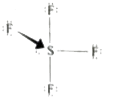 Sulphur atom GETS a total of 10 electrons 8 from the bonds and 2 as lone pair. This is quite possible for sulphur because it has easy access to its 3d orbital which means that it can expand its octet and accommodate more than 8 electrons. Sulphur FORMS 4 single bonds and has 1 lone pair which means that its steric number is equal to 5. In this case sulphur will use five hybrid orbitals, such as one 3s orbital three 3p orbitals and one 3d orbital. So the central atom is `sp^(3)`d hybridised. (ii) `C C1_(4)` It is not NECESSARY to invoke hybridisation especially in `C C1_(4).`It mustbe invoked for all tetrahedral bonds of carbon and other atoms. The electronic configuration of an isolated carbon atom in its ground state is `1s^(2)" "2s^(2)" "2p^(2)`. `C C1)(4)`is a tetrahedral molecule comprising of four single bonds known as `signa` bonds between the carbon atom and the chlorine atoms. In this type of bonding, the 2s orbital and three 2p orbitals of carbon atoms are mixed to produce four identical orbitals, a process known as `sp^(3)`hybridisation. 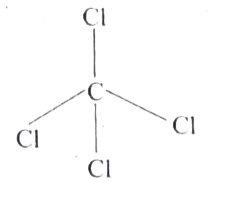
|
|
| 13. |
Explain the bond formation in SF_(4)" and "C Cl_(4) using hybridisation concept. C Cl_(4) |
|
Answer» SOLUTION :`C Cl_(4)` : It is not NECESSARY to invoke hybridisation especially in `C Cl_(4)` .It must be invoked for all tetrahedral bonds of carbon and other atoms. The electronic configuration of an isolated carbon atom in its ground state is `1s^(2)2s^(2) 2p^(2) C Cl_(4)`is a tetrahedral molecule COMPRISING of four single bonds know as `sigma` bonds between the carbon atom and thechlorine atoms. In this type of bonding the 2s orbital and THREE 2p orbitals of carbon atoms are mixed to produce four identical orbital is a PROCESS known as `sp^(3)` hybridisation . 
|
|
| 14. |
Explain the bond formation in MgCl_(2). |
|
Answer» Solution :Bond FORMATION in `MgCl_(2)` : Mg is a metal with 2 valence electrons. CL is a non-metal with 7 valence electrons and honce it needs one ELECTRON to complete the octet. THUS Mg DONATES one electron to each Cl and becomes positively charged . Each Cl accepts one electron and becomes negatively charged. |
|
| 15. |
Explain the bond formation in ethylene and acetylene. |
|
Answer» Solution :Bonding in Ethylene. `C_(2)H_(4)`: (i) onding in ethylene can be explained by hybridisation concept. (ii) The valency of carbon is 4. The electronic CONFIGURATION of carbon is `ls^(2)" "2s^(2)" "2p_(x)^(1)" "2p_(y)^(1)" "2p_(z)^(0).` One electron from 2s orbital is promoted to `2p_(z)` orbital in the excited state to satisfy the valency of carbon. 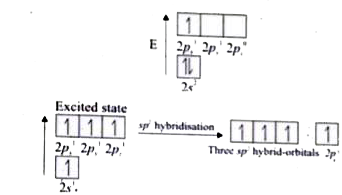 (iii) In ethylene both the carbon ATOMS undergo `sp^(2)` hybridisation involving `2s, 2p_(x) and 2p_(y)` orbitals resulting in 3 equivalent `sp^(2)` hybridised orbitals LYING in the XY plane at an angle of `120^(@)`other. The unhybridised `2p_(z)` orbital lies perpendicular to the xy plane. 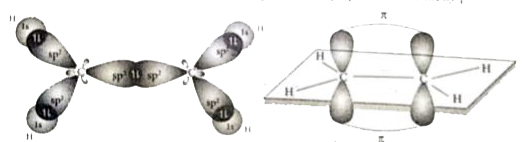 (iv) One of the `sp^(2)`hybridised orbitals of each carbon atoms lying along the X-axis linearly overlaps with each other resulting in the formation of C- C sigma bond. The other two `sp^(2)`hybridised orbitals of both carbon atom linearly OVERLAP with the four Is orbitals of four hydrogen atoms leading to the formation of two C-H sigma bonds on each carbon atom. (v) The unhybridised `2p_(z)` orbital of both carbon atoms can overlap only sideways as they are not in the molecular axis. This lateral overlap results in the formation of a pi bond between the two carbon atoms. Bonding in acetylene `(C_(2)H_(2))`: (i) The electronic configuration of valence shell of carbon atom in the ground state is `[He]2s^(2)" "2p_(x)^(1)" "2p_(z)^(0).`One electron from 2s orbital is promoted to `2p_(z)` orbital in the excited state to satisfy the valency of carbon. (ii) n acetylene molecule, both the carbon atoms are in sp hybridised state. I he 2s and `2p_(x)` Orbilals resulting in two equivalent sp hybridised orbitals are formed lying in a straigh: line along the X-axis. The unhybridised `2p_(y) and 2p_(z)`orbitals lie perpendicular to the X-axis. 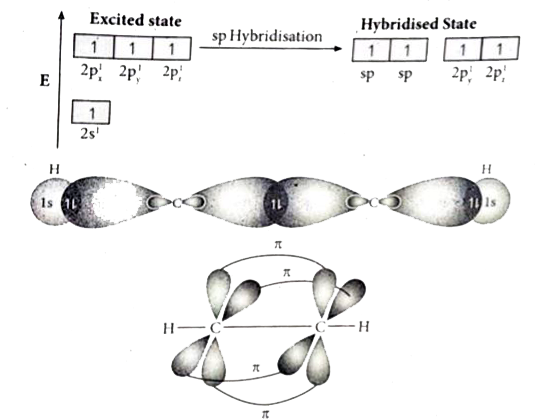 (iii) One of the two sp hybridised orbitals of each carbon atom linearly overlaps with each other resulting in the formation of a C-C sigma bond. The other sp hybridised orbital of both carbon atoms linearly overlap with the two Is orbitals of two hydrogen atoms leading to the formation of one C-H sigma bond on each carbon atom. (iv) The unhybridised `2p_(y) and 2p_(z)`orbitals of each carbon atom overlap sideways. This lateral overlap results in the formation of two pi bonds. `(p_(y) - p_(y)) and (p_(z) - p_(z))` between the two carbon atoms. |
|
| 16. |
Explain the boiling point of isomeric branched structure of alkane. |
Answer» Solution :Alkane e.g. in the isomers of pentane `(C_(2)H_(12))` GAS the branch increases as the boiling point DECREASES.  Explanation : With increase in number of branched chains, the molecule attains the shape of a sphere. THis results in smaller area of contact and THEREFORE weak intermolecular forces betwen spherical moelcules there is decreases in boiling point. |
|
| 17. |
Explain the bond formation in BeCl_(2) and MgCl_(2). |
|
Answer» Solution : `BeCl_(2)` bond formation : (i) ectronic eonfiguration of `Be(Z = 4)" is " " 1s^(2)2s^(2)` and electronic configuration of `Cl (Z = 17) " is " "1s^(2)2p^(6)3s^(2)3P^(5)` (ii) Beryllium has 2 electrons in its valence shell and chlorine atoms (2) have 7 electrons in their valence shell. (iii) By losing two electrons, Beryllium ATTAINS the inert gas configuration of Helium and becomes a dipositive cation, `Be^(2+)` ansd each chlorine atom accepts one electron to become `(Cl^(-))` uninegative ANION and attains the stable electronic configuration of Argon. (iv) Then `Be^(2+)` combine with `2Cl^(-)` ions to FORM an ionie CRYSTAL in which they are held together by electrostatic attractive forces. (v) During the formation of l mole of `BeCl_(2),` the amount of energy released is - 468 kJ/mol. This favours the formation of `BeCl_(2)` and its stabilisation. `MgCl_(2)` bond formation: (i)Electronic configuration of Mg `(z = 12)" is "1s^(2)2s^(2)2p^(6)3s^(2)` Electronic configuration of `Cl (z = 17) " is "1s^(2)2s^(2)2p^(6)3s^(2)3p^(5)` (ii) Magnesium has 2 electrons in ils valence shell and chlorine has 7 electrons in its valence shell. (iii) By losing two electrons, magnesium attains the inert gas configuration of Neon and becomes a dipositive cation `(Mg^(2+))` and two chlorine atoms accept these electrons to become two uninegative anions `[2C1^(-)]` by attaining the stable inert gas configuration of Argon. (iv) These ions, `Mg^(2+) and 2C1^(-)` combine to form an ionic crystal in which they are held together by electrostatic attractive forces. (v) The energy released during the formation of I mole of `MgC1_(2)` is - 783 kJ/mole. This favours the formation of `MgCl_(2)` and its stabilisation. |
|
| 18. |
Explain the bond formation by sp orbitals. OR Explain the bond formation in BeCl_(2) explain why BeCl_(2) is linear. |
|
Answer» SOLUTION :In `BeCl_(2), "Be [He]" 2s^(2)`.And form exited `Be^(*) ["He"] 2s^(1) 2p^(1)`. The divalency of Be in exited STATE the one electron ARRANGE in 2s and one in 2p orbit. One 2s and one 2p orbital of exited Be undergo hybridization and form two sp hybrid orbital. These two sp hybrid orbitals are oriented in opposite direction formatting an angle of `180^(@)`. Cl atom [NE]` 3s^(2) 3p_(x)^(2) 3p_(y)^(2) 3p_(z)^(1)`. Every sp orbital overlap with `3p_(z)` orbital of chlorine (Cl) with z axis and form two Be - Cl `sigma` bond.  Each of the sp hybridised orbital overlaps with the 2p orbital of chlorine axially and form two Be-Cl sigma bond and `BeCl_(2)` form with LINEAR shape. |
|
| 19. |
Explain the biological importance of magnesium and calcium. |
| Answer» Solution :Biological importance of Mg and Ca are: (a) Mg ion is present in CHLOROPHYLL which is responsible for photosynthesis. (b) `Ca^(2+)` IONS are REQUIRED for maintaining heart BEAT. (c ) `Ca^(2+)` and `Mg^(2+)` ions are required for CLOTHING of blood. | |
| 20. |
Explain the advantage of sawhorse projection formula over the fisher projection formula with an example. |
|
Answer» Solution :(i) The fisher projection formula inadequately portrays the spatial relationship between LIGANDS attached to the atoms. The sawhorse projection attempts to clarify the relative location of the groups. (ii) In sawhorse projection formula, the bond between TWO CARBON atoms is drawn diagonally and slightly elongated. The lower LEFT hand carbon is CONSIDERED lying towards the front and the upper right hand carbon towards the back. (iii) 
|
|
| 21. |
Explain the action of zinc and HCl on chloroform . |
| Answer» Solution :`underset("CHLOROFORM") (CHCl_(3)) overset(Zn + HCl) underset("2(H)") (to) underset("Methylene CHLORIDE") (CH_(2) Cl_(2)) + HCl` | |
| 22. |
What is the action of heat on orthoboric acid ? |
|
Answer» Solution :When hydro basic acid is heated two moles of WATER is liberated as follows `{:(H_(3)BO_(3)underset(-H_(2)O)OVERSET(DELTA)(to)HBO_(2)),(2HBO_(2)underset(-H_(2)O)overset(Delta)(to)B_(2)O_(3)):}}` |
|
| 23. |
Explain the action of sodium with water. |
|
Answer» Solution :Sodium reacts so RAPIDLY with water with the evolution of HEAT. The metal whizzes AROUND the surface of water. The hydrogen GAS liberated may catch fire giving yellow coloured flame because of sodium. `2Na + 2H_(2)O to 2NaOH + H_(2)uarr + heat` |
|
| 24. |
Explain the action of sodium hydrogen sulphide with bromoethane ? |
| Answer» SOLUTION :`CH_(3) underset("BROMOETHANE") (-CH_(2) Br) + NaSHoverset("Alcohol") underset(H_(2)O , Delta)(to) CH_(3) underset("ETHANE thiol") (- CH_(2) SH) + NaBr` | |
| 25. |
Explain the action of soda lime with(i) SiO_(2) and (ii)P_(4) O_(10) |
|
Answer» Solution :QUICK lime mixed with soda gives solid soda lime. It combines with acidic oxides such as Sio. and P O to FORM calcium silicate and calcium phosphate, respectively `CaO +SiO_(2) to underset("Calcium silicate")(CaSiO_(3))` `6CaO +P_(4)O_(10) tounderset("Calcium phosphate")(2Ca_(3)(PO_(4))_(2)` |
|
| 26. |
Explain the action of soap with hard water. |
|
Answer» Solution :i) The cleaning capacity of soap is reduced when used in hard water. (II) Soaps are SODIUM or potassium salts of long chain fatty acids. (iii) When soap is added to hard water, the divalent MAGNESIUM and CALCIUM cations present in hard water react with soap. (iv) The sodium salts present in soaps are converted to their corresponding magnesium and calcium salts which are precipitated as scum or precipitate. `M^(2+)+2RCOONato(RCOO)_(2)M_((s))+2Na_((aq))^(+)` Where, M = Ca or Mg: R=`C_(17)H_(35)`. |
|
| 27. |
Explain the action of metallic zinc with (i) Ethylidene dichloride (ii) Ethylene dichloride. |
|
Answer» SOLUTION :`underset("Ethylidene dichloride ")(CH_3-CHCl_2) + Zn overset("Methanol")to underset("Ethylene ")(CH_2 = CH_2) + ZnCl_2` (II) `underset(CL)underset(|)(CH_2)-underset(Cl)underset(|)(CH_2) + Zn underset(Delta)overset("Methanol")tounderset("Ethylene")(CH_2=CH_2) + ZnCl_2` |
|
| 28. |
Explain the action of (i) PCl_(5) (ii) PCl_(3) with ethanol |
|
Answer» Solution :(i) `CH_(3) underset("ETHANOL")(-CH_(2)) OH + PCl_(5) to Cunderset("ETHYL chloride")(H_(3) - CH_(2) Cl) + POCl_(3) + HCl` (ii) `3 CH_(3) underset("Ethanol") (-CH_(2)) OH + PCl_(3) to 3 underset("Ethyl chloride") (CH_(3) - CH_(2) Cl) + H_(3) PO_(3)` |
|
| 29. |
Explain the action of hydrogen with alkali metals |
|
Answer» SOLUTION :All ALKALI metals REACT with hydrogen at about 673K (lithium at 1073K) to FORM their HYDRIDES, which are ionic in nature. Reactivity of alkali metals with hydrogen increases from Lito Cs `2M + H_(2) to 2 M^(+)H^(-)`(where M-Li, Na, K, Rb and Cs) |
|
| 30. |
Explain the action of halogen with alkaline earth metals. |
|
Answer» SOLUTION :All the ALKALINE earth metals combine with halogen at elevated TEMPERATURE to form their halides`M+X_(2) toMX_(2)` Where M = Be, Mg, Ca, SR, Ba and RA. X = F, CI, Br and I For e.g., `Be + Cl_(2) to BeCl_(2)` |
|
| 31. |
Explain the action of Ethyl chloroformate with Methyl magnesium iodide . |
Answer» SOLUTION :Ethyl CHLOROFORM reacts with Grignard REAGENT to FORM esters as follows : 
|
|
| 32. |
Explain the action of halogen with alkali metals |
|
Answer» SOLUTION :Alkali metals combine READILY with halogens to form ionic halides MX Reactivity of alkali metals with HALOGEN increases down the group because of corresponding increase in electropositive CHARACTER. `2M+X_(2) to 2M^(+) X^(-)` (M=Li, Na, K, Rb and Cs) (X=F, CI, Brand I) |
|
| 33. |
Explain the action of chlorine with water. |
|
Answer» SOLUTION :Chlorine REACTS with the water to form HYDROCHLORIC acid and hypochlorous acid. `CI_(2_(s))+H_(2)O_((l))toHCI_((AQ))+HOCI_((aq))` |
|
| 34. |
Explain the action of chlorine on methane in the presence of sunlight. |
|
Answer» Solution :Methane REACTS with CHLORINE in the presence,of diffused SUNLIGHT to give methyl chloride, methylene chloride, CHLOROFORM and carbon tetrachloride. `CH_(4) + Cl_(2) UNDERSET("sunlight")overset("Diffused")(rarr)CH_(3)Cl + HCl` `CH_(3) Cl + Cl_(2) underset("sunlight")overset("Diffused")(rarr)CH_(3)Cl_(2) + HCl` `CH_(2) Cl_(2) + Cl_(2) underset("sunlight")overset("Diffused")(rarr)CHCl_(2) + HCl` `CH Cl_(3) + Cl_(2) underset("sunlight")overset("Diffused")(rarr)"CCl"_(4) + HCl` |
|
| 35. |
Explain the action of alcoholic potash with bromoethane. |
|
Answer» Solution :ELIMINATION reaction TAKES place when alcoholie potash reacts with bromoethane: `underset("BROMO ethane") (CH_(3) - CH_(2)Br + overset("Alcoholic")(KOH) to CH_(2) underset("Ethylene") (= CH_(2)) + KBR + H_(2) O` |
|
| 36. |
Explain the action of alcoholic KOH with 2-bromobutane. |
Answer» SOLUTION : According to Saytzeff.s rule, when 2-bromobutane reacts with alcoholic KOH, yields a mixture of OLEFINS in different amounts. (ii) In a dehydrohalogenation reaction, the preferred product is that alkene which has more number of alkyl GROUPS ATTACHED to the doubly BONDED carbon alkene. |
|
| 37. |
Explainthe acidic nature of alkynes |
|
Answer» Solution :Analkyneshowsacidicnatureonlyif itcontainsterminalhydrogenatom thiscan BES- characterof sphybridorbitalis more than `sp^(2)`hybridorbitalofalkeneand `sp^(3)`thus facilitatingdonationof `H^(+)`ions tobases .Sohydrogenattachedto triply bondedcarbonatomsisacidicis NATURE (i) `CH_(3) - CH_(2)-C= CH+ 2A NO_(3)2NH_(4)OH toCH_(3)-CH_(2) - C- AG` (ii) `CH_(3)- C=C - CH_(3) + 2AgNO_(3) + 2NH_(4) OHto`No reactiondue toabsenceof |
|
| 38. |
Explain the above vaiation in solubility with respect to temperature for selective compounds. |
|
Answer» Solution :the solubilities of ammonium NITRATE CALCIUM chloride ceric sulphate nano-hydrate and sodium chloride in water at different temperature are given in the following graph. The following conclusions are drawn from the above graph. (i) The solubility of sodium chloride does not vary appeciable as the maximum solubility is achieved at normal temperature .In fact there is only 10% increase in solubility between `0^(@)"to " 100 ^(@) C ` (ii) The dissolution process of ammonium nitrate is ENDOTHERMIC ,the solubility increase steeply with increase in temperature. (iii) In the case of ceric sulphate the dissolution is exothermic and the solubility decrease with increase in temperature. (iv) Even though the dissolution of calcium chloride is exothermic the solubility increases moderately with increase in temperature .Here the entropy factor ALSO plays a signicant role in deciding the position of the equilibrium. |
|
| 39. |
Explain terms of Avogadro constant, molecules volume of 1 mole gases,STP. |
|
Answer» SOLUTION :Avogadro constant : 1 mole gas contain `6.22 xx 10^(23)` molecules is known as Avogadro constnat. 1 mole : According to mole concept 1 mole means `6.22xx10^(23)` particles. (Atom, molecule electron …..) Molecules volume OR Molar volume `(22.71084 = mol^(-1))` : According to Avogadro PRINCIPLE, volume of gas `(V)prop` mole of gas number (n) STP temperature and pressure 1 mole gas occupy or molecular volume. At STP molar volume ideal gas on a combination of ideal gases is 22.71098 L `mol^(-1)`. It is also known as molar volume. Meaning of STP : STANDARD temperature and pressure means `273.15 K (0^(@)C)` temperature and 1 bar (exactly `10^(5)` PASCAL) pressure. These values approximate freezing temperature of water and ATMOSPHERIC pressure at sea level. |
|
| 40. |
Explain symmetrical distribution of electrons. |
| Answer» SOLUTION :When all the R(or d or F) orbital are HALF FILLED the nuclear will be UNIFORM. This increases stability of the atom. | |
| 41. |
Explain Swarts reaction . |
|
Answer» SOLUTION :CHLORO (or) bromoalkanes on heating with AgF give fluoroalkanes . This reaction is called Swarts reaction . `UNDERSET("Bromoethane") (CH_(3) - C) H_(2) Br + Nal to Cunderset("Iodoethane")(H_(3) - CH_(2))I + NaBr` |
|
| 42. |
Explain : Surface tension |
|
Answer» SOLUTION :Effect of Surface tension : That liquids assume the shape of the container. But …… Mercury is liquid. Small drops of mercury form spherical bed instead of spreading on the surface. Particles of the SOIL at the bottom of river remain separated but they stick together when they taken out. A liquid rise in a thin capillary as soon as the capillary touches the surface of the liquid. All these phenomena are caused due to the characteristic PROPERTY of liquids called surface tension. Explanation of surface tension and its unit :A molecule in the bulk of liquid experiences equal INTERMOLECULAR forces from all sides. The molecule, therefore does not experience any net force, but for the molecule on the surfasce of liquid, net attractive force is towards the interior of the liquid (See figure), due to the molecules below it. Since there are no molecules above it.  The molecule on the surface of liquid, net attractive force is towards the interior of the liquid it is surface tension. The molecules of surface experience a net downward force and have more energy than the molecules in the bulk, Therefore liquids tend to have minimum number of molecules at their surface. Surface tension energy : If surface of the liquid is increased by pulling a molecules from the bulk, attractive forces will have to be overcome and this will required expensiture of energy. The energy required to increase the surface area of the liquid by one unit is defined called .surface tension energy. or .surface energy.. Definition of surface tension : ..Surface tension is defined as the force acting PER unit length perpendicular to the line drawn on the surface of liquid... Surface tension it is denoted by Greek letter `gamma` (Gamma). The unit of surface energy : `J m^(-2)` Dimensions of surface tension : `kg s^(-2)` The SI unit of surface tension : `Nm^(-1)` The shape of the surface of the lowest energy state of the liquid, its examples and factors : The lowest energy staste of the liquid will be when surface area is minimum. If surface of liquid is spherical shape then surface area becomes lowest so maximum stable state is obtained So, Mercury is form spherical drops but it is not from dots. Fire polishing of glass : This is the reason that sharp glass edges are heated from making them smooth. ..On heating, the glass melts and the surface of the liquid tends to take the rounded shape at the edges, which makes the edges smooth. This is called .fire polishing of glass... Liquid tends to rise (or fall) in the capollary because of surface tension. Liquids wet the things because they spread across their surfaces as thin film. Moist soil grains are pulled together because surface area of thin film of water is reduced. Factor affecting on magnitude of surface :It is surface tension which gives stretching property to the surface of a liquid. On flat surface, droplets are slightly flattened by the effect of gravity , but in the gravity free environments deops are perfectly spherical. Sdo factor affecting on magnitiude of surface is an under. Magnitude of atraction force : Magnitude of Attraction forces increase with surface tension. Ex. Surface tension of `O_(2)`, ether, ethanol and water increases respectively. Effect of temperature : Kinetic energy increases with temperature, magnitude of intermo0lecular attraction force decreases so, surface tension decreases with temperature. |
|
| 43. |
Explain sublimation technique of purification method of organic compound |
| Answer» Solution :Definition: On heating some solid substances change from solid to vapour STATE WITHOUT PASSING through liquid state. The purification technique based on the above PRINCIPLE is known as sublimation. Uses: It is used to separate sublimable compounds from non sublimable impurities. Examples: Sublimation technique is used for purification of mixture of CALCIUM sulphate and camphor. Because camphor undergoes sublimation and separated and calcium sulphate settle at bottom without sublimation. | |
| 44. |
Explain structure of water. |
Answer» Solution :In the gas phase water is a bent molecule with a bond angle of `104.5^@`, and O-H bond length of 95.7 pm as shown in fig.  It is a HIGHLY polar molecule. Its orbital overlap picture is shown in FIGURE. In the liquid phase water molecules are associated together by hydrogen bonds. The CRYSTALLINE form of water is ice. At atmospheric pressure ice crystallises in the hexagonal form, but at very LOW temperatures it condenses to cubic form. Density of ice is less than that of water. Therefore, an ice cube floats on water. In winter season ice formed on the surface of a lake provides THERMAL insulation which ensures the survival of the aquatic life. |
|
| 45. |
Explain structure of ice. |
|
Answer» SOLUTION :Ice has a highly ordered three dimensional hydrogen BONDED structure as shown in figure. Examination of ice crystals with X-rays SHOWS that each oxygen atom is surrounded tetrahedrally by four other oxygen ATOMS at a distance of 276 pm. Hydrogen bonding gives ice a RATHER open type structure with wide holes. These holes can hold some other molecules of appropriate size interstitially. 
|
|
| 46. |
Explain stock notation theory with example. |
|
Answer» Solution :The oxidation number/state of a metal in a COMPOUND is sometime presented according to the NOTATION given by GERMAN chemist, Altered Stock known as stock notation. Oxidation number is expressed by putting a Roman numeral. Oxidation number in parenthesis after the symbol of the metal in the molecular formula. These THEORY is useful for the metal oxides. `Cu_(2)Oto` Copper (I) Oxide CuO `to` Copper (II) Oxide FeO `to` Iron (II) Oxide `Fe_(2)O_(3)to` Iron (III) Oxide `Na_(2)CrO_(4)to` Sodium cromate (VI) `K_(2)Cr_(2)O_(7)to` Potassium dichromate (VI) `V_(2)O_(5)to` Vanadium (V) Oxide `Cr_(2)O_(3)to` Cromium (III) Oxide `FeSO_(4)to` Iron (II) Sulphate potassium `KMnO_(4)to` Potassium Permanganate (VII) `Mn_(2)O_(7)to` MANGANESE (VII) Oxide |
|
| 47. |
Explain standard enthalpy of ionization. |
| Answer» SOLUTION :The amount of energy required to REMOVE electrons one by at standard conditions is KNOWN as standard ENTHALPY of ionization. | |
| 48. |
Explain standard enthalpy of subslimation [Delta_("sub")H^(@)). |
|
Answer» Solution :It is defined to the CHANGE in enthalpy when one MOLE of a solid substance sublimes at a constant temperature and standard pressure (1 bar) Example : `CO_(2(g)) rarr CO_(2(g)) , Delta_("sub")H^(@) = 25.2 kJ mol^(-1)`. |
|
| 49. |
Explain standard enthalpy of formation |
|
Answer» Solution :The standard enthalpy CHANGE for the formation of one mole of a compound from its elements in their most stable states of aggregation is called standard molar enthalpy of formation. Its symbol is `Delta_(f) H^(Theta)`. Elements are in their most stable states of aggregation. e.g., `H_(2) and O_(2)` are in gaseous state at 298 K temperature and 1 bar PRESSURE. `H_(2(g)) + (1)/(2) O_(2(g)) to H_(2) O((l))` `Delta_(f) H^( Theta) = - 285.8 "kJ mol"^(-1)` `C_("(graphite.s)") + 2H_(2(g)) to CH_(4(g)), Delta_(f) H^( Theta) = - 74.8 "kj mol"^(-1)`. Where one mole of a compound is formed from its constituent elements such as water, methane is formed. In contrast, the enthalpy change for an exothermic reaction. `CaO_((s)) + CO_(2(g)) to CaCO_(3 (s))` `Delta_(r) H^( Theta) = -178.3 "kj mol"^(-1)` It is not an enthalpy of formation of calcium carbonate, since calcium carbonate has been formed from other compounds, and not from its constituent elements. Enthalpy change is not standard enthalpy of formation, `Delta_(f) H^( Theta)` for `HBr_((g))`. `H_(2(g)) + Br_(2(g)) to 2HBr_((g)), Delta_(r) H^(Theta) =-72.8 "kj mol"^(-1)` Standard enthalpy of any element is taken as zero. CALCULATION of HEAT needed in DECOMPOSITION of `CaCO_(3)` is as under. `CaCO_(3 (s)) to CaO_((s)) + CO_(2 (g)),Delta_(r) H^( Theta) = (?)` `Delta_(f) H^( Theta) = sum_(i) a_(i) Delta_(f) H_(("product"))^(Theta) - sum_(i) b_(i) Delta_(f) H_(("reactions"))^( Theta)` `Delta_(f) H^( Theta) = Delta_(f) H^( Theta) [CaO_((s)) ]+ Delta_(f) H^( Theta) [ CO_(2 (g))] - Delta_(f) H^( Theta) [CaCO_(3 (s)) ]` `=[1(-635.1)+ 1(-393.5)] - [(-1206.9)]` `=178.3 kj//mol` Thus, the. decomposition of `CaCO_(3 (s))` is an endothermic process. Standard Molar Enthalpies of Formation `(Delta_(f) H^( Theta) )` at 298 K of a Few Selected Substances 
|
|
| 50. |
Explain standard enthalpy of atomisation (Delta_(s)H^(@)) |
|
Answer» Solution :It is defined as the enthalpy change ACCOMPANYING the DISSOCIATION of one mole of the substance completely into its atoms in the gasous state. Example : `H_(2(g)) RARR 2H_((g)) , Delta_(s)H^(@) = 435.4 kJ mol^(-1)`. |
|