

Saved Bookmarks
This section includes 7 InterviewSolutions, each offering curated multiple-choice questions to sharpen your Current Affairs knowledge and support exam preparation. Choose a topic below to get started.
| 1. |
Explain tropospheric pollution in 100 words |
|
Answer» Solution :Troposphere pollution occurs due to the presence of undesirable gases and the solid particles in the air The major gaseous and the PARTICULATE pollutants present in the STRATOSPHERE are as follows (i)Gaseous air pollutants. These include mainly Oxides of sulphur `(SO_2, SO_3)`, oxides of NITROGEN `(NO, NO_2)` and oxides of carbon `(CO, CO_2)` in addition to HYDROGEN sulphide `(H_2S)`, hydrocarbons OZONE and other oxidants (ii) Particulate pollutants. These include dust, mist, fumes, smoke, smog, etc. |
|
| 2. |
Explain troposheric pollution done by oxides of sulphur with suitable examples. |
|
Answer» Solution :When sulphur containing fossil FUEL is burnt, oxides of sulphur are produced. The most common SPECIES sulphur dioxide, is a gas that is poisonous to both animals and plants. A low concentration of sulphur dioxide causes respiratory disease. e.g., asthma, bronchitis, emphysema in human beings. Sulphur dioxide causes irritation to the eyes, resulting in TEARS and redness. High concentration of `SO_2` leads to stiffness of flower buds which eventually fall off from plants. Uncatalysed oxidation of sulphur dioxide is slow. The presence of particulate matter in polluted air catalyses the oxidation of sulphur dioxide to sulphur trioxide. `2SO_(2(g)) + O_(2(g)) to 2SO_(3(g))` The reaction can also be promoted by ozone and hydrogen peroxide. `SO_(2(g)) + O_(3(g)) to SO_(3(g)) + O_(2(g))` `SO_(2(g)) + H_(2) O_(2(g)) to H_2 SO_(4(AQ))` |
|
| 3. |
Explain tropospheric pollution in 100 words. |
|
Answer» Solution :Troposphere pollution is generated by unwanted components present in the lowest level of atmosphere. Oxides of carbon, nitrogen and sulphur HYDROCARBONS are the main gaseous pollutants. oxides of sulphur `(SO_2 and SO_3)` and oxide of nitrogen `(NO and NO_2)` are produced by burning of fossil fules. This oxide forms nitric ACID (HNO3) and sulphuric acid `(H_2 SO_4)` on REACTING with oxygen in atmosphere. It will be the reason of acid rain in the end. `2SO_(2(g)) + O_(2(g)) + 2H_2 O_((l)) to 2H_2 SO_(4(AQ))` `4NO_(2(g)) + O_(2(g)) + 2H_2 O_((l)) to 4HNO_(3(aq))` Acid rain is harmfull to trees and agriculture. Hydrocarbons are made of hydrogen and carbon and oxides of carbon are obtaine DFROM combusion of its. Hydrocarbons are carcinogenic and the components made of it are the main pollutants. CO is highly poisonous too. Men dies when it mixes into the blood. `CO_2` is not poisonous in nature but it performs a major role in global warming. Therefore temperature of earth is increased and ice of north and south ploes melts. Specific types of smoke, dust, mist, fumes and smog causes the dieses in humans related to respiratory system. |
|
| 4. |
Explain three dimensional representation of organic molecules and give examples |
|
Answer» Solution :The three dimensional (3-D) structure of organic molecules can be represented on paper by using certain CONVENTIONS. (a) Solid and dashed wedge formula: In these formulas the solid wedge  is used to indicate a bond projecting out of the plane of paper towards the OBSERVER. is used to indicate a bond projecting out of the plane of paper towards the OBSERVER. The dashed wedge  is sued to depict the bond projecting out of the plane of the paper and away from the observer. is sued to depict the bond projecting out of the plane of the paper and away from the observer. The bonds lying in plane of the paper are depicted by using a normal line (-). e.g. : 3-D representation of methane molecule on paper has been shown in following  wedge and dash representation of `CH_(4)` (b) Molecular Models: Molecular models are physical devices that are used for a better visualisation and perception of three dimensional shapes of organic molecules. (i) Framework Model (ii) Ball ADN Stick Model (iii) Space FILLING Model (i) Framework Model: In it only bonds connecting the atoms of a molecule and not the atoms. This model emphasizes the pattern of bonds of a molecule while ignoring the size of ATOM. eg. Framework model of methane (ii) Ball and stick model: In this model, both the atoms and the bonds are shown. In this model ball represent atoms and the stick denotes a bond Compounds containing C- C (e.g, ethene) can best be represented by using springs in place of sticks. The sticks of four `C-H` bond length is same. White ball of four H are same volume. The black ball of carbon is big (iii) Space filing model:  These models emphasises the relative size of each atom based on its van der Waals radius. Bonds are not shown in this model. It conveys the volume occupied by each atom in the molecule. In addition to these models, computer graphics can also be used for molecular modelling. |
|
| 5. |
Explain Thomson's atom mode/plum pudding model. |
|
Answer» Solution :Thomson PROPOSED that an atom consists of a uniform SPHERE of positive ELECTRICITY in which the electrons are distributed more (or) less UNIFORMLY. This model assumed that mass of the atom is evenly spread over the entire atom. The model also explain electrical neutrality of atom. |
|
| 6. |
Explain : Thermal Energy |
|
Answer» Solution :THERMAL energy is the energy of a body arising from MOTION of its atoms or MOLECULES. It is directly proportional to the TEMPERATURE of the substance. It is the measure of average kinetic energy of the particles of the MATTER and is thus responsible for movement of particles. Thermal motion : This movement of particles is called thermal motion. |
|
| 7. |
Explain the water pollution occurs by the chemical pollutants. |
|
Answer» Solution :(iii) Chemical POLLUTANTS : water is an excellent solvent. Water soluble inorganic chemicals that include heavy metals such as cadmium, mercury, nickel etc. constitute an important class of pollutants. All these metals are dangerous to humans because our body cannot excrete them. Over the time, it crosses the tolerance limit. These metals then can damage kidneys, central nervous system, liver etc. Acids like sulphuric acid from mine drainage and salts from many different sources including raw salt used to melt snow and ice in the colder climates. Petroleum products pollute many sources of water e.g., major oil spills in oceans. Various industrial chemicals like POLYCHLORINATED biphenyls, which are used as cleansing agent, detergents and fertilizers are aslo the water pollutants. PCBs are suspected to be carcinogenic. Most of the detergents are biodegradable but still they create other PROBLEMS. The bacteria responsible for degrading biodegradable detergent feed on it and grow rapidly. The lack of OXYGEN kills all other forms of aquatic life such as fish and plants. Fertilizers contain PHOSPHATES as additives. The addition of phosphates in water enhances algae growth. Such profuse growth of algae, covers the water surface and reduces the oxygen concentration in water. This leads to anaerobic conditions, commonly with accumulation of abnoxious decay and animal death. Thus, bloom-infested water inhibits the growth of other living organisms in water. This process in which nutrient enriched water bodies support a dense plant population, which kills animal life by depriving it of oxygen and results in subscquent loss of biodiversity is known as Eutrophication. |
|
| 8. |
Explain the various steps involved in crystallization method. |
|
Answer» Solution :Most solid organic COMPOUNDS are purified by crystallization method. This process is carried out by the following steps. (i) Selection of solvent: Organic substances being covalent do not dissolve in water, hence selection of suitable solvent becomes necessary. Hence the powdered organic substance is taken in a test tube and the solvent is added little by little with constant stirring and heating, till the amount added is sufficient to dissolve the organic compound. If the solid dissolves UPON heating and throws out maximum crystals on cooling, then the solvent is suitable. This process is repeated with benzene, ether, acetone and alcohol various solvent, till the most suitable one is sorted out. (ii) Preparation of solution: The organic compound is dissolved in MINIMUM quantity of suitable solvent small amount of animal charcoal can be added to decolourize any coloured substance. The solution may be prepared by heating over a wire gauze or water bath. (iii) Filtration of HOT solution: The hot solution so obtained is filtered through a fluted FILTER paper placed in a funnel. (iv) Crystallization: The hot filtrate is then allowed to cool. Most of the impurities are removed on the filter paper, the pure solid substance separate as crystal. If the rate of crystallization slow, it is induced either by scratching the walls of the beaker with a glass rod or by adding a few crystals of pure compounds to the solution. (v) Isolation and drying of crystals: The crystals are separated from the mother liquor by filtration is done under reduced pressure using a Buchner funnel. Finally the crystals are washed with small amount of pure cold solvent and dried. |
|
| 9. |
Explain the wave nature of light. |
|
Answer» Solution :Wave NATURE of light: According to Newton, light is a stream of particles which are also known as corpuscles of light This could not account for the phenomena of interference and deflection (as Rutherford's MODEL) but justified reflection and refraction. Hygen suggested in his wave THEORY that the light travels in the FORM of waves later James Maxwell proposed that light and other radiations are transmitted, these waves are associated with oscillating electric and magnetic FIELD. |
|
| 10. |
Explain the various periodic trends in the alkali metals down the group |
|
Answer» Solution : In alkali metals, as we move down the group (i) REACTIVITY increases (ii) atomic radii i increases (iii) SCREENING effect increases (iv) tendency to formcation by loosing OUTER electron increases (v) melting point and boiling tendency nd boiling point DECREASES ionization enthalpy decreases and (vii) density increases |
|
| 11. |
Explain the variation of atomic radii in group 13 elements. |
| Answer» Solution :Aluminium has a sharp INCREASE in size from that of BORON. This is due to greater SCREENING effect produced by the 8 electrons of L-shell in aluminium. Gallium has a smaller atomic radius due to completely FILLED 3d subshell which cannot shield the outermost electrons from the nuclear FORCE of attraction. | |
| 12. |
Explain the use of equilibrium constant to predicate the proportion of reaction with example. |
|
Answer» Solution :The numerical value of the equilibrium constant for `(K_c)` a reaction indicates the extent of the reaction but equilibrium constant does not give any information about the rate. The magnitude of `K_c` or `K_p` is directly proportional to the concentrations of products and inversely proportional to the concentrations of the reactants. "As the value of K is high the concentration of product remain high and as the value of K is low the concentration of the products remain low. Value of K `PROP` [Products] `prop 1/"[Reactants]"` The following generalisation covering the composition of equilibrium MIXTURES. (a)If `K_c gt 10^3` : Products predominate over reactants, i.e., if `K_c` is very large, the reaction proceeds nearly to completion. Consider the following examples : (i) The reaction`H_2+1/2O_2 to H_2O` of `H_2` with `O_2` at 500 K has a very large equilibrium constant `K_c`. `K_c=2.4xx10^47` (ii)`H_(2(G)) + Cl_(2(g)) hArr 2HCl_((g))` at 300 K has a very large `K_c`. `K_c=4.0xx10^31` (iii)`H_(2(g)) + Br_(2(g)) hArr 2HBr_((g))` at 300 K has a very large `K_c`. `K_c=5.4xx10^(18)` (b) If `K_c lt 10^(-3)`: Reactants predominate over products, i.e., if `K_c` is very small, the reaction proceeds rarely. Consider the following examples (1) The decomposition of `H_2O` into `H_2` and `O_2` at 500K has a very small equilibrium constant `K_c=4.1xx10^(-48)` (ii) At 298 K temp, inatmosphere `N_2` and `O_2` combine as `N_(2(g)) + O_(2(g)) hArr 2NO_((g))` the `K_c=4.8xx10^(-31)` is very less. (c) if `K_c` is in the range of `10^(-3)` to `10^(+3)` : Appreciable concentrations of both reactants and products are present. Example : The value of K is important for the following reaction. (i) For reaction of `H_2` with `I_2` to give HI, `K_c` = 57.0 at 700 K. (ii) Gas phase decomposition of `N_2O_4` to `NO_2` is another reaction with a value of `K_c = 4.64 xx 10^(-3)` at `25^@C` which is neither too small nor too large. Hence, equilibrium mixtures contain appreciable concentrations of both `N_2O_4` and `NO_2`. The values of `K_c` and the ratio of reactants and products at the equilibrium can show by the figure GIVEN under: 
|
|
| 13. |
Explain the uses of common ion effect. |
|
Answer» Solution :In PURIFICATION of NaCl : To remove the impurities of `Na_2SO_4 , MgSO_4` from NaCl solution HCl gas is passed in solution of NaCl so ppts of NaCl obtained by common ion effect. To separate soap from solution : Soap is a sodium salt of fatty acid if NaCl is added to solution of fatty acid `Na^+` ion is common ion so soap is separated as solid.  As `Na^+` is common ion so the REACTION PROCESSED in reverse direction and solid soap is separately . This is called salting process. In quantitatively analysis : if `K_(sp)` is less thancomplete precipitation is carried out. (i)For complete precipitation of `BaSO_4`excess `H_2SO_4` is added . (ii)For precipitation of `Ag^+` as AgCl excess NaCl is used. (iii) For precipitation of `Fe^(3+)` as `Fe(OH)_3` excess `OH^-` is maintain. (iv)In quantitatively analysis selective precipitation of reaction is carried on to by common ion effect. Qualitative analysis : In qualitative analysis `Ag^(+) , Hg^(+)` precipitate as chloride by HCl. e.g.-1 : In group II `Cu^(+2) , Cd^(2+)` have `K_(sp)` less for their precipitation `[S^(2-)]` must be less so HCl + `H_2S` is added . As a common ion effect of `H^+` the concentration of `S^(2-)` remain less and it is limited for CuS,CdS. e.-2 : In group III A `Fe^(2+) , Fe^(3+) , Al^(3+) , Cr^(3+)` ions are precipitation out as hydroxide. For that `OH^-` mustbe controlled so first `NH_4Cl` is added and than `NH_4OH` is added so as the common ion effect of `NH_4^+` the concentration of `[OH^-]` DECREASES so only IIIA precipitated. `[Q_(sp) gt K_(sp)]` . eg.-3 : Group-III B `Ni^(2+) , Co^(2+) , Zn^(2+), Mn^(2+) NH_4Cl, NH_4OH` and `H_2S` successful added so `NH_4^+` increase and `[OH^-]` decrease with that help `H^+` of `H_2S` increase and hence `[S^(2-)]`is more `Q_(sp) gt K_(sp)` sulphite of positive ion precipitated . (v) In drugs , cosmetic , fertilizers, by use of common ion effect pH is maintain . |
|
| 14. |
Explain the types of substitution reaction? |
|
Answer» Solution :Substitution reactions are classified into three types. They are, (i) Nucleophilic substitution reaction (ii) Electrophilicsubstitution reaction. (iii) Free radical substitution reaction (i) Nucleophilic substitution reaction : A nucleophilic substitution reaction is organicchemistry is a TYPE of reaction where a nucleophilic gets attached to the positive charged ATOMS or molecules of the other substamce, A good example of a nucleophilic substitution reaction is the hydrolysis of alkyl BROMIDE, under the basic conditions where in the NUCLEOPHILE is nothing but the base`O^(oplus)H`, whereas the LEAVING group is the `Br^(oplus)`.The reaction for the following is as give below. ` underset "(methyl bromide)"(CH_(3)Br) overset(aq^(oplus)OH) to underset"(methanol)"(CH_(3)OH + Br^(oplus))` (ii) Electrophilicsubstitution reaction : Theelectrophilicsubstitution reaction involves the electrophiles. The electrophilic reactions occur mostly with the aromatic compounds.This type of substitution reaction arebasically defined as those chemical reactions where the electrophile replaces the functional group in a compound but not the hydrogen atom, sometimes hydrogen atom can be also replaced by electrophiles. For example  (iii) Free radical substitution reaction : Free radical substitution reaction involving free radicals are a reactive intermediate. A - X + Y rightarrow A - Y + X` `CH_(4) + CI rightarrow CH_(3) + HCI` `CH_(3) + CI rightarrow underset ("methyl chloride") (CH_(3)CI) ` |
|
| 15. |
Explain the types of substitution reaction ? |
|
Answer» Solution :Substitution reactions are CLASSIFIED into three TYPES they are . (i) Nucleophilic substitution reaction : A nucleophilic substitution reaction in organic chemistry is a type of reaction where a nucleophilic gas attached to the positive charged atom or molecules of the other substance . A Good example of a nucleophilic susbstitution reactionthe hydrolysis of alkylbromide, under the basic conditions where in the nucleophile is nothing but the base`overset (-) (O)H` , where as the leavinggroup in the ` Br^(-)` , the reaction for the following is as given below . `underset ("bromide") underset ("Methyl")(CH_(3) Br ) overset (-)overset(OH)to underset ("Methanol ")(CH_(3) OH + Br^(Theta))` (II) Electrophilic INSTITUTION reaction : The electrophilic substitution involver the electrophiles the electrophilic reaction occurs MOSTLY with the aromatic compounds. This type of substitution reaction are basically defined as those chemical reactions where the electrophile replaces the functional group in a compound but not the hydrogen atom, sometimes hydrogen atom can be also replaced by electrophilies . For example : 
|
|
| 16. |
What are the types of hydrogen bonding? Give example. |
|
Answer» Solution :There are TWO types of HYDROGEN bonding (i) lntramolecular hydrogen bonding (ii) Intermolecular hydrogen bonding lntramolecular hydrogen bonds are those which occur within a single MOLECULE. Example : Ortho nitrophenol, Salicilaldehyde Intermolecular hydrogen bonds occur between two SEPARATE molecules. For example, intermolecular hydrogen bonds can occur between ammonia molecule themselves or between WATER molecules themselves or between ammonia and water. |
|
| 17. |
Explain the types of addition reactions? |
|
Answer» Solution :Addition REACTIONS are classified into three types. They are, (i) Electrophilic addition reaction. (ii) Nucleophilic addition reaction. (iii) Free radical addition reaction (i) Electrophilic addition reaction: An electrophilc addition reaction can bedescibed as an addition reaction in which a reactant with multiple bonds as in a double or triple bond UNDERGOES has its `pi` bond broken and two new `rho` bond are formed.  (ii) Nucleophilic addition reaction: A nucleophilic addition reaction is an addition reactionwhere a chemical compound with an electron deficient or electrophilic double or triple bond, a `pi` bond, reacts with a nucleophilic which is an electron rich reactant with the disappearance of the double bond and creation of two new single or `rho` bonds.  (iii) Free radical addition reaction: It is an addition reaction in organic chemistryinvolving free radicals. The addition may occur between a radical and a NON radical or between two radicals. `underset ("ETHENE") (CH_(2) =CH_(2)) + H-Br overset("Benzoyl peroxide") to underset ("ETHYL bromide") (CH_(3) - CH_(2)-Br)` |
|
| 18. |
Explain the types of addition reactions. |
|
Answer» Solution :Addition reactions are classified into three types they are, (i) Electrophilic addition reaction (ii) Nucleophilic addition reaction (iii) Free radical addition reaction. (i) Electrophilic addition reaction: An electrophilic addition reaction can be described as an addition reaction in which a reactant with multiple bonds as in a double or TRIPLE bond undergoes has its at bond broken and two new o bond are formed.  (ii) Nucleophilic addition reaction: A nucleophilic addition reaction is an addition reaction where a CHEMICAL compound with an electron deficient or electrophilic double or triple bond, a `pi` bond, reacts with a nucleophilic which is an electron rich reactant with the disappearance of the double bond and creation of two new single or `sigma` bonds.  (iii) Free radical addition reaction: It is an addition reaction in organic chemistry INVOLVING free radicals. The addition MAY occur between a radical and a non radical or between two radicals. `underset(("ethane"))(CH_(3)=CH_(2))+H-Broverset("BENZYL peroxide")tounderset(("ethyl bromide"))(CH_(3)-CH_(2)-Br)` |
|
| 19. |
Explain the type of hybridization. |
Answer» Solution :(a) sp-hybridisation : One s-orbital and one p-orbital can HYBRIDIZE to give sp hybridization forming TWO equivalent sp-hybrid orbitals. 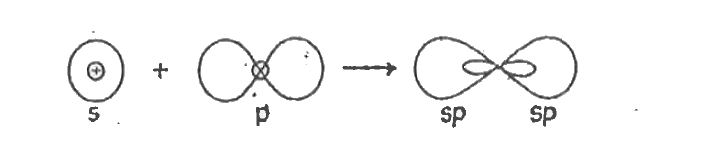 (b) `sp^(2)` hybridisation : One s-orbital sand two p-orbitals mix up to give three `sp2` hybrid orbitals. 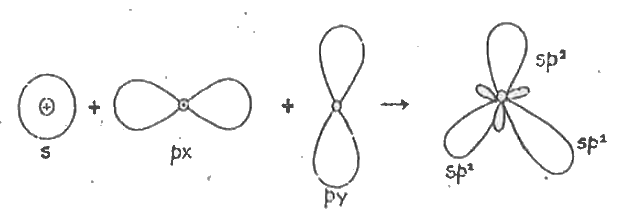 (c) `sp^(3)` hybridiation : One S-orbtial and three p- orbitals hybridise to give FOUR `sp3` hybride orbitals. 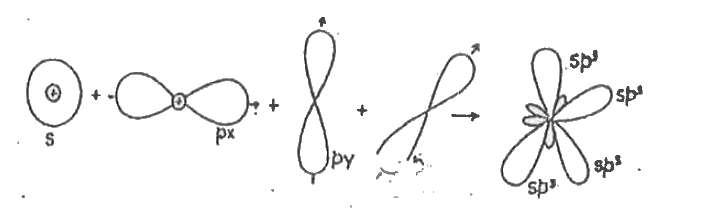
|
|
| 20. |
Explain the terms inductive and electromeric effects. Which electron displacement effect explains the following correct order of the acidity of the carboxylic acids ? (a) CH_(3)COOH gt Cl_(2)CHCOOH gt ClCH_(2)COOH (b) CH_(3)CH_(2)COOH gt (CH_(3))_(2)CHCOOH gt (CH_(3))_(3)COOH |
|
Answer» Solution :For the details of the effects, Section 12.22 & Section 12.23 (a) The order of acidity is explained by `-I` EFFECT of the CHLORINE atoms. Greater the magnitude of `-I` effect, EASIER will be the release of `H^(+)` from `O-H` bond and stringer will be acid.  (b) The order of acidity is explained by `+ I` effect of alkyl groups. As the number of alkyl groups increases, the magnitude of `+ I` effect also increases. As a result, the release of `H^(+)` from `O-H` bond becomes more and more DIFFICULT and acidic strength decreases. 
|
|
| 21. |
Explain the terms inductive and electromeric effects. Which electron displacement effect explains the following correct orders of acidity of the carboxylic acids? (a) Cl_(3)C COOH gt Cl_(2)CHCOOH gt ClCH_(2)COOH (b) CH_(3)CH_(2)COOH gt (CH_(3))_(2)CHCOOH gt (CH_(3))_(3)C.COOH |
|
Answer» Solution :(a) -I EFFECT as shown below : As the number of halogen ATOMS decreases, the overall -I effect decreases and the acid strength decreases accordingly.  (B) +I-effect as shown below : As the number of alkyl group INCREASES, the +I-effect increases and the acid strength decreases accordingly. 
|
|
| 22. |
Explain the terms inductive and Electromeric effects. Which electron displacement effect explains the following correct orders of acidity of the carboxylic acids? (a) Cl_(3)C COOH gt Cl_(2)CHCOOH gt ClCH_(2)COOH (b) CH_(3)CH_(2)COOH gt (CH_(3))_(2)CHCOOH gt (CH_(3))_(3) C.COOH |
|
Answer» Solution :(a) `Cl_(3)COOH gt Cl_(2)CHCOOH gt ClCH_(2)COOH`: These correct order of acidity is explain by NEGATIVE inductive effect (-I) of CL. Cl group containing electron attracting inductive effect As the no. of Cl group is more the electron attracting induction is more. These inductive effect displace in C-C, C-O and O-H bond. So electron of O-H bond remain near to O and away from H and H and `O-H` bond become `O^(delta -)- H^(delta +)` polar. The disability of removed of `H^(+)` is maximum in `Cl_(3)C COOH`  `(i) rarr (ii) rarr (iii)`, as the no. of Cl decreases, the tendency of removal of O-H bond decreases, so acidic strength is also decreases. (b) `CH_(3)CH_(2)COOH gt (CH_(3))_(2) CHCOOH gt (CH_(3))_(3)C COOH`: In these the alkyle groups are containing electron donating (REPULSIVE) (+I) inductive effect. As the NUMBER of alkyl group `-CH_(3)` is increase, then the electron repulsion is also increases. And therefore electron are comes near to O-H bond and O-H bond becomes weak. `H^(+)` donating tendency is decrease so, acidic strength also decrease . THe (+I) effect of -`CH_(3)` displace in bond is as under. 
|
|
| 24. |
Explain the term .laminar flow.. Is the velocity of molecules same in all the layers in laminar flow ? Explain your answer. |
Answer» Solution :When a liquid flows over a fixed surface, the LAYER of molecules are stationary. As the distance of layers from the fixed layer increases, the VELOCITY of the upper layers increases. This type of FLOW in which there is a regular gradation of velocity in PASSING from one layer to the next is called laminar flow. In laminar flow, the velocity of molecules is not same in all the layers because every layer offers some resistance or friction to the layer immediately below it. |
|
| 25. |
Explain the term ''Hydration of Ions'' |
|
Answer» Solution :When ionic solid is dissolved in polar solvent like water, the cations & ANIONS of ionic solid is attracted by oxygen and hydrogen of water respectively. As a result cach IONS surrounded by many number of water moleclule to form hydrated. This exothermic process is called Hydration. Degree of hydration depends upon the charge density of an ion. Degree of hydration decreases as size of ion INCREASES Example: `Li^(+)gtNa^(+)gtK^(+)` Ionic solid dissolves in water easily, if lattice ENERGY is less than hydration energy. |
|
| 26. |
Explain the sulphonation of benzene |
Answer» SOLUTION :Benzenereactswithfumingsulphuric ACID andgivebenzenesulphoicacid .Although`SO_(3)` moleculeit DOESNOT havepositivechargeyetit is astrongelectrophilc .thisis becausedesulphonationoccusreadilyin AQUEOUSMEDIUM 
|
|
| 27. |
Explain the substitution reaction in detail with suitables examples . |
|
Answer» Solution :In this reaction an atom or a group of atoms attached to a carbon atom os replaced by a new atom or a group of atoms . BASED on the NATURE of the attacking reagent , this reactions can be classied as i) NUCLEOPHILIC substitution ii) Electrophilic sunstitions . (iii) Nucelophilic substtions This reaction can be represented as  Here Y - is incoming nucleophile or and attacking species and x - is the leaving group . Example : Hydrolysis of alkyl halides ` CH_(3) Br overset (" aqueous OH ") (to) CH_(3) OH + Br ` Aliphatic mucleophilic substitution reaction take place either by ` S_(N) I " or " S_(N) 2 ` mechanism . (ii) Electrophilic substitution :  Here Y + is an electrophile Example : Nitration of Benzene  (iii) Free radical substitution : ` A - X + Y to A - Y +X ` ` CH_(4) + CL to CH_(3) + HCl ` Aliphatic electrophilic sunstitution A general aliphatice electrophilic sunstitution is represented as ` R - X + E ^(oplus) to R - E + X^(oplus) ` ` R_(2) NH + Noverset (+) O to R_(2) N - NO + H^(+) ` |
|
| 29. |
Explain the struture of CO_3^-2 ion in terms of resonance. |
Answer» Solution :According to the EXPERIMENTAL findings,all CARBON to oxygen bonds in `CO_3^2-` are equivalent. Therefore the carbonate ION is best described as a resonance hybrid of the canonical FORMS I,II,and III shown below:
|
|
| 30. |
Explain the structure of triple bond of ethynes. |
Answer» Solution :Each CARBON atom of the ethyne is sp hybridised. One sp hybrid orbital each of the two carbon atoms overlap axially to form C - C sigma BOND. The remaining two sp hybrid orbitals overlap with is orbitals of hydrogen to form two C - H sigma bonds. Each carbon atom has two unhybridised p -orbitals. These overlap SIDEWAYS to form two PI bonds. thus, ethne molecule contains THREE sigma bonds and two pi bonds. it is a linear molecule with bond angle `180^(@)`. the `C equiv C` bond, (Bond energy 823 KJ/mole ) is stronger than C = C bond (bond energy 681 kJ/mole). Henel C `equiv` C bond length (120 pm) is shorter than C `equiv` C bond (134 pm).
|
|
| 31. |
Explain the structure of ( SiO_(2)) silicon dioxide . |
Answer» Solution :Silicon dioxide is a covalent SOLID having three dimensional NETWORK structure in which each silicon atom is bonded to four oxygen atoms which are arrange tetrahedrally AROUND it and each oxygen atom is attached to two silicon atoms by covalent bonds as shown in the FIGURE. The ENTIRE silicon and oxygen atoms as shown in the figure.
|
|
| 32. |
Explain the structure of orthoboric acid . |
Answer» SOLUTION :It has a layer structure in which planar `BO_(3)^(3-)` units are linked to one another through hydrogen atoms. Each H ATOM is linked with one unit of `BO_(3)^(3-)` through a covalent BOND and through hydrogen bond with other units of `BO_(3)^(3-)` as shown in the FIGURE. 
|
|
| 33. |
Explain the structure of graphite giving the reason for its softness as well as its electrical conductivity. |
| Answer» Solution :A good CONDUCTOR of electricity graphite carbon atom is `sp^(3)` hybridised . Out of the four valency electrons in each carbon atom only three electrons one from 2s and TWO from 2p are involved in hybridisation . One space electron in its `2p_(z)` ORBITAL is left free. These `2p_(z)` orbital overlap to from deloclised `pi` system which extends above and below each layer . In this delocalised space electrons are free to move WITHIN the layer and hece graphite is a good conductor of electricity. The conductivity of graphite perpendicular to the plane of the layers of hexagons is low and increases with increase in temperature signifying that graphite is a semiconductor in that direction. The electrical conductivity is much higher paraller to the plane but decreases as the temperature is raised . It is a soft flaky and slippery substance : In graphite each layer of the hexagons are hold together by a weak VAN der Waal's force of attraction at a large distance of 3.40 Å. Even the slight pressure causes the layers to slide over one another . Hence graphite is soft flaky and slippery. Graphite is used as a lubricant . | |
| 34. |
Give the structure of diborane. |
|
Answer» Solution :(I) The FOUR terminal HYDROGEN atoms and two boron atoms lie in one plane. (ii) Two bridging hydrogen atom lie above and below the plane. (iii) Bonding between boron atom and terminal hydrogen atom is normal covalent BOND WHEREAS with bridging hydrogen atom it is 3 centred 2 electron bond. (iv) Banana bond is formed with bridging H atoms. |
|
| 35. |
Explain the structure of diamond giving the reason for its harness as well as non conductivity of electricity. |
|
Answer» Solution :Non-CONDUCTOR of electricity : All the FOUR electrons present in the valence shell of carbon atoms are used up in `sp^(3)` hybridisation and form sigma bonds . No mobile electrons are left in the diamond crystals to allow the conduction of electricity. Hence diamond is a non - conductor of electricity. Extremely hard : Due to HIGH strength of covalent bonds HOLDING all the carbon atoms in diamond together , diamond is very hard . Infact diamond is the hardest substance known. |
|
| 36. |
Explain the structure of CO_(3)^(2-) ion in terms of resonance. |
Answer» Solution :The carbonate ion shown by three Lewis structure and two SINGLE bond (C - O ), one double bond (C = O ) between carbon and oxygen in it. I, II and II resonance structure by `CO_(3)^(2-)` and (IV) structure is resonance HYBRID. I, ll, III lewis structure of `CO_(3)^(2-)` are not described correctly. In this C - 0 bond length is 143 pm is not obtained. But all C = 0 bond has equal 132 pm bond length. It can be explain by hybrid resonance structure . IV. In `CO_(3)^(2-)` all C - O bonds are equipment . |
|
| 37. |
Explain the structure of CO_2 molecule. |
Answer» Solution :The exparimentally determined cardon to oxygen bond lenght in `CO_2` is 115 pm. The lengths of a normal carbon to oxygen double bond `(C = O)` and carbon to oxgen triple bond `(CequivO)` are 121 pm and 110 pm respectively.The cabon-oxygen bond lengths in `CO_2` (115 pm) LIE between the VALUES for C=O and C`equiv` O. Obviously, a single LEWIS struture cannot explain this position and it becomes necessary to wire more than one Lewis structures to consider that the structure of `CO_2` is best described as a hybird of the canonical or resonance forms I,II,and III.
|
|
| 38. |
Explain the structure of CH_(4) molecule. |
Answer» SOLUTION :
|
|
| 39. |
Explainthe structureof benzene |
|
Answer» Solution :1. Molecular formula: Elementalanalysis and molecularweightdeterminationhaveprovedthat themolecularformulaof benzene`C_(6) H_(6)`.Thisindicatesthat benzeneis ahighlyunsasturatedcompound. 2.straight chainstrucure is not possible: Benzene could beconstructedas a straightchain but itnot feasiblesince it does not shown thepropertiesofalkenes ore alkynes . forexample it does not decolorisethe brominewaterin `C CI_(4)` 3. Evidence of cyclicstructure :in theprosenceNickel benzenereactswith hydrogenmolecutewith threedoublebond.  4. Resonance descriptionof benzene :the phenomenonin whichor morecan bewritenforhybrinof variouspoststructureand structure(III)is theresonancehybrinof structureI and II  6. Molecularorbitalstructure : (i)Benzeneis a flathyxagonalmolecule withall carbons`sp^(2)`hybrinorbitalof carbonoverlapwith eachotherand withs- orbitalsof sixhydrogenatomsformingsixsigma`(alpha) C-H`bondsand sixsigma`(alpha) c-c`BONDS  (ii) All the`alpha`-bondsin benzeneliesin oneplanewithbondangleof `120^(@)` Eachc-atomin benzenepossesandunhybridisedp- orbitalcontainingoneelectronThelateralovertalyc-atomsand aresaidto bedelocalisedDueto thisdelocalisationstrong `PI-`bondisformedwhichmakesthe moleculestable  7.Representationof benzene: Hencethereare threewaysis whichbenzenecan berepresented  |
|
| 40. |
Explain the structure of BeCl_2 |
Answer» Solution :BERYLLIUM chloride has a chain structure in the SOLID state. In the vapour PHASE `BeCl_2` TENDS to form a chloro-bridged DIMER. 
|
|
| 41. |
Explain Born-Haber cycle for the fomation of 1 mole of sodium chloride crystal. |
|
Answer» Solution :Step 1 : Sublimation of metallic sodium of gaseous sodium atom with ENTHALPY sublimation `=DeltaH_(s)` `Na(s) overset("sub lim ation")to Na(g), Delta= Delta H_(s)` Step : 1 Dissociation of molecules to chlorine atoms with enthaply of dissociation = `DeltaH_(d)(1)/(2)Cl_(2) (g) overset("Dissociation") to CL(g), DeltaH=DeltaH_(4)` Step-3 : Ionization of gaseous sodium with entahlpy of ionization `=DeltaH_(1)` `Na(g)overset("Ionization")to Na^(+)(g)` Step-4 : Addition of electron to gaseson chlorine atom with enthaply of electron affinity `Delta H_(Ed)Cl_((g))+e^(-)overset("Addition")toCl^(-)(g), DeltaH=DeltaH_(EA)` Step -5 Close packing of gaseous sodiumion and chloride ion the form lattice structure of NACL, with lattice chloride ion to form lattice structure of NaCl, Lattice ENERGY `U,NaCl^(+)(g)+Cl^(-)(g) to NaClDelta, Delta H=U` Step -6 But sum of all the energies will be equal to the heat of formation of one mole of sodium chloride form its reluctant i.e., `DeltaH_(f)` `Na(s)+(1)/(2)Cl_(2)(g) to NaCl(s), DeltaH=Deltaf_(f)` |
|
| 42. |
Explain the steps involved in Born Haber cycle for the formation of NaCl. |
|
Answer» Solution :Step 1: Sublimation of metalic sodium of gaseous sodium ATOM with ENTHALPY of sublimation `=DeltaH_(s)` `Na(s)overset("sublimation")(to)Na(g),DeltaH=DeltaH_(s)` Step 2:Dissociation of molecule of chlorine to chlorine atoms with enthalpy of dissociation `=DeltaH_(d)` `1/2Cl_(2)(g)overset("Dissociation")(to)Cl(g),DeltaH=DeltaH_(d)` Step 3: IONIZATION of gaseous sodium with enthalpy of ionization `=DeltaH_(i)` `Na(g)overset("ionization")(to)Na^(+)(g)` Step 4: Addition of electron to gaseous chlorine atom with enthalpy of electron affinity `=DeltaH_(Ea)` `Cl_((g))+e^(-)overset("addition of" e^(-))(to) Cl^(-1)(g),DeltaH=DeltaH_(Ea)` Step -5: Close packing of gaseous sodium ion and chloride ion to FORM lattice structure of NaCl, with lattice chloride ion to form lattice structure of NaCl, with Lattice energy `=U, NaCl^(+)(g)+Cl^(-1)(g)toNaClDelta, DeltaH=U` Step 6: But sum of all the energies will be equal to the heat of formation of one mole of sodium chloride form its reluctant i.e. `DeltaH_(f)` `Na(s)+1//2Cl_(2)(g)toNaCl(s),DeltaH=DeltaH_(f)` |
|
| 43. |
Explain the steps involved in ion-electron method for balancing redox reaction. |
|
Answer» Solution :Ion electron method MAKES use of the Half reactions. Steps involved in this method are, 1. Write the equation in the net ionic form without attempting to balance it. 2. Write and locate the oxidation number of atoms undergoing oxidation and reduction from the knowledge of calculation of oxidation number. 3. Write two half reactions showing oxidation and reduction separately. 4. Balance oxygen atoms by adding required number of water molecules to the side deficient in oxygen atoms. 5. ADD required number of `H^(+)` ions to the side deficient in hydrogen atom if the reaction is in acidic medium 6. Add ELECTRONS to whichever side is NECESSARY to make up the difference in oxidation number. 7. Add the two half reactions. The resulting equation is a net balanced equation. 8. For reactions in basic medium, add `H_(2)O` and hydrogen ion to balance H and O. 9. Finally balance the equation by cancelling common species PRESENT on both sides of the equation. |
|
| 44. |
Explain the state of equilibrium based on the following illustration. See-saw |
|
Answer» SOLUTION :See-saw There are different TYPES of equilibrium. For example, if TWO persons with same weight sit on OPPOSITE sides of a see-saw at equal distance from the fulcrum, then the see-saw will be stationary and straight and it is said to be N equilibrium. |
|
| 45. |
Explain the state of equilibrium based on the following illustration. Tug of war |
|
Answer» Solution :Tug of war : Another example of a STATE of equilibrium is the game of ''tug-of-war''. In this game a ROPE is PULLED taut between two terms.There may be a situation when both the teams are PULLING the rope with EQUAL force and the rope is not moving in either direction. This state is said to be in equilibrium. |
|
| 46. |
Explain the standard enthalpy of reactions. |
|
Answer» Solution :Enthalpy of a reaction depends on the conditions under which a reaction is CARRIED out. It is, THEREFORE, necessary that we MUST specify some standard conditions. The standard enthalpy of reaction is the enthalpy change for a reaction when all the participating substances are in their standard STATES. The standard state of a substance at a specified TEMPERATURE is its pure form at 1 bar. For example, the standard state of liquid ethanol at 298 K is pure liquid ethanol at 1 bar , standard state of solid iron at 500 K is pure iron at 1 bar. Usually data are taken at 298 K. Standard conditions are denoted by adding the superscript `Theta` to the symbol `Delta H `, e.g., `Delta H^(Theta)` |
|
| 47. |
Explain the standard enthalpy of combustion Delta_(C) H^( Theta). |
|
Answer» Solution :When the enthalpy change per mole of a substance undergoes combustion and all the reactants and products are in their standard states at the specified temperature is known as standard enthalpy of combustions. e.g., Cooking gas in cylinders CONTAINS mostly butane `(C_(4) H_(10) )`. We can write the thermochemical reactions for this as : `C_(4) H_(10(g)) + (13)/(2) O_(2(g)) to 4CO_(2(g)) + 5H_(2) O_((I)): Delta_(R) H^( Theta) = -2658.0 "kj/mol"` Combustion of GLUCOSE, `C_(6) H_(12) O_(6(g)) to 6 CO_(2(g)) + 6H_(2) O_((I)), Delta_(r) H^( Theta)=-2802.0 "kj/mol"` |
|
| 48. |
Explain the solubilities of ammonium nitrate, 'calcium chloride, ceric sulphate and sodium chloride in water at different temperature with a graph. |
|
Answer» SOLUTION :(i) The solubility of sodium chloride does not very appreciably as the maximum slubility is achieved at normal temperature. In fact, there is only `105` increase in solubility between `0^(@)C` to `100^(@)C.` (II) The dissolution process of ammonium nitrate is endothermic, the solubility increases with increase in temperature. (IIII) In the case of ceric SULPHATE, the dissolution is exothermic and the solubility decreases with increase in temperature. (iv) Even though the dissolution of calcium chloride is exothermic,the solubility increases role in deciding the position of equilibrium. 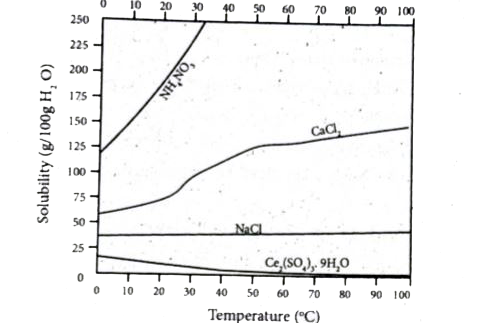
|
|
| 49. |
Explain the significance of sodium , potassium , magnesium and calcium in biological fluids. |
| Answer» SOLUTION :For `Na^(+)` and `K^(+)` and for `MG^(2+)` and `Ca^(2+)` | |
| 50. |
Explain the significance of the +ve and -ve sign |
|
Answer» Solution :`+`ve and -ve sign is not related with charge. It is the symbol of work FUNCTION and it represent the ORIENTATION of orbitals. These signs correspond to + and - signs of the WAVES. It MAY be noted that crests of the ELECTRON wave are usually given + sign and the troughs are given .-. sign. 
|
|