

Saved Bookmarks
This section includes 7 InterviewSolutions, each offering curated multiple-choice questions to sharpen your Current Affairs knowledge and support exam preparation. Choose a topic below to get started.
| 1. |
If all the following four compounds were sold at the same price, which would be cheapest for preparing an antifreeze solution for a car radiator ? |
|
Answer» `CH_(3)OH` |
|
| 2. |
IfAl^(3+)replacesNa^(+)at the edge centre of NaCl lattice then calculate that vacanicles in 1 mole NaCl. |
|
Answer» SOLUTION :1 mole of NaCl contains1 mole of ` Na^(+)`IONS. ` 6.023 xx 10^(23)Na^(+)` ions . NaCl has fcc arragement of `Cl^(-)` ions and ` Na^(+)`ions are present at eh edge CENTRES and body - centre. As there are 12 edge centre and each edge centre is shared by 4 shared by 4 unitcells, their contribution per unit cell ` = 1/4 xx 12 = 3` Conribution of ` Na^(+) ` ionat the body -centre =1 Thus, for every ` 4 Na^(+)`ions, the ions present at the edge centres = 3 . This means that `N^(+)`ions which havebeen replaced ` = 3/4 xx 6.023 xx 10^(23)=4.517 xx 10^(23)` ` 1Al^(3+)`ion will REPLACE ` 3Na^(+)`ions to maintain electrical neutrality . one vacancy will be occupied by ` Al^(3+)` ion and the remaining 2 will be vacent. The means that ` 1/3` rd of these positions will be occupied by `Al^(3+)`ions and ` 2/3` rd will remain vacant. Hence, no. of vanancies in1 mole of ` NaCl = 2/3 xx 4.517 xx 10^(23)= 3.01 xx 10^(23)` |
|
| 3. |
If Al^(3+) replaces Na^+ at the edge centre of NaCl lattice then calculate the vacancies in 1 mole NaCl |
|
Answer» SOLUTION :1 mole of NaCl contains 1 mole of `Na^+` IONS, i.e., `6.023xx10^23 Na^+` ions . NaCl is fcc arrangement of `Cl^-` ions and `Na^+` ions are present at the edge CENTES and body centre. As there are 12 edge centres and each centre is shared by 4 unit cells, their contribution per unit cell=`1/4xx12`=3 Contribution of `Na^+`ion at the body-centre=1 Thus, for every 4 `Na^+` ions, the ions present at the edge centres=3. This means that `Na^+` ions which have been replaced =`3/4xx6.023xx10^23 =4.517xx10^23` 1 `Al^(3+)` ion will replace 3 `Na^+` ions to maintain electrical neutrality.One vacancy will be occupied by `Al^(3+)` and the REMAINING 2 will be vacant. This means that `1/3` rd of these positions will be occupied by `Al^(3+)` ions and `2/3` rd will remain vacant. HENCE, no. of vacancies in 1 mole of NaCl =`2/3xx4.517xx10^23=3.01xx10^23` |
|
| 4. |
If agas expands through a volume of 100mL against atmospheric pressure,the work done by the gas = "…................" joule . |
| Answer» SOLUTION :`10.13 J( 1L ATM= 101.3J)` | |
| 5. |
If acetyl chloride is reduced in the presence of BaSO_(4) and Pd, then |
|
Answer» `CH_(3)CHO` is formed |
|
| 6. |
If AB_(3) (For atom) molecule posses dipole moment zero and not zero than what is it indicate ? |
| Answer» Solution :If `AB_(3)` molecule, `mu` = 0, So, It should be DECIDE that its shape is symmetrical TRIANGLE. It `AB_(3)` molecule, `mu NE `So, it should be decide the its shape should be TRIGONAL PYRAMIDAL. | |
| 7. |
If a trivalent atom replacesafew silicon atoms in three dimensional networkof silicon dioxide, what would be the type ofcharge on overall structure ? |
| Answer» Solution :If a few tetrahedral silicon atoms ina three-dimensional networkstructureof `SiO_(2)`is REPLACEDBY an equalnumber of TRIVALENT atoms, then one VALENCY of each siliconatom becomesfree. In other words, each substitutionof siliconatom by a trivalentatom introducesone unit negative CHARGE into the three-dimensionalnetworkstructure of `SiO_(2)`. Thus. `SiO_(2)` becomes negatively CHARGED. | |
| 8. |
If a trivalent atom replaces a few silicon atoms in three dimensional network of silicon dioxide, what would be the type of charge on overall structure ? |
Answer» SOLUTION :In `SiO_2` STRUCTURE , if a trivalent ATOM replaces Si atom, then holes are created . These holes will make the crystal, The crystals as whole are ELECTRICALLY neutral.  In the following arrangement , when silicon atom is substituted by trivalent atom, then there is increase in positive charge by approximately one. This increase in positive charge makes the crystal conductor. 
|
|
| 9. |
If a system absorbs heatand expands through a volume DeltaV against external pressure, P accompanied by increas in internal energy, Delta U , then q = "…...............". |
| Answer» SOLUTION :`Q = DELTAU +PDELTAV` | |
| 10. |
If 'a' stands for the edge lenth of the cubic systems : simple cubic ,body centred cubic and face centred cubic, then the ratio of the radii of the spheres in these systems will be respectively |
|
Answer» `1/2 a : SQRT3/4 a : 1/(2SQRT2) a` |
|
| 11. |
If 'a' stands for the edge length of the cubic systems : simple cubic, body centred cubic and face centred cubic, then the ratio of the radii of the spheres in these systems will be respectively |
|
Answer» `1/2 a : sqrt3/4a : 1/(2SQRT2)a` |
|
| 12. |
If a stands for the edge length of the cubic systems : Simple cubic, body centred cubic and face centred cubic, then the ratio of the redius of the spheres in these systems will be respectively |
|
Answer» `1/2 a : sqrt3/4 a : 1/(2*sqrt2)a` `a/2 : sqrt3/4a : (sqrt2a)/4 or a/2 : sqrt3/4a : a/(2sqrt2)` |
|
| 13. |
If a springly soluble salt is placed in water, after some time an equilibrium is established when the rate of dissolution of ions form the soid equal to the rate of precipitation of ions from the saturated solution at a particular temperature. Thus, a dynamic equilibrium exists between the undissociated solid species and the dissolved ionic species in a saturated and the dissolved ionic species in a saturated solution at a particular temperature. For example, in AgCl, we have the following equilibrium: AgCl_((aq.)) Ag_((aq))^(+) + Cl_((aq))^(-) The equilibrium constant K_(eq) = ([Ag^(+)][Cl^(-)])/([AgCl]) K_(eq) xx [AgCl] = [Ag^(+)] [Cl^(-)] rArr K_(sp) (AgCl) = [Ag^(+)][Cl^(-)]"........"(A)" :' [AgCl] is constant If there would not have been a saturated solution, then from equation (A), Keq. [AgCl] ne K_(sp), but K_(eq).[AgCl] = Q_(AgCl), where Q is ionicproduct, it implies that for a saturated solution, Q = K_(sp) K_(sp) is temperature dependent. When Q lt K_(sp), then the solution is unsaturated and there will be no precipitate formation. When Q = K_(sp), then solution will be saturated, no and ppt. will be formed When Q gt K_(sp), the solution will be supersaturated and there will be formation precipitate. Slaked lime, Ca(OH)_(2)(s) hArr Ca^(2+)(aq) + 2OH^(-)(aq): K_(sp) = 5.5 xx 10^(-6) |
|
Answer» `1.66` `k_(SP) = 4S^(3),k_(sp) = 5.5 XX 10^(-6)` `S =3sqrt((k_(sp))/(4))= 3sqrt((5.5 xx 10^(-6))/(4))` `=3sqrt(1.375 xx 10^(-6)) = 1.119 xx 10^(-2)` `[OH^(-)] = 1.119 xx 10^(-2)` `[OH^(-)] = 2s = 2.2238 xx 10^(-2)` `p^(OH) = -"log"2.2238 xx 10^(-2) = 1.6529` `:. p^(H) = 12.34` |
|
| 14. |
If a springly soluble salt is placed in water, after some time an equilibrium is established when the rate of dissolution of ions form the soid equal to the rate of precipitation of ions from the saturated solution at a particular temperature. Thus, a dynamic equilibrium exists between the undissociated solid species and the dissolved ionic species in a saturated and the dissolved ionic species in a saturated solution at a particular temperature. For example, in AgCl, we have the following equilibrium: AgCl_((aq.)) Ag_((aq))^(+) + Cl_((aq))^(-) The equilibrium constant K_(eq) = ([Ag^(+)][Cl^(-)])/([AgCl]) K_(eq) xx [AgCl] = [Ag^(+)] [Cl^(-)] rArr K_(sp) (AgCl) = [Ag^(+)][Cl^(-)]"........"(A)" :' [AgCl] is constant If there would not have been a saturated solution, then from equation (A), Keq. [AgCl] ne K_(sp), but K_(eq).[AgCl] = Q_(AgCl), where Q is ionicproduct, it implies that for a saturated solution, Q = K_(sp) K_(sp) is temperature dependent. When Q lt K_(sp), then the solution is unsaturated and there will be no precipitate formation. When Q = K_(sp), then solution will be saturated, no and ppt. will be formed When Q gt K_(sp), the solution will be supersaturated and there will be formation precipitate. At 25^(0)C, will a precipitate of Mg(OH)_(1) form when a 0.0001 M solution of Mg(NO_(3))_(2) is adjusted to a pH of 9.0 ? At what minimum value of pH will precipitation start? [Given : K_(sp) (Mg(OH)_(2)) = 10^(-11) M^(3)] |
|
Answer» No, pH `= 3.5` |
|
| 15. |
If a springly soluble salt is placed in water, after some time an equilibrium is established when the rate of dissolution of ions form the soid equal to the rate of precipitation of ions from the saturated solution at a particular temperature. Thus, a dynamic equilibrium exists between the undissociated solid species and the dissolved ionic species in a saturated and the dissolved ionic species in a saturated solution at a particular temperature. For example, in AgCl, we have the following equilibrium: AgCl_((aq.)) Ag_((aq))^(+) + Cl_((aq))^(-) The equilibrium constant K_(eq) = ([Ag^(+)][Cl^(-)])/([AgCl]) K_(eq) xx [AgCl] = [Ag^(+)] [Cl^(-)] rArr K_(sp) (AgCl) = [Ag^(+)][Cl^(-)]"........"(A)" :' [AgCl] is constant If there would not have been a saturated solution, then from equation (A), Keq. [AgCl] ne K_(sp), but K_(eq).[AgCl] = Q_(AgCl), where Q is ionicproduct, it implies that for a saturated solution, Q = K_(sp) K_(sp) is temperature dependent. When Q lt K_(sp), then the solution is unsaturated and there will be no precipitate formation. When Q = K_(sp), then solution will be saturated, no and ppt. will be formed When Q gt K_(sp), the solution will be supersaturated and there will be formation precipitate. A solution is a mixutre of 0.05 M NaI. The concentration of iodide ion in the solution when AgCl just starts precipitating is equal to : (K_(sp) AgCl = 1 xx 10^(-10)M^(2): K_(sp) Ag = 4 xx 10^(-16) M^(2)) |
|
Answer» `4 xx 10^(-6) M` `[Ag^(+)]=(10^(-10))/(0.05)` `[Ag^(+)][I^(-)] = 4 xx 10^(-16)m^(2)` `:. [I^(-)] = (4 xx 10^(-16)m^(2))/([Ag^(+)]) = 2 xx 10^(-7) M` |
|
| 16. |
if aspecieshas 16 proton 18 electron and 16 neutronfind thespeciesand itscharge |
|
Answer» <P>`s^(-1)` |
|
| 17. |
If a plot a V vs .^(@)C at constant pressure is drawn, at what temperatures will it cut the volume and temperature axes? |
Answer» SOLUTION :
|
|
| 18. |
If a person spends one million rupees per sec, continously, how manyyears it takes to spend Avogadro number of rupees? |
|
Answer» Solution :Number of rupees to spend `=6.022xx10^(23)` Time REQUIRED `=(6.022xx10^(23))/(10^(6))=6.022xx10^(17)SEC` Number ofyears required `=(6.022xx10^(23))/(60xx60xx24xx365)=1.91xx10^(10)` |
|
| 19. |
If A overset(K_1) hArr B,B overset(K_2)hArr C,C overset(K_3) D What is the value of K_4 " in "A hArr D |
|
Answer» Solution :`A overset(K_1) HARR B,B overset(K_2) hArr C, C overset(K_3) hArr D` `thereforeK_(4) = K_(1)K_(2) K_(3)for A hArr D` |
|
| 20. |
If a neutral solution has pK_(w) = 13.36at 50^(@) C, thenpH of the solution is |
|
Answer» 6.68 As `[H^(+)]=[OH^(+)]=[OH^(-)], pK_(w)=2xxpH` or, `pH = 13.36//2=6.68` |
|
| 21. |
If a mole were to contain 1 xx 10^24 particles, what would be the mass of - (i) one mole of oxygen, and (ii) a single oxygen molecule? |
|
Answer» Solution :Mass of 1 MOLE of `O_(2)`is its molecular weight in g, i.e. 32 g `THEREFORE` mass of a single `O_(2)` molecule `=("mass of 1 mole")/("no. Of molecules in 1 mole")` `=32/(1 xx 10^(24)) = 3.2 xx 10^(-23)` g |
|
| 22. |
If a mixture 0.4 "mole" H_(2) "and" 0.2 mole Br_(2) is heated at 700K at equilibrium, the value of equilibrium constant is 0.25xx10^(10) then find out the ratio of concentrations of (Br)(2)) "and" (HBr) (Report your answer as (Br_(2))/(HBr)xx10^(11) |
|
Answer» <BR> SOLUTION :`H_(2)+Br_(2)hArr2HBr``{:(t=0,0.4,0.2,-),(t=t_(eq),0.2,y,0.4):}` `="negligible"=y` `because (1)/(4)xx10^(10)=(0.4xx0.4)/(0.2xxy)` `y=3.2xx10^(-10)` `(Br_(2))/(HBr)xx10^(11)=(3.2)/(0.2)xx10^(-10)xx10^(11)=80` |
|
| 23. |
If a man takes a diet which giveshim energy equal to 9500 kJ per day and he expends energy in all forms to a total of 12000 kJ per day, what is the change in internal energy per day ? If the energy lost was stored as sucrose ( 1632kJper 100 g ) , how many days should it take to lose 1 kg ? Ignore the water loss. |
|
Answer» Solution :Loss of energy per day `= 12000- 9500 = 2500kJ` Since the man can be considered as a system with constant volume, hence lossof energy can be taken as equal to THELOSS of internal energy. As internal energy decreases, `Delta U` is negative. THUS CHANGE in internal energy. `Delta U = 2500 kJ` For a loss of 1632 kJ of energy , SUCROSE `( C_(12) H_(22) O_(11))` lost `= 100` G ( given ) For a loss of 2500 kJ of energy, sucrose lost` = (100) /( 1632) xx 2500 g = 153.2 g` Thus, 153.2 g of loss of weight takes place in 1 day `:.` 1 kg ( 1000g ) of loss of weight will take place in `(1)/(153.2) xx 1000` days `=6.5 ` days |
|
| 24. |
If a liquid compound decomposes at its boiling point, which method (s) can you choose fot its purification. It is known that the compound is stable at low pressure, steam volatile and insoluble in water. |
|
Answer» Solution :The LIQUID compound can be purified by steam distillation. For details, consult section 12.38 Note : ANSWER the questions 46 to 48 on the basis of information GIVEN below : "stability of CARBOCATION depends upon the electron releasing inductive effect of groups ADJACENT to positively charged carbon atom involvement of neighbouring groups in hyperconjugation and resonance". |
|
| 25. |
If a liquid compound decomposes at its noiling point, which method (s) an can you choose for its purification. It is known that the compound is stable at low pressure, steam volatile and insoluble in water. |
| Answer» SOLUTION :A liquid which decomposes at its boiling POINT but is steam volatile, insoluble in water and stable at low PRESSURE can be purified by steam DISTILLATION. | |
| 26. |
If a liquid compound decomposes at its boiling point, which method (s) can you choose for its purification. It is known that the compound is stable at low pressure, steam volatile and insoluble in water |
| Answer» Solution :A liquid which decomposes at its boiling point but is STEAM volatile, INSOLUBLE in WATER and stable at loco pressure can be purified by steam distillation. | |
| 27. |
if a is the length of the side of a cube, the distance between the body-centred atom and one corner atom in the cube will be |
|
Answer» `2sqrt3a` 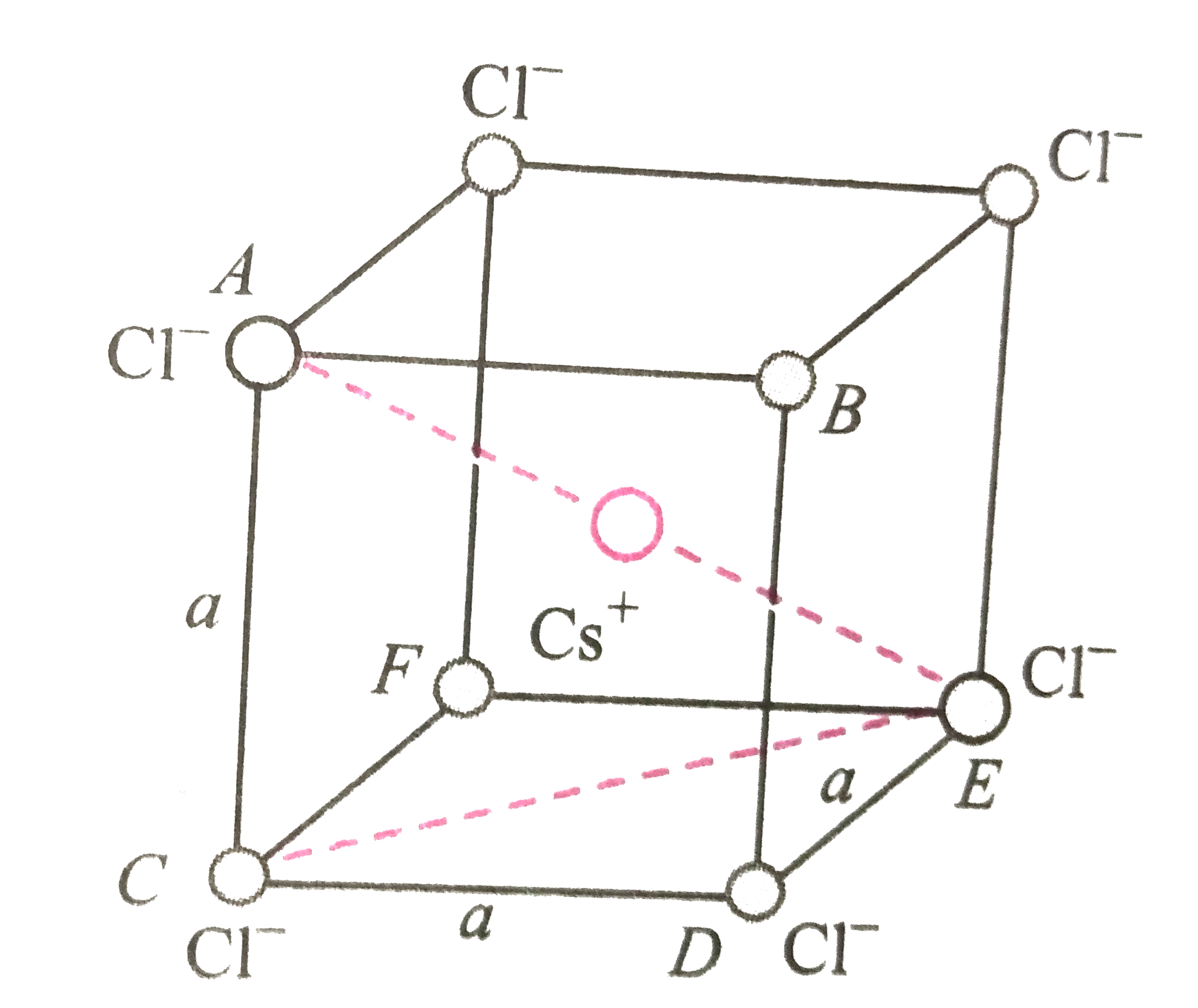 `therefore` Body diagonal, AE=`2r_(Cs^+)+ 2r_(Cl^-)` But body diagonal =`sqrt3a` (From right angled `triangleCDE`, CE=`SQRT(a^2+a^2)=sqrt2a` From right angled `triangle ACE` , `AE=sqrt(AC^2+CE^2)=sqrt(a^2+2a^2)=sqrt(3a^2)=sqrt3a`) `therefore 2(r_(Cs^+)+r_(Cl^-))=sqrt3a` or `r_(Cs^+) +r_(Cl^(-))=sqrt3/2a` |
|
| 28. |
If a is the length of the side of a cube, the distance between the body-centred atomand one corner atom in the cube will be |
|
Answer» `2/sqrt3 a ` |
|
| 29. |
If a half cell A+E^(-)rarrA^(-) has a large negative potential it follows that |
|
Answer» a is easily REDUCED |
|
| 30. |
If a given amount of gas is compressed to half of its volume, the density is _________. |
|
Answer» DOUBLED |
|
| 31. |
If a gas is allowed to expand at constant temperature then: |
|
Answer» the KINETIC ENERGY of the GAS molecules decreases |
|
| 32. |
If a gas expands at constant temperature. |
|
Answer» KINETIC energy of MOLECULES REMAINS the same |
|
| 33. |
If a gas expands at constant temperature, it indicates that |
|
Answer» no. of MOLECULES of gas INCREASES. |
|
| 34. |
If a gas expands at constant temperature, it indicates that : |
|
Answer» Kinetic ENERGY of molecules decreases Thus option (c ) is correct ANSWER. |
|
| 35. |
If a gas diffuses at the rate of one-half as fast as O_(2), find the molecular mass of the gas. |
|
Answer» Solution :Applying Graham.s law of diffusion . `(r_(1))/(r_(2)) = SQRT((M_(2))/(M_(1))) , (1/2)/(1) = sqrt((32)/(M_(1)))` Squaring both sides of the equation `((1)/(2))^(2) = (32)/(M_(1)) (or) (1)/(4) = (32)/(M_1)` `M_1 = 128` Thus the molecular mass of the unknown gas is 128. |
|
| 36. |
If a gas diffuses at the rate of one-half as fast as O_2, find the molecular mass of the gas. |
|
Answer» Solution :APPLYING Graham.s law of diffusion . `(r_(1))/(r_(2)) = sqrt((M_(2))/(M_(1))) , (1/2)/(1) = sqrt((32)/(M_(1)))` SQUARING both sides of the equation `((1)/(2))^(2) = (32)/(M_(1)) (or) (1)/(4) = (32)/(M_1)` `M_1 = 128` Thus the MOLECULAR mass of the UNKNOWN gas is 128. |
|
| 37. |
If a gas contains only three molecules that move withvelocities of 100,200, 500 ms^(-1). What is the rms velocity of that gas in ms^(-1) ? |
|
Answer» `100sqrt(8 //3)` |
|
| 38. |
If a compound has ‘n’ different types of asymmetric carbon atoms then the maximum number of possible stereoisomers are |
| Answer» Solution :`2^(n)` | |
| 39. |
If a compound contains conjugated system, the measured bond lengths differ form the expected bond length but 1, 3 diene contains following resonance structures Which of the following is correct |
|
Answer» In 1,3 - BUTADIENE all C-atoms are `sp^(2)` |
|
| 40. |
If a compound contains conjugated system, the measured bond lengths differ form the expected bond length but 1, 3 diene contains following resonance structures Increasing order of bond length between carbon and nitrogen is |
|
Answer» `II LT III lt I` |
|
| 41. |
If a compound contains conjugated system, the measured bond lengths differ form the expected bond length but 1, 3 diene contains following resonance structures The bond length between C_(2)-C_(3) carbon is |
|
Answer» `1.20 A^(@)` |
|
| 42. |
If a body of a fish contains 1.2 g hydrogen in its total body mass, if all the hydrogen is replaced with deuterium then the increase in body weight of the fish will be |
|
Answer» 1.2g If all the 1.2 g HYDROGEN is REPLACED with deuterium, the weight will become 2.4g. Hence the increase in body weight is (2.4 - 1.2 = 1.2 g). |
|
| 43. |
If A + B - 70J//mol hArr D, reaction temperature is increased then reaction moves in ............... direction. |
|
Answer» |
|
| 44. |
If A and B are two different atoms, when does AB molecule become covalent ? |
| Answer» SOLUTION : When the electronegalivity dirference between the two atoms FORMING the bond is LESS than 1.7, then the bond becomes covalent | |
| 45. |
If ""_(90)Th^(238) disintegrates to ""_(83)Bi^(212) , then the number alpha and beta particles emitted is |
|
Answer» `4 alpha` and `7 BETA` `THEREFORE 228 =212 +4N impliesn=4` 90=83 + 2n-m `impliesm=1` `therefore alpha`-particles emitted, n=4 `beta` particles emitted , m=1 |
|
| 46. |
If 75.2% of compound is carbon and the rest of the weight is hydrogen, the formulaof the compound is |
|
Answer» `C_(3)H_(6)` |
|
| 47. |
If 6.3 g of NaHCO_3 are added to 15.0 g of CH_3COOH solution, the residue is found to weigh 18.0 g. What is the mass of CO_2 released in the reaction ? |
|
Answer» Solution :According to the law of conservation of mass, the total amount of reactants is always equal to the total amount of PRODUCTS in a chemical reaction. In the given CASE, Total amount of reactants `(NaHCO_(3))+CH_(3)COOH)` `=6.3 + 15.0 = 21.3 g` Suppose, x g of `CO_(2)` is released in the reaction, `therefore` Total amount of products (RESIDUE `+CO_(2)`) `=18.0 + xg` `therefore x= 3.3 g` Hence, the amount of C02 released in the reaction is 3.3 g. |
|
| 48. |
If 5ml of methane is completely burnt the volume of oxygen required and the volume of CO_(2) formed under the same conditions are |
| Answer» Solution :`CH_(4) +2O_(2) rarr CO_(2) +2H_(2)O` | |
| 49. |
If 5.6of KOH is present in (a) 500 mL and (b) 1 litre of solution, calculate the molarity of each of these solutions. |
|
Answer» Solution :Mass of KOH `= 5.6 G` No. of moles `= (5.6)/(56) =0.1` mol (i) Volume of the solution `= 500 ml = 0.5 L` (ii) Volume of the solution = 1L Molarity `= ("Number of moles of SOLUTE")/("Volume of solution (in L)") = (0.1)/(0.5) = 0.2 M` (iii) Volume of the solution = 1L Molarity `= (0.1)/(1) = 0.1 M` |
|
| 50. |
If 500 mL of a 5M solution is diluted to 1500 mL, what will be the molarity of the solution obtained ? |
|
Answer» 1.5M `M_(1)V_(1) = M_(2)V_(2)` `:.500xx5M = 1500xxM` `:.M = 5/3 = 1.66M` Given `M_(1)=5M` `V_(1)= 500 mL` `V_(2) = 1500 mL` `M_(2)=M` |
|