Saved Bookmarks
This section includes 7 InterviewSolutions, each offering curated multiple-choice questions to sharpen your Current Affairs knowledge and support exam preparation. Choose a topic below to get started.
| 1. |
If DeltaG for a reaction is negative , the change is ____ |
| Answer» SOLUTION :SPONTANEOUS | |
| 2. |
If Delta H = 35.5 kJ/mol and Delta S = 83.6 J/mol K. At what temperature the reaction will be spontaneous? |
|
Answer» `T GT 425 K` `T= (Delta H)/( Delta S) = (35.5 xx 1000)/( 83.6) = 425K` `therefore` Reaction will be spontaneous at temperature `T gt 425 K`. |
|
| 3. |
If Delta H gt Delta G for the given process, then .......... |
|
Answer» `q_("rev") gt 0` |
|
| 4. |
If DeltaG = - 177 K cal for (1) 2 Fe(s) + (3)/(2)O_(2)(g) rarr Fe_(2)O_(3)(s) and DeltaG = - 19 K cal for (2) 4 Fe_(2)O_(3)(s) + Fe(s) rarr 3 Fe_(3)O_(4) (s) What is the Gibbs free energy of formation of Fe_(3)O_(4) ? |
|
Answer» `+ 229.6 ("kcal")/("mol")` `3Fe_((s)) + 2O_(2(g)) RARR Fe_(3)O_(4(s))` …(1) And we have reactions as follows: `2Fe_((s)) + (3)/(2) O_(2(g)) rarr Fe_(2)O_(3(s))` …(2) `4Fe_(2)O_(3(s)) + Fe_((s)) rarr 3Fe_(3)O_(4)` ..(3) Eq (1) `= (Eq(2) XX 4 + Eq (3) xx 1)/(3)` So, `Delta G = (4 (-177) + (-19))/(3)` `= -242.3` Kcal/mole |
|
| 5. |
If Delta G = Delta H - T Delta S and Delta G = Delta H + T [(d(Delta G))/(dT)]_(P) then variation of emf of a cell E, with temperature T is given by: |
|
Answer» <P>`(Delta H)/(NF)` |
|
| 6. |
If Delta E is the energy emitted in electron vots when an electronic transition occurs from higher energy level to a lower energy level in H-atom, the wavelength of the line produced is approximately equal to |
|
Answer» `(19800)/(DeltaE) Å` If `Delta E` is in joules, `lamda = ((6.6 xx 10^(-34) KG m^(2) s^(-1)) (3.0 xx 10^(8) ms^(-1)))/(Delta E (kg m^(2) s^(-1)))` `= (19.8 xx 10^(-26))/(Delta E) m` If `Delta E` is in eV, then as `1 eV = 1.6 xx 10^(-19) J` `lamda = (19.8 xx 10^(-26))/(Delta E xx 1.6 xx 10^(-19)) m = (12.375 xx 10^(-7))/(Delta E) m` `= (12375 xx 10^(-10))/(Delta E) m = (12375)/(Delta E) Å` |
|
| 7. |
If CuSO_(4).5H_(2)O(s)hArrCuSO_(4).3H_(2)O(s)+2H_(2)O(g) K_(p)=4xx10^(-4)atm^(2) |
|
Answer» `gt15.2mm` |
|
| 8. |
If C_p, bar(C ) and C of CO_2 gas are equal at T_1 ,T_2 and T_3 temperatures then |
|
Answer» `T_1 LT T_2 lt T_3` normally at same `T, C_p < C` but as `T uarr, C_p = C_((T)) implies T_1 > T_2` Similarly `T_2 > T_3`. |
|
| 9. |
If concentration of two weak acids are C_(1) and C_(2) "mol"//L and degree of ionization are alpha_(1) and alpha_(2) respectively then their relative strength can be compared by : |
|
Answer» `([H^(+)]_(1))/([H^(+)]_(2))` |
|
| 10. |
If concentration quotient of reaction is less than its equilibrium constant, then the reaction will proceed in the ……….. direction. |
|
Answer» |
|
| 11. |
If concentration of OH^(-) ions in the reaction Fe (OH)_(3) (s) hArr Fe^(3+) (aq) + 3 OH^(-) (aq) is decreased by 1/4 times, then equilibrium concentration of Fe^(3+) will increase by |
|
Answer» 8 times If `[OH^(-)]` is decreased to y/4, to keep K CONSTANT ` x'(y/4)^(3)= x +y ^(3):. x' = 64 x ` |
|
| 12. |
If concentration are expressed in moles L^(-1) and pressure in atmospheres, what is the ratio of K_(p) " to " K_(c) for the reaction :2 SO_(2) (g) + O_(2) (g) hArr 2 SO_(3) (g) " at " 25^(@) C? |
| Answer» Solution :` Delta _(n_(g)) = n_(p) - n_(r) = -1. "Hence ", K_(p) = K_(c) (RT)^(-1) or K_(p)//K_(c)= 1//RT= 1/(0*0821 XX 298) = 0*04` | |
| 13. |
If compressibility factor of a gas is less than one at STP, then its …………. . |
|
Answer» `V GT 22.4` litres |
|
| 14. |
If CO_(2) is allowed to escape from the following reaction at equilibrium CO_(2)+H_(2)O+H_(2)CO_(3)hArr 2H^(+) + 2HCO_(3)^(-) |
|
Answer» pH will DECREASE Hence, `H^(+)` ion CONCENTRATION will decrease or pH will increase. |
|
| 15. |
If CI_(2) HCI and O_2 are mixed in such a manner that the partial pressure of each is 2 atm and the mixture (V.P.=0.5 atm). What would be the approximate partial pressure of CI_2 when equilibrium is attained at temperature (T)? If your answer in scientific notation is xx x10^(-y) ,write the value of y. [Given: 2H_2O(g)+2CI_2(g)hArr4HCI(g)+O_2(g),K_(p)=12xx10^(8)atm) |
|
Answer» |
|
| 16. |
If CH_(3)COOH(K_(a)=10^(-5)) reacts with NaOH at 298K, then find out the value of the maximum rate constant of the reverse reaction at 298 K at the end point of the reaction. Given that the rate constant of the forward reaction is 10^(-11)mol^(-1) L sec^(-1) at 298 K. Also calculate Arrhenius parameter for backward reaction if DeltaH_(298K)=44kcal and E_(a(f))= 94kcal. |
|
Answer» |
|
| 17. |
If C_(4)H_(8) is not alkene then this compound is ………… |
| Answer» SOLUTION :CYCLOBUTANE | |
| 18. |
If C+O_(2) to CO_(2) + 94.2 K.Cal H_(2) + (1)/(2) O_(2) to H_(2) O + 68.3 K.Cal CH_(4) + 2O_(2) to CO_(2) + 2H_(2) O + 210.8 K.Cal Calculate the enthalpy of formation of CH_(4). |
|
Answer» `47.3` K.CAL |
|
| 19. |
IfC_2H_5O H andH_2 solution is example of non-ideal solution then which graphical representation is correct? |
|
Answer» ` (##SUR_CHE_XI_V02_C09_E02_026_O01.png" WIDTH="30%"> |
|
| 20. |
If c is the molar concentration of the solution of a weak electrolyte, then its degree of dissociation is proportionalto ............ . |
|
Answer» |
|
| 21. |
If Bohr radius is represented by a_(0), the radius of the second orbit of helium ion (He^(+)) will be...... |
| Answer» Solution :`2 a_(0) ( :' r_(N) = a_(0) n^(2)//Z)` | |
| 22. |
If beta_(1), beta_(2) and beta_(3) are stepwise formation constants of MC1, MC1_(2), MC1_(3) and K is the overall formation constant of MC1_(3), then |
|
Answer» `K = beta_(1) + beta_(2) + beta_(3)` |
|
| 23. |
If barium sulphate is precipitated in a solution containing potassium permanganate it is coloured pink (violet) by: |
|
Answer» ABSORPTION of some of the permanganate |
|
| 24. |
Define dipole moment. The dipole moment of BF_3 is zero. Why? |
|
Answer» |
|
| 25. |
If B–Cl bond has a dipole moment,explain why BCl_(3) molecule has zero dipole moment. |
Answer» Solution :The ELECTRONEGATIVITY of boron is 2.0, while that of CI is 3.0. Due to the difference in electronegativity, B - CI bond is polar and has a definite dipole moment. `BCl_3` is a trigonal planar molecule due to `sp^2` hybridisation state of B in it. In `BCl_3`, the three B - Cl BONDS lie in the same plane at an angle of `120^@`. THEREFORE, the RESULTANT dipole moment of two B - Cl bonds is EQUAL in magnitude and opposite in direction to the dipole moment of the third B-Cl bond. As a result, the net dipole moment of `BCl_3` molecule is zero as shown below. 
|
|
| 26. |
If B-Cl bond has a dipole moment, explain why BCl_3 molecule has zero dipole moment. |
|
Answer» Solution :As a result of the difference in the electronegativities of B and CL, the B Cl bond is polar in nature. HOWEVER, the `BCl_3` molecule is non-polar. This is because `BCl_3` is trigonal planar in SHAPE. It is a symmetrical molecule.  Hence, the RESPECTIVE dipole-moments of the B-Cl bond cancel each other, there by causing a zero-dipole MOMENT. |
|
| 27. |
If Avogadro number N_(A), is changed from 6.022 xx 10^(23) mol^(-1) to 6.022 xx 10^(20) mol^(-1), this would change |
|
Answer» the mass of one MOLE of carbon If `N_(A)` is changed to `6.022 xx 10^(200)` then mass of 1 mole of carbon atoms `= ((12g))/((6.022xx10^(23)))xx(6.022xx10^(20))=1.2xx10^(-2)g`. |
|
| 28. |
If Avagadro number were changed from 6.022xx10^(23) " to " 6.022xx10^(20), this would change |
|
Answer» The ratio of chemical species to each other in a balanced equation. |
|
| 29. |
If Aufbau rule is not followed, K-19 will be placed in ….. Block (1) s (2) p (3) d (4) f |
|
Answer» |
|
| 30. |
If Aufbau rule is not followed, K - 19. will be placed in |
|
Answer» s |
|
| 31. |
If atomic numberis(z=26)then givennumberof 3d electrons . |
|
Answer» 6 |
|
| 32. |
If atomic number increases, then the atomic radius of period and the group ....... and ....... respectively. |
|
Answer» INCREASES, increases |
|
| 33. |
If atomic mass of hydrogen on a hypothetical scale is choosen to be 10.0000, what is the molecular mass of a gas which has a vapour density of 22 ? |
|
Answer» 44 |
|
| 34. |
If at 550 K temperature, Hydrogen gas and Oxygen gas reacts to form water vapour in presence of catalyst, calculate the total pressure of vessel, if the partial pressure of Hydrogen gas is 2 bar and that of Oxygen gas is 1 bar at 550 K in a closed vessel. |
|
Answer» 4 bar |
|
| 35. |
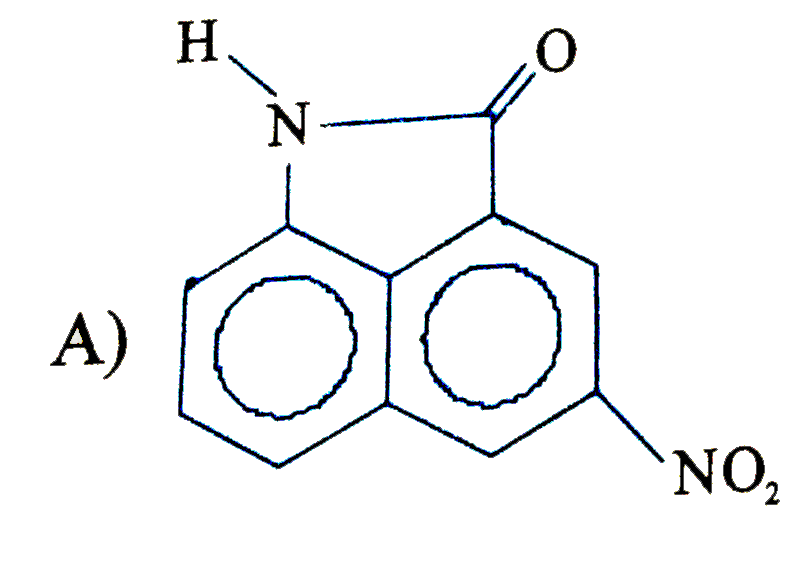
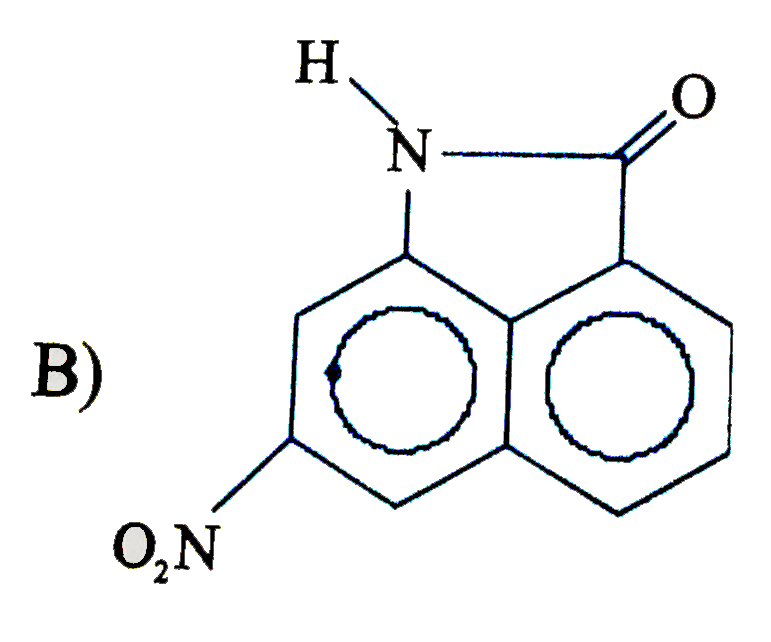
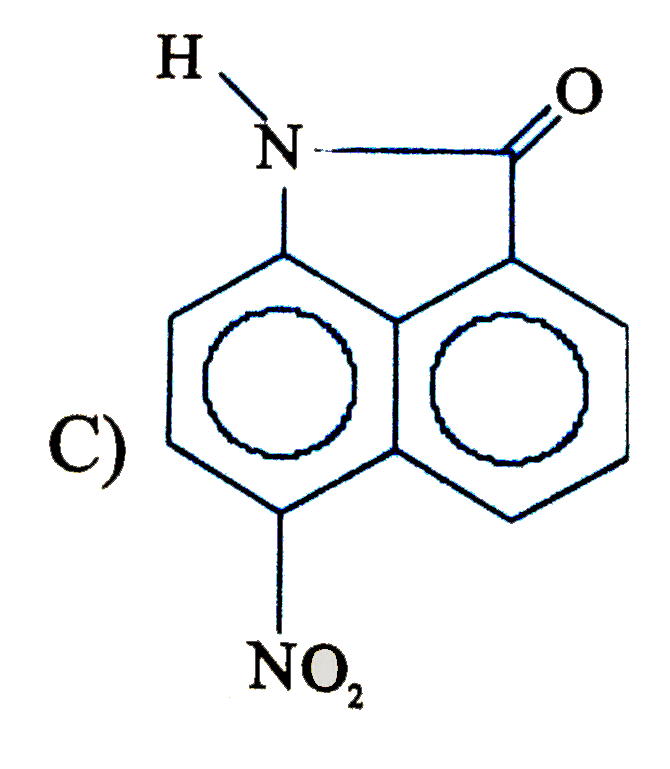
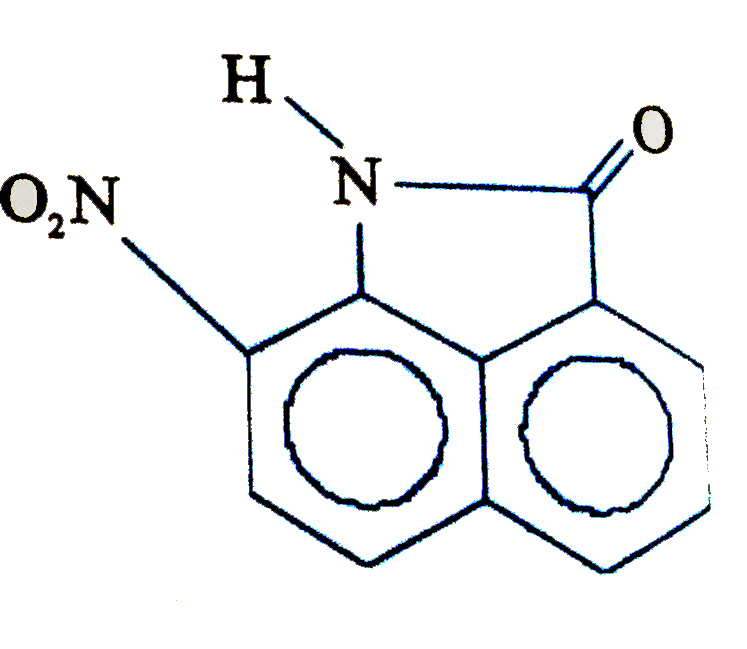
If aromatic ring is substituted by more than one group then electrophilic aromatic substitution reaction take place according to more activating group. The group which donates electrons to aromatic ring knwn as activating group and which withdraw electrons from the ring is called electron withdrawing group. generally all lectron releasing groups activates benzene ring towards electrophilic substitution and electron withdrawing groups deactivates ring towards electrophilic substitutions. Q. Find out major product of following reaction |
|
Answer»
 is ACTIVATING and ORTHO, para directing GROUP `gtC=0` deacting and m-directing. is ACTIVATING and ORTHO, para directing GROUP `gtC=0` deacting and m-directing.
|
|
| 36. |
If arsenic is added as impurity to silicon, the type of semiconductor obtained is called ________ |
|
Answer» |
|
| 37. |
If Ar is added to the equilibrium N_(2(g))+3H_(2(g))hArr2NH_(3) at constant volume, then equilibrium will |
|
Answer» Shift in FORWARD direction |
|
| 38. |
If any equilibrium process equation is multiply by any factor n, still there is no change in equilibrium constant explain with example. |
|
Answer» Solution :The equilibrium of HI SYNTHESIS at definite temperature is as under. `H_(2(g)) + I_(2(g)) hArr 2HI_((g))`…(Eq.-i) The equilibrium constant `K_c` is as, `K_c=([HI]^2)/([H_2][I_2])=X` ….(Eq.-ii) On MULTIPLYING the [7.9(ii)] HI synthesis equation by n, we GET (Eq.-7.18). `nH_2+nI_2=2n HI`....(Eq.-iii) For this (Eq.-7.18) reaction the equilibrium constant `K.._c` so, `K.._c=([HI]^(2n))/([H_2]^n [I_2^n])=[[HI]^2/([H_2][I_2])]^n=X^n`....(Eq.-iv) Thus , `K_c=[I_2]^n` and `K.._c=X^n` `therefore (K_c)(K.._c)=(X)(X)^n` `therefore K.._c=(K_c)^n`...(Eq.-v) It should be noted that because the equilibrium constants `K_c` and `K.._c` have different numerical values, it is important to SPECIFY the form of the balanced chemical equation when quoting the value of an equilibrium constant. |
|
| 39. |
If angular momentumquantumnumberl=3 then givepossiblevaluesof magneticquantum number m. |
|
Answer» 0,1,2 |
|
| 40. |
If an inert gas expands at constant pressure by providing heat |
|
Answer» The temperature increases |
|
| 41. |
If an endothermic reaction is non-spontaneous at freezing point of water and becomes feasible at its boiling point, then |
|
Answer» `Delta H` is -ve, `Delta S` is +ve |
|
| 42. |
If an element 'X' is assumed to have the types of radii, then their order is |
|
Answer» Crystal RADIUS GT Van DER Waals radius gt COVALENT radius |
|
| 43. |
If an electron is moving with a velocity 600 ms^(-1) which is accurate upto 0.005%, then calculate the uncertainty in its position (h = 6.63 xx 10^(-34)Js, " mass of electron" = 9.1 xx 10^(-31) kg) |
|
Answer» Solution :Velocity of the ELECTRON `= 600 ms^(-1)` Uncertainty in velocity `= (0.005)/(100) xx 600 ms^(-1) = 0.03 ms^(-1) = 3 xx 10^(-2) ms^(-1)` Now `(DELTA x) (m Delta v) = (h)/(4PI)` `:. Delta x = (h)/(4pi m Delta v) = (6.63 xx 10^(-34) kg m^(2) s^(-1))/(4 xx 3.14 xx 9.1 xx 10^(-31) kg xx 3 xx 10^(-2) ms^(-1)) = 1.93 xx 10^(-3)m` |
|
| 44. |
If an electron travels with a velocity of 1/100th speed of light in the first in the first Bohr orbit, what is its velocity (relative to the speed of light) in the 5th Bohr orbit ? |
|
Answer» Solution :`v_(N) = v_(0) (Z)/(n)` `v_(1) = (1)/(100) xx c = v_(0) (1)/(1) = v_(0), " i.e., " v_(0) = (c)/(100)` `v_(5) = v_(0) (1)/(5) = (c)/(100) xx (1)/(5) = (c)/(500) = 0.002 c` |
|
| 45. |
If an electron is accelerated by a potential of V volts, the wavelength acquired by the electron will be...... |
| Answer» SOLUTION :`h//sqrt(2meV)` | |
| 46. |
If an electron in H-atom has an energy of -78.4 kcal/mole, the electron is present in__ orbit. |
|
Answer» |
|
| 47. |
If an Einstein (E) is the total energy absorbed by 1 mole of a substance and each molecule absorbs one quantum of energy, then calculate the value of 'E' in terms of lamda in cm. |
|
Answer» |
|
| 48. |
If an automobile engine burns petrol at a temperature of 816^(@)Cand if surrounding temperature is 21^(@)C,what is its maximum percentage ? |
|
Answer» SOLUTION :% EFFICIENCY - `[(T_h-T_c)/T_h]XX100` Here `T_h`=816+273=1089 K , `T_c`=21+273=294 K % Efficiency =`((1089-294)/1089)xx100` % Efficiency =73% |
|
| 49. |
If an atom has electronic configuration 1s^(2)2s^(2), 2p^(6) 3s^(2) 3p^(6) 3d^(3) 4s^(2) It will be placed in |
|
Answer» SECOND group |
|
| 50. |
If aluminium is added as impurity to silicon, the type of semiconductor formed is called _________ |
|
Answer» |
|