

Saved Bookmarks
This section includes 7 InterviewSolutions, each offering curated multiple-choice questions to sharpen your Current Affairs knowledge and support exam preparation. Choose a topic below to get started.
| 1. |
In visible spectrumwhichcolourhas minimumenergy?State ite wavelengthand frequency. |
|
Answer» SOLUTION :Redcolourhas minimum energy Wavelength`(lambda) : 760 nm (760 A)` Frequency`( F): 4 xx 10^(14) HZ` |
|
| 2. |
In view of the signs of Delta_(r)G^(@)for the following reactions : PbO_(2)+ Pb rarr 2PbO, Delta_(r)G^(@)lt 0 SnO_92)+Sn rarr2SnO, Delta_(r)G^(@) gt 0 Which oxidation states are more charactersitic for lead and tin? |
|
Answer» For lead `+4`, for TIN `+2` `overset(+4)(SnO_(2)) +SN rarr overset(+2)(2SnO)`. As `Delta_(r)G^(@) gt 0`, i.e., it ispositive,reverse reaction will be spotaneous , i.e., `Sn^(+4)` willbe morestable than`Sn^(+2)`. These facts are also supported by the INERT pair EFFECT down the group. |
|
| 3. |
In visiblespectrum whichcolourhas maximumenergy? Staticits wavelengthand frequency . |
|
Answer» Solution :Violetcolourhasmaximumenergy WAVELENGTH`(lambda) :380 NM`(3800 A) FREQUENCY(f ) = `7.5 xx 10^(14)Hz` |
|
| 4. |
In view of the sign of delta_(n)G^(o) for the following reaction : PbO_2 +Pb rArr 2PbO , delta_(n)G^(o) lt 0 SnO_2+ Sn rarr 2SnO , delta_(n)G^(o) gt 0 Which oxidation states are more characteristic for lead and tin ? |
|
Answer» For lead +4 , for TIN +2 |
|
| 5. |
In Victor Meyer's experiment, 0.6 g of a volatile substance displaced 112 mL of air at S.T.P. Find the molecular mass of the substance. |
|
Answer» |
|
| 6. |
In Vector-Meyer's test the colour given by 1^(@), 2^(@) and3^(@) alcohols are respectively |
|
Answer» RED, COLOURLESS, BLUE |
|
| 7. |
In vapour phase, BeCl, possess polymer like arrangement. |
| Answer» SOLUTION :False STATEMENT (BECL, possess polymer like arrangement in solid state.) | |
| 8. |
In van der Waals' equation of state of the gas law, the constnat 'b' is a measure of : |
|
Answer» INTERMOLECULAR COLLISIONS per UNIT volume |
|
| 9. |
In van der Waals' equation of state, the constant 'b' is a measure of |
|
Answer» intermolecular repulsion |
|
| 10. |
In Vander Waal's equation of state of the gas law, the constant 'b' is a measure of |
|
Answer» Intermoleculer repulsions |
|
| 11. |
In two vessels of 1 litre each at the same temperature lg of H_(2)and 1 g of CH_(4) are taken, for these : |
|
Answer» `V_(RMS)` values will be same |
|
| 12. |
In treatment of cancer ....... salts are used. |
|
Answer» Mg |
|
| 13. |
In transition elements, the shells that are incompletely filled |
|
Answer» Ultimate SHELL only |
|
| 14. |
In transforming 0.01 mole of PbS to PbSO_(4) , the volume of '10 volume' H_(2)O_(2) required will be |
|
Answer» 11.2 mL `underset(0.04 "mole")(4H_(2)O_(2)) to 4H_(2)O + underset(0.02xx22400 mL "at N.T.P.")(2O_(2))` Vol of `O_(2)` at N.T.P. `=0.02xx22400` `=448` mL `THEREFORE` Volume of 10 volume `H_(2)O_(2)` solution `=448//10=44.8` mL. |
|
| 15. |
In transforming 0.01 mole of PbSin to PbSO_4 the volume of 10 "volume " H_2O_2 requred will be |
|
Answer» SOLUTION :1 mole of `PBS to 4` moles of `H_2O_2` `4 = 10 /11.2xxV (Lt)` |
|
| 16. |
In transforming 0.01 mole of PbS to PbSO_(4), the volume of 10 volume H_(2)O_(2) required will be : |
|
Answer» 11.2 mL 0.04 mole of `H_(2)O_(2)` is required to REACT with 0.01 mole PbS. Molarity of `H_(2)O_(2)` may be calculated as, Volume strength = Molarity `xx 11.2` `10= M xx 11.2` M=0.892 NUMBER of MOLES`=(MV)/(1000)` `0.04 =(0.892xxV)/(1000)` V=44.8 mL |
|
| 17. |
In TLC for compound X R_(f) = 0.7 and for B R_(f)= 0.4 which substance migrate more? |
| Answer» SOLUTION :COMPOUND X MIGRATE more | |
| 18. |
In TLC, aminoacidsare easilydetectedbyspraying the TLCplatewith _______. |
| Answer» Answer :A | |
| 19. |
In three moles of ethane (C_(2)H_(6)), calculate the following: (i) Number of moles of carbon atoms. (ii) Number of moles of hydrogen atoms. (iii) Number of molecules of ethane. |
|
Answer» SOLUTION :(i) 1 MOLE of ETHANE contains 2 moles of carbon ATOMS. `therefore` Number of moles of carbon atoms in 3 moles of ethane `=3 XX 2=6` (ii) 1 mole of ethane contains 6 moles of hydrogen atoms. `therefore`Number of moles of hydrogen atoms in 3 moles of ethane `= 3 xx 6 = 18` (iii) 1 mole of ethane contains `6.022 xx 10^23` (Avogadro.s no.) molecules. `therefore` Number of molecules in 3 moles of ethane `= 3 xx 6.022 xx 10^(23)` `=18.066 xx 10^(23)` |
|
| 20. |
In three moles of ethane (C_(2)H_(6)) calculate the following : (i) Number of moles of carbon atoms. (ii) Number of moles of hydrogen atoms. (iii) Number of molecules of ethane. |
|
Answer» (ii) 6 mol Hydrogen molecule are in 1 mol ethane `(C_(2)H_(6))`. Therefore in three mole ethane `3xx6 = 18` molecules of hydrogen present. (iii) 1 mol ethane `= 6.022xx10^(23)` ethane molecule `:. 3` mol ethene `= (?)` `= 3 xx 6.022xx10^(23)` `= 18.066xx10^(23)` ethane molecule |
|
| 21. |
In three moles of ethane (C_(2)H_(6)) calculate the following:(i) Number of moles of carbon atoms.(ii) Number of moles of hydrogen atoms.(iii) Number of molecules of ethane. |
|
Answer» SOLUTION :(i) 1 mole of `C_(2)H_(6)` contains 2 moles of Carbon atoms. `:.` 3 moles of `C_(2)H_(6)` will have 6 moles of Carbon atoms. (ii) 1 mole of `C_(2)H_(6)` contains 6 moles of Hydrogen atoms. `:.` 3 moles of `C_(2)H_(6)` will have 18 moles of Hydrogen atoms. (III) 1 mole of `C_(2)H_(6)` contains `6.023xx10^(23)` NUMBER of molecules. `:.` 3 moles of `C_(2)H_(6)` will contain `3xx6.023xx10^(23)` molecules. |
|
| 22. |
In three dimension wave function may be expressed in spherical co-ordinate system (r,0,phi),r=distance of electron from the nucleus 0= Angle from 'z' axis varying from 0 to pi phi = Angle from 'x' axis …… 0 to 2pi ltbr. Psi may be represented as Psi (r,0,phi)=R (r) .A(0, phi) The R(r) is detemind by 'n' and 'l'. The A (0,phi) is determined by 'l' and 'm'. Which of the following is R(r) part of '3p' atomic orbital of hydrogen atom ["Given" alpha_(0) = 0.529 "Å"]? |
|
Answer» `(2)/((a_(0))^(3//2))e^(-R//a_(0))` |
|
| 23. |
In this, sulhonation is most favorable at the carbon number. |
|
Answer» 1 |
|
| 24. |
In this reaction, the main product is |
|
Answer» PICRIC acid 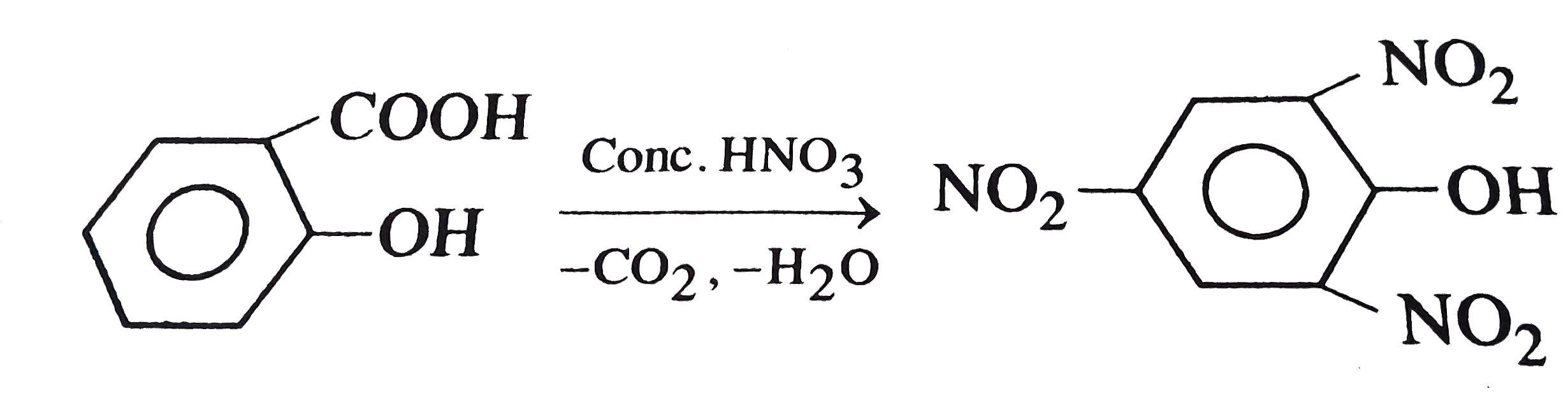
|
|
| 25. |
In this reaction CO_((g)) + H_2O_((g)) hArr CO_(2(g)) + H_(2(g)) initially [CO]=0.1 M and at equilibrium [CO]=0.067 M so, in this reaction will K_c gt 0 or K_c lt 0 ? |
| Answer» Solution :The REACTION is FORWARD because REACTANT is DECREASES. If the reaction is forward `K_c gt 0` and positive. | |
| 26. |
In this reaction ozone acts as: |
|
Answer» an oxidisng agent |
|
| 27. |
In this reaction CO_((g)) + H_2O_((g)) hArr CO_(2(g)) + H_(2(g)) initially [CO]=0.1 M and at equilibrium [CO]=0.067 M so, if K_c=4.24 than what will be the value of K_p ? |
|
Answer» Solution :`K_p=K_c=4.24` as `Deltan_((G))=0,K_p = (K_c)(RT)^(Deltan)` `therefore K_p=K_c` |
|
| 28. |
In this reaction 2AuCl_(3) + 3SnCl_(2) to 2Au + 3SnCl_(4) which is an oxidising agent? |
|
Answer» `AuCl_(3)` |
|
| 29. |
In this paragraph, some statements are given based on isomerism. Read the following statements given for every question and provide the anser Which of the following structures of a cyclic alkene with the lowest number of C atoms shows geometrical isomerism having two meso steroisomers? |
|
Answer» I |
|
| 30. |
In this process I_(2) + I^(-) hArr I_(3)^(-) (in aq medium), initially there are 2 mole I_(2) & 2 mole I^(-) . But at equilibrium due to addition of AgNO_(3 (aq)) , 1.75 mole yellow ppt is obtained . K_(C) for the process is ( V_("flask") = 1 dm^(3) ) nearly |
|
Answer» 0.08 |
|
| 31. |
In this paragraph, some statements are given based on isomerism. Read the following statements given for every question and provide the answer. Which of the following structrues of a cyclic alkene with the lowest number of C atoms shows geometrical isomerism having two meso stereiosomers? |
|
Answer» (I) |
|
| 32. |
In thermodynamics, a process is called reversible when |
|
Answer» Surroundings and SYSTEM CHANGE into each other |
|
| 33. |
In thermo dynamics a process is called reversible when : |
|
Answer» surroundings and system CHANGE into each other |
|
| 34. |
In thenitration mixture concentrated sulphuric acid is used |
|
Answer» As a sulphonating agent |
|
| 36. |
In the unit cell of a cubic close-packed structure, total number of voids is __________ whereas in the unit cell of a hexagonal close-packed structure, total number of voids is________ |
|
Answer» |
|
| 37. |
In the treatment of domestic sewage water, the weight of oxygen that can be required to oxidise 1Omg of carbon is |
|
Answer» 2.67mg |
|
| 38. |
In the titration of K_(2)Cr_(2)O_(7) iodometrically, near the end point the colour of the solution becomes : |
| Answer» Solution :N//A | |
| 39. |
In the titration of K_(2)Cr_(2)O_(7) and FeSO_(4), the following data is obtained : V_(1) mL " of " 1M_(1) K_(2)Cr_(2)O_(7) requires V_(2) mL " of " 1M_(2) FeSO_(4). Which of the following relations is true for the above titration ? |
|
Answer» `6 M_(1)V_(1)=M_(2)V_(2)` `(M_(1)V_(1))/(n_(1))(K_(2)Cr_(2)O_(7))=(M_(2)V_(2))/(n_(2))(FeSO_(4))` `(M_(1)V_(1))/(1)=(M_(2)V_(2))/(6)` `6M_(1)V_(1)=M_(2)V_(2)` |
|
| 40. |
In the titration of weak acid against strong base match the pH of the solution at different stage of titration. |
|
Answer» |
|
| 41. |
In the titration of nitric acid against potassium carbonate, the indicator used is : |
|
Answer» METHYL orange |
|
| 42. |
In the titration of ferrous ammonium sulphate and potassium dichromate, the external indicator used is : |
|
Answer» KCNS |
|
| 43. |
In the titration of FeSO_(4) against KMnO_(4) in acidic medium, one mole of KMnO_(4) reacts with x moles of FeSO_(4). The value of x is |
|
Answer» 10 |
|
| 44. |
In the titration of CH_(3)COOH against NaOH, we cannot use the : |
|
Answer» METHYL orange |
|
| 45. |
In the titration of a weak acid of known concentratin with a standard solution of a strong base, a ph water was used to follow the progress of the titration. Which of the following is true of this experiment. |
|
Answer» The pH at the EQUIVALENCE point DEPENDS on the INDICATOR used |
|
| 46. |
In the titration of acetic acid versus sodium hydroxide , the pH of the solution at equivalence point (whenetemperature is 25^(@)C )is : |
|
Answer» about 5.5 |
|
| 47. |
In the titration ofa weak acid aginst a strong base, at the half-equivalence point (half. Neutralisation ) |
|
Answer» `pH = (1)/(2) pK_(a)` |
|
| 48. |
In the titration of a monoprotic acid with a solution of sodium hydroxide of known concentration, what quantites are equal at the equivalaence point? |
|
Answer» The concentrations of HYDROXIDE and HYDRONIUM ions |
|
| 49. |
In the titration of a solutionof weak acid, HX withNaOH ,the pH is 5.8after 10 mL of NaOH solution has been added and 6.40 after 20.0mLof the NaOH has been added. What is the ionisation constant of the acid HX ? |
|
Answer» `7. 94 xx 10 ^(-7) ` ` 5.8= pKa + log ""(10 xx B)/( A- 10B) ...(1) ` ` 6.4 = pKa +log "" ( 20 xx B)/( A - 20 B ) ...(2) ` ` 0.6 = log ""( 20 B)/( A- 20B) xx (A-10B)/(10B) ` ` 0.6 = log ""(2(A-10 B))/( (A-20B)) =log 4` ` rArr (A- 10B )/( A- 20 B)=2 rArr A =30 B ` substituting in ..........(1) ` 5.8= PKa+ log ""( 10 B)/( 3 0 B - 10 B) ` ` 5.8 = PKa+log ""(10B) /( 30 B -10 B) ` `5.8= pKa +log ""( 1)/(2) ` ` pKa =5.8 -log "" (1)/(2) = 5.8+0.3 =6.1` ` -log KA =6.1 , log Ka = -7 +0.7 = 7 . 9 4 xx 10 ^(-7)` |
|
| 50. |
In the thermite reaction used forobtainingenergy, aluminium and ferric oxide reactto fromiron andaluminiumoxide . From the given datw identifytheoption (s)whichis (are ) correct :[Given :Delta H_(f)^(@) Al_(2)O_(3) =- 390 KJ//"mole", DeltaH_(f)^(@) Fe_(2)O_(3)=-176kJ//mol,density ofaliuminium =2.7gm//ml density of Fe_(2)O_(3)=-3.2gm//ml"] |
|
Answer» Maximum calorific value of the FUEL can be`1000 J//gm.` |
|