

Saved Bookmarks
This section includes 7 InterviewSolutions, each offering curated multiple-choice questions to sharpen your Current Affairs knowledge and support exam preparation. Choose a topic below to get started.
| 1. |
A and B are two objects-moving with velocities oversettoV_Aand oversettoV_B. What is the velocity of A relative to B? |
| Answer» SOLUTION :`oversettoV_(AB)=oversettoV_A-oversettoV_B` | |
| 2. |
A heavy ball of radius R is travelling on a smooth horizontal surface with a velocity of u0 towards left. A horizontally moving small ball of mass mstrikes it at a height (R)/(2) above the centre whiletravelling with velocity u towards right. (a) After collision the small ball moves in vertically upwards direction with velocity u.Prove that this can happen only if ugt sqrt(3)u_(0) (b) Find the velocity of small ball after collision if the collision is elastic and the balls are smooth. |
|
Answer» |
|
| 3. |
(A): Equal moles of helium and oxygen gases are given cqual quantities of heat at constant volume. There will be greater rise in the temperature of helium compared to that of oxygen. (R): The molecular weight of oxygen is greater than the moleculat weight of helium. |
|
Answer» Both (A) and ( R) are true and (R ) is the CORRECT EXPLANATION of (A) |
|
| 4. |
To maintain a rotor at a uniform angular speed of 200 rad s^(-1), an engine needs to transmit a torque of 180 N m. The power required by the engine. Assume that the engine is 100% efficient. |
| Answer» ANSWER :A | |
| 5. |
A physical quantity is represented by x=M^(a)L^(b)T^(c ). The percentage of errors in the measurements are alpha %, beta %, gamma % then the maximum percentage error is |
|
Answer» `ALPHA a+beta B-C GAMMA` |
|
| 6. |
Three uniform spheres each of mass .m. and diameter D are kept in such a way that each touches the other two, then the magnitude of the gravitational force on any one sphere due 82 to other two is |
|
Answer» `(3Gm^2)/D^2` |
|
| 7. |
A travelling harmonic wave on a string is described by y(x,t) = 7.5 sin (0.005 x + 12t+ pi//4) (a) what are the displacement and velocity of oscillation of a point at x=1 cm, and t=1s? Is this velocity equal to the velocity of wave propagation? (b) Locate the points of the string which have the same transverse displacements and velocity as the x=1 cm point at t=2s, 5s and 11s |
|
Answer» Solution :(a) 1.66 cm, `87.75 cm s^(-1)`, No, the velocity of WAVE propagation is `-24ms^(-1)` (B) All POINTS at distance of `N LAMDA (n = +- 1, +-2, +-3..)` where `lamda= 12.6m` from the point x=1 cm |
|
| 8. |
Equation of continuity expresses the law of conservation of |
| Answer» Answer :B | |
| 9. |
At a pressure of 24xx10^(5) dyne/cm^(2),the volume of O_(2) is 10 litre and mass is 20 gm.The r.m.s velocity will be |
|
Answer» 800 m/sec |
|
| 10. |
The side of a cube, as measured with a vernier calipers of least count 0.01cm is 3.00cm. The maximum possible error in the measurement of volume is |
|
Answer» `+- 0.01 CM^(3)` |
|
| 11. |
A plate of area 10m^(2) is made to move horizontally with a speed of 0.5 ms^(-1) by applying a force over the surface a liquid. If the depth of the liquid is 2.5m, coefficient of viscosity of liquid is 10^(-3)Nsm^(-2), then calculate the horizontal force needed to move the plate. |
|
Answer» Solution :Given `Deltav=0.5 MS^(-1)` `Deltax=2.5m` velocity gradient `=(Deltav)/(Deltax)=(0.5)/(2.5)=0.2(ms^(-1))/(m)` 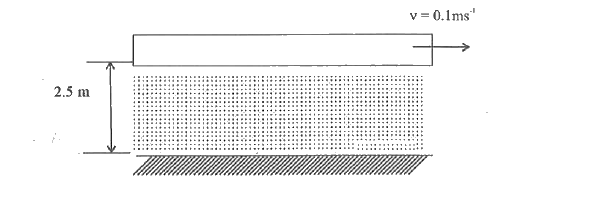 We KNOW that |F| `=etaA((Deltav)/(Deltax))=10^(-3) xx 10^(2) xx 10^(-2)=10^(-3)N` Hence `10^(-3)N` of force is needed to be applied, to KEEP the PLATE moving. |
|
| 12. |
A sphere of mass 3 kg and radius 0.2 m rolls down from the slope of height 7 m, its rotational kinetic energy will be …………. |
|
Answer» `42J` `v=sqrt((2gh)/(1+(k^(2))/(R^(2))))=sqrt((2gh)/(1+(2)/(5)))[because k=sqrt((2)/(5))Rrarr" for sphere"]` `therefore v=sqrt((10gh)/(7))=sqrt((10xx10xx7)/(7))=10m//s` Now rotational KINETIC energy `therefore k=(1)/(2)Iomega^(2)` `therefore k=(1)/(2)xx(2)/(5)MR^(2)xx(v^(2))/(R^(2))[because" For sphere "I=(2)/(5)MR^(2),omega=(v)/(R)]` `therefore k=(1)/(5)Mv^(2)=(1)/(5)xx3xx(10)^(2)=(300)/(5)` `therefore k=60J` |
|
| 13. |
(A) : When a bicycle is in motion, the force of friction exerted by the ground on the two wheels is always in forward direction.(R ) : The frictional force only when the bodies are in contact. |
|
Answer» Both (A) and (R ) are true and (R ) is the CORRECT explanation of (A) |
|
| 14. |
If k is the force constant of a spring the work done [against restoring force] in increasing its extension from l_(1) to l_(2) will be |
|
Answer» `K(l_(2)-l_(1))` |
|
| 15. |
To move an object, which one is easier, push or pull? Explain |
|
Answer» Solution :When a body is pushed at an arbitraryangle `theta(0 " to " (pi)/(2))`, the applied force F can be resolved into two components as F `SIN theta` PARALLEL to the surface and F `cos theta` perpendicularto the surface as shown in Figure. The total downward force ACTING on the body is `mg+Fcos theta`. It implies that the normal force acting on the body increases. Since thereis no acceleration along the verticaldirectionthe normal force N is equal to `N_("push")=mg+F cos theta""...(1)` As a result the maximal static friction also increases and is equal to `f_(s)^("max")=N_("push")=mu_(s)(mg+Fcos theta)""...(2)` Equation (2) shows that a greater force needs to be applied to push the OBJECT into motion.  When an object is pulled at an angle `theta`, the applied force is resolved into two components as shown in Figure. The total downward force acting on the object is `N_("pull")=mg+F cos theta"" ...(3)`  Equation (3) shows that the normal force is less than `N_("push")`. From equations (1) and (3), it is EASIER to pull an object than to push to make it move. |
|
| 16. |
The solar radiation spectrum reveals that the intensity corresponding to a wave length of 4750 A^(@) is maximum. Estimate the surface temperature of the sun (Given Wien's constant = 2.89xx10^(-3)m-K) |
|
Answer» Solution :From Wien.s displacement law, the temperature T of a body CORRESPONDING to maximum intensity wavelength `lamda_(m)` is GIVEN by `T=b/lamda_(m)" "thereforeT=(2.89xx10^(-3)m-K)/(4750xx10^(-10)m)=6084K` This temperature is corresponding to the CHROMOSPHERE (surface) of the sun. |
|
| 17. |
Two pendulums of lengths 100 cm and 121 cm suspended side by side. A suspended bobs suspended at its end stretched and leave together. After how many minimum oscillations of big pendulum, both are in same phase? |
|
Answer» `11` `T_(1)= 2pi sqrt((100)/(g))" and "T_(2)= 2pi sqrt((121)/(g))""[therefore T_(1) LT T_(2)," because "l_(1) lt l_(2)]` Suppose at t=0, both oscillate at same time but their oscillations are the same due to different period. Suppose pendulum of long string MAKES n oscillations and pendulum of short string makes `(n+1)` oscillations. `therefore (n+1)T_(1) = nT_(2)` `therefore (n+1)xx 2pi sqrt((100)/(g))= n xx 2pi sqrt((121)/(g))` `therefore (n+1)10= 11n` `therefore 10n +10 = 11n` `therefore n = 10`. |
|
| 18. |
A block of mass 1 kg starts from rest at x = 0 and moves along the x - axis under the action of a force F = kt, where t is time and k = 1 N/s. The distance the block will travel in 6 seconds is |
|
Answer» 36 m or, `int_(0)^(v) = (k)/(m)int_(0)^(t)" "or, v = (1)/(2)(k)/(m)cdot t^(2) " " or, (dx)/(dt) = (1)/(2)(k)/(m)t^(2)` `or," " int_(0)^(x) dx = (1)/(2)(k)/(m)int_(0)^(6) t^(2) dt` `or," "x = (1)/(2)(k)/(m)(6^(3))/(3) xx (1)/(2)xx(1)/(1) xx (216)/(3) [ because k = 1 N//s, m = 1 kg]` = 36 m The option A is CORRECT. |
|
| 19. |
Find the work done in stretching a wire Im long and area of cross section 0.03 cm under a load of 100 N if Young.s modulus of the material of the wire is 2 xx 10^(11)N//m^(2) |
|
Answer» |
|
| 20. |
A large cylindrical tank has a hole of area A at its bottom. Water is poured in the tank by as tube of equal cross sectional area A ejecting water at the speed v. |
|
Answer» The water level in the tank will KEEP on rising |
|
| 21. |
A body istied at the end of a string of length .l. and rotated in a vertical circle. The string is just taut when the body is at the highest point. Velocity of the body when the string is in horizontal position is |
|
Answer» `3sqrt(GR)` |
|
| 22. |
A uniformcylinder of length L and mass M having cross - sectional area A is suspended , with its length vertical from a fixed point by a massless spring , such that it is half submerged in a liquidof density sigma atequilibrium position .The extension x_(0)of the spring when it is in equilibrium is . |
|
Answer» `(MG)/k `  Mass of cross section A , `M = (AL)/2 ` and LENGTH `L/2 ` ` :. ` Buoyant force in liquid of sensity `sigma ` `F_(B) = igma Mg = sigma (Alg)/2 ` Suppose extension of spring is `x_(0)` ` :. ` Restoring force in upward direction in spring ` = kx_(0)` When k = spring constant and force of WEIGHT on the cylinder in downward direction = Mg ` :. ` For equilibrium condition of cylinder , ` :. mg = (sigmaALg)/2 + kx_(0)` ` :. kx_(o)=mg - (sigmaALg)/2 ` ` :. x_(0) =(mg-(sigmaALg)/2)/k` ` :. x_(0) =(Mg)/k (1- (sigmaLA)/(2M))` |
|
| 23. |
A student measures the thickness of a human hair by looking at it through a microscope of magnification 100. He makes 20 observations and finds that the average width of the hair in the field of view of the microscope is 3.5mm. What is the estimate on the thickness of hair? |
|
Answer» 0.5cm |
|
| 24. |
Why there is no hydrogen in earth's atmosphere ? |
| Answer» Solution :As the ROOT mean square speed of hydrogen is much less than that of nitrogen , it EASILY escapes from the Earth's ATMOSPHERE. | |
| 25. |
The radius of earth's orbit is 1.5xx10^(8) km and that of Mars is 2.5xx10^(11)m. In how many years, does the Mars complete its one revolution ? |
|
Answer» |
|
| 26. |
If you want to pile up sand onto a circular area of radius R. The greatest height of the sand pile that can be created without spilling the sand onto the surrounding. Area, if mu is the coefficient of friction between sand particle is: |
| Answer» ANSWER :b | |
| 27. |
A bullet of mass 50 g is fired from below into a suspended object of mass 450 g. The object rises through a height of 1.8 m with bullet remaining inside the object. Find the speed of the bullet. Take g=10ms_(-2) |
|
Answer» Solution :`m_(1)50g=0.05kg,m_(2)=450g=0.45g` The speed of the bullet is up. The second BODY is at rest`(u_(2)=0)`. Let the common velocity of the bullet and the object after the bullet is embedded into the object is V. `v=(m_(1)u_(1)+m_(2)u_(2))/((m_(1)+m_(2))` `v(00.5u_(1)+(0.45xx0))/((00.5+0.45))=(0.05)/(0.50)u_(1)` The combined velocity is the INITIAL velocity for the vertical upward motion of the combine bullet and the object. From second equation of motion, `v=SQRT(2gh)` `v=sqrt(2xx10xx1.8)=sqrt(36)` `v=6ms^(-1)` Substituting this in the above equation, the value of `U_(1)` is `6=(0.05)/(0.50)u_(1) "or" u_(1)(0.50)/(0.05)xx6=10xx6` `v=60ms_(-1)` 
|
|
| 28. |
A gun (mass = M) fires a bullet (mass = m) with speed v_(r) relative to barrel of the gun which is inclined at an angle of 60^(@) with horizontal. The gun is placed over a smooth horizontal surface. Find the recoil speed of gun. |
|
Answer» Solution :Let the recoil seed of gun is `v`. Taking gun`+`bullet as the system. Net EXTERNAL force on the system in horizontal directioin zero. initial the system was rest. Therfore, applying the PRINCIPLE of conservation of inear momentum in horizontal direction, we get `MV-m(v_(R)cos60^(@)-v)+0` `:. v=(mV_(r)cos60^(@))/(M+m)` or `v=(mV_(r))/(2(M+m))` |
|
| 29. |
A particle executes SHM represented by the equation , y= 0.02sin(3.14t+ (pi)/(2)) meter. Find maximum velocity |
|
Answer» Solution :COMPARING equation `y= 0.02sin(3.14t+ (PI)/(2))`with the general from of the equation , `y= A sin(omegat+phi_(0))` Maximum VELOCITY `v_("max")= AOMEGA= 0.02 xx 3.14= 0.68 ms^(-1)` |
|
| 30. |
A barometer kept in an elevator reads 76 cm when it is at rest. If the elevator goes up with increasing speed, the reading will be |
|
Answer» Zero |
|
| 31. |
A body take 1 1/3 times as much time to slide down a rough inclined plane as it takes to slide down an identical but smooth inclined plane. If the angle of inclination is 45^(@), find the coefficient friction. |
|
Answer» SOLUTION :`mu_(K)=7/16` |
|
| 32. |
The distance between the object and the real image formed by a convex lens is d. IF the linear magnificationis m, find the focal length of the lens in terms of d and m. |
|
Answer» Solution :The convex lens formula for a real image is `1/v+1/u=1/f` Where no sign conventions are to be used, Multiplying by u we get `u/v+1=u/f or 1/m=u/f-1=(u-f)/f` or `m(u-f)=f or u=((l+m)f)/m`……..(II) Multiplying (i) by v we get `1+v/u=v/f or 1+m=v/f or v=f(1+m)`......(iii) Now u+v=d Using (ii) and (iii) wehave `d=((1+m)f)/m+f(1+m)` which gives `f=(MD)/(1+m)^2` |
|
| 33. |
In a smooth circular tube a radius R a mass of 3m at rest splits into two fragments of m and 2m respectively. The smaller mass attains a speed of 2V_(0) tangentially at that point and continues to move in circular path. The other fragment also moves in the circular tube. The arrangement is present in a horizontal plane. Which of the following is/are correct. |
|
Answer» instantaneously the heavier fragment ACQUIRES a SPEED of `2V_(0)` |
|
| 34. |
A light rod of length 200cm is suspended from the ceiling horizontally by means of two vertical wires of equal length tied to its ends. One of the wires is made of steel and is of cross-section 0.1cm^(2) and the other of brass of cross-section 0.2 cm^(2). A distance long the rod at which a weight may be hung to produce equal stresses in both the wires? |
|
Answer» `(4)/(3)` m from steel WIRE  As stresses are equal, so `(T_(1))/(A_(1)) = (T_(2))/(A_(2))` or `(T_(1))/(T_(2)) = (A_(1))/(A_(2)) = (0.1)/(0.2) or T_(2) = 2T_(1)` Now for TRANSLATORY equilibrium of the rod, `T_(1) + T_(2) = W` From (i) and (ii), we get `T_(1)= (W)/(3), T_(2) = (2W)/(3)` Now, if X is the distance of weight W from steel wire, then for rotational equilibrium of rod, `T_(1) x = T_(2) (2-x) or (W)/(3) x = (2W)/(3) (2-x) :. x= (4)/(3)m` |
|
| 35. |
Calculate the efficiency of a carnot engine working between the two temperatures: 30^(@)Cand 100^(@)C |
|
Answer» SOLUTION :Temperature of source `= T _(1) = 100+ 273 = 373 K` Temperature of SINK `= T_(2) = 30 + 273 = 303 K` EFFICIENCY `= eta= (T_(1) - T_(2))/(T_(1)) = (373-303)/(373) = 0.188 = 18.8 %` |
|
| 36. |
Pendulum of a clock consists of very thin sticks of iron and an alloy. At room temperature the iron sticks 1 and 2 have length L_0 each. Length of each of the two alloy sticks 4 and 5 is 0 and the length of iron stick 3 (measured up to the centre of the iron bob) is l_0. Thickness of connecting strips are negligible and mass of everything except the bob is negligible. The pendulum oscillates about the horizontal axis shown in the figure. It is desired that the time period of the pendulum should not change even if temperature of the room changes. Find the coefficient of linear expansion (alpha) of the alloy if the coefficient of linear expansion for iron is alpha_(0). |
|
Answer» |
|
| 37. |
Two bodies of masses 1 kg 3 kg are tied at the two ends of a thread 60 cm and the arrangement is kept diametrically on a table. If the table is rotated about an axis passing through its centre, then it is observed that no motion in the thread is generated along the diameter. What is the distance of the 1 kg mass from the centre of the table? |
|
Answer» |
|
| 38. |
Hydraulic brakes are based on |
|
Answer» PASCAL's LAW |
|
| 39. |
(A) A famouspainting was painted by not using brush strokes in the usual manner, but rather a myriad of small colour dots. In this painting the colour you see at any given place on the painting changes as you move away. ( R) The angular separation of adjacent dots changes with the distance from the painting. |
|
Answer» Both A and R are true and R is the correct EXPLANATION of A |
|
| 40. |
Drope of water fall at regular intervals from the roof of a building of height H=16m, the first dro striking the ground at the same moment as the fifth drop detaches from the roof. Find the distance between the successive drops. |
|
Answer» Solution :Step-I : Time TAKEN by the first • 5 drop to touch the ground = `t=sqrt((2h)/(g))` • 4 For `h=16m,t=sqrt((2xx16)/(g))=4sqrt((2)/(g))` • 3 Time interval between two drops is • 2 `t_("interval")=((1)/(n-1))t=((1)/(4))t=sqrt((2)/(g))` • 1 Where n =number of drops Step - II : Distance between first and second drops `=S_(1)-S_(2)=(1)/(2)g t_("interval")^(2)[4^(2)-3^(2)]=7m` Distance between second and third drops `=S_(2)-S_(3)=(1)/(2)g t_("interval")^(2)[3^(2)-2^(2)]=5m` Distance between third and fourth drops `=S_(3)-S_(4)=(1)/(2)g t_("interval")^(2)[2^(2)-1^(2)]=3m` Distance between fourth and FIFTH drops. `=S_(4)-S_(5)=(1)/(2)g t_("interval")^(2)[1^(2)-0]=1m`. |
|
| 41. |
A girl is swinging a swing in the sitting position. What will be the effect on the time period of the swing if she stand up? |
|
Answer» increase |
|
| 42. |
The value of C_p/C_v is |
|
Answer» zero |
|
| 43. |
When a cycle tyre suddenly bursts, the air inside the tyre expands. This process is……. |
|
Answer» isothermal |
|
| 44. |
Two particles move in a uniform gravitational field with an acceleration g. At the initial moment the particles were located at one point and moved with velocities u_(1)=3.0ms^(-1) and u_(2)=4.0ms^(-1) horizontally in opposite directions. Find the distance betwen the particles at the moment when their velocity vectors become mutually perpendicular. |
Answer» Solution :The situation is shown fig.  Let the velocity vectors become PERPENDICULAR after time t when both particles has fallen same vertical distance `1/2"GT"^(2)` and have acquired same vertical velocites gt. Let their RESULTANT velocities make angle `theta_(1)` and `theta_(2)` with horizontal. Then `tan theta_(1)=("gt")/(v_(1))` and `tan theta_(2)=("gt")/(v_(2))` Since velocity vectors are perpendicular `theta_(1)+theta_(2)=90^(@)`, hence `tan theta_(2)=cot theta_(1)` It makes `tan theta_(1)=("gt")/(v_(1))` and `cot theta_(1)=("gt")/(v_(2))` On multiplying we GET `t=(sqrt(v_(1)v_(2)))/g` and `D=(u_(1)+u_(2))t` |
|
| 45. |
A clock regulated by a seconds pendulum keeps correct time. During summer the length of the pendulum increases to 1.02m. How much will the clock gain or lose in one day? |
|
Answer» `2280 SEC` |
|
| 46. |
According to Bemoulli's theorem the pressure of water should remain constant in a pipe of uniform radius. But in practice, it goes on decreasing. Why? |
|
Answer» |
|
| 47. |
The distance travelled by a body during last second of its upward journey is d when the body is projected with certain velocity vertically up. If the velocity of projection is doubled, the distance travelled by the body during last second of its upward journey is |
|
Answer» 2d |
|
| 48. |
A stone is projected from the top of a tower with velocity 20ms^(-1) making an angle 30(@) with the horizontal. If the total time of flight is 5s and g = 10ms^(-2), |
|
Answer» the HEIGHT of the tower is 75m |
|
| 49. |
The percentage errors in measurement of mass and velocity are 2 % and 3% resoectively . How much will be the maximum wrror in estimate of kinetic energy , obtained by measuring mass and velocity ? |
|
Answer» 1 |
|