Saved Bookmarks
This section includes 7 InterviewSolutions, each offering curated multiple-choice questions to sharpen your Current Affairs knowledge and support exam preparation. Choose a topic below to get started.
| 1. |
The horse power needed to pump 1000 kg of water in a tank in 5 minutes under pressure of 100 g wt/(mm)^(2) is appromiately equalt o x (1 hp =746 Watt). Find the value of x. |
|
Answer» Solution :`m=1000 kg` `t=5"min"=5 xx 60=300s` `P=100"g WT (mm)"^(2)` `=(100)/(1000) xx (9.8)/((10^(-3))^(2)) m^(2)` `=(9.8 xx 10^6)/(10)` `=9.8 xx 10^(6))/(10)` `=9.8 xx 10^(5) N//m^(2)` `P=W/t=(PV)/(t)` `=(9.8 xx 10^(5) xx "MASS")/(300 xx "density")` `=(9.8 xx 10^(5) xx 1000)/(300 xx 1000)` `=4.37 hp approx 4` |
|
| 2. |
Explain primary concept of force. |
|
Answer» Solution :To bringstationaryobjectin motionforceis required.Similarlyto slowdownobjectinmotionor tostopmovingobjectforceisrequired EFFECTOF FORCEON a BODYCAN befollowing (i)FORCE canbringbody inrestto motionorbodyin motionto rest. (ii)forcechangeshapeof anobject. |
|
| 3. |
The kinetic energy of a particle continuously increases with time. a) The resultant force on the particle must be parallel to the velocity at all instants b) The resultant force on the particle must be at an angle less than 90o all the time Its height above the ground level mus continuously decrease The magnitude of its linear momentum is increasing continuously |
|
Answer» a, b are CORRECT |
|
| 4. |
Which of the following shows the correct relationship between the perssure and density of an ideal gas constant temperature ? |
|
Answer»
|
|
| 5. |
A point on the rim of a rim of a wheel 3 m in diameter has linear velocity of 18 ms^(-1). The angular velocity of the wheel is |
|
Answer» `4 RADS^(-1)` |
|
| 6. |
Angle and strain have no dimensions. Why? |
| Answer» SOLUTION :They are the RATIO of SIMILAR QUANTITIES. | |
| 7. |
In a barometer tube of 1m long and 2cm^(2) cross -section, mercury stands at a height of 75 cm of Hg. When a small amount of oxygen is introduced in the space above the mercury, the level falls by 10 cm . Find the mass of oxygen introduced. ( Room tempetature = 27^(@)C, density of mercury= 13.6 gm/cc, g = 10 ms^(-2) ) |
|
Answer» Solution :Volume of OXYGEN `V = 2 xx (100 - 65) xx 10^(-6) = 70 xx 10^(-6) m^(3)` Pressure of oxygen, P = `rho` gh `= (13.6 xx 10^(3)) (10) (10 xx 10^(-2)) = 13,6000 Nm^(2)` TEMPERATURE oxygen T = 300 K, `therefore ` mass of oxygen, m `= (PVM)/(RT ) = 13,600 xx 70 xx 10^(-6) xx 32 xx (10^(-3))/(8.3 xx 300) ` = 0.012 gm |
|
| 8. |
A boy can throw a stone up to a maximum height of 10m. The maximum horizontal distance that the boy can throw the same stone up to will be : |
|
Answer» 10m |
|
| 9. |
"Steam engine is called a reciprocating double-acting engine". Why? |
| Answer» SOLUTION :The incoming STEAM ACTS on both sides of the PISTION and pushes to and fro. So it is called a RECIPROCATING double-acting engine, | |
| 10. |
Distance covered by ball thrown upwards with speed 'u' in last 't' seconds before it reaches max. height is ............. |
|
Answer» ` (u + g t)t ` Suppose time taken by ball to reach max, height is T. `THEREFORE v = u - gT In v =0` Final velocity is zero at max. height `therefore u = gT` `therefore T = u/g ""…(1)` velocity gained by ball in `(T-t)s,` `v =u -g (T-t)` `=u -g ((u)/(g) -t) (because` From (1)) `=u - u + g t` `therefore v = g t""...(2)` Distance COVERED in last .t. SECONDS, `d = vt - 1/2 g t^(2)` `= (g t)t - 1/2 g t^(2) (because ` For (2)) `= g t ^(2) -1/2 g t^(2)` `therefore d = 1/2 g t^(2)` |
|
| 11. |
A motor cyclist is trying to jump across a path as shown by driving horizontally off a cliff A at a speed of 5 m s^(-1). Ignore air resistance and take g = 10 m s^(-2). The speed with which he touches the cliff B is |
|
Answer» `2.0 ms^(-1)` So, `v_1 = 5 ms^(-1)` In vertical direction Loss of GRAVITATIONAL potential energy = gain in kinetic energy `:. mgh = 1/2 mv_2^2` or `v_2^2 = 2gh = 2 xx 10 xx (70 - 60) = 200` Hence , the speed with which he touches the cliff B is `v= sqrt(v_1^2 + v_2^2) = sqrt(25 + 200) = sqrt(225) = 15 ms^(-1)`. |
|
| 12. |
What is the difference between forced oscillation and resonance ? |
|
Answer» SOLUTION :(i) Forced oscillation: Frequency of the external PERIODIC FORCE is different from the natural frequency. (ii) Reasonance : Frequency of the external periodic force is EQUAL to the natural frequency. |
|
| 13. |
When air bubble comes from bottom to the top of a lake its radius becomes n times. If temperature remains constant through out the lake the depth of the lake will be, |
|
Answer» Solution :From Boyle.s law PV = constant `P_(1)V_(1)=P_(2)V_(2),4/3piR^(3)(P_(0)+hrhog+(2S)/R)=(P_(0)+(2S)/(nR))4/3pi(nR)^(3)` `hrhog=P_(0)(n^(3)-1)+(2S)/(nR)n^(3)-(2S)/R,H=(P_(0)(n^(3)-1)+(2S)/R[n^(2)-1])/(rhog)` |
|
| 15. |
The Shortest distance travelled by a particle executing SHM from mean position in 2 s is equal to sqrt(3)//2 times its amplitude . Determine its time period. |
|
Answer» |
|
| 16. |
At equilibrium, the springs are released, mass M is oscillating under the influence of three springs, k_(1),k_(2)andk_(3) as shown. Its frequency (upsilon) of oscillation is (1)/(2pi)sqrt((k_(eq))/(M)), where k_(eq) I such that |
|
Answer» `k_(eq)=k_(1)+k_(2)+k_(3)` `F_("net")=-(k_(1)+k_(2)+k_(3)).x,` Thus, `k_(eq)=k_(1)+k_(2)+k_(3)` 
|
|
| 17. |
Two blocks of mass 2 kg and 5 kg are connected by an ideal string passing over a pulley. The block of mass 2 kg is free to slide on a surface inclined at an angle of 30^@with the horizontal whereas 5 kg block hangs freely. Find the acceleration of the system and the tension in the string. |
Answer» Solution : Let a be the acceleration of the SYSTEM and T be the TENSION in the string. Equations of motions for 5 kg and 2 kg blocks are 5g - T = 5a...(1) `T =2 g sin theta - f = 2a`...(2) where f= force of limiting friction `mu R = mu mg cos theta = 0.3 xx 2 g xx cos 30^@` SOLVING (1) and (2) `a = 4.87 m//s^2` `T = 24.65 N` |
|
| 18. |
Acyclist comes to a skidding stop in 10m. During this process, the forceon the cycle due to the road is 200 N and is directy opposed to the motion. How much work does the cycle do on the road? |
|
Answer» Solution :Work DONE on the cycle by the road is the work done by the stopping (frictional) force on the cycle due to the road. From Newton.s THIRD LAW an equal and opposite force acts on the road due to the cycle. Its magnitude is 200 N. However, the road UNDERGOES no displacement. Thus, work done by cycle on the road zero. |
|
| 19. |
Acyclist comes to a skidding stop in 10m. During this process, the forceon the cycle due to the road is 200 N and is directy opposed to the motion. How much work does the road do on the cycle? |
|
Answer» Solution :Work done on the cycle by the ROAD is the work done by the stopping (frictional) force on the cycle due to the road. The stopping foce and the DISPLACEMENT MAKE an angle of `180^(@) (pi rad)` with each other. Thus, work done by the road, `W_(r )= Fd cos theta` `=200 xx 10 xx cos pi = -2000 J` It is negative work that BRINGS the cycle to a halt in accordance with WE theorem. |
|
| 20. |
Why are the spoles fitted in a cycle wheel? |
|
Answer» Solution :To PRESERVE the circular structure of the rim of the WHEEL. (b) To withstand the centripetal force, ACTING radially inwards, when the wheel is in circular MOTION during RUNNING along a road. |
|
| 21. |
1 g of water at 100^(@)C is converted into steam at the same temperature. If the volume of steam is 1671 cc find the change in internal energy of the system. Latent heat of steam =2256 J g ^(-1). |
|
Answer» Solution :According to first law of thermodynamics `dQ = dU + PdV` `mL = dU + P( VS - Vw)` Mass of water `= m = 1 g = 10 ^(-3) kg ` Latent heat of STEAM `= L = 2256 Jg ^(-1) = 2256 XX 10 ^(3) Jkg ^(-1)` Changle in internal energy ` = dU = ?` Atmospheric pressure ` = P = 1. 013 xx 10^(5) Nm ^(-2)` Volume of steam `V_(s) = 1671 c c = 1671 xx 10 ^(-6) m ^(3)` Volume fo water `V_(w) = ( "mass")/("density") = (10 ^(-3))/( 10 ^(3)) = 10 ^(-6) m ^(3)` `dU = mL - P (Vs - vW)` `= 10^(-3) xx 2256 xx 10 ^(3) - 1. 013 xx 10 ^(5) (1617 xx 10 ^(-5) - 10 ^(-6))` `= 1156 - 1.013 xx 10 ^(5) xx 10 ^(-6) xx 1670` `= 2256 - 169.171 = 2086 . 829 J` |
|
| 22. |
A student writes the equation for the capillary rise of a liquid in a tube as h=(rhog)/(2Tcos theta), where r is the radius of the capillary tube, rho is the density of liquid, T is the surface tension and theta is the angle of contact. Check the correctness of the equation using dimensional analysis? |
|
Answer» |
|
| 23. |
In the rho-T graph shown in figure, match the following. |
|
Answer» <P> |
|
| 24. |
A vertical hollow cylinder of height 1.52 m is fitted with a movable piston of negligible ,nass and thickness. The lower half portion of the cylinder contains an ideal gas and the upper half is filled with mercury. The cylinder is initially at 300 K. When the temperature is raised, half of the mercury comes out of the cylinder. Find this temperature, assuming the thermal expansion of mercury to be negligible. |
|
Answer» Solution :Initially, PRESSURE = 76 + 76 = 152 cm of Hg From PV = NRT `(152 xx 76 xx A)/(300) = nR ` .... (1) final pressure = 76 + 38 = 114 cm of Hg `therefore (114 xx (76 + 38) A)/(T )= nR `.... (2) From (1) and (2) `(152 xx 76)/(300) = (114 xx 114)/(T)` `T = (300 xx 114 xx 114)/(152 xx 76) = (300 xx 3)/(4) xx (3)/(2) = 337.5 ` K 
|
|
| 25. |
How will you convert SI unit of enregy (Joule) to CGS unit of energy (erg)? |
| Answer» Solution :`1 J= 10^(7) `ERGS | |
| 26. |
A ball of sqrt(3)xx10^(-2) kg hits a hard surface at 45^(@) to normal with speed 4sqrt(2) m//s and rebounds with 8//sqrt(3)m//s , at 60^(@) angle. If ball remains in contact for 0.1 sec, what force does it exert ? |
Answer» Solution :During rebounce, HORIZONTAL component of momentum (parallel to surface) does not change but VERTICAL component (normal to surface) changes by, `Delta p = mv_(2)cos 60-(-mv_(1)cos 45)` `= m(8//sqrt(3))1//2+m(4sqrt(2))1//sqrt(2)=m((4//sqrt(3))+4)` `= sqrt(3)xx10^(-2)((4//sqrt(3))+4)=(4+4sqrt(3))xx10^(-2)=10.92xx10^(-2)N-s` `therefore F=(Delta p)/(Delta t)=(10.92xx10^(-2))/(0.1)=10.92xx10^(-1)N`, Normal to surface. |
|
| 27. |
Let V,T,L,K and r denote the speed, time period, angular momentum, kinetic energy and radius of satellite in circular orbit, then (a)V prop r^(-1) , (b)L prop r^(1//2) , (c)T prop r^(3//2) , (d)K prop r^(-2) |
|
Answer» only a & B are true |
|
| 28. |
The following four wires are made of the same material. Which of these will have the largest extension when the same tension is applied? |
|
Answer» LENGTH = 200 cm, diameter = 0.5 mm `Y=(Fl)/(((PID^(2))/(4))x)` Y is same. `thereforex=(Fl)/(((pid^(2))/(4))y)` `thereforexprop(1)/(d^2)` Hence the value of l must be most and that of d must be least. |
|
| 29. |
A block of mass 1kg and of volume of 10^(-2)m^(3) is completely submerged in water and tied with a string and a spring of spring constant K=100N/m as shown in the figure. The natural length of spring is 0.2 meter and the length of the string is 0.1 meter. The tak is accelerated upward with an acceleration of 1m//s^(2) The tension in the string is |
|
Answer» 109N |
|
| 30. |
A body at rest breaks up into three parts. If two parts having equal masses, flyr off perpendicularly, to each with a speed of 12ms^(-1). The mass of the tird fragment is thrice the mass of the each of the other fragments, then |
|
Answer» the speed of the THIRD fragment is `6sqrt(2)ms^(-1)` |
|
| 31. |
Water is filled in a vessel at a certain temperature. When the vessel is heated or cooled water overflows. What is the initial temperature of the water? |
| Answer» Solution :The initial temperature is `4^(@)C` since WATER EXPANDS on either side of `4^(@)C ` | |
| 32. |
Bernoulli's principle is not involved in the working explanation of |
|
Answer» movement of SPINNING ball |
|
| 33. |
A particle of mass 4 kg moves between two points A and B on a smooth horizontal surface under the aciton of two forces such that when it is at a point P, the forces are 2vec(P)AN and 2vec(P)B N.If the particle is released from rest at A, find the time it takes to travel a quarter of the way A toB. |
|
Answer» |
|
| 34. |
If speed of light (c), acceleration due to gravity (g) and pressure (P) are taken as fundamental units, the dimensions of gravitational constant (G) are |
|
Answer» `[c^(0)gP^(-3)]` Where k is a dimensionless constant. `:. [M^(-1)L^(3)T^(-2)]= [LT^(-1)]^(x)[LT^(-2)]^(y)[ML^(-1)T^(-2)]^(z)= [M^(z)L^(x+y-z)T^(-x-2y-2z)]` Applying PRINCIPLE of HOMOGENEITY of dimensions we get, z=- 1...(i) x+y-z= 3...(ii) -x-2y-2z= -2,..(iii) On solving (i), (ii) and (iii) we get, `x=0, y=2, z=-1 :. [G]= [c^(0)g^(2)P^(-1)]` |
|
| 35. |
When a body revolves in a circular path at a constant speed it is in an unstable equilibrium ___ true or false? |
|
Answer» |
|
| 36. |
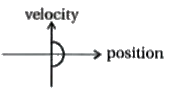
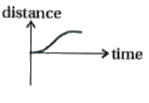
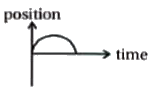
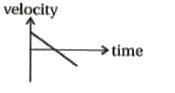
The below shown graphs represent the same motion. But one of them is incorrect. Find it. |
|
Answer»
(2) Object doesn.t cover same distance in same time. Motion is not constant. (3) This graph SHOWS motion of object in UPWARD DIRECTION (4) This is also a constant motion. Hence, (A), (C) and (D) represent same constant motion. (B) doesn.t represent the same. |
|
| 37. |
Energy required to move a body of mass 'M' from an orbit of radius 2R to 3R is........ |
|
Answer» `(GM)/(12R)` `DeltaU = GMm [1/(r_(1))-1/(r_(2))]= GMm [1/(2R) -1/(3R)] = (GMm)/(6R)` |
|
| 38. |
Two different adiabatic parts for the same gas intersect two isothermals at T_(1) "and" ^_(2) as shown in P-V diagram . Then the ratio of (V_(a))/(V_(b)) will be |
|
Answer» `(V_(C ))/(V_(d))` `T_(1)V_(B)^(gamma-1)=T_(2)V_(C)^(gamma-1)` Dividing (i) by (ii) `(V_(b))/(V_(a))^(gamma-1)=(V_(C))/(V_(d))^(gamma-1) rArr (V_(a))/(V_(b))=(V_(d))/(V_(C))` |
|
| 39. |
Moment of inertia of a rigid body depends on (A) Mass of body (B) Position of axis of rotation (C) Angular velocity of the body (D) Time period of its rotation |
|
Answer» A and B are CORRECT |
|
| 40. |
Two solidsphere of same matericalbut diameters in the raito of 5: 4 are at temperature 227^(@)Cand 127^(@)Crespectively. Thetemperatureof thesurroundingis 270^(@)Cand Stefan's lawholds . Calculatethe rates of heatradiation of thespheres ? |
|
Answer» Solution :If `E_("net")` is the enegylostper secondby unitsurfacce area , then `E_("net") = sigma (T^(4) - T_(0)^(4))` `therefore ` Energy lostby the wholesphere in 1 sec ` = 4pi r^(2) sigma (T^(4) - T_(0)^(4))` Now `("Rateof heat lostby sphere I")/("Rateof heat lost by sphere II") =(r_(1)^(2)(T_(1)^(4) - T_(0)^(4)))/(r_(2)^(2)(T_(2)^(4) - T_(0)^(4))) = ((5)/(4))[(500^(4) - 300^(4))/(400^(4) - 300^(4))] = (34)/(7)` |
|
| 41. |
Define coefficient of linear expansion. Give its unit. |
| Answer» Solution :The COEFFICIENT of LINEAR expansion of the material of a SOLID rod is defined as the increase in length per unit original length per degree rise in its temperature. The unit of `alpha_(L) " is "^(@)C^(-1) (or) K^(-1)` | |
| 42. |
What isthermodynamicsystem ? Giveexample |
|
Answer» Solution :Thermodynamic system: A thermodynamic system is a finite part of the UNIVERSE. It is a collection of LARGE number of particles (ATOMS and molecules) SPECIFIED by certain parameters called pressure (P), Volume (V) and Temperature (T). The remaining part of the universe is called SURROUNDING. Both are separated by a boundary. Examples: A thermodynamic system can be liquid, solid, gas and radiation. |
|
| 43. |
In the previous question, if the two gases are compressed to the same final volume |
|
Answer» the final temperature is greater for the adiabatic process |
|
| 44. |
Explain the physical significance of momentum with example . |
| Answer» SOLUTION :Let US consider a butterfly and a stone , both moving towardsus with same VELOCITY`5ms^(-1)`. If both hityour body, the effects with not be the same. The effects not only depend UPON the velocity , but also on the mass . The stone has greater mass than to the butterfly . Themomentum of the stone is thus greater than the momentumofthe butterfly . | |
| 45. |
Two particlesA andBof masses 1kg and 2kg respectively are kept at very large separation. They are released from rest and move under their gravitational attraction. If the speedof .A. at certain instance is 4ms^(-1) speed of .B. at that instance in ms^(-1) is ____________ |
|
Answer» |
|
| 46. |
A boy executes S.H.M. The potential energy (PE), kinetic energy (KE) and total energy (TE) are measured as friction of displacement (x). Which of the following statement is true |
|
Answer» KE is MAXIMUM when X=0 |
|
| 47. |
The efficiency of an ideal heat engine working between the freezing point and boiling point of water is ____ |
|
Answer» `12.5%` Boiling point of water `T_1=100^@C` =373 K Efficiency `ETA=(T_1-T_2)/T_1xx100%` `=(373-273)/373xx100%` `=100/373xx100%` `=26.8%` |
|
| 48. |
A point moves along the x axis according to the law x = sin^2(omega t - pi//4) the amplitude and period of oscillations are 2/n and (m pi)/omegathen the values of n and m are |
|
Answer» |
|
| 49. |
What is the nature of the graph in the following : i) pressure and volume, keeping temperature constant. ii) pressure and reciprocal volume, keeping temperature constant. |
|
Answer» Solution :i) Shape of pressure (P) and volume (V) graph at constant temperatures is a rectangular HYPERBOLA. II) Shape of pressure (P) and RECIPROCAL of volume (1/V) graph at constant temperature is a STRAIGHT line. |
|