

Saved Bookmarks
This section includes 7 InterviewSolutions, each offering curated multiple-choice questions to sharpen your Current Affairs knowledge and support exam preparation. Choose a topic below to get started.
| 1. |
Streamline flow of the liquid is the flow in which every particle of the liquid follows the same path as the path of the preceeding particle and has the same velocity as that of the preeding particle while crossing through the same points. Two streamlines can never cut each other. When a liqui moves randomly or in irregular manner such that its velocity becomes greater than the critical velocity than the flow is turbulent flow. Critical velocity is given by v_(c)=(K eta)/(pr). For flow to be streamlined the |
|
Answer» CRITICAL VELOCITY should be large. |
|
| 2. |
Streamline flow of the liquid is the flow in which every particle of the liquid follows the same path as the path of the preceeding particle and has the same velocity as that of the preeding particle while crossing through the same points. Two streamlines can never cut each other. When a liqui moves randomly or in irregular manner such that its velocity becomes greater than the critical velocity than the flow is turbulent flow. Critical velocity is given by v_(c)=(K eta)/(pr). For liquids having Reynold number greater than 3000 the flow is |
|
Answer» STREAMLINED |
|
| 3. |
Assertion : The root mean square and most probable speeds of the molecules in a gas are the same. Reason : The maxwell distribution for the speed to molecules in a gas is symmetrical. Which one of the following statement is correct ? |
|
Answer» Both assertion and REASON are true and reason is the CORRECT EXPLANATION of the assertion. |
|
| 4. |
An inclined track ends in a circular loop of diameter 'D'. From what height on the track a particle should be released so that is completes that loop in the vertical plane? |
| Answer» Answer :C | |
| 5. |
One mole of an ideal gas undergoes a cyclic change ABCD where (P,V) co-ordinates are: A(5,1), B(5,3), C(2,3) and D(2,1). P is in atmosphere and V is in litre. Calculate the work done along AB, BC, CD, and DA and also net work done in the process. Given 1 atmosphere = 1.01xx10^(5)Nm^(-2) |
|
Answer» `W_(1)= AREA ABFEA=EAxxEF` `=(5xx1.01xx10^(5))xx2xx10^(-3)= 1010J`  (II) Work done along BC, `W_(2)= P(dV)= Zero` (III) Work done along CD, `W_(3)= -area CDEFC= -EDxxEF` `= -(2xx1.01xx10^(5))xx2xx10^(-3)= -404J` (iv) work done along DA, `W_(4)=P(dV)= Zero` Net work done in process `W=W_(1)+W_(2)+W_(3)+W(4)` `=1010+0-404+0= 606J` |
|
| 6. |
A particle of mass M is placed at the centre of a uniform spherical shell of equal mas and radius a. The gravitational potential at a point P at a distance a"/"2 from the centre |
|
Answer» `-(GM)/(3A)` |
|
| 7. |
Answer the following questions based on the P-T phase diagram of CO_(2): What happens when CO_(2)at 4 atm pressure is cooled from room temperature at constant pressure ? |
| Answer» Solution :It CONDENSES to SOLID directly without PASSING through the liquied PHASE. | |
| 8. |
Streamline flow of the liquid is the flow in which every particle of the liquid follows the same path as the path of the preceeding particle and has the same velocity as that of the preeding particle while crossing through the same points. Two streamlines can never cut each other. When a liqui moves randomly or in irregular manner such that its velocity becomes greater than the critical velocity than the flow is turbulent flow. Critical velocity is given by v_(c)=(K eta)/(pr). The viscosity of water is 0.0013 Nsm^(-2). The maximum velocity of water in a tube of diameter 0.3 cm for the flow to be laminar is |
|
Answer» 0.34m/s |
|
| 9. |
A seconds pendulum gives correct reading on the earth's surface, but when it is taken inside a mine, it goes slow by 10 s in a day. What is the depth of the mine? (Radius of the earth = 6400 km) |
|
Answer» |
|
| 10. |
Streamline flow of the liquid is the flow in which every particle of the liquid follows the same path as the path of the preceeding particle and has the same velocity as that of the preeding particle while crossing through the same points. Two streamlines can never cut each other. When a liqui moves randomly or in irregular manner such that its velocity becomes greater than the critical velocity than the flow is turbulent flow. Critical velocity is given by v_(c)=(K eta)/(pr). Which of the following is incorrect? |
|
Answer» The Reynold number is a PURE number and its VALUE is ALWAYS greater than unity. |
|
| 11. |
Mention the two processes responsible for the conduction of heat. |
| Answer» Solution :VIBRATION of atoms and MOTION of FREE ELECTRONS. | |
| 12. |
Which of the following are positive and which are negative work done ? Work done by the gravitational force in the above case. |
| Answer» SOLUTION :NEGATIVE | |
| 13. |
If 484J of energy is spent in increasing the speed of wheel from 60 rpm to 360 rpm, the M.I of the wheel is |
|
Answer» `1.6kgm^(2)` |
|
| 15. |
It is easier to open or close a door by pushing it at the edges than by pushing closer to the hinges. Explain. |
| Answer» Solution :A door is fitted to the door frame using hinges. OPENING or CLOSING of a door means a ROTATION about these hinges. Application of a higher moment of force will facilitate this rotation. If the force applied remains the same the moment of force is higher when the arm is LONGER. So the door is USUALLY pushed farthest from the hinges i.e., at the edges. | |
| 16. |
As the temperature is increased, the time period of a pendulum |
|
Answer» INCREASES as its effective length increases EVEN though its centre of MASS still remains at the centre of the bob. Time period of pendulum `T=2pisqrt(L/g)""(2pi" and g are constant")` `:.propsqrt(L)` `:.` T increases with increases in L. |
|
| 17. |
A uniform metal rod of length 1 and mass m is rotating with an angular velocity of magnitude o about an axis passing through its centre and perpendicular to the rod. If the temperature of the rod increases by T^@C , then change in its magnitude of angular velocity varies directly with |
|
Answer» `1/omega ` `L. = l (1 + alpha T)` where a is the coefficient of linear expansion. From the law of CONSERVATION of angular momentum, we have `I omega = I. omega. ` ` rArr 1/12 ml^2 omega = 1/12 ml^2 omega.` ` rArr (omega.)/(omega) = ( (l)/(l.))^2 = (1)/((1+ alpha T)^2) = (1+ alpha T)^(-2)` For GIVEN VALUE of` T, (1 + alpha T)^(-2)`is constant, say, C ` therefore (omega.)/(omega) = C` `(omega. -omega) /(omega) = C- 1` ` rArr omega. - omega = (C - 1) omega` ` rArr omega. - omega prop omega ` |
|
| 18. |
The PV diagram for cyclic process is a triangle ABC see Fig. drawn in order. The co-ordinates of A, B and Care (4,1), (2,4) and (2,1). The co-ordinates are in order of P and V in which P is N/m^2 and volume is in litre. Calculate the work done during the process from A to B, B to C and C to A. Also calculate the work done in the complete cycle. |
| Answer» Solution :WORK done == Area of TRIANGLE `ABC = (1//2) XX 3 xx 10 ^(-3) xx 2 = 3 xx 10 ^(-3) J` | |
| 19. |
A ring has a mass of 0.5 kg and radius 1 m. The moment of inertia of the ring about its diameter is. |
|
Answer» `0.75 KGM^(2)` |
|
| 20. |
A cricket fielder can throw the cricket ball with a speed v_(0).If the throws the ball while running with speed u at an angle theta to the horizontal. The theta_(max) for which maximum range change if u lt lt v_(0) is |
|
Answer» `pi/2` |
|
| 21. |
Find the centre of mass of a uniform L-shaped lamina (a thin flat plate) with dimensions as shown. The mass of the lamina is 3 kg. |
Answer» Solution :Choosing the X and Y axes as shown in Fig. 7.11 we have the coordinates of the vertices of the L-shaped lamina as given in the figure. We can think of the L-shape to consist of 3 squares each of length 1M. The mass of each SQUARE is 1kg, since the lamina is uniform. The centres of mass `C_(1), C_(2) and C_(3)` of the squares are, by symmetry, their geometric centres and have coordinates (1/2,1/2), (3/2,1/2), (1/2,3/2) respectively. We take the masses of the squares to be concentrated at these points. The centre of mass of the whole L shape (X, Y) is the centre of mass of these mass points. 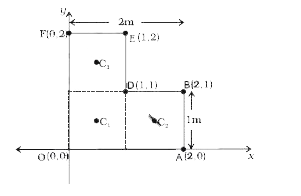 Hence `X=([1(1//2)+1(3//2)+1(1//2)]kgm)/((1+1+1)kg)=(5)/(6)m` `Y=([1(1//2)+1(1//2)+1(3//2)]kgm)/((1+1+1)kg)=(5)/(6)m` The centre of mass of the L-shape lies on the line OD. We could have guessed this without calculations. Can you TELL why? SUPPOSE, the three squares that make up the L shaped lamina of Fig. 7.11 had different masses. How will you then determine the centre of mass of the lamina? |
|
| 22. |
Equation of a wave propagating on a string is y =3 cos {pi (100 t - x)}(Where x is in cm and t is in s). Find its wavelength. |
|
Answer» 100 CM COMPARING with `y = a cos (OMEGA t - kx) ` we get, `k = pi implies (2pi)/(lamda) = pi implies lamda = 2 cm` |
|
| 23. |
Maximum energy transfer for an elastic collision will occur if one body is at rest when |
|
Answer» `m_(1)=m_(2)` |
|
| 24. |
If vec(a)_(1) and vec(a)_(2) are two non collinear unit vectors and if |vec(a)_(1) + vec(a)_(2)|= sqrt3, then the value of (vec(a)_(1)- vec(a)_(2)).(2vec(a)_(1) + vec(a)_(2)) is |
|
Answer» SOLUTION :`a_(1)= a_(2) =1 and a_(1)^(2) + a_(2)^(2) + 2a_(1)a_(2) cos theta = (sqrt3)^(2)= 3 or 1 + 1 + 2 cos theta= 3 or cos theta= 1//2` Now `(VEC(a)_(1)- vec(a)_(2)).(2vec(a)_(1) + vec(a)_(2))= 2a_(1)^(2)- a_(2)^(2)- a_(1)a_(2) cos theta` `=2-1 -(1)/(2)= (1)/(2)` |
|
| 25. |
When source of sound moves away from stationary listener we obtian f _(L) lt f _(S). Why ? |
Answer» SOLUTION : We have the FORMULA, `(F _(L))/(v + v _(L)) = (f _(S)/(v + v _(S)))` `therefore (f _(L))/(v +0) = (f _(S))/(v + v _(S))` `therefore f_(L) = ((v)/( v + v _(S))) f _(S) implies f _(L) lt f _(S) (because (v)/(v + v _(S)) lt 1)` |
|
| 26. |
Dimensions of (L)/(RCV) are |
|
Answer» `[A^(-1)]` `:.[(L)/(R)]= [T]` `:. "Charge" = "Capacitance" xx "Potential DIFFERENCE"` `Q= CV :. [CV]= [AT]` `:. [(L)/(RCV)]= [(T)/(AT)]= [(1)/(A)]= [A^(-1)]` |
|
| 27. |
Temperature is the degree of hotness of a body. Temperature of a normal human body is 98.6^@F. What is the corresponding temperature in the Celsius scale? |
|
Answer» SOLUTION :`t_c/100` = `(t_F- 32)/180 `t_c/100` = (98.6-32)/180 `t_c` = `37^@C` |
|
| 28. |
Considering the pressure 'P' to be proportional to the density of air 'd', the pressure at height 'h' if the pressure on surface of earth is 'P_(0)' and density 'd_0', under isothermal conditions |
|
Answer» <P>`P_(0) E^( - (P_0)/( d_0) GH)` |
|
| 29. |
An ideal gas is compressed to half of the volume. How much work is done if the process of compression is (a) Isothermal (b) Adiabatic ? In which of the two cases will the work done by more ? How do you account for the difference ? |
|
Answer» Solution :(a) In case of isothermal change `W=nRT log_(e) (V_(F)//V_(I))` So `W_(1)=nRTlog_(e) [1//2] = -0.6930nRT "…….." (1)` (b) In case of ADIABATIC change, `W=(nR[T_(F)-T_(I)])/(1-gamma)" with "TV^(gamma-1)=constant` i.e.,`W=(nRT_(1))/(1-gamma)[1-T_(F)/T_(I)]" with " T_(F)/T_(I)=[V_(I)/V_(F)]^(gamma-1)` so `W=(nRT)/([(5//3)-1])[1-2^(2//3)] ["as "gamma =5/3,T_(1)=T]` or `W_(A) = -3/2 nRTxx0.5874=-0.88 nRT "......."(2)` Negative sign means that work is done on the gas. COMPARING Eqns. (1) and (2) we find that for same COMPRESSION `W_(A) gt W` , i.e., more work is required in adiabatic compression than in isothermal. In adiabatic compression, temperature and hence internal energy of THEGAS also increase and so more work will be required in comparison to isothermal compression in which temperature and hence internal energy remains constant. |
|
| 30. |
A southwardwind of speed5 m/s affects raindrops falling vertically at 4m/s.Acyclist moves towards south with a speed of 2m/s . What are the magnitude and direction of the speed of the raindrops relativeto the cyclist ? |
|
Answer» |
|
| 31. |
Two bodies A and B of masses m_(1) and m_(2) moving with velocities V_(1) and V_(2) respectively collide. If m_(2)gt m_(1) then the force exerted by B on A during the collision is |
|
Answer» GREATER than the FORCE exerted by A on B |
|
| 32. |
A U-shaped wire is dipped in a soap solution, and removed. The thin soap film (which includes the small weight of the slider). The length of the slider is 30 cm. what is the surface tension of the film? |
| Answer» SOLUTION :`2.5 TIMES 10^-2 N m^-1` | |
| 33. |
A solid body rotates with deceleration about a stationary axis with an angular deceleration |alpha|= ksqrt(omega) where k is a constant and omega is the angular velocity of the body. If the initial angular velocity is omega_(0) then mean angular velocity of the body averaged over the whole time of rotation is |
|
Answer» `(7omega_(0))/(3)` |
|
| 34. |
What is the moment of inertia of a square sheet of side land mass per unit areamuabout an axis passing through the centre and perpendicular to its plane |
|
Answer» `(MUL^(2))/(12)` |
|
| 35. |
From a disc of radius R, a mass M, a circular hole of diameter R, whose rim passes through the center is cut. What is the moment of Inertia of the remaining part of the disc about a perpendicular axis passing through it |
|
Answer» `15 MR^(2)//32` |
|
| 36. |
In a double star system two stars of masses m_1 and m_2separated by a distance .d. rotates about their centre of mass. Then the common angular velocity and time period is |
Answer» Solution : The gravitational FORCE between the masses provides the necessary centripetal force `(Gm_1m_2)/d^2 =m_(1)r_(1)omega^2rarr(1)` The distance of centre of mass from `m_1` is `r_(1)=(m_(2)d)/(m_1+m_2)RARR(2)` From (1) and (2) `(Gm_1m_2)/d^2 =(m_1m_2d)/(m_1+m_2).omega^2` (or)`omega^2=(G(m_1+m_2))/d^3 " (or) " omega=sqrt((G(m_1+m_2))/d^3)` |
|
| 37. |
It is a well known fact that during a total solar eclipse the disk of the Moon almost completely covers the disk of the Sun. From this fact and from the information your can gather from examples 2.3 and 2.4 determine the approximate diameter of the Moon. |
|
Answer» Solution :DISTANCE of MOON from EARTH `r_(ME)=3.84xx10^(8)m` distance of Sun FORM Earth `r_(SE)=1.494xx10^(11)m` diameter of sun `D=1.39xx10^(9)m` During solar eclipse Moon almost completely covers Sun. Angular diameter of Moon=Angular diameter of sun  `(d)/(r_(ME))=(D)/(r_(SE))` `:.d=D(r_(ME))/(r_(SE))` `:.d=1.39xx10^(9)xx(3.84xx10^(8))/(1.496xx10^(11))` `:.d=3.5679xx10^(6)` `=3567.9xx10^(3)m` `:.d=3567.9km` |
|
| 38. |
When the length of a microscope tube increases, its magnifying power. |
|
Answer» Decreases |
|
| 39. |
The ratio of the densities of oxygen and nitrogen is 16 : 14 . Calculate the temperature when the speedof sound in nitrogen gas at 17^(@) C is equal to the speed of sound in oxygen gas . |
|
Answer» Solution :From equation , we have `v = sqrt((gamma P)/(rho))` But ` rho = (M)/(V)` Therefore , `v = sqrt((gamma PV)/(M))` Using equation , `v = sqrt((gamma RT)/(M))` Where , R is the universal gas constant and M is the molecular mass of the gas . The speed of sound in nitrogen gas at `17^(@) C` is `v_(N) = sqrt((gamma R (273 K + 17K))/(M_(N))) = sqrt((gamma R(290K))/(M_(N))) "" ... (1)` Similarly , the speed of sound in oxygen gas at t in K is `v_(O) =sqrt((gamma R (273 + t))/(M_(O))) "" ... (2)` Given that the value of `gamma` is same for both the gases , the two speeds must be EQUAL . HENCE , equating equation (1) and (2) , we get `v_(O) = v_(N)` `sqrt((gamma R (273 + t))/(M_(O))) = sqrt((gamma R (290))/(M_(N)))` Squaring on both sides and cancelling `gamma R` term and rearranging , we get `(M_(O))/(M_(N)) = (273+ t)/(290) "" .... (3)` Since the densities of oxygen and nitrogen is `16 : 14` , `(rho_(O))/(rho_(N)) = (16)/(14) "" ... (4)` `(rho_(O))/(rho_(N)) = ((M_(O))/(V))/((M_(N))/(V)) = (M_(O))/(M_(N)) implies (M_(O))/(M_(N)) = (16)/(14)` Substituting equation (5) in equation (3) , we get `(273 + t)/(290) = (16)/(14) implies 3822 + 14 t = 4640 implies t = 58.4 K` |
|
| 40. |
An oscillating simple pendulum is arranged in a vacuum jar, then |
|
Answer» It stops oscillating |
|
| 41. |
A uniform rope having mass m hangs vertically from a rigid support. A transverse wave pule is produced at the lower end. The speed v of wave pulse varies with height h from the lower end as: |
|
Answer»
|
|
| 42. |
A uniform rope of length (piR)/(2)has been placed onfixed cylinder of radius R as shown in the fig. One end of the rope is at the top of the cylinder. The coefficient of friction between the rope and the cylinder is just enough to prevent the rope from sliding. Mass of the rope is M. (a) At what position, the tension in the rope is maximum? (b) Calculate the value of maximum tension in the rope. |
|
Answer» (b) `T_("MAX") = 2 ((sqrt2-1)/(PI))Mg` |
|
| 43. |
The length of a uniform rod is 100.0 cm. If length is measured with a meter rod having least count 1 mm and radius is measured with vernier callipers having least count 0.1 mm, the percentage error in calculated volume of cylinder is |
|
Answer» 0.021 |
|
| 44. |
For an equilateral prism it is observed that when a ray strikes grazinglyat one face it emerges grazingly at the other, its refrative index will be |
|
Answer» SOLUTION :`i_1=i_2=90^@` `r_1=r_2=A/2=30^@ IMPLIES MU= (SIN i_1)/(sin r_1)=2` |
|
| 45. |
Find the moment of inertia of a hydrogen molecule about an axis passing through its center of mass and perpendicular to the interatomic axis. Given : mass of hydrogen atom 1.7 xx 10^(-27) kg and inter atomic distance is equal to 4 xx 10^(-10) m. |
|
Answer» Solution :Moment of INERTIA `I=2m(R/2)^(2)=(MR^(2))/2` `I=(1.7xx10^(-27)xx4x4xx10^(-20))/2` `=1.36xx10^(-46)KGM^(2)` |
|
| 46. |
A train of mass 4000 metric tons is moving with a velocity of 18 KMPH. With the application of a force, its velocites changes to varphi in 2 minutes. If the power of the engine is 10 MW, the value of 'varphi' is (in KMPH) |
|
Answer» 72 |
|
| 47. |
A ball A is projected from the ground such that its horizontal range is maximum. Another ball B is dropped from a height equal to the maximum range of A. The ratio of the time of flight of A to the time of fall of B is |
|
Answer» `SQRT2 :1` |
|
| 48. |
Maximum ……….. Error in proudct or …………… of two quantites is ………….. Of ……………. Errors in …………….. |
|
Answer» |
|
| 49. |
Draw the graph representing linear momentum and changein kinetic energy . |
|
Answer» SOLUTION :Linear momentum of a PARTICLE of MASS m, `p=sqrt(2mK)` [where K is kinetic energy of the particle] `therefore p prop sqrt(K)` |
|


