

Saved Bookmarks
This section includes 7 InterviewSolutions, each offering curated multiple-choice questions to sharpen your Current Affairs knowledge and support exam preparation. Choose a topic below to get started.
| 1. |
Is there any change in the angular velocity of the earth when a body strikes the earth's surface from outside ? |
| Answer» Solution :We know that angular momentum of a body = momentum of inertia of that body `xx` angular VELOCITY of the body. The velocity of any body coming from outside and striking the surface of the earth is usually directed TOWARDS the CENTRE of the earth. For this reason, the body possesses no angular momentum with respect to the axis of rotation of the earth. As a result, the angular momentum of the earth remains CONSERVED. But due to the inclusion of the body, the mass of the earth increases and consequently, the moment of inertia of the earth also increases. For this reason, the angular velocity of the earth decreases slightly. But actually the mass of such a foreign body is so SMALL that there is no appreciable change in either the moment of inertia or the angular velocity of the earth. | |
| 2. |
A bullet of mass 10gm moving with a velocity 'u' penetrates 4cm in to a target before coming to rest. If the average resistance offered by the target is 200N, the value of 'u' is |
| Answer» Answer :B | |
| 3. |
What is estimation of error ? Write method for estimation. |
|
Answer» Solution :MAXIMUM error during EXPERIMENT is estimated and it is represented with RESULT of experiment. This is called estimation of error. Error is estimated in three ways: (1) Absolute error (2) Relative error and Fractional error (3) PERCENTAGE error. |
|
| 4. |
A trolley intially at rest with a solid cylinder placed on its bedsuch that cylinder axis makes angle theta with direction of motion of trolley as shown in the figure starts to move forward with constant acceleration a. If initial distance of midpoint of cylinder axis from rear edge of trolley bed is d, calculate the distance s which the trolley goes before the cylinder rolls off the edge of its horizontal bed. Assume dimensions of cylinder to be very small in comparision to other dimensions. Neglect slipping. Calculate als, frictional force acting on the cylinder. |
Answer» Solution :Since axis of cylinder is inclined at angle `THETA` with the direction of motion of trolley, therefore components of acceleration a of trolleys, are `a costheta` along axis of cylinder and `asintheta` norma to axis of the cylinder. Cylinder rolls backward due to this normal component `a sintheta`. 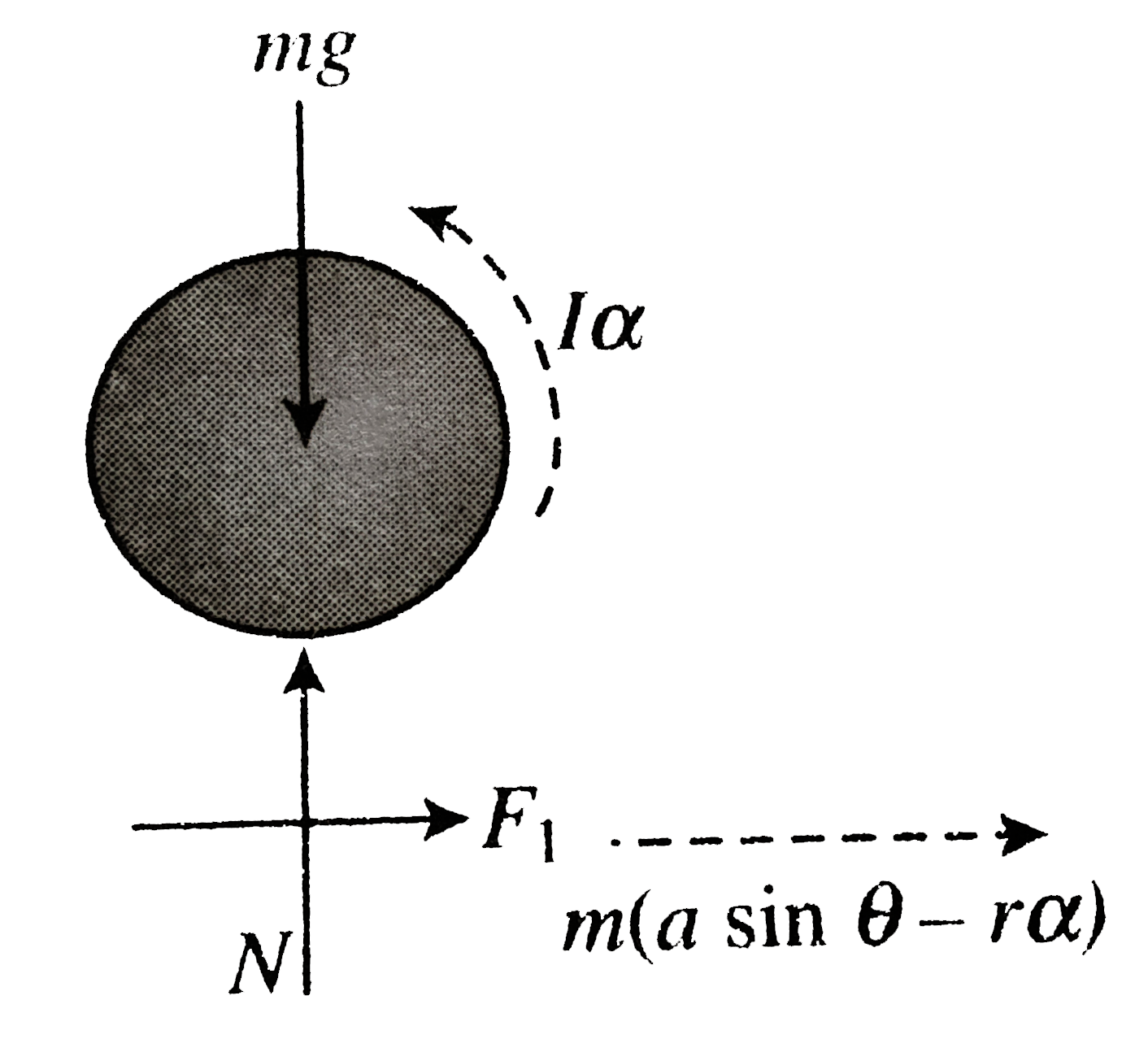 Due to angular acceleration cylinder axis has acceleration RELATIVE trolley BED, which will be EQUAL to `ralpha` normal to cylinder axis. But component of accelerations of trolley normal to cylinder axis is ` sintheta`. Therefore, net acceleration of cyinnder axis `(a sintheta-ralpha)` normal to axis. Consider free body diagram of the cylinder as shown in the figure. `F_(2)=masintheta` `F_(2)` is not shown in the free body diagram because in this diagram FORCES acting nromjal to cylinder axis are shown. For horizontal forces. `F_(1)=m(asintheta-ralpha)`.........i Taking moment about cyinder axis `F_(1)r=Ialpha` `I=(mr^(2))/2impliesF_(1)=1/2mralpha` ..............ii From eqn i and ii `ralpha=2/3asintheta` The cylinder will roll off the edge of trolley bed when its centre of mass reaches the edge. Since, cylinder axis is inclined at an angle `theta` withdirectionof motion of trolley, therefore, its centre of mass follows a straightline path relative to the trolley bed, and that staightline is normal to cylinder axis. Hence, displacement of centre of mass of the cylinder, relative to trolley is equal to `(dcosectheta)`. Considering motion of cylinder relative to the trolley, `u=0` Acceleration `= ralpha=2/3a sintheta` `s=dcosectheta, t=?` Using, `s=ut+1/2at^(2),t=sqrt((3d)/(asin^(2)theta))` Now considering motion of trolley during this interval of time `u=0` acceleration =a `t=sqrt((3d)/(asin^(2)theta),s=?` Using `s=ut+1/2at^(2),s=3/2dcosec^(2)theta` `F_(1)=1/2mralpha=1/3masintheta` total frictional force acting on the cylinder is `F=sqrt(F_(1)^(2)+F_(2)^(2))=1/3masqrt(sin^(2)theta+9cos^(2)theta)` |
|
| 5. |
An aeroplane is heading north east at a speed of 141.4ms^(-1). The northward component of its velocity is |
|
Answer» `141.4ms^(-1)` |
|
| 6. |
A disc of radius R is cut from a larger disc of radius 2R in such a way that the edge of the hole touches the edge of the disc. The centre of mass of the remaining portion is at |
|
Answer» R/2 from the CENTRE of BIG DISC away from the centre of the hole |
|
| 7. |
Two balls are projected simultaneously in same vertical plane from the same point with velocities V_1 and V_2with angles theta_1 and theta_2respectively with the horizontal. If V_1 cos theta_1 = V_2 cos theta_2 ,the path of one ball as seen from the position of another ball is |
|
Answer» parabola |
|
| 8. |
The motion of centre of mass of a system of two particles is unaffected by their internal forces |
|
Answer» IRRESPECTIVE of the actual directions of the internal forces |
|
| 9. |
Rain drops are spherical because of ………….. . |
|
Answer» gravitational FORCE |
|
| 10. |
A particle of mass m is moving in a horizontal circle of radius r under a centripetal force given by((-K)/(r^(2))) where k is a constant then, |
|
Answer» the total ENERGY of the particle is`((-K)/(2R))` |
|
| 11. |
A thick glass tumbler gets cracks when boiling water is poured irito it, because of |
|
Answer» POOR QUALITY |
|
| 12. |
A car is negotiating a curved road of radius R. The road is banked at an angle theta. The coefficient of friction between the types of the car and the road is mu_(s). The maximum safe velocity on this road is |
|
Answer» `sqrt(gR(mu_(s)+TAN THETA)/(1-mu_(s)tan theta))` |
|
| 13. |
For an ideal gas V-T curves as constant pressures P_1 & P_2 are shown in figure - from the figure |
|
Answer» `P_1 GT P_2` |
|
| 14. |
Action and reaction forces are |
|
Answer» Unequal in magnitude and in same direction Resultant force is PERPENDICULAR to `F_(1)`, then `F_(2)^(2)-F_(1)^(2)=F^(2)` `F_(2)^(2)-F_(1)^(2)=8^(2) RARR (F_(2)-F_(1))(F_(2)+F_(1))=64` `(F_(2)-F_(1))xx16=64"_______________(2)"` Solving (1) & (2), we get `F_(1)=6N, F_(2)=10N` |
|
| 15. |
Which of the following dimensions are correctly matched ? (theta =temperature) |
|
Answer» ANGULAR momentum : `M^(1)L^(2)T^(-1)` |
|
| 16. |
Dimensional method helps in converting the units from one system into another.Using dimension, prove 1 Newton = 105 dynes |
| Answer» SOLUTION :Out of SYLLABUS | |
| 17. |
A carnot engine takes heat from a reservoir at 627^(@)C and rejects heat to a sink at 27^(@)C. Its efficiency is |
|
Answer» `3//5` |
|
| 18. |
Give the equation of stateforan adiabaticprocess. |
|
Answer» SOLUTION :The equation of state for an adiabatic process is given by `PV^(GAMMA)=` constant Here `gamma` is called adiabatic exponent `(gamma=C_(p)//C_(v))` which depends on the NATURE of the GAS. |
|
| 19. |
The horizontal and vertical displacements of a projectile at time t are x = 36t and y = 48t -4.9t^2 respectively. lmtial velocity of the projectile in ms^-1 is |
|
Answer» 15 |
|
| 20. |
A person runs along a circular path of radius 5m. If he comletes half of the circlefind the magnitude of the displacement vector, How far the parson ran? |
|
Answer» `10M, 5pim` |
|
| 21. |
A raindrop of mass 1 g falling from a height of 1 km hits the ground with a speed of 50 m s^(-1). If the resistive force is proportional to the speed of the drop, then the work done by the resistive force is (Take g = 10 ms^(-2)) |
|
Answer» 10 J |
|
| 22. |
The rear side of a truck is open and a box of 40 kg mass is placed 5 m away from the open end as shown in Fig.The coefficient of friction between the box and the surface below it is 0.15.On a straight road, the truck starts from rest and accelerates with 2 m s^(-2) .At what distance from the starting point does the box fall off the truck?(Ignore the size of the box). |
|
Answer» Solution :Force on the BOX due to accelerated motion of the truck. F = ma = 40 x 2 = 80 N (in forward DIRECTION) Reaction on the box, F. = F = 80 N (in backward direction) Force of limiting friction, `f = muR = 0.15 XX 40 xx 10 = 60 N` NET force on the box in backward direction is P=F.- f=80 – 60 = 20 N Backward acceleration in the box = ` a = P/m = 20/40 = 0.5 ms^(-2)` t= time TAKEN by the box to travel s = 5 m and falls off the truck, then from ` s = ut + 1/2 at` `5 = 0 xx t + 1/2 xx 0.5 xx t^2` `t = 4.47 ` If the truck travels a distance x during this time then ` x= 0 xx 4.34+ 1/2 xx 2 xx(4.471)^2` x = 19.98 m |
|
| 23. |
When a capillary tube is dipped in water vertically, water rises to a hcight of 10 mm. The tube is now titled and makes an angle 60^(@)C with vertical. Now length of water column in tube is, |
| Answer» Answer :C | |
| 24. |
A soap film is formed in a circular frame loop of thread is lying on the film. If the film inside the loop is broken then the tension in the thread will be - |
|
Answer» `2 PI r T` |
|
| 25. |
In a two dimensional motion, instantaneous speed v_(0) is a positive constant. Then which of the following are neccessarily true? |
|
Answer» The acceleration of the PARTICLE is zero. |
|
| 26. |
(a) Water in a storage tank stands 2.5m above the level of a value in the side of a tank with what speed, will the water rush out if you neglect friction? (b) At what depth 'h'a hole may be made in the tank so that the emerging horizontal stream of water will travel maximum distance. (c) What is this maximum distance ? |
| Answer» SOLUTION :(a) 7 m/s, (B)H/2 (C )h | |
| 27. |
Consider a one dimensional elastic collision between a given incoming body A and body B, initially at rest. How would you choose the mass of B in comparison to the mass of A in order that B should recoil with (a) greatest speed (b) greatest momentum ? |
|
Answer» Solution :As in a collision, momentum is always conserved `m_(A)u=m_(A)v_(A)+m_(B)v_(B)` `u=v_(A)+kv_(B)("with k"=m_(B)//m_(A))` `v_(A)=u-kv_(B) ""`….(1) `(1)/(2)m_(A)u^(2)=(1)/(2)m_(A)v_(A)^(2)+(1)/(2)m_(B)v_(B)^(2)` `u^(2)=v_(A)^(2)+kv_(B)^(2) ""`.....(2) Substituting the value of `v_(A)` from Eqn. (1) in (2) `u^(2)=(u-kv_(B))^(2)+kv_(B)^(2)` Which on solving GIVEN `v_(B)=(2u)/(1+k) ""`.....(3) (a)So for `v_(B)` to be MAXIMUM, k must be minimum, i.e., `k =(m_(B))/(m_(A))to 0` or `m_(B)lt lt m_(A)` (b) Now `P_(B)=m_(B)v_(B)` In PERFECT elastic collisions, when masses are equal, the total momentum of A is COMPLETELY transfered to B. i.e., `m_(A)=m_(B)`. |
|
| 28. |
Five kilomoles of oxygen is heated at constant pressure. The temperature of the oxygen gas is increased from 295K to 305K. If the molar heat capacity of oxygen at constant pressure is 6.994 kcal/kmole K. The amount of heat absorbed is in kcal, |
|
Answer» 249.7 |
|
| 29. |
An ideal monoatomic gas undergoes a process where its pressure is inversely proportional to its temperature (a) Calculate the specific heat for the process (b) Find the work done by two moles of gas if the temperaturechangesfromT_1to T_2 |
| Answer» SOLUTION :`(7R )/(2 ) ,2 R (T_2 -T_1)` | |
| 30. |
During a journey from earth to the moon and back, the greatest energy required for the speceship rocket to overcome |
|
Answer» The earth.s gravity at TAKE-off |
|
| 31. |
A projectile is fired on a horizontal ground. Coefficient of resitution between the projectile and the ground is e. If a, b and c be the ratio of time flight [T_(1)//T_(2)] maximum height [H_(1)//H_(2)] and horizontal range [R_(1)//R_(2)] in first two collisions with the ground. Then |
| Answer» Answer :D | |
| 32. |
For a simple pendulum graph between L and T^(2) will be a |
|
Answer» Rectangular HYPERBOLA |
|
| 33. |
At what temperature the density of liquid is 4% less chan its value at 0^(@)C? |
|
Answer» SOLUTION :Let `’d _(0)’` e the density of the liquid at `0^(@)C.` If `d _(0) =100 ` UNITS, `d _(t) = 96` units We KNOW `gamma _(R ) = (d _(0) -d _(1))/( d _(t) (t)) = (100- 96)/(96(t)) impliest = (4)/(96 gamma _(R )) = (1)/(24 gamma _(g ))` where `’gamma _(R )’` is the coefficient of REAL expansion of the liquid. |
|
| 34. |
Among following media, sound has its maximum velocity in ...... |
|
Answer» air Here among elasti cmedia-air, water and steel, it is steel for which ratio `(B)/(rho)` is maximum and so v = max. in steel. (Sound can not PROPAGATE in vacuum). |
|
| 35. |
From a point on the ground a particle is projected with initial velocity u, such that its horizontal range is maximum. The magitude of average velocity during its ascent is |
|
Answer» `(SQRT(5)U)/(2)` |
|
| 36. |
If x=at^(2)+bt+c where x is displacement as a function of time. The dimension of 'a' and 'b'are respectivily …. |
|
Answer» `LT^(-1)` and `LT^(-2)` dimensionally, `[L]+[LT^(-2)][T^(2)]+[LT^(-1)][T]` where a =`LT^(-2)` and `b=LT^(-1)` |
|
| 37. |
A Vector vec(P) points vertically downwards and another vector vec(Q) points towards north then. Then vector vec(P) xx vec(Q) points towards |
|
Answer» East |
|
| 39. |
If L = 20.04 m pm0.01 m , B= 2.52 m pm0.02 m . What are the values of (L xx B) and (L+B) ? |
|
Answer» Solution :Given errors are absolute errors, while the rule says that percentage errors are to be added . Hence, the first step will be to convert the given absolut errors into percentage errors. `L=20.04m+-(0.01)/(20.04)XX100%=20.04m+-0.05%` `B=2.52m+-(0.02)/(2.52)xx100%=2.52m+-0.79%` `LxxB=(20.04xx2.52)m^(2)+-(0.05+0.79)%=50.50m^(2)+-0.84%` This is the result . However, since the data GIBEN the QUESTION was in terms of absolute errors, so we should give our result also in absolute errors. `LxxB=50.50m^(2)+-(0.84)/(100)xx50.50m^(2)=50.50m^(2)+-0.42m^(2)` |
|
| 40. |
A particle projected horizontally from P, so that it hits the inclined plane perpendicularly U = |
|
Answer» `SQRT((2gh SIN^(2) theta)/(1+cos^(2)theta))` |
|
| 41. |
Four identical masses .m. are kept at the corners of a square of side ‘a’. Find the gravitational force exerted on a point mass ‘m. kept at the centre of the square. |
| Answer» SOLUTION :0 NEWTON | |
| 42. |
Define precision and accuracy. Exp,ain with one example. |
| Answer» Solution :The accuracy of a measurement is a measure of how close the measured value is to the TRUE value of the QUANTITY. Precision of a measurement is a closeness of two or more measured values to each other. The true value of a certain length is near 5.678 cm. In one experiment, using a measuring instrument of RESOLUTION 0.1 cm, the measured value is found to be 5.5 cm. In another experiment using a measuring instrument of GREATER resolution, say 0.01 cm, the length is found to be 5.38 cm. We find that the FIRST measurement is more accurate as it is closer to the true value, but it has lesser precision. On the contrary, the second measurement is less accurate, but it is more precise. | |
| 44. |
A parachute is advised to be used by a person, while jumping out of an aeroplane. Explain why? |
| Answer» Solution :Viscous force on the parachute is large as `F = 6PI eta r nu, F alpha` r, so its terminal velocity becomes SMALL so the person hits the GROUND with this small velocity and does not get INJURED. | |
| 45. |
(A) : I_(S) and I_(H) are moment of inertia about the diameters of a solid and thin - walled hollow sphere respectively. If the radius and masses of above spheres are equal, then I_(H)gt I_(S).(R ) : In solid sphere, the mass is continuously and regularly distributed about the centre, where as the mass, to a large extent, is concentrated on the surface of hollow sphere. |
|
Answer» Both (A) and (R ) are true and (R ) is the CORRECT explanation of (A) |
|
| 46. |
Round off to 3 significant figures (a) 20.96 and (b) 0.0003125 |
|
Answer» Solution :(i) 20.96 has four significant figures. The FOURTH significant figure is more than 5 and hence on ROUNDING off to three significant figures, the GIVEN measurement will become 20.9 + 0.1 i.e., 21.0. (II) 0.0003125 has four significant figures. The fourth significant figure is 5 and hence on rounding off to three significant figures, the given measurement will become 0.000312 or `3.12 xx 10^(-4)`. This is because 2 before 5 is an even number. |
|
| 47. |
The density of a non-uniform rod of length 1 m is given by rho (x) = a (1 + bx^2) where a and b are constant and 0 le x le 1. The centre of mass of the rod will be |
|
Answer» `(3(2 + B))/(4 (3 + b))` |
|
| 48. |
Water is being boiled in a flat bottom kettle placed on a stove. The area of the bottom is 3000 cm^(2) and its thickness is 2 mm. If the amount of steam produced is 1 g/min, calculate the difference of temperatures between the inner and outer surfaces of the bottom. Thermal conductivity for the material of the kettle is 0.5cal//""^(0)C//s//cm, and the latent heat of steam is 540 cal/g. |
|
Answer» `1.2xx10^(-3)""^(0)C` |
|
| 49. |
If some amount of ice is mixed with hot water at 10^@C in such a way that heat released by ice when it melts completely is greater than the heat absorbed by not water to come at 0^@C then at steady state. |
|
Answer» the mixture has ice only, and the TEMPERATURE is `0^@C` |
|