

Saved Bookmarks
This section includes 7 InterviewSolutions, each offering curated multiple-choice questions to sharpen your Current Affairs knowledge and support exam preparation. Choose a topic below to get started.
| 1. |
A spherical shell of copper is completely filled with a liquid at a temperature t^(@)C. The bulk moduls of the liquid is K and coefficient of volume expansion is gamma. If the temperature of the liquid and the shell is increased by DeltaT, then the outward pressure Deltap on the shell that results from the temperature increase is given by (alpha is the coefficient of linear expansion of the material to the shell): |
|
Answer» `K ( gamma-3 ALPHA ) DELTA T` |
|
| 2. |
Answer the following question : The motion of a simple pendulum is approximately simple harmonic for small angle oscillations. For larger angles of oscillation, a more involved analysis shows that T is greater than 2pisqrt(l/g), Think of a qualitative argument to appreciate this result. |
| Answer» Solution :`sin theta lt theta`, if the restoring force, `mg sin theta` is replaced by `mgtheta`, this amounts to effective reduction in angular ACCELERATION [Eq.(14.27)] for LARGE angles and hence an increase in TIME PERIOD T over that GIVEN by the formula `T=2pisqrt(l/g)` where one assumes `sintheta=theta` | |
| 3. |
Two bodies A and B of masses m, and m, moving with velocities V_(1) and V_(2)respectively collide. If m_(2) gt m_(1)then the force exerted by B on A during the collision is |
|
Answer» GREATER than the FORCE EXERTED by A on B |
|
| 4. |
A knife edge of mass .m. is dropped from a height .h. on to ground. On reaching the ground it pierces through a distance .s. and stops finally. Find the resistance force offered by the ground and also the time of penetration, retardation during penetration. |
|
Answer» Solution :(i) The potential energy at the height P.E = mgh , Let resistance be R, then mgh `- (R - mg)s` `R = (mgh)/(s) + mg = mg (1 + (h)/(s))` (ii) Velocity on reaching the GROUND `V = sqrt(2 GH)` and stops finally after penetrating through a distance .s. `rArr ((v+0)/(2))`t = s , where .t. is the time of penetration `vt = 2s , t = (2s)/(v) = (2s)/(sqrt(2gh))` (iii) From THIRD EQUATION `v^(2) - u^(2) = 2as , 0^(2) - (sqrt(2gh))^(2)` = 2as retardation `= - a = (2gh)/(2s) = (gh)/(s)` |
|
| 5. |
Four small spheres each of radius .r. and mass.m. are placed with their centres at the four corners of a square of side .L.. The M.I. of the system about any side of square is |
|
Answer» `(8mr^(2))/5 + mL^(2)` |
|
| 6. |
Particles of masses 1gm,2gm,3gm and 4gm are placed at x=1cm , x=2cm , x=3cm, x=4cm respectively. Then X_(cm)= |
| Answer» Answer :C | |
| 7. |
Two paper screens A and B are separated by a distance of 100m. A bullet pierces A and then B. The hole in B is 10cm below the hole in A. If the bullet is travelling horizontally at the time of hitting the screen A, calculate the velocity of the bullet when it hits the screen A. Neglect the resistance of paper and air. |
Answer» Solution :The SITUATION is SHOWN in Fig.  `d = usqrt((2(h_(1)-h_(2)))/(G))` `100=usqrt((2xx0.1)/(9.8))` u = 700m/s |
|
| 8. |
An iron ball of radius 0.3 cm falls through a column of oil of density 0.94 gcm ^(-3) .It is found to attain a terminal velocity of 0.5 cm s ^(-1) . Determine the viscosity of the oil. Given that the density of iron is 7.8 gcm^(-3) |
|
Answer» |
|
| 9. |
(A) : In the uniform gravitational field centre of mas and centre of gravity coincide with each other. Where as in the case of non- unifrom gravitational field they will not coincide with each other. (R ) : Centre of mass is independent of acceleration due to gravity but centre of gravity depends on acceleration due to gravity. |
|
Answer» Both 'A' and 'R' and true and 'R' is the correct explantation of 'A' |
|
| 10. |
Choose the correct alternatives : |
|
Answer» For a general rotational motion, angular momentum L and angular VELOCITY `OMEGA` MUST be PARALLEL |
|
| 11. |
Three capillary tubes of some radius 1 cm but of lengths 1m, 2m and 3m are fitted horizontally to the bottom of a long vessel containing a liquid at constant pressure land flowing through these tubes. What is the length of a single tube which can replace the three capillaries. |
|
Answer» Solution :`V_(1)=(piPr^(4))/(8 eta1_(1)),V_(2)=(piPr^(4))/(8 eta 1_(2)),V_(3)=(piPr^(4))/(8 eta I_(3))` and `V=(piPr^(4))/(8etal)` Now `V=V_(1)+V_(2)+V_(3)implies1/l+1/(l_(1))+1/(l_(2))+1/(l_(3))` Susbtituting the VALUES we get `l=(l_(1)l_(2)_(3))/(l_(1)l_(2)+l_(1)l_(3)+l_(2)l_(3))=(1xx2xx3)/(1xx2+1xx3+2xx3)=6/11` m |
|
| 13. |
Three identical vessels are filled with equal masses of three different liquids A, B and C. The pressure at the base will be |
|
Answer» EQUAL in all vessels |
|
| 14. |
The speed of a train is reduced from 60km//h, to 15km//h, while it travels a distance of 450m. If the retardation is uniform, find how much further it will travel before coming to rest? |
|
Answer» SOLUTION :Here `u=60xx(5)/(18)=(50)/(3)m//s` `v=15xx(5)/(18)=(25)/(6)m//s` Using `v^(2)=u^(2)+2as`, we GET `((50)/(3))^(2)=((25)/(6))^(2)+2xxaxx450or` `a=-(125)/(36xx12)m//s^(2)` If `s^(1)` is the further distance travelled before coming to rest, then `s^(1)=(v^(2))/(2a)=(25)/(6)xx(25xx36xx12)/(6xx2xx125)=30M` |
|
| 15. |
Show that in simple harmoni motion, the acceleration is directly proportional to its displacement at the given instant. |
|
Answer» Solution :Consider the instantaneous displacement of PARTICLE executing SHM, `y=A sin (OMEGA-phi)` The instantaneous velocity of the particle `v=(dy)/(DT)=omega A cos (omega t-phi)` The instantaneous acceleration of the particle `=a=(dv)/(dt)` i.e., `a=-omega^(2)A sin (omegat-phi)` `i.e., a=-omega^(2)y` Hence `a prop y` and ACTS opposite to the displacement. |
|
| 16. |
If two wires have same dimension but of different materials, the graph between load and extension is as follow, then which of the following is true: |
|
Answer» `Y_(B)=Y_(A)` |
|
| 17. |
Two persons are holding a rope of negligible weight tightly at its ends so that it is horizontal. A 15 kg weight is attached to rope at the midpoint which now no more remains horizontal. The minimum tension required to completely straighten the rope is |
|
Answer» 150 N To make rope straight, `theta=90^(@)` |
|
| 18. |
Five moles of hydrogen when heated through 20 K expand by an amount of 8.3xx10^(-3)m^(3) under a constant pressureof 10^(5)N//m^(2). If C_(v)=20 J/moleK, find C_(p) |
|
Answer» Solution :Mayer.s relation `C_(p)-C_(v)=R` Multiplying throughoutby `n DeltaT` `nC_(p)DeltaT - nC_(v) DeltaT=nR DeltaT` `nDeltaT(C_(p)-C_(v))=P DeltaV ( :.nR DeltaT=PDeltaV)` `C_(v) =20J`/mole Kand `DeltaV=8.3xx10^(-3) m^(3)` `5xx20(C_(p)-20)=10^(5) xx8.3 xx 10^(-3)` `( :.n=5, DeltaT=20K, P=1xx10^(5)N//m^(2))` `Cp-20=8.3""Cp=28.3 `J/mole K. |
|
| 20. |
Length of the vector is always . . . .Quantity |
|
Answer» negative |
|
| 21. |
Explain red shift and blue shift in Doppler effect. |
| Answer» Solution :If the spectral lines of the STAR .are found to SHIFT towards red end of the spectrum ( CALLED as red shift) then the star is receding away from the EARTH. Similarly, if the spectral lines of the star are found to shift towards the blue end of the spectrum ( called as blue shift) then the star is approaching Earth. | |
| 22. |
The vector product of two non-zero vector is zero |
|
Answer» only when they are in the same DIRECTION |
|
| 23. |
Name a pair of physicalqauantities having same dimensions . |
|
Answer» SOLUTION :WORK and TORQUE work = FORCE * DISPLACEMENT |
|
| 24. |
Assertion: The motion of a simple pendulum is simple harmoni for all angular displacement. Reason: Motion of simple pendulum is independent of the angular displacement. |
|
Answer» If both assertion and reson are true and reason is the correct EXPLANATION of assertion |
|
| 25. |
Given the unit of power as 1 million erg/ min, the unit of force as 1000 dynes, unit of time as 1/10 s, what is the unit of mass and length. |
|
Answer» Solution :Power `=[ML^(2)T^(-3)]=10^(6)("erg")/("minute")=(10^(6))/60("erg")/s`….i force `=[MLT^(-2)]=10^(3)` dyne ……II Time `=[T]=1/10s`……iii Dividing (i) by (ii) we get `([M L^(2)T^(-3)])/([MLT^(-2)])=(10^(6))/60xx1/(10^(3))` `[LT^(-1)]=50/3`.......iv MULTIPLYING equation (iv) and (iii) we get `[LT^(-1)xxT]=50/3xx1/10` `L=5/3cm` Substituting the vaues of L and T in equation (ii) `Mxx5/3xx100=10^(3),M=1000xx3/5xx1/100` `M=6g` |
|
| 26. |
When a force (8i + 4j) newton displace a particle through (3i- 3j) metre, the power is 0.6W. The time of action of the force is |
|
Answer» 20s |
|
| 27. |
A circular metal disc of mass 200g and radius 20cm makes 10 revolutions per second about an axis passing through the centre and perpendicular to its plane. Find a) Moment of inertia about to axis, b) Torque required to change its angular velocity from 10 rps to 20 rps in 5s. |
|
Answer» SOLUTION :`(a) I=(Mr^(2))/(2)=(0.2xx(0.2)^(2))/(2)=4xx10^(-3)kgm^(2)` (B) Torque `TAU=Ialpha=(I(omega_(2)-omega_(1)))/(t)` `:.tau=(4xx10^(-3)(40pi-20pi))/(5)`, `tau=0.05Nm` |
|
| 28. |
A smooth sphere of mass m is moving on a horizontal plane with a velocity 3hat(i) + hat(j) when t collides with a vertical wall which is parallel to the vector hat(j). If the coefficiet of restitution between the sphere and the wall is 1/2 The velocity of the sphere after impact is |
|
Answer» `(3)/(2)HAT(i) + hat(j)` |
|
| 29. |
A police car with a siren of frequency 8 kHz is moving with uniform velocity 36 km/h towards a tall building which reflect the sound waves. The speed of sound in air is 320 m/s. What is the frequency of the siren heard by the car driver ? |
|
Answer» Solution :(a) Frequency RECEIVED by the BUILDING. `f. = ((V)/(v-v_c))` The wall (source) reflect this frequency,So frequency heard by the car DRIVER is `f..=((v+v_c)/v)f. = ((v+v_c)/v)(v/(v-v_c))f` `= ((v + v_c)/(v-v_c)) f= ((320 + 10)/(320 - 10)) xx 8 kHz = 33/31 xx 8= 8.5 kHz` |
|
| 30. |
A smooth sphere of mass m is moving on a horizontal plane with a velocity 3hat(i) + hat(j) when t collides with a vertical wall which is parallel to the vector hat(j). If the coefficiet of restitution between the sphere and the wall is 1/3 The loss in kinetic energy caused by the impact is |
|
Answer» `(m)/(8)` |
|
| 31. |
A smooth sphere of mass m is moving on a horizontal plane with a velocity 3hat(i) + hat(j) when t collides with a vertical wall which is parallel to the vector hat(j). If the coefficiet of restitution between the sphere and the wall is 1/4 The impulse hat(j) that acts on the sphere is |
|
Answer» `(9M)/(2) HAT(i)` |
|
| 32. |
Two waves of nearly same frequencies travelling in the same direction superimpose on each other. Name the resulting phenomenon. |
| Answer» SOLUTION :FORMATION of BEATS . | |
| 33. |
Which of the following equations represents a wave? |
|
Answer» `y = A SIN (OMEGA t - kx)` |
|
| 34. |
Speed of transwerse wave of a straight wire having mass 6.0g length 60cm and area of cross- section 1.0 mm^(2) is 90 m/s. If the Young's modulus of wire is 1.6 xx 10^(11) Nm^(-2), the extension of wire over its natural length is |
|
Answer» 0.1mm `L= 60cm = 0.6m` `A=1 mm^(2) = 1 xx 10^(-6) m^(2)` `v= SQRT((T)/(mu)) RARR v^(2) = (T)/(mu)` `:. V^(2) = (T)/(10^(-2)) [ :. mu= (M)/(L) = (6 xx 10^(-3))/(0.6) = 10^(-2) (kg)/(m)]` `:. T= (10)^(-2) v^(2)` `=(10)^(-2) xx (90)^(2)= 81N` Now Young.s modulus `y= ("stress")/("Strain") = (T//A)/(DeltaL//L)` `:. y= (TL)/(Delta LA)` `:. Delta L= (T L)/(Ay) = (81 xx 0.6)/(1 xx 10^(-6) xx 1.6 xx 10^(11))` `=30.375 xx 10^(-5m)` `=0.30375 xx 10^(-3m)` =0.3mm |
|
| 35. |
If two objects A and B are moving along a straight line in the same direction with the velocities V_(A)andV_(B) respectively, then the relative velocity is |
|
Answer» Assertion and REASON are CORRECT and Reason is correct EXPLANATION of Assertion |
|
| 36. |
A body subjected to strain a number of times does not obey Hooke's law due to |
|
Answer» YIELD POINT |
|
| 37. |
Two ideal gas thermometers A and B use oxygen and hydrogen respectively. The following observations are made: {:("Temperature","Pressure","Pressure"),(,"thermometer A","thermometer B"),("Triple - point water",1.250 xx10^(5) Pa,0.200 xx 10^(5) Pa),("Normal melting point of sulphur",1.797 xx10^(5)Pa,0.287 xx10^(5)Pa):} (a) What is the absolute temperature of normal melting point of sulphur as read by thermometers A and B ? (b) What do you think is the reason behind the slight difference in answers of thermometers A and B ? (The thermometers are not faulty). What further procedure is needed in the experiment to reduce the discrepancy between the two readings ? |
| Answer» Solution :(a) `T_(Lambda) = 392.69 K, T_(B) = 391.98 K`, (b)The discrepancy arises because the gases are not perfectly ideal To reduce the discrepancy. readings should be taken for lower and lower pressures and the plot between TEMPERATURE measured versus absolute pressure of the GAS at TRIPLE point should be extrapolated to obtain temperature in the limit pressure tends to ZERO, when the gases approach ideal gas behaviour. | |
| 38. |
In the ideal pulley particle system shown, the mass m_(2) is connected with a vertical spring of spring constant K. (m_(2)gtm_(1)). If the mass m_(2) is released from rest when the spring is underformed, find the maximum compression of the spring. |
|
Answer» `((m_(2)-m_(1))G)/K` |
|
| 39. |
(A) : Two similar trains are moving along the equatorial line with the same speed but in opposite direction. They will exert equal pressure on the rails. ( R) : In uniform circular motion the magnitude and direction of acceleration remains constant but the direction of motion continuously changes. |
|
Answer» Both (A) and ( R) are ture and ( R) is the CORRECT EXPLANATION of (A) |
|
| 40. |
A man should hold his umbrella with vertical, when rain fals vertically with velocityV_(R)and man walk horizontally with velocityV_(M). It's direction is given by : |
|
Answer» `tan ^(-1) ((V_(M))/(V_(R)))` |
|
| 41. |
When a force F acts on a body of mass m, the acceleration produced in the body is a. If three equal forces F_(1) = F_(2)=F_(3)=F act on the same body as shown in figure the acceleration produced is |
|
Answer» `(sqrt2-1)a` |
|
| 42. |
In each situation of Table-1, a uniform disc of mass m and radius R rolls on a rough fixed horizontal surface as shown. At, t=0 (initially) the angular velocity of disc is omega_(0) and velocity of centre of mass of disc is v_(0) (in horizontal direction). The relation between v_(0) and omega_(0) for each situation and also initial sense of rotation is given in Table-1 . Then match the statements in Table-1 with the corresponding results in Table-2. |
|
Answer» <P> |
|
| 43. |
Size of universe is of the order of |
|
Answer» `10^(18)m` |
|
| 44. |
Energyof a body thrown upward is |
|
Answer» MAXIMUM at the HIGHEST point |
|
| 45. |
In question number 85, what is the relative velocity of a car A with respect to car B, if car is moving eastward and car B is moving toward westward? |
|
Answer» `15 km h^(-1)` Velocity of car B w.r.t ground`therefore v_BG = -45 km h^(-1)` Relative velocity of car A w.r.t car B is `v_AB = v_AG + v_GB = v_AG - v_BG = 105 km h^(-1)`(since`v_GB = -v_BG)` |
|
| 46. |
A liquid is flowing through horizonatal pipes as shown in figure. |
|
Answer» <P> SOLUTION :The EQUIVALENT circuit can be drawn as under,`X prop (L)/(R^(4)) "" ( "as" X=(8 eta L)/(pi R^(4)))` 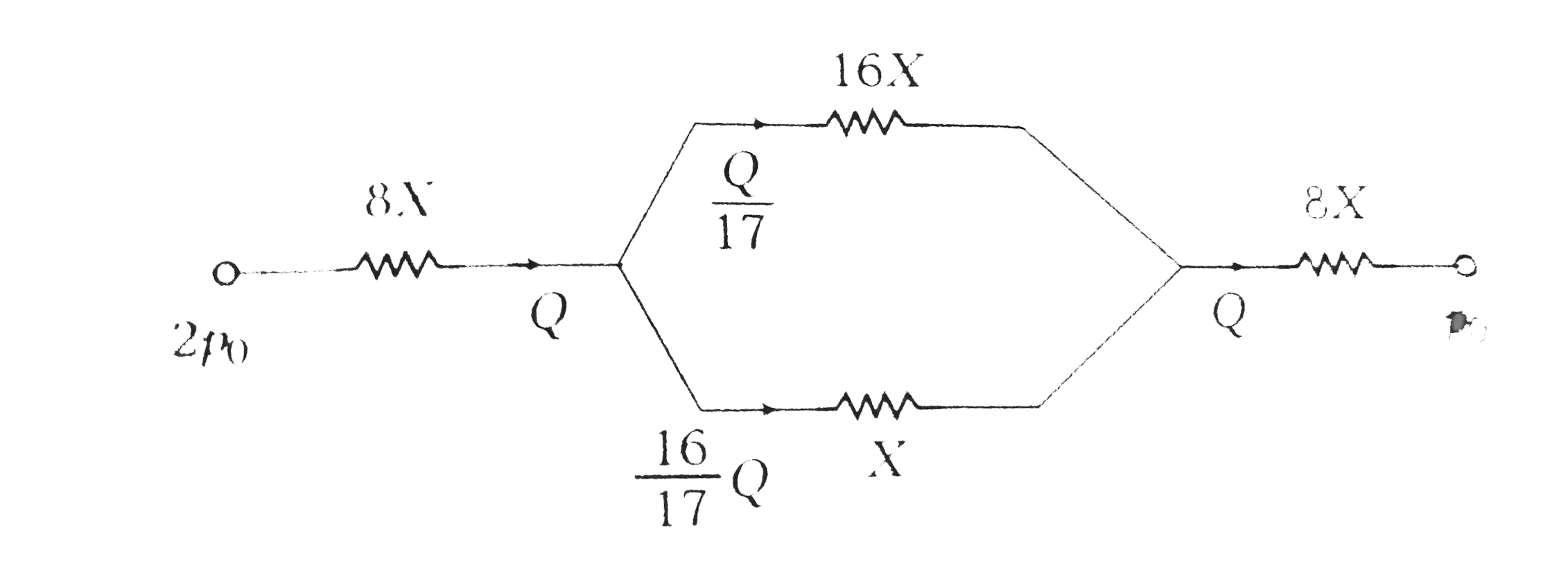 `therefore X_(AB) : X_(CD) : X_(EF) : X_(GH)` `=((1)/(2))/(((1)/(2))^(4)):(((1)/(2)))/(((1)/(2))^(4)):((1))/((1)/(2))^(4):((1))/((1)^(4))=8:8:16:1` (a) As the CURRENT is distributed in the inverse ration of the resistance (in parallel). The Q will be distributed in the inverse ratio of X. Thus, volume FLOW through EF will be `(Q)/(17)` and that from GH will be `(16)/(17)Q`. (b) ` X_("net")=8X+[((16X)(X))/((16X)+(X))]+8X=(288)/(17)X` ` therefore Q=(Deltap)/(X_("net")) "" (" as" i=(Delta V)/(R ))` `=((2p_(0)-p_(0)))/((288)/(17)X)=(17p_(0))/(288X)` Now, let `p_(1)` be the pressure at E, then `2p_(0)-p_(1)=8QX=(8xx17 p_(0))/(288)` `therefore "" p_(1)=(2-(17xx8)/(288)) p_(0)=1.53 P_(0)` Similarly, if `p_(2)` be the pressure at F, then `p_(2)-p_(0)=8 QX` `therefore "" p_(2)=p_(0)+(8xx17)/(288)p_(0) " or " p_(2)=1.47 p_(0)` |
|
| 47. |
A cube of wood supporting a 400 g just floats in water. When the mass is removed, the cube rises by 2 cm. What is the side of the cube nearly ? |
|
Answer» 1.414 cm |
|
| 48. |
Moment of inertia of a uniform hollow cylinder about an axis passing perpendicular to the length and passing through the center is |
|
Answer» `MR^(2)` |
|
| 49. |
The pair of quantities having same units and dimensions is |
|
Answer» FOCAL powe and Magnifying power |
|