

Saved Bookmarks
This section includes 7 InterviewSolutions, each offering curated multiple-choice questions to sharpen your Current Affairs knowledge and support exam preparation. Choose a topic below to get started.
| 1. |
When two equal and opposite forces acting on the body at two different points, it may give |
|
Answer» NET force |
|
| 2. |
A satellite in force free space sweeps stationaryinterplanetary dust at a rate (dm)/(dt)= alphav where m is mass , V is the velocity of the satellite and alphais a constant . What is the decelration of the satellite . |
| Answer» Solution :`F = (dp)/(dt) IMPLIES F = v. (dM)/(dt) , F=v(ALPHA v ) implies F = alpha v^(2) implies Ma=alphav^(2) implies a=(alphav^(2))/(M)` | |
| 3. |
A body is moving in a vertical circle of radius 'r' by s string. If the ratio of maximum to minimum speed is sqrt(3) : 1, the ratio of maximum to minimum tensions in the string is |
| Answer» ANSWER :C | |
| 4. |
A body projected vertically from the earth reaches height equal to earth's radius before returning to the earth. The power exerted by the gravitational force is greatest |
|
Answer» At the instant just before the body HITS the earth |
|
| 5. |
Two different ideal gases are enclosed in two defferent vessels at the same pressure . Ifrho_(1) and rho_(2) are their and nu_(1) and nu_(2) their rms their speed , respectively then - is equal to ................ . |
|
Answer» `(rho_(1)^(2))/rho_(2)^(2)` |
|
| 6. |
The elevator can carry a maximum load of 2800 kg (elevator +passengers) is moving up with a constant speed of 2ms^(-1). The frictional force opposing the motion is 5000 N .Determine the minimum power delivered by the motorto the elevator in watts as well as in horse power . |
|
Answer» <P> SOLUTION :`P = 99000 W, 132.7 HP` |
|
| 7. |
A: The bridges declared unsafe after a long use. R: Elastic strength of bridges increase with time. |
|
Answer» Both are true and the reason is the CORRECT EXPLANATION of the ASSERTION. Elastic STRENGTH of bridges decreases with time. |
|
| 8. |
If a particle is oscillating on the same horizontal plane on the ground, |
|
Answer» It has only KE but no PE |
|
| 9. |
The unit of length conventent on the nuclear scale is a fermi : 1f = 10^(-15)m. Nuclear sized obey roughly the following empirical relation: r = r_(0)A^(1//3) Where r is the radius of the nucleus, A its mass number, and r_(0) is a constant equal to about, 1.2 f. Show that the rule implies that nuclear mass density is nearly constant for different nuclei. Estimate the mass density of sodium nucleus. Compare it with the average mass density of a sodium atom obtained in Exercise . 2.27. |
| Answer» SOLUTION :`~= 0.3xx10^(18) kg m^(-3)` -Nuclear DENSITY is TYPICALLY `10^(15)` times ATOMIC density of matter. | |
| 10. |
An object is vertically projected with an initial velocity of20ms^(-1). Calculate the distance travelled by the object in 3 seconds. (g = 10ms^(-2)) |
|
Answer» |
|
| 11. |
Two moles of a gas is expanded to double its volume by two different processes. One is isobaric and the other is isothermal. If W_(1) and W_(2) are the works done respectively them |
|
Answer» Solution :`W_(1)= P_(i) (V_(f)-V_(i)) = P_(i) V_(i)[V_(f)/V_(i)-1]` `nRT (2-1)= nRT` `W_(2) = nRT log_(E) [V_(f)/V_(i)] = nRT log_(e) (2) = W_(1) log_(e) (2)` |
|
| 12. |
At two particular closest instants of time t_(1) and t_(2), the displacements of a particle performing SHM are equal. At these instants. |
|
Answer» Instantaneous SPEEDS are equal. |
|
| 13. |
A wave travelling along a string is described by y(x,t)=0.005sin(80.0x-3t) in which the numerical constants are in SI units. calculate the wavelength and frequency of the wave. |
|
Answer» SOLUTION :`2pi/lemda` = 80,`lemda` = 0.0785m `2PIV` = 3,V = 0.48HZ |
|
| 14. |
Distant explosion can break glass windows. How? |
| Answer» Solution :Explosion produces sound waves of large amplitudie in all DIRECTIONS. Sound waves are pressure waves and carry mechanical ENERGY. These waves make glass windows to execute FORCED VIBRATIONS. Glass is brittle so it breaks. | |
| 15. |
A person fires a bullet directly towards a monkey sitting on a tree. Just when the bullet leaves the gun, the monkey starts falling freely. The monkey falls in the range of the bullet. The bullet |
|
Answer» Will GO above the monkey |
|
| 16. |
In joule's experiment the weithts which wer 1 1//2 kg each fell through 1m on an average. When they fell 84 times the temperature of the water in the calorimeter rose through 4^(@)C. Calculate Joule's mechanical equivalent of heat if 150g was the water equivalent of the calorimeter and its contents and the time of fall of the weights was found to be 2 seconds. Sp. heat capacity of water is 1000 cal kg^(-1)K^(-1). |
|
Answer» |
|
| 17. |
The relative density of lead is 11.3. Its density is ………..g cm^(-3) or …………..kgm^(-3). |
| Answer» SOLUTION :11.3, `1.13xx10^(4)` | |
| 18. |
If x, v and a denote the displacement, the velocity and the acceleration of a particle executing simple harmonic motion of time period T, then, which of the following does not change with time? |
|
Answer» `(aT)/(v)` `=(4pi^(2))/(T)=`constant. |
|
| 19. |
Calculate the density of a body of mass (10+-0.6)g and volume (4.4+-0.7) cm^(3), to the correct significant figures? |
|
Answer» `DeltaA=0.037xxA=13.6` AREA of CIRCLE `=A+-DeltaA=(366.6+-13.6)m^(2)`, corrected to ONE decimal PLACE. |
|
| 20. |
A drum of radius R and mass M, rolls down without slipping along an inclined plane of angle theta. The frictional force: |
|
Answer» a) DISSIPATES energy as heat |
|
| 21. |
If a satellite of mass m is revolving around the earth with distance r from centre, then total energy is |
|
Answer» `-(GMM)/R` |
|
| 22. |
A paralle beam of light is incident on a converging lens parallel to its principal axis. As one moves away from the lens on the other side. On its principal axis. The intensity of light |
|
Answer» REMAINS constant |
|
| 23. |
A given element in a star is giving out radiations of certain wavelength.The wavelength , when sighted on earth, has a shift of 0.025 % towards the longer wavelength side.What is the velocity of the star in theline the sight ? Given the velocity of light, c=3xx10^(8) ms^(-1). |
|
Answer» |
|
| 24. |
A particle is acted simultaneously by mutually perpendicular simple harmonic motion x=a cos omegat and y=a sin omegat the trajectory of motion of the particle will be |
|
Answer» an ellipse |
|
| 25. |
What are stationary waves ? Obtain its equation. |
|
Answer» Solution :Stationary WAVES : "When two waves of same amplitude, same time period, same frequency, same wavelength are travelling in opposite directions on the same line superpossed, then resultant wave formed is called stationary Waves. OR When two waves having the same amplitude and frequency (i.e. wavelength) and travelling in mutually opposite directions are superposed, the resultant wave formed loses the property of propagation and a stationary pattern is created in the medium. Such a wave is called a stationary wave. These resultant waves cannot move in any direction. Hence, they cannot conduct energy. Suppose, a resultant wave, moving in NEGATIVE x-direction obtained by reflection of wave moving in POSITIVE x-direction of same wavelength and amplitude. Suppose, initial phase `phi =0`which is shown in figure,  `therefore y _(1) (x,t) = a sin (kx - omega t )` (Wave travelling in the positive direction of x-axis) `y _(2) (x,t) = a sin (kx + omega t)` (Wave travelling in the negative direction of x-axis) The principle of superpostion gives, for the combined wave, `y (x,t)=y _(1) (x,t) +y _(2) (x,t)` `= a sin (kx - omega t ) + a sin (kx + omegat )` `=a [2 sin [ ((kx - omega t ) + (kx + omega t ))/( 2)]` `cos [ ((kx - omegat ) - (kx + omega t ))/( 2) ]]` `= 2 a sin kx cos (-omega t )` `therefore y (x,t) =2 a sin kx cos omega t ""...(1)` `[ because cos [-theta)=cos theta]` `[because sin (A+B) + sin (A-B) =2 sin A cos B]` EQUATION (1) is general equation of stationary wave. Amplitude of stationary wave is 2a sinkx and different points are oscillating with different amplitude. kx and ot are different terms but not combined. Hence, stationary wave is not function of `f(kx - omegat)` Hence, they are not progressive waves. Wave pattern is not moving on left or RIGHT hand so, that it is called stationary wave. |
|
| 26. |
A uniform circular disc of mass m is set rolling on a smooth horizontal table with a uniform linear velocity v. Find the total K.E., of the disc. |
|
Answer» Solution :M.I. of th DISC about its own axios, Formula, `I=1/2 MR^(2)` As `v=R omega: omega^(2)=(v^(2))/(r^(2))` Rotational K.E. `=1/2 I omega^(2)` `=1/2xx1/2mr^(2)XX(v^(2))/(r^(2))=1/4 mv^(2)` Translational K.E. `=1/2mv^(2)` Total K.E. `=` Rotaltional K.E.+Translational K.E `=1/4mv^(2)+1/2 mv^(2)` `=3/4 mv^(2)` |
|
| 27. |
Figure shown objectO.Final image I isformed after two refraction and one refraction is also shown in figure .Findthe length of mirror.(in cm). |
|
Answer» `10` for reflraction at place SURFACE `(mu_(2))/(v)-(mu_(1))/(u)=(mu_(2)-mu_(1))/(oo)` `(mu_(2))/(v)=(mu_(1))/(u)` ` v=(mu_(2))/(mu_(1))xxu` =`(1)/(4//3)xx(-33.25)` `v=-25cm` Image of object due to first refraction will act as object for MIRROR.Image due to reflected rays will acts as virtual object for refraction, `(mu_(2))/(v)=(mu_(1))/(u) rArr u=(mu_(1))/(mu_(2))v` ` u=(1xx25)/(4//3) rArr u=(75)/(4)CM` Applying mirror formula `(1)/(v)+(1)/(u)=(1)/(f) rArr (1)/(-(15+75//4))+(1)/(-(15+25))=(1)/(f)` `(1)/(f)=-[(4)/(135)+(1)/(40)] rArr (1)/(f)=-[(160+135)/(135xx40)]` `f=-(135xx40)/(295) rArr f=-27xx(2)/(3)` `f=-18cm` |
|
| 28. |
The maximum time period of a bucket full of water whirled in a vertical circle of radius 10m so that the water may not fall is (g= 10 ms^(-2)) |
|
Answer» `2PI s` |
|
| 29. |
Angle of inclination ofthe resultant when two vectors actat right to each other is : |
|
Answer» <P>`(Q)/(P)` |
|
| 30. |
A body projected at an angle alpha to the horizontal lands at the same point after hitting a verticle wall. This time it makes an angle beta with the horizontal. Show that e tan beta=tan alpha where e is the coefficient of restitution between the body and the wall. |
|
Answer» |
|
| 31. |
In the position of minimum deviation when a ray of yellow light passes through the prism, then its angle of incidence is |
|
Answer» less than the EMERGENT angle |
|
| 32. |
In a given optical bench, a needle of length 10 cm is used to estimate bench error. The object needle, image neddle & lens holder have their reading as shown. X_(0) = 1.1 cm , X_(1) = 0.8 cm , X_(L) = 10.9 cm Estimate the bench error which are present in image neddle holder and object needle holder. Also find the focal length of the convex lens when X_(0)= 0.6 cm , X_(1) = 22.5 cm , X_(L) = 11.4 cm |
|
Answer» = observed distance = ACTUAL distance `= (x_(L)-x_(o))-10cm=-0.2cm` `U=(x_(L)-x_(o))-(-0.2)=10.8-(-0.2)=11cm` `v=(x_(L)-x_(o))-(0.2)=22.5=11.4-0.2=10.9cm` `(1)/(f)=(1)/(v)=(1)/(u)=(1)/(10.9)-(1)/(-11)rArrf=5.5cm` and `(Deltaf)/(f^(2))=(Deltau)/(u^(2))+(Deltav)/(v^(2))rArr Deltaf=[(0.1)/((11)^(2))+(0.1)/((10.9)^(2))][5.5]^(2)=0.05` `rArr f=(5.5 pm 0.05)cm` |
|
| 33. |
Explain why (a) a horse cannot pull a cart and run in empty space, (b) passengers are thrown forward from their seats when a speeding bus stops suddenly, (c) it is easier to pull a lawn mower than to push it, (d) a cricketer moves his hands backwards while holding a catch. |
|
Answer» Solution :(a)whenhorsepullscartitsfeetappliesdifiniteforcecertainangleon thesurfaceon feetof THEHORSE. Duetocomponentofforcecart comesintomotion . ( b)Whenbusis inmotiondue toinertiapassengerinsidethe busalsoare inmotionwhen thebussuddenlystopdue toarethrownforwardtheirseats . (c )  To pulllawnmoverforceis appliedbymakingangle `THETA`withhorizontalshowninfigureverticallycomponentof thisforce ismg sin `theta` DUETO thisnetforcewillbecomemg -F sin ` theta` Whenmachineis givenpushforceis appliedby makingangle `theta`downwarddirectioncomponentof forcein downward directionwill bemg +F sin `theta`.Dueto thisis EASY topulllawnmoverinsteadof pushingit. (d ) Whencricketcatchesballby takinghishandin backward directionthesebyincreasetimeof contactbetweenballandhencelessforceact on handimpulseofforceincrease. |
|
| 34. |
Assertion (A) & Reason (R ) Type Questions (A): During a free expansion of an ideal gas workdone is zero (R): Workdone against vacuum is zero |
|
Answer» Both (A) and(R ) are true and (R ) is the correct EXPLANATION of (A) |
|
| 35. |
Water flows through a horizontal pipe of varying cross-seetions. The pressure of water equals 0.1 m of mercury at a place where the velocity of flow is 0.4 ms^(-1). What will be the pressure at another place, where the velocity of flow is 0.5ms^(-1). |
|
Answer» <P> Solution :Given `P_(1)=0.1"M of HG"=0.1 xx 13600 xx 9.8``v_(1)=0.4ms^(-1) =1332Nm^(-2) P_(2)=? V_(2)=0.5 ms^(-1)` Applying `(P_(1)-P_(2))=1/2 rho(v_(2)^(2)-v_(1)^(2))` we get , `=1/2 xx 10^(3) (0.5^(2)-0.4^(2))` `13328-P_(2)=500(0.9) (0.1)` `therefore P_(2)=13328-45=13283 Nm^(-2)` `or P_(2)=(13283)/(13600 xx 9.8)=0.0996"m of mercury"` |
|
| 36. |
The length of a sonometer wire between two fixed ends is 1.10 m. Where should the two bridges be placed to provide the wire into three segments whose fundamental frequencies are in the ratio of 1 : 2 : 3? |
|
Answer» Solution :Let `l_(1) , l_(2) , l_(3)` be the lengths of three segments. Given ` l_(1) + l_(2) + l_(3) = 1.10`(i) From relation` n = (1)/( 2l) sqrt ((T)/(mu))` If tension `T` and mass per UNIT length ` mu` are fixed , then ` n prop 1//l` So ` nl = constant` ` n_(1) l_(1) = n_(2) l_(2) = n_(3) l_(3)` `:. l_(1) : l_(2) : l_(3) = (1)/( n_(1)) : (1)/( n_(2)) : (1)/( n_(3)) = (1)/(1) : (1)/(2) : (1)/(3) = ( 6 : 3 : 2)/( 6) = 6 : 3 :2` `:. l_(1) = 6 K , l_(2) = 3k , l_(3) = 2k , k` being a constant . From EQ. (i) `6 k + 3k + 2k = 1.10 or 11k = 1.10` `:.k = 1.10 //11 = 0.1` `:. l_(1) = 6 XX 0.1 = 0.6 m` `l_(2) = 3 xx 0.1 = 0.3 m` `l_(3) = 2 xx 0.1 = 0.2 m` Therefore the bridges must be placed at distance `0.6 m and ( 0.6 + 0.3 ) = 0.9 m` 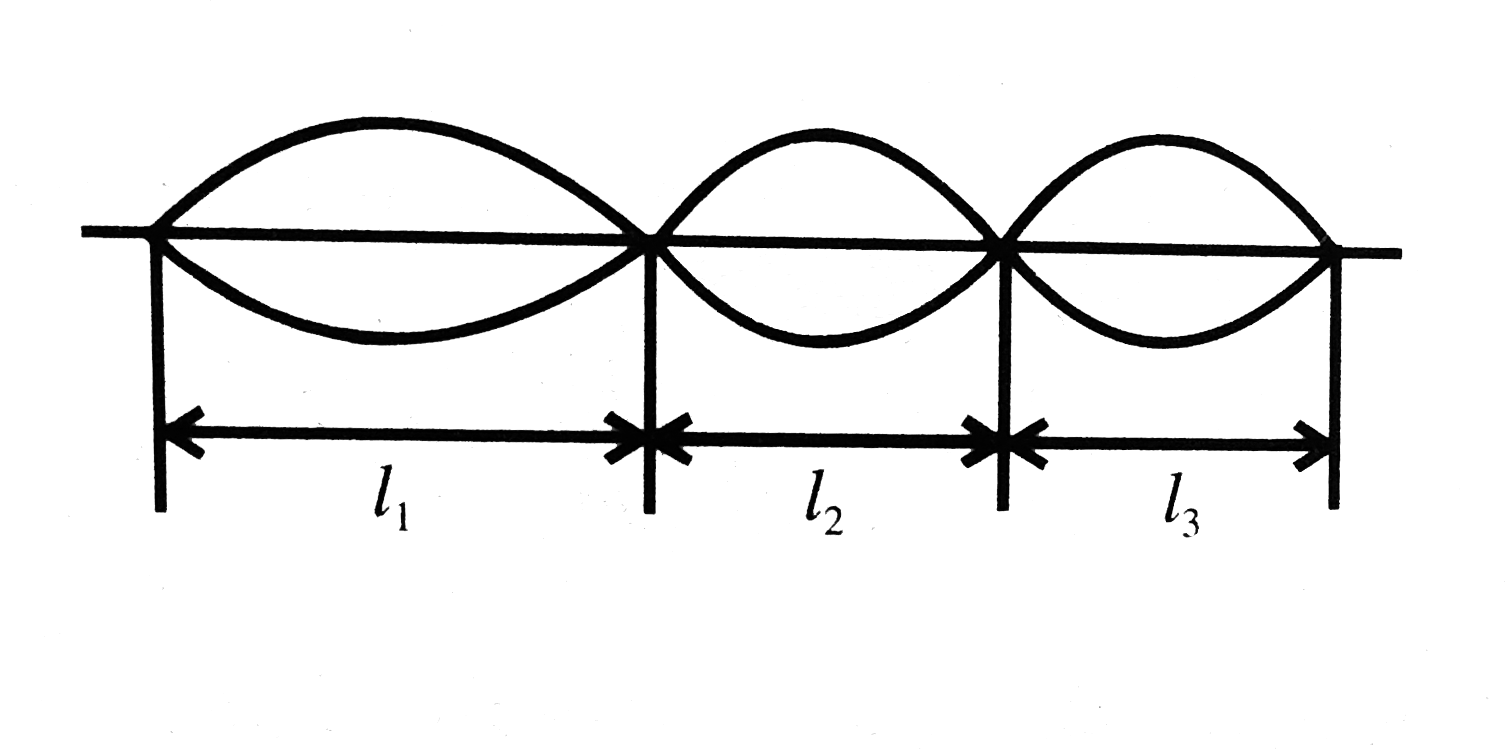
|
|
| 37. |
If a ball fallen freely from 'h' height reaches in time 't' at ground, then what will be the time when it reaches at height h/2 ? |
|
Answer» Solution :For freefall,` t = sqrt ((2h)/(g)) ""…(1)` Time taken to reach at `(H)/(2),` `t . = sqrt ((2h)/(2G)) [ because h . =(h)/(2)]` ` therefore t. = sqrt ((h)/(g)) ""...(2)` By taking ratio of EQUATION (2) and (1). `(t.)/(t) = sqrt((h)/(g)XX (g)/(2h)) = (1)/(sqrt2)` `therefore t .= (t)/(sqrt2) s` |
|
| 38. |
Compare moment of inertia and mass. |
| Answer» Solution :A. The role of moment of INERTIA (I) in rotatory motion is QUITE similar to the role of MASS (m) in linear motion Moment of Inertia represents inertia of a body in rotatory motion whereas mass is a measure for inertia of the body in linear motion. EX: Force Fema: Torque `tau=Ialpha` Momentum `vecp`=mv, ANGULAR momentum `vecL=Iomega` | |
| 39. |
A cylindrical tank of height 0.4m is open at the top and has a diameter 0.16m. Water is filled in it uo to height of 0.16m. Find the time taken to empty the tank through a hole of radius 5xx10^(-3)m in its bottom. |
|
Answer» Solution :The VELOCITY of efflux through the hole `V=sqrt2gh` Let R, r nr the radius of cylindrical TANK and hole and .dh. is the GEIGHT of WATER in the .dt.sec useprinciple of continuity at the top and hole . then `-piR^(2)(dh)/(dt)=pir^(2)v = pir^(2) sqrt2gh` or `-(dh)/(sqrth)=(r^(2))/(R^(2))sqrt2g dt` integrating it wuthin the condition of PROBLEM, `-int_(h)^(0)(dh)/(sqrth)=((5xx10^(-3))/(0.08))^(2) sqrt2xx9.8 int_(0)^(t)dt` `2sqrth=((0.005)/(0.008))^(2)sqrt2xx9.8xxt` (or)`t=(2xxsqrt0.16)/(((0.005)/(0.08))^(2) xx sqrt2 xx 9.8) =46.26s` |
|
| 40. |
( I) A Refrigeratorisa reverseof carnotengine . (ii) Carnotenginehas thelowestefficiency Whichoneiscorrectstatement? |
| Answer» Answer :A | |
| 41. |
What is called absolute zero temp ? |
| Answer» Solution :For IDEAL gas, GRAPH `PtoT` is linear. By extending this linear ggraph BEHIND, the POINT at which it INTERSECTS the temperature axis is called absolute zero temperature and it is `-273.15^(@)C`. | |
| 42. |
One mole of an ideal diatomic gas undergoes a transition from A to B along a path AB as shown in the figure. The change in internal energy of the gas during the transition is |
|
Answer» 20 J `= n((5R)/(2))(T_(B) - T_(A))` [for diatomic gas, `C_(V) = (5R)/(2)`] `= (5nR)/(2) ((P_(B)V_(B))/(nR) - (P_(A)V_(A))/(nR)) [because PV = nRT]` `= (5)/(2) (P_(B)V_(B) - P_(A)V_(A)) = (5)/(2)(2 xx 10^(3) xx 6 - 5 xx 10^(3) xx 4) = -20 kJ` 
|
|
| 43. |
Two 3 kg masses have velocities bar(v_(1))=2hat(i)+3hat(j)m//s and bar(v_(2))=4hat(i)-6hat(j)m//s. Find (a) velocity of centre of mass, (b) the total momentum of the system, (c ) The velocity of centre of mass 5s after application of a constant force bar(F)=24 hat(i)N, (d) position of centre of mass after 5s if it is at the origin at t = 0. |
|
Answer» Solution :(a) `vec(v)_(c )=(m_(1)vec(v)_(1)+m_(2)vec(v)_(2))/(m_(1)+m_(2)), vec(v)_(c )=(3(2hat(i)+3hat(j))+(4hat(i)-6hat(j)))/(6)` `therefore` Velocity of centre of mass `bar(V)_(c )=3hat(i)-1.5 hat(j) ms^(-1)` (b) The momentum of the system `= Mv_(c )=6kg(3hat(i)-1.5 hat(j))ms^(-1)=18 hat(i)-9 hat(j)kg ms^(-1)` (c ) To find the velocity of centre of mass after 5 s of application of the force `vec(F)=24hat(i)N` we first find the ACCELERATION of the centre of mass. It is given by `vec(a)_(c )=(vec(F))/(M)=(24hat(i))/(6)=4hat(i)ms^(-2)` The velocity of centre of mass before the force is APPLIED is `vec(v)_(c )` and from the equaion `vec(v)_(c ).=vec(v)_(c )+vec(a)_(c )`.t `vec(v)_(c ). = (3hat(i)-1.5 hat(j))+(4hat(i))5=(3hat(i)-1.5hat(j)+20hat(i))` `vec(V)_(c )^(1)=(23 hat(i)-1.5 hat(j))ms^(-1)` (d) From the equation of the position vector `vec(r )= vec(r )_(0)+vec(v)_(0)t+(1)/(2)vec(a)t^(2)`, where `vec(r )_(0)=vec(0)` (origin at t = 0), `vec(v)_(0)=vec(v)_(c ), vec(a)=vec(a)_(c )` and t = 5s `vec(r )=(3hat(i)-1.5hat(j))5+(1)/(2)(4hat(i))25 = (15 hat(i)-7.5hat(j)+50 hat(i))` `therefore vec(r )=(65 hat(i)-7.5 hat(j))m` The coordinates of the centre of mass after 5 s of application of the force `vec(F)` are (65 m, 7.5 m) |
|
| 44. |
A soap bubble formed at the end of the tube is blown very slowly. The graph between excess of pressure inside the bubble with time is |
|
Answer»
|
|
| 45. |
The height of a barometer at a temperature of 30^(@) C appears to be 76 cm according to the brass scale which gives correct readmg at 0^(@) C. ( alpha_("Brass") = 19 xx 10^(-6)//^(@) C, gamma_(Hg) = 180 xx 10^(-6)//^(@) C ) |
|
Answer» `74.22 CM` |
|
| 46. |
If vecP=2hati+4hatj "and" vecQ=4hati-4hatj+10hatk find the magnitude of vecP+vecQ |
| Answer» SOLUTION :`6hati+10hatk,SQRT(136)` | |
| 47. |
To simulate car accidents, auto manufacturers study the collisions of moving cars with mounted springs of different spring constants. Consider a typical simulation with a car of mass 1000 kg moving with a speed 18.0 km/h on a smooth road and colliding with a horizontally mounted spring of spring constant 6.25xx10^(3) Nm^(-1). What is the maximum compression of the spring? |
|
Answer» Solution :At MAXIMUM compression the kinetic energy of the car is converted entirely into the potential energy of the spring. The kinetic energy of the moving car is `K= (1)/(2)mv^(2)` `=(1)/(2)xx10^(3)xx5xx5` `K= 1.25xx10^(4) J` where we have converted `18 kmh^(-1)" to "5ms^(-1)`[ It is useful to remember that `36KMH^(-1)= 10 ms^(-1)`]. At maximum compression `x_(m)`, the potential energy V of the spring is EQUAL to the kinetic energy K of the moving car from the principle of conservation of mechanical energy. `V= (1)/(2)kx_(m)^(2)` `=1.25 xx 10^(4) J` We obtain `x_(m)= 2.00 m` We note that we have idealised the situation. The spring is considered to be massless. The surface has been considered to possess negligible friction. |
|
| 48. |
Which of the following has dimensions different from the other three,- |
| Answer» Answer :D | |
| 49. |
The maximum staic friction on a body is F=muN. Here N= normal reaction force on the body. mu= coefficient of static friction. The dimension of mu is |
|
Answer» `[MLT^(-2)]` `:[mu]=[F/N]=([MLT^(-2)])/[(MLT^(-2)])=` dimensionless |
|
| 50. |
A uniform table of mas M stays horizontally and symmetrically on two wheels rotatig in opposite directions figure. The separsation between the wheels is L. The friction coefficeint between each whee, and the plate is mu. Find the time period of oscilationof the pate if it is slightly displaced along its length and released. |
|
Answer» `R_1+R_2=mg` Taking moment about g we get `R_1(l/2-x)=R_2(1/2-x)` `=(mg-R_1)(l/2+x)…………1 `ltbr.gt `S, R_1(l/2-x)=(mg-R_1)(l/2+x)` `rarr R_1 1/2-R_1x=` `mgl/2-R_1x+mgx-R_1l/2` L `rarrR-1l/2+R_1l/2=mg(x+1/2)` `rarr R_1(l/2+l/2)=mg((2x+1)/2)` `rarr R_1l=mg(2x+1) R_1=mg((1+2x)/(2l)` .........i Now, `F_1=muR_1=mumg((1+2x))/(2l)` similarly `F_2=muR=mumg((1+2x))/(2l)` similarlty `F_2=muR_2=muMg((1+2x))/(2l)` SIN `F_1gtF_2` `rarrF_1-F_2=ma-(2mu(mg)/l)x` `a/x=2mu=(mg)/l=omega^2` `rarr =omegamusqrt(g/l)` `: Time period `=2pisqrt(l/(2mug))` |
|


