Saved Bookmarks
This section includes 7 InterviewSolutions, each offering curated multiple-choice questions to sharpen your Current Affairs knowledge and support exam preparation. Choose a topic below to get started.
| 1. |
The relation between internal energy U, pressure P and volume V of a gas in an adiabatic process is U = a + bPV where a and b are positive constants. What is the value of gamma ? |
|
Answer» `(a)/(b)` From the first law of THERMODYNAMICS, we get or `bPdV + bVdP + PdV = 0` or (b+1)PdV + bVdP = 0 or `(b+1) (DV)/(V) + b(dP)/(P) = 0` or `(b+1)(dV)/(V) = -b(dP)/(P)` Integrating both sides, we get (b+1) ln V + b ln P = constant or ln `(V^(b+1)P^(b))` = constant or `PV^((b+1)/(b))` = another constant Compare with the STANDARD equation of an adiabatic process `PV^(gamma)` = constant, we get `gamma = (b+1)/(b)` |
|
| 2. |
Two satellite of same mass are launched in the same orbit of radius r around the earth so as to rotate opposite to each other. If they collide inelastically and stick together as wreckage, the total energy of the system just after collision is |
|
Answer» `-(2GMm)/(R)` KE = 0, only PE is present `:. E=U=2(-(GMm)/(r))=-(2GMm)/(r)` . |
|
| 3. |
An eraser weighing 2N is pressed against the black board with a force of 5N. If the co-efficient of friction is 0.4. How much force parallel to the black board is required to slide the eraser upwards |
| Answer» ANSWER :C | |
| 4. |
What is the work done in taking an object of mass 1kg from the surface of the earth to a height equal to the radius of the earth ? ( G = 6.67 xx10^(-11) Nm^(2)//kg^(2)Radius of the earth = 6409km, Mass of the earth = 6 xx10^(24)kg) |
|
Answer» Solution :The work done in TAKING an OBJECT to a height = `(GMm)/(R(R+h)), ""` Here h = R `= (6.67 xx10^(-11) xx6 xx10^(24) xx1)/(2xx6.4 xx10^(24) xx1) = 3.127 xx10^(7)J` |
|
| 5. |
A spring of force constant 800 N m^(-1)has an extension of 5 cm. The work done in extending it from 5 cm to 15 cm is |
|
Answer» 16J `=1/2 xx 800[(15 xx 10^(-2))^(2) - (5 xx 10^(-2))^(2)]` `= 400 xx 200 xx 10^(-4) = 8 J` . |
|
| 6. |
Let us assume that you have lifted a suitcase and kept it on a table. On which of the following does the work done by you depend or not depentd? Why ? a) The path taken by the suitcase "" b) The time taken by you in doing so c) The weight of the suitcase "" d) Your weight |
|
Answer» a, B & d are correct |
|
| 7. |
Gravel is dropped on a conveyer belt at rate of 0.5 kg//sec . Find the extra force required in Newton to keep the belt moving at 2 m//sec. |
| Answer» SOLUTION :`F=((DM)/(DT))xxv=0.5xx2=1 N` | |
| 8. |
Certain quantity of water cools from 70^(@)C to 60^(@)C in the first 5 minutes and to 54^(@)C in the next 5 minutes and to 54^(@)C in the next 5 minutes. The temperature of the surroundings is |
|
Answer» `45^(@)C` `(T_(2)-T_(1))/(t)=-k[(T_(1)+T_(2))/(2)-T]` `:.(60-70)/(5)=-k[(60+70)/(2)-T]` `:.-2=-k[65-T`. . .(1) For the NEXT 5 minutes, `(54-60)/(5)=-k((54+60)/(2)-T)` `:.-(6)/(5)=-k(57-T)`. . . (2) Dividing equation (1) by equation (2), `(10)/(6)=(65-T)/(57-T)` `:.570-10T=390-6T` `:.570-390=10T-6T` `:.180=4T` `:.T=(180)/(4)` `:.T=45^(@)C` |
|
| 9. |
A body is thrown up with a velocity 29.23 "ms"^(-1) distance travelled in last second of upward motion is |
|
Answer» 2.3m |
|
| 10. |
Equivalent of one joule is………… |
|
Answer» `Nm` |
|
| 11. |
At what temperature is the rms speed o gaseous hydrogen molecules equal to that of oxygen molecules at 47°C |
| Answer» Answer :A | |
| 12. |
An aircraft executes a hrorizontal loop of radius 1 km with a steady speed of 900 km h^(-1) Compare its centripetal acceleration with the acceleration due to gravity ? |
|
Answer» |
|
| 13. |
A block of mass of 2kg placed on the floor of on an elevator. Acceleration of elevator is 6 hati + 7 hatj ml s ^(2) If mu = 0.5 .g=10 ms ^(-2) and horizontal, vertically upward directions are taken as +ve x, +ve y axes. Then |
|
Answer» Fraction is 12 N |
|
| 14. |
The centre of mass of a system of three particles of masses 1 g, 2 g and 3 g is taken as the origin of a coordinate system. The position vector of a fourth particle of mass 4 g such that the centre of mass of the four particle system lies at the point (1,2,3) is alpha(hati +2hatj+3hatk), where alpha is a constant. The value of alpha is |
|
Answer» `(10)/(3)` or `0 = (1 x_(1) + 2x_(2) + 3 x_(3))/(1 + 2 + 3) or x_(1) + 2x_(2) + 3x_(3) = 0` Let the fourth particle of mass 4 g be placed at `(x_(4) , y_(4) , z_(4))` so that the centre of mass of the four particles system lies at (1 , 2 , 3) `therefore 1 = (x_(1) + 2x_(2) + 3x_(4) + 4 x_(4))/(1 +2 + 3 + 4) ` or `x_(1) + 2x_(2) + 3 x_(4) + 4 x_(4) = 10 "" .... (ii)` Subtract (i) from (ii) , we get `4x _(4) = 10 or x_(4) = (10)/(4) = (5)/(2) therefore alpha= (5)/(2)` |
|
| 15. |
A spring is loaded with two blocks m_(1) and m_(2), where m_(1) is rigidly fixed with the spring and m_(2) just kept on the block m_(1) as shown in the figure. The maximum energy of oscillation that is possible for the system having the block m_(2) in contact with m_(1) is |
|
Answer» `(m_(1)^(2)g^(2))/(k)` 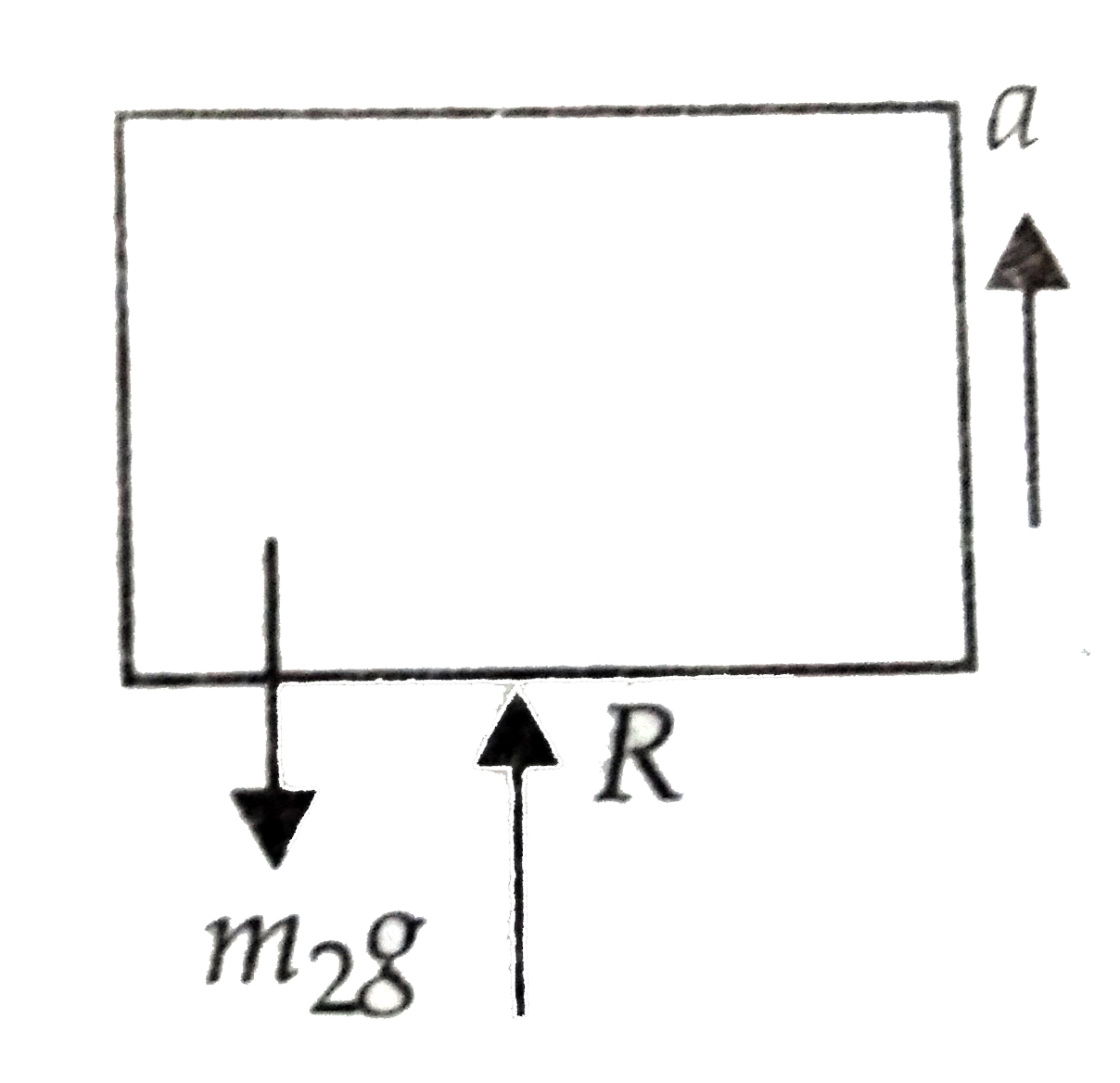 let x be the required amplitude of oscillation for this amplitude of oscillation the normal contact FORCE between the BLOCKS can be GIVEN by `R-m_(2)g=m_(2)a` where, acceleration `a=-omega^(2)x` `thereforeR-m_(2)g=-m_(2)omega^(2)x` For maximum amplitude of oscillation without loosing contact of block `m_(2)` with block `m_(1)`, R=0 we get, `x=g//omega^(2)` Where `omega` is the angular frequency of oscillation of `(m_(1)+m_(2))` and spring. therefore `omega=sqrt((k)/((m_(1)+m_(2))))` or `omega^(2)=(k)/((m_(1)+m_(2)))` `impliesx=((m_(1)+m_(2))g)/(k)` Hence, the maximum energy of oscillation `u_(max)=(1)/(2)kx^(2)=((m_(1)+m_(2))^(2)g^(2))/(2k)` |
|
| 16. |
A car without passengers moving with certain velocity on a level ground can be stopped in a distance of 10 m. If the passengers add 25% of its weight, its stopping distance for the same braking force and velocity is (ignore (friction) |
|
Answer» 15m |
|
| 17. |
(A) : Gravitational potential of eart at every place on it is negative. (R) : Every body on earth is bound by the attraction of earth. |
|
Answer» Both (A) and (R) are true and (R) is the correct EXPLANATION of (A) |
|
| 18. |
The physical quantity which remains constant in simple harmonic motion is : |
|
Answer» POTETNTIAL energy |
|
| 19. |
The mass of a body is measured as 2.00 xx 10^3 Kg . Its significant figures is |
|
Answer» 6 |
|
| 20. |
A gun mounted on the top of moving truck is aimed in the backward direction at an angle of 30^(@) to the vertical. If the muzzle velocity of the bullet is 4 ms^(-1) the value of speed of the truck that will make the bullet come of out vertically is |
|
Answer» `1 MS^(-1)` |
|
| 21. |
A particle moves according to the law x = a cos""(pit)/(2) .The distance covered by it in the timeinterval between t = 0 to t =3 sec is |
|
Answer» Solution :COMPARING the given EQUATION with `x = a cosomegat IMPLIES omega= (pi)/(2) (2pi)/(T)= (pi)/(2) implies T= 4"sec"` The given time `t= 3"sec"` is really `(3T)/(4)` At time t=0 particleat x=a ( at extremeposition) and at `t=3 "sec" = (3T)/(4)` it will be at MEAN POSITION x=0 `:.` distance covered will be .3a.. |
|
| 22. |
A pendulum is hung in a very high building and is moving freely to and fro like a simple harmonic oscillator. If the acceleration of the bob is 16 ms^(-1) at a distance of 4 m from the mean position, then the time period is |
|
Answer» 2s DISPLACEMENT, `y=4m` According to SHM, `a=omega^(2)y` `omega^(2)=(16)/(4)=4` `THEREFORE omega=2rad//s` TIME period, `T=(2PI)/(omega)=(2pi)/(2)` `T=pisec` |
|
| 23. |
What should be the shape of the pillars or column in building and bridge ? |
Answer» Solution :As SHOWN in digures a pillars or COLUMNS with rounded ends SUPPORTS less load that that with a distributed shape at the ends can be USED.  A pillar with rounded ends support less load that that with a distributed shape at the ends. |
|
| 24. |
Passage - I : Angular speed omega is the rate which an object rotates Although usually measured in radians per second, omega can also be expressed in degrees per second. For instance, consider a merry - go - round. Figure shows its angular speed as a function of time t. In this graph, a positive value of omega indicates counterclockwise rotation. A ''complete revolution'' occurs when the merry-go-round turns through one full circle Between t=0 s and t=10 s, about how many revolutions does the merry - go- round complete ? |
|
Answer» 1 |
|
| 25. |
Passage - I : Angular speed omega is the rate which an object rotates Although usually measured in radians per second, omega can also be expressed in degrees per second. For instance, consider a merry - go - round. Figure shows its angular speed as a function of time t. In this graph, a positive value of omega indicates counterclockwise rotation. A ''complete revolution'' occurs when the merry-go-round turns through one full circle Between t=10 s and t=20 s, the merry-go-round |
|
Answer» ROTATES CLOCKWISE, at a CONSTANT rate |
|
| 26. |
Give any two examples of torque in day-to-day life. |
| Answer» SOLUTION :The opening and CLOSING of a door about the hinges and TURNING of a nut using a WRENCH. | |
| 27. |
Passage - I : Angular speed omega is the rate which an object rotates Although usually measured in radians per second, omega can also be expressed in degrees per second. For instance, consider a merry - go - round. Figure shows its angular speed as a function of time t. In this graph, a positive value of omega indicates counterclockwise rotation. A ''complete revolution'' occurs when the merry-go-round turns through one full circle Between t=30s and t=40 s, the merry-go-round |
|
Answer» ROTATES clockwise, at a CONSTANT rate |
|
| 28. |
A ball of mass 'm' moves normal to a wall with a velocity 'u' and rebounds with the same speed. The change in momentum of the ball during the rebounding is |
|
Answer» 2MU TOWARDS the WALL |
|
| 29. |
A metallic plate has been fabricated by welding two semicircular discs - D_(1)and D_(2)of radii R and(R)/(2) respectively (fig. a). O and O' are the centreof curvature of the two discs and each disc has a mass 6m. The plate is in xy plane. Now the plate is folded along the y axis so as to bring the part OAB in yz plane. (fig. b). The plate is now set free to be able to rotate freely about the z – axis. A particle of mass m, moving with a velocity v in the xy plane along the line x = dhits the plate and sticks to it (d lt R) . Just before collision speed of the particle was v. (a) (a) Find the moment of inertia of inertia of the plate about z axis. (b) Find the angular speed of the plate after collision. |
|
Answer» (B) `omega = (2vd)/(11R^(2))` |
|
| 30. |
A small disc P is placed on an inclined plane forming an angle theta with the horizontal and imparted an initial velocity v_(0). Find how the velocity of disc depends on the angle phi which its velocity vector makes with the x axis (see figure). The coefficient of friction is mu= "tan" theta and initially phi_(0) = (pi)/(2) |
|
Answer» |
|
| 31. |
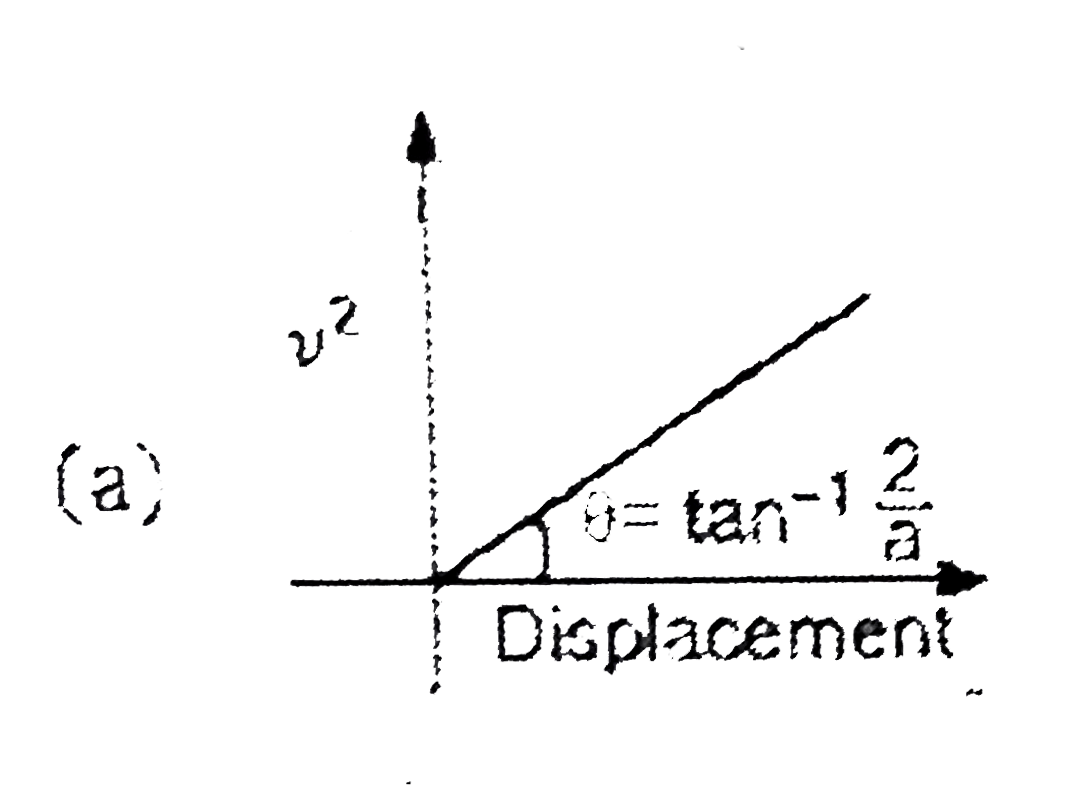
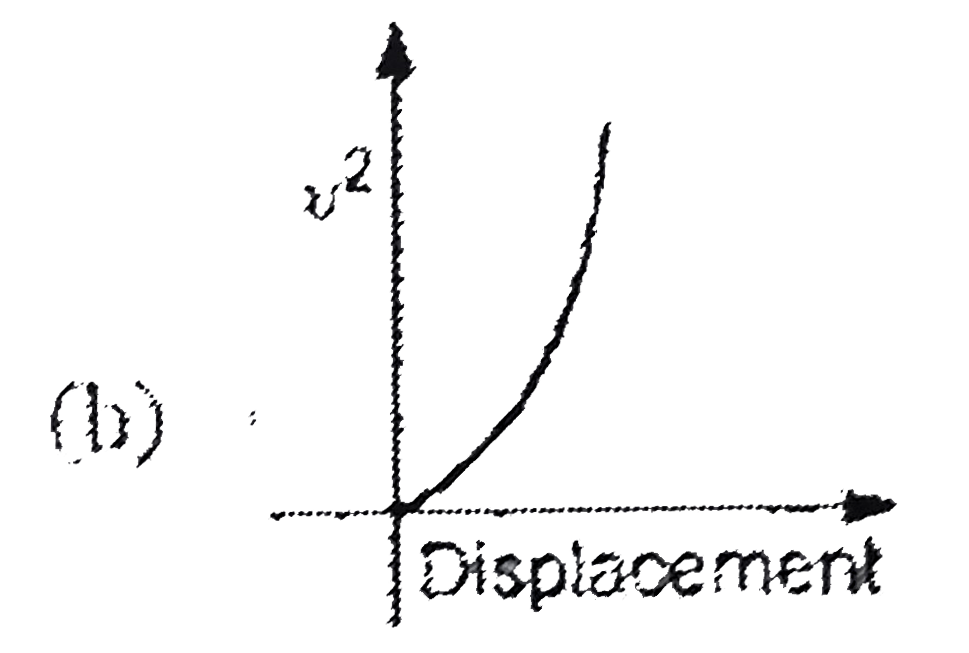
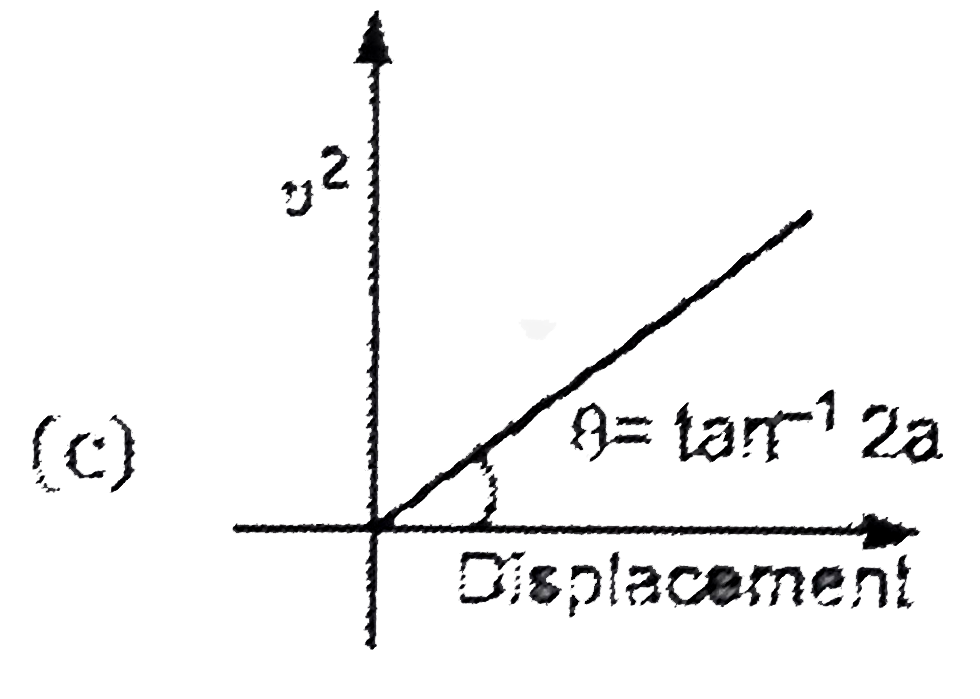
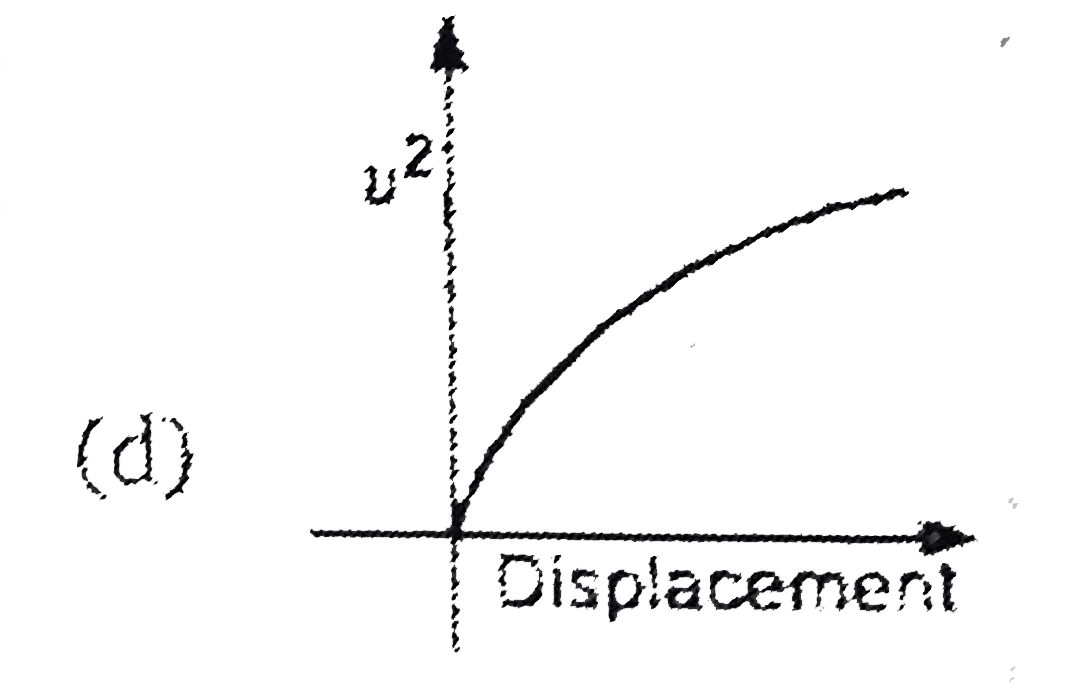
A particle moves with constant acceleration a in the positive x-axis. At t=0 the particle is at origin is at rest , then correct graph between ("velocity")^(2) and displacement is : |
|
Answer»
|
|
| 32. |
If a raindrop falls under the influence of the downward gravitational force and the opposing resistive force. Consider a drop of mass 1.00g falling from a height 1.00km. It hits the ground with a speed of 50.0 ms^(1). (1) What is the work done by the gravitational force ? (2) What is the work done by the unknown resistive force? |
|
Answer» Solution :(1) The chang in kinetic energy of the drop is `DELTA K = (1)/(2) mv^(2) - 0 = (1)/(2) xx 10^(-3) xx 50 xx 50= 1.25J` Work done by the gravitational force is `W_(g)= mg h = 10^(-3) xx 10 xx 10^(3)= 10.0J` (2) The work done by the RESISTIVE force on the RAINDROP. Thus `W_(r )= Delta K- W_(g)` `= 1.25 - 10= -8.75J` |
|
| 33. |
What is the dimensional formula of angular velocity? |
| Answer» Solution :ANGULAR velocity `=("ANGLE")/("time")=1/T=[T^(-1)]` | |
| 34. |
A body of mass 8kg is in limiting equilibrium over an inclined plane of inclination 30%@. If the inclination is made 60^@, the minimum force required to prevent the body from sliding down is |
| Answer» Answer :B | |
| 35. |
A boats man finds that he can save 6 sec in crossing a river by quicker path, then by shortest path if the velocity of boat and river be respectively 17 m/s and 8 m/s, then river width is |
|
Answer» 675 m |
|
| 36. |
A cubical vessel of side 10 cm is filled with Ice at 0°C and is immersed in water bath at 100°C. If thickness of walls of vessel is 0 .2 cm and conductivity is 0.02 CGS units, then time in which all the Ice melts is (Density of Ice =0.9 "gm/cc" ) |
|
Answer» 6 sec |
|
| 37. |
In 1978, a New Zealand motorcylist roared off a 36^@ ramp at a speed of 30 m//s, flying into the air, overa parked airplane anddown onto ramp at the same level. Some withnesses knew from the engine noise that the man had made a fatal mistake. As soon as the jump began, he should have closed the throttle to stop driving the rear wheel. Instead, he kept thethrottle wide open. When the motorcycle left the ramp and friction disappeared, the rear wheel suddenly spun up to itws maximum angular speed omega_(wf) of 160 rad//s and themotorcycle began to rotate around its centre of mass. Thus the motorcycle was far from the correct orientation whenit reached the second ramp. Assume the following. The wheel radius was 0.30 m the rotational inertial I_(C) of the motorcycle about its center of mass was 20 kg. m^(2), and the rotational inerfia I_(w) of the rear wheelabout its centre was 0.40 kg. m^(2). Also assume that omega_(wf) was reached immediatelyafter takcoff, and neglect any effect of theman on the motorcycle. Suppose themotorcycle moved from right to left and before take off, the wheel rolled purely. In radius through what angle did the motorcycle rotate during the flight - |
|
Answer» `4.32 RAD` |
|
| 38. |
For a planet moving around the sun in an elliptical orbit, which of the following quantities remain constant ? (a) The total energy of the sun plus planet system (b) The angular momentum of the planet about the sun (c) The force of attraction between the two (d) The linear momentum of the planet |
|
Answer» only a & B are true |
|
| 39. |
(A): Two identical solid balls, one of ivory and the other of wet-clay are dropped from the same height on the floor. Both the balls will rise to same height after bouncing.(R) : Ivory is less elastic than wet-clay. |
|
Answer» Both (A) and (R) are TRUE and (R) is the correct EXPLANATION of (A) |
|
| 40. |
A body of mass m is attached to a spring of spring constant k which hangs from the ceiling of a elevator al rest in equilibrium. Now the elevator starts accelerating upwards with leration varying with time as a = pt+4. where p and q are positive constant. In the from of |
|
Answer» the BLOCK will PERFORM S.H.M for all value of p and q |
|
| 41. |
The twisting coupleper unittwistfor a solid cylinder of radius 3 cm is 0.1 Newton-meter.The twistingcouple per unit twist, for a hollow cylinder of same material with outer and inner radii 5 cm and 4 cm respectively, will be |
|
Answer» 0.1 NEWTON - METER for solid cylinder `C_(1)=(PI eta r^(4))/( 2l)` Hollow cylinder `C_(2)=(pi eta (r_(2)^(4) -r_(1)^(4)))/(2l)` `therefore C_(2)=C_(1)(r_(2)^(4)-r_(1)^(4))/(r^(4)) =(0.1xx(625-256)xx10^(-8))/( 81xx10^(-8))` `(36.9)/(81)=0.455` Newton-meter |
|
| 42. |
A stone is dropped from the top of a cliff. It is seen to hit the ground below after 4.2 s. How high is the cliff ? |
|
Answer» 86.44 m |
|
| 43. |
For a freely falling body, Find the ratio of the times taken to fall successive equal distances. |
|
Answer» SOLUTION :Ratio of TIMES TAKEN to fall equal distances is `(SQRT(1)-sqrt(0)):(sqrt(2)-sqrt(1)):(sqrt(3)-sqrt(2)): ..........:(sqrt(n)-sqrt(n-1))` use `t=sqrt((2h)/(g))` |
|
| 44. |
Kinetic friction is also called as |
|
Answer» sliding FRICTION |
|
| 45. |
A massless inextensible srting connects two masses m_(1)=3kg "and" m_(2)=1 kg . Mass m_(1) is lifted until mass m_(2) touches the floor and then released . The initil height of mass m_(1)is h = 1m. What height above the floor will the mass m_(2) rise after mass m_(1) fall on to the floor. |
|
Answer» |
|
| 46. |
A small body A is fixed to the inside of a thin rigid hoop of radius R and mass equal to that of the body A. The hoop rolls without slipping over a horizontal plane, at the moments when the body A gets into the lower position, the centre of the hoop moves with velocity v_(0). At what values of v_(0) will the hoop move without bouncing? |
|
Answer» Now CONSIDER `FBD` of the attached body `N+mg=(mv^(2))/R`.i [where `v=`velocity of cenntre of mass of the hoop at tis moment. Again velocity of the body at its moment with RESPECT to the hooop centre of mass `=2v-v=v`] For the hoop `N+R=mg`.....ii From i and ii `(mv^(2))/R-mg+R=mgimpliesR=2mg=(mv^(2))/R`..........iii `Rge0, implies v^(2)le2ghr`........iv Now CONSERVING energying the reference rame of the ground: `mv_(0)^(2)1/2 mv_(0)^(2)+1/2MR^(2)omega_(0)^(2)` `=1/2mv^(2)+1/2(mR^(2))omega^(2)+1/2m(2v)^(2)+2mgR` `implies` Putting `v_(0)=Romega_(0)` and `v=Romega:` `v_(0)=sqrt(8gR)` |
|
| 47. |
When a ball is thrown up vertically with velocity v_(0) it reaches a maximumheight ofh. when the ball reaches to triple t he maximum height. The velocity with which the ball was thrown is: |
|
Answer» `3v_(0)` Here ` u = v_(0), s = h, v = 0 , a = - g` `0^(2) - v_(0)^(2) - 2 (-g)h` `:. v_(0)^(2) = 2gh""i.e., v_(0)^(2) prop h` i,e.,`v_(0)^(2) prop 3h` `(v'_(0)^(2))/(v'_(0)^(2))= (3h)/(h) = 3 ` `:. v'_(0)^(2)= 3 v_(0)^(2) ` `:. v'_(0) = sqrt(3) v_(0)` |
|
| 48. |
While studying the theory of planetary motion, kepler established three laws. According to kepler's second law, the line joining a planet to the sun sweeps out equal areas in equal intervals of time, i.e., the areal velocity of the planet around the sun is constant. This led him to conlude from the sun. Read the above passege and answer the following questions : (i) What is the basis of kepler's second law? (ii) Mercury is closer to the sun than the earth. Will time period of mercury be less or more than one year ? Why ? (iii) What value of life do you learn from kepler's second law? |
|
Answer» Solution :(i) kepler's second LAW is based on the law of conservation of angular momentum. (ii) According to kepler's 3rd law, `T^(2) prop R^(3)` or `T prop R^(3//2)`. For mercury, `R` is less (than `R` for earth). Therefore, TIME period of mercury will be less than one year. (ii) Kepler's second law establishes that the linear speed of a planet, when closer to the sun, is more than its linear speed when away the sun. The PLANETS revolve around the sun on account of gravitational pull of the sun. Thus sun is the source of energy. the law implies that when you are closer to the source of energy, your speed/progress is faster. And when you are from the source of energy, your speed/progress becomes slow. This is so true in everyday life. |
|
| 49. |
Three equal masses ofkg each are fixed at the vertices of an equilateral triangle ABC (a) What is the force acting on a mass 2m placed at the centroid G of the triangle. (b) What is the force if the mass at the vertex A is doubled ? Take AG = BG = 1 m |
|
Answer» Solution :The individual force in VECTOR notation are `F_(GA) = (G(m)(2M))/(1)hat(j)` `F_(GB) = (G(m)(2m))/(1) (-hat(l) COS 30^(@) - hat(j) sin 30^(@))` `F_(GC) = (G(m)(2m))/(1) = (hat(l) = cos 30^(@) - hat(j) SIN30^(@))` From the principle of superposition and the law of vector addition the RESULTANT gravitational force `F_(R)` on (2m) is `F_(R) = F_(GA) + F_(GB) + F_(GC)` `F_(R) = 2Gm^(2)hat(j) + 2Gm^(2) (-hat(i) cos 30^(@) - hat(j) sin 30^(@))` `+2Gm^(2)(hat(i) cos30^(@) - hat(j)sin 30^(@)) = 0` (b) By symmetry, the X-component of the force cancels out. The Y-component survives. `therefore F_(R) = 4Gm^(2)hat(j) - 2Gm^(2)hat(j) = 2Gm^(2)hat(j)` 
|
|
| 50. |
Dynamic lift' is related to ………….. . |
|
Answer» Bernoulli's PRINCIPLE |
|