

Saved Bookmarks
This section includes 7 InterviewSolutions, each offering curated multiple-choice questions to sharpen your Current Affairs knowledge and support exam preparation. Choose a topic below to get started.
| 1. |
A cube is floating on mercury with (1//5)^(th)of its volume submerged. If suficient water Is added to cover the cube, what fraction of its volume will remain immersed in mercury ? Density of mercury = 13600 kg//m^(3) . |
|
Answer» SOLUTION :When the cube floats on MERCURY, Volume of cube `xx` density of cube D = Volume of immersed portion of the cube `xx` density of mercury D. ` "" V xx D= (1)/(5)V xx 13600` ` ""D = (13600)/( 5)=2720 kg//m^(3)` When water is poured let the fraction of cube immersed in mercury be x. Then the fraction immersed in water will be `(1-x)` ` "" VD = xVd+(1-x) Vrho ` where` RHO` is the density of water ,`rho = 1000 kg //m^(3)` ` 2720 = 13600 x+( 1-x) 1000` `"" x=0.14 m ` |
|
| 2. |
Explain whya cyclist bends while negotiating a curve road? |
|
Answer» Solution :Let usconsidera cyclistnegotatingacircularlevelroad( notbankedof radiusrwitha speedv.The cycleand thesystemis Cand itgoesin acircleofradiusr withcenteratO / Letuschoosethe lineOCas X-axisand theverticallinethroughO as Z- axisas showninfigure Thesystemas aframeis rotatingaboutZ - axisthe systemis at restin thisrotatingframe.TOsolveproblemsinrotatingframeor reference, wehaveto applya centrifugal force ( pseudoforce) on thesystemwhichwill be`( mv^2 )/(r ) `thisforcewill actthroughthe centrerof gravity .Theforcesactingon thesystemare,(i )gravitationalforce(mg ), (ii ) normalforce (N ) , (iii )frictionalforce(f )and(iv )Centrifugal force`((mv^2)/(r ))` . Asthesystemis in equilibriumin therotationalframeofreference , the n E texternalforceand n e texternaltorque mustbe zero. Let usconsideralltorques aboutthe pointA infigure . Forrotationalequilibrium, ` VEC(tau)_(n e t) =0` The TORQUE DUE tothe gravitionalforceaboutaboutpointA is( mg AB )whichcausesaclockwiseturnthat istakenas negative. Thetorquedueto thecentripetalforceis `((mv^2)/(r) B C)` whichcausesan anticlockwiseturnthatis takenas positive . `- mgAB + (mv^2)/(r)B C=0` `mg AB= (mv^2 )/(r )BC ` from` Delta ABC ,` `AB = ACsin thetaandBC = ACcos theta ` ` Mg AC sin theta= ( mv^2 )/(r )ACcos theta ` ` tan theta = (v^2)/(rg ) ` ` theta = tan^(-1)((v^2)/(rg ))`  
|
|
| 3. |
The pressure and density of a diatomic gas (gamma = 7/5) change adiabatically from (p,d) to(p., d.). If (d)/(d.) =32 , and P = 256cm of Hg. P^1 in cm of Hg is __ |
|
Answer» |
|
| 4. |
Two harmonic oscillators starts oscillating simultaneouly in the same direction. Their time periods are T and (5T)/(8) respectively. The phase difference between them, when second oscillator has completed one oscillation, will be |
| Answer» Answer :C | |
| 5. |
An ideal gas at pressure P and volume V is expanded to volume 2V. Column I represents the thermodynamic process used during expansion. Column II represents the work done during processes in the random order. |
|
Answer» `A rarr Q, B rarr R, C rarr P` Work done `= Pdelta V = P(2V - V) = PV` For an ISOTHERMAL process, Work done `= RT ln ((2V)/(V)) = PV ln 2` For an adiabatic process, `PV^(GAMMA) = P_(1)(2V)^(gamma)` or `P_(1) = ((1)/(2))^(gamma) P = P_(2)^(-gamma)` `:.` Work done`= (PV - P_(1)(2V))/(gamma - 1) = (PV (1-2^(1-gamma)))/(gamma - 1)` Thus, `A rarr Q, B rarr, C rarr P` |
|
| 6. |
A steet wire of length 4.7 m and cross - sectional area 3.0xx10^(-5)m^(2) stretches by the same amount as a copper wire of length 3.5 m and cross- sectional area of 4.0xx10^(-5)m^(2) under a given load. What is the ratio of the Young's modulus of steel to that of copper ? |
|
Answer» |
|
| 7. |
What is condition for a body suspended at the end of a spring having simple harmonic oscillation? |
| Answer» Solution :SPRING MUST be elastic and OSCILLATION OCCURS in the absence of resistive force. | |
| 8. |
The image formed by a concave mirror |
|
Answer» is always REAL |
|
| 9. |
A hollow sphere of inner radius R_(1)=0.25m and outer radius R_(2)=0.50 m is placed inside a heat reservoir of temperature T_(0)=1000^(0)C. The hollowsphere contains water at initial temperature 0^(0)C. The thermal conductivity of the material is K=(10^(2))/(4pi)W//m-K. The time required to convert all the water into steam 100^(0)C. |
|
Answer» 10 min 24 sec |
|
| 10. |
A hollow sphere of inner radius R_(1)=0.25m and outer radius R_(2)=0.50 m is placed inside a heat reservoir of temperature T_(0)=1000^(0)C. The hollowsphere contains water at initial temperature 0^(0)C. The thermal conductivity of the material is K=(10^(2))/(4pi)W//m-K. The thermal resistance is |
|
Answer» `3xx10^(-2)` K/W |
|
| 11. |
A hollow sphere of inner radius R_(1)=0.25m and outer radius R_(2)=0.50 m is placed inside a heat reservoir of temperature T_(0)=1000^(0)C. The hollowsphere contains water at initial temperature 0^(0)C. The thermal conductivity of the material is K=(10^(2))/(4pi)W//m-K. The time required to raise the temperature of water to 100^(0)C. |
| Answer» Answer :A | |
| 12. |
The planet Mars has two moons, phobos and delmos. (i) phobos has a period 7 hours, 39 minutes and an orbital radius of 9.4 xx103 km. Calculate the mass of mars. (ii) Assume that earth and mars move in circular orbits around the sun, with the martian orbit being 1.52 times the orbital radius ofthe earth. What is the length of the martian year in days ? |
|
Answer» Solution :(1)We employ Eq. (8.38) with the sun’s mass replaced by the martian mass`M_(m)` `T^(2) = (4 pi^(2))/(GM_(m)) R^(3)` `M_(m) = (4 pi^(2))/(G)(R^(3))/(T^(2))` = `(4 xx (3.14)^(2) xx (9.4)^(3) xx 10^(18))/(6.67 xx 10^(-11) xx (459 xx 60)^(2))` `M_(m) = (4 xx (3.14)^(2) xx (9.4)^(3) xx 10^(18))/(6.67 xx (4.59 xx 6)^(2) xx 10^(-5))` (ii) Once again Kepler.s THIRD law comes to our. atd. `(T^(2)_(m))/(T^(2)_(E)) = (R^(3)_(MS))/(R^(3)_(RS))` where `R_(MS)` is the mars - sun distance and `R_(ES)` is the earth-sun distance. ` therefore T_(M) = (1.52)^(3//2) xx 365` = 648 days we note that the ornits of all planets except Mercury. Mars and PLUTO are very CLOSE to being ctruclar. For example. the ratio of the semi-minor to semi-major axis for our Earthis . b/a = 0.99986. |
|
| 13. |
Find the minimum attainable pressure of one mole of an ideal gas if during its expansion its temperature and volume are related as T=T_(0)+alphaV^(2) where T_(0)" and "alpha are positive constants. |
|
Answer» Solution :GIVEN that one mole of gas is used, thus from gas law, we have PV = RT or `P=(RT)/V=R/V(T_(0)+alphaV^(2))""["as "T=T_(0)+alphaV^(2)]` Here pressure P will be minimum when `(dP)/(DV)=0" or "(dP)/(dV)=(RT_(0))/V^(2)+alphaR=0" or "V=sqrt(T_(0)/alpha)` Thus pressure of gas is minimum when its volume is `V=sqrt(T_(0)/alpha)` and at this volume its temperature is given as `T=T_(0)+alphaV^(2)` `T=T_(0)+alpha(sqrt(T_(0)/alpha))^(2)=2T_(0)` Thus minimum value of pressue is `rArr P_(MIN)=(RT)/V=(R(2T_(0)))/sqrt(T_(0)//alpha)=2Rsqrt(T_(0)alpha)` |
|
| 14. |
A body released from certain height reaches the surface of the earth after 't' seconds. If the same body is released from the same height on the moon, it reaches the surface after (g_("moon") = g_(e)//6) |
|
Answer» `(t)/(6)S` |
|
| 15. |
Pressure P, volume V and temperature T for a certain gas are related by P=(alpha T - alpha T^2)/(V)Where alpha and betaare constants. Find the work done by the gas if the temperature changes from T_1 and T_2 while the pressure remains the constant. |
|
Answer» |
|
| 16. |
On loading a metal wire of cross section 10^(-6) m^(2)and length 2m by mass of 210 kg it extends by 16mm and suddenly broke from the point of support. If density of that metal is 8000 "kgm"^(-3) and its specific heat is 420 "Jkg"^(-1) "K"^(-1) the rise in temperature of wire is (g=10 "ms"^(-2) ) |
|
Answer» `2.5^(@) C` |
|
| 17. |
The moment of inertia of a uniform circular disc of mass M and of radius R about one of its diameter is |
|
Answer» `(1)/(4) MR^(2)`  x and y axes lie in the plane of the disc and z is perpendicular to it. By the theorem of perpendicular axes, `I_(z) = I_(x) +I_(y)` As x and y axes are along two diameters of the disc . By symmetry, the moment of inertia of the disc is the same about any diameter . Hence `I_(x) = I_(y) "" therefore = I_(z) = 2 I_(x)` `because I_(z) = (1)/(2) MR^(2) "" therefore I_(x) = (I_(z))/(2) = (1)/(4) MR^2` Thus , the moment of inertia of the disc about any of its diameter is `(1)/(4) MR^(2)`. |
|
| 18. |
If, the speed of the stone is increased beyond the maximum permissible value, and the string breaks suddenly, which of the following correctly describes the trajectory of the stone after the string breaks : (a) the stone moves radially outwards, (b) thestone flies off tangentially from the instant the string breaks, (c) the stone flies off at an angle with the tangent whose magnitude depends on the speed of the particle ? |
| Answer» SOLUTION : ALTERNATIVE (B) is CORRECT, according to the First LAW | |
| 19. |
A collision is an isolated event in which……………..exert……………….on one another for……………… . |
| Answer» Solution :two or more COLLIDING bodies `,` RELATIVELY strong force `,` relatively SHORT TIME. | |
| 20. |
If a refrigerator's door is kept open, will the room become cool or hot ? Explain. |
| Answer» Solution :If a refrigerator.s DOOR is KEPT open, then room will BECOME hot, because the refrigerator exhaust more HEAT into the room than earlier. | |
| 21. |
A ball is projected vertically down with an initial velocity from a height of 20mon to a horizontal floor. During the impact it loses 50% of its energy and rebounds to the same height. The velocity of projection is (g=10ms^(-2)) |
| Answer» Answer :A | |
| 22. |
Each situation in Table-1 gives graph of a particle moving in circular path. The variables omega, theta and t represent angular speed (at any time t), angular displacement (in time t) and time respectively. Table-2 gives certain resulting interpretation. Match the graphs in Table-1 with statements in Table-2. 0 |
|
Answer» |
|
| 23. |
The speed of light in vacuum is 3xx10^(8)m//s. How many nanosecond does it take to travel one metre in a vacuum? |
|
Answer» `8ns` `=1/3xx(10^(-8))/(10^(-9))ns=10/3ns` |
|
| 24. |
What are vapourization and boiling point ? Explain the process of boiling of water. |
|
Answer» Solution :On heating, when the ice gets converted into water and as we continue further heating, we shall see that temperature begins to rise. The temperature keeps on rising till it reaches nearly `100" "^(@)C` when it again becomes steady. The heat supplied is now being utilised to change water from liquid state to vapour or gaseous state. The change of state from liquid to vapour (or gas) is called vaporisation. It is observed that the temperature REMAINS constant until the ENTIRE amount of the liquid is converted into vapour. Both the liquid and vapour states of the substance coexist in thermal equilibrium, during the change of state from liquid to vapour. The temperature at which the liquid and the vapour states of the substance coexist is called its boiling point. The process of boiling of water :  Take a round - bottom flask, more than half filled with water. Keep it over a burner and fix a thermometer and steam outlet through the cork of the flask. As water gets heated in the flask, note first that the air, which was dissolved in the water, will come as small bubbles. Leter, bubbles of steam will form at the bottom but as they rise to the cooler water near the top, they condense and disappear. Finally, as the temperature of the entire mass of the water reaches `100^(@)C`, bubbles of steam reach the surface and boiling is said to occur. The steam in the flask may not be visible but as it comes out of the flask, it condenses as tiny droplets of water, giving a foggy appearance. If now the steam outlet is closed for a few seconds to INCREASE the pressure in the flask, you will notice that boiling stops. More heat would be required to RAISE the temperature (depending on the increase in pressure) before boiling begins again. Thus boiling point increases with increase in pressure. Let us now remove the burner. Allow water to cool to about `80^(@)C`. Remove the thermometer and steam outlet. Close the flask with the airtight cork. Keep the flask turned upside down on the stand, POUR ice-cold water on the flask. Water vapours in the flask condense reducing the pressure on the water surface inside the flask. Water begins to boil again, now at a lower temperature. Thus boiling point decreases with decrease in pressure. |
|
| 25. |
When it is raining, it is not advised to resist water drops falling on the tent from inside the tent. Explain Why? |
|
Answer» Solution :In the absence of EXTERNAL forces, the SURFACE tension binds the molecules within a spherical drop which rolls away from the surface of the tent. Water drops break down and WET the tent when water drops are resisted on FALLING on the tent. |
|
| 26. |
An ideal gas undergoes a process in which PV^(-a)= constant, where V is the volume occupied by the gas initially at pressure P. At the end of the porcess, .rms. speed of gasmolecules has become a 1/2 times of its initial value. What will be the value of C_v so that energy transferred in the form of heat to the gas is.a. times of the initial energy |
|
Answer» `((a^(2)+1)R)/(a^(2)-1)` |
|
| 27. |
At the equilibrium position of a particle executing S.H.M |
|
Answer» RESTORING force ACTING on the PARTICLE is zero |
|
| 28. |
A body is released from the top of a tower of height h and takes 'T' sec to reach the ground. The position of the body at T/2 sec is |
|
Answer» `(H)/(4)` from ground |
|
| 29. |
The pressure of a certain mass of ideal gas is increased from 1 atm to 20 atm adiabatically. If y=1.4, (i) by what factor does the volume change and (ii) by what factor does the temperature change? |
|
Answer» <P> SOLUTION :`(V_(2) //V _(1)) = (P_(1) //P_(2)) ^( t//GAMMA) = (1//20) ^( 1//1.4) , (T_(2) //T_(1)) = (P_(2) //P_(1)) ^( 1 - (1)/(gamma)) = (20) ^( 0.4//1.4)` |
|
| 30. |
Two identical solid copper sphere of radius R are placed in contact with each other. The gravitational force between them is proportional to. |
|
Answer» Solution :The gravitational force` F = (G(M)(M))/((2R)^(2)) = (G(4/3 PIR^(3)rho))/(4R^(2))` Mass of the sold sphere`M = 4/3 piR^(3)rho` ` F = (G(16pi^(2)R^(6)rho^(2)))/(9xx 4xx R^(2))` `F = 4/9 Gpi^(2)rho^(2)R^(4)" , "F prop 4/9 pi^(2) rho^(2) R^(4)` ` :. ` The gravitational force between them is propor tionalto 4TH power of radius . |
|
| 31. |
Explain why does drinking water kept in an earthern pot cool down ? |
| Answer» SOLUTION :Water oozes out the PORES of the earthern POT to the surface where it evaporates.Heat REQUIRED for this absorbed from the water in the pot.Hence water inside the pot gets COOLER. | |
| 32. |
Explain the types of equilibrium with suitable examples |
Answer» SOLUTION :
|
|
| 33. |
A fixed pulley carries a weightless thread with masses m_(2) and m_(1) at its ends (m_(2) gt m_(1)). There is friction between the thread and the pulley. If it is such that the thread starts slipping when the ratio of m_(2) to m_(1) is n_(0). Find : (a) the friction coefficient (b) the acceleration of the masses when (m_(2))/(m_(1))=n gtn_(0) [Hint : Consider an element of the thread of width d theta at angular distance theta from the horzontal diameter of the pulley. The forces at the ends are T and T = dT. If dN is the normal reaction of the pulley on the element than df (frictional force on the element) = mu dN Resolving the tensions at the ends along and perpendicular to the radius vector of the element, we have for equilibrium of the element dT = df and dN = T d theta Integrate from T_(1) to T_(2).T_(1)=m_(1)g and T_(2)=m_(2)g. These are obtained by considering equilibriumof m_(1) and m_(2)] |
|
Answer» |
|
| 34. |
If vec(A) + vec(B) = vec(C ), then magnitude of vec(B) is |
|
Answer» `VEC(C )- vec(A)` |
|
| 35. |
The melting point of ice and the boiling point of water are taken as standard fixed pointsIs it correct ? |
| Answer» SOLUTION :No , the MELTING point of ice and boiling point of WATER change if the PRESSURE changes and impurities are DISSOLVED in water. | |
| 36. |
A ball of mass 50g falls from rest vertically downwards through a distance of 40m and hits the ground. Find the kinetic energy and the finaly velocity of the ball before it hits the ground (g= 9.8 ms^(-2)). |
|
Answer» Solution :m= 50 gm `= 50 xx 10^(-3)kg` h= 40m, g= `9.8 ms^(-2)` From law of CONSERVATION of energy loss in P.E= GAIN in K.E `rArr mgh = (1)/(2) mv^(2) and v= SQRT(2gh)` Final velocity, `v= sqrt(2 xx 9.8 xx 40)= 28 ms^(-1)` `K.E. = (1)/(2) mv^(2)= (1)/(2) xx 50 xx 10^(-3) xx 28 xx 28= 19.6J` |
|
| 37. |
Find out the results of the following operations. (i) 117.3 xx 0.0024 (ii) 9.27 div 41 (iii) 42 xx 0.041 (iv) 124.2 + 52.487 (v) 124.2-52.487 (vi) sqrt(58.97)(vii) (17.5)^(2) |
|
Answer» Solution :(i) 0.0024 has 2 significant figures. Hence 117.3 is rounded off to have `2+1= 3` significant figures. It becomes 117 only. Now `117 xx 0.0024 = 0.2808` This is to be rounded off to have two significant figures only. The result is 0.28. (ii) 41 has only 2 significant digits. Hence 9.27 can have `2 +1= 3` significant digits. It has 3 significant digits only. No need for ROUNDING off. `(9.27)/(41)= 0.2260975` This is to be rounded off to two significant digits. The result is 0.23. (iii) Both number have two significant digits `42 xx 0.041= 1.722`. This to be rounded off to 2 significant digits. The result is 1.7. (iv) As this is a sum, we have to CONSIDER decimal PLACES. 124.2 has only one decimal place. Hence 52.487 is to be rounded off to `1 + 1= 2` decimal places. It becomes as 52.487 = 52.49 Now `124.2 + 52.49= 176.69`. This is to be rounded off to one decimal place. The result is as 176.69= 176.7 (v) Here again, we have `124.2- 52.487= 124.52.49 = 71.71`. This is to be rounded off to one decimal place The result is 71.7 (vi) `sqrt(58.97)= 7.679`. This has got the same number of significant digits (4) as 58.97. (vii) `(17.5)^(2)= 306.25`. The original number 17.5 has only 3 significant digits. And hence the result will be 306 (Here we have to consider the significant figures). |
|
| 38. |
Explain error of a sum or a difference. |
|
Answer» Solution :Let two physical QUANTITIES A and B has measured value `A+-DeltaA and B+- AB` where, (1) For addition : Let Z is quantity obtained by addition of A and B. `:.Z=A+B` Let ERROR is Z be`DeltaZ` `Z+-DeltaZ=(A+-DeltaA)+(B+-DeltaB)` `A+B=Z` `:. +-Z=+-DeltaA+-DeltaB` For maximum absolute, error `DeltaZ = DeltaA+DeltaB` (ii) For Subtractio n : Let diference of A and B is Z. `:.Z=A-B` [ Let `A GT B]` `Z+-DeltaZ=(A+-DeltaA)-(B +-DeltaB)` `=(A-B)-(+-DeltaA+-DeltaB)` `A-B=Z` `+-DeltaZ=+DeltaA+- DeltaB` For maximum error in Z, `DeltaZ=DeltaA+DeltaB` Rule : When two quantities are added or subtracted, the absolute error in the final result is the sum of the absolute errors in the INDIVIDUAL quantities. |
|
| 39. |
The motion of a particle is expressed by the equation a=- bx where a' is acceleration, 'x' is the displacement from the equilibrium position and 'b' is a constant. The periodic time will be |
|
Answer» `(2PI)/(B)` |
|
| 40. |
If vec(A) = 3hat(i) + 4hat(j) and vec(B) = 7hat(i) + 24 hat(j), find a vector having the same magnitude as vec(B) and parallel to vec(A). |
|
Answer» SOLUTION :The vector parallel to `vec(A)` and having magnitude of `vec(B)` is `vec(C) = |vec(B)|(vec(A))/(|vec(A)|) = |vec(B)|hat(A)` `B = SQRT(7^(2) + 24^(2)) = 25` and `hat(A) = (vec(A))/(A) = (3HAT(i) + 4hat(j))/(sqrt(3^(2) + 4^(2))) = (1)/(5)(3hat(i) + 4hat(j))` `vec(C) = 25 xx (1)/(5)(3hat(i) + 4hat(j)) = 15 hat(i) + 20 hat(j)` |
|
| 41. |
Ariver is flowing from west to east at a speed of 5 m/s. Aman on the south bank of the river capable of swimming at 10 m/s in a still water wants to swim, across the river in a shortest time He should swim in a direction |
|
Answer» DUE NORTH |
|
| 42. |
The dimensional formula for work is |
| Answer» Answer :D | |
| 43. |
The dimensional formula for relative density is : |
|
Answer» `ML^(-3)` |
|
| 44. |
For a body travelling with uniform acceleration, its final velocity is v=sqrt(180-7x), where x is the distance travelled by the body. Then the acceleration is |
|
Answer» `-8m//s^(2)` |
|
| 45. |
A cylindrical wire is twisted with an angle theta, what is torsion produced in it? |
|
Answer» `(C )/(THETA)` Means `tau prop theta or tau = C theta,` where C is restoring couple PER unit twise. |
|
| 46. |
An ideal gas is compressed to half its initial volume by means of several processes. Which of the process results in the maximum work done on the gas ? |
|
Answer» Isothermal `W_"isochoric"=0` and in adiabatic process , 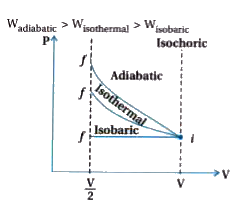 Area under the graph REPRESENTS the work done by an ideal gas. Here, area obtained MAXIMUM for adiabatic process, hence the work is maximum. |
|
| 47. |
The displacement of a particle executing periodic motion is given by y=4cos^(2)(t/2)sin (1000t). Find independent constituent simple harmonic motions. |
|
Answer» SOLUTION :`y=4cos^(2)(t/2)sin(1000t)` `y=2[1+cost]sin 1000t` `[2cos^(2) theta =(1+COS^(2)theta)]` `y=2sin 1000 t+2sin 1000 t.cos t` `y=2sin 1000 t+sin 1001t+sin 999t` [as `2 sin A cos B=sin(A+B)+sin(A-B)` `:. `The given expression is the resultant of three INDEPENDENT simple HARMONIC MOTION. |
|
| 48. |
A simple pendulum has a time period T in vacuum. Its time period when it is completely immersed in a liquid of density one -eighth of the density of the material of the bob is |
|
Answer» `SQRT(7/8)T` |
|
| 49. |
If the mass of two bodies is doubled and the distance of two bodies also doubled, the newgravitational force becomes what ? |
|
Answer» |
|
| 50. |
A copper calorimeter of a mass 300 g contains 500 g of water at a temperature of 20^@C A 500 g of copper block at 100^@Cis dropped into calorimeter . If the resultant temperature is 25^@C .then find the specific heat of copper in J "kg"^(-1)K^(-1) . |
|
Answer» 190 |
|