Saved Bookmarks
This section includes 7 InterviewSolutions, each offering curated multiple-choice questions to sharpen your Current Affairs knowledge and support exam preparation. Choose a topic below to get started.
| 1. |
The pressure and temperature of an ideal gas in a closed vessel are 720 Kpa and 40^(@)C respectively. If (1//4)^(th) of the gas is released from the vessel and the temperature of the remaining gas is raised to 353^(@)C. The final pressure of the gas is |
|
Answer» 1440 kPa |
|
| 2. |
The following four wires are made of the same material. If same tension is applied to each, the wire having largest extension is |
|
Answer» L = 50CM and DIAMETER 0.5mm |
|
| 3. |
Block B of mass m has been placed on block A of mass 3 m as shown. Block A rests on a smooth horizontal table. F_(1) is the maximum horizontal force that can be applied on the block A such that there is no slipping between the blocks. Similarly, F_(2) is the maximum horizontal force that can be applied on the block B so that the two blocks move together without slipping on each other. When F_(1) "and" F_(2) both are applied together as shown in figure. (a) Find the friction force acting between the blocks. (b) Acceleration of the two blocks. (c) If F_(2) is decreased a little, what will be direction of friction acting on B. |
|
Answer» (b) `(F_(1))/(3m) = (F_(2))/(m)` (c) To RIGHT |
|
| 4. |
Join the relation of physical quantities in Column-I to the details given in Column-II appropriately: |
| Answer» SOLUTION :`(a-iv), (b-ii)` | |
| 5. |
A force of (4x^(2) + 3x) N acts on a particle which displaces it from x=2m to x= 3m. The work done by the force is |
|
Answer» 32.8J |
|
| 6. |
For a surface molecule …….. |
|
Answer» the net force on it is zero.  Let US consider a molecule A asthe CENTRE of sphere of molecular action inside the liquid .The net force on this sphere is zero .A sphere of molecular action at the surface of liquid having half of its spere is OUTSIDE .The liquid contains the MOLECULES of air and liquid vapor and half its part is inside the liquid .Hence ,this molecule is under the influence of downward resultant force .(OPTION B) The potential energy of molecule B is more than inside molecule A (Option D) |
|
| 7. |
Shooting of an arrow from the bow, is an example for______ |
|
Answer» PROJECTILE MOTION |
|
| 8. |
In a planet a sucrose solution of coefficient of viscocity 0.0015 N-sm^(2) is driven at a velocity of 10^(-3) ms^-1 through xyleni vessels of radius 2mum and length 5mum The hydrostatic pressure difference across the length of xylem vessels in Nm^(-2) is |
|
Answer» 5 |
|
| 9. |
On an acceleration- time graph, the area under the graph represents |
|
Answer» DISTANCE travelled |
|
| 10. |
Define gravitational potential. Give its unit. Is gravitational potential vector or scalar ? |
| Answer» SOLUTION :` IMPLIES (m//s^(2))`or J/kg or SQUARE of VELOCITY. | |
| 11. |
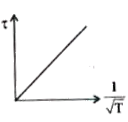
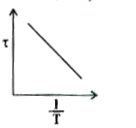
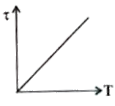
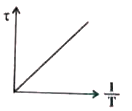
Which graph correctly represents the variation between relaxation time (tau) of gas molecules with absolute temperature (T) of the gas? |
|
Answer»
|
|
| 12. |
In the figure shown consider the first reflection at the plane mirror and second at the convex mirror .AB is object. |
|
Answer» The second image is REAL ,inverted of `1//5^(th)`magnification  for image by convex mirror Distance of image of `A'`is `v_(A)` `(1)/(v)+(1)/(u)=(1)/(f)` `(1)/(v_(A))+(1)/(-60)=(1)/(60) rArr v_(A)=-30cm` Distance of image of `B'` is `v_(B)` `(1)/(v_(B)) +(1)/(-90)=(1)/(60)` `(1)/(v_(B)) =(1)/(60)+(1)/(90) rArr (1)/(v_(B))=(5)/(180)` `v_(B)=36cm` `m=("length of image")/("length of object")=(6)/(30)=(1)/(5)` Distance of image increases with convex mirror. |
|
| 13. |
what is the role of Physics in our daily life ? |
|
Answer» Solution :Physics has innumerable applicatiosn in our daily life. For example, STUDEY of electricity has led to development of electrical appliances like generator, motor, fans, heaters, coolers, air CONDITIONER etc. The electromagnetic waves are used in RADIO, televison, radar, wireless communications, telephons, mobiles, internet. The discovery of silicon chip has revolutionised computer industry. RADIOACTIVE isotopes are being widely used in medicine, agriculture and industry. |
|
| 14. |
State and explain the work done in the following situations: A person carrying a heavy load on a level road. |
| Answer» SOLUTION :Since there is no VERTICAL displacement, WORK done along the vertical direction is ZERO. | |
| 15. |
In K=(p^(2))/(2m) find the relative error. (Take mass m, constant) |
| Answer» Solution :`(DELTAK)/(K)=2(Deltap)/(p)+(DELTAM)/(m)`but `DELTA m=0` is CONSTANT `:.(DeltaK)/(K)=(2Deltap)/(p)` | |
| 16. |
A metal piece is heated upto T K, the temperature of the surrounding is t K. The heat loss to the surrounding due to radiation is proportional to |
|
Answer» `(T-t)^(4)` |
|
| 17. |
Block B moves to the right with a constant velocity v_(0). The velocity of body A relative to B is |
|
Answer» `(v_(0))/(2)`, towards LEFT `therefore"" v_(A)=(T_(B))/(T_(A)).v_(B)=(3)/(2)v_(0)`(towards right) `therefore"" v_(AB)=(3v_(0))/(2)-v_(0)=(v_(0))/(2),` towards right. In such cases, velocity and acceleration are in the ration of tensions. |
|
| 18. |
The average momentum of a molecule in an ideal gas depends on |
|
Answer» TEMPERATURE |
|
| 19. |
Given two vectors vec(A) = hat(i) - 2hat(j) - 3hat(k) and vec(B) = 4hat(i) - 2hat(j) + 6hat(k). The angle made by (vec(A) + vec(B)) with the X-axis is |
|
Answer» `30^(@)` |
|
| 20. |
A monatomic gas at pressure P_(1) and volume V_(1) is compressed adiabatically to (1)/(8)^(th) of its original volume. What is the ginal pressure of the gas ? |
|
Answer» `64P_(1)` `PV^(GAMMA)` = CONSTANT or `P_(1)V_(1)^(gamma) = P_(2)V_(2)^(gamma)` For monatomic gas `gamma = (5)/(3)` `:. P_(1)V_(1)^(5//3) = P_(2)((V_(1))/(8))^(5//3) rArr P_(2) = P_(1) xx (2)^(5) = 32 P_(1)` |
|
| 21. |
Why is sand drier than clay? |
| Answer» Solution :Due to pores, NARROW capillaries are present in CLAY, water rises and is RETAINED in them. It is not so in sand. This is why sand is drier than clay. | |
| 22. |
Derive the relation between pressure and mean kinetic energy. |
|
Answer» Solution :The internal of the gas is given by `U = 3/2 NkT` The above equation can ALSO be a written as `U=3/2 PV` Since , PV = NkT `P = 2/3 U/V = 2/3 u "" …(1)` From the equation (1), we can state that the pressure of the gas is equal to two thirds of internal energy per unit VOLUME or internal energy DENSITY `(u = U/V)` . Writing pressure in terms of mean kinetic energy density using equation, `P =1/3nmbar(v^2) =1/3rhobar(v^2)"" ...(2)` where `rho` = nm = mass density (Note n is number density) Multiply and divide R.H.S of equation (2) by 2 , we get `P = 2/3 (rho/2bar(v^2))` `P = 2/3 bar(KE)` |
|
| 23. |
Following are equations of four waves(i)y _(1) a sin omega (t - (x)/(v))(ii)y_(2) = a cos omega (t + (x)/(v))(iii)z_(1) = a sin omega (t - (x)/(v))(iv)z_(2) = a cos omega (t + (x)/(v))Which of the following statements are correct ? |
|
Answer» on superposition of waves (i) and (ii), a TRAVELLING wave having AMPLITUDE ` asqrt(2)`will be formed |
|
| 24. |
If the displacement at time 't' is x = acost, the acceleration is ....... |
|
Answer» ` COS t ` `(DX)/(dt) =- a sin t` `(d ^(2)x)/(dt ^(2)) =- a cos t` |
|
| 25. |
A cylindrical vessel with a circular hole of radius 0.2mm in its bottom, is filled with water. If surfacetension of water is equal to 70 dyne cm-, density of water is lg cm^(-3) and g is equal to 980 cms-2 then the maximum height to which the vessel can be filled without water flowing out of the hole is 'x' (3.57) cm. Find x |
|
Answer» |
|
| 26. |
What is breaking point ? |
| Answer» SOLUTION :beyond C the extension ge son INCREASING without any additional LOAD . In this region constrictions develop at few points . It breaks at a POINT D called the BREAKING point .`##BIN_DAC_PHY_XI_C09_S01_011_A01##` | |
| 27. |
If a vibrating tuning fork is held at the open end of a tube closed at one end, then for a particular length of the tube an intense sound is heard. This phenomenon is known as |
|
Answer» beats |
|
| 28. |
Assertion : on a rainy day it is difficult to drive a bus at high speed Reason : Due to wetting of the surface the value of coefficient of friction is loweredWhich one of the following statementis a correct statement |
|
Answer» Assertion is true and reasoin is FALSE |
|
| 29. |
A car manufacturer claims that his car can be accelerated from rest to a velocity of 10 m s^(-1) in 5s. If the total mass of the car and its occupants is 1000 kg, then the average horse power developed by the engine is |
|
Answer» `(10^3)/(746)` |
|
| 30. |
Two bodies are in equilibrium when suspended in water from the arms of a balance. The mass of one body is 36 g and its density is 9g/cm^(3). If the mass of the other is 48 g, its density in g/ cm^3 is |
| Answer» ANSWER :C | |
| 31. |
The viscosity of water is |
| Answer» Answer :A | |
| 32. |
Dhivya was a talented cyclist. She used to go to school in her bicycle presented by her Dad. She used to ride faster, as she always goes late from home. When she was going by the road one day. She skid down from her cycle and got injured. That was a curved road where she has to take a turn, and as she was in hurry, this incident has happened. Why does Dhivya skid from her cycle ? (i) What is the condition for skidding ? (ii) Derive an equation for the Angle for safer riding. |
|
Answer» Solution :(i) While moving in a circular level road of radius 'r' at a velocity 'v' a cyclist has to bend by an angle `theta` from the vertical given by the expression `tan theta = (v^(2))/(rg)` to stay in equilibrium (i.e. To AVOID a skidding or fall). So Dhivya while taking a circular path, must have gone with a particular speed to PREVENT skidding. Condition for skidding When the CENTRIPETAL force is greater than the frictional force. Skidding occurs If `mu` is the co-efficient of fircition between the road and tyre then the limiting friction (firctional force) is f = `mu`R where Normal reaction R = mg , f = `mu`(mg) Thus for skidding, Centripetal force `gt` frictional force `(mv^(2))/(r) gt mu (mg) , (v^(2))/(rg) gt mu` `(v^(2))/(rg) = tan theta (theta-"Angle of Banking")` `therefore tan theta gt mu` (In this condition, skidding occurs) (ii) Let r be the radius of circular path m be the mass of Dhivya (cyclist) along with the bicycle, v be the velocity When the cyclist takes the curve she bends inwards from the vertical making an angle `'theta'`. Let 'R' be the reaction of the ground an Dhivya. R can be resolved into two components (i) `R sin theta rarr` acting towards the centre of curve Providing necessary centripetal force. (ii) `R cos theta rarr` balancing the weight of the cyclist along with the bicycle. `R sin theta = (mv^(2))/(r)""...(1)` `R cos theta = mg""...(2)` DIVIDING (1) by (2), `(R sin theta)/(R cos theta) = ((mv^(2))/(v))/(mg)` `tan theta = (v^(2))/(rg) , theta = tan^(-1) ((v^(2))/(rg))` |
|
| 33. |
when 200J of work is done on a fly wheel its frequency of rotation from 4Hz to 9Hz. The M.I. of thw wheel about the axis of rotation is |
|
Answer» `0.15" KG m"^(2)` |
|
| 34. |
A rectangular block of dimensions 6m xx 4m xx 2m and of density 1.5 gm/c.c is lying on horizontal ground with the face of largest area in contact with the ground. The work done in arranging it with its smallest area in contact with the ground is, (g= 10 ms^(-2)) |
|
Answer» 2880kJ |
|
| 35. |
The speed (v) of ripples on surface of water depends upon the surface tension (sigma) density rho and wave length (lambda) the speed v is proportional to |
|
Answer» `((SIGMA)/(RHO LAMDA))^(1//2)` |
|
| 36. |
{:("List - 1","List - 2"),("a) Electron volt","e) 746 W"),("b) kWH","f)" 10^(-15) m),("c) Horse power","g)"36 xx 10^(5) "J"),("d) Fermi","h)" 1.6 xx 10^(-19) "J"):} |
|
Answer» a-h b-g c-e d-f |
|
| 37. |
Find the kinetic energy needed to project a body of mass m from the surface of earth to infinity. |
|
Answer» SOLUTION :`implies` NEEDED kinetic energy `=1/2 m xx ( "ESCAPE speed")^2` `=1/2 m(sqrt(2gR))^2` `=mgR` |
|
| 38. |
A particle moving along x - axis has acceleration a at time t given by a=a_(0)(1- t/T) where a_(0) and T are constants. The particle at t=0 has zero velocity . The particle's velocity when acceleration reduces to zero. |
|
Answer» `1/2 a_(0)T^(2)` |
|
| 39. |
Explain cross product of two vectors. |
|
Answer» Solution :Defination : The vector product or cross product of two vector `veca and vecb` is another vector `vec c`m whose magnitude is equal to product of magnitude of the two vectors and sine of the smaller angle between them. If the product of two vector gives resultant vector quantity then this product is vector product. Suppose two vectors `veca and vecb` and angle between them is `theta` `therefore` Vector product `vecaxxvecb=|veca||vecb|sinthetavecn=ab sinthetahatn` where `|veca|=aand |vecb|=b` and `hatn` is a unit vector PERPENDICULAR to the plane FORM by `veca and vecb` The product is known as cross `(xx)` product also. Suppose `vecaxxvecb` is denoted by `vec c` then `vecc=ab sin thetahatn` and magnitude of `c=ab SINTHETA` Direction of `vecc` is perpendicular to the plane form by `veca and vecb` and its direction is given by right HAND screw RULE. |
|
| 41. |
In the above problem range of body is m. [g = 10 ms^(-2)] |
|
Answer» `125sqrt(3)` |
|
| 42. |
Two soap bubbles combine under isothermal conditions to form a single soap bubble. If in this process, the change in volume is V and change in area is S, then ( P is atmospheric pressure) |
| Answer» Answer :C | |
| 43. |
A body is thrown up with a velocity 29.23 ms^(-1) distance travelled in last second of upward motion is |
|
Answer» 2.3m |
|
| 44. |
Which of the following cannot be obtained by the dimensional method? |
|
Answer» `T=ksqrt(l/g)` |
|
| 45. |
A moving particle of mass 'm' makes head-on elastic collision with a particle of mass '2m' which is initially at rest. The fraction of K.E. lost by colliding particle is |
| Answer» Answer :C | |
| 46. |
The amplitude of a damped oscillator becomes 1/27 th of its iniital value after 6 minutes. What the amplitude after 2 minutes? |
|
Answer» SOLUTION :For DAMPED oscillator `A=A_(0)e^(-bt)` Here `(A_(0))/27=A_(0)e^(-6b)` That is `e^(-6b)=1//27)` `A_(2)=A_(0)e^(-2b)=A_(0)[e^(-6b)]^(1//3)` `=A_(0)(1/27)^(1/3)=A_(0)//3` |
|
| 47. |
State Newtons Universal law of gravitaion. |
|
Answer» Solution :Newton.s LAW of gravitation: States that the gravitational force between TWO masses is DIRECTLY proportional to product of masses and inversely proportional to SQUARE of the distance between the masses. In mathematical form, it can be written as, ` vec(F)= (GM_(1)M_(2))/(r^(2)) hat(r)` |
|
| 48. |
Apersonaimingtoreachtheexactlyoppositepointon thebankof astreamisswimmingwithaspeedof 0.5 ms^-1atanangleof120^(@)withthedirectionofflowof water.Thespeedof waterinthestream,inms^-1is , |
|
Answer» `1 MS^(-1)` |
|
| 49. |
If vecP=i+j+2k and vecQ=3i-2j+k, the unit vector perpendicular to both vecP and vecQ is |
|
Answer» `(hati+hatj-hatk)/(SQRT(3))` |
|