

Saved Bookmarks
This section includes 7 InterviewSolutions, each offering curated multiple-choice questions to sharpen your Current Affairs knowledge and support exam preparation. Choose a topic below to get started.
| 1. |
Below Figure represents a painter in a crate which hangs alongside a building. When the painter of mass 100 kg pulls the rope, the force exerted by him on the floor of the crate is 450N. If the crate weighs 25 kg, find the acceleration and tension in the rope, (g = 10 m//s^(2)) |
|
Answer» |
|
| 2. |
Two metallic strings A and B of different materials are connected in series forming a joint . The strings have similar cross - sectional area .The length odA is l_(A) = 0.3 m and B is l_(B) = 0.75 m . One end of the combined string is tied with a support rigidly and the other end is loadedwith a block of mass m passing over a frictionless pulley . Transverse waves are set up in the combined string using an external source of variable frequency , calculate a. The lowest frequency for which standing waves are observed such that the joints is a node and b. The total number of antinodes at this frequency . The densitiesofA and B are 6.3 xx 10^(3) kg // m^(3) and 2.8 xx 10^(3) kg//m^(3) , respectively . |
|
Answer» Solution :Given that ` l_(A) = 0.3 m , l_(B) = 0.75 m , T = mg , A_(A) = A_(B) = A , d_(A) = 6.3 XX 10^(3) kg//m^(3)` `d_(B) = 2.8xx10^(3)` Let P = NUMBER of loops formed in stringA and q = number of loops formed in string B. a. Both `p and q` will be integer NUMBERS , as the one end is fixed rigidly , the other end is loaded and the joint `P` is a node. For string `A , n_(A) = (p)/( 2l_(A)) sqrt((A)/(A d_(A)))` For string `B , n_(B) = (q)/( 2l_(B)) = sqrt((T)/(Ad_(B)))` As both the strings are to be exerted by the same source of variable frequency , hence ` n_(A) = n_(B)`. `(p)/( 2 l_(A)) sqrt((T)/(Ad_(A))) = (q)/( 2 l_(B)) sqrt((T)/(A d_(B)))` `(p)/(q) = (l_(A))/(l_(B)) = sqrt((d_(A))/(d_(B))) = ( 0.3)/( 0.75) sqrt(( 6.3 xx 10^(3))/( 2.8 xx 10^(3))) = ( 2)/(5) sqrt((9)/(4)) = (2)/(5) xx (3)/(2) = (3)/( 5)` or ` (6)/( 10) or (9)/( 15)` As we have to determine the lowest frequency hence the mode of variation will be as shown in Fig . 7.46. `n_(min) = ( 3)/( 2l_(A)) sqrt((T)/( Ad_(A)))` ` = (3)/( 2 xx 0.3) sqrt (( m xx 10)/( A xx 6.3 xx 10^(3)))` `= (3)/( 2 xx 0.3 xx 10) sqrt ((m)/( 6.3 A)) = sqrt((m)/( 25.2 A))` b. The total number of antinodes at this frequency ` = 3 + 5 = 8` 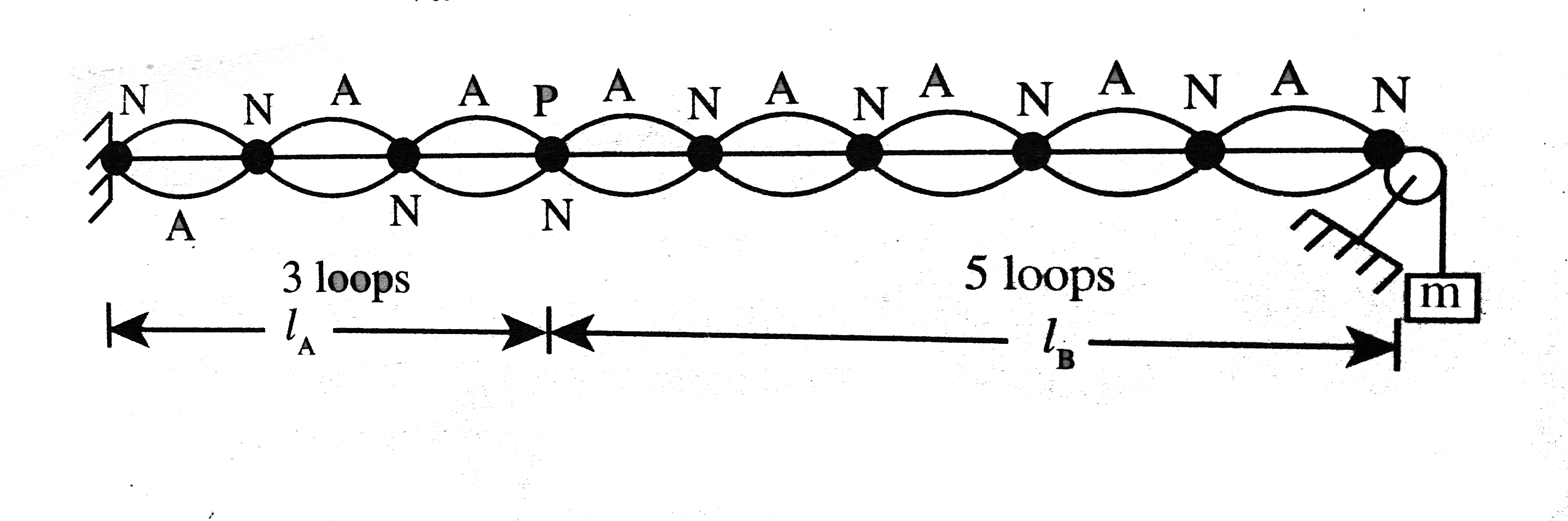
|
|
| 3. |
The pressure at the bottom of a liquid tank does not depends on ………….. . |
|
Answer» ACCELERATION DUE to GRAVITY |
|
| 5. |
An extensible string is wound over a rough pulley of mass M_(1) and radius R and a cylinder of mass M_(2) and radius R such that as the cylinder rolls down, the string unwounds over the pulley as well as the cylinder. The linear acceleration of cylinder M_(2) is (n(M_(1)+M_(2))g)/(3M_(1)+2M_(2)) where 'n' is |
|
Answer» |
|
| 6. |
A uniform rod AB of mass 3m and length 4l, which is free to turn in a vertical plane about a smooth horizontal axis through A, is released from rest when horizontal. When the rod first becomes vertical, a point C of the rod, where AC = 3l, strikes a fixed peg. Exerted by the peg on the rod if the rod is brought to rest by peg is x/3msqrt(3gl) where 'x' is |
|
Answer» |
|
| 7. |
The volume of a liquid (v) flowing per second through a cylindrical tube depends upon the pressure gradient (p//l) radius of the tube (r) coefficient of viscosity (eta) of the liquid by dimensional method the correct formula is |
|
Answer» <P>`V ALPHA (Pr^(4) ) /( ETA l) ` |
|
| 8. |
What is elasticity ? What is plastic body and plasticity? |
|
Answer» Solution :The property of a body by VIRTUE of which it tends to regain its ORIGINAL size and shape when the applied FORCE is removed is known as elasticity and the deformation caused is known as ELASTIC deformation. If you apply force to a LUMP of putty or mud they have no gross tendency to regain their previous shape and they get permanently deformed. Such substance are called plastic and this property is called plasticity. Putty and mud are close to ideal plastics. |
|
| 9. |
The potential energy U of a body u wil mass moving ill une dimensional conservative force field is given by U = x^2 - 4x +3. All units are in Sl. For situation mark out the correct statements(s) |
|
Answer» The body will perform simple harmonic motion about X = 2 units |
|
| 10. |
H calories of heat is required to increase the temperature of one mole of monoatomic gas from 20^@Cto 30^@Cat constant volume. The quantity of heat required to increase the temperature of 2 moles of a diatomic gas from 20^@C to 25^@Cis at constant volume is |
|
Answer» `(4H)/(3)` |
|
| 11. |
Calculate the amount of work done is blowing a soap bubble to a radius of 0.05m by blowing the soap solution which has a surface tension of 0.03Nm^(-2). |
|
Answer» Solution :Given `T=0.30Nm^(-1)` `r=0.05m` We know that W=(T) (surface area) SINCE soap bubble has two free surfaces `SA=2(4pir^(2))=8pir^(2)` Hence `W=T(8pir^(2))` i.e, `W=0.3 xx 8 xx 3.142 xx (0.05)^(2)` i.e, `W=1.88 xx 10^(-3)J` |
|
| 12. |
The natural angular frequency of a particle of mass 'm' attached to an ideal spring of force constant 'K' is |
|
Answer» `SQRT((K)/(m))` |
|
| 13. |
Which of the following is//are correct? |
|
Answer»
or `nu^(2) prop (t + 273)` (c ) `nu = sqrt(T//mu)` `:. nu prop sqrt(T)` or `nu^(2) prop T` (d) `f_(o) = (nu)/(2l)` or `(nu)/(4l)` `rArr f_(o) prop (1)/(l)` |
|
| 14. |
A solid sphere, a hollow sphere, a solid disc and a hollow cylinder are allowed to roll down a sufficiently rough inclined plane starting from rest. All have same mass and radius. |
|
Answer» <P> |
|
| 15. |
The distance travelled by a particle in n^(th) second is S_(n) = u + (a)/(2) (2n-1) where u is the velocity and a is the acceleration. The equation is |
|
Answer» dimensionally true |
|
| 16. |
A ball is thrown from the top of a tower of 61 m high with a velocity 24.4ms^(-1) at an elevation of 30^(@) above the horizon. What is the distance from the foot of the tower of the point wher the ball hits the ground? |
|
Answer» |
|
| 17. |
A particle is executing SHM on a straight line with zero initial phase. It crosses the point from where the time is considered for the motion at successive intervals t and 2t with a speed v . Find the amplitude of the motion: |
|
Answer» `2 VT` |
|
| 18. |
(i) A cylindrical container has area of cross section equal to 4A and it contains a non viscous liquid of density 2rho. A wooden cylinder of cross sectional area A and length L has density rho. It is held vertically with its lower surface touching the liquid. It is released from this position. Assume that the depth of the container is sufficient and the cylinder does not touch the bottom. (a) Find amplitude of oscillation of the wooden cylinder. (b) Find time period of its oscillation. Two cubical blocks of side length a and 2a are stuck symmetrically as shown in the figure. The combined block is floating in water with the bigger block just submerged completely. The block is pushed down a little and released. Find the time period of its oscillation. Neglect viscostiy. |
|
Answer» (ii) `3pi sqrt((2a)/(G))` |
|
| 19. |
The SI unit of power is |
|
Answer» Solution :Power = `("Work")/("Time")` The SI unit of power is `("joule")/("second")` = watt. |
|
| 20. |
Vibratory motion is also known as |
|
Answer» CIRCULAR MOTION |
|
| 21. |
Explain why (a) The blood pressure in humans is greater at the feet than at the brain (b) Atmospheric pressure at a height of about 6 km decreases to nealy half of its value at the sea level through the height of the atmosphere is more than 100 km (c) Hydrostatic pressrure is a scalar quantity even though pressure is force divided by area. |
|
Answer» Solution :The pressure of a liquid is given by the RELATION: `P = rhogh` Where, `P = Pressure` `h =` Height of the liquid column `rho =` Density of the liquid `g =` Acceleration due to the gravity It can be inferred that pressure is directly proportional to height. HENCE, the blood pressure in human vessels depends on the height of the blood column is the BODY. The height of the blood column is more at the feet than it is at the brain. Hence, the blood pressure at the feet is more than (b) Density of air is the maximum near the sea level. Density of air decreases with increases in height from the surface. At a height of about `6 km`, density decreases to nealy HALF of its value at the sea level. Atmospheric pressure is proportional to density. Hence, at a height of `6 km` from the surface, it decreases to nearly half of its value at the sea level. (c) When force is applied on a liquid, the pressure in the liquid is transmitted in all DIRECTIONS. Hence, hydrostatic pressure does not have a fixed direction and it is a scalar physical quantity. |
|
| 22. |
A spiral spring is stretched by a force the resultant strain produced in the spring is |
|
Answer» VOLUME strain |
|
| 23. |
Which of the following statement is correct but satellites ? |
|
Answer» A satellite cannot move in a stable orbit in a plane passing through the earth's CENTRE. So, orbital speed of satellite DECREASE with the increase in the radius of its orbit. We need more than one satellite for global communication. For stable orbit, satellite must pass through the centre of earth. Only (b) is a correct statement. |
|
| 24. |
What is the SI unit of surface tension ? |
| Answer» SOLUTION :`N.m^-1` | |
| 25. |
The frequency of oscillation of a mass m suspended by a spring is 'v'. If mass is cut to one fourth then what will be the frequency of oscillation? |
|
Answer» SOLUTION :The frequency of OSCILLATION of a mass suspended by a SPRING `V = (1)/(2pi) sqrt((k)/(m))` `therefore v propto (1)/(sqrt(m))` `therefore (v_2)/(v_1)= sqrt((m_1)/(m_2))= sqrt((m_1)/((m_1)/(4)))= sqrt(4) = 2` `therefore v_(2) = 2v""[therefore v_(1) = v]`. |
|
| 26. |
If the gravitational potential at the earth's surface is de What is the gravitational potential at a height from earth's surface equal to its radius? |
|
Answer» `phi_e/2` `phi = -(Gme)/r` - Gme is constant `:. Phi =1/r` `:. Phi_2/phi_1 =r_1/r_2` here `r_1 = R_e and phi_1 = phi_e and r_2 = 2R_e` `:.phi_2 = phi_e xx (R_e)/(2Re) = (phi_e)/2` |
|
| 27. |
State Wien's displacement law and mention the value of the Wien's constant. |
| Answer» SOLUTION :Thewavelenghtcorrespodingto themaximum ENERGYIS inverselyproportional to the Kelvintemperatureof the bodyi.e., ` lambda_(m) T` = constant (Wien.s constant) Thevalue of the Wien.sconstant`= 0.2892cm` .K | |
| 28. |
Define and illustrate the following terms.Parallel vectors, |
Answer» Solution :If TWO vectors `vec(A) and vec(B)`act in the same DIRECTION along the same line oron parallel lines , such that the ANGLE between them is`0^(@)` .
|
|
| 29. |
If a freely falling body covers half of its total distance in the last second of its journey, Find its time of fall. |
|
Answer» SOLUTION :Suppose t is the time of free fall. `H=(1)/(2)G t^(2)…….(1)` `(h)/(2)=(1)/(2)g(t-1)^(2)..........(2)` Solving 1, 2 `t=(2+sqrt(2))s` SINCE `2-sqrt(2)` is not ACCEPTABLE. |
|
| 30. |
A ball bounces to 80% of its original height. Calculate the mechanical energy lost in each bounce. |
|
Answer» Solution :LET Initial P.E.=MGH `"P.E. after first BOUNCE" =" mg"xx80% "of" h=0.80 mgh` P.E.lost in each bounce =0.20 mgh `therefore` FRACTION of P.E. lost in each bouce `=(0.20mgh)/(mgh)=0.20` |
|
| 31. |
One mole of an ideal monoatomic gas undergoes a process described by the equation PV^3 = constant. The heat capacity of the gas during this process is …….. |
|
Answer» 2R Heat capacity according to polytropic process formula, `[C=C_V+R/(1-x)]` `RARR` COMPARING `PV^3`= constant with `PV^x` = constant x=3 and for monoatomic GAS f=3 `therefore C_V=(FR)/2` Now `C=C_V+R/(1-x)` `therefore C=(fR)/2 + R/(1-x)` `=(3R)/2+R/(1-3) [because f=3, x=3]` `=(3R)/2-R/2` `therefore` C=R |
|
| 32. |
A wheel having radius 10cm is coupled by a belt to another wheel of radius 30cm. 1^(st) wheel increases its angular speed from rest at a uniform rate of 1.57 rads^(-2). The time for 2^(nd) wheel to reach a rotational speed of 100 rev/min is....(assume that the belt does not slip) |
|
Answer» 20 sec |
|
| 33. |
Which one of the following is not an assumption of kinetic theory of gases ? |
|
Answer» The force of attraction between the MOLECULES is negligible . |
|
| 34. |
Can a body have zero velocity and non-zero acceleration? |
| Answer» SOLUTION :YES. A body THROWN vertically upwards has-zero velocity at its highest POINT. But at the highest point it has an acceleration equal to acceleration DUE to gravity. | |
| 35. |
The value of atmosphere pressure is 10^(6) dynes/cm^(2). Find the value in S.I. using dimensional analysis? |
|
Answer» |
|
| 36. |
A body weighs 63 N on the surface of the earth. What is the gravitational force on it due to the earth at a height equal to half the radius of the earth ? |
|
Answer» Solution :`implies` Here `h = (R_E)/ 2` ACCELERATION DUE to gravity at height h from the surface of earth, `g(h) = g_e/((1+h/R_E)^2)` `= (g_e)/([1+(R_E/2)/(R_E)]^(-2))[:. h=R_E/2]` `=g_e/((1+1/2)^2)` `:. g(h) = 4/9 "ge"` WEIGHT on earth W = mg = 63 N Weight at a height EQUAL to half of radius of theearth `(h =(R_E)/2)` from the surface of earth. `W= mg (h) = 4/9 "mge"` `:. W. = 4/9 (63)[ :. mg_e = 63 N]` `:. W. = 28 N` |
|
| 37. |
The velocities of three particles of masses 20 g, 30 g and 50 g are 10hati, 10hatj and 10hatk respectively. The velocity of the centre of mass of the three particles is |
|
Answer» `2vec(i)+3vec(j)+5vec(K)` |
|
| 38. |
Two adjacent natural frequencies of an organ pipe are found to be550 Hz and 650 Hz. Calculate the fundamental frequency and length of this pipe .( Use v = 340 m//s.) |
|
Answer» Solution :These will be fairly high harmonics of the pipe , which we except to be long pipe for a bass note . We use the WAVE under boundary conditions model . We are not TOLD in advance whether the pipe is open at one end or at both ends , so we MUST think about possibilities . Because harmonic frequencies are given by `f_(1) n` for open pipe , and `f_(1) ( 2n - 1)` for closed pipes , the difference between adjacent harmonics is constant in both cases . Therefore , we can find each harmonic below `650 Hz` by subtracting `Delta f_( Harmonic) = ( 650 Hz - 550 Hz ) = 100 Hz` from the previous value. The harmonic frequencies are the set of the following values : ltbgt `650 Hz , 550 Hz , 450 Hz , 350 Hz , 250 Hz , 150 Hz, 150 Hz and 50 Hz` a. So the fundamental frequency , is `50 Hz`. b. The wavelength of the fundamental vibration can be calculated from the speed of sound as ` LAMBDA = (v)/(f) = ( 340 m//s)/( 50.0 Hz) = 6.80 m` Because the step size `Delta f` is twice the fundamental frequency . We know the pipe is closed , with an ANTINODE at the open end , and a node at the closed end . The wavelength in this situation is four times the pipe length , so ` L = (lambda)/( 4) = 1.70 m` The frequency `50 Hz is a G` in low register . The harmonics measured in the problem are the ` 11 th and the 13 th`, which can be perfectly observable as resonances using a function generator , a small loudspeaker , and your ear as detector .For some ranks of organ pipes , higher harmonics like these can be important contributors to a brassy or ringing sound quality . |
|
| 39. |
When a metal sphere is suspended at the end of a metal wire its extension is 0.4mm. If another metal sphere of the same material with its radius half as the previous is suspended then extension would be |
|
Answer» 0.05 MM |
|
| 40. |
The pressure inside two soap bubbles is 1.01 and 1.02 atmosphers respectively. The ratio of their volumes is (atmospheric pressure = 10^(5)Pa) |
|
Answer» `1:2` |
|
| 41. |
An air column in a pipe which is closed at one end, will be in response with the vibrating body of frequency 83 Hz. Then the length of the air column is |
|
Answer» 1.5 m Frequency , f `= (v)/(LAMBDA)` `83 = (v)/(lambda)` For air column in a pipe CLOSED at one end , `l_(1) = (lambda)/(4) implies = 4 l_(1)` `therefore 83 = (v)/(4l_(1))` VELOCITY of sound in air = `v = 343 ms^(-1)` `83 = (343)/(4l_(1))` `therefore = (343)/(332) = 1.033` m |
|
| 42. |
A sound wave is transmitted into a tube as shown in figure. The sound wave splits into two waves at the point A which recombine at point B. Let R be the radius of the semicircle which is varied until the first minimu. Calculate the radius of the semi-circle if the wavelenght of the sound is 50.0 m |
|
Answer» <P> Solution :The sound travelling in the curved path DISTANCE = `pi R``L_(1) = pi R` The sound travelling in the straight path distance = 2 R  The path distance of straight and curved path `DeltaP = L_(1) - L_(2) "" …… (1)` The DIFFERENT in the path length of thesound WAVES , `Delta P = (lambda)/(2) "" .... (2)` Equating (1) and (2) , `(lambda)/(2) = R(pi - 2) , lambda = 50 m` `R = (lambda)/(2 (pi - 2)) = (50)/(2 (3.14 - 2)) = (50)/(2.28)` `R = 21.9` m |
|
| 43. |
A small glass marble is put on a smooth gramophone disc. When the disc starts rotating, the marble flies off the disc. Explain why. |
| Answer» Solution :When the disc starts rotating, the marble flies off because the FRICTIONAL force between the SURFACE of the GRAMOPHONE disc and the marble cannot provide the NECESSARY centripetal force required by the marble for its revolution. | |
| 44. |
What are the resultants of the vector product of two given vectors given byvec(A) = 4 hat(i) - 2 hat(j) + hat(k) and brc(B) = 5 hat(i) + hat(j) - 4 hat(k)? |
|
Answer» SOLUTION :`vec(A) = 4hat(i) - 2 hat(j) + hat(K)` `vec(B) = 5 hat(i) + 3 hat(j) - 4 hat(k)` `vec(A) xx vec(B) = |{:(i," "j,k),(4,-2,1),(5," "3,-4):}|` `= i (8 - 3) + j [ 5 - (-16)]+ k [ 12- (-10)]` `= 5 hat(i) + 21hat(j) + 22 hat(k)` |
|
| 45. |
Brakes are applied to a car moving with disengaged engine, bringing it to a halt after 2s. Its velocity at the moment when the breaks are applied if the coefficient of friction between the road and the tyres is 0.4 is |
|
Answer» `3.92 MS^(-1)` |
|
| 46. |
Define Thermal equilibrium . State the zeroth law of thermodynamics (or) How does it lead to zeroth Law of Thermodynamics ? |
| Answer» Solution :ZEROTH law of thermodynamics : If two BODIES or two systems say A and B are individually in thermal EQUILIBRIUM with a third body or system say .C., then A and B are also in thermal equilibrium with each other. | |
| 47. |
The fundamental frequency of a closes organ pipe of length 20 cm is equal to the second overtone of an organ pipe open at both the ends. The length of the organ pipe open at both the ends is …….. . |
| Answer» Solution :`(v)/(4 L_("CLOSED")) = (3v)/(2 L_("open")) implies L_("open") = 6 L_("closed") = 120 ` cm | |
| 49. |
An aeroplane fles a straight path from town (A) to townB, 500 km way . Town (B) is due East ot town (A) and a strong with blows from South to North at 1 300 km//h. Tf the lanes air speed is900 km//h. Which of following statements is true ? |
|
Answer» Trip time is ` 5 /6 sqrt 5 ) hour` 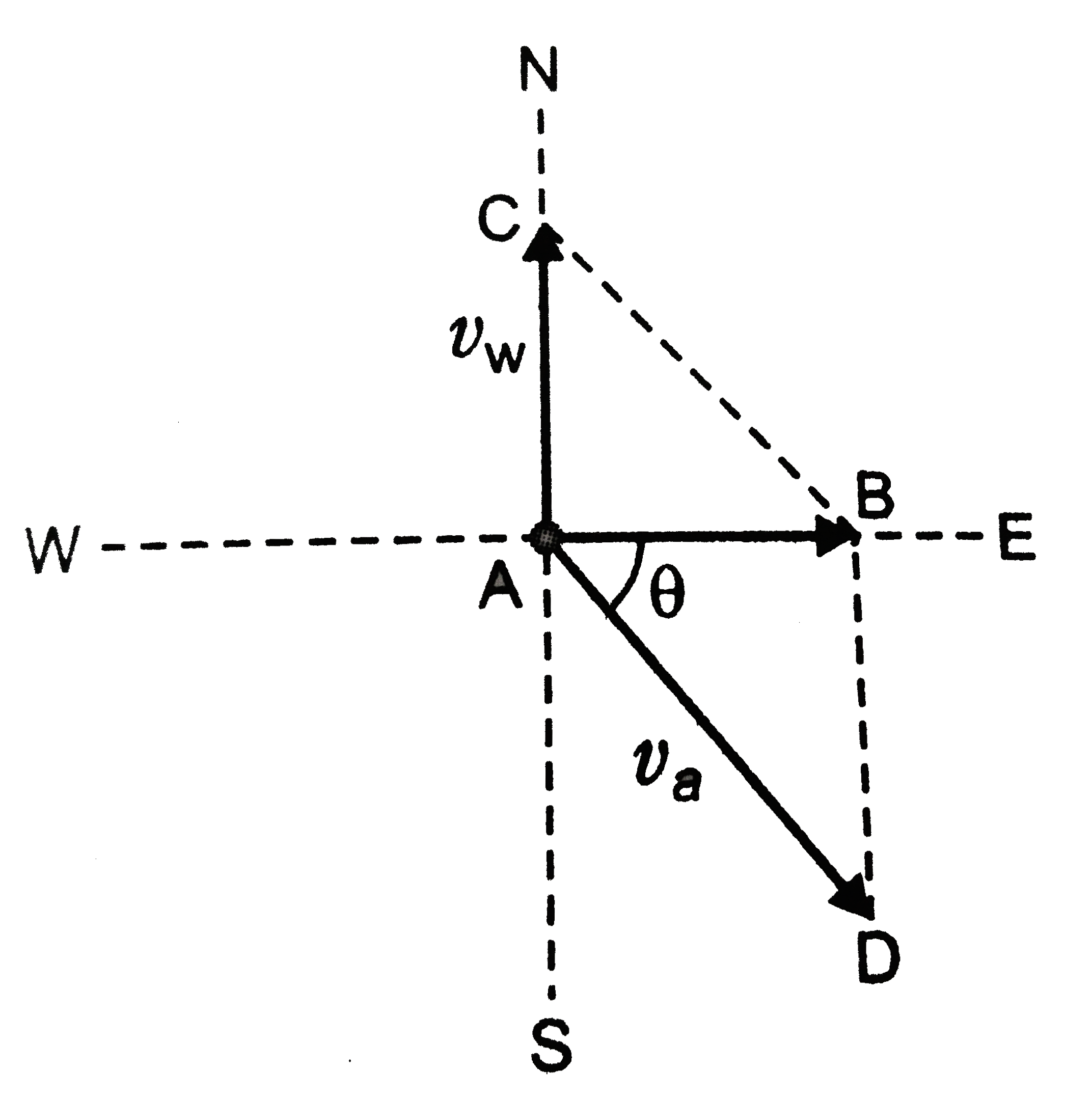 . VELOCITY of WIND , ` v_w = 300 km//h` along ` AC`. The air plane can fly a st. path `AB` if the resultant velocity of aeroplane and with acts along ` AB`. It will be so it the velocity of aeroplane is represented by ` AD`. V elocity along ` AB, ` v= sqrt (v_a^2 -v_w^2)` ` = sqrt ( 900^2 - 300 ^2 ) = sqrt ( 7200 ) = 600 sqr 2 km//h` Time taken to reach ` B, t= S/v = ( 500 km )/(600 sqrt 2 km/h)` ` 5/( 6 sqrt 2)` ` sin theta = v_w /v_a = (300)/( 900) = 1/3 = 0 3333 = sin 19^2 28'` ` theta= 19^@ 28'` ` theta 19^@ 28' Suoth of East . |
|
| 50. |
Four particles each of mass .m. are located at the four corners of a square of side a. If the system is revolving in a circle due to their mutual force of attractions then the angular velocity and time period of each particle is |
Answer» Solution : From the FIG. `r=a//SQRT2` The resultant GRAVITATIONAL force on ONE of the particles `F_R=sqrt2(Gm^2)/a^2 + (Gm^2)/(2a^2)` This gravitational force provides the NECESSARY centripetal force `mromega^2 =(Gm)/a^2(sqrt2+1/2) rArr` `a/sqrt2 omega^2 =(Gm)/a^2((2sqrt2+1)/2) rArr omega=sqrt((Gm)/a^3(2+1/sqrt2))` `T=(2pi)/omega =2pi sqrt(a^3/(Gm)(sqrt2/(2sqrt2+1)))` |
|


