

Saved Bookmarks
This section includes 7 InterviewSolutions, each offering curated multiple-choice questions to sharpen your Current Affairs knowledge and support exam preparation. Choose a topic below to get started.
| 1. |
A rain drop of radius 2mm falls from a height of 500 m above the ground. It falls with decreasing acceleration (due to viscous resistance of the air) until at half its original height, it attains its maximum (terminal) speed, and moves with uniform speed thereafter. What is the work done by the gravitational force on the drop in the first and second half of its speed on reaching the ground is 10 ms^(-1)? |
| Answer» SOLUTION :`0.082 J` in each HALF , `-0.163 J` | |
| 2. |
Why is it impossible for a ship to use the internal energy of sea water to operate its engine? |
| Answer» Solution :No. For the normal WORKING of heat engine there must be SINK. In this CASE there is no sink to reject the heat which is not used for doing WORK. | |
| 3. |
The size of the needle of a syringe controls flow rate better than the thumb pressure exerted by a doctor while administering an injection |
|
Answer» <P> Solution :For a constant height , the Bernoulli.s theorem is expressed as `P+(1)/(2)rhov^(2)` = constantHere , pressure occurs with a SINGLE power whereas the velocity occurs with a square power . Therefore , the velocity has more effect compared to the pressure . It is for this reason that needle of the syringe CONTROLS flow rate BETTER. |
|
| 4. |
The dimensions of Young's modulus of elasticity is |
|
Answer» `ML^(2)T^(-2)` |
|
| 5. |
A particle is projected from the ground with an initial speed of v at an angle of projection theta. The average velocity of the particle between its time of projection and time it reaches highest point of trajectory is |
|
Answer» `v/2 SQRT(1+ 2 COS^2 theta)` |
|
| 6. |
The equation of state for n moles of an idea gas is PV=nRT. Where R is the universal contant. The dimension of R is |
|
Answer» `M^(0)LT^(-2)K^(-1)mol^(-1)` Dimensionally, `ML^(2)T^(-2)K^(-1)mol^(-1)` |
|
| 7. |
The power for a hoverting helocipter depends on its linear size, the density of air and (gxx"density of the helicopeter)as Power"oo("linear size")^(x)("density of air")^(y)(gxx"density of helicopter")^(z) where g is acceleration due to gravity. Given ,[Power] =ML^(2)T^(-3),[Linear size]=L'[Density]=ML^(-3) The ratio of power output of engines of two helicopters is one fourth of linear size of other and all other parameters remaining same is |
|
Answer» 132 |
|
| 8. |
The power for a hoverting helocipter depends on its linear size, the density of air and (gxx"density of the helicopeter)as Power"oo("linear size")^(x)("density of air")^(y)(gxx"density of helicopter")^(z) where g is acceleration due to gravity. Given ,[Power] =ML^(2)T^(-3),[Linear size]=L'[Density]=ML^(-3) The value of x in the abvoe expressionis |
|
Answer» `1/2` |
|
| 9. |
The power for a hoverting helocipter depends on its linear size, the density of air and (gxx"density of the helicopeter)as Power"oo("linear size")^(x)("density of air")^(y)(gxx"density of helicopter")^(z) where g is acceleration due to gravity. Given ,[Power] =ML^(2)T^(-3),[Linear size]=L'[Density]=ML^(-3) The value foin above expression is |
|
Answer» `1/2` |
|
| 10. |
Define the following: Loss of kinetic energy in inelastic collision |
|
Answer» Solution :The LOSS in kinetic energy during collision is transformed to another form of energy LIKE SOUND, thermal, heat, light etc. Loss of KE = `[(KE_(f))-(KE_(i))]` |
|
| 11. |
A body is moving at constant speed over a frictionless surface. What is the work done by the weight? |
| Answer» Solution :WORK done by the weight is zero, since the FORCE and DISPLACEMENT are at right ANGLES to each other. | |
| 12. |
A Saturn year is 29.5 times the earth year. How far is the Saturn from the sun if the earth is 1.5xx10^8 km away from the sun? |
|
Answer» SOLUTION :Given that `T_8 = 29.5 T_e` and `R_e = 1.5 xx 10^8 Km` ACCORDING to kepler.s third law , we can write `T^2 PROP R^3` ` = (T_s/T_e)^2 = (R_s/R_e)^3 rArr R_s = R_e (T_s/T_e)^(2//3)` ` rArr R_s = 1.5 xx 10^8 ((19.5T_e)/(T_e))^(2//3) rArr R_s = 1.43 xx 10^9 km` |
|
| 13. |
A hemispherical cup of radius r with its centre of gravity at C distant c from its centre rests on the top of a spherical surface of radius R as shown in figure 6.15 .Assuming that there is sufficient friction to prevent slipping , establish the criterion of stablility of the cup in the position shown. |
|
Answer» |
|
| 14. |
In Ingen Hauz experiment the wax melts up to 5 cm and 10 cm on bars A and B, respectively. The ratio of the thermal conductivites of A and B is |
|
Answer» `1:2` |
|
| 15. |
Explainpressure measuring device at any point in fluid in short. |
Answer» SOLUTION :An idealized form of pressure -measuring device is shown in the figure . It consists of an EVACUATED CHAMBER with a spring that is calibrated to measure the force acting on the piston. This device is placed at a point inside the fluid. The inward force exerted by the fluid on the piston is balanced by the OUTWARD spring force and is thereby measured . The force `DeltaF` acting on the surface of the piston then pressure of fluid `P=(DeltaF)/(DeltaA)` The piston area can be made arbitraaily small . The pressure is then DEFINED in a limiting sense as `P=underset(DeltaAto0)(lim)(DeltaF)/(DeltaA)` |
|
| 16. |
A uniform block of mass M and dimensions as shown in the figure is placed on a rough horizontal surface and given a velocity V_(0)to the right. A is a point on the surface to the left of the block. (a) Write the angular momentum of the block about point A just after it begins to move (b) Due to friction the block stops. What happened to its angular momentum about point A? Which torque is responsible for change in angular momentum of the block? |
|
Answer» (b)NORMAL reaction produces a TORQUE |
|
| 17. |
A wheel of radius 0.4 m can rotated freely about its axis as shown in the figure. A string is wrapped over its rim and a mass of 4 kg is hung, An angular acceleration of 8" rad - s"^(-2) is produced in it due to the torque. Then moment inertia of the wheel is (g=10" ms"^(-2)) |
|
Answer» `2" KG - m"^(2)` |
|
| 18. |
Consider the pervious situation with V_(R) gt V_(bR) Let V_(R)=V_(1):V_(bR)=V_(2)For this given situation the person |
|
Answer» Can never reach the EXACTLY opposite point A by swim. |
|
| 19. |
A body projected from the top of a tower with a velocity vec(u) = 3hat(i) + 4hat(j) + 5hat(k) ms^(-1). Where hat(i), hat(j) and hat(k) are unit vectors along east, north and vertically upwards respectively. If the height of the tower is 30m, horizontal range of the body on the ground is (g = 10 ms^(-2)) |
|
Answer» 12m |
|
| 20. |
The work done by external agent in stretching a spring of force constant k from length l_1 to l_2is |
|
Answer» `K (l_2^2 - l_1^2)` |
|
| 21. |
Two bodies of masses m_(1)and m_2 (m_1 gt m_2) respectively are tied to the ends jof a string which passes over a light frictionless pulley. The masses are intitially at rest and released. What is the acceleration of the centre of mass ? |
|
Answer» |
|
| 22. |
A vessel is containing a liquid. A hole is made at a depth to the side wall of the vessel. The rate of flow of liquid is V. If size (area) of the hole is doubled |
|
Answer» VELOCITY of EFFLUX is doubled but RATE of flow is halved |
|
| 23. |
The radius of the earth is 4 times that of the moon and its mass is 80 times that of the moon. If the acceleration due to gravity on the surface of the earth is 10m//s^2that on the surface of the moon will be ......... |
|
Answer» ` 1ms^(-2)` on MOON `g_m =(GM_m)/(R_m^2)` `:. g_m/(g_e)=(M_m)/(M_e)xx((R_e)/R_m)^2` `=(1/8)(4)^2` ` :. (gm) /10 =1/5` `:. g_m = 2ms ^(-2)` |
|
| 24. |
The load verses elongation graph for four wires of the same material is shown in figure which of the wire is thickest |
|
Answer» A |
|
| 25. |
A reference frame attached to the earth a) is an inertial frame by definition b) can not be an inertial frame because the earth is revolving around the sun c) is an inertial frame because Newton's laws are applicable in this frame d) cannot be an inertial frame because the earth is rotating about its axis |
|
Answer» 1, 2, 3 are CORRECT |
|
| 26. |
A stone is dropped from a height h. Simultaneously another stone is thrown up from the ground with such a velocity that it can reach a height of 4h. The time when two stones cross each other is sqrt(((h)/(kg))) where k is |
|
Answer» |
|
| 27. |
One string wave is given by y (x,y) =0.1 sin {pi(5x-2t)} with all the values in SI units. Find (a) amplitude (b) wave length (c ) periodic time, frequency and displacement of this wave at x=3 m and t=2s. |
|
Answer» Solution :Given `y=0.1 sin (5pi x -2pit)` We have `y=a sin (kx - omega t)` COMPARISON gives: (a) AMPLITUDE `a =0.1 m` (b) `k = 5pi (RAD)/(m) implies (2pi)/(lamda) = 5pi implies lamda = 0.4m` (c ) `omega =2pi (rad)/(s) implies (2pi)/(T) = 2pi implies T=1 s` `f = 1/T=1/1 =1 Hz` `y =0.1 sin {(5x xx 3) -(2pi xx 2)}` `=0.1 sin (11pi) =0.1 sin (10 pi+pi)` `THEREFORE y =0.1 sin pi =0""(because sin pi =0)` |
|
| 28. |
(A) In multiplication or division, the final result should retain only that many significant figures as are there in the original number with the least number of significant figures. (B) In addition or subtraction the final result should retain only that many decimal places as are there in the number with the least number of decimal places |
|
Answer» only A is correct |
|
| 29. |
A round uniform body of radius R , mass M and moment of inertia I rolls down (without slipping ) an inclined plane making an angle theta with the horizontal. Then what will be its acceleration ? |
|
Answer» |
|
| 30. |
In image formation from spherical mirrors, only paraxial rays are considered because they |
|
Answer» are EASY to handle geometrically |
|
| 31. |
Given an example for a mechanical wave. |
| Answer» SOLUTION :SOUND WAVE is a MECHANICAL WAVES. | |
| 32. |
If vec(B) = n vec(A) and vec(A) is anti parallel with vec(B), then n is: |
|
Answer» a vector |
|
| 33. |
The power radiated by a black body is P and it radiates maximum energy around the wavelength lambda_(0). Now the temperature of the black body is changed so that it radiates maximum energy around wavelength lambda_(0)//2. The power radiated by it will now increase by a factor of |
|
Answer» 2 |
|
| 34. |
A simple pendulum have time periods .T. and 5T/4. They start vibrating at the same instant from the mean position in the same phase. The phase difference between them when the pendulum with higher time period completes one oscillations is |
|
Answer» `30^(@)` |
|
| 35. |
(A) : The centre of mass of system of n particles is the weight average of the position vector of the n particles making up the system. (R ) : The position of the centre of mass of a system is independent of co-ordinate system. |
|
Answer» Both (A) and (R ) are true and (R ) is the CORRECT EXPLANATION of (A) |
|
| 36. |
A space - ship is launched into a circular orbit close to the earth.s surface. What additional velocity should now be imparted to the space - ship in the orbit to overcome the gravitational pull. [Radius of earth = 6400 km and g=9.8 m//s^2 ] |
| Answer» Solution :Additional velocity to be IMPARTED to the ORBITING SATELLITE for ESCAPING = `V_e-V_0`=11.2-8 =3.2 km/s | |
| 37. |
What is the mass of the goods that must be put on the piston so that the volume of the gas becomes halved? |
|
Answer» 56 kg `RARR P = 2P=8 xx 10^5 = P_0 +(MG+MG)/(S_0)` `7xx 10^5 xx 20 xx 10 ^-4 - 600 = Mg` `rArrM = 80 kg` |
|
| 38. |
Viscous force on small sphere of radius R moving in fluid varies as |
|
Answer» `R^2` |
|
| 39. |
Statement-A: AN engine A can perform a given work in 1hr and engine B can perform the same work in ½ hr. then B has greater power than A. Statement B: Power is the dot product of force and velocity |
|
Answer» A & B is CORRECT |
|
| 40. |
If the work done in blowing a soap bubble of volume 'V' is W, then the work done in blowing a soap bubble of volume '2V' is |
|
Answer» |
|
| 41. |
A uniform rod is 4m long and weighs 10kg. If it is supported on a knife edge at one metre from the end, what weight placed at that end keeps the rod horizontal ? |
| Answer» ANSWER :B | |
| 42. |
A person of mass 70 kg wants to lose 5 kg by going up and down a 10 m high stairs. He burns twice as much fat while going up than coming down. If 1 kg is burnt on expending 7000 kilocalories, the number of times he must go up and down to reduce his weight by 4 kg is |
|
Answer» 1000 |
|
| 43. |
vecA=3hati+2hatj and vecB=hati+hatj-2hatk" in "vecA-vecB magnitude of y-component will be …... . |
|
Answer» |
|
| 44. |
10^(3)(g)/(cm^(3))=,,(kg)/(m^(3)) |
|
Answer» `10^(6)` `=(10^(3)xx10^(-3))/(10^(-6))=10^(6)(kg)/(m^(3))` |
|
| 45. |
An optician while testing the eyes finds the vision of a patient to be 6/12. By this means that |
|
Answer» The person can read the letters of 6 INCHES from a distance of 12m |
|
| 46. |
Assertion : The length of a cylinder is 23.8 cm. In this measurement there are three significant figures. Reason : The same length when expressed in millimeter as 23800 mm has four significant figures. Which of the following is correct? |
|
Answer» Assertion is TRUE and reason is true. |
|
| 47. |
Consider a particle moving along x-axis. Its distance from origin O is described by the co-ordinate x which varies with time. At a time t_(1), the particle is at point P, where its co-ordinate is x_(1) and at time t_(2), the particle is at point Q, where its co-ordinate is x_(2). The displacement during the time interval from t_(1) to t_(2) is the vector from P to Q, the x-component of this vector is (x_(2) - x_(1)) and all other components are zero. It is convenient to represent the quantity x_(2) - x_(1) the change in x by means of a notation Delta, thus Delta x = x_(2) - x_(1) and Delta t = t_(2) - t_(1). The average velocity bar(V) = (x_(2) - x_(1))/(t_(2) - t_(1)) = (Delta x)/(Delta t) A particle moves according to the equation x = t^(2) + 3t + 4. The average velocity in the first 5 s is: |
|
Answer» 8 m/s `x_(1) = 4` `x_(2) = 44` `v_(av) = ((x_(2) - x_(1))/(DELTA T))` |
|
| 48. |
Consider a particle moving along x-axis. Its distance from origin O is described by the co-ordinate x which varies with time. At a time t_(1), the particle is at point P, where its co-ordinate is x_(1) and at time t_(2), the particle is at point Q, where its co-ordinate is x_(2). The displacement during the time interval from t_(1) to t_(2) is the vector from P to Q, the x-component of this vector is (x_(2) - x_(1)) and all other components are zero. It is convenient to represent the quantity x_(2) - x_(1) the change in x by means of a notation Delta, thus Delta x = x_(2) - x_(1) and Delta t = t_(2) - t_(1). The average velocity bar(V) = (x_(2) - x_(1))/(t_(2) - t_(1)) = (Delta x)/(Delta t) The resistive force suffered by a motor boat is proportional to v^(2), where v is instantaneous velocity. The engine was shut down when the velocity of the boat was v_(0). Find the average velocity at any time t. |
|
Answer» `(v_(0) + v)/(2)` `F = -Kv^(2)` `m (dv)/(dt)` or `mv (dv)/(DS) = - kv^(2)` `rArr v (dv)/(dt) = - cv^(2)` `rArr int_(v_(0))^(v) (dv)/(v) = - C int_(0)^(s) ds` |
|
| 49. |
Consider a particle moving along x-axis. Its distance from origin O is described by the co-ordinate x which varies with time. At a time t_(1), the particle is at point P, where its co-ordinate is x_(1) and at time t_(2), the particle is at point Q, where its co-ordinate is x_(2). The displacement during the time interval from t_(1) to t_(2) is the vector from P to Q, the x-component of this vector is (x_(2) - x_(1)) and all other components are zero. It is convenient to represent the quantity x_(2) - x_(1) the change in x by means of a notation Delta, thus Delta x = x_(2) - x_(1) and Delta t = t_(2) - t_(1). The average velocity bar(V) = (x_(2) - x_(1))/(t_(2) - t_(1)) = (Delta x)/(Delta t) A particle moves half the time of its journey with u. The rest of the half time it moves with two velocities v_(1) and v_(2) such that half the distance it covers with v_(1) and the other half with v_(2). The net average velocity is: (Assume straight line motion) |
|
Answer» `(u (v_(1) + v_(2)) + 2 v_(1) v_(2))/(2 (v_(1) + v_(2)))` `s_(1) = u xx (T)/(2)` `(s_(2))/(2) = v_(1) xx t_(1)` and `(s_(2))/(2) = v_(2) xx t_(2)` where `t_(1) + t_(2) = (T)/(2)` Av. Velocity `= ("Total DISTANCE")/("Total time")` `= ((s_(1) + s_(2))/(T))` 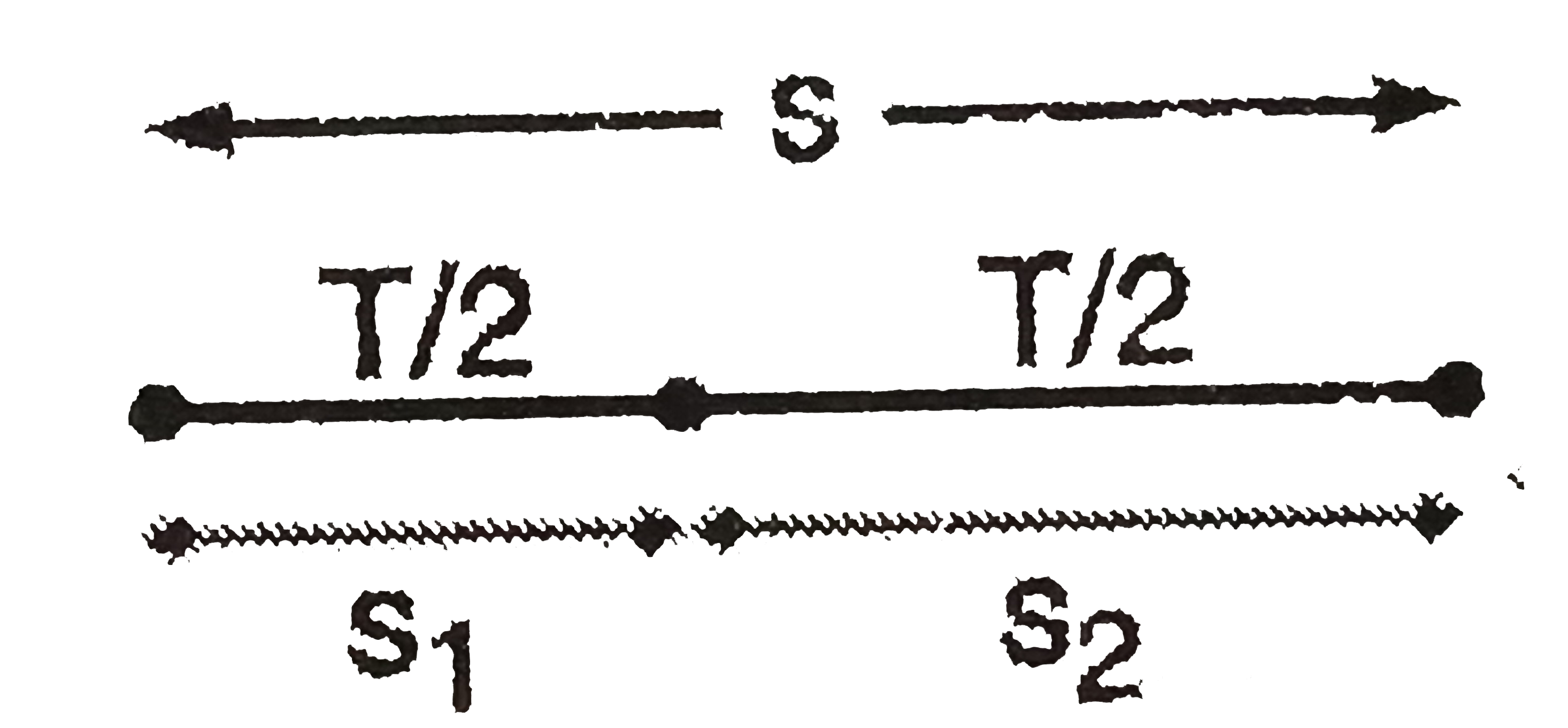
|
|
| 50. |
[J. m^(-3)] may be the unit of |
|
Answer» Strain energy DENSITY |
|