Saved Bookmarks
This section includes 7 InterviewSolutions, each offering curated multiple-choice questions to sharpen your Current Affairs knowledge and support exam preparation. Choose a topic below to get started.
| 1. |
If the average velocity of a body moving with uniform acceleration under the action of a force is "v" and the impulse it receives during a displacement of "s" is "I", the constant force acting on the body is given by |
|
Answer» `(I XX v)/(2S)` |
|
| 2. |
An ideal liquid is flowing in a cylindrical tube of internal diameter 4 cm with a velocity of 5 ms^(-1). If this tube is connected to another tube of internal diameter 2 cm, then the velocity of the liquid in the second tube will be ? |
|
Answer» Solution :According to the equation of continuity `a_2v_2 = a_1v_1 , d_2^2 v_2 = d_1^2v_1` `v_2 = ((d_1)/(d_2))^(2) xx v_1 = (4/2)^2 xx 5` `v_2 = 20 MS^(-1)`. |
|
| 3. |
"The weak nuclear force is stronger than gravitational force''. State whether this statement is True or False. |
|
Answer» |
|
| 4. |
Discuss the effect of (i) Density (ii) humidity on the velocity of sound in gases? |
|
Answer» Solution :(i) Effect of density: Let us consider two gases with DIFFERENT denisties having same temperature and pressure. Then the SPEED of sound in the two gases are `v_(1)=sqrt((gamma_(1)P)/(rho_(1)))""......(1)` and `v_(2)=sqrt((gamma_(2)P)/(rho_(2)))"".....(2)` Taking ratio of equation (1) and (2), we get `(v_(1))/(v_(2))=sqrt((gamma_(1)P)/(rho_(1)))/(sqrt((gamma_(2)P)/(rho_(2))))=sqrt((gamma_(1)P_(2))/(gamma_(2)rho_(1)))` For gases having same value of `gamma`, `(v_(1))/(v_(2))=sqrt((rho_(2))/(rho_(2)))"".....(3)` Thus the velocity of sound in a gas is inversely proportional to the square root of the density of the gas. (II) Effect of moisture (humidity): We know that density of moist air is 0.625 of that of dry air that means the presence of moisture in air (INCREASE in humidity) DECREASES its density. Hence speed of sound increases with rise in humidity. `v=sqrt((gammaP)/(rho))` Let `rho_(1),v_(1)andrho_(2),v_(2)` be the density and speeds of sound in dry air and moist air, respectively. Then `(v_(1))/(v_(2))=sqrt((gamma_(1)P)/(rho_(1)))/(sqrt((gamma_(2)P)/(rho_(2))))=sqrt((rho_(2))/(rho_(1)))` if `gamma_(1)=gamma_(2)` Since P is the total atmospheric pressure, it can be shown that `(rho_(2))/(rho_(1))=(P)/(p_(1)+0.625p_(2))` where `p_(1)andp_(2)` are the partial pressures of dry air and water vapour respectively. Then `v_(1)=v_(2)sqrt((P)/(p_(1)+0.625p_(2)))` |
|
| 5. |
Two planets of radii r_1 and r_2are made from the same material. The ratio of the acceleration due to gravities at the surface of the two planets is |
|
Answer» `r_1/r_2` |
|
| 6. |
If a car and a scooter have the same momentum, then which one is having greater speed? |
| Answer» Solution :scooter | |
| 7. |
The displacement of a progressive wave is represented by y= A sin (omegat-kx) where x is distance and t is time. Write the dimensional formula of (i) w and (ii) k. |
|
Answer» Solution :Now [LHS]= [RHS] `[y]=[A]=L` because `OMEGAT- KX` is DIMENSIONLESS, `[kx]=M^(0)L^(0)T^(0) "" :. [omega t]=M^(0)L^(0)T^(0)` `:. [K]L=M^(0)L^(0)T^(0) "" :. [omega]T=M^(0)L^(0)T^(0)` `:. [k]=L^(-1) "" :. [omega]=T^(-)` |
|
| 8. |
A block is gently placed on a conveyor belt moving horizontally with constant speed. After t = 4s, the velocity of the block becomes equal to the velocity of the belt. If the coefficient of friction between the block and the belt is mu = 0.2, then the velocity of the conveyor belt is |
|
Answer» `2ms^(-1)` |
|
| 9. |
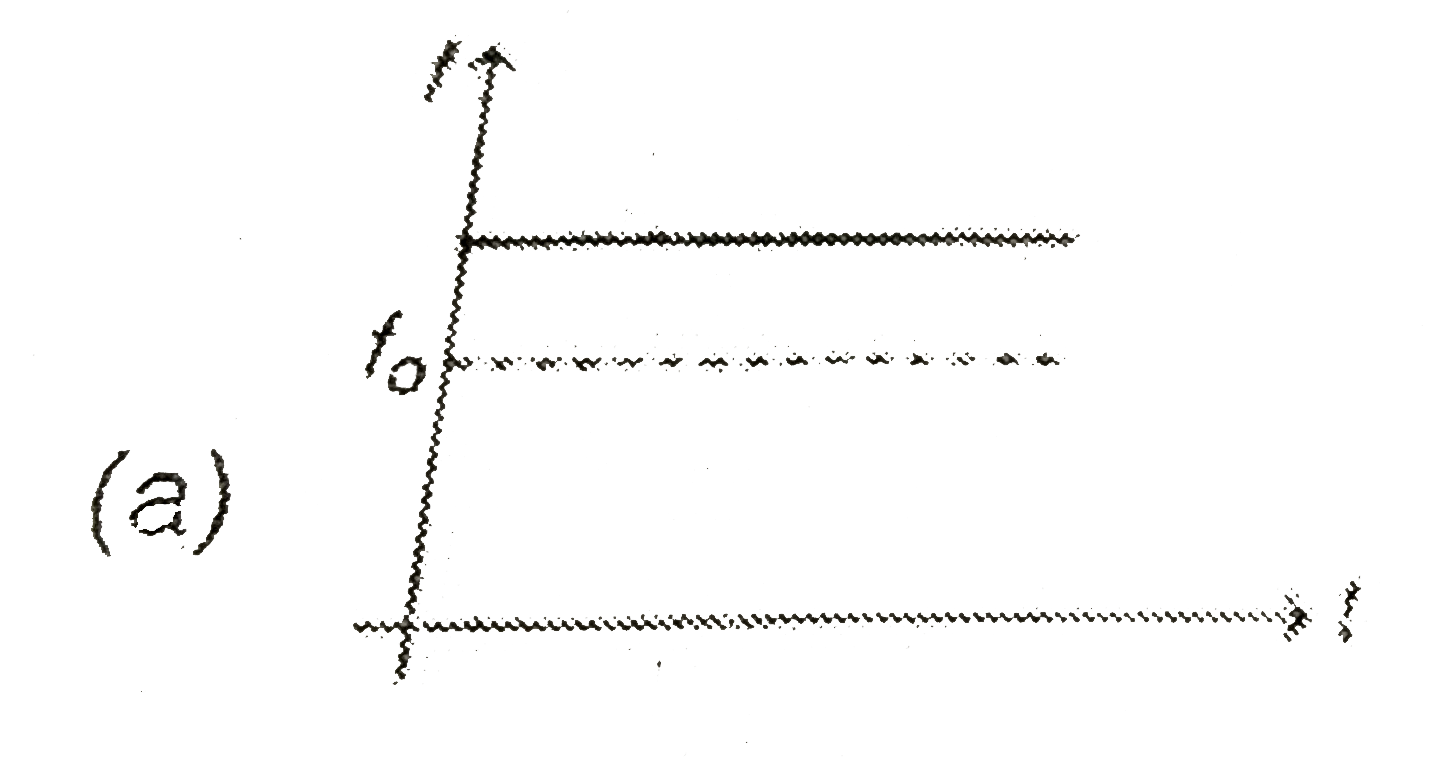
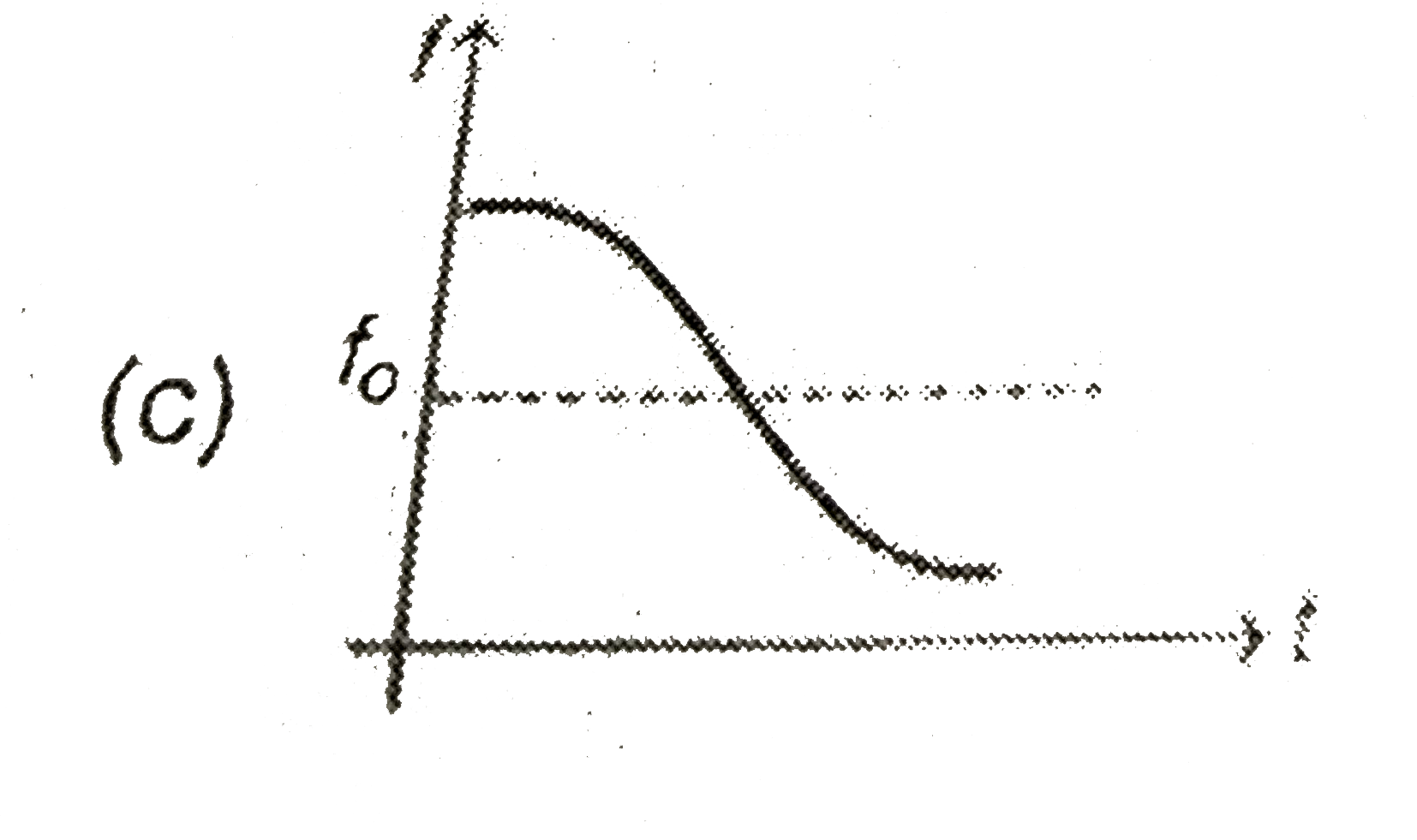
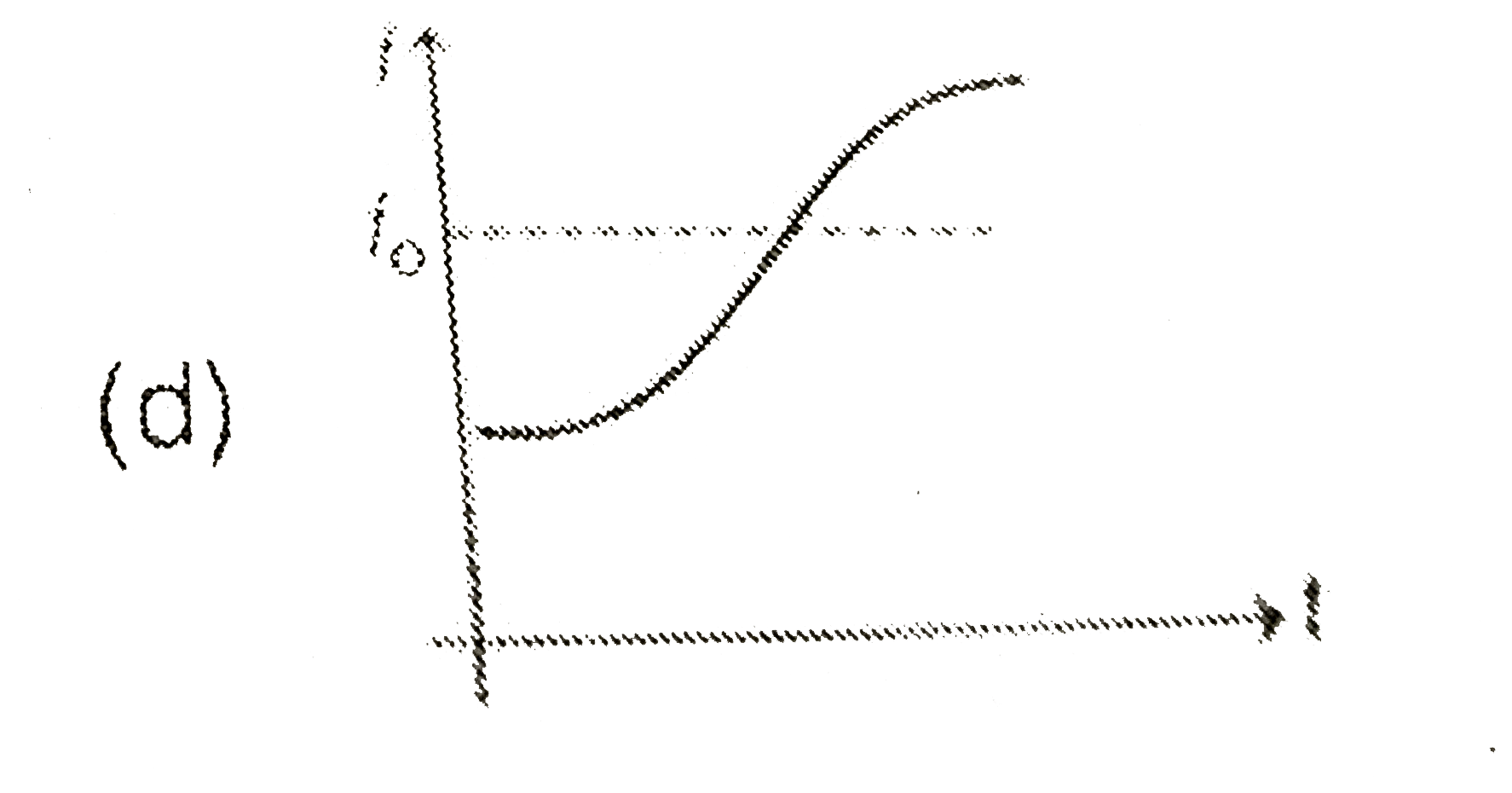
source and observer both start moving simultaneously from origion one along y - axis with speed of source = 2 (speed of observer ). The graph between the apparent frequency observed by observer (f) and time (t) would be |
|
Answer»
|
|
| 10. |
Elongation of an elastic material is very low. What should be the shape of a body for which the longitudinal strain will be appreciable? |
|
Answer» a thinbut long wire |
|
| 11. |
A wooden box lying at rest on an inclined surface of a wet wood is held at static equilibrium by a constant force vec(F) applied perpendicular to the incline. If the mass of the box is 1kg, the angle of inclination is 30^(@) and the coefficient of static friction between the box and the inclined plane is 0.2, the minimum magnitude of vec(F) is (Use g=10m//s^(2)) |
|
Answer» 0 N, as `30^(@)` is LESS than ANGLE of repose |
|
| 12. |
(A) : When a body is dropped or thrown horizontally from the same height, it would reach the ground at the same time. ( R) : Horizontal velocity has no effect on the vertical direction. |
|
Answer» Both (A) and ( R) are TURE and ( R) is the correct explanation of (A) |
|
| 13. |
A particle of mass 120 g moving at speed of 750 cm/s is acted upon by a variable force opposite to its direction of motion. If the velocity of the particle becomes 250 cm/s along the direction of force, find the value of time 't' for which force acted. |
|
Answer» Solution :AREA of FT GRAPH = Impulse = change in MOMENTUM `(1)/(2)(t+6)xx10^(-2)xx10` `= 120xx10^(-3)(7.5+2.5)` `therefore t=18 s` 
|
|
| 14. |
A body is projected with velocity 24 ms^(-1) making an angle 30^(@) with the horizontal. The vertical component of itsvelocity after 2s is (g = 10 ms^(-1)) |
|
Answer» `8 MS^(-1)` UPWARD |
|
| 15. |
Four pairs of initial and final position of a body along an x-axis are given. Which pair gives a positive displacement of the body? |
|
Answer» -10M, +15m |
|
| 16. |
Two bodies are thrownatangles theta and (90- theta ) from the same point with same velocity 25ms^(-1). If the difference between their maximum heights is 15m, the respective maximum heights are (g=10 ms^(-2)) |
|
Answer» `(185)/(8)m` and `(65)/(8)m` |
|
| 17. |
A man carries a load of 50 kg to a height of 40 m in 25 s. If the power of the man is 1568 W, the mass of the man is, |
| Answer» Answer :B | |
| 18. |
On what factors does the value of angle of contact depend ? |
|
Answer» Solution :The ANGLE of contact depend on FOLLOWING factors : (1) The nature of liquid and solid in contact. (2)CLEANLINESS of contact surface of liquid . (3)The medium which exists above the free surface of the liquid. (4) Temperature of liquid. |
|
| 19. |
An ideal gas is compressed to haf f its initial volume by means of several processes. Which of the process results in the maximum work done on the gas ? |
|
Answer» Isochoric |
|
| 20. |
A cubical box is to be constructed with irogn sheets 1 mm in thickness. What can be the minimum value of the external edge so that the cube does not sink in water? Density of iron =8000kg m^-3and density of water =1000 kgm^-3. |
|
Answer» `-rho_1=8000kg/m^3` `=8gm/u` `rho_w=1000kg/m^3` `=1gm/u` `:.w=u` 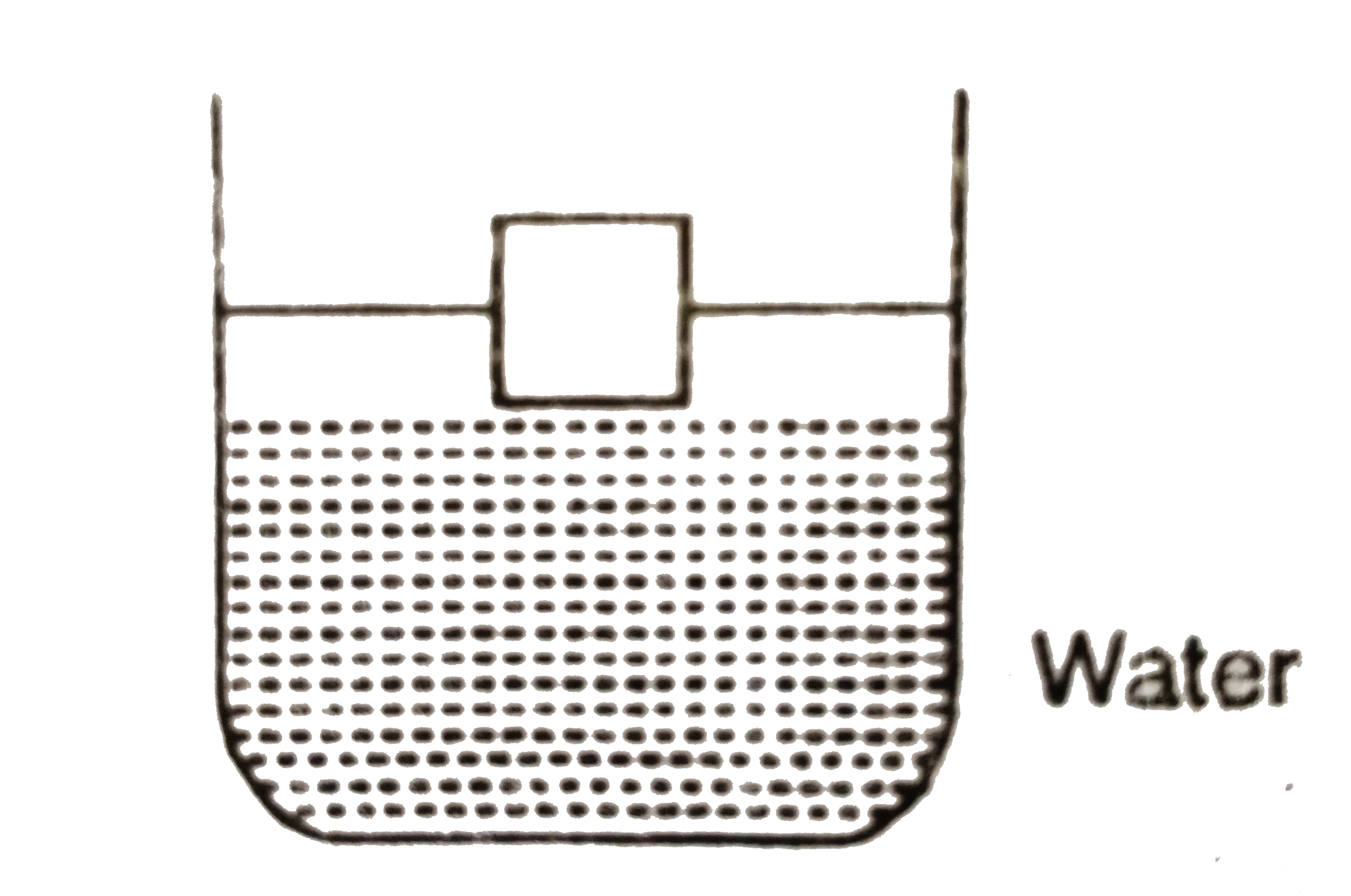 `=For the given CONDITION `Weight of the box=Buoyant force `rarr V_1g=vrho_ug` `rarr (x^2xx(0.1)xx6)xx8=xy^3xx1` [Because VOLUME of iron `=v_1=6volume of each SHEET]` `rarr x=4.8cm` |
|
| 21. |
An impulse is supplied to a moving object with the force at an angle 120^(@) with the velocity vector. The angle between the impulse vector and the change in momentum vector is |
|
Answer» `120^(@)` |
|
| 22. |
A thin uniform rod of mass m and length l rotates with the constant angular velocity omega about the vertical axis passing through the rod's suspension point O. In doing so, the rod describes a conical surface with a half separated angle theta.Find the angle theta as well as the magnitude and direction of the reaction force at the point O. |
|
Answer» |
|
| 23. |
Show that Newton's second law of motion is the real law of motion. |
|
Answer» SOLUTION :From Newton.s 2nd law, the force `vec(f) = (d)/(dt) (m vec(v)),` with proper choice of the UNIT of force. (i) If the external force `vec(F)` = , we have, `(d)/(dt)(m vec(v))` = 0 `therefore""m vec(v)` = CONSTANT, so `vec(v)` = constant This means that a body at rest would remain at rest and body in motion would continue to maintain its uniform velocity. This is Newton.s 1ST law of motion. We consider a system of two bodies, 1 and 2. `vec(F_(21))`= force on body 1, exerted by body 2, and `vec(F_(12))` = force on body 2, exerted by body 1. In the absence of any other external forces, Newton.s 2nd law gives, For body 1 : `vec(F_(21)) = (d)/(dt)(m_(1) vec(v_(1)))` for body 2 : `vec(F_(12)) = (d)/(dt)(m_(2) vec(v_(2)))` Now, if the combination of the two bodies is considered. `vec(F_(21)) and vec(F_(12))` are internal forces only and do not contribute to any external force. If the external force is zero, we have from the 2nd law, 0 = `(d)/(dt)(m_(1) vec(v_(1)) + m_(2) vec(v_(2))) = (d)/(dt)(m_(1)vec(v_(1))) + (d)/(dt)(m_(2) vec(v_(2)))` 0 = `vec(F_(21)) + vec(F_(12))` `therefore""vec(F_(21)) = - vec(F_(12))`. This is Newton.s 3rd law. thus, Newton.s 2nd law of motion is sometimes called the " real" law of motion-it encompasses However, Newton.s wisdom dictated him to propose the 1 st and the 3rd laws separately in order to introduce. respectively, (a) the notion of the inertial frames of reference, and (b) the concept of action-reaction pair of forces. |
|
| 24. |
In an adiabatic process, the system is insulated from the surroundings and heat absorbed or released is zero. (b) Two samples, A and B, of exygen at the same initial temperature and pressure are compressed from volume V to V/2 . A is compressed isothermally and B adiabatically. Find out the ratio of the final pressure of A and B gamma=1.4 |
|
Answer» SOLUTION :In the CASE of `A, P_1V_1=P_2V_2 `P_2=(P_1V_1)/V_2 =(P_1V)/(V/2)=2P_1` `B, P_1V._1=P_2V._2` `THEREFORE P_2.=P_1((V_1)/V_2)^lambda=P_1((V)/V_2)^1.4=2^1.4P_1=2.64 P_1` |
|
| 25. |
Let A be the Area Swept by the line joining the earth and the sun during Feb-2007. The Area Swept by the same line during the first week of that month is |
| Answer» ANSWER :A | |
| 26. |
A water tank has a hole at a distance of 7 m from free water surface. Find the velocity of water through the hole. If the radius of the hole is 2 mm what is the rate of flow of water? |
|
Answer» Solution :` ""h= 7m, R= 2 xx 10 ^(-3)m` VELOCITY of efflux of water `= v= sqrt(2gh ) ` ` ""= sqrt(2XX 9 .8 xx 7) = 11 . 71 m//s` Rate of FLOW of water = velocity `xx` area` =11.71 xx PI xx (2 xx 10 ^(-3)) ^(2)= 1.47 xx 10 ^(-4)m^(3)//s` |
|
| 27. |
In example, which point has the miximum pressure and which has the minimum pressure . |
|
Answer» |
|
| 28. |
A certain amount of water of mass m, at a temperature T_(2)cools.to temperature T_(1). The heat given out by the water is absorbed by n mole of an ideal gas. The gas expands at constant temperature T and changes its volume from V _(i)to V _(f)What is its initial volume ? |
|
Answer» Solution :HEAT given out by water `= m _(w) C _(w) (T _(2) - T _(1))` where `C _(w) ` is the specific heat capacity of water. Work done by the gas `W = int _(V _(T)) ^(V _(F)) PdV` But `PV + nRT` ` P = ( n RT)/( V)` `W = int _(V _(1)) ^(V _(2)) ( n RT)/(V) dV` `= n RT [log _(e) V]_(V_(i)) ^(V_(f)) ` `W = nRT log _(e) ""(V _(f))/(V _(i))` `(W)/( nRT) = log _(e) "" ( V _(f))/( V _(i))` `( V _(f))/( V _(i) )= e ^((W)/( nRT))` `(V_(i ))/(V_(f)) = e ^(- (W)/( n RT))` `Vi = V_(f) e ^(- (W)/( nRT))` where `W = m _(w) ( C _(w) ( T _(2) - T _(1)),` becaue the expansion of the gas takes PLACE at constant temperature T. The heat absorbed is used to do external work. |
|
| 29. |
Two quantities A and B have different dimensions. Which of the following is physically meaningful? |
|
Answer» A+B |
|
| 30. |
Ball 1 collides with an another identical ball 2 at rest as shown in figure. For what value of coefficient of restitution e, the velocity of second ball becomes two times that of 1 after collision ? |
|
Answer» SOLUTION :Here `m_(1) = m_(2) and u_(2) = 0`. After collision, `v_(2) = ((1+c)/(2)) u and v_(1) = ((1-e)/(2))u` GIVEN , `v_(2) = 2v_(1)` on solving we GET, `e = (1)/(3)` |
|
| 31. |
During an adiabatic process, if the pressure of an ideal gas is proportional to the cube of its temperature, find gamma . |
|
Answer» <P> Solution :For an ideal gas of one MOLE `PV=RT^(3)`During an ADIABATIC process `P oo T^(3) rArr P=KT^(3)` `P=K((PV)/(R ))^(3)rArr P=((K)/(R^(3)))P^(3)V^(3)` `P^(2)V^(3)=` constant`""PV^(3//2)=` constant Comparing it with the equation `PV^(gamma) =` constant for an adiabatic process, we get `gamma=3//2` |
|
| 32. |
Two bodies of equal masses moving with momentum of first double that of the second collide completely inelastically. If the total final kinetic energy is 9 joule, the initial kinetic energy of the body of greater momentum is |
|
Answer» 5 joule |
|
| 33. |
Which of the following circular rods, (given radius r and length l) each made of the same material and whose ends are maintained at the same temperature will conduct most heat? |
|
Answer» `r=2r_(0),l=2l_(0)` |
|
| 34. |
The rotational kinetic energy of a body is E and its moment of inertia is I. The angular momentum is |
|
Answer» `EI` Now,ANGULAR momentum `L = I omega = sqrt(2EI)`. |
|
| 35. |
Even Carnot engine cannot give 100%efficiency because we cannot |
|
Answer» prevent radiation |
|
| 36. |
Statement I : The total energy of a particle performing simple harmonic motion could be negative. Statement II : Potential energy of a system could be negative. |
|
Answer» STATEMENT I is true, statement II is true , statement II is a CORRECT EXPLANATION for statement I. |
|
| 37. |
A piece of metal weighs 46 gm in air. When immersed in a liquid of specific gravity 1.24, at 27°C it weighs 30 gm. When the temperature of the liquid is raised to 42°C the metal piece weighs 30.5 gm. Specific gravity of liquid at 42°C is 1.20, the coefficient of linear expansion of solid is |
|
Answer» `2.32 XX 10^(-5)//^(@) C` |
|
| 38. |
A particle is executing SHM. At a point x=A/3, kinetic energy of the particle is K, where A is the amplitude. At a point x=2A/3, kinetic energy of the particle will be |
| Answer» ANSWER :C | |
| 40. |
The boides of masses 100 kg and 8100 kg are held at a distance of 1 m. The gravitational field at a point on the line joining at them is zero. The gravitational potential at the point in J/kg is (G = 6.67 xx 10^(-11) Nm^(2 // kg^(2)) |
|
Answer» `-6.67xx10^(-7)` |
|
| 41. |
For the damped oscillator, the mass m of the block is 400g, k = 120 Nm^(-1) and the damping constant b is 50 gs^(-1). Calculate the period of oscillation. |
| Answer» SOLUTION :`T= 0.36s` | |
| 42. |
Two objects A and B are of lengths 5 cm and 7cm determined with errors 0.1 cm and 0.2 cm respectively.What is the error in determing (a) the total length and (b) the difference in their lengths? |
|
Answer» Solution :a=5cm, `Delta a= 0.1cm` `b= 7cm, Delta b= 0.2cm` If x= a+ b is the total length, then `Delta x = Delta a + Delta b= 0.1 + 0.2 = 0.3cm and x= (5+7) +- 0.3 = (12 +- 0.3)CM` If .x. is the DIFFERENCE between the lengths, then `Delta x= Delta a + Delta b= 0.3cm and x= |5-7| +- 0.3 = (2 +- 0.3)cm` |
|
| 43. |
A solid sphere is rolling on a frictionless plane surface about its axis of symmetry. Find ratio of its rotational energy to its total energy. |
|
Answer» SOLUTION :Rot. `K.E.=(1)/(2) I OMEGA^(2)=(1)/(2)xx(2)/(4) mR^(2)xx(v^(2))/(R^(2)) "" ( "as" omega=(v)/(R), I=(2)/(5) mR^(2))` `=(1)/(5) mv^(2)` Total energy - Translational `K.E.+"Rot" K.E.=(1)/(2) mv^(2)+(1)/(5) mv^(2)=(7)/(10) mv^(2)` `("Rot. K.E.")/("Total Energy")=((1)/(5)mv^(2))/((7)/(10)mv^(2))=(2)/(7)` |
|
| 44. |
If a height h_(2) of water level is further decreases then: |
|
Answer» cylinder will not MOVE up and remains at original positoin. |
|
| 45. |
"Carts with rubber tyres are better than those with iron tyres". Why ? |
| Answer» Solution :The COEFFICIENT of FRICTION between RUBBER and road is LESS than that between iron and road. | |
| 46. |
For the damped oscillator, the mass m of the block is 400g, k = 120 Nm^(-1) and the damping constant b is 50 gs^(-1). Calculate time taken for its amplitude of vibration to drop to half of the initial value. |
| Answer» SOLUTION :`t_(1/2) = 5.5 s` | |
| 47. |
Five moles of hydrogen is heated through 20 K under constant pressure. If R=8.312"J/mole K", find the external work done |
|
Answer» 831.2 J |
|
| 49. |
What is the direction of areal velocity of the earth around the sun ? |
|
Answer» Solution :`IMPLIES` Areal velocity, `(dA)/(dt) = L/(2m) = (R xx mv) /(2m) = 1/2 (rxxv)` where LIS the ANGULAR MOMENTUM and m is the mass of the earth. Hence, the direction of areal velocity`((dA)/(dt))`the direction of `(r xx v).` |
|
| 50. |
A planet is moving in an elliptical orbit around the Sun. If T, V, E and L stand respectively for its kinetic energy, gravitational potential energy, total energy and magnitude of angular momentum about the centre of force, then which of the following is correct? |
|
Answer» V is always positive |
|