

Saved Bookmarks
This section includes 7 InterviewSolutions, each offering curated multiple-choice questions to sharpen your Current Affairs knowledge and support exam preparation. Choose a topic below to get started.
| 1. |
Three equal masses m are placed at the three vertices of an equilateral triangle of side a. The gravitational force exerted by this system on another particle of mass m placed at the centroid of triangle |
|
Answer» `(Gm^2)/(3a^2)` |
|
| 2. |
Distinguish between mechanical and non-mechanical waves with an example for each type. |
Answer» SOLUTION :
|
|
| 3. |
A pendulum bob mass m revolves in a horizontal circle of radius R by an inextensible string of length L (Conical pendulum). Match the following column : {:("Column-I","Column-II"),((A)(omega_(PO))/(omega_(PC)),(P)1),((B)(L_(PO))/(L_(C)),(Q)tantheta),((C)(tau_(PO))/(tau_(PC)),(R)sintheta),((D)(a_(PO))/(a_(PC)),(S)"cos ec"theta):} |
|
Answer» |
|
| 4. |
A string is wrapped around a cylinder of mass M and radius R. The string is pulled vertically upwards to prevent the centre of mass from falling as the cylinder upwinds the string. The tension in the string is: |
|
Answer» `2Mg//3` `T=Mg-Ma=Mg-2/3Mg=1/3Mg` |
|
| 5. |
Earthquakes generate sound waves inside the earth. Unlike a gas, the earth can experience both transverse (S) and longitudinal (P) sound wave. Typical the speed of S wave is about 4.0 kms^(-1), and that of P wave is 8.0km s^(-1). A seismograph records P and S waves from an earthquake. The first P wave arrives 4min before the first S wave. Assuming the waves travel in straight line, at what distance does the earthquake occur? |
Answer» Solution :Following diagram shows the situation as per the STATEMENT.  Here, suppose P waves reaches the DETECTOR (seismograph) at time t. At per the statement, S wave reaches seismograph 4 MIN. later. i.e. 240 second later than P wave. Hence S wave will reach seismograph at `(t + 240)` second. Here S wave reaches seismograph later because its veocity is smaller than that of P wave as we are given `v _(P) = 8km//s and v _(S) =4 km //s.` Now, from the diagram, (i) For P wave `d = v _(P)t ""...(1)` (ii) For S wave `d = v _(S) (t + 240) ""...(2)` From equation (1) and (2), `v _(P)t = v _(S) (t + 240)` `therefore 8t =4 (t + 240)` `therefore 2t = t + 240 implies t = 240 s""...(3)` From equation` (1) and (3),` `d = v _(P) t = 8 xx 240 =1920 km` |
|
| 6. |
An engine develops 10 KW of power. How much time will it take to lift a mass of 200kg to a height of 40m. (g= 10 ms^(-2)) |
| Answer» Answer :C | |
| 7. |
A bullet of mass 10g and speed 500ms^(-1) is fired into a door and gets embedded exactly at the centre of the door. The door is 1.0m wide and weighs 12kg. It is hinged at one end and rotates about a vertical axis practically without friction. Find the angular speed of the door just after the bullet embeds into it |
Answer» Solution : M.I of door about an axis at ONE end`=(ML^2)/(3)` Given `m_b=10^(-2)KG""v_b=500ms^(-1)` `md_d=12kg,L=1m` `:.I=(12xx1^2)/3=4kgm^2` `K.E_b=1/2xxm_bv_b^2=1/2xx10^(-2)xx(500)^2=1250J` but K.E`=1/2Iomega^2`i.e `omega^2=(2K.E)/I=(2xx1250)/4` `omega^2=625` or `omega=25rads^(-1)` |
|
| 8. |
The temperature of a thin uniform rod increases by Delta t . If moment of inertia I about an axis perpenducular to its Jength, then its moment of increases by |
|
Answer» 0 |
|
| 9. |
Eleven identical rods are arranged as shown in Fig. Each rod has length l, cross sectional area A and thermal conductivity of material L. Ends A and F are maintained at temperatures T_1 and T_2(ltT_1), respectively. If lateral surface of each rod is thermally insulated, the rate of heat transfer ((dQ)/(dt)) in each rod is |
|
Answer» `((DQ)/(dt))_(AB)=((dQ)/(dt))_(CD)` 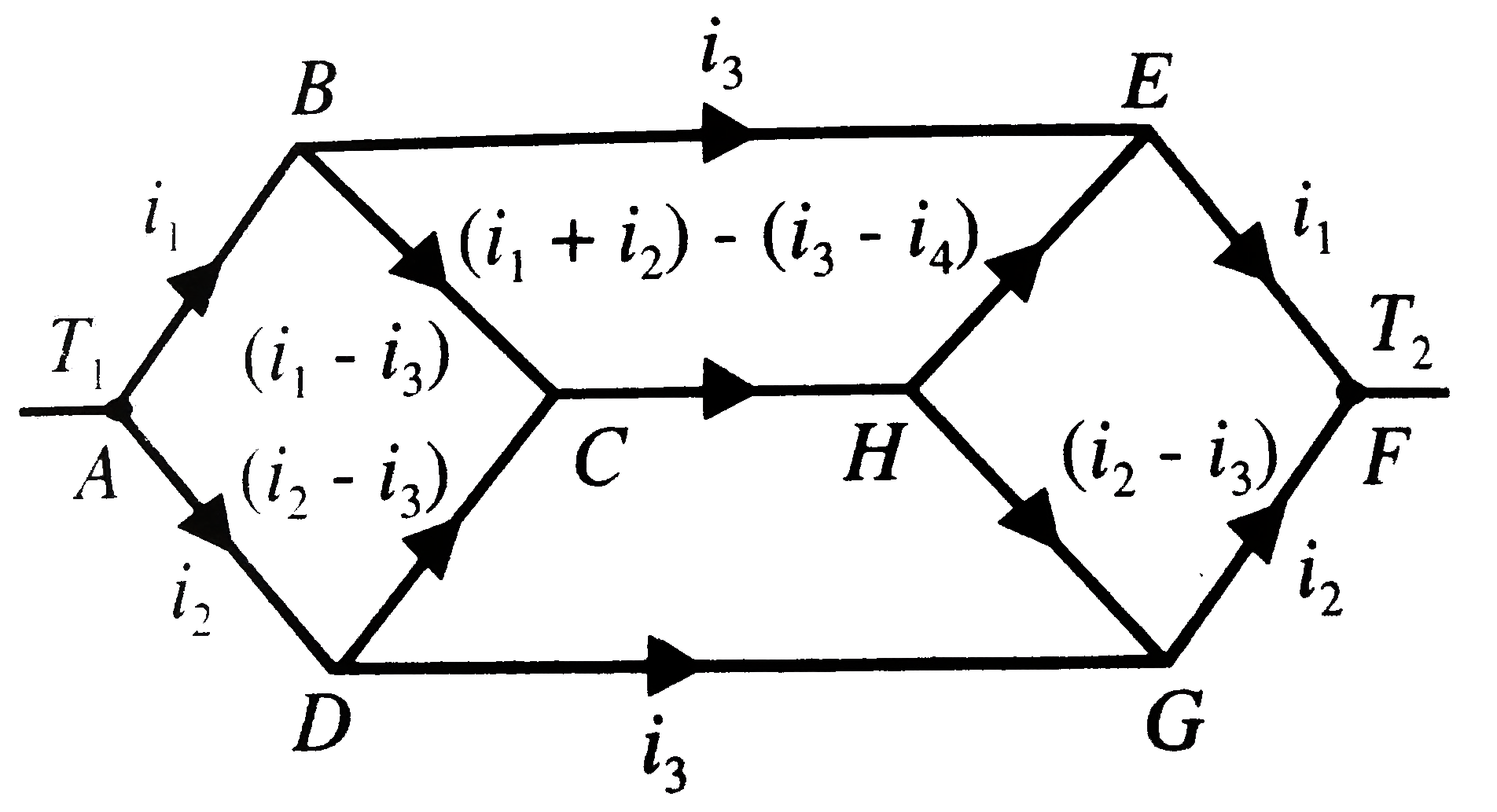 Resistance of each ROD `R=(l)/(kA)` In STEADY state `T_B=T_D` `T_E=T_G` Thermal current `((dQ)/(dt))=i` `i_1R+i_3R+i_1R=(T_1-T_2)` `2i_1+i_3=((T_1-T_2))/(R )` ..(i) `2i_1+i_3=(T_1-T_2)/( R)`.(ii) `i_1=i_2` For the path ABCHGF `i_1R+(i_1-i_3)R+2(i_1+i_3)R+(i_1-i_3)R+i_1R=(T_1-T_2)` `6i_i-4i_3=((T_1-T_2))/(R )=2i_i+i_3`.(iv) `4i_i=5i_3impliesi_3=(4)/(5)i_i`.(v) From eqs (ii) and (v) `2i_i+(4)/(5)i_1=((T_1-T_2))/(R )` `(14i_i)/(5)=((T_1-T_2))/(R )` Equivalent thermal resistance `((T_1-T_2))/(2i_i)=(7)/(5)R` `((dQ)/(dt))_(AB)=i_1=(5(T_1-T_2)KA)/(14l)` `((dQ)/(dt))_(BE)=(2)/(7)((T_1-T_2)KA)/(l)` `((dQ)/(dt))_(BC)=((T_1-T_2)KA)/(14l)` `((dQ)/(dt))_(CH)=((T_1-T_2)KA)/(7l)` 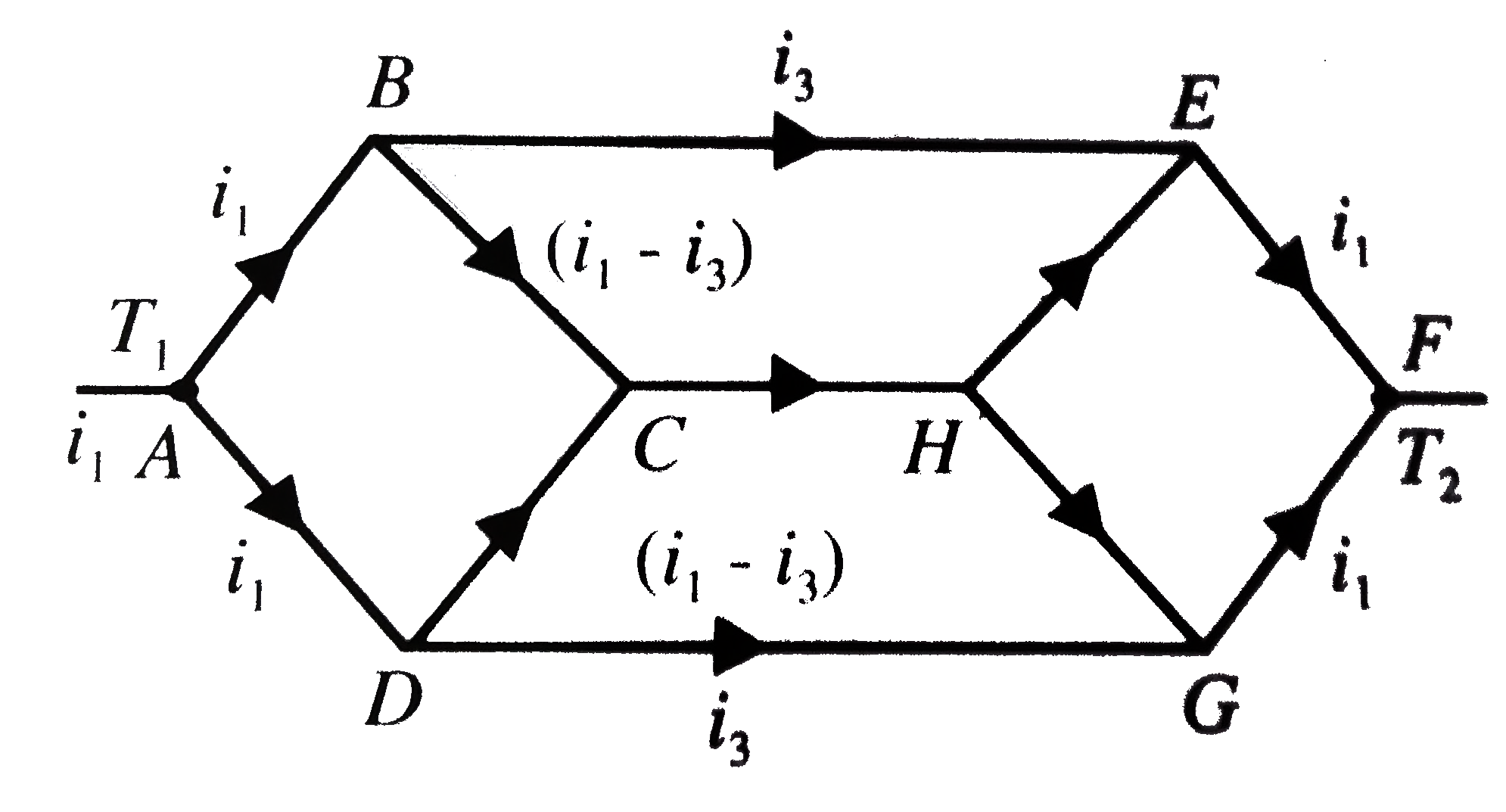
|
|
| 10. |
A mass m moves with a velocity .y. and collides inelastically with another identical mass. After collision the first mass moves with velocity (v)/(sqrt3) in a direction perpendicular to the initial direction of motion. What is the speed of second mass after collision ? |
|
Answer» |
|
| 11. |
The mass and diameter of a planet are two times those of earth. If a seconds pendulum is taken to it, the time period of the pendulum in seconds is: |
|
Answer» `1/SQRT(2)` |
|
| 12. |
(A) : Plotting the acceleration - time graph from a given position-time graph a particle moving along a straight line is possible. ( R) : From position time graph sign of acceleration can not be determind. |
|
Answer» Both (A) and ( R) are ture and ( R) is the correct explanation of (A) |
|
| 13. |
The pair of vector quantities having the same dimensions is |
|
Answer» FORCE and Impulse |
|
| 14. |
Two particles of equal mass have velocitiesand . First particle has an accelerationwhile the acceleration of the other particle is zero. The centre of mass of the two particles moves in a path of |
|
Answer» straight line `veca_(1)=(3hati+3hatj)MS^(-2), veca_(2)=0 ms^(-2)` `therefore vecv_(CM)= (m_(1)vecv_(1)+m_(2)vecv_(2))/(m_(1)+m_(2))=(vecv_(1)+vecv_(2))/(2)= (2hati+2hatj)/(2)` `(therefore m_(1)=m_(2))` `=(hati+hatj)ms^(-1)` Similarly, `veca_(CM) = (veca_(1)+veca_(2))/(2) = (3hati+3hatj+0)/(2) = 3/2(hati+hatj)ms^(-2)` SINCE, `vecV_(CM)` is parallel to `veca_(CM)`, the PATH will be straight line. |
|
| 15. |
A sphere is rotating between two rough inclined wallsas shoen in fiogure. Cofficent of friction between each wall and the sphere is (1)/(3). If f_(1) and f_(2) be the ffriction forces at PO and Q. Then (f_(1))/(f_(2)) is |
|
Answer» `(4)/(SQRT3)+1` |
|
| 16. |
0.1203 gm of copper is deposited on a copper plate of mass 9.2 g. What is the total mass of the copper plate? |
| Answer» SOLUTION :TOTAL MASS of the COPPER PLATE `=0.1203+9.2=9.3203g=9.3g` | |
| 17. |
A ballet dancer, dancing on a smooth floor is spinning about a vertical axis with her arms folded with an angular velocity of 20 rad/s. When she stretches her arms fully, the spinning speed decreases to 10 rad/s. If I is the initial moment of inertia of the dancer, the new moment of inertia is |
|
Answer» 2I I. = 2I |
|
| 18. |
In the figure, the vertical sections of the string are long. A is released from rest from the position shown. Then |
|
Answer» the system will REMAIN equilibrium |
|
| 19. |
Mass of a ring is non-uniformly distributed around its geometric centre. If R is radius of the ring, then (a) Centre of mass does not coincide with geometric centre (b) Position of centre of mass from the geometric centre will be x(0 lt x lt R) (c ) Centre of mass will be nearer to the greater mass distribution (d) Centre of mass may lie out side the periphery |
|
Answer» only a and B are CORRECT |
|
| 20. |
A uniform disc of mass M object of mass M is attached to the rim and raised to the highest point above the centre. The unstable system is then released. The angular speed of the system when the attached object passes directly beneath the pivot is. |
|
Answer» `sqrt((3R)/(8R))` |
|
| 21. |
The power of a water pump is 2 kW. If g = 10 ms^(-12), the amount of water it can raise in one minute to a height of 10 m is |
|
Answer» 2000 LITRE `m = (2000 W xx 60S)/(10 ms^(-2) xx 10m) = 1200 kg = 1200 `litre. |
|
| 22. |
Give two examples of a rigid body where the center of mass lies outside in material of rigid body. |
| Answer» Solution :CIRCULAR RING, Ring, Hollow Cylinder, Photo FRAME, Flute. | |
| 23. |
(A) : A body is first taken along a smooth inclined plane through certain height. In the next case it is lifted vertically upwards to same height, workdone by rgavity in both cases is same (R) : Gravitational force is conservative force |
|
Answer» Both (A) and (R) are TRUE and (R) is the CORRECT EXPLANATION of (A) |
|
| 24. |
Dimensional formula of Intensity of Magnetization is |
|
Answer» `IL` |
|
| 25. |
The magnitude of the Sun's gravitational field as experienced by Earth is: |
|
Answer» same over the year It depends on the distance r that VARY from January to July. |
|
| 26. |
Rear flapdoor of a lorry is open and a box of mass 40 kg is on the floor of the lorry, 5 m away from the open flap. Coefficient of friction between the box and the lorry floor is 0.15. The lorry starts from rest with an acceleration of 2 "m.s"^(-2). How far will it go before the box slides off its floor? |
|
Answer» |
|
| 27. |
Explain oblique collision . |
| Answer» Solution :When TWO bodies of equal masses one of its is REST and experience a oblique each other , then both bodies MOVE perpendicular relative to eachother . | |
| 28. |
The propeller of a small airplane is mounted in the front. The propeller rotates clockwise if seen from behind by the pilot. The plane is flying horizontally and the pilot suddenly turns it to the right. Will the body of the plane have a tendency to get inclined to the horizontal? If yes, does the nose of the plane veer upward or downward? Why? |
|
Answer» |
|
| 29. |
A particle travels in a circle of radius 20 cm at a uniformly increasing speed. If the speed changes from 8 ms^(-1) to 9 ms^(-1) in 2s, what would be the angular acceleration in "rad s"^(-2) ? |
|
Answer» `1.5 "rad s"^(-2)` When speed is `8 ms^(-1) and 9 ms^(-1)`, then ANGULAR speeds are respectively `omega_(1)=(8)/(20xx10^(-2))=40 "rads"^(-1)` and `omega_(2)=(9)/(20xx10^(-2))=45 "rads"^(-1)` `:.` Angular acceleration `= (omega_(2)-omega_(1))/(t)=(45-40)/(2)=2.5 "rad s"^(-2)`. |
|
| 30. |
A particle moves on the x-axis according to the equation x = x_(0) sin 2omegat. The motion is simple harmonic. |
|
Answer» with amplitude `x_(o)//2` |
|
| 31. |
When the amplitude of oscillation of a particle in SHM is increased to two times, the time period |
|
Answer» Is DOUBLED |
|
| 32. |
What are the advantages of SI system? |
|
Answer» SOLUTION :The ADVANTAGE of S.I system are (i) It uses only one unit for one physical quantity, which means a rational system of units. (II) In this system, all the derived units can be easily obtained from BASIC and supplementary units, which means it is a coherent system of units. (iii) It is a METRIC system which means that multiples and submultiples can be expressed as powers of 10. (iv) It is a coherent system of unit. (v) It has permanece and reproduceability. |
|
| 33. |
"After the steady state, the temperature of a conductor does not rise, even though heat is supplied",. Why? |
| Answer» Solution :During steady state the HEAT conducted is EQUAL to the heat RADIATED. | |
| 34. |
A metal piece of mass 120 g is stretched to form a plane rectangular sheet of area of cross section 0.54ms^(-1). If length and breadth of this sheet are in the ratio 1:6, find its moment of inertia about an axis passing through its centre and perpendicular to its plane. |
|
Answer» Solution :Mass M=120 g=`120xx10^(-3)kg`,area =lb=0.54 `m^(2)(L)/(b)=(1)/(6)` `therefore l=(b)/(6),ib0.54(b)/(6).b=0.545,b^(2)=0.54xx6impliesb=sqrt(3.24)1.8 m` SIMILARLY `l=(0.54)/(1.8)=0.3 m`. Moment of inertia `I(M(l^(2)+b^(2)))/(12)=(120xx10^(-3)(0.3)^(2)+(1.8)^(2))/(12)` =`(0.12xx(0.09+3.24))/(12)=(3.33)/(100)` `impliesI=33.3xx10^(-3)kg m^(2)` |
|
| 35. |
The displacement of a particle in a medium at any instant due to the effect of more than one wave is |
|
Answer» not dependent on the displacements due to the individual waves |
|
| 36. |
Poisson's ratio cannot have the value ……….. . |
|
Answer» 0 and 1 |
|
| 37. |
Figure 12.5 shows the P-V diagram of an ideal gas undergoing a change of state from A and B. Four different parts I,II,III and IV as shown in the figure may lead to the same change of state. a) Change in internal energy is same in IV and III cases, but not I and II b) Change in internal energy is same in all the four cases c) Work done is maximum in case I d) Work done is minimum in case II |
|
Answer» Only a, B are CORRECT |
|
| 38. |
Show that a screw gauge of pitch I mm and 100 divisions is more precise than a vernier caliper with 20 divisions on the sliding scale. |
|
Answer» Solution :Least count of SCREW gauge = `("Pitch")/("No. of divisions") = (1 mm)/(100) = 0.01` mm Least count of vernier CALIPER = `(1)/(20)` mm = 0.05 mm As SHOWN, the least count of screw gauge is lesser than vernier caliper, hence screw gauge more precise. |
|
| 39. |
A tungsten wire, 0.5 mm in diameter, is just stretched between two fixed points at a temperature of 40^@C . Determine the tension in the wire when the temperature falls to 20^@C . (coefficient of linear expansion of tungsten = 4.5 xx 10^(-6)//""^@C, Young's modulus of tungsten = 3.45 xx 10^11Nm^(-2) ) |
|
Answer» 6.097N |
|
| 40. |
A truck is moving at a constant speed of 50km/h on a straight road which terminates on a wall. A fly starts moving with a constant speed of 100km/h from the wall towards the truck when the truck is at a distance 25km from the wall. Fly reaches the truck and then turns back towards the wall and then turns back towards the wall and then on reaching the wall it again turns towards the truck and so on. it makes several trips between the truck and the wall, before the truck just reaches the wall. (a) What is the total distance travelled by the fly during this period? (b) how many trips the fly makes between the truck and the wall? |
|
Answer» Solution :(a) time taken by the truck to reach the wall `=("Distance")/("speed")=(25km)/(50km//h)=(1)/(2)h`, Hence with a speed of 100km/hr, fly will cover 50 KM in `(1)/(2)` hr. (b) let us ASSUME that at a certain instant fly is at the wall and truck is at a distance `x_(1)` from the wall. fly and truck are moving towards each other with speeds 100km/h and 50km/h, respectively. hence relative speed becomes 100+50=150km/h. time taken by the fly to reach the truck can be written as follows: `t_(1)=(x_(1))/(150)` Distance travelled by the fly to reach the truck `x=100t_(1)=100xx(x_(1))/(150)=(2)/(3)x_(1)` Distance travelled by truck in time interval `x"=50xxt_(1)=50xx(x_(1))/(150)-(x_(1))/(3)` Further time taken by the fly to reach back the wall `t_(2)=(x)/(100)=(2x_(1))/(3xx100)=(x_(1))/(150)` Further distance travelled by truck in time `t_(2)` `x=50xxt_(2)=50xx(x_(1))/(150)=(x_(1))/(3)` Distance between truck and the wall after trip of the fly is complete can be written as follows: `x=x_(1)-x-x=x_(1)-(x_(1))/(3)-(x_(1))/(3)=(x_(1))/(3)` `rArr x_(2)=x_(1)//3` Using the above result we can write the following Distance between the truck and the wall at the BEGINNING of `1^("st")` trip=20km Distance between the truck and the wall at the beginning of `2^("nd")` trip`=((1)/(3))xx20` km Distance between the truck and the wall at the beginning of `3^("rd")` trip`=((1)/(3))^(2)xx20` km Similarly Distance between the truck and the wall at the beginning of `n^("th")` trip`=((1)/(3))^(n-1)xx20` km Distance between the truck and the wall will reduce to zero only when n APPROACHES infinity. Hence, the fly will theoretically make infinite trips between truck and the wall before truck touches the wall. |
|
| 41. |
The position of centre of mass of rigid body is inside it. |
|
Answer» |
|
| 42. |
Select the correct choice (s) : |
|
Answer» The gravitational FIELD inside a spherical cavity, within a sperical planet must be non zero and uniform. |
|
| 43. |
There is a small hole near the bottom of an open tank filled with a liquid the speed of water ejected does not depend on |
|
Answer» AREA of the hole |
|
| 44. |
Hot liquid flow easily than cold liquid .Give reason . |
| Answer» Solution :The coefficient of HOT water is LESS .Hence, VISCOUS force between two consecutive layers exerted less . So hot liquid FLOW easily than cold liquid . | |
| 45. |
At 0K which of the following properties of a gas will be zero |
|
Answer» KINETIC energy |
|
| 46. |
A metallic solid sphere is rotating about its diameter as axis of rotation. If the temperature is increased by 200^(@)C the percentage increase in its moment of inertia is (Coefficient of linear expansion of the metal = 10^(-5)//^(@)C). |
|
Answer» `0.1` |
|
| 47. |
An object reaches a maximum vertical height o 23.0 m when thrown vertically upward on the earth. How high would it travel on the moon where the acceleration due to gravity is about one sixth that on the earth? Assume that initial velocity is the same. |
|
Answer» 138 m |
|
| 48. |
Find the centre of mass of a uniform : (a) half-disc, (b) quarter-disc. |
|
Answer» `((4R)/(3pi),(3R)/(3pi))` ,`((4R)/(3pi),(3R)/(3pi))` `m=(M)/((1)/(2)piR^(2))=(2M)/(piR^(2))` 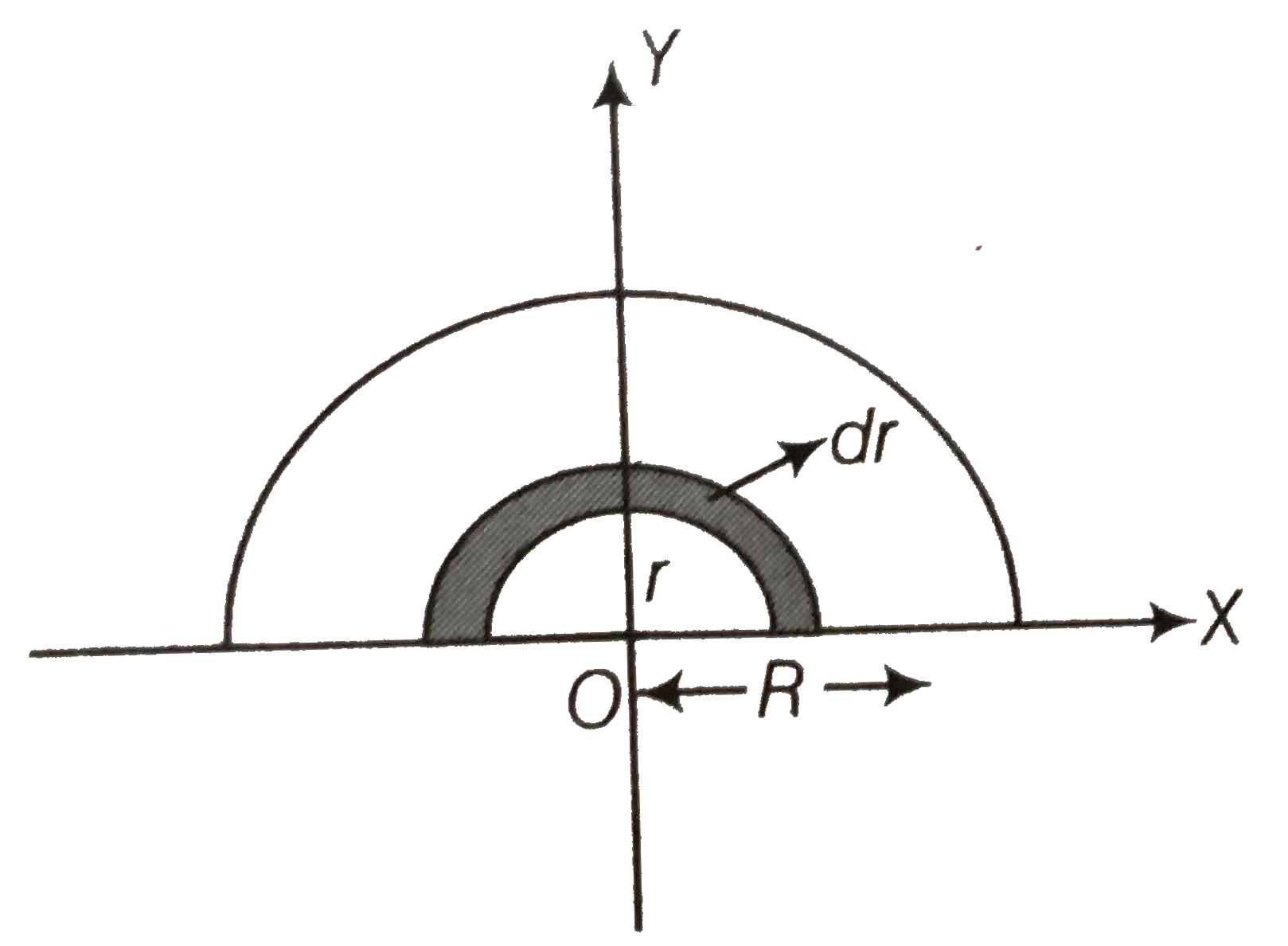 (a)thehalf -disc can besupposed to beconsistsof a large numberof semicircularrings ofmass dm andthicknessdrand rangingfromr=0 to r=R Surfaceareaof semicircular ringof radiusr andof thickness `dr=(1)/(2)2 pi r XX dr =pi r dr` `therefore`Massof thiselemetary ring`dm=pirdrxx(2M)/(piR^(2))` `dm =(2M)/(R^(2))rdr` If (x,y) arecoordinates of centreof massof thiselement, then, `(x,y)=(0,(2r)/(pi))` therefore , `x=0and y=(2r)/(pi)` Let`x_(cM)`and`y_(CM)` be thecoordinates of thecentreofthecentre ofthesemicircular disc. then `x_(CM)=(1)/(M)int_(0)^(R)xdm =(1)/(M)int_(0)^(R)dm=0` ` y_(CM)=(1)/(M)int_(0)^(R)ydm=(1)/(M)int_(0)^(R)(2l)/(pi)xx((2M)/(R^(2))rdr)` `=(4)/(piR^(2))int_(0)^(R)r^(2)dr=(4)/(piR^(2))[(r^(3))/(3)]_(0)^(R)` ` =(4)/(piR^(2))xx((R^(3))/(3)-0)=(4R)/(3pi)` `therefore ` Centre of mass of thesemiciculardisc `=(9,(4R)/(3pi))` ( b)Centreof mass a unifromquarter disc, Massper unitareaof thequarter disc `=(M)/((piR^(2))/(4))=(4M)/(3PiR^(3))` Usingsymmetry for a halfalongy - axiscentreof masswill beat `x=(4R)/(3pi)` Fora half- discalongx-axiscentre of masswill beat `x=($R)/(3pi)` Hence, forthequarter disc centreof mass `=((4R)/(3pi),(3R)/(3pi))` 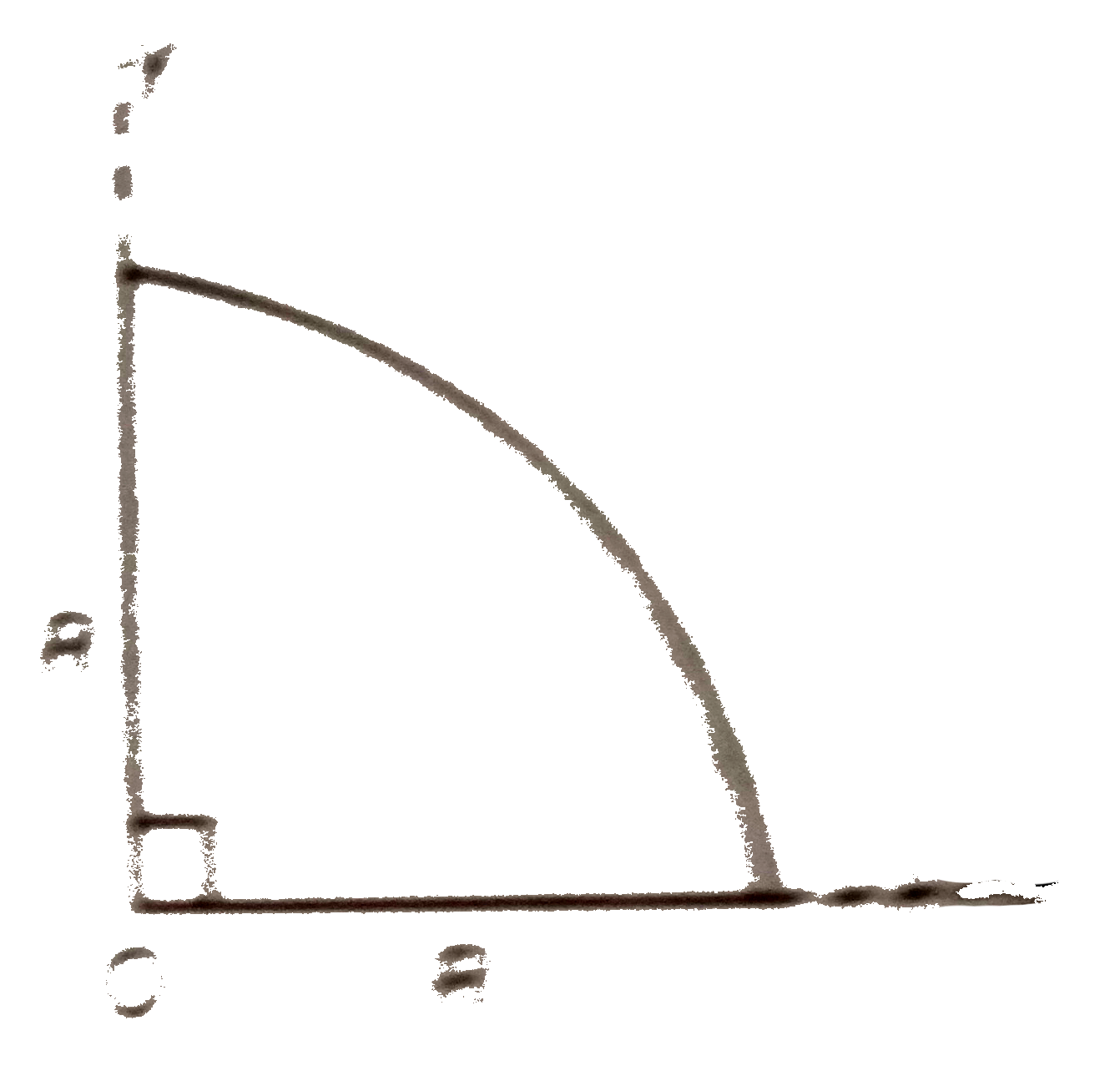
|
|
| 49. |
A block of mass m sits rest on afriction less table in a moving car with speed V_(c) a long a straight horizontal track (As shown in fig). A person riding in the car pushes on the block with a net horizontal force F for a time t in the direction of the car's motion. Which of the following are correct |
|
Answer» The final speed of the BLOCK according toa PERSON in car `(Ft)/m` |
|
| 50. |
A block of mass m sits rest on afriction less table in a moving car with speed V_(c) a long a straight horizontal track (As shwon in fig). A person riding in the car pushes on the block with a net horizontal force F for a time t in the direction of the car's motion. Which of the following are correct |
|
Answer» K.E. of the BLOCK change, according to the person in car `1/2(F^(2)t^(2))/m` |
|